
United States Digital Health Technologies Market Summary
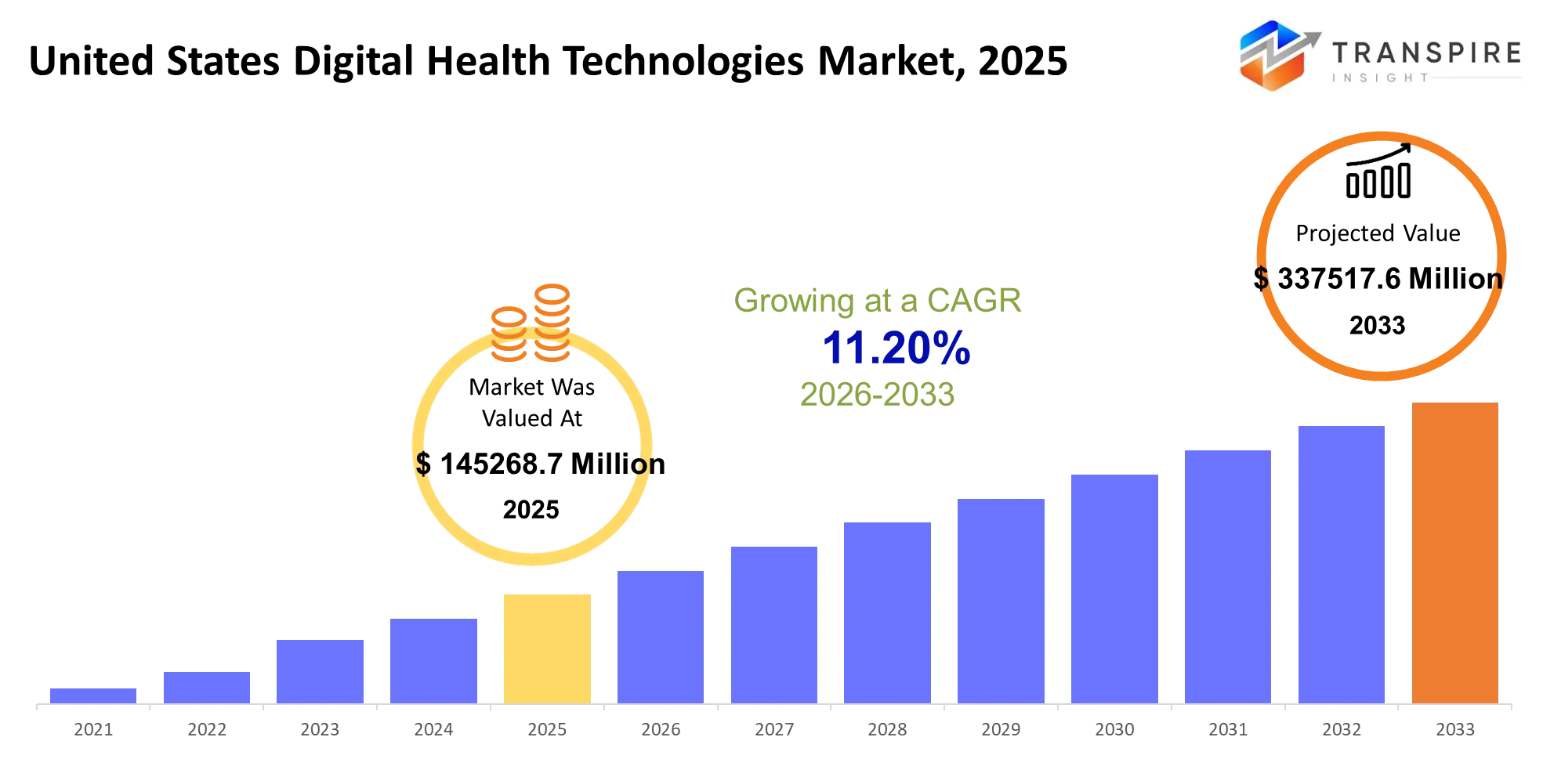
As per Transpire Insight Analysis the United States Digital Health Technologies Market size is estimated at USD 145268.7 Million in 2025 and is anticipated to reach USD 337517.6 Million by 2033, growing at a CAGR of 11.20% from 2026 to 2033.
The United States Digital Health Technologies Market sorta helps healthcare delivery ,through telehealth platforms , remote monitoring, connected devices, clinical software and digital therapeutics, plus data analytics. In actual use these tools let hospitals manage patients beyond the normal physical facilities, they provide clinicians faster reach to patient details, and sometimes they automate bits of diagnosis, treatment, and care coordination. Over the last three to five years, the sector has really drifted away from separate standalone digital tools, and more toward connected platforms that braid together electronic health records, wearable sensor data, virtual care, and artificial intelligence.The COVID-19 pandemic really sped that shift up, mostly because providers had to broaden virtual care and remote monitoring at an almost unreal pace. Federal policy also helped strengthen the digital groundwork, with CMS extending a number of telehealth flexibilities, while keeping reimbursement channels open for remote patient monitoring. Put together, this has moved digital health from being “extra help” into more of a core piece of how healthcare operations run , which enables growth from USD 145.3 billion in 2025 to USD 337.5 billion by 2033.
United States Digital Health Technologies Market Size & Forecast:
- United States Digital Health Technologies Market Size 2025: USD 145268.7 Million
- Expected Market Value 2033: USD 337517.6 Million
- Forecast CAGR: 11.20%
- Key Profile: Epic Systems, Oracle Health, Teladoc Health, GE HealthCare, Philips Healthcare, Medtronic plc, Microsoft Corporation, Google Cloud, Amazon Web Services, IBM Corporation, Siemens Healthineers, Dexcom Inc., Abbott Laboratories, Omron Healthcare, Veradigm
Key Market Insights
- In 2025 the Northeast kind of dominated , you know, with major hospital networks behind it plus steady technology investment , academic medical centers too, and that dense healthcare infrastructure factor that makes everything feel more together and faster.
- Meanwhile the Western United States is showing up as the fastest-growing place , pushed along by health-tech startups, cloud infrastructure, and digital care innovations that keep popping up.
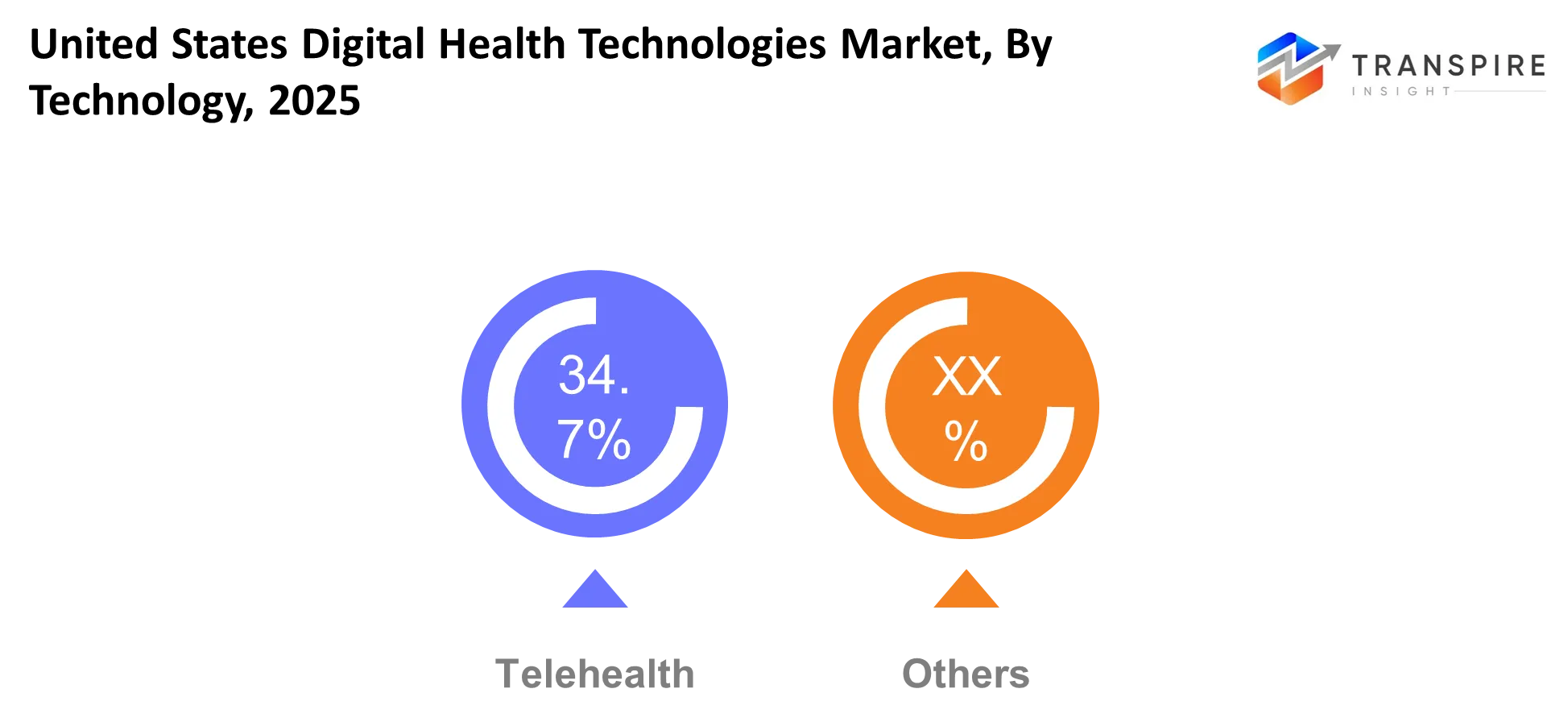
- Telehealth is still a major technology segment, basically because virtual-care adoption got widespread during the COVID-19 pandemic, and reimbursement support kept it alive and usable after that.
- Remote patient monitoring is getting real commercial momentum, in the sense that connected sensors let providers handle chronic conditions without constantly pulling people into hospital visits, which is kinda practical.
- After 2020, AI healthcare applications broadened, sort of moving from pilot projects toward clinical documentation, imaging analysis, workflow automation, and decision support.
- Wearable health devices are getting more clinically connected these days, with companies like Dexcom and Abbott linking continuous monitoring to digital care platforms ,so it feels less standalone.
- Cloud-based healthcare platforms keep seeing more adoption, since providers want scalable data infrastructure, interoperability, analytics, and also fewer internal IT maintenance headaches, almost like less friction.
- Hospital systems are still major technology buyers, but home healthcare is getting more important as care delivery shifts toward more decentralized and patient-centered models.
- Digital therapeutics plus mobile applications are spreading across the market too, supporting behavioral health, medication adherence, chronic disease management, and personalized treatment programs.
- Competitive strategies increasingly blend software, devices, AI, and analytics, so healthcare technology providers can capture revenue across multiple patient care stages , instead of only one step.
What are the Key Drivers, Restraints, and Opportunities in the United States Digital Health Technologies Market?
Driver: The strongest growth force is the shift toward connected and distributed care, kinda like the whole thing is pulling healthcare in that direction. COVID-19 showed that virtual consultations and remote monitoring could keep care available when in-person visits got hard, and CMS reimbursement pathways were useful too, because they helped set up commercial models for telehealth and remote patient monitoring. Basically, the outcome is a bigger addressable market for software, connected devices, analytics, and digital care services, since healthcare organizations can extend monitoring beyond hospital walls, and manage more patients with technology-enabled workflows.
Restraint: Interoperability and data governance still act like major structural barriers, even if people talk about it all the time. Healthcare organizations run large collections of legacy systems, proprietary databases, medical devices and clinical applications that often use different data formats, plus different integration methods. To replace, or at least link those systems, it takes a good deal of spending on cybersecurity controls, staff training and regulatory compliance, and it can end up slowing deployments down and pushing total ownership costs higher. On top of that, data privacy rules tied to HIPAA, plus a handful of state-level regulations, add yet another layer of day to day operational difficulty.
Opportunity: Generative AI together with ambient clinical technology is starting to fuel a more meaningful next phase of expansion. AI systems can take clinical conversations and turn them into structured documentation, also they can condense patient records, support coding tasks, and reduce that administrative burden clinicians deal with. Microsoft, Epic, and a few other vendors are already folding AI capabilities into clinical workflows. If these tools roll out more widely, it can unlock new software revenue, while also boosting clinician productivity and cutting down time spent on repetitive documentation, which is really the practical win.
What Has the Impact of Artificial Intelligence Been on the United States Digital Health Technologies Market?
Artificial intelligence is kind of moving digital health , from basic data gathering toward more automated clinical and administrative processes , and honestly it’s getting used faster than people expect. More hospitals are leaning on AI for medical image interpretation, clinical paperwork, patient risk flagging, appointment flow, medical coding , and decision assistance. Generative AI in particular can compress and rewrite medical records , plus it may turn clinician–patient conversations into draft chart notes. That tends to cut back on the same repetitive documentation , so clinical teams can spend more time on hands-on care and less on admin. Microsoft meanwhile has been widening healthcare AI features through Azure AI , and through collaborations with clinical and life science groups, while Epic has folded generative AI tooling directly into the electronic health record routines.
Then there’s machine learning, which backs predictive healthcare use cases. It can point toward patients who are more likely to worsen , or get readmitted, have medication issues, or show chronic illness progression. Remote monitoring tools often blend sensor outputs with prior clinical context , so they can spot odd trends earlier and nudge teams to intervene. AI driven imaging systems can also help sort and prioritize suspicious scans, and they can offer radiologists quantitative detail, which may improve workflow efficiency , and potentially reduce the time it takes to finish reports.
Still , a big obstacle stays data quality and interoperability. AI models need datasets that are consistent and representative, yet scattered charts, missing details, different coding conventions, and uneven device outputs can all drag accuracy down. On top of that the integration costs are high, cybersecurity expectations are strict, and clinical validation is required, which slows rollouts, especially for smaller healthcare organizations where resources are limited .
Key Market Trends
- Since 2020, telehealth went from that emergency-capacity mode toward more routine virtual care delivery across primary, specialty, and behavioral healthcare, kind of a slow pivot but still steady.
- After 2022, AI adoption kind of took off—moving away from experimental pilots toward things like documentation, medical imaging, coding, workflow automation, and clinical decision support, all more practical I guess.
- Remote patient monitoring also kept growing, because connected devices helped push chronic disease care beyond hospitals, into homes and outpatient settings where it actually sticks.
- Wearable technology, at first it was mostly fitness tracking, then it shifted toward clinical monitoring instead , with Abbott and Dexcom expanding their continuous glucose monitoring ecosystems.
- On the provider side, many organizations leaned into cloud infrastructure to link electronic records, analytics, AI workloads, and patient-generated data across the whole care environment, not just one clinic.
- Digital therapeutics started getting more traction too, as health systems explored technology based interventions for behavioral health, chronic disease, medication adherence, and lifestyle management, yes even the day to day stuff.
- Generative AI adoption rose during 2024 and 2025, and healthcare organizations began testing ambient documentation and automated clinical summarization tools.
- Meanwhile, hospital systems increasingly prioritized interoperability, because fragmented patient records basically limited what those connected devices could really do, and also made cross platform analytics messier.
- Home healthcare gained real strategic importance as providers looked for lower cost models for chronic disease monitoring, post discharge care, and longer term patient management.
- And tech vendors more and more combined hardware, software, cloud services, and analytics, to build integrated healthcare platforms rather than standalone digital products.
United States Digital Health Technologies Market Segmentation
By Technology:
Telehealth supports virtual consultations , follow up appointments, specialist access and remote clinical services kinda all together, while mobile health applications let people handle appointment management, medication reminders, health tracking , and patient communication. Wearable devices gather continuous physiological info such as glucose, heart rate, activity , sleep, and oxygen levels , and yes that comes in the background most of the day. AI in healthcare helps with imaging analysis , documentation , risk prediction, clinical decision support and also administrative automation which sounds small but it isn’t. Remote patient monitoring ties sensors to clinical platforms for chronic disease management and post discharge observation, like a longer thread of care. Digital therapeutics deliver structured technology based interventions for situations such as diabetes, behavioral health disorders, and cardiovascular risk.
Health analytics turns clinical and operational data into usable guidance for providers, payers and researchers. Cloud healthcare platforms provide scalable infrastructure for records, applications , analytics and AI workloads. IoMT connects medical devices to healthcare networks, supporting continual data collection and automated monitoring in practice not just in theory. Other tech includes specialized clinical applications, connected diagnostic tools, and emerging digital care technologies, with different levels of readiness depending on the setting.
By Component:
Software may support electronic records , clinical workflows patient engagement analytics, telehealth, and care management kinda. On the hardware side there are connected medical devices, monitoring equipment, diagnostic systems, plus wearable technologies. Services tend to cover implementation integration, maintenance, consulting, and technical support stuff. Then there are mobile applications that show patient-facing features like health tracking, medication reminders, virtual consultations and communication with healthcare providers. For sensors, they produce physiological and behavioral data, enabling remote monitoring and connected care.
AI platforms provide machine learning, generative AI, imaging analysis , prediction, and some automation capabilities. Cloud solutions help with scalable data storage, application hosting interoperability, and computational workloads across different healthcare organizations. Data analytics platforms turn clinical, financial and operational information into insights that help with care planning and internal organization decisions. Other building blocks include cybersecurity tools, integration interfaces , authentication systems, and specialized digital infrastructure too.
By Application:
Chronic disease management is a big use case because diabetes, heart disease types, respiratory illnesses, and other ongoing problems all need continuous monitoring, plus some kind of repeated adjustments. Wellness and fitness apps back exercise routines, meals planning, rest habits, and kind of preventive health actions. At the same time clinical decision support basically helps clinicians with risk scoring, treatment details, time sensitive alerts, and diagnostic help, sometimes in that “you should look here” way. Medication management apps cover reminders, adherence tracking, prescription related context, and medication reconciliation, so nothing gets lost. Mental health tools offer online counseling, digital interventions, behavioral check ins, and remote help, for people who can’t always show up in person.
In imaging, diagnostic scans more and more rely on AI for reading the pictures, sorting workflows, and doing quantitative evaluation. Patient engagement platforms enable messaging, appointment setup, education materials, and access to one’s own health records. Population health management brings together large patient datasets to flag risk cohorts, watch outcomes, and better distribute healthcare resources. Other options show up too, like virtual rehabilitation, digital screening, remote diagnostics, more tailored care planning, and follow-up monitoring after acute care.
By End User:
Hospitals are among the biggest digital health users, mostly because large healthcare systems need electronic records, imaging platforms, patient monitoring, telehealth, analytics, cybersecurity, and AI focused clinical workflows. Meanwhile, clinics tend to lean on digital applications for virtual consults, appointment organization patient messages, prescribing, and clinical paperwork, you could say documentation in a daily sense. Home healthcare is also shifting fast, with remote monitoring, wearable sensors, telehealth, and connected devices helping people while they are outside the institutional environment. On the patient side, mobile applications plus wearable devices are commonly used for health tracking, medication handling, virtual consultations, and fairly direct access to personal health information.
Health insurance companies usually bring in digital tech for claims analytics, population health, care coordination, risk evaluation, and member engagement activities. Pharmaceutical organizations often rely on digital tools for clinical trials, patient support, medication adherence programs, real world evidence, and research pipelines. Research institutes work with healthcare datasets, analytics, AI systems, and connected devices to run clinical studies and population based research projects. Government organizations use digital platforms for public health initiatives, healthcare administration, data management, and remote service delivery, even in tougher regions. Other digital health users include employers, laboratories, diagnostic centers, and rehabilitation providers.
By Deployment:
Cloud-based deployment really helps with scalable healthcare applications, it brings centralized data handling, remote access, plus analytics, and even AI workloads. Meanwhile on-premise systems are still a thing for some health organizations that want direct control over their infrastructure, or they need those specialized security rules , or they are stuck integrating with older clinical systems. Hybrid cloud mixes internal infrastructure with outside cloud resources, so teams can modernize slowly without a total wipe of the current setup. Then there are SaaS platforms which tend to cut down implementation effort , because they’re subscription-based solutions for telehealth, analytics, patient engagement, and day to day clinical workflows. Private cloud gives a more contained infrastructure for sensitive healthcare data, while public cloud is basically flexible computing power.
With multi-cloud strategies, healthcare orgs can spread applications and data across more than one provider , this lowers the risk of depending on only a single infrastructure environment. Edge computing goes a bit more local, it enables processing near medical devices, imaging, monitoring, and other time-sensitive clinical applications. Besides these, there are other options like dedicated hosting, managed infrastructure, and specialized environments built for highly regulated healthcare work.
In the end, deployment choices increasingly come down to cybersecurity, interoperability, data residency, performance, scaling, and overall ownership costs, not just the basics.
What are the Key Use Cases Driving the United States Digital Health Technologies Market?
Chronic disease management plus remote patient monitoring really count as big use cases because diabetes cardiovascular disease and respiratory issues often need ongoing attention, not just those normal appointments. With connected glucose monitors , wearable sensors mobile applications , and virtual check-ins, hospitals and home care teams can keep an eye on patients in between visits. This kind of setup tends to enable earlier intervention and, honestly, cuts down how much everyone relies on repeated in person appointments, even if people still have to come in sometimes.
At the same time clinical decision support along with telehealth is growing across hospitals and clinics, mainly because providers are folding digital tools into the usual day to day workflow. Things like AI assisted imaging, automated clinical documentation, virtual consultations, and patient engagement platforms can reduce administrative overhead, while also widening access to specialists. Health insurers are doing their part too, they use analytics and remote-care data for population health management, plus coordination across care.
Now for the newer applications, there is generative AI for ambient clinical documentation, AI supported diagnostics, and digital therapeutics for behavioral health. On the other side pharmaceutical companies and research institutes are also using connected devices and analytics for more decentralized clinical trials, and for generating real world evidence. Overall these applications may help expand technology adoption, as healthcare organizations look for more scalable, data driven care models, that feel practical rather than theoretical.
|
Report Metrics |
Details |
|
Market size value in 2025 |
USD 145268.7 Million |
|
Market size value in 2026 |
USD 160562.8 Million |
|
Revenue forecast in 2033 |
USD 337517.6 Million |
|
Growth rate |
CAGR of 11.20% from 2026 to 2033 |
|
Base year |
2025 |
|
Historical data |
2021 - 2024 |
|
Forecast period |
2026 - 2033 |
|
Report coverage |
Revenue forecast, competitive landscape, growth factors, and trends |
|
Regional scope |
United States |
|
Key company profiled |
Epic Systems, Oracle Health, Teladoc Health, GE HealthCare, Philips Healthcare, Medtronic plc, Microsoft Corporation, Google Cloud, Amazon Web Services, IBM Corporation, Siemens Healthineers, Dexcom Inc., Abbott Laboratories, Omron Healthcare, Veradigm |
|
Customization scope |
Free report customization (country, regional & segment scope). Avail customized purchase options to meet your exact research needs. |
|
Report Segmentation |
By Technology (Telehealth, Mobile Health (mHealth), Wearable Devices, AI in Healthcare, Remote Patient Monitoring, Digital Therapeutics, Health Analytics, Cloud Healthcare Platforms, IoMT, Others); By Component (Software, Hardware, Services, Mobile Applications, Sensors, AI Platforms, Cloud Solutions, Data Analytics, Others); By Application (Chronic Disease Management, Fitness & Wellness, Clinical Decision Support, Medication Management, Mental Health, Diagnostic Imaging, Patient Engagement, Population Health Management, Others); By End User (Hospitals, Clinics, Home Healthcare, Patients, Health Insurance Companies, Pharmaceutical Companies, Research Institutes, Government Organizations, Others); By Deployment (Cloud-Based, On-Premise, Hybrid Cloud, SaaS, Private Cloud, Public Cloud, Multi-Cloud, Edge Computing, Others) |
Which Regions are Driving the United States Digital Health Technologies Market Growth?
The Northeast is still kinda the leading regional market, backed by thick clusters of hospitals, academic medical centers , insurers, technology firms, and life science companies across New York , Massachusetts, Pennsylvania and surrounding states. New York and Boston really stand out , since they bring in a very strong clinical research ecosystem, while big integrated health systems open up serious purchasing chances for electronic health records, AI, imaging, remote monitoring and analytics. This area also has that established digital health investment network , plus advanced healthcare IT infrastructure, which in practice helps new tools reach market faster. On top of that, there’s a strong grouping of specialist providers and research institutions that keeps demand steady for advanced clinical applications, connected devices, and data platforms.
The Midwest comes next with a somewhat different growth rhythm, more or less built around large integrated hospital networks, manufacturing muscle, and consistent spending on healthcare infrastructure. States like Illinois, Minnesota, Ohio, and Michigan have major health systems that increasingly lean on cloud platforms, medical imaging, connected monitoring, and clinical analytics to boost operational effectiveness. Compared with the Northeast’s feel of concentrated finance and research activity, the Midwest ends up offering a wider blend of regional hospitals, specialty providers, and healthcare technology manufacturers .
Then the West is positioned as the fastest moving region. California and nearby tech hubs combine venture investment, cloud infrastructure, biotechnology, and a dense set of digital health startups, so the momentum stays high.
Who are the Key Players in the United States Digital Health Technologies Market and How Do They Compete?
Competition still stays broad, because digital health sort of covers electronic health records , telehealth , medical devices, cloud infrastructure, AI, analytics, and also remote monitoring it’s not really one isolated technology category. Big healthcare tech companies tend to defend long standing hospital relationships while cloud and AI providers roll in new capabilities that can alter clinical workflows, sometimes pretty fast, even if the change feels subtle.
So competition ends up being less about price alone and more about interoperability , clinical integration, how well AI performs, cybersecurity, scalability, and that recurring software revenue model. In other words, the players that can link multiple healthcare functions inside the existing provider infrastructure, can build stronger customer retention with less friction.
Epic Systems competes by using a deeply integrated electronic health record platform plus extensive clinical data connectivity, where shared records support care coordination across specialties. Epic said that dentists using the system helped patients avoid more than 260,000 potential drug interactions during 2025 , which basically shows how useful integrated clinical information can be in practice. Oracle Health, meanwhile is pushing further into AI-driven healthcare data through its Life Sciences AI Data Platform, combining different datasets with more than 129 million de-identified longitudinal records aimed at research and commercialization. GE HealthCare is expanding in a similar but slightly different direction , more through acquisitions and AI partnerships than just depending on equipment sales.
In March 2026, GE HealthCare wrapped up its $2.3 billion acquisition of Intelerad. That deal adds cloud-first imaging, SaaS, AI, and workflow capabilities while also reinforcing recurring software revenue, so it’s not just hardware momentum but more sustainable software footing.
Company List
- Epic Systems
- Oracle Health
- Teladoc Health
- GE HealthCare
- Philips Healthcare
- Medtronic plc
- Microsoft Corporation
- Google Cloud
- Amazon Web Services
- IBM Corporation
- Siemens Healthineers
- Dexcom Inc.
- Abbott Laboratories
- Omron Healthcare
- Veradigm
Recent Development News
"In January 2026, GE HealthCare entered a collaboration with NXP Semiconductors. The companies are developing edge-AI concepts for anesthesiology and neonatal care, targeting low-latency clinical intelligence and secure processing in acute-care environments. https://www.gehealthcare.com
What Strategic Insights Define the Future of the United States Digital Health Technologies Market?
The market is sort of structurally moving toward integrated healthcare intelligence platforms , where EHR data, medical devices, cloud infrastructure, AI agents, remote monitoring, and the whole clinical workflows run through connected systems. The main driving thing is economic value, like turning scattered healthcare data into automated decisions and lower-cost care delivery not just, digitizing what was already being done. There is also a kinda hidden risk: AI deployment concentration, meaning hospitals could end up dependent on a small handful of cloud, EHR, and AI platforms, so exposure rises for vendor outages, cybersecurity incidents, pricing shifts, and interoperability restrictions.
At the same time, the emerging opportunity is edge AI for clinical devices, especially imaging, ultrasound, monitoring, and emergency care, because local processing can shrink latency and also keep sensitive data more protected. GE HealthCare and NXP are already working on edge-AI ideas for anesthesiology and neonatal care. Market players should prioritize interoperable AI platforms with strong governance, portable data architectures, and flexible deployment choices across cloud plus edge environments.
United States Digital Health Technologies Market Report Segmentation
By Technology
- Telehealth
- Mobile Health (mHealth)
- Wearable Devices
- AI in Healthcare
- Remote Patient Monitoring
- Digital Therapeutics
- Health Analytics
- Cloud Healthcare Platforms
- IoMT
- Others
By Component
- Software
- Hardware
- Services
- Mobile Applications
- Sensors
- AI Platforms
- Cloud Solutions
- Data Analytics
- Others
By Application
- Chronic Disease Management
- Fitness & Wellness
- Clinical Decision Support
- Medication Management
- Mental Health
- Diagnostic Imaging
- Patient Engagement
- Population Health Management
- Others
By End User
- Hospitals
- Clinics
- Home Healthcare
- Patients
- Health Insurance Companies
- Pharmaceutical Companies
- Research Institutes
- Government Organizations
- Others
By Deployment
- Cloud-Based
- On-Premise
- Hybrid Cloud
- SaaS
- Private Cloud
- Public Cloud
- Multi-Cloud
- Edge Computing
- Others
Frequently Asked Questions
Find quick answers to common questions.
The expected United States Digital Health Technologies Market size for the market will be USD 337517.6 Million in 2033.
Key segments for the United States Digital Health Technologies Market are By Technology (Telehealth, Mobile Health (mHealth), Wearable Devices, AI in Healthcare, Remote Patient Monitoring, Digital Therapeutics, Health Analytics, Cloud Healthcare Platforms, IoMT, Others); By Component (Software, Hardware, Services, Mobile Applications, Sensors, AI Platforms, Cloud Solutions, Data Analytics, Others); By Application (Chronic Disease Management, Fitness & Wellness, Clinical Decision Support, Medication Management, Mental Health, Diagnostic Imaging, Patient Engagement, Population Health Management, Others); By End User (Hospitals, Clinics, Home Healthcare, Patients, Health Insurance Companies, Pharmaceutical Companies, Research Institutes, Government Organizations, Others); By Deployment (Cloud-Based, On-Premise, Hybrid Cloud, SaaS, Private Cloud, Public Cloud, Multi-Cloud, Edge Computing, Others).
Major United States Digital Health Technologies Market players are Epic Systems, Oracle Health, Teladoc Health, GE HealthCare, Philips Healthcare, Medtronic plc, Microsoft Corporation, Google Cloud, Amazon Web Services, IBM Corporation, Siemens Healthineers, Dexcom Inc., Abbott Laboratories, Omron Healthcare, Veradigm.
The United States Digital Health Technologies Market size is USD 145268.7 Million in 2025.
The United States Digital Health Technologies Market CAGR is 11.20% from 2026 to 2033.
- Epic Systems
- Oracle Health
- Teladoc Health
- GE HealthCare
- Philips Healthcare
- Medtronic plc
- Microsoft Corporation
- Google Cloud
- Amazon Web Services
- IBM Corporation
- Siemens Healthineers
- Dexcom Inc.
- Abbott Laboratories
- Omron Healthcare
- Veradigm
About the Authors

Pankaj Ghogare Patil
I am Pankaj Ghogare Patil, a Senior Research Analyst at Transpire Insight, specializing in the Pharmaceutical, Chemicals & Materials, Healthcare IT, and Biotechnology industry. My expertise lies in conducting comprehensive market research, analyzing industry trends, evaluating competitive landscapes, and translating complex data into actionable insights. At Transpire Insight, I closely follow emerging technologies, regulatory developments, and market innovations to create accurate, well-researched, and informative content that helps businesses and professionals make informed decisions. I am committed to producing credible, evidence-based articles that reflect industry best practices while making technical topics accessible and valuable for a broad audience.

Chakradhar Khansole
Chakradhar serves as the Research Director at Transpire Insight, bringing over 8 years of experience in technology, innovation, and strategic market intelligence. He specializes in transforming complex market data into actionable business insights that enable organizations to make informed, growth-oriented decisions. Recognized for his strategic vision and analytical expertise, Chakradhar leads high-impact research initiatives, delivering comprehensive market assessments, competitive intelligence, and forward-looking industry analysis.
Recently Published Reports
-
Apr 2026
AI in Diabetic Retinopathy Market
AI in Diabetic Retinopathy Market Size, Share & Analysis Report By Type (Screening AI Systems, Diagnostic AI Systems, and Predictive AI Models), By Application Segment (Hospitals, Ophthalmology Clinics, Diagnostic Centers, and Research and Development), and Geography (North America, Europe, Asia-Pacific, Middle East and Africa, South and Central America), 2021 - 2031
-
Apr 2026
Psychometric Tests Market
Psychometric Tests Market Size, Share & Analysis Report By Type (Personality Tests, Ability/Aptitude Tests, Skill/Knowledge Tests, and Others), By Application (Talent Acquisition and Talent Management), and Geography (North America, Europe, Asia-Pacific, Middle East and Africa, South and Central America), 2021 – 2031
-
Apr 2026
Rare Biological Sample Collection Market
Rare Biological Sample Collection Market Size, Share & Analysis Report By Type (Isolation Kits & Reagent, Blood Collection Tubes, and Others), By Application (Oncology, Transcriptomics, Pharmacogenomics, and Others), and Geography (North America, Europe, Asia-Pacific, Middle East and Africa, South and Central America), 2021 – 2031
-
Jul 2026
Diabetic Retinopathy Market
Diabetic Retinopathy Market Size, Share & Analysis Report By Type (Proliferative Diabetic Retinopathy, and Diabetic Macular Edema (DME)), By Treatment Type (Anti VEGF Drug, Steroid Implants, Laser Surgeries, and Vitrectomy), and Geography (North America, Europe, Asia-Pacific, Middle East and Africa, South and Central America), 2021 – 2031
Our Clients







