
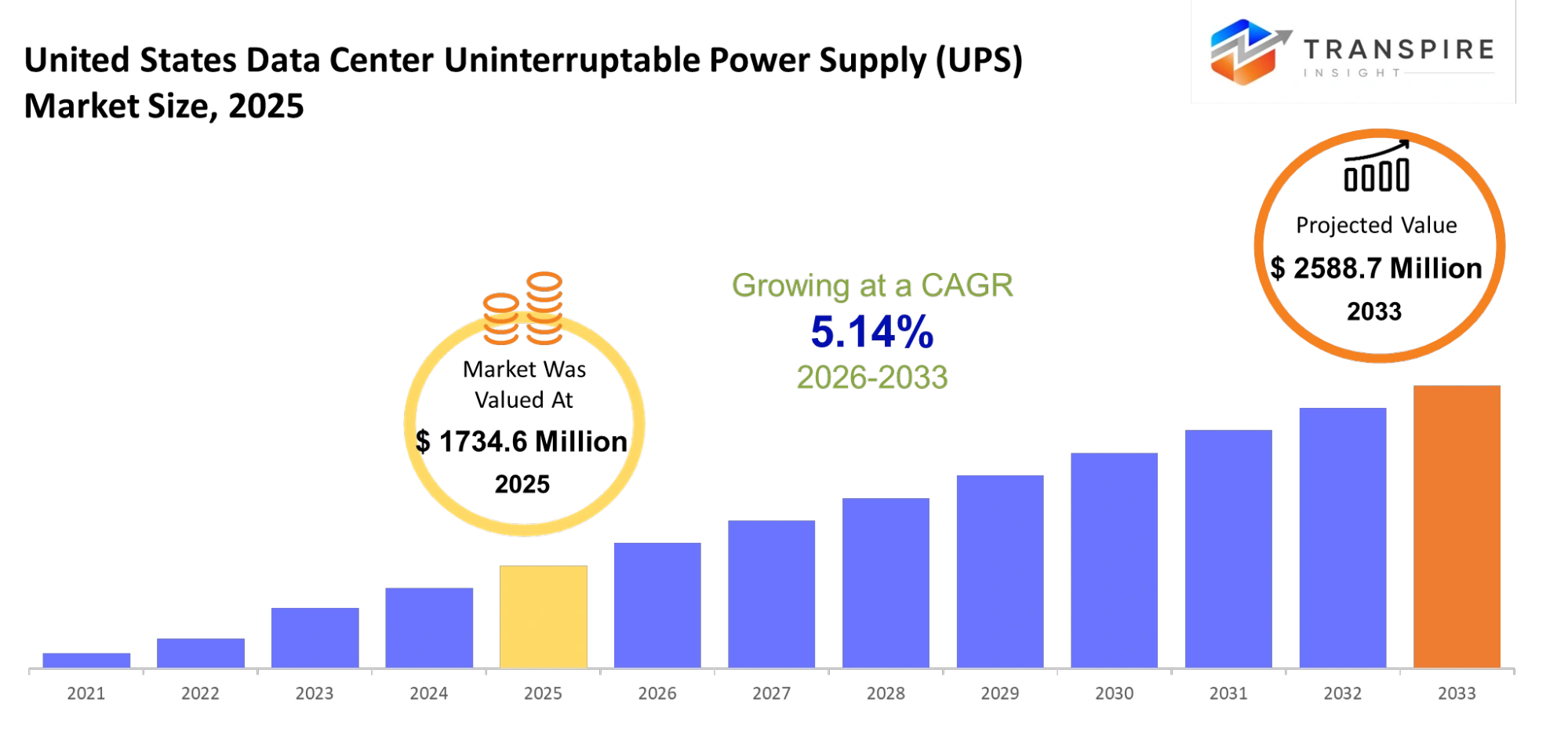
United States Data Center Uninterruptable Power Supply (UPS) Market Size & Forecast:
- United States Data Center Uninterruptable Power Supply (UPS) Market Size 2025: USD 1734.6 Million
- United States Data Center Uninterruptable Power Supply (UPS) Market Size 2033: USD 2588.7 Million
- United States Data Center Uninterruptable Power Supply (UPS) Market CAGR: 5.14%
- United States Data Center Uninterruptable Power Supply (UPS) Market Segments:By Type (Online, Line-interactive, Offline, Modular, Centralized, Distributed, Lithium-ion), By Power (Below 10kVA, 10–100, 100–500, 500–1000, >1MVA, Hyperscale, Edge), By Application (Cloud, Enterprise, Colocation, Edge, Telecom, BFSI, Healthcare), By Component (Battery, Inverter, Rectifier, Control, Cooling, Monitoring, Software), By End-User (IT, Telecom, Govt, Healthcare, BFSI, Industrial, Retail).
To learn more about this report,  Download Free Sample Report
United States Data Center Uninterruptable Power Supply (UPS) Market Summary:
The United States Data Center Uninterruptable Power Supply (UPS) Market size is estimated at USD 1734.6 Million in 2025 and is anticipated to reach USD 2588.7 Million by 2033, growing at a CAGR of 5.14% from 2026 to 2033. The United States Data Center Uninterruptible Power Supply (UPS) market experiences strong growth because data consumption increases and cloud services become more popular and hyperscale facilities continue to expand. Businesses show greater need for reliable backup power systems because they want to maintain operational uptime and safeguard their essential infrastructure. The market shows increasing demand for energy-efficient UPS systems that use modular design because of technological progress. The demand for power solutions which provide continuous operational support and reduced downtime risks is increasing because of the rising need for AI-powered operations and edge computing.
Key Market Trends & Insights:
- The need for continuous power supply becomes essential because businesses depend on real-time data. UPS systems function as vital infrastructure which protects against expensive system failures while maintaining operational continuity.
- Cloud providers expand their data centers which drives the requirement for high-capacity UPS solutions. The facilities need systems which can grow their capacity while operating at peak efficiency to manage their extensive workload.
- The need for flexible power solutions which support easy system upgrades is driving companies to choose modular UPS systems. The system enables operators to increase power capacity according to rising demand while maintaining operational activities.
- The rise of edge data centers creates a requirement for small yet dependable UPS systems. The smaller facilities require reliable power backup solutions which need to be distributed throughout their facilities.
- The industry now prefers lithium-ion batteries as replacements for traditional lead-acid batteries because they provide longer operational life and speedier recharging capabilities. The batteries require less upkeep and occupy less space within data center facilities.
- Today's UPS systems include sophisticated monitoring capabilities together with data analysis features. The system enables operators to identify upcoming breakdowns while improving their work efficiency and boosting system dependability.
United States Data Center Uninterruptable Power Supply (UPS) Market Segmentation
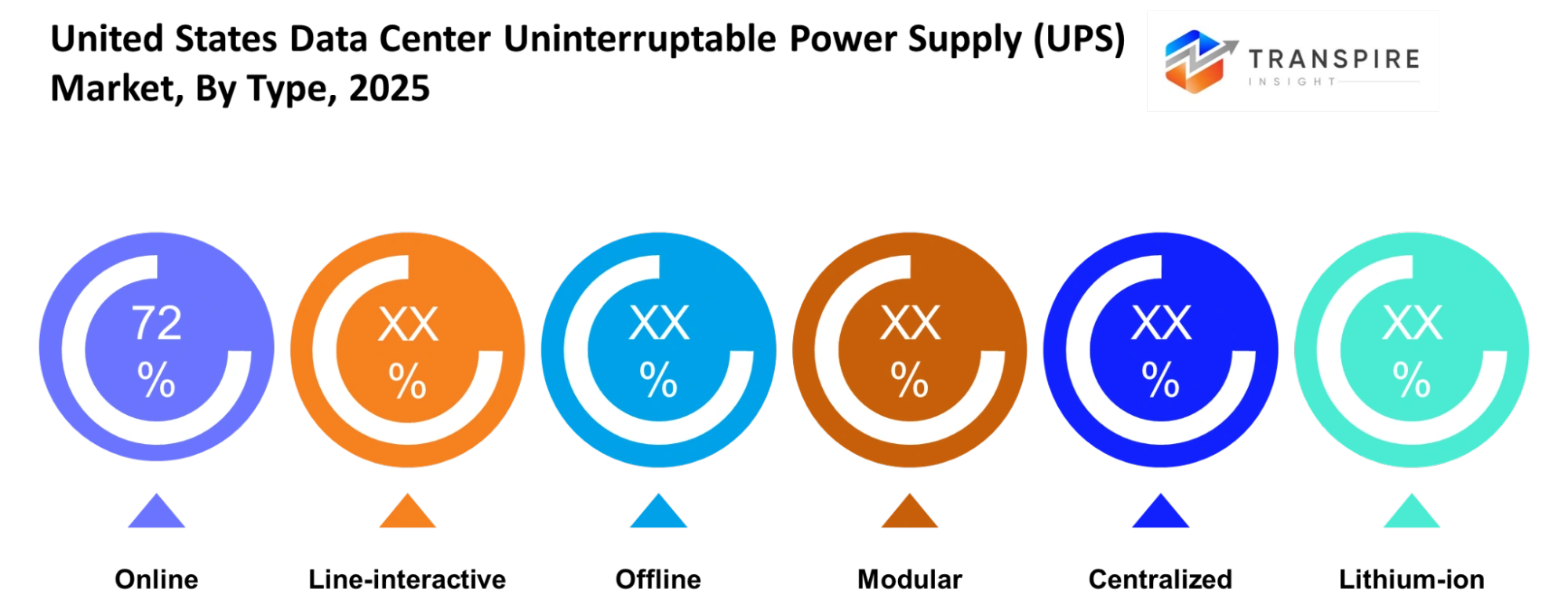
By Type
- Online: The critical data centre environments depend on online UPS systems because these systems deliver continuous power, which maintains system operation without any interruptions. The systems provide better protection against voltage fluctuations and power outages, which makes them suitable for high-performance computing environments that require complete operational uptime.
- Line-interactive: Line-interactive UPS systems provide an effective solution which combines cost efficiency together with operational performance. The system uses automatic voltage regulation to manage small power fluctuations, which makes it appropriate for mid-sized data centres. Businesses prefer this solution because it delivers trustworthy backup power at a reasonable cost without requiring them to purchase complete online systems.
- Offline: The budget limitations of smaller setups lead to the common use of offline UPS systems as their standard power backup solution. The system delivers basic power backup during power outages, although it experiences a brief time delay before switching to backup mode. The solution provides a low-cost option which protects non-sensitive systems, although it does not meet mission-critical operational needs.
- Modular: The market demand for modular UPS systems increases because their design enables users to expand and customise their power systems. Data centre operators have the ability to increase or decrease system capacity by adding or removing power modules according to their operational needs. The method minimises system downtime during system updates while it maximises resource efficiency, which makes it appropriate for organisations which experience continuous growth and operational changes.
- Centralized: Centralised UPS systems provide backup power through a single unit which supplies multiple connected loads. These systems find application in large facilities which benefit from streamlined maintenance operations through centralised power management. Redundancy must be established because system failures will lead to multiple systems experiencing operational disruptions.
- Lithium-ion: The adoption of lithium-ion UPS solutions has grown because of their extended product life and smaller dimensions and rapid battery charging abilities. The technology starts at a higher price point but becomes cost-effective for modern data centres because it lowers operational expenses and maintenance requirements.
To learn more about this report, Download Free Sample Report
By Power
- Below 10 kVA: The UPS systems below 10 kVA which exist in small-scale data centres or edge locations. They provide essential backup for limited equipment, and their compact design together with their low cost makes them valuable for businesses which require modest power capacity.
- 10–100kVA: This power range caters to mid-sized data centres and enterprise environments. The UPS systems provide a capacity cost balance which enables them to handle moderate workloads while they deliver backup power during power outages and voltage changes.
- 100–500kVA: UPS systems in this category are designed for larger data centres with significant power demands. The systems operate multiple servers and essential systems which guarantee system reliability in situations where continuous operation needs to be maintained.
- 500–1000 kVA: Businesses use high-capacity UPS solutions from this category in their large enterprise and colocation organisations. The system delivers powerful backup capability which protects complete IT systems while executing high-density operations and sustaining business activities through power outages.
- >1MVA: The hyperscale data centres, which need excessive power consumption, require UPS systems which exceed 1MVA capacity. The systems are designed to support heavy loads while delivering consistent power supply to essential functions which operate at optimal performance and dependability.
- Hyperscale: The large cloud providers and major technology companies use hyperscale UPS solutions. The system delivers operational capacity which allows for massive data processing while operating at high energy efficiency and with a redundant power supply.
- Edge: The edge UPS systems are small-sized power systems which provide power to remote data centres that operate near their end-user locations. They provide uninterrupted power supply to remote areas which run IoT and real-time analytics systems while maintaining low latency.
By Application
- Cloud: The data centres which operate on cloud technology depend on UPS systems to deliver their services without interruptions. The growing use of cloud computing requires businesses to have dependable backup power systems which will stop service interruptions and provide continuous access to online services.
- Enterprise: Enterprise applications require dependable UPS systems to protect internal data and operations. The system design which needs to deliver operational efficiency through cost savings must generate enough power backup for business operations during electrical outages.
- Colocation: Colocation facilities maintain their power systems as the most essential element because they serve multiple customers. The UPS systems in these settings need to operate with different types of equipment while maintaining constant operational availability to fulfil their established performance requirements.
- Edge: Edge applications require power solutions to deliver real-time processing capabilities at local sites. The UPS systems in this market segment provide backup power solutions to support smaller remote systems which operate in distant areas.
- Telecom: Telecom infrastructure depends on UPS systems to maintain network connectivity during outages. The system provides backup power which enables continuous operation of communication services during critical times and in environments with high demand.
- BFSI: The banking, financial services and insurance sector needs UPS systems which deliver maximum reliability to safeguard their confidential information and financial transactions. The need for power backup becomes critical because even brief power outages contribute to major financial damages.
- Healthcare: Healthcare facilities depend on UPS systems to protect their essential equipment and systems which provide patient treatment. The system depends on reliable power backup, which keeps life-saving equipment and data systems running without interruptions.
By Component
- Battery: Batteries act as the fundamental components which power every UPS system because they store energy needed to provide backup power during electrical outages. The development of lithium-ion battery technology allows modern data centers to achieve better system performance through improved efficiency and extended battery lifespan and enhanced system reliability.
- Inverter: Inverters change stored direct current power into alternating current power which data center equipment can use. Their performance directly impacts the quality and stability of power supplied during outages.
- Rectifier: Rectifiers transform incoming AC power into DC electricity which they use to charge batteries. Efficient rectifiers help maintain battery health and ensure system readiness during power interruptions.
- Control: Control systems manage the overall functioning of UPS units, ensuring smooth transitions and system coordination. Advanced control features improve system reliability together with better operational performance.
- Cooling: Cooling systems serve as vital components which enable UPS systems to function at their required operating temperatures. Effective thermal management prevents equipment overheating, which results in longer equipment lifespan.
- Monitoring: Monitoring tools deliver instant performance and health data about UPS systems. They enable proactive maintenance and help prevent unexpected failures.
- Software: Software solutions improve UPS management through their analytical capabilities and automated functions. Operators can use these tools to enhance system performance while forecasting problems which will help them achieve optimal operational results.
By End-User
- IT: The systems which UPS provides to IT companies create protection against data interruptions through their unbroken power supply, which maintains all data processing activities together with data storage operations. The reliable power backup system enables crucial business activities to continue functioning while it protects against data loss, which would occur during power outages.
- Telecom: The telecom industry depends on UPS systems to provide continuous network operation. The communication services require permanent power supply because their operations need to function throughout emergency situations and peak demand times.
- Government: Government agencies require secure and reliable power backup for data centres handling sensitive information. The UPS systems provide two main functions, which include maintaining operational activities while safeguarding all data assets.
- Healthcare: Healthcare institutions use UPS systems to support critical medical equipment and IT systems. The healthcare system requires backup systems which operate reliably to protect patient safety while delivering continuous medical services.
- BFSI: The financial sector relies on UPS systems to protect both financial transactions and confidential business information. The organisation maintains a continuous power supply to establish customer trust and operational reliability while meeting all required compliance standards.
- Industrial: Industrial sectors use UPS systems to support automated processes and data systems. The organisation uses power backup systems to protect its production activities from interruptions which would result in financial losses.
- Retail: Retail businesses count on UPS systems to support their point-of-sale systems and their inventory control operations. The organisation uses a continuous power supply to enable its customers to complete transactions while maintaining uninterrupted business activities.
Country Insights
The United States Data Center Uninterruptible Power Supply (UPS) market exists because the country maintains its advanced digital infrastructure together with its fast technology development. The increasing data centre demand for dependable power backup systems has created a continuous need for power backup systems because hyperscale and enterprise data centres exist in the area. The growth of major tech centres in Northern Virginia and Silicon Valley and Dallas receives support from rising demand for cloud computing and artificial intelligence workloads and edge computing implementations. The country’s focus on minimising downtime and ensuring data security further strengthens UPS adoption. The sustainability objectives of organisations drive them to adopt energy-efficient systems together with advanced lithium-ion battery technologies. The market development depends on government regulations and investments in infrastructure that maintains system resilience. The United States functions as a mature market which continues to develop because UPS deployment depends on innovative solutions which need to scale and operate efficiently in various business sectors.
Recent Development News
In April 2026, AI Data Center Boom Strains Power Infrastructure: Rapid AI expansion is increasing demand for reliable backup systems like UPS. Power shortages and equipment delays are impacting deployment timelines.
In April 2026, Half of U.S. Data Center Projects Face Delays : Shortages of transformers and electrical components are delaying projects, highlighting rising dependence on UPS and power resilience systems.
|
Report Metrics |
Details |
|
Market size value in 2025 |
USD 1734.6 Million |
|
Market size value in 2026 |
USD 1822.5 Million |
|
Revenue forecast in 2033 |
USD 2588.7 Million |
|
Growth rate |
CAGR of 5.14% from 2026 to 2033 |
|
Base year |
2025 |
|
Historical data |
2021 – 2024 |
|
Forecast period |
2026 – 2033 |
|
Report coverage |
Revenue forecast, competitive landscape, growth factors, and trends |
|
Country scope |
United States |
|
Key company profiled |
Schneider, Eaton, Vertiv, ABB, Siemens, Huawei, Delta, Mitsubishi, Toshiba, Legrand, Riello, CyberPower, Socomec, Fuji, AEG |
|
Customization scope |
Free report customization (country, regional & segment scope). Avail customized purchase options to meet your exact research needs. |
|
Report Segmentation |
By Type (Online, Line-interactive, Offline, Modular, Centralized, Distributed, Lithium-ion), By Power (Below 10kVA, 10–100, 100–500, 500–1000, >1MVA, Hyperscale, Edge), By Application (Cloud, Enterprise, Colocation, Edge, Telecom, BFSI, Healthcare), By Component (Battery, Inverter, Rectifier, Control, Cooling, Monitoring, Software), By End-User (IT, Telecom, Govt, Healthcare, BFSI, Industrial, Retail). |
Key United States Industrial Coating Company Insights
The United States Data Center Uninterruptible Power Supply (UPS) market is highly competitive, with leading companies focusing on innovation and reliability together with energy efficiency to maintain their competitive advantage. Key players are investing in advanced technologies through their development of modular designs and lithium-ion battery systems and intelligent monitoring systems which help them fulfil their requirements for data centre solutions. The companies in the industry use strategic partnerships together with mergers and product launches to achieve their goals of increasing market presence. The companies in the industry develop sustainable eco-friendly solutions which help clients decrease operational costs while their systems maintain performance without interruption.
Company List
- Schneider
- Eaton
- Vertiv
- ABB
- Siemens
- Huawei
- Delta
- Mitsubishi
- Toshiba
- Legrand
- Riello
- CyberPower
- Socomec
- Fuji
- AEG
United States Data Center Uninterruptable Power Supply (UPS) Market Report Segmentation
By Type
- Online
- Line-interactive
- Offline
- Modular
- Centralized
- Distributed
- Lithium-ion
By Power
- Below 10kVA
- 10–100
- 100–500
- 500–1000
- >1MVA
- Hyperscale
- Edge
By Application
- Cloud
- Enterprize
- Colocation
- Edge
- Telecom
- BFSI
- Healthcare
By Component
- Battery
- Inverter
- Rectifier
- Control
- Cooling
- Monitoring
- Software
By End-User
- IT
- Telecom
- Govt
- Healthcare
- BFSI
- Industrial
- Retail
Frequently Asked Questions
Find quick answers to common questions.
The approximate United States Data Center Uninterruptable Power Supply (UPS) Market size for the market will be USD 2588.7 Million in 2033.
The key segments of the United States Data Center Uninterruptable Power Supply (UPS) Market are By Type (Online, Line-interactive, Offline, Modular, Centralized, Distributed, Lithium-ion), By Power (Below 10kVA, 10–100, 100–500, 500–1000, >1MVA, Hyperscale, Edge), By Application (Cloud, Enterprise, Colocation, Edge, Telecom, BFSI, Healthcare), By Component (Battery, Inverter, Rectifier, Control, Cooling, Monitoring, Software), By End-User (IT, Telecom, Govt, Healthcare, BFSI, Industrial, Retail).
Major players in the United States Data Center Uninterruptable Power Supply (UPS) Market are Schneider, Eaton, Vertiv, ABB, Siemens, Huawei, Delta, Mitsubishi, Toshiba, Legrand, Riello, CyberPower, Socomec, Fuji, AEG.
The current market size of the United States Data Center Uninterruptable Power Supply (UPS) Market is USD 1734.6 Million in 2025.
The United States Data Center Uninterruptable Power Supply (UPS) Market CAGR is 5.14%.
- Schneider
- Eaton
- Vertiv
- ABB
- Siemens
- Huawei
- Delta
- Mitsubishi
- Toshiba
- Legrand
- Riello
- CyberPower
- Socomec
- Fuji
- AEG
Recently Published Reports
-
Apr 2026
3D Optical Profiler Market
3D Optical Profiler Market Size, Share & Analysis Report By Type (Desktop 3D Optical Profiler, and Portable 3D Optical Profiler), By Technology (Confocal Technology, and White Light Interference), By End-Use Industry (Manufacturing, Research Institutions, Automotive, Aerospace and Defense, Medical Devices, and Other), and Geography (North America, Europe, Asia-Pacific, Middle East and Africa, South and Central America), 2021 - 2031
-
Apr 2026
Depth Sensor Market
Depth Sensor Market Size, Share & Analysis Report By Type (Infrared Depth Sensors, Time-of-Flight (ToF) Sensors, Stereo Vision Sensors, Structured Light Sensors, Ultrasonic Depth Sensors), By Application (Automotive, Robotics, Gaming, Consumer Electronics, Industrial Automation, Healthcare, Security & Surveillance, Others), By End Users (Automotive Manufacturers, Consumer Electronics Companies, Healthcare Providers, Industrial Companies, Security Agencies, Gaming Companies, Robotics Companies, Others), and Geography (North America, Europe, Asia-Pacific, Middle East and Africa, South and Central America), 2021 – 2031
-
Apr 2026
Digital Manufacturing Market
Digital Manufacturing Market Size, Share & Analysis Report By Component (Hardware, Software, and Services), By Technology (Robotics, 3D Printing, Internet of Things (IoT), and Others), By Application (Automotive and Transportation, Aerospace and Defense, Consumer Electronics, Industrial Machinery, and Others), By Process Type (Computer-Based Designing, Computer-Based Simulation, Computer 3D Visualization, Analytics, and Others), and Geography (North America, Europe, Asia-Pacific, Middle East and Africa, South and Central America), 2021 – 2031
-
Apr 2026
Digital Visa Services Market
Digital Visa Services Market Size, Share & Analysis Report By Type (Individual Travelers, Group Travelers), By Application (Tourism, Business Travel, Others), and Geography (North America, Europe, Asia-Pacific, Middle East and Africa, South and Central America), 2021 – 2031