

United States Consumer Network Attached Storage Market Summary
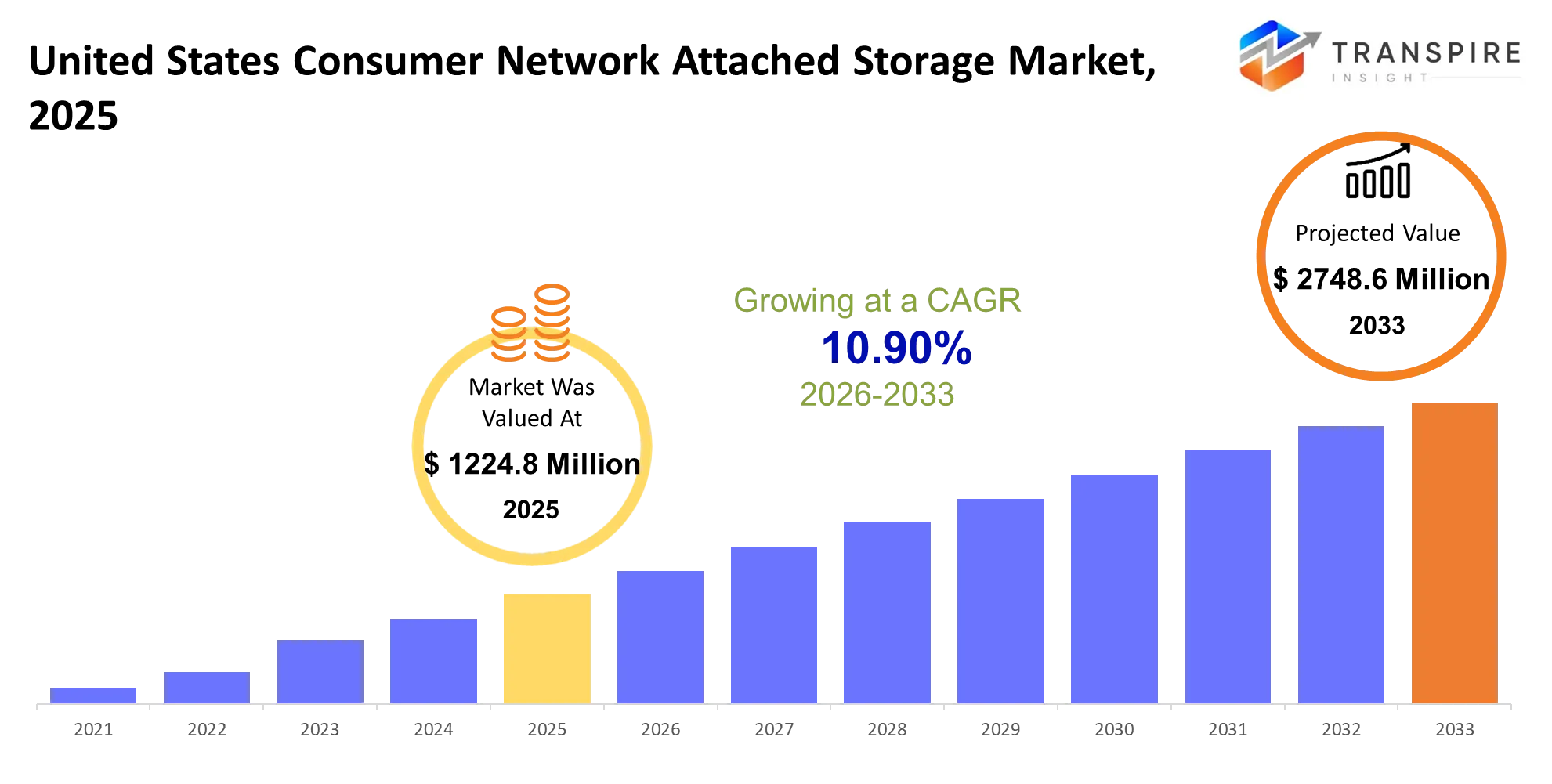
As per Transpire Insight, the United States Consumer Network Attached Storage Market size is estimated at USD 1224.8 Million in 2025 and is anticipated to reach USD 2748.6 Million by 2033, growing at a CAGR of 10.90% from 2026 to 2033.
Consumer NAS systems basically give households home offices creators and tech enthusiasts some local “space” to store, back up, keep in order, and reach all kinds of large files without having to depend on ongoing cloud subscriptions every single month. Beyond that, these systems also cover media streaming, remote access to files, photo curation, and multi device backup, so centralized storage becomes more doable, as digital content keeps growing and multiplying faster.
In the last three to five years, the market kind of moved away from purely technical home servers toward easier app driven storage hubs. Remote work, smartphone photos, 4K video, gaming libraries, and connected home gear all raised the storage needs inside normal homes, and at the same time vendors have made setup smoother, remote file access less of a headache, plus automated backup features more consistent. One big trigger, has been the quick spread of AI along with broader data center buildouts, which has tightened HDD availability and pushed storage economics into a phase that feels less stable and more uncertain. Recent industry notes point to strong enterprise HDD allocation and higher pricing for drives aimed at consumers, so buyers are feeling pressure to choose larger capacity drives and squeeze more efficiency out of their storage layout.
United States Consumer Network Attached Storage Market Size & Forecast:
- United States Consumer Network Attached Storage Market Size 2025: USD 1224.8 Million
- Expected Market Value 2033: USD 2748.6 Million
- Forecast CAGR: 10.90%
- Key Profile: Synology Inc., QNAP Systems, Western Digital, Seagate Technology, Asustor Inc., TerraMaster, Buffalo Americas, NETGEAR, D-Link Corporation, ASUS, Dell Technologies, Hewlett Packard Enterprise, Lenovo Group, Toshiba Corporation, Zyxel Communications
Key Market Insights
- Market size : revenue is estimated around USD 1,224.8 million in 2025 , and adoption seems to be drifting toward higher capacity systems plus more software heavy storage platforms, not just the plain hardware anymore.
- Regional leadership : North America still held about 34.0% of global consumer NAS revenue in 2025 , which kind of confirms there’s solid, structural demand across the region.
- Design leadership : In the U.S. , 4-bay systems accounted for 34.77% of revenue in 2025 , and that was backed by RAID flexibility along with expandable home storage, the whole idea is “grow as you go”.
- Fastest-growing design : 2-bay NAS systems are forecast to show the quickest design growth, and that tracks with easier installation, lower entry costs , plus “good enough” capacity for many households.
- Storage transition : Buyers are more and more willing to go for larger HDD configurations as smartphone video, gaming collections and creator workflows basically push household storage needs up, it’s not subtle.
- Connectivity upgrade : Multi-gigabit Ethernet is moving past specialist households and into mainstream setups, because faster home networking reduces file transfer delays for big media libraries.
- AI integration : AI powered photo classification and search are starting to appear inside consumer storage again, and Synology in particular is positioning AI based sorting of faces and subjects.
- Cloud substitution : Local storage products increasingly bundle remote access with backup and synchronization, so some people treat them as substitutes to recurring cloud-storage subscriptions, instead of paying month after month.
- Competitive pressure : Synology’s 2025 drive compatibility policy sparked consumer frustration earlier than DSM 7.3 later came in and restored broader third party HDD and SSD functionality.
- Supply-chain pressure : Also, AI driven data center spending is redirecting HDD capacity toward enterprise customers , and that tends to raise cost pressure across consumer NAS storage components.
What are the Key Drivers, Restraints, and Opportunities in the United States Consumer Network Attached Storage Market?
Driver: The biggest growth push is, basically, the conversion of NAS from a specialist home-server thing into a more approachable personal data-management platform. Remote work, high-resolution smartphone photography, gaming installs and creator workflows have raised the amount and the tempo of household data creation , so it sort of never really slows down. Vendors then answer with guided setup, mobile backup, remote access, and automated file organization, which lowers the technical hurdles that used to block adoption. Synology’s BeeStation for example, gives built-in storage, computer backup, mobile photo backup and AI assisted photo ordering, and it kinda shows how manufacturers are simplifying local storage for more mainstream users.
Restraint: Hardware cost still acts like a rigid barrier , especially because NAS ownership usually means an enclosure plus one or more storage drives. On top of that, the recent HDD supply pressure adds more cost volatility, since AI and data-center investment are pulling in a lot of storage capacity. Seagate has pointed to strong enterprise and cloud demand, while newer market notes suggest that even consumer NAS-drive pricing has taken hits too. Those higher starting costs can postpone purchases among households that already subscribe to cloud storage and may see NAS setup as extra technical spending that they don’t really need.
Opportunity: AI-enabled local data management looks like the next-stage opening. With AI based image recognition, semantic search, automatic sorting, anomaly detection, and privacy minded local processing, storage hardware can be turned into an intelligent data-management environment. Synology already uses AI to organize photos by individuals and topics, and newer product plans are extending those local AI abilities further, like in practical everyday ways.
What Has the Impact of Artificial Intelligence Been on the United States Consumer Network Attached Storage Market?
Artificial intelligence is reshaping consumer storage kind of indirectly, mainly via automated organization, smarter search, backup intelligence, and some ongoing system monitoring. It’s not really the maritime-style scrubber or fleet applications the prompt alludes to, more like everyday stuff people actually do. Modern NAS platforms can lean on AI recognition to sort and classify photographs by faces, subjects, places, and other similar signals, which cuts down the manual sorting chores across huge personal libraries. Synology’s BeeStation, for instance , leans into AI-powered photo organization and automatic album creation, and then newer Synology software keeps extending that AI-centric data-management angle.
There’s also machine-learning support for anomaly detection, file classification, security monitoring, and even more “quiet” intelligent backup workflows. In practice this can shrink the time spent on administration and make it easier to find files later, especially when someone is dealing with large photo and video archives. AI is nudging vendors too, toward running more processing nearer to the storage device. That helps in privacy-sensitive situations where people want local control, rather than sending personal data out elsewhere.
Still, the biggest limiter is the real world hardware and software capability. Advanced AI workloads need enough processing power, memory, storage bandwidth, plus software that’s tuned properly. Smaller consumer NAS units may not be able to run sophisticated models efficiently. On top of that, there are integration costs, and model accuracy can wobble when the dataset is large, mixed quality, and messy in the way real personal collections usually are. So AI adoption will probably stay strongest in practical roles, like photo classification, searching, anomaly detection, and automated organization, rather than trying to deliver fully autonomous storage management.
Key Market Trends
- After 2020, remote work kind of sped up household file centralization, and it pushed NAS gear past just media storage , more toward home-office backup and some kind of day to day collaboration… kinda.
- At the same time smartphone cameras moved into higher resolution video , which also means larger personal libraries, and that strengthened the need for expandable local storage.
- Four bay systems hit 34.77% of U.S. revenue by 2025, suggesting people are still into redundancy, plus the idea that capacity can scale later.
- Two bay setups are expected to grow fastest, because manufacturers are going after consumers who want simpler configurations, with lower hardware prices, and installation costs that feel less annoying.
- AI assisted photo organization is now showing up in consumer products, so instead of manually cataloging, users get automatic recognition of people, subjects, and near identical images.
- Meanwhile multi gigabit networking is getting more relevant, as creators and households move bigger video libraries across computers , cameras, and storage devices.
- Cloud sync also expanded from plain backup, toward hybrid “personal cloud” workflows, where local files stay linked to services like Google Drive, Dropbox, and OneDrive.
- HDD supply economics shifted after 2025 too , because AI infrastructure absorbed more enterprise capacity, and that put extra pressure on consumer drive pricing.
- Vendors have been turning their ecosystems into something more deliberate, with surveillance, media servers, mobile backup, collaboration, and AI features wrapped around the storage hardware.
- Finally, drive compatibility became a competitive talking point in 2025, and Synology later restored wider third party drive support after consumer pushback.
United States Consumer Network Attached Storage Market Segmentation
By Product Type:
1-Bay NAS, 2-Bay NAS, 4-Bay NAS, 5-Bay NAS, 6-Bay NAS, 8-Bay NAS, Rackmount NAS, Portable NAS, High-Capacity NAS, Others: these product configurations handle different storage needs , redundancy levels , speed expectations, and physical installation concerns. The 1-Bay NAS is kind of aimed at basic personal backup, and media libraries , meanwhile a 2-Bay NAS offers a better midway point between being budget friendly and using RAID-based protection. The 4-Bay NAS is still the most common blueprint, it makes up 34.77% of U.S. revenue in 2025, as listed in Grand View Research’s market database.
5-Bay NAS, 6-Bay NAS, 8-Bay NAS, Rackmount NAS, Portable NAS, High-Capacity NAS, Others are more about bigger collections, power users, small office setups, creators, and even niche home deployments. Rackmount models are for folks who need tight density in closets or racks , while portable NAS units emphasize movement, and quick direct use. High-capacity configurations become more relevant as video files, game libraries, surveillance recordings, and private archives keep growing.
By Storage Capacity:
Below 4 TB, 4–8 TB, 8–16 TB, 16–32 TB, Above 32 TB : picking the capacity now feels more tied to how big your photo, video, gaming, and backup collections end up being. Under 4 TB still works if you’re mostly dealing with standard files, like simple documents , plus a few personal backups. But 4–8 TB and 8–16 TB get more sensible for wider household needs, because libraries slowly grow even when nobody wants to admit it. Once you move into the bigger tier, creators and people who keep several years of high-resolution media tend to benefit more from the extra room.
16–32 TB, Above 32 TB, Expandable Storage, SSD-Based NAS, HDD-Based NAS, Hybrid Storage, Others : as the amount of data grows, higher-capacity setups matter more, and the reason is that multi-drive designs keep getting more flexible. HDD-based systems keep a solid cost per terabyte advantage , so they’re often the pragmatic choice. SSD-based NAS products instead focus on performance , meaning workloads that need faster responsiveness. Hybrid Storage is basically a negotiated compromise : it pairs high-capacity HDD storage with SSD acceleration, so you get a more reasonable mix of speed, capacity, and cost, without going all-in on just one side.
By Connectivity:
Ethernet, Wi-Fi, USB, Thunderbolt, 10 Gigabit Ethernet, Dual LAN, Wireless Mesh, Cloud Sync, Others kinda still feels like the backbone. Ethernet stays central cause wired networking gives stable throughput for big file transfers and also multi-device backup, without much drama. Wi-Fi and USB add convenience for everyday household gear, while Thunderbolt supports high-speed creator workflows, you know, like fast editing and stuff. 10 Gigabit Ethernet and Dual LAN increasingly aim at advanced users who move large video libraries, or run several connected systems at once.
Wireless Mesh, Cloud Sync, Others lean more into distributed home networks, plus hybrid storage workflows. Cloud Sync is basically local storage that can talk to external cloud platforms, so you get extra backup pathways and access options too. Wireless Mesh helps extend coverage across larger homes, while faster wired standards still matter a lot for high-volume transfers.
By Application:
Personal Backup, Home Media Server, Smart Home Storage, Content Creation, Gaming Storage, Home Office, Photo & Video Storage, Surveillance Storage, Others… somehow all of these end up mattering, because NAS systems gather files from computers, smartphones, and other household devices in one place. Personal Backup stays kind of the core application, since the consolidation is the whole point, and it helps you keep everything in order. Then Home Media Server applications do what they say, centralized libraries and streaming, which is also where many people start. Content Creation feels different though, because it needs higher throughput plus bigger capacities. Gaming Storage kinda sneaks in as well, since modern game installs take a lot more space on your local drive than people expect.
Home Office, Photo & Video Storage, Surveillance Storage, Others, yeah, they extend adoption beyond simple backup. For Home Office, you often want centralized documents and automated computer backup, not just a manual copy. For Photo & Video Storage, large camera and smartphone libraries are the real workload, so capacity and organization matter. Surveillance Storage adds yet another use case through continuous camera recording, especially in smart-home setups where cameras never really “rest”, not even for a minute.
By End User:
Home Users, Gamers, Content Creators, Small Offices, Students, IT Enthusiasts, Remote Workers, Smart Home Users, Others : basically, Home Users are a wide group looking for centralized backup, media access, and private file storage. Gamers and Content Creators usually need more capacity , and quicker transfer speeds too , because big game libraries plus high-resolution media tend to eat space fast. IT Enthusiasts are still a big deal as early adopters , since advanced networking, virtualization, RAID , and self-hosted applications pull in buyers who like to tinker and configure everything just so.
Then you have Small Offices, Students, Remote Workers, Smart Home Users, Others, which open more pathways to adoption. Small Offices lean on NAS for shared files and backup routines, while Remote Workers want dependable document access between locations, kind of seamless. Smart Home Users can blend storage with camera recording, device backups, and home-media tasks, so the NAS role grows beyond plain file storage, more like a hub for everyday living.

What are the Key Use Cases Driving the United States Consumer Network Attached Storage Market?
Personal backup kind of acts like a leading use case , because many households now end up juggling photographs, videos, documents , and even device backup across smartphones and computers. Having the storage in one place reduces reliance on those scattered external drives, and it also enables automated backup plus remote access, which is sort of the whole point. Consumer products like BeeStation are aimed specifically at computer and mobile backup , so it kind of underlines how people actually want personal data management to be easy and fairly straightforward.
Photo and video storage is growing, and so are home media servers , along with gaming storage, mainly since resolution keeps climbing and digital libraries keep getting bigger. Content creators often need quicker transfers, and an expandable amount of space. Meanwhile gamers tend to like centralized storage for their huge libraries, because it feels less hassle. Even home-office setups and remote-worker routines push adoption , since centralized document backup and file access make everyday work a bit smoother.
More emerging use cases show up too, like AI-assisted personal data organization and smart-home storage. AI photo classification can automatically organize massive image collections, without the user doing all the manual tagging. Then, surveillance integration comes into play , where storage platforms can support connected cameras and keep local video for later review or retention. Overall, Synology current consumer products point to this sort of convergence—personal storage, AI organization, backup, and home monitoring , all moving together instead of staying separate.
|
Report Metrics |
Details |
|
Market size value in 2025 |
USD 1224.8 Million |
|
Market size value in 2026 |
USD 1334.2 Million |
|
Revenue forecast in 2033 |
USD 2748.6 Million |
|
Growth rate |
CAGR of 10.90% from 2026 to 2033 |
|
Base year |
2025 |
|
Historical data |
2021 - 2024 |
|
Forecast period |
2026 - 2033 |
|
Report coverage |
Revenue forecast, competitive landscape, growth factors, and trends |
|
Regional scope |
United States |
|
Key company profiled |
Synology Inc., QNAP Systems, Western Digital, Seagate Technology, Asustor Inc., TerraMaster, Buffalo Americas, NETGEAR, D-Link Corporation, ASUS, Dell Technologies, Hewlett Packard Enterprise, Lenovo Group, Toshiba Corporation, Zyxel Communications |
|
Customization scope |
Free report customization (country, regional & segment scope). Avail customized purchase options to meet your exact research needs. |
|
Report Segmentation |
By Product Type (1-Bay NAS, 2-Bay NAS, 4-Bay NAS, 5-Bay NAS, 6-Bay NAS, 8-Bay NAS, Rackmount NAS, Portable NAS, High-Capacity NAS, Others); By Storage Capacity (Below 4 TB, 4–8 TB, 8–16 TB, 16–32 TB, Above 32 TB, Expandable Storage, SSD-Based NAS, HDD-Based NAS, Hybrid Storage, Others); By Connectivity (Ethernet, Wi-Fi, USB, Thunderbolt, 10 Gigabit Ethernet, Dual LAN, Wireless Mesh, Cloud Sync, Others); By Application (Personal Backup, Home Media Server, Smart Home Storage, Content Creation, Gaming Storage, Home Office, Photo & Video Storage, Surveillance Storage, Others); By End User (Home Users, Gamers, Content Creators, Small Offices, Students, IT Enthusiasts, Remote Workers, Smart Home Users, Others) |
Which Regions are Driving the United States Consumer Network Attached Storage Market Growth?
Western United States is kinda the main regional demand center here, backed by high technology take up, pretty solid creator economies, and a lot of focused activity across software, gaming, and digital media. California, plus Washington, gives a big base of technology intense households and small businesses, and they tend to push substantial volumes of video, development files, and cloud-linked data. Also, strong broadband availability helps a ton , and early multi gigabit networking adoption keeps pulling higher performance NAS configurations along with it. So the regional tech ecosystem kind of becomes a ready made lane, where Synology, QNAP, NETGEAR and other storage vendors can push premium products in more easily.
Northeastern United States looks different, it gives a steadier kind of demand, fueled by dense urban markets, professional households, universities, and smaller businesses. There’s heavy clustering of financial services, education, media, and professional work, which turns into ongoing needs for local backup , secure file access , and hybrid cloud storage. In contrast to that very tech heavy Western market, Northeastern adoption leans more toward retiring scattered external-drive arrangements and it puts more weight on data protection. Economic resilience plus established IT purchasing channels also means the region keeps showing up as a consistent national revenue contributor.
Southern United States feels like the strongest growth lane , mostly because population migration, new housing build outs, expanding small business activity, and data heavy home tech are all moving storage needs upward. Texas, Florida, Georgia , and North Carolina are adding technology oriented businesses and households. That creates good conditions for cost effective multi bay NAS systems and home office storage solutions, without it getting too expensive.
Who are the Key Players in the United States Consumer Network Attached Storage Market and How Do They Compete?
Competition is sort of moderately concentrated, mostly around specialist NAS vendors and the big storage manufacturers, where players like Synology, QNAP, Western Digital, Seagate, ASUSTOR, and NETGEAR are competing in different parts of the value chain. Lately the competition seems to turn more and more toward software ecosystems, storage capacity, networking speed, security, AI capabilities, and the overall ease of installation, not just hardware price. Specialist vendors try to stand out via integrated operating systems and also applications, but storage manufacturers have the advantage of solid drive portfolios and established retail distribution. And that move toward personal cloud platforms, it also opens more ways for vendors to make money, through software, backup, synchronization, and subscription services, in practice.
Synology is strengthening its differentiation through AI-assisted management, private-cloud services, automated backup, and consumer-oriented products, like BeeStation. Also its February 2026 ISO/IEC 27001 certification, kind of reinforces its security positioning even further. QNAP, on the other hand, leans hard into hardware flexibility, high-speed networking, ZFS based storage, plus AI-ready systems. It even lists a March 2026 10-bay all-flash TS-h1077AFU, which fits that angle.
Seagate Technology competes using its storage-media know-how and high-capacity drives that back NAS use cases, gaming, and creator workloads. In April 2026 it expanded its consumer and prosumer portfolio with new storage products, intended for larger photo, video, gaming, and AI-creative workloads. Western Digital benefits from having broad HDD and SSD capabilities, while ASUSTOR emphasizes performance-driven NAS hardware and keeps a lot of application flexibility. Taken together, it’s basically competition between integrated software ecosystems, high-capacity storage economics, and performance focused configuration choices.
Company List
- Synology Inc.
- QNAP Systems
- Western Digital
- Seagate Technology
- Asustor Inc.
- TerraMaster
- Buffalo Americas
- NETGEAR
- D-Link Corporation
- ASUS
- Dell Technologies
- Hewlett Packard Enterprise
- Lenovo Group
- Toshiba Corporation
- Zyxel Communications
Recent Development News
- "In February 2026, Synology achieved ISO/IEC 27001:2022 certification. The certification covers Synology's information security management system, secure development lifecycle, and security-response processes, strengthening trust and security positioning across its storage portfolio. https://www.synology.com/en-us/company/news/article/iso27001 (Synology)."
- "In March 2026, QNAP Systems introduced the TS-h1077AFU, a 10-bay ZFS-based all-flash NAS powered by AMD Ryzen PRO 7000 processors. The product expands high-density flash storage capabilities and targets high-speed media workflows, virtualization, databases, and backup consolidation. https://www.qnap.com/en-us/news/2026/qnap-releases-the-10-bay-zfs-based-high-density-all-flash-ts-h1077afu-sata-ssd-nas-powered-by-amd-ryzen-pro-7000-series-processors (QNAP)."
- "In April 2026, Seagate Technology introduced new and refreshed consumer and prosumer storage products across its Seagate, FireCuda, and LaCie brands. The portfolio includes the LaCie 8big Pro5 multi-bay RAID solution and targets higher-resolution media, expanding game libraries, and AI-driven creative workflows. https://www.seagate.com/stories/articles/seagate-introduces-storage-built-for-consumer-data-explosion-pr/ (Seagate Technology)."
What Strategic Insights Define the Future of the United States Consumer Network Attached Storage Market?
The United States Consumer Network Attached Storage Market is slowly, kind of structurally, moving away from mostly hardware-centered backup toward something like intelligent personal data infrastructure. The main push is the very fast growth of locally produced data from smartphones, gaming rigs, creator apps, connected appliances, and AI-produced material, so centralized and scalable storage becomes more valuable, like really quickly. The part people often miss is the storage-media supply concentration issue, where AI infrastructure is pulling in a large share of enterprise HDD capacity, and that can raise component costs and make procurement for consumer NAS units drag out longer.
The most promising opportunity is local AI-enabled storage, where NAS boxes can categorize, locate, summarize, and handle everyday personal data, without sending sensitive files fully over to external cloud platforms all the time. Synology’s DSM 7.4, for example, already brings AI-guided management plus storage-efficiency functions, which suggests the industry is walking toward that approach. So market participants should really lean into NAS platforms that have AI-ready processors, faster networking, capacity that can expand, and a solid software ecosystem rather than trying to win mainly by enclosure price only.
United States Consumer Network Attached Storage Market Report Segmentation
By Product Type
- 1-Bay NAS
- 2-Bay NAS
- 4-Bay NAS
- 5-Bay NAS
- 6-Bay NAS
- 8-Bay NAS
- Rackmount NAS
- Portable NAS
- High-Capacity NAS
- Others
By Storage Capacity
- Below 4 TB
- 4–8 TB
- 8–16 TB
- 16–32 TB
- Above 32 TB
- Expandable Storage
- SSD-Based NAS
- HDD-Based NAS
- Hybrid Storage
- Others
By Connectivity
- Ethernet
- Wi-Fi
- USB
- Thunderbolt
- 10 Gigabit Ethernet
- Dual LAN
- Wireless Mesh
- Cloud Sync
- Others
By Application
- Personal Backup
- Home Media Server
- Smart Home Storage
- Content Creation
- Gaming Storage
- Home Office
- Photo & Video Storage
- Surveillance Storage
- Others
By End User
- Home Users
- Gamers
- Content Creators
- Small Offices
- Students
- IT Enthusiasts
- Remote Workers
- Smart Home Users
- Others
Frequently Asked Questions
Find quick answers to common questions.
The expected United States Consumer Network Attached Storage Market size for the market will be USD 2748.6 Million in 2033.
Key segments for the United States Consumer Network Attached Storage Market are By Product Type (1-Bay NAS, 2-Bay NAS, 4-Bay NAS, 5-Bay NAS, 6-Bay NAS, 8-Bay NAS, Rackmount NAS, Portable NAS, High-Capacity NAS, Others); By Storage Capacity (Below 4 TB, 4–8 TB, 8–16 TB, 16–32 TB, Above 32 TB, Expandable Storage, SSD-Based NAS, HDD-Based NAS, Hybrid Storage, Others); By Connectivity (Ethernet, Wi-Fi, USB, Thunderbolt, 10 Gigabit Ethernet, Dual LAN, Wireless Mesh, Cloud Sync, Others); By Application (Personal Backup, Home Media Server, Smart Home Storage, Content Creation, Gaming Storage, Home Office, Photo & Video Storage, Surveillance Storage, Others); By End User (Home Users, Gamers, Content Creators, Small Offices, Students, IT Enthusiasts, Remote Workers, Smart Home Users, Others).
Major United States Consumer Network Attached Storage Market players are Synology Inc., QNAP Systems, Western Digital, Seagate Technology, Asustor Inc., TerraMaster, Buffalo Americas, NETGEAR, D-Link Corporation, ASUS, Dell Technologies, Hewlett Packard Enterprise, Lenovo Group, Toshiba Corporation, Zyxel Communications.
The United States Consumer Network Attached Storage Market size is USD 1224.8 Million in 2025.
The United States Consumer Network Attached Storage Market CAGR is 10.90%from 2026 to 2033.
- Synology Inc.
- QNAP Systems
- Western Digital
- Seagate Technology
- Asustor Inc.
- TerraMaster
- Buffalo Americas
- NETGEAR
- D-Link Corporation
- ASUS
- Dell Technologies
- Hewlett Packard Enterprise
- Lenovo Group
- Toshiba Corporation
- Zyxel Communications
About the Authors

Avinash Kumar
I’m Avinash Kumar, a Senior Research Analyst at Transpire Insight, with expertise in the Electronics and Semiconductor and Energy & Power industry. My work focuses on analyzing emerging technologies, market trends, industry developments, and innovation across these sectors. I specialize in transforming complex technical and market insights into clear, research-backed content that helps professionals, businesses, and decision-makers stay informed. Through continuous industry research and data-driven analysis, I strive to deliver accurate, reliable, and practical perspectives on the latest advancements shaping the semiconductor and energy landscape.

Chakradhar Khansole
Chakradhar serves as the Research Director at Transpire Insight, bringing over 8 years of experience in technology, innovation, and strategic market intelligence. He specializes in transforming complex market data into actionable business insights that enable organizations to make informed, growth-oriented decisions. Recognized for his strategic vision and analytical expertise, Chakradhar leads high-impact research initiatives, delivering comprehensive market assessments, competitive intelligence, and forward-looking industry analysis.
Recently Published Reports
-
Apr 2026
Fiber Optic Faceplates Market
Fiber Optic Faceplates Market Size, Share & Analysis Report By Type (< 300 mm2, 300-350 mm2, and > 350 mm2, By Application (Night Vision, Holographic Imaging, Medical, and Others), and Geography (North America, Europe, Asia-Pacific, Middle East and Africa, South and Central America), 2021 - 2031
-
Apr 2026
High Temperature Superconductors Market
High Temperature Superconductors Market Size, Share & Analysis Report By Type (1G HTS, and 2G HTS), By Application (Power Cable, Fault Current Limiter, and Transformer), and Geography (North America, Europe, Asia-Pacific, Middle East and Africa, South and Central America), 2021 - 2031
-
Apr 2026
Industrial Plugs and Socket Market
Industrial Plugs and Socket Market Size, Share & Analysis Report By Type (Industrial Plugs, Industrial Sockets), By Current (Up to 32 A, 32 to 125 A, Above 125 A), By Protection (Dustproof and Splash Proof, Waterproof, Explosion Proof), By End User (Heavy Industries, Oil and Gas, Chemicals and Pharmaceuticals, Power Generation, Others), and Geography (North America, Europe, Asia-Pacific, Middle East and Africa, South and Central America), 2021 - 2031
-
Apr 2026
InGaAs Avalanche Photodiodes Market
InGaAs Avalanche Photodiodes Market Size, Share & Analysis Report By Type (1100 - 1700 nm, and 1000 - 1600 nm), By Application (Missile Warning System, Muzzle Flash Detection, Wafer Defect Inspection, Laser Rangefinders, and Others), and Geography (North America, Europe, Asia-Pacific, Middle East and Africa, South and Central America), 2021 - 2031