

United States Compressed Natural Gas (Cng) Market Size & Forecast:
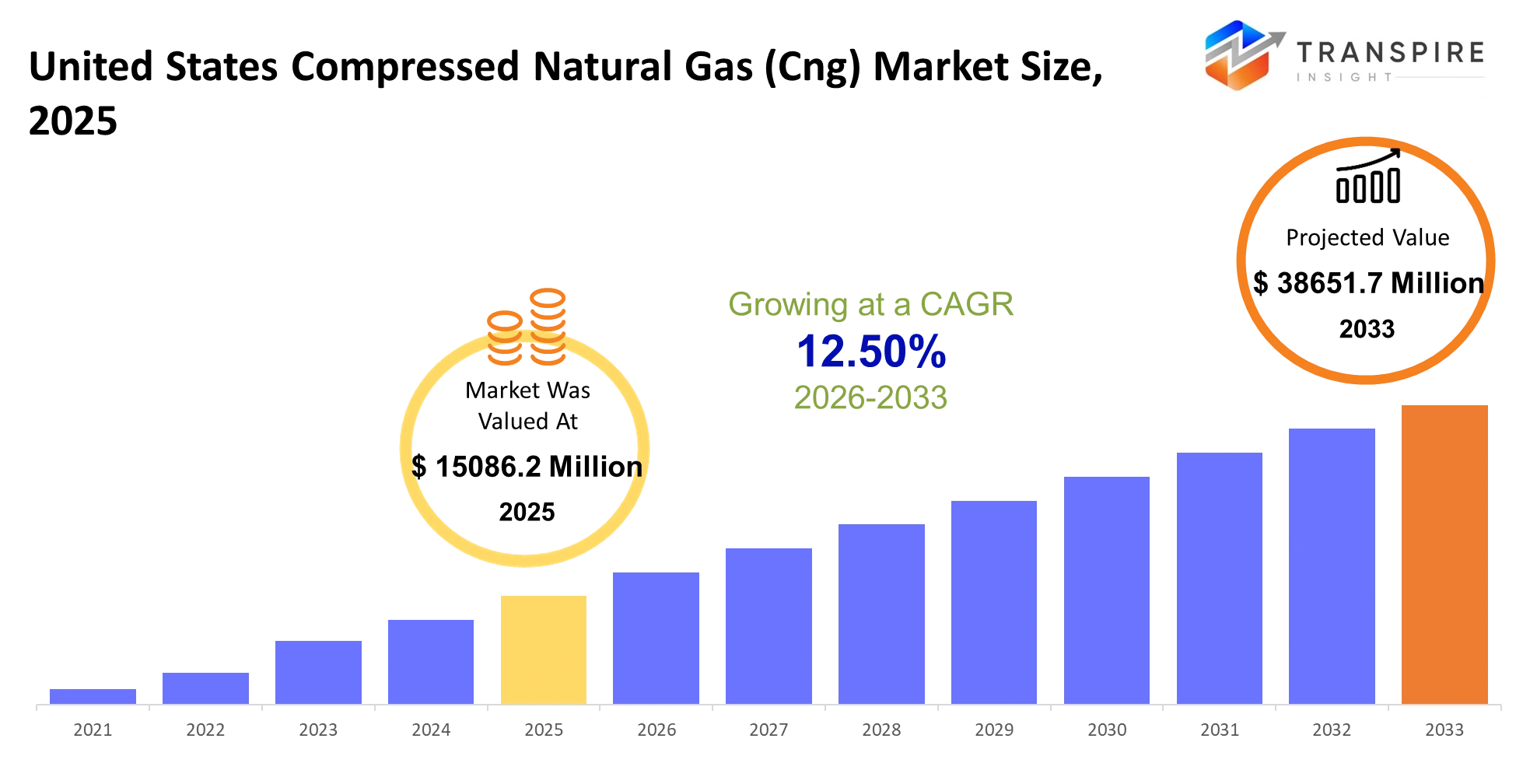
- United States Compressed Natural Gas (Cng) Market Size 2025: USD 15086.2 Million
- United States Compressed Natural Gas (Cng) Market Size 2033: USD 38651.7 Million
- United States Compressed Natural Gas (Cng) Market CAGR: 12.50%
- United States Compressed Natural Gas (Cng) Market Segments:By Type (Compressed Natural Gas, Renewable CNG, Biogas, LNG), By Application (Transportation, Industrial, Power Generation, Residential), By End-User (Fleet Operators, Utilities, Industrial Users, Consumers), By Distribution (Pipelines, Stations, Direct Supply, Mobile Units), By Vehicle Type (Passenger Cars, Buses, Trucks, Commercial).
To learn more about this report,  Download Free Sample Report
United States Compressed Natural Gas (Cng) Market Summary:
The United States Compressed Natural Gas (CNG) Market size is estimated at USD 15086.2 Million in 2025 and is anticipated to reach USD 38651.7 Million by 2033, growing at a CAGR of 12.50% from 2026 to 2033. The United States Compressed Natural Gas (CNG) market is steadily expanding because people need cleaner and more affordable fuel options. The rising environmental worries, together with government support policies, create an environment that promotes CNG adoption for transportation and fleet operations. The development of fuelling station infrastructure, together with other infrastructure advancements, leads to increased market expansion. The industrial sector moves toward low-emission energy solutions which make CNG an effective energy option. The market demonstrates strong potential for future growth despite existing challenges which include restricted infrastructure development across certain areas.
Key Market Trends & Insights:
- CNG usage in buses and trucks and municipal fleets keeps expanding because it offers lower emissions and better cost-effectiveness. Fleet operators try to achieve their sustainability goals through cleaner fuels which will lower their future fuel costs.
- CNG fuelling stations are increasing their presence in important areas, which makes it easier for people to access this service. The current process of expanding CNG availability helps solve the main problem that prevents people from using CNG.
- CNG offers lower costs than gasoline and diesel, which attracts heavy vehicle operators to use it. Businesses that operate large fleets achieve substantial financial advantages through their ability to save on fuel expenses over extended periods.
- The United States is currently investigating various renewable energy options that would decrease its need for conventional fuels. CNG serves as a vital transitional fuel which connects existing energy systems with future renewable energy systems.
- Engine efficiency upgrades and storage system advancements produce better vehicle functionality. CNG-powered vehicles become more trustworthy through these technological breakthroughs, which enable a wider range of users to find them useful.
- CNG usage extends beyond transportation, as industries utilise it for both industrial heating needs and power production requirements. The cleaner combustion process combined with its economical nature makes this solution suitable for multiple industrial processes.
United States Compressed Natural Gas (Cng) Market Segmentation
By Type
- Compressed Natural Gas (CNG): The market continues to rely on Conventional CNG which serves as the primary fuel for both transportation and industrial applications. The fuel provides a cleaner substitute for gasoline and diesel because it generates fewer emissions and maintains constant prices. Businesses in multiple industries consider this product their most reliable option because they have established its supply chain and infrastructure systems.
- Renewable CNG: Renewable CNG which comes from organic waste materials, has gained recognition because of its sustainable advantages. The process provides extensive advantages to both the environment and circular economy frameworks. The increasing necessity of companies striving to abide by environmental regulations and targets relating to greenhouse gases has led to the adoption of this technology.
- Biogas: Biogas has become a leading market segment because it produces environmentally friendly energy through agricultural waste and organic waste. The process creates two advantages because it handles waste material while generating power. Biogas energy solutions receive more investments from industries and local governments because their advantages become more known and existing programs create funding opportunities.
- LNG: Liquid Natural Gas is also an appropriate complementary fuel for compressed natural gas for heavy-duty travel or long-distance operations. The fuel serves both the trucking industry and marine operations because of its increased energy density. LNG technology gains popularity in areas where businesses require both extended operational range and high efficiency because its infrastructure development remains incomplete.
By Application
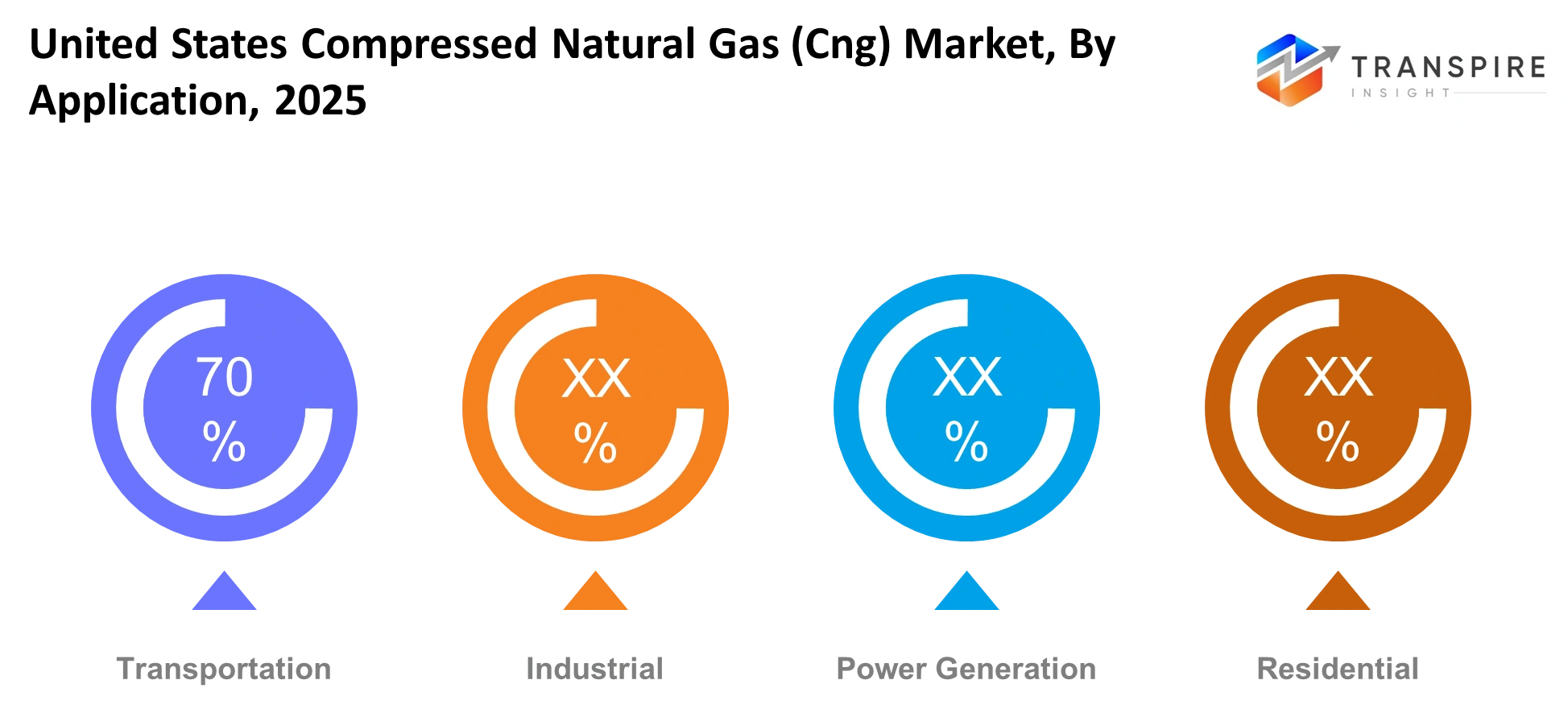
- Transportation: The CNG market reaches its highest growth level through transportation because people show increasing preference for environmentally friendly transportation modes. Public transit systems and logistics companies and private fleets have started using CNG vehicles in their operations because CNG helps them achieve lower emissions and reduced fuel expenses, which creates ongoing opportunities for this technology to develop.
- Industrial: CNG has become an affordable option which industrial businesses use as their sustainable fuel solution. The system delivers essential heating and processing and electrical power resources while ensuring companies meet their environmental requirements. The system provides reliable energy because it produces fewer emissions, so it becomes an efficient substitute for fossil fuel power sources.
- Power Generation: CNG has become a popular fuel choice for power generation because it provides both cleaner combustion and efficient energy production. The system operates as a bridge energy source that maintains grid operations while decreasing greenhouse gas emissions. The system provides multiple energy generation pathways which result in reduced environmental damage for both main power generation and emergency backup systems.
- Residential: Homeowners use CNG in their homes for cooking and heating because the fuel provides affordable prices and environmentally friendly performance. Urban areas are expanding their access to the service because new pipeline systems are built. The market shows a trend where consumers increasingly choose CNG because it provides better safety and cost savings compared to traditional home fuels.
To learn more about this report, Download Free Sample Report
By End-User
- Fleet Operators: CNG adoption among fleet operators has reached its highest level because operators want to reduce expenses while decreasing their emissions. CNG serves as an effective solution for large vehicle operations because public transport and delivery services and logistics companies can benefit from its fixed fuel costs and reduced maintenance expenses.
- Utilities: The utility companies function as primary distributors for CNG supply management. The company expands its network and infrastructure capacity to handle increasing customer demand. The organisation guarantees continuous service delivery while enabling the use of cleaner energy sources across various energy systems.
- Industrial Users: CNG serves as the primary fuel source that industrial users utilise because it provides both cost savings and environmental compliance. The product has established itself as a standard resource throughout various manufacturing and processing sectors. Industries are adopting CNG because they want to minimise their emissions while decreasing their operational expenses.
- Consumers: CNG usage among individual consumers is increasing because they utilize it for their personal vehicles and home energy needs. Their fuel selection process gets affected by two factors, which include rising fuel costs and their growing understanding of environmental issues. CNG has become more accessible and affordable so people start using it as their daily energy source.
By Distribution
- Pipelines: The pipeline distribution system represents the most effective and dependable solution for transporting CNG. The system provides continuous service which operates with high reliability. The development of pipeline networks serves as an essential requirement to meet market demands while improving access to urban and semi-urban areas.
- Stations: CNG fueling stations are necessary for vehicles to operate. Their growing presence makes it easier for users to access their services. High-demand regions benefit from strategic expansion which helps to decrease range anxiety that drivers experience while increasing CNG vehicle adoption rates.
- Direct Supply: Direct supply delivers CNG to industrial or commercial users without intermediaries. The method provides continuous fuel supply which allows large operations to function without interruptions. The solution benefits industries which require continuous energy because it delivers both efficiency and cost savings.
- Mobile Units: Mobile CNG units enable fuel delivery to locations that lack access to fixed infrastructure. The technology serves as a solution for areas that do not have permanent infrastructure. The approach enables market development because it connects supply deficiencies while providing developing areas with access to sustainable fuel solutions.
By Vehicle Type
- Passenger Cars: The popularity of passenger cars which use CNG as fuel has increased because these vehicles offer cheaper fuel expenses and produce fewer emissions.Consumers select CNG variants for their daily travel needs more than they choose other available options. Automotive manufacturers expand their CNG product ranges because of increasing customer demand for environmentally friendly vehicle options.
- Buses: Public transportation systems use CNG-powered buses as their primary bus service. The buses help cities decrease their air pollution levels while also saving operational expenses. Cities receive environmental benefits when governments and transit authorities invest in CNG bus systems which support sustainable transportation solutions.
- Trucks: The use of CNG-powered trucks has become more popular in freight transport operations which include logistics activities. The trucks provide businesses with substantial fuel reductions together with decreased emissions in comparison to diesel-powered trucks. The development of infrastructure will enable businesses to move their heavy-duty truck fleets toward CNG-based systems.
- Commercial Vehicles: CNG-powered commercial vehicles have become more common for both vans and delivery vehicles. Businesses experience advantages through decreased fuel costs together with successful emissions regulation compliance. The segment experiences consistent expansion because businesses pursue both operational productivity and their environmental responsibilities.
Country Insights
The United States Compressed Natural Gas (CNG) market undergoes ongoing transformations which create pathways for the country to achieve environmentally sustainable energy solutions. The United States can fulfil rising CNG requirements because it possesses abundant natural gas reserves and a well-developed energy infrastructure. Urban areas demonstrate high adoption rates because public transportation systems and commercial fleets transition to low-emission fuels which enable them to fulfil environmental regulations. States like California and Texas provide infrastructure development and policy support which help more people access their services. The country strengthens its dedication to carbon emission reductions through rising investments in renewable CNG. The United States energy system relies on CNG because it remains essential to the energy transition process even though distribution challenges exist and government backing and technological advancements drive its continued progress.
Recent Development News
In March 2026, Fleet operators lead U.S. alternative fuel adoption: Commercial fleets continue to dominate CNG demand due to cost savings and emission compliance requirements.
In March 2026, Clean fuel demand accelerates CNG vehicle adoption: Increasing environmental awareness is pushing transportation sectors toward cleaner fuels like CNG across the U.S.
|
Report Metrics |
Details |
|
Market size value in 2025 |
USD 15086.2 Million |
|
Market size value in 2026 |
USD 16942.4 Million |
|
Revenue forecast in 2033 |
USD 38651.7 Million |
|
Growth rate |
CAGR of 12.50% from 2026 to 2033 |
|
Base year |
2025 |
|
Historical data |
2021 – 2024 |
|
Forecast period |
2026 – 2033 |
|
Report coverage |
Revenue forecast, competitive landscape, growth factors, and trends |
|
Country scope |
United States |
|
Key company profiled |
Clean Energy Fuels, Shell, BP, ExxonMobil, Chevron, TotalEnergies, Kinder Morgan, Enbridge, NextEra Energy, Dominion Energy, Chesapeake Energy, EQT, Sempra Energy, ConocoPhillips, Gazprom. |
|
Customization scope |
Free report customization (country, regional & segment scope). Avail customized purchase options to meet your exact research needs. |
|
Report Segmentation |
By Type (Compressed Natural Gas, Renewable CNG, Biogas, LNG), By Application (Transportation, Industrial, Power Generation, Residential), By End-User (Fleet Operators, Utilities, Industrial Users, Consumers), By Distribution (Pipelines, Stations, Direct Supply, Mobile Units), By Vehicle Type (Passenger Cars, Buses, Trucks, Commercial). |
Key United States Compressed Natural Gas (Cng) Company Insights
The market for compressed natural gas (CNG) in the United States consists of established energy companies together with new enterprises that develop clean fuel technologies. The leading companies of the industry currently invest their resources to build more fuelling stations while they work on supply chain enhancements and renewable CNG system development to satisfy the increasing market need. Through partnerships and collaborations, companies achieve market expansion while they access new customer segments. The majority of industry participants are now directing their efforts toward developing fleet solutions together with personalised energy service offerings. Organisations create their strategic plans to achieve sustainability objectives, which results in increased competition that drives permanent market development.
Company List
- Clean Energy Fuels
- Shell
- BP
- ExxonMobil
- Chevron
- TotalEnergies
- Kinder Morgan
- Enbridge
- NextEra Energy
- Dominion Energy
- Chesapeake Energy
- EQT
- Sempra Energy
- ConocoPhillips
- Gazprom
United States Compressed Natural Gas (Cng) Market Report Segmentation
By Type
- Compressed Natural Gas
- Renewable CNG
- Biogas
- LNG
By Application
- Transportation
- Industrial
- Power Generation
- Residential
By End-User
- Fleet Operators
- Utilities
- Industrial Users
- Consumers
By Distribution
- Pipelines
- Stations
- Direct Supply
- Mobile Units
By Vehicle Type
- Passenger Cars
- Buses
- Trucks
- Commercial
Frequently Asked Questions
Find quick answers to common questions.
The approximate United States Compressed Natural Gas (Cng) Market size for the market will be USD 38651.7 Million in 2033.
The key segments of the United States Compressed Natural Gas (Cng) Market are By Type (Compressed Natural Gas, Renewable CNG, Biogas, LNG), By Application (Transportation, Industrial, Power Generation, Residential), By End-User (Fleet Operators, Utilities, Industrial Users, Consumers), By Distribution (Pipelines, Stations, Direct Supply, Mobile Units), By Vehicle Type (Passenger Cars, Buses, Trucks, Commercial).
Major players in the United States Compressed Natural Gas (Cng) Market are Clean Energy Fuels, Shell, BP, ExxonMobil, Chevron, TotalEnergies, Kinder Morgan, Enbridge, NextEra Energy, Dominion Energy, Chesapeake Energy, EQT, Sempra Energy, ConocoPhillips, Gazprom.
The current market size of the United States Compressed Natural Gas (Cng) Market is USD 15086.2 Million in 2025.
The United States Compressed Natural Gas (Cng) Market CAGR is 12.50%.
- Clean Energy Fuels
- Shell
- BP
- ExxonMobil
- Chevron
- TotalEnergies
- Kinder Morgan
- Enbridge
- NextEra Energy
- Dominion Energy
- Chesapeake Energy
- EQT
- Sempra Energy
- ConocoPhillips
- Gazprom
Recently Published Reports
-
Apr 2026
Active Power Filter Market
Active Power Filter Market Size, Share & Analysis Report By Type (Shunt Active Power Filters, Series Active Power Filter, Hybrid Active Power Filter), By Application (Harmonics Mitigation, Reactive Power Compensation, Voltage Regulation, Power Factor Correction), By Phase (Single Phase, Three Phase), By End-User Industry (Manufacturing, Healthcare, Commercial, Automotive, Oil and Gas, Others), and Geography (North America, Europe, Asia-Pacific, Middle East and Africa, South and Central America), 2021 - 2031
-
Apr 2026
Electrical Transformer Market
Electrical Transformer Market Size, Share & Analysis Report By Core (Closed, Shell, and Berry), By Insulation (Gas, Oil, Solid, Air, and Other), By Phase (Single, and Three), By Rating (100 MVA to 500 MVA, 501 MVA to 800 MVA, and 801 MVA to 1200 MVA), and Geography (North America, Europe, Asia-Pacific, Middle East and Africa, South and Central America), 2021 – 2031
-
Apr 2026
Hydraulic Piston Pumps Market
Hydraulic Piston Pumps Market Size, Share & Analysis Report By Type (Axial Piston Pumps, Radial Piston Pumps), By Operating Pressure (Low Pressure, Medium Pressure, High Pressure), By Application (Construction, Mining, Agriculture, Automotive, Oil & Gas, Industrial Machinery, Others), By End-User (OEMs, Aftermarket), and Geography (North America, Europe, Asia-Pacific, Middle East and Africa, South and Central America), 2021 – 2031
-
Apr 2026
Laboratory Gas Generators Market
Laboratory Gas Generators Market Size, Share & Analysis Report By Product (Nitrogen Gas Generator, Hydrogen Gas Generator, Zero Air Gas Generator, Purge Gas Generator, TOC Gas Generators, Others), By Application (Gas Chromatography, Liquid Chromatography-mass Spectrometry (LC-MS), Gas Analyzers, Others), By End-user (Life Science, Chemical & Petrochemical, Food & Beverage, Others), and Geography (North America, Europe, Asia-Pacific, Middle East and Africa, South and Central America), 2021 – 2031