
United States Cellulose Fibers Market Size & Forecast:
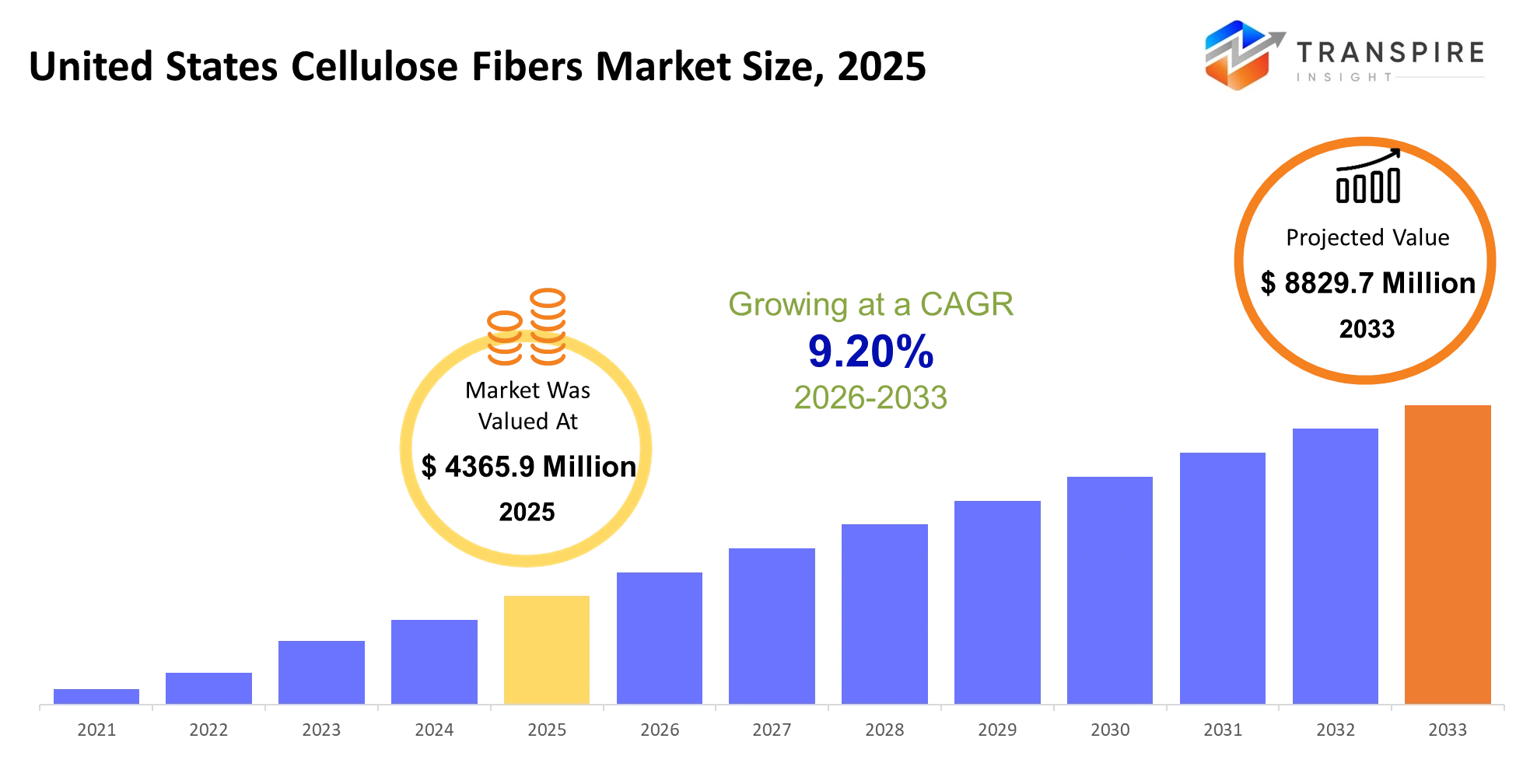
- United States Cellulose Fibers Market Size 2025: USD 4365.9 Million
- United States Cellulose Fibers Market Size 2033: USD 8829.7 Million
- United States Cellulose Fibers Market CAGR: 9.20%
- United States Cellulose Fibers Market Segments:By Type (Rayon, Lyocell, Modal, Acetate), By Application (Textiles, Hygiene Products, Industrial, Packaging), By End-User (Textile Industry, FMCG, Healthcare, Packaging), By Source (Wood Pulp, Cotton Linter, Bamboo, Recycled), By Form (Staple Fiber, Filament, Tow, Flakes).
To learn more about this report,  Download Free Sample Report
United States Cellulose Fibers Market Summary:
The United States Cellulose Fibres Market size is estimated at USD 4365.9 Million in 2025 and is anticipated to reach USD 8829.7 Million by 2033, growing at a CAGR of 9.20% from 2026 to 2033. The United States cellulose fibers market is experiencing consistent expansion because of increasing demand for sustainable biodegradable materials used in textiles and packaging and hygiene products. The shift of both consumers and industries toward eco-friendly alternatives leads to new developments in fiber processing and applications. The main industry participants are currently focusing their efforts on creating new production methods while they expand their manufacturing capacity to meet shifting needs of the market. The market outlook improves because of environmental regulations that provide support and public awareness about plastic waste reduction, making cellulose fibers vital for creating a sustainable future.
Key Market Trends & Insights:
- People who buy products now demonstrate greater knowledge about environmental problems, which leads to increased demand for products that use biodegradable and renewable materials. The industry experts now choose cellulose fibers as their main material because these fibers provide different performance attributes when compared to synthetic materials.
- Products such as diapers and tissues and sanitary items use cellulose fibers because those fibers possess moisture-absorbing capabilities. The rising understanding about hygiene practices is increasing product demand for this market segment.
- Companies adopt cellulose fibers because the material helps their business operations through two advantages sustainable development and reduced plastic waste. The regulations create market development effects which compel businesses to implement environmentally friendly practices.
- The system of recycling that companies are developing will create closed-loop production processes which help them achieve their target of minimising material waste. The organisation establishes a base for sustainable environmental protection through this transition, which enables it to accomplish its eco-friendly sustainability objectives.
United States Cellulose Fibers Market Segmentation
By Type
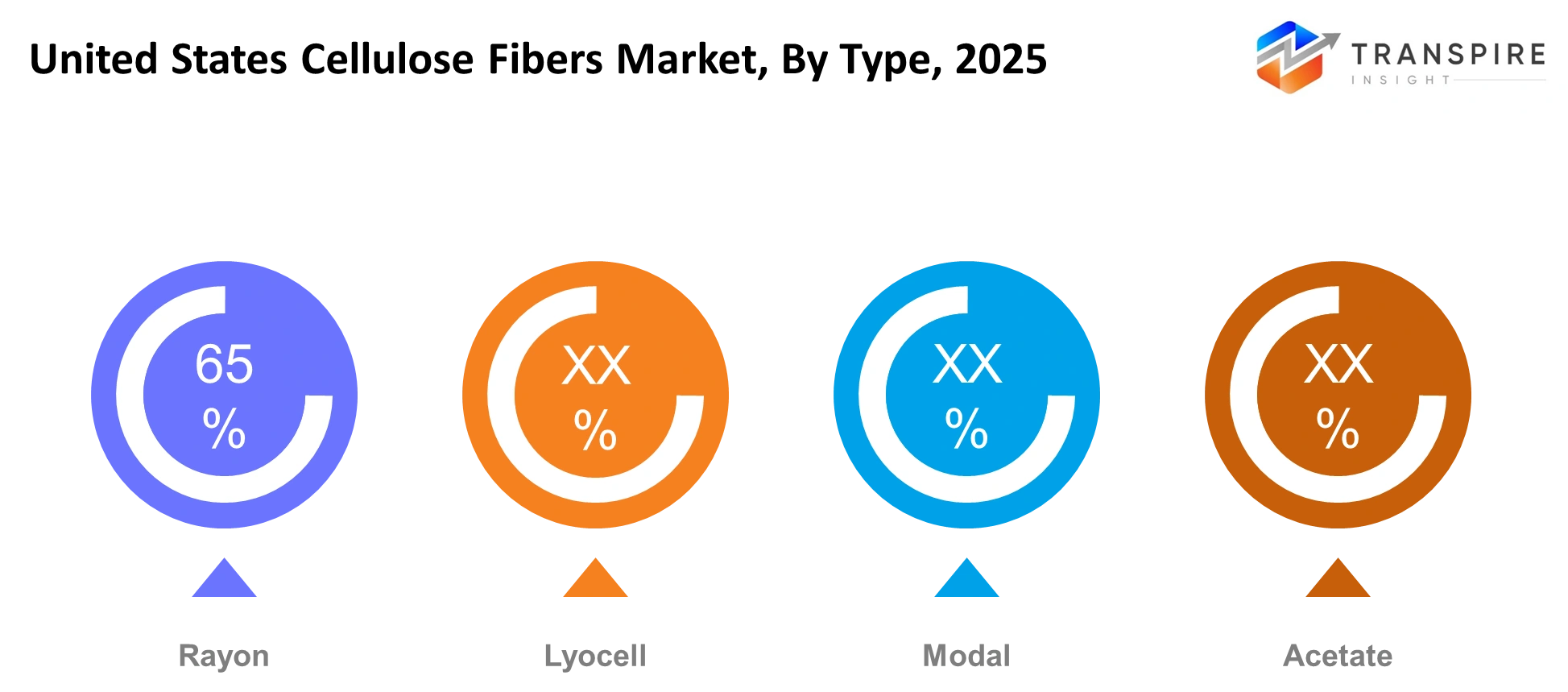
- Rayon: The United States maintains rayon as the most commonly utilised cellulose fiber because of its wide-ranging applications and budget-friendly nature. The material functions as a textile solution for both clothing and home textile purposes which provides users with a soft, breathable texture. The material maintains constant demand because it can be used in multiple fields, including fashion and industrial applications.
- Lyocell: Lyocell functions as a sustainable high-grade fiber which manufacturers produce through their implementation of an eco-friendly closed-loop production method. The material serves sustainable fashion design because it combines strength with softness and moisture-wicking abilities. The United States market experiences increased product adoption rates because consumers become more aware of environmentally responsible products.
- Modal: Modal fibers provide exceptional softness together with smooth texture and resistance against shrinkage. Modal serves as the main material for intimate apparel and activewear because it delivers both comfort and strength. The textile product becomes popular among manufacturers who need high-quality materials because it maintains its original shape and colour.
- Acetate: Acetate fibers find their main application in high-end fashion, which uses the material for both clothing and decorative elements. The materials create attractive visual effects while providing excellent draping capabilities. Acetate maintains its presence in upscale fashion markets because the material delivers visual elegance and comfortable wear.
To learn more about this report, Download Free Sample Report
By Application
- Textiles: The cellulose fibers market shows its highest market share because the textile industry needs sustainable fabric solutions which currently drive its growth. The textile industry uses these fibers to produce clothing and upholstery and home furnishings. The United States fashion market prefers these materials because of their breathable properties and comfortable design, which suits both casual and high-end fashion needs.
- Hygiene Products: Hygiene products protect human health through their use of cellulose fibers which appear in diapers and sanitary napkins and wipes. Personal care products use these materials because their ability to absorb moisture helps maintain soft texture. The segment experiences substantial growth because people now demand more disposable hygiene products as their health awareness increases.
- Industrial: Cellulose fibers find industrial applications through their use in filtration systems and insulation materials and reinforcement components. The material demonstrates multiple applications because it possesses strength characteristics and biodegradable properties and an affordable price. The industrial sector demands sustainable solutions which force manufacturers to select cellulose-based materials instead of synthetic products.
- Packaging: The packaging sector currently uses cellulose fibers as a sustainable solution that replaces plastic materials. Packaging companies utilise the fibers to produce biodegradable materials and moulded fibre products and protective packaging solutions. The United States companies currently deal with two major challenges because they need to meet growing environmental concerns and comply with stringent regulatory standards which require them to create environmentally friendly packaging options.
By End-User
- Textile Industry: The textile industry remains the largest end-user of cellulose fibers, because sustainable fabrics which provide comfort to users have become more popular. Manufacturers are increasingly using these fibers in their product development process to create products which match current consumer needs and environmental protection standards.
- FMCG: Fast-moving consumer goods companies use cellulose fibers for their packaging materials and personal care items. FMCG brands seek to replace plastics through their commitment to sustainable development and their use of biodegradable materials. Businesses can satisfy consumer expectations while fulfilling their environmental duties because of the transition.
- Healthcare: The healthcare sector utilises cellulose fibers for medical textiles and wound care products and hygiene items. Sensitive applications require materials which possess soft and absorbent and hypoallergenic characteristics. The growing need for healthcare services combined with rising awareness about hygiene practices creates demand for this product category.
- Packaging: Packaging companies are using cellulose fibers to develop environmentally friendly solutions which can be recycled or composted. Businesses are now directing their resources towards developing fiber-based packaging solutions because of the rising demand to decrease plastic waste. This trend shows strong growth among companies which want to improve their environmental sustainability framework.
By Source
- Wood Pulp: Wood pulp serves as the main source of cellulose fibers which American manufacturers use to create their products. The material provides manufacturers with dependable raw materials which they can use to produce goods in large quantities. The market dominance of this material is enhanced by sustainable forestry practices, which include certification systems that authenticate its eco-friendly use.
- Cotton Linter: Cotton linter fibers are derived from short fibers left on cotton seeds after ginning. The fibers demonstrate high purity together with softness, which makes them suitable for specialised uses. The medical industry, together with the cosmetic industry and the high-quality textile industry, uses these fibers for their products.
- Bamboo: Bamboo functions as an environmentally sustainable material which generates cellulose fibers from its fast growth characteristics. The material attracts environmentally conscious consumers because it possesses natural antibacterial properties and quick regeneration capabilities. The rising demand for sustainable materials has resulted in increased usage of bamboo-based fibers across multiple applications.
- Recycled: The circular economy approach is gaining momentum because recycled cellulose fibers have become important. The materials are created from waste textile materials and waste paper products which help decrease ecological damage. Companies are increasingly investing in recycling technologies to create sustainable fiber solutions and minimise resource consumption.
By Form
- Staple Fiber: The definition of staple fibers involves short-length fibers which textile manufacturers use to create spun yarns. The fibers establish potential for creating fabrics through their ability to blend with various fibers which find application in both clothing and household textile products. The market offers multiple applications for this material because of its ability to serve various purposes.
- Filament: Filament fibers are long, continuous strands which exhibit both strength and smooth texture. The textiles and specialised fabrics which require high performance use these materials. The material structure provides both durability and visual appeal, which makes it suitable for use in premium products.
- Tow: Tow fibers consist of bundles of continuous filaments which industrial and filtration markets use as their primary material. The material delivers exceptional strength combined with efficient processing capabilities. The material structure functions effectively for producing both nonwoven fabrics and technical textile products.
- Flakes: Flakes represent processed cellulose material which serves as a basic component for fiber production and industrial uses. The material functions effectively in large-scale manufacturing operations because of its lightweight and simple-to-handle nature. The upstream processing procedures produce essential materials which guarantee standardized fiber production.
Country Insights
The United States cellulose fibers market shows active market development through innovative solutions and sustainable practices which meet industrial requirements. The country develops high-quality eco-friendly fiber solutions through its strong manufacturing base and advanced research capabilities. Packaging and personal care products now use biodegradable materials because consumers understand the environmental problems that affect textiles and packaging and personal care items.
The government established regulations that require companies to decrease their plastic usage, which has caused firms to switch to cellulose-based solutions. The domestic production capacity receives additional support from top market companies that keep investing in new technologies. Established textile and industrial centres show increased technology adoption because they have strong supply chain networks and well-developed infrastructure. The market trends show how people now care more about circular economy practices, which involve recycling and responsible sourcing. The U.S. market shows consistent development, which results from sustainability objectives and innovative solutions and changing customer demands.
Recent Development News
In January 2026, International Paper Completes Sale of Cellulose Fibers Unit: International Paper completed its fibers business sale, which brought about a complete market transformation for U.S. cellulose fibers. The company adopted this approach because it wanted to focus on essential packaging operations while implementing eco-friendly business practices.
In January 2026, $1.5 Billion Deal Reshapes the U.S. Fiber Industry: American Industrial Partners acquired International Paper's cellulose division to boost their investment in absorbent pulp production capacity. The agreement demonstrates increasing market needs for products used in personal care and hygiene applications.
|
Report Metrics |
Details |
|
Market size value in 2025 |
USD 4365.9 Million |
|
Market size value in 2026 |
USD 4767.5 Million |
|
Revenue forecast in 2033 |
USD 8829.7 Million |
|
Growth rate |
CAGR of 9.20% from 2026 to 2033 |
|
Base year |
2025 |
|
Historical data |
2021 – 2024 |
|
Forecast period |
2026 – 2033 |
|
Report coverage |
Revenue forecast, competitive landscape, growth factors, and trends |
|
Country scope |
United States |
|
Key company profiled |
Lenzing, Aditya Birla, Sateri, Kelheim Fibres, Eastman, Mitsubishi Chemical, Grasim, Tangshan Sanyou, Thai Rayon, Birla Cellulose, Sappi, Rayonier Advanced Materials, Daicel, Nippon Paper, Fulida. |
|
Customization scope |
Free report customization (country, regional & segment scope). Avail customized purchase options to meet your exact research needs. |
|
Report Segmentation |
By Type (Rayon, Lyocell, Modal, Acetate), By Application (Textiles, Hygiene Products, Industrial, Packaging), By End-User (Textile Industry, FMCG, Healthcare, Packaging), By Source (Wood Pulp, Cotton Linter, Bamboo, Recycled), By Form (Staple Fiber, Filament, Tow, Flakes). |
Key United States Cellulose Fibers Company Insights
The United States cellulose fibers market is shaped by a mix of established manufacturers and innovative emerging players who concentrate on sustainable product development and performance improvement. Organisations are putting their resources into new processing technologies and sustainable manufacturing methods to satisfy the increasing need for biodegradable products. Businesses use different methods such as partnerships and facility growth and product expansion to maintain their market position. Many firms are also prioritizing circular economy initiatives which include recycling and responsible sourcing. Companies develop their sustainable fiber solutions through ongoing improvements which help them achieve their environmental protection goals.
Company List
- Lenzing
- Aditya Birla
- Sateri
- Kelheim Fibres
- Eastman
- Mitsubishi Chemical
- Grasim
- Tangshan Sanyou
- Thai Rayon
- Birla Cellulose
- Sappi
- Rayonier Advanced Materials
- Daicel
- Nippon Paper
- Fulida
United States Cellulose Fibers Market Report Segmentation
By Type
- Rayon
- Lyocell
- Modal
- Acetate
By Application
- Textiles
- Hygiene Products
- Industrial
- Packaging
By End-User
- Textile Industry
- FMCG
- Healthcare
- Packaging
By Source
- Wood Pulp
- Cotton Linter
- Bamboo
- Recycled
By Form
- Staple Fiber
- Filament
- Tow
- Flakes
Frequently Asked Questions
Find quick answers to common questions.
The approximate United States Cellulose Fibers market size for the Market will be USD 8829.7 Million in 2033.
The key segments of the United States Cellulose Fibers Market are By Type (Rayon, Lyocell, Modal, Acetate), By Application (Textiles, Hygiene Products, Industrial, Packaging), By End-User (Textile Industry, FMCG, Healthcare, Packaging), By Source (Wood Pulp, Cotton Linter, Bamboo, Recycled), By Form (Staple Fiber, Filament, Tow, Flakes).
Major players in the United States Cellulose Fibers Market are Lenzing, Aditya Birla, Sateri, Kelheim Fibres, Eastman, Mitsubishi Chemical, Grasim, Tangshan Sanyou, Thai Rayon, Birla Cellulose, Sappi, Rayonier Advanced Materials, Daicel, Nippon Paper, Fulida.
The current market size of the United States Cellulose Fibers Market is USD 4365.9 Million in 2025.
The United States Cellulose Fibers Market CAGR is 9.20%.
- Lenzing
- Aditya Birla
- Sateri
- Kelheim Fibres
- Eastman
- Mitsubishi Chemical
- Grasim
- Tangshan Sanyou
- Thai Rayon
- Birla Cellulose
- Sappi
- Rayonier Advanced Materials
- Daicel
- Nippon Paper
- Fulida
Recently Published Reports
-
Dec 2024
Healthcare Polymer Packaging Market
Healthcare Polymer Packaging Market Size, Share & Analysis Report By Packaging Type (Syringes, IV Bottles and Pouches, Clamshells, Blisters, Bottles & Jars, Containers, Tubes, IV Parental Packaging, Others), By Type (Regulated, Non-regulated), By Polymer Type (LDPE (Low-Density Polyethylene), HDPE (High-Density Polyethylene), Homo-polymer (Homo), Random Copolymer (Random), Block Copolymer (Block), PET, Polystyrene, Polyvinyl Chloride, Polyamide/EVOH, Others), and Geography (North America, Europe, Asia-Pacific, Middle East and Africa, South and Central America), 2021 - 2031
-
Jan 2025
Hydrophilic Tape (Waterstop) Market
Hydrophilic Tape (Waterstop) Market Size, Share & Analysis Report By Type (Bentonite-Based Hydrophilic Tape, Rubber-Based Hydrophilic Tape), By Application (Residential Buildings, Commercial Buildings, Infrastructure Projects), and Geography (North America, Europe, Asia-Pacific, Middle East and Africa, South and Central America), 2021 - 2031
-
Jan 2025
Metalens Market
Metalens Market Size, Share & Analysis Report By Type (Visible Light Metalens, and Infrared Metalens), By Application (Consumer Electronics, Automotive Electronics, Industrial, Medical, and Others), and Geography (North America, Europe, Asia-Pacific, Middle East and Africa, South and Central America), 2021 - 2031
-
Jan 2025
PBT Resin Market
PBT Resin Market Size, Share & Analysis Report By Type (Reinforced PBT Resin, Unreinforced PBT Resin), By Processing Method (Injection Molding, Extrusion, Blow Molding, Others), By End-User (Automotive, Electrical & Electronics, Consumer Appliances, Industrial Machinery, Medical Devices, Packaging, Others), and Geography (North America, Europe, Asia-Pacific, Middle East and Africa, South and Central America), 2021 - 2031