

United States Agricultural Films Market Summary
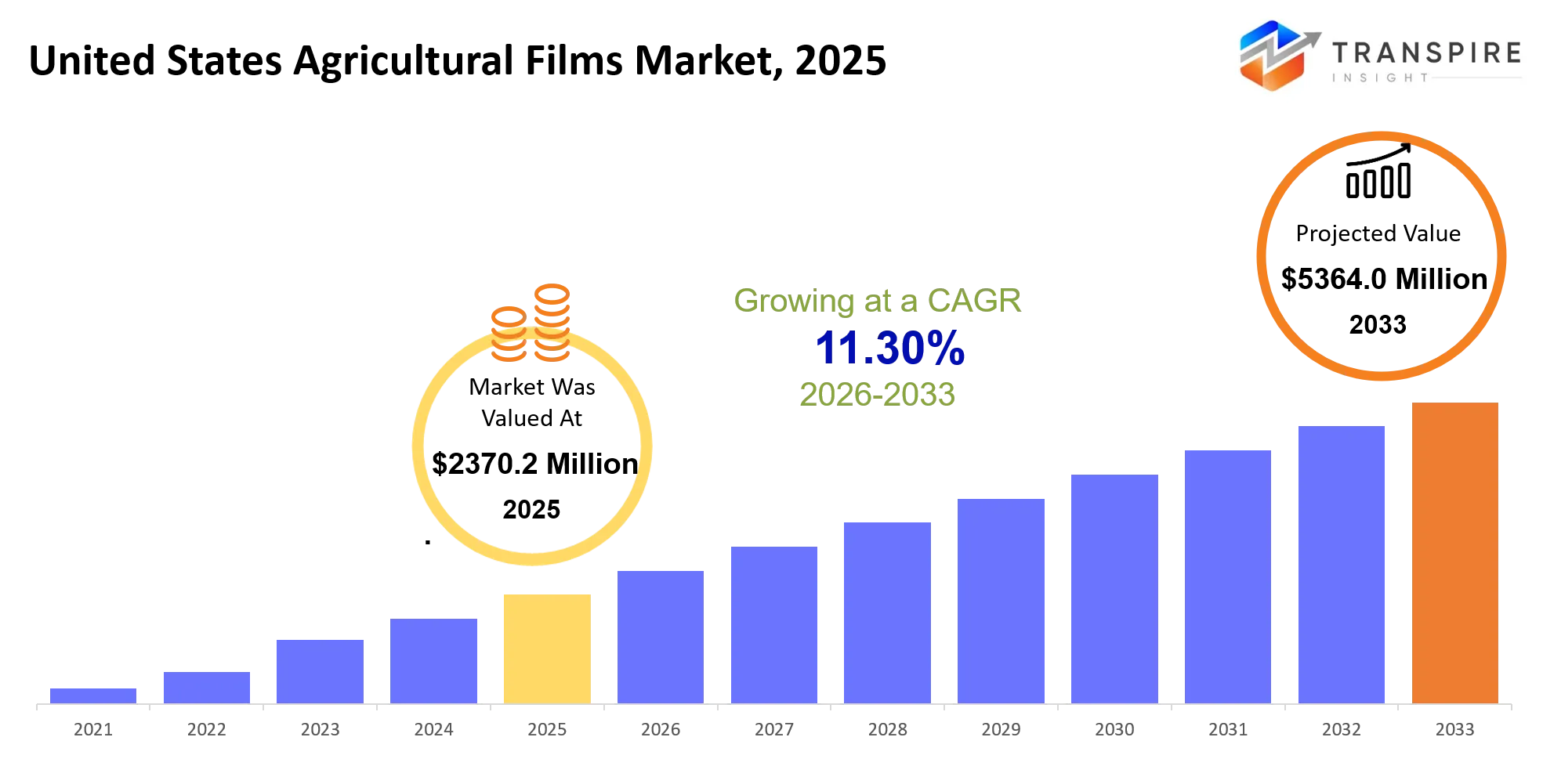
As per Transpire Insight Analysis the United States Agricultural Films Market size is estimated at USD 2370.2 Million in 2025 and is anticipated to reach USD 5364.0 Million by 2033, growing at a CAGR of 11.30% from 2026 to 2033.
Agricultural films are used by U.S. growers to somehow keep soil moisture under control, limit weeds, moderate temperature, manage crop exposure, and even help with feed preservation, all while cutting losses that come from weather and rough handling. Mulch, greenhouse, silage, and crop-cover films have turned into practical production instruments for commercial farms, horticulture activities and controlled-environment agriculture, where the details really matter.
In the last 3–5 years, the whole sector has leaned away from traditional polyethylene films. Now it’s more common to see thinner, higher-performance structures, more recycled-content materials, and also biodegradable options showing up. USDA research points to a rising curiosity around soil-biodegradable mulch, and in parallel controlled-environment agriculture operations expanded, from 1,476 in 2009 up to 2,994 in 2019. On top of that, California’s stricter plastics framework has added pressure for redesigning materials and improving end-of-life management, meaning better disposal or recovery plans. These changes make adoption easier, because growers increasingly look for films that reduce irrigation losses, lower weed-control labor, prevent crop spoilage, and reduce production variability. Because of that, the market is expected to grow from USD 2,370.2 million in 2025 to USD 5,364.0 million by 2033.
United States Agricultural Films Market Size & Forecast:
- United States Agricultural Films Market Size 2025: USD 2370.2 Million
- Expected Market Value 2033: USD 5364.0 Million
- Forecast CAGR:11.30%
- Leading region in 2025:Western United State
- Fastest Growing region:Southern United States
- Key Profile: Berry Global, RKW Group, Armando Alvarez Group, Coveris Holdings, ExxonMobil, BASF SE, Dow Inc., Trioplast Group, Kuraray Co. Ltd., Ab Rani Plast, Plastika Kritis, Novamont S.p.A., RPC Group, Sigma Plastics Group, AEP Industries
Key Market Insights
- Western states kind of dominate agricultural film consumption, mostly because California’s specialty-crop production and its large horticultural farming infrastructure keep things moving. Southern states look like they’re emerging too, as faster-growth markets, and they’re doing it through protected cultivation , more horticulture expansion, and longer seasonal production cycles that sort of stretch the window.
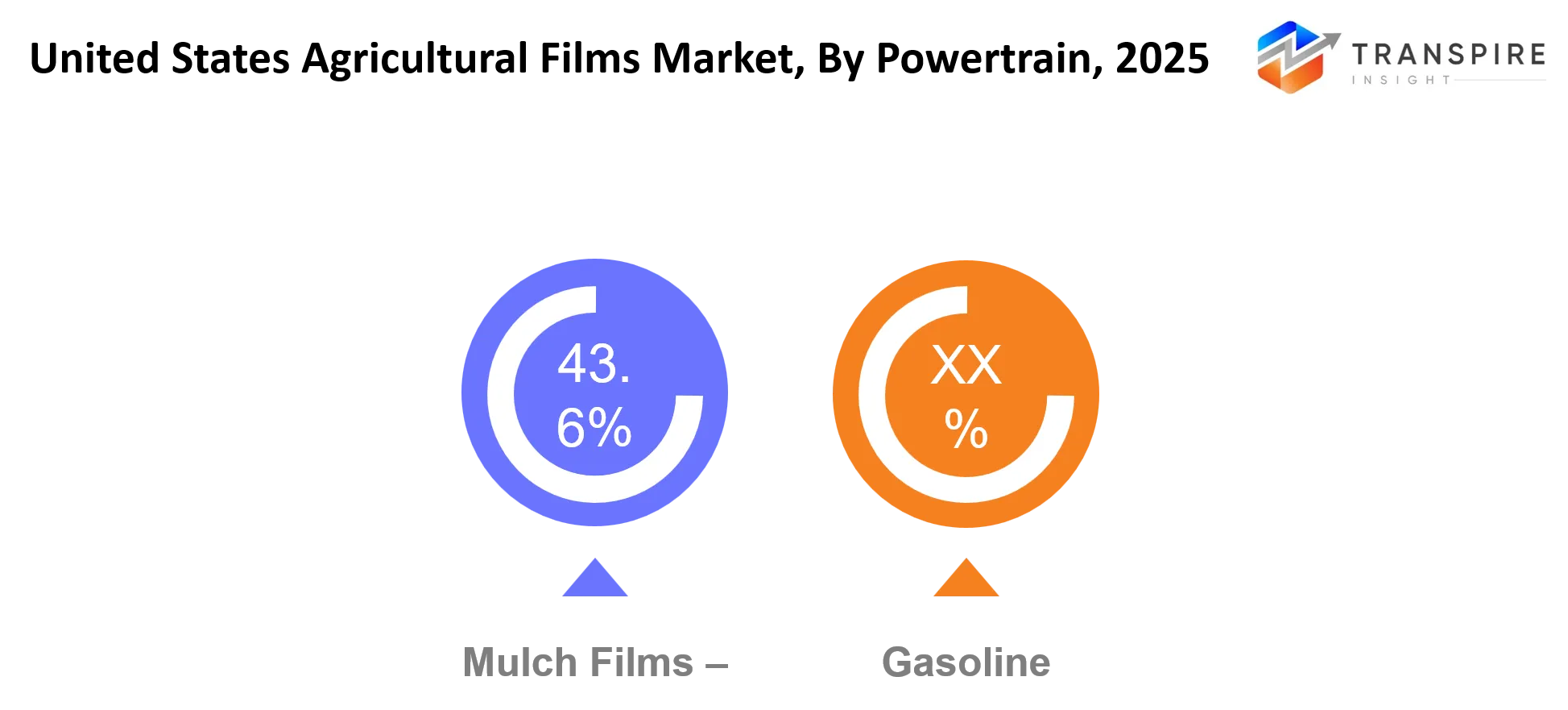
- In 2025, conventional plastics captured about 83.26% of U.S. market revenue, which shows the processing infrastructure is already there, and the cost advantages are still strong. Biodegradable films are getting more strategic attention now, though the higher costs and the uncertain field degradation make it hard for most companies to fully replace polyethylene at scale.
- Mulch films stay a central product group, because they help growers with weed control, conserve soil moisture, and even smooth out crop-zone temperatures in practice. Controlled-environment agriculture has also expanded sharply, with U.S. CEA operations increasing more than 100% from 2009 to 2019 , like it wasn’t subtle.
- When people talk about materials, LDPE and LLDPE remain preferred choices, mainly due to flexibility, puncture resistance, solid film-forming performance, and processing that’s relatively efficient. Recycled plastics are getting more attention as manufacturers try to lower material costs while improving circularity credentials, without compromising the film performance that customers expect.
- California regulation is pushing material innovation ahead, and it’s also pulling more focus toward recyclability, compostability, certification , plus producer responsibility. And digital farming is shifting how film gets used, since sensors and AI increasingly tie soil moisture, irrigation, crop health, and protected-cultivation decisions together.
What are the Key Drivers, Restraints, and Opportunities in the United States Agricultural Films Market?
Driver: The most compelling growth momentum comes from the economic value created by controlled crop conditions . Mulch films cut down evaporation, muffle weeds, and help temper soil temperatures, while greenhouse films enable protected production, against weather swings. USDA research points to these roles as key gains from plastic mulches in commercial horticulture. At the same time, expansion of controlled-environment agriculture boosts film demand even more , since greenhouse production needs sturdy covering materials for climate governance. U.S. CEA operations rose from 1,476 in 2009 to 2,994 in 2019 , which effectively builds up a broader installed base for greenhouse and specialty films.
Restraint: End-of-life handling is still the main structural drag. Typical polyethylene films may need retrieval, cleaning, hauling, and specialized recycling after field use, which adds labor and disposal expenses. Biodegradable films can sound like a fix but USDA research flags cost, uncertainty around how fast and how reliably they degrade, and certification requirements, as persistent hurdles. Together these limitations stretch out replacement timing and nudge growers to stay careful about paying extra premiums for the newer materials .
Opportunity: Soil-biodegradable films and spray-applied biopolymer films , represent a real technology opening. USDA research published in 2026 showed a chitosan-lignosulfonate film that pulled soil evaporation down from 678 to 480 g/m²/day and biodegraded quickly during testing. If commercialization follows through , it could lower film retrieval needs and also open premium product lanes for horticulture and specialty-crop growers .
What Has the Impact of Artificial Intelligence Been on the United States Agricultural Films Market?
Artificial intelligence is sorta indirectly changing the demand for agriculture-related video content, mainly because it helps with irrigation precision crop watching, greenhouse regulation and even day to day field routines. Sensor networks can collect soil moisture, temperature, humidity and crop vitality numbers , and then machine learning systems sift through the steady signals and recommend tweaks to irrigation or local climate. In one paper that used U.S. farm soil moisture records, AI anomaly detection and irrigation event spotting were presented, which helps operators make more exact water management decisions.
As for greenhouse work, AI can tie environmental sensors to automated ventilation, irrigation, heating, and humidity governance. Some experimental smart greenhouse setups mix IoT monitoring with deep learning disease recognition, and one evaluated model reportedly landed at 92% accuracy for drought stress and rust leaf recognition.These kinds of abilities raise the overall argument for greenhouse films, because tighter climate monitoring lets producers pull higher productivity out of protected cultivation, even if conditions fluctuate
Still, a big snag remains: integration expense and data quality. AI models lean on dependable sensor arrays, crop-specific learning sets, stable connectivity, and technical know-how. More recent work also underlines how connectivity plus deployment realities can trip up smaller farms, especially in areas where cloud-based systems dominate, and the local setup is more complicated than it looks
Key Market Trends
- Since 2020 manufacturers have been sort of pushing downgrading and multilayer arrangements , to cut down on resin use while still holding on to tensile strength and puncture resistance.
- Since 2023 biodegradable mulch progress has really picked up, growers want alternatives to leftover polyethylene residue that just doesn’t really go away.
- Controlled environment farming has expanded a lot too, in the U.S. operations more than doubled from 2009 to 2019, which surprised a few people.
- California’s plastic rules are still ramping up, increasing pressure for better recyclability , plus certification and clearer material accountability across the whole supply chain.
- Even in 2025, conventional plastics kept an 83.26% revenue share in the U.S. and that basically shows continued dependence on familiar polyethylene film methods.
- Recycled content mixes have shifted from small niche uses toward broader commercial testing, since producers keep chasing material efficiency and circularity.
- AI enabled irrigation , along with soil moisture analytics are moving farm decisions away from rigid timetables and more toward sensor guided water handling.
- Spray applied biodegradable films have also shown up as a new research pathway in 2026, and it could reduce the need for frequent film installs, as well as retrieval after harvest.
- Greenhouse teams are increasingly combining film coverings with automated climate systems, to manage temperature humidity, irrigation and crop control more directly.
- And manufacturers are competing more and more on crop specific film traits, like UV stabilization , thermal management , durability, permeability , plus longer service life.
United States Agricultural Films Market Segmentation
By Product Type
Mulch Films kinda support weed control , soil moisture retention , and temperature management across vegetable and specialty-crop production, yes. In a similar way Greenhouse Films provide light, heat, and weather control for protected cultivation, while Silage Films, Stretch Films, and Bale Wrap Films protect forage during storage and handling. Then there are Tunnel Films for seasonal crop protection, and Fumigation Films that help keep the treated soil conditions controlled during soil preparation, somehow.
Pond Liners help farm water storage by reducing seepage, and also improving water-use efficiency. Crop Covers guard plants from frost, insects , wind and too much sunlight, so you get steadier crop production across different seasons. Other options include specialty film products made for particular farm needs, crop conditions, storage, and even production methods. The final product choice depends on crop type, local climate, how durable it must be, and the way installation is done, really.
By Material
LDPE and LLDPE still get used a lot because they’re kinda flexible to process, they handle moisture well, they have decent strength, and they also make good film forming surfaces , which fits many agricultural needs. HDPE gives you more stiffness and long lasting durability, while EVA is used when you want better flexibility, clearer appearance, and thermal performance that behaves more steady. PVC ends up in selected covering jobs where durability and resistance matter, so it works in practical farm situations . Biodegradable films are now getting more attention too, since some growers are trying to find alternatives to the usual plastic mulch.
Polypropylene comes in for strength, and for thermal stability too, for certain agricultural items. Ethylene copolymers, in turn, give improved flexibility, better clarity, and overall performance inside specialized film structures. Recycled plastics help lower how much virgin resin you rely on, and they support material recovery targets, even if processing quality still really matters. Other options include blends aimed at specific barrier needs, strength and pliancy levels, degradation behavior, or temperature control requirements.
By Application
Crop protection is still a major use of agricultural films, mostly because they cut down exposure to weather, insects, soil contamination, and a bunch of other production hazards . Soil moisture retention plays a similar role , since it helps evaporation slow down and keeps growing conditions a bit more steady, Greenhouse farming then takes it further by using these films for temperature, humidity , light, plus overall weather handling. Silage preservation is also important , it shields stored forage from oxygen and moisture, so the feed quality stays better for livestock operations .
Weed control reduces competing vegetation and can lower how much people rely on manual work or chemical management. Water conservation is mostly about cutting evaporation down and using irrigation in a more efficient, disciplined way, which in theory sounds simple but in real life really matters. In fruit cultivation and vegetable cultivation, films are installed for moisture control, crop safeguarding, temperature adjustment , and to keep production steadier. Floriculture, meanwhile, depends on tuned growing environments for blooms and ornamental plants, while others also handle nursery tasks, protect seedlings , and deal with more niche agricultural requirements.
By End User
Commercial Farms, like, tend to be one of the biggest user groups because huge cultivated areas need regular help from things such as mulch, greenhouse, crop-cover, and storage films. Greenhouses themselves tend to lean on specialized films, especially for light passage, temperature regulation, moisture handling, and overall weather shielding. Horticulture Farms spread these films across fruit and vegetable fields, plus flowers, nurseries, and specialty-crop production, while Dairy Farms, in most cases, mainly go after Silage Films and Bale Wrap Films to keep forage in good condition.
Agricultural Cooperatives generally act as support for joint purchasing and product distribution, so member farms can move supplies more easily. Government Farms and Research Institutes often use agricultural films for production trials, crop testing, protected cultivation, and soil-management studies. Organic Farms use mulch and crop-cover materials for weed suppression, along with moisture control, and biodegradable options can bring extra promise here. Other categories cover nurseries, livestock operations, specialty growers, and agricultural service providers, each with their own specific film needs, sometimes pretty particular.
By Distribution Channel
Direct Sales tend to serve big farms, greenhouse operators, and other agricultural businesses, especially when they need bulk amounts or more custom specifications. Agricultural Dealers usually bring local availability along with product guidance, and they often add some hands-on technical support too. Online Retail gives smaller farms and horticulture operations easy access to standard film offerings. Cooperatives bring together purchasing needs and, in a way, can make product access better and pricing a bit more friendly for the member farms.
Distributors typically support regional inventory , warehousing, and logistics. Wholesalers are more focused on moving high-volume agricultural film through already established supply chains. Retail Stores work well for smaller growers who want quick access to the commonly used products. OEM Supply connects film manufacturers with agricultural equipment makers, and greenhouse system providers as well. “Others” can cover specialty suppliers farm-service companies, institutional procurement channels and even digital agricultural purchasing platforms.
What are the Key Use Cases Driving the United States Agricultural Films Market?
Mulch film stay kinda like a core use case across commercial vegetable and specialty-crop production, mainly because soil moisture retention , weed suppression, and temperature control tangle directly with how productive the crop is and what the field-management bill ends up being. The value gets even more pronounced for high-value horticultural crops, where better growing conditions can quietly cover the film installation expense. USDA research basically confirms the practical production benefits tied to plastic mulch, even when you look at day to day operations.
Greenhouse films and crop covers are also getting bigger, especially along with controlled-environment agriculture and intensive horticulture. Greenhouse operators use specialized coverings to steer light, temperature, humidity, and weather exposure , while some dairy farms lean on silage and bale-wrap films to protect the stored forage. Over in the U.S., CEA operations increased by more than 100% from 2009 to 2019, which really strengthens the structural argument for protected cultivation materials.
Newer things are showing up too, like soil-biodegradable mulch, films made with recycled-content, and spray-applied biopolymer coverings. USDA research in 2026 showed a spray-applied biodegradable film that lowered measured soil evaporation and also avoided conventional film retrieval during testing. If these methods keep improving , they could be adopted across organic farms, specialty-crop producers, and water-constrained agricultural regions as both performance and certification become easier to meet.
|
Report Metrics |
Details |
|
Market size value in 2025 |
USD 2370.2 Million |
|
Market size value in 2026 |
USD 2530.6 Million |
|
Revenue forecast in 2033 |
USD 5364.0 Million |
|
Growth rate |
CAGR of 11.30% from 2026 to 2033 |
|
Base year |
2025 |
|
Historical data |
2021 - 2024 |
|
Forecast period |
2026 - 2033 |
|
Report coverage |
Revenue forecast, competitive landscape, growth factors, and trends |
|
Regional scope |
United States; Canada; Mexico; United Kingdom; Germany; France; Italy; Spain; Denmark; Sweden; Norway; China; Japan; India; Australia; South Korea; Thailand; Brazil; Argentina; South Africa; Saudi Arabia; United Arab Emirates |
|
Key company profiled |
Berry Global, RKW Group, Armando Alvarez Group, Coveris Holdings, ExxonMobil, BASF SE, Dow Inc., Trioplast Group, Kuraray Co. Ltd., Ab Rani Plast, Plastika Kritis, Novamont S.p.A., RPC Group, Sigma Plastics Group, AEP Industries |
|
Customization scope |
Free report customization (country, regional & segment scope). Avail customized purchase options to meet your exact research needs. |
|
Report Segmentation |
By Product Type (Mulch Films, Greenhouse Films, Silage Films, Stretch Films, Tunnel Films, Bale Wrap Films, Fumigation Films, Pond Liners, Crop Covers, Others); By Material (LDPE, LLDPE, HDPE, EVA, PVC, Biodegradable Films, Polypropylene, Ethylene Copolymers, Recycled Plastics, Others); By Application (Crop Protection, Soil Moisture Retention, Greenhouse Farming, Silage Preservation, Weed Control, Water Conservation, Fruit Cultivation, Vegetable Cultivation, Floriculture, Others); By End User (Commercial Farms, Greenhouses, Horticulture Farms, Dairy Farms, Agricultural Cooperatives, Government Farms, Research Institutes, Organic Farms, Others); By Distribution Channel (Direct Sales, Agricultural Dealers, Online Retail, Cooperatives, Distributors, Wholesalers, Retail Stores, OEM Supply, Others) |
Which Regions are Driving the United States Agricultural Films Market Growth?
The Western United States is still kinda the main stage , mostly because California has a huge specialty-crop base , plus intensive horticulture, lots of greenhouse activity, and pretty solid agricultural supply networks behind it. Also California’s rules and oversight kinda push manufacturers to think harder about plastic recovery, and to look for more sustainable film solutions , so there’s a real nudge to build recyclable and biodegradable products. The area really leans on the established irrigation setup, big commercial farms, agricultural dealers, and specialized film providers. All of this ends up making a mature customer pool, where mulch , greenhouse, crop-cover, and fumigation films can see broad commercial use without too much friction.
The Midwest looks different , more like demand follows large row-crop production pretty closely, then livestock operations, dairy farming, and also silage preservation. Because there’s extensive acreage, the region tends to keep buying silage films, bale wraps, crop covers, and other protective materials—more than it depends on high-value horticulture alone. There are also strong farm equipment networks , plus agricultural cooperatives that are already in place, which helps keep distribution steady across rural markets. So even if specialty-crop activity in Western states shifts around, the Midwest can still lean on dependable revenue potential.
The Southern United States has the strongest growth momentum, mainly as protected cultivation grows, along with horticulture, specialty crops, and controlled-environment farming moving deeper into warmer production zones. With longer growing seasons, there are clearer openings for greenhouse films, tunnel films, mulch items, and crop covers that help manage heat , moisture, pests, and general weather exposure.
Who are the Key Players in the United States Agricultural Films Market and How Do They Compete?
Competition is kind of moderately fragmented, you can see polymer producers alongside specialized agricultural-film manufacturers, plus diversified plastics companies that split up the value chain between them. Cost still matters a lot, but things like film thickness, real durability, recycled content, UV resistance, barrier performance, and even technical support are starting to drive the decision more often, not just the sticker price. Big producers have the advantage of resin access and manufacturing scale. Meanwhile specialist players kinda push back with crop-specific designs, and application knowledge, more tailored solutions, less one-size-fits-all. On top of that regulatory pressure is nudging suppliers toward recyclable structures and also lower-material formulations, so there is more focus on composition.
Berry Global competes with high-performance silage and agricultural films, including the Film&Film bale-wrapping technology that effectively layers protective film over a wider share of the bale surface, which sounds simple but it helps in practice. They also emphasize lightweighting and recycled content, connecting material efficiency directly to farm operating costs. RKW Group differentiates via greenhouse, crop-cover, and silage offerings, including seven-layer agricultural films, plus products that incorporate recycled materials in the mix.
Armando Alvarez Group relies on crop-specific mulch technology. Recently they added Solar Shrink®, which is a film made to contract when hit by solar heat, so ground contact improves and removal becomes easier, or at least less of a hassle. Coveris Holdings leans into sustainable silage stretch film. Its Unterland R product uses at least 30% recycled agricultural film and ties production to renewable electricity.
Taken together, these approaches point to a move away from pure volume-based competition, and more toward performance-focused positioning, resource efficiency, and sustainability benefits that you can actually measure, not just claim.
Company List
- Berry Global
• RKW Group
• Armando Alvarez Group
• Coveris Holdings
• ExxonMobil
• BASF SE
• Dow Inc.
• Trioplast Group
• Kuraray Co., Ltd.
• AB Rani Plast
• Plastika Kritis
• Novamont S.p.A.
• RPC Group
• Sigma Plastics Group
• AEP Industries
Recent Development News
"April 2025, Berry Global launched Silotite Film&Film for agricultural bale wrapping. The combination of Baletite pre-oriented baler film and SilotitePro silage wrap adds protective layers across the bale surface, improving puncture protection, fermentation performance, and material efficiency.
"September 2025, Grupo Armando Alvarez entered a strategic alliance for Solar Shrink®, an advanced agricultural mulch film developed by Solar Shrink PTY Ltd. The technology contracts under solar heat, improving ground contact while supporting cleaner film removal and more efficient recycling.
"December 2025, AB Rani Plast acquired Swedish film manufacturer Kullaplast. The acquisition expanded Rani Plast's film portfolio and strengthened geographic reach, supporting broader manufacturing capabilities and customer coverage.
What Strategic Insights Define the Future of the United States Agricultural Films Market?
The sector is sort of structurally moving toward thinner, stronger, recyclable and biodegradable films as growers feel more pressure to control input costs while regulators keep tackling agricultural plastic waste. The less visible part is material substitution, like, improvements in biological mulch, paper based coverings, and spray applied films could shrink conventional polyethylene volumes in selected high value crops faster than the usual market growth story implies. Meanwhile biodegradable mulch is still an emerging opportunity because newer formulations can cut down on post harvest collection and disposal duties. USDA research on spray-applied biodegradable films shows the direction of this technology shift pretty clearly. Market participants should then really lean into crop specific film platforms that use less material while still delivering verified field results and sensible end of life solutions. Manufacturers, meanwhile, might also want regional partnerships with growers, recyclers and agricultural distributors before regulatory requirements trigger these forced product transitions.
United States Agricultural Films Market Report Segmentation
By Product Type
• Mulch Films
• Greenhouse Films
• Silage Films
• Stretch Films
• Tunnel Films
• Bale Wrap Films
• Fumigation Films
• Pond Liners
• Crop Covers
• Others
By Material
• LDPE
• LLDPE
• HDPE
• EVA
• PVC
• Biodegradable Films
• Polypropylene
• Ethylene Copolymers
• Recycled Plastics
• Others
By Application
• Crop Protection
• Soil Moisture Retention
• Greenhouse Farming
• Silage Preservation
• Weed Control
• Water Conservation
• Fruit Cultivation
• Vegetable Cultivation
• Floriculture
• Others
By End User
• Commercial Farms
• Greenhouses
• Horticulture Farms
• Dairy Farms
• Agricultural Cooperatives
• Government Farms
• Research Institutes
• Organic Farms
• Others
By Distribution Channel
• Direct Sales
• Agricultural Dealers
• Online Retail
• Cooperatives
• Distributors
• Wholesalers
• Retail Stores
• OEM Supply
• Others
Frequently Asked Questions
Find quick answers to common questions.
The expected United States Agricultural Films Market size for the market will be USD 5364.0 Million in 2033.
Key segments for the United States Agricultural Films Market are By Product Type (Mulch Films, Greenhouse Films, Silage Films, Stretch Films, Tunnel Films, Bale Wrap Films, Fumigation Films, Pond Liners, Crop Covers, Others); By Material (LDPE, LLDPE, HDPE, EVA, PVC, Biodegradable Films, Polypropylene, Ethylene Copolymers, Recycled Plastics, Others); By Application (Crop Protection, Soil Moisture Retention, Greenhouse Farming, Silage Preservation, Weed Control, Water Conservation, Fruit Cultivation, Vegetable Cultivation, Floriculture, Others); By End User (Commercial Farms, Greenhouses, Horticulture Farms, Dairy Farms, Agricultural Cooperatives, Government Farms, Research Institutes, Organic Farms, Others); By Distribution Channel (Direct Sales, Agricultural Dealers, Online Retail, Cooperatives, Distributors, Wholesalers, Retail Stores, OEM Supply, Others)
Key segments for the United States Agricultural Films Market are By Product Type (Mulch Films, Greenhouse Films, Silage Films, Stretch Films, Tunnel Films, Bale Wrap Films, Fumigation Films, Pond Liners, Crop Covers, Others); By Material (LDPE, LLDPE, HDPE, EVA, PVC, Biodegradable Films, Polypropylene, Ethylene Copolymers, Recycled Plastics, Others); By Application (Crop Protection, Soil Moisture Retention, Greenhouse Farming, Silage Preservation, Weed Control, Water Conservation, Fruit Cultivation, Vegetable Cultivation, Floriculture, Others); By End User (Commercial Farms, Greenhouses, Horticulture Farms, Dairy Farms, Agricultural Cooperatives, Government Farms, Research Institutes, Organic Farms, Others); By Distribution Channel (Direct Sales, Agricultural Dealers, Online Retail, Cooperatives, Distributors, Wholesalers, Retail Stores, OEM Supply, Others)
Major United States Agricultural Films Market players are Berry Global, RKW Group, Armando Alvarez Group, Coveris Holdings, ExxonMobil, BASF SE, Dow Inc., Trioplast Group, Kuraray Co. Ltd., Ab Rani Plast, Plastika Kritis, Novamont S.p.A., RPC Group, Sigma Plastics Group, AEP Industries
The United States Agricultural Films Market size is USD 2370.2 Million in 2025.
The United States Agricultural Films Market CAGR is 11.30%from 2026 to 2033.
- Berry Global
• RKW Group
• Armando Alvarez Group
• Coveris Holdings
• ExxonMobil
• BASF SE
• Dow Inc.
• Trioplast Group
• Kuraray Co., Ltd.
• AB Rani Plast
• Plastika Kritis
• Novamont S.p.A.
• RPC Group
• Sigma Plastics Group
• AEP Industries
About the Authors

Pankaj Ghogare Patil
I am Pankaj Ghogare Patil, a Senior Research Analyst at Transpire Insight, specializing in the Pharmaceutical, Chemicals & Materials, Healthcare IT, and Biotechnology industry. My expertise lies in conducting comprehensive market research, analyzing industry trends, evaluating competitive landscapes, and translating complex data into actionable insights. At Transpire Insight, I closely follow emerging technologies, regulatory developments, and market innovations to create accurate, well-researched, and informative content that helps businesses and professionals make informed decisions. I am committed to producing credible, evidence-based articles that reflect industry best practices while making technical topics accessible and valuable for a broad audience.

Chakradhar Khansole
Chakradhar serves as the Research Director at Transpire Insight, bringing over 8 years of experience in technology, innovation, and strategic market intelligence. He specializes in transforming complex market data into actionable business insights that enable organizations to make informed, growth-oriented decisions. Recognized for his strategic vision and analytical expertise, Chakradhar leads high-impact research initiatives, delivering comprehensive market assessments, competitive intelligence, and forward-looking industry analysis.
Recently Published Reports
-
May 2026
Healthcare Polymer Packaging Market
Healthcare Polymer Packaging Market Size, Share & Analysis Report By Packaging Type (Syringes, IV Bottles and Pouches, Clamshells, Blisters, Bottles & Jars, Containers, Tubes, IV Parental Packaging, Others), By Type (Regulated, Non-regulated), By Polymer Type (LDPE (Low-Density Polyethylene), HDPE (High-Density Polyethylene), Homo-polymer (Homo), Random Copolymer (Random), Block Copolymer (Block), PET, Polystyrene, Polyvinyl Chloride, Polyamide/EVOH, Others), and Geography (North America, Europe, Asia-Pacific, Middle East and Africa, South and Central America), 2021 - 2031
-
Apr 2026
Hydrophilic Tape (Waterstop) Market
Hydrophilic Tape (Waterstop) Market Size, Share & Analysis Report By Type (Bentonite-Based Hydrophilic Tape, Rubber-Based Hydrophilic Tape), By Application (Residential Buildings, Commercial Buildings, Infrastructure Projects), and Geography (North America, Europe, Asia-Pacific, Middle East and Africa, South and Central America), 2021 - 2031
-
Apr 2026
Metalens Market
Metalens Market Size, Share & Analysis Report By Type (Visible Light Metalens, and Infrared Metalens), By Application (Consumer Electronics, Automotive Electronics, Industrial, Medical, and Others), and Geography (North America, Europe, Asia-Pacific, Middle East and Africa, South and Central America), 2021 - 2031
-
Apr 2026
PBT Resin Market
PBT Resin Market Size, Share & Analysis Report By Type (Reinforced PBT Resin, Unreinforced PBT Resin), By Processing Method (Injection Molding, Extrusion, Blow Molding, Others), By End-User (Automotive, Electrical & Electronics, Consumer Appliances, Industrial Machinery, Medical Devices, Packaging, Others), and Geography (North America, Europe, Asia-Pacific, Middle East and Africa, South and Central America), 2021 - 2031