
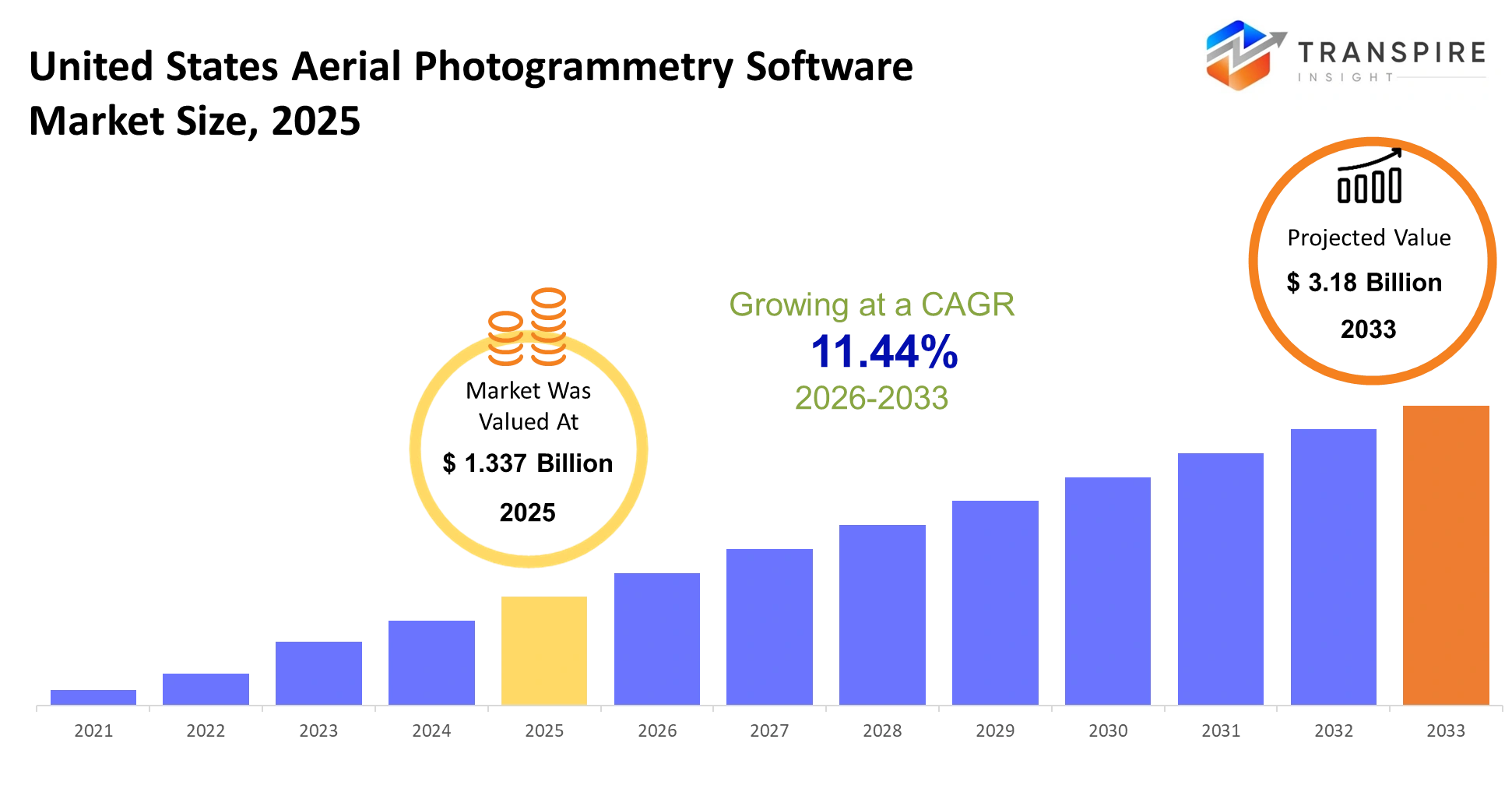
United States Aerial Photogrammetry Software Market Size & Forecast:
- United States Aerial Photogrammetry Software Market Size 2025: USD 1.337 Billion
- United States Aerial Photogrammetry Software Market Size 2033: USD 3.18 Billion
- United States Aerial Photogrammetry Software Market CAGR: 11.44%
- United States Aerial Photogrammetry Software Market Segments:By Type (2D, 3D, LiDAR, Drone Mapping, Satellite, GIS, BIM), By Application (Surveying, Construction, Mining, Agriculture, Defense, Urban, Environment), By Deployment (Cloud, On-premise, Hybrid, SaaS, Edge, Mobile, Desktop), By End-User (Surveyors, Engineers, Govt, Defense, Construction, Agriculture, Research), By Data (Imagery, LiDAR, Thermal, Multispectral, Hyperspectral, Radar, Video).
To learn more about this report,  Download Free Sample Report
United States Aerial Photogrammetry Software Market Summary:
The United States Aerial Photogrammetry Software Market size is estimated at USD 1.337 billion in 2025 and is anticipated to reach USD 3.18 billion by 2033, growing at a CAGR of 11.44% from 2026 to 2033. The United States aerial photogrammetry software market experiences continuous growth because various industries, including construction and agriculture and urban planning, require accurate geospatial information. The development of drone technology combined with AI-based image processing systems improves system accuracy while results become easier to use. The government supports implementation through its infrastructure projects and environmental monitoring programmes. The market develops new software solutions which provide mapping and 3D modelling tools that meet different professional requirements because businesses need these capabilities.
Key Market Trends & Insights:
- The growing adoption of drones in construction and agriculture work is creating a higher need for photogrammetry software. Businesses use drones because they collect data faster and safer while costing less than traditional surveying methods.
- Modern software uses AI technology to perform automatic image processing tasks which enhance processing speed. The system enables users to create precise 3D models and mapping materials which need less manual work.
- The industrial sectors are using 3D visual display technology more frequently to support their planning needs and analytical requirements. High-quality 3D visual displays have become necessary from smart city development to infrastructure projects because they enhance decision-making processes.
- The government is funding infrastructure development projects which leads to businesses implementing new software solutions. Photogrammetry tools assist in monitoring project sites while tracking project development and verifying project details during all project stages.
- Photogrammetry software has become more accessible through cloud platforms which also enable users to scale their operations. Users can analyze extensive data sets from remote locations while working together with others in real-time without requiring advanced computer equipment.
- The software has widespread applications to monitor environmental changes and manage disaster response and conduct land surveys. The system provides officials with complete and precise geographic information which helps them make better decisions.
- Developers are working to create software systems which non-specialists can use without difficulties. The combination of simple user interfaces and step-by-step operation procedures has made small and medium-sized businesses more willing to adopt the technology.
- The industry has entered a phase where intense competition requires businesses to develop new solutions at every moment. This process results in enhanced product capabilities and better accuracy while creating more economical options for users.
United States Aerial Photogrammetry Software Market Segmentation
By Type
- 2D: The 2D photogrammetry method continues to serve its purpose in mapping work and basic surveying activities. The system generates precise top view photographs that enable experts to determine distances and study land characteristics. The system functions as the perfect assessment tool which requires minimal processing power to operate in various industries for small-scale projects.
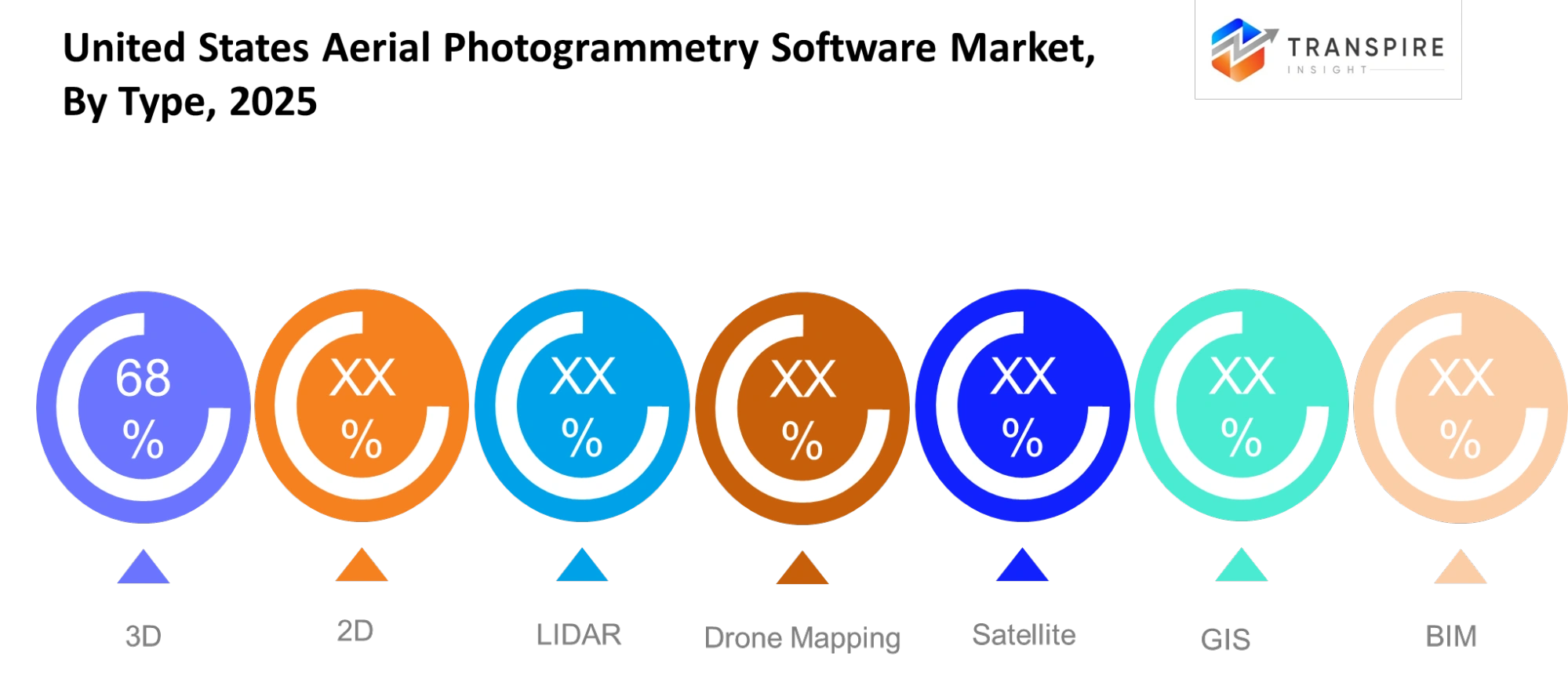
- 3D: The 3D photogrammetry technology has gained widespread popularity because it enables users to develop highly accurate digital models and lifelike 3D representations. The construction and urban planning sectors use this technology to improve their design processes and simulation capabilities and decision-making abilities. The system enables users to observe how objects exist in space through its realistic spatial relationship demonstration.
- LIDAR: LIDAR solutions operate with high accuracy throughout complex terrain areas and regions with dense vegetation. The system uses laser pulses to acquire precise elevation information. This technology proves vital for planning infrastructure projects and conducting forestry assessments and environmental research because standard imaging techniques cannot deliver the required results.
- Drone Mapping: The introduction of drone mapping technology has revolutionised data collection because it enables organisations to gather information at high speeds while spending less money. The system enables users to take high-quality aerial photographs from above without needing many people to operate it. The construction industry and the agricultural sector and the mining field use this technology to monitor their operations and assess conditions in real time.
- Satellite: Satellite photogrammetry enables large-area mapping, which makes it appropriate for both regional and national mapping purposes. Satellite data provides less detail than drone information, but it serves essential functions in monitoring environmental changes and conducting disaster management operations which require information about extensive areas.
- GIS: The software for GIS-based photogrammetry allows users to conduct spatial data analyses through structured data analysis methods. The system combines mapping functions with data layer capabilities to assist industries in making better decisions. This type of system is necessary for urban planning, utility management, and environmental monitoring purposes.
- BIM: Photogrammetry for BIM purposes enables precise building design and infrastructure development through detailed 3D modelling. The system enables construction workers to combine physical site measurements with their digital construction models. The system improves project accuracy through better data synchronisation, which results in fewer mistakes while improving teamwork throughout all project stages.
To learn more about this report, Download Free Sample Report
By Application
- Surveying: The primary application of photogrammetry shows improved accuracy and efficiency for surveying work. The method combines fieldwork reduction with accurate measurement results, which makes it the main method used for land assessment work, boundary mapping tasks and infrastructure development projects.
- Construction: Construction companies use photogrammetry to monitor worksite development and assess construction quality. The team applies the system for evaluating construction sites and measuring material volumes while receiving current project information. The system improves project workflow by enabling better teamwork, which decreases expensive mistakes throughout all stages of the project.
- Mining: Mining companies implement photogrammetry technology to create site maps and assess mineral reserves. The system enables secure and effective supervision of dangerous locations. The system enables organisations to improve their operational efficiency while handling potential threats and fulfilling their legal obligations.
- Agriculture: The software provides agricultural support through its crop observation and precision agriculture capabilities. The system allows farmers to evaluate their crops between three essential elements, which include plant health and irrigation requirements and soil conditions. The system produces higher crop yields while managing resources more effectively through continual development.
- Defense: Photogrammetry serves defence purposes through its use in surveillance operations and terrain assessments and mission development activities. The system distributes precise data which enables military leaders to make strategic choices and run their operations efficiently.
- Urban: Smart city and infrastructure design needs detailed aerial data for effective urban planning. The system enables planners to create visual representations of growth trends, which helps them control resources and enhance public service delivery.
- Environment: Environmental studies use the system for tracking three main environmental issues, which include climate change, deforestation and natural disasters. Photogrammetry delivers dependable information which is essential to both conservation work and sustainable development policy decisions.
By Deployment
- Cloud: The platform processes extensive datasets through its cloud deployment, which provides users with both flexibility and scalability. The system enables users to work together while accessing system resources from remote locations, which has made it a preferred solution for contemporary businesses.
- On-premise: Organisations that need to maintain strict data security standards for their operations choose on-premise solutions because these systems permit complete data control and protection. The government and defence sectors, which require strict security measures, prefer these systems for their operations.
- Hybrid: Hybrid deployment combines the benefits of cloud and on-premise systems. Enterprises can use this solution because it provides them with two essential business requirements which need to be met.
- SaaS: SaaS models simplify access by offering subscription-based services. The software provides users with an easy implementation method because it does not require them to pay high initial expenses which makes it appealing to small and medium-sized enterprises.
- Edge: Edge deployment enables real-time data processing closer to the source, such as drones. The process reduces latency while enhancing efficiency in applications that require immediate response.
- Mobile: Mobile-based solutions enable users to access data and conduct data processing while they travel. The solution provides fieldworkers with a practical way to obtain immediate information which they will need to complete their tasks.
- Desktop: Desktop software serves as a vital tool for conducting advanced data analysis through its ability to handle complex processing tasks. The system provides users with advanced capabilities which enable them to accomplish demanding tasks which require professional skills.
By End-User
- Surveyors: Surveyors use photogrammetry as their main tool, which provides precise measurements of land. The system enables them to complete tasks quickly because it prevents them from making mistakes during their work.
- Engineers: The software serves engineers as their tool for designing projects and analysing engineering work while they plan their project requirements. The software allows engineers to create virtual building designs which help them achieve their construction goals with exact results.
- Government: Government agencies apply photogrammetry technology to develop infrastructure projects and handle land resources and guarantee public security. The system enables organisations to make better choices throughout their different administrative functions.
- Defense: Defence organisations require precise geospatial information to execute their operational activities and conduct their surveillance missions. Photogrammetry provides crucial information which assists in both the assessment of the current situation and the development of strategic plans.
- Construction: Construction companies utilize the system for monitoring construction sites and tracking work progress and ensuring product quality. The system enhances project results while it minimizes project delays.
- Agriculture: Farmers and agribusinesses apply photogrammetry technology to boost their crop yield. The system enables users to monitor agricultural assets while they handle all aspects of farm resource management.
- Research: Scientific research institutions employ the software for conducting scientific research purposes and performing data analysis tasks. The system enables users to pursue research activities which lead to new discoveries across different academic fields.
By Data
- Imagery: Standard imagery forms the backbone of photogrammetry, which uses visual data to create maps and conduct analyses. Its simple design and easy access make it a popular choice among users.
- LiDAR: The LiDAR data set provides precise elevation measurements together with complete terrain information. The system supports projects which demand exact measurement and construction work.
- Thermal: Thermal data enables the identification of temperature shifts which agriculture and energy evaluation and monitoring tasks utilise. The system reveals information that standard visual data cannot display.
- Multispectral: Multispectral data enables researchers to collect data by measuring various wavelengths of light. The system serves agricultural purposes because it helps farmers evaluate their crops and monitor their soil health.
- Hyperspectral: Hyperspectral data enables scientists to obtain more knowledge because it collects data from an extensive range of electromagnetic radiation. The system serves research activities and environmental studies by providing in-depth analytical capabilities.
- Radar: Radar technology operates effectively during any weather conditions because its signals can pass through cloud cover. The system serves both large-area surveillance operations and military defence purposes.
- Video: The system uses video data to create live monitoring systems which perform ongoing analysis. The system has found growing application in monitoring activities and conducting inspections and tracking events.
Country Insights
The United States aerial photogrammetry software market shows strong technological progress which benefits multiple industry sectors. The country establishes an ideal market expansion framework through its sophisticated infrastructure system and early implementation of drone technology. The construction sector, the agriculture industry and the urban planning field use precise geospatial information to achieve better operational results and make informed choices. The government actively develops smart cities and environmental monitoring systems and infrastructure projects which create additional requirements for smart city technologies. The main technology companies in the area drive innovation through their research efforts, especially regarding AI mapping tools and cloud computing systems.
Different regions show different technology adoption rates because urban areas concentrate on construction and planning work while rural communities use the technology to enhance their agricultural operations. The United States market maintains its development because businesses and government entities require precise systems that deliver automated solutions with current data.
Recent Development News
In March 2026, drones became core to photogrammetry at Geo Week 2026: Drone technology is now central to modern mapping workflows in the U.S., transforming how data is captured and processed. Industry events highlight this shift toward automation and digital integration.
In March 2026, the U.S. Photogrammetry Software Market Shows Strong Growth Outlook: The U.S. market continues to expand with strong growth forecasts driven by construction and 3D mapping demand across industries.
|
Report Metrics |
Details |
|
Market size value in 2025 |
USD 1.337 Billion |
|
Market size value in 2026 |
USD 1.49 Billion |
|
Revenue forecast in 2033 |
USD 3.18 Billion |
|
Growth rate |
CAGR of 11.44% from 2026 to 2033 |
|
Base year |
2025 |
|
Historical data |
2021 – 2024 |
|
Forecast period |
2026 – 2033 |
|
Report coverage |
Revenue forecast, competitive landscape, growth factors, and trends |
|
Country scope |
United States |
|
Key company profiled |
Pix4D, Autodesk, Bentley, Trimble, Esri, Agisoft, DroneDeploy, Hexagon, DJI, Propeller, Leica, Skycatch, SimActive, Datumate, 3Dsurvey |
|
Customization scope |
Free report customization (country, regional & segment scope). Avail customized purchase options to meet your exact research needs. |
|
Report Segmentation |
By Type (2D, 3D, LiDAR, Drone Mapping, Satellite, GIS, BIM), By Application (Surveying, Construction, Mining, Agriculture, Defense, Urban, Environment), By Deployment (Cloud, On-premise, Hybrid, SaaS, Edge, Mobile, Desktop), By End-User (Surveyors, Engineers, Govt, Defense, Construction, Agriculture, Research), By Data (Imagery, LiDAR, Thermal, Multispectral, Hyperspectral, Radar, Video). |
Key United States Industrial Coating Company Insights
The United States aerial photogrammetry software market is shaped by a mix of established technology firms and innovative startups striving to deliver more accurate and user-friendly solutions. The companies work on developing better data processing systems which use artificial intelligence, cloud computing, and automation to create more precise real-time mapping solutions. The firms use strategic partnerships together with product upgrades and R&D investments to build their operations for upcoming industry changes. The companies develop their products to fit construction, agriculture and defence industries while maintaining flexible systems that enhance user experience and operational efficiency.
Company List
- Pix4D
- Autodesk
- Bentley
- Trimble
- Esri
- Agisoft
- DroneDeploy
- Hexagon
- DJI
- Propeller
- Leica
- Skycatch
- SimActive
- Datumate
- 3Dsurvey
United States Aerial Photogrammetry Software Market Report Segmentation
By Type
- 2D
- 3D
- LiDAR
- Drone Mapping
- Satellite
- GIS
- BIM
By Application
- Surveying
- Construction
- Mining
- Agriculture
- Defense
- Urban
- Environment
By Deployment
- Cloud
- On-premise
- Hybrid
- SaaS
- Edge
- Mobile
- Desktop
By End-User
- Surveyors
- Engineers
- Govt
- Defense
- Construction
- Agriculture
- Research
By Data
- Imagery
- LiDAR
- Thermal
- Multispectral
- Hyperspectral
- Radar
- Video
Frequently Asked Questions
Find quick answers to common questions.
The Approximate United States Aerial Photogrammetry Software Market size for the Market will be USD 3.18 Billion in 2033.
The key Segments of the United States Aerial Photogrammetry Software Market are By Type (2D, 3D, LiDAR, Drone Mapping, Satellite, GIS, BIM), By Application (Surveying, Construction, Mining, Agriculture, Defense, Urban, Environment), By Deployment (Cloud, On-premise, Hybrid, SaaS, Edge, Mobile, Desktop), By End-User (Surveyors, Engineers, Govt, Defense, Construction, Agriculture, Research), By Data (Imagery, LiDAR, Thermal, Multispectral, Hyperspectral, Radar, Video).
Major Players in the United States Aerial Photogrammetry Software Market are Pix4D, Autodesk, Bentley, Trimble, Esri, Agisoft, DroneDeploy, Hexagon, DJI, Propeller, Leica, Skycatch, SimActive, Datumate, 3Dsurvey.
The Current Market size of the United States Aerial Photogrammetry Software Market is USD 1.337 Billion in 2025.
The United States Aerial Photogrammetry Software Market CAGR is 11.44%.
- Pix4D
- Autodesk
- Bentley
- Trimble
- Esri
- Agisoft
- DroneDeploy
- Hexagon
- DJI
- Propeller
- Leica
- Skycatch
- SimActive
- Datumate
- 3Dsurvey
Recently Published Reports
-
Apr 2026
3D Optical Profiler Market
3D Optical Profiler Market Size, Share & Analysis Report By Type (Desktop 3D Optical Profiler, and Portable 3D Optical Profiler), By Technology (Confocal Technology, and White Light Interference), By End-Use Industry (Manufacturing, Research Institutions, Automotive, Aerospace and Defense, Medical Devices, and Other), and Geography (North America, Europe, Asia-Pacific, Middle East and Africa, South and Central America), 2021 - 2031
-
Apr 2026
Depth Sensor Market
Depth Sensor Market Size, Share & Analysis Report By Type (Infrared Depth Sensors, Time-of-Flight (ToF) Sensors, Stereo Vision Sensors, Structured Light Sensors, Ultrasonic Depth Sensors), By Application (Automotive, Robotics, Gaming, Consumer Electronics, Industrial Automation, Healthcare, Security & Surveillance, Others), By End Users (Automotive Manufacturers, Consumer Electronics Companies, Healthcare Providers, Industrial Companies, Security Agencies, Gaming Companies, Robotics Companies, Others), and Geography (North America, Europe, Asia-Pacific, Middle East and Africa, South and Central America), 2021 – 2031
-
Apr 2026
Digital Manufacturing Market
Digital Manufacturing Market Size, Share & Analysis Report By Component (Hardware, Software, and Services), By Technology (Robotics, 3D Printing, Internet of Things (IoT), and Others), By Application (Automotive and Transportation, Aerospace and Defense, Consumer Electronics, Industrial Machinery, and Others), By Process Type (Computer-Based Designing, Computer-Based Simulation, Computer 3D Visualization, Analytics, and Others), and Geography (North America, Europe, Asia-Pacific, Middle East and Africa, South and Central America), 2021 – 2031
-
Apr 2026
Digital Visa Services Market
Digital Visa Services Market Size, Share & Analysis Report By Type (Individual Travelers, Group Travelers), By Application (Tourism, Business Travel, Others), and Geography (North America, Europe, Asia-Pacific, Middle East and Africa, South and Central America), 2021 – 2031