

United Kingdom Set Top Box Market Size & Forecast:
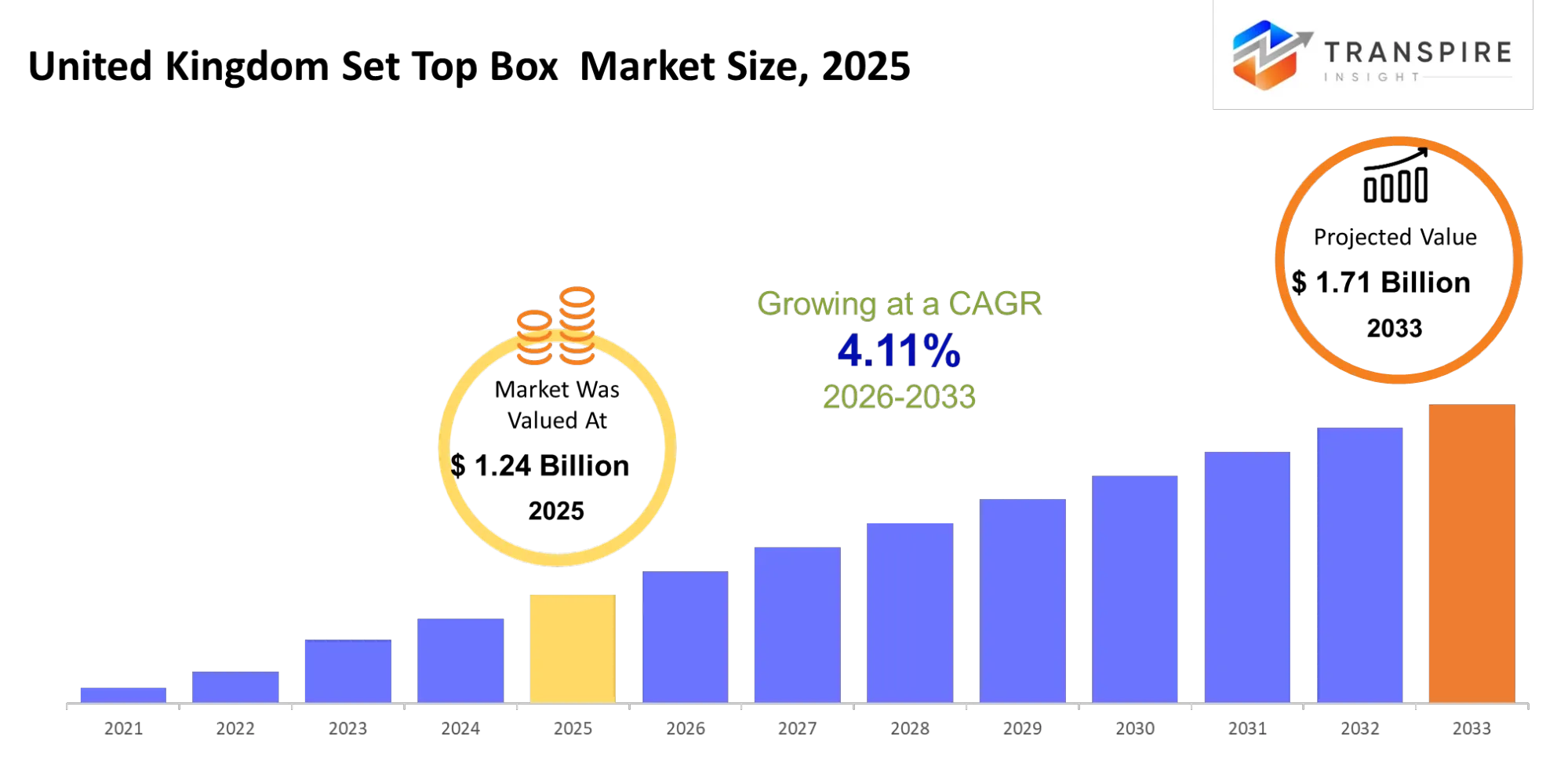
- United Kingdom Set Top Box Market Size 2025: USD 1.24 Billion
- United Kingdom Set Top Box Market Size 2033: USD 1.71 Billion
- United Kingdom Set Top Box Market CAGR: 4.11%
- United Kingdom Set Top Box Market Segments: By Product Type (Cable Set Top Boxes, Satellite Set Top Boxes, IPTV Set Top Boxes, OTT Streaming Devices, Hybrid Set Top Boxes, HD Set Top Boxes, Smart Set Top Boxes, Others); By Resolution (HD Devices, Full HD Devices, 4K UHD Devices, 8K Devices, Others); By Application (Residential Entertainment, Commercial Entertainment, Hospitality Services, Educational Streaming, Others); By End User (Residential Users, Hotels, Broadcasters, Telecom Operators, Others)
To learn more about this report,  Download Free Sample Report
United Kingdom Set Top Box Market Summary
The United Kingdom Set Top Box Market was valued at USD 1.24 Billion in 2025. It is forecast to reach USD 1.71 Billion by 2033. That is a CAGR of 4.11% over the period.
The United Kingdom set top box market kinda plays a critical role in delivering TV and digital entertainment stuff to households, by enabling access to broadcast, satellite, cable, and internet based content through one interface. In practice, these devices sort of bridge legacy television infrastructure with newer streaming ecosystems, helping operators handle content delivery, subscription services, and those more interactive watching experiences that feel a bit personalized, or at least tailored.
Over the past three to five years, the market has been going through a structural shift, from old style pay-TV hardware toward hybrid, and IP enabled set top boxes that mix streaming apps in, cloud based services, and personalized content suggestions. This shift really picked up during the COVID-19 period , when people were stuck at home longer, home entertainment consumption increased a lot, and that pushed service providers to modernize their platforms. Since broadband penetration keeps rising, and streaming adoption keeps changing consumer behavior, operators are leaning into advanced devices that allow smoother content aggregation, plus software based upgrades. This whole evolution is expanding service revenues, improving customer retention, and opening up more chances for value added digital entertainment offerings across the UK media landscape.
Key Market Insights
- In England the United Kingdom Set Top Box Market really, kinda dominates, bringing in more than 80% of the industry revenue, mostly because it has such a big subscriber base and digital infrastructure that’s more advanced than in many other places.
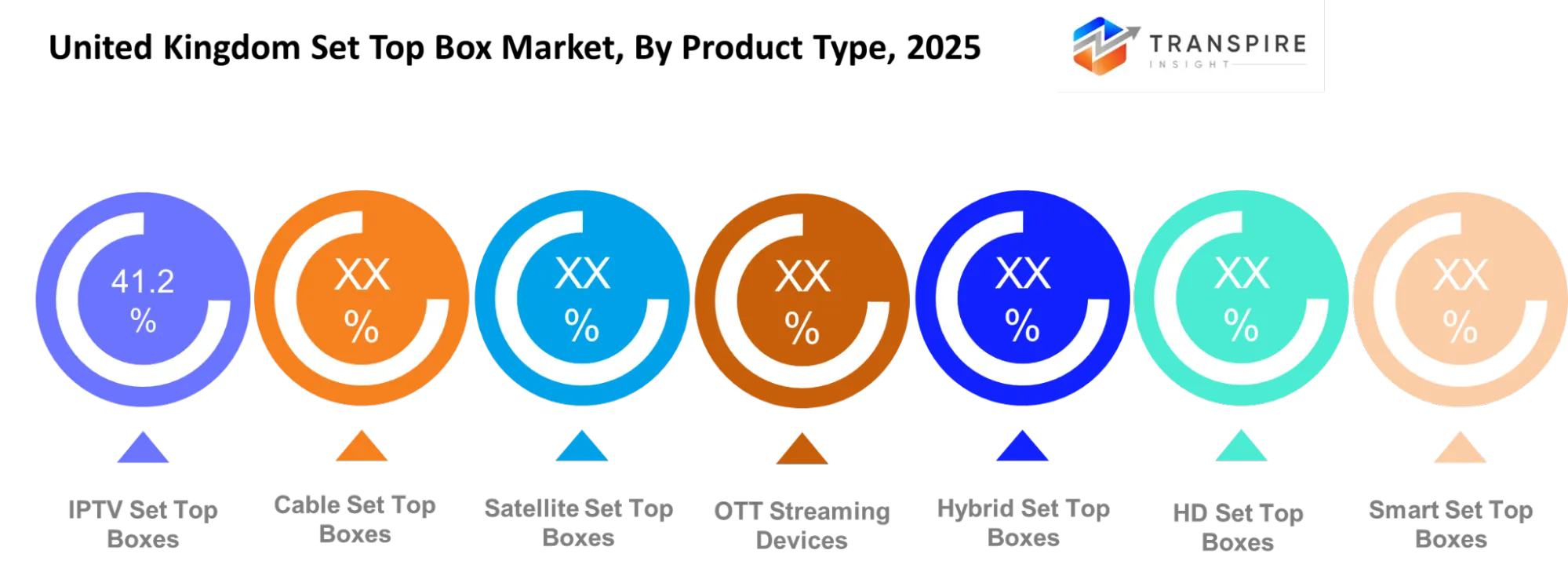
- IP-based set top boxes are also leading, they’re around 45% market share in 2025 , largely pulled by strong demand for streaming-enabled content delivery, you know that kind of thing.
- Hybrid set top boxes come next as the second-largest chunk, mixing “old school” broadcasting with internet based entertainment platforms in the same device.
- From 2025 to 2030 Android TV and smart set top boxes look like the fastest-growing segment, since people keep wanting app-based viewing experiences rather than only traditional channels.
- Another trend that’s starting to show up more is cloud-integrated devices , these allow remote software upgrades and personalized content recommendations, which sounds pretty fancy but it’s basically convenience.
- When it comes to where the demand comes from, residential applications lead, contributing nearly 75% of total demand as households keep shifting toward digital and on-demand content.
- For application type, OTT and streaming content delivery is the fastest-growing area, helped by the expansion of subscription video platforms across the UK.
- Multi-screen viewing and interactive entertainment services keep adding pressure for more advanced set top box solutions, because people want it to work everywhere at once.
- On the end-user side, pay TV subscribers are still the main segment, holding a meaningful share of the United Kingdom Set Top Box Market.
- Finally, streaming-focused households are growing the quickest, backed by changing content consumption patterns and high-speed internet access, and honestly that part is probably the key driver.
What are the Key Drivers, Restraints, and Opportunities in the United Kingdom Set Top Box Market?
The strongest force pushing growth in the United Kingdom Set Top Box Market is, in a way, the move away from old fashioned linear television toward more integrated digital entertainment. This shift picked up speed because streaming services have been expanding their catalog, and telecom operators have been upgrading broadband capacity throughout the nation. People are more and more drawn to the idea of one single device that can handle live TV, on demand content, and also streaming apps. So operators roll out more sophisticated IP based and hybrid set top boxes. Because of that, providers can earn extra money via premium content bundles, more precise targeted advertising, and various value added digital services, and the faster pace of device swapping also keeps hardware sales supported.
The biggest obstacle to market expansion is the structural decline in conventional pay TV subscriptions. More households now watch using smart televisions, streaming sticks, and mobile applications, which cuts down on how much they depend on operator supplied set top boxes. This problem is hard to fix, since it isn’t just a short term market wobble it’s tied to a long lasting shift in what viewers choose to do. The result is sluggish subscriber growth for pay TV players, plus weaker replacement demand, and that in turn limits revenue development across several hardware categories.
A pretty big growth opportunity sits in cloud and AI-enabled set top boxes, that kind of act as a main entertainment hub for the household. Operators are going for platforms that can do personalized recommendations, use voice control , and even link up with smart home setups, more and more. And as full-fibre broadband keeps spreading across the UK, these smarter devices can open up fresh subscription ways, plus generate recurring revenue streams, not only the usual television services.
What Has the Impact of Artificial Intelligence Been on the United Kingdom Set Top Box Market?
Artificial intelligence is starting to feel like a key technology in the United Kingdom Set Top Box Market, as operators try to push better content discovery, keep customers around, and run the platform with less wasted effort. These days, modern set top boxes often rely on AI based recommendation engines, they basically scan viewing habits, search history and engagement signals, then they surface personalized suggestions without much manual work. That sort of automation cuts the time people spend hunting for something to watch, and at the same time it tends to lift viewer engagement. When this works, it helps service providers strengthen subscription retention and also boosts advertising performance.
On top of that, machine learning models add predictive support across digital television networks. Operators use these tools to spot likely device faults, software malfunctions, or network slowdowns before they fully hit users. In practice, predictive maintenance can notice unusual operating patterns, which means remote troubleshooting becomes more feasible and service interruptions drop. So the payoff shows up as better platform uptime, reduced maintenance spending, and fewer back-and-forth calls to customer support.
Then there are the advanced analytics platforms that help fine tune bandwidth allocation and how content gets delivered. With AI assisted traffic management, operators can manage peak streaming demand with more control, which usually improves video quality and also lowers the number of buffering moments. Voice enabled interfaces combined with natural language processing are getting more traction too, giving people a smoother experience because navigation becomes quicker, and interactions can feel more tailored.
Still though, one big limitation remains the high cost and overall complexity involved in rolling out AI across older broadcasting infrastructure. Lots of operators work with mixed technology stacks, so standardizing data and deploying models becomes a bit of a puzzle, and that can slow down large scale implementation. It also can dilute the real impact of AI driven insights, even when the tools themselves are solid.
Key Market Trends
- From 2020 through 2025, UK operators kind of pushed quicker migration away from satellite-centric gear, toward IP enabled set top boxes that also handle integrated streaming apps. And yes, it did feel like a slow pivot at first, then suddenly it was everywhere.
- Hybrid set top boxes gained share because households wanted one kind of console style access, to both broadcast channels and paid subscription streaming services, in the same place.
- Ever since 2021, providers like Sky and Virgin Media O2 have kept expanding cloud based functionality, which really cuts down on the need for hardware specific upgrades, or at least it tries to.
- Also, AI powered recommendation engines became basically standard, helping people find content faster and nudging viewer engagement up across the whole digital tv landscape, rather than just the app side.
- After 2020, the portion of households watching on demand content rose a lot , and that changed how devices were designed, plus it reshaped service bundling strategies too.
- Manufacturers increasingly used Android TV and other app centric operating systems, trading away proprietary interfaces for a wider content ecosystem.
- Meanwhile supply chain disruptions during 2021 and 2022, forced operators to diversify where components come from and to tighten up inventory planning , not just hope for the best.
- Voice enabled remote controls also moved from premium add ons into mainstream products, since consumers wanted easier and more direct navigation through content, without too much fuss.
- And as broadband expanded, especially with full fibre deployment, competition started to shift away from “do we have the channels”, toward user experience, and how well content aggregation actually feels.
- So in the end, differentiation is leaning more and more on software capabilities , personalized services, and smoother integration with smart home, plus connected devices too.
United Kingdom Set Top Box Market Segmentation
By Product Type:
In the United Kingdom Set Top Box Market, the product type segment breaks down into Cable Set Top Boxes, Satellite Set Top Boxes, IPTV Set Top Boxes, OTT Streaming Devices, Hybrid Set Top Boxes, HD Set Top Boxes, Smart Set Top Boxes, and Others, more or less. Cable set top boxes connect TV services via cable networks and they still basically stay relevant for homes with long standing cable subscriptions. Satellite set top boxes take television signals straight from satellites, and they stay pretty important in places where cable infrastructure doesn’t reach very well, or at least not easily.
IPTV set top boxes send content over internet protocol networks, so viewers can get live channels and on demand programming using broadband connections. OTT streaming devices lean toward internet based material from streaming platforms. Hybrid set top boxes, sort of, blend traditional broadcast services with online applications. Then you have HD and smart set top boxes, which back up sharper picture quality, stronger app integration, voice control, and interactive functions, in a more engaging way.Finally, the “Other” categories handle more niche consumer and commercial needs, so the overall product scene across the market looks fairly wide. In other words it’s a mix, not just one narrow path.
To learn more about this report, Download Free Sample Report
By Resolution:
The resolution segment has HD Devices, Full HD Devices, 4K UHD Devices, 8K Devices, and Others kind of grouped together in a way. HD devices give better picture quality compared with standard-definition systems, and honestly they still fit quite well for a lot of households who want dependable viewing experiences with moderate costs. Full HD devices, meanwhile, tend to deliver sharper image clarity and they support a broad selection of entertainment content across various television platforms, too.
Then there are 4K UHD devices which have really found solid traction , mainly because ultra-high-definition content keeps showing up more often from broadcasters and streaming services. In practice these devices provide more fine detail, richer visuals, and a noticeable uplift in overall viewing quality. 8K devices sit at the premium end of the market and aim at consumers who are interested in advanced display technology, not just the basics. Other resolution categories cover more niche requirements and legacy systems that are still in operation with certain user groups and they kind of stay there.
By Application:
The application segment comes with Residential Entertainment, Commercial Entertainment, Hospitality Services, Educational Streaming, and Others, even if it feels a bit mixed sometimes. Residential entertainment is the biggest application area, with set top boxes letting households reach television channels, streaming content, and stored, recorded programming, plus a few interactive viewing features inside the home. In practice, the constant growth of digital content libraries also keeps pushing broader adoption here, in that same direction all the time.
Commercial entertainment applications generally cover public venues, business settings, and shared viewing spots where the way content is distributed becomes part of customer engagement strategies. Hospitality services use set top boxes to give guests more personalized television and entertainment choices in hotels, and accommodation facilities, without too much fuss. Educational streaming applications are there for access to learning content, virtual classes, and digital resources that work on demand. Then other applications handle specialized needs across different institutional environments, depending on what each place really requires at the moment.
By End User:
The end-user segment consists of Residential Users, Hotels, Broadcasters, Telecom Operators, and Others. Residential users are a big part of the market demand because households basically lean on set top boxes for television access, streaming services and a more cohesive entertainment experience. At the same time, ongoing upgrades within connected home technologies still keep shaping what people decide to buy in this segment.
Hotels use set top box solutions so they can raise guest entertainment quality, and also to deliver customized viewing options, which is kind of a big deal for customer satisfaction. Broadcasters rely on these devices to send content more efficiently to audiences, across multiple distribution channels too. Telecom operators fold set top boxes into bundled service offerings, typically mixing television with broadband and communication services.
What are the Key Use Cases Driving the United Kingdom Set Top Box Market?
Residential entertainment is still the main thing driving adoption in the United Kingdom Set Top Box Market . People in households use advanced set top boxes so they can get live television, streaming platforms, catch-up services , and tailored content, all through one single interface, which is kinda the point. This ease keeps supporting replacement cycles and also helps operators keep subscription based service revenues, it just sort of continues that way.
But outside the home, hospitality providers are rolling out connected set top box systems more and more to make guest experiences smoother, they add on-demand content and offer customized viewing choices. At the same time educational institutions and training providers are buying into digital content delivery platforms that back remote learning and streamed instruction. So it’s not only fun, it’s also kind of practical.
On top of that, some new opportunities keep showing up around smart home integration and AI enabled entertainment services. Newer devices can act as central hubs for voice control, connected home management , and personalized recommendations. There’s also more interest in cloud based gaming targeted advertising and interactive digital services, because operators want to extend income beyond traditional television distribution during the forecast period .
|
Report Metrics |
Details |
|
Market size value in 2025 |
USD 1.24 Billion |
|
Market size value in 2026 |
USD 1.29 Billion |
|
Revenue forecast in 2033 |
USD 1.71 Billion |
|
Growth rate |
CAGR of 4.11% from 2026 to 2033 |
|
Base year |
2025 |
|
Historical data |
2021 - 2024 |
|
Forecast period |
2026 - 2033 |
|
Report coverage |
Revenue forecast, competitive landscape, growth factors, and trends |
|
Regional scope |
Middle East and Africa (Saudi Arabia, United Arab Emirates, South Africa, Rest of Middle East and Africa) |
|
Key company profiled |
Sky Group, Samsung Electronics, LG Electronics, Technicolor, Huawei, ARRIS, Cisco Systems, Roku, Amazon, Apple, Sagemcom, Humax, Xiaomi, ZTE, Echostar |
|
Customization scope |
Free report customization (country, regional & segment scope). Avail customized purchase options to meet your exact research needs. |
|
Report Segmentation |
By Product Type (Cable Set Top Boxes, Satellite Set Top Boxes, IPTV Set Top Boxes, OTT Streaming Devices, Hybrid Set Top Boxes, HD Set Top Boxes, Smart Set Top Boxes, Others); By Resolution (HD Devices, Full HD Devices, 4K UHD Devices, 8K Devices, Others); By Application (Residential Entertainment, Commercial Entertainment, Hospitality Services, Educational Streaming, Others); By End User (Residential Users, Hotels, Broadcasters, Telecom Operators, Others) |
Which Regions are Driving the United Kingdom Set Top Box Market Growth?
England kinda stands as the leading area in the United Kingdom Set Top Box Market, mainly because there s a big population base , solid broadband reach, and a strong cluster of big telecommunications and media operators. There has been a lot of full-fibre rollout as well, and that has helped speed up IPTV take-up , hybrid services, and smart set top box platforms in a pretty direct way. On top of that, television providers keep investing, they upgrade the way content delivery works, so the whole setup stays ready for higher demand. Also there s a pretty mature digital entertainment ecosystem running in the background, with streaming providers, broadcasters, and technology vendors all in the mix, and that just reinforces England’s dominant position.
Scotland comes next as the second-largest regional contributor, though the results seem driven more by infrastructure modernization than by sheer population size. The ongoing buildout of high-speed broadband networks has made things stable for connected television services, especially across cities, and also in semi rural spots where it used to be weaker. Consumer adoption is still backed by consistent household spending on digital entertainment and subscription based content platforms. So yeah, with reliable connectivity plus continuing investment, Scotland stays a dependable source of market revenue, even if the numbers don t feel as large on day one.
Wales is sort of emerging as the fastest-growing region, since broadband expansion projects are steadily improving access to advanced television services in communities that used to be underserved, and that kind of change is noticeable. In the last while, upgrades to digital infrastructure have already nudged operators toward newer IP based plus cloud enabled set-top box offerings, which feels pretty logical. Also the growing habit of streaming services has sped up the swap out of older hardware, and now people lean more toward connected devices, they’re able to handle multiple content platforms at once, you know. Over the 2026–2033 period this momentum should open up quite attractive opportunities for technology providers , platform developers, and service operators who want fresh customer acquisition channels.
Who are the Key Players in the United Kingdom Set Top Box Market and How Do They Compete?
Competition in the United Kingdom set-top box market is moderately consolidated, but it still feels like everyone is at least partly doing the same dance. Telecommunications operators , pay-TV providers , and device manufacturers compete through technology integration more than pure price moves. The overall direction is away from hardware-only rivalry, you know, the usual box-focused story , and toward software features, content aggregation, and user experience that actually matters day to day. Big, established operators keep trying to hold their positions by upgrading existing subscribers to IP-enabled and hybrid platforms. Meanwhile, tech-first entrants look for space in streaming-centered devices, even if that means a different kind of interface or workflow. The main battleground tends to be content accessibility , cloud-based functionality, personalization, and whether everything ties in smoothly with broadband services.
Sky, in particular, separates itself by going deep on how live television, streaming applications, and cloud-based content administration work inside a single platform. The company leans hard into innovation, with voice-enabled controls, AI-driven content suggestions, and connected home features that help strengthen retention. Its expansion keeps moving via content partnerships and ongoing platform refinements , which broadens entertainment reach without forcing customers into major hardware swaps.
Virgin Media O2 tends to compete by bundling broadband with television ,so the whole thing feels more compelling, kind of a value stack. They lean on network performance, plus the integrated customer offering, so it stays convenient. BT Group, on the other hand, leans into IPTV delivery, and they use their broadband infrastructure investments to enable richer television experiences. Humax and Sagemcom mostly keep their edge through device innovation—basically they supply smart hybrid set top box solutions , these are designed for 4K content, app ecosystems, and remote software updates that happen without too much hassle. Overall these companies keep a competitive advantage by helping operators roll out scalable, future-ready platforms that can flex fast when viewing habits shift around.
Company List
- Sky Group
- Samsung Electronics
- LG Electronics
- Technicolor
- Huawei
- ARRIS
- Cisco Systems
- Roku
- Amazon
- Apple
- Sagemcom
- Humax
- Xiaomi
- ZTE
- Echostar
Recent Development News
In February 2025, Sky launched Sky Glass Gen 2. The new streaming TV introduced a brighter 4K HDR display, enhanced seven-speaker Dolby Atmos audio system, and continued Sky’s shift away from satellite-based set-top boxes toward internet-delivered television services in the United Kingdom.Source https://www.advanced-television.com/
In June 2025, Sky launched Sky Glass Air. The lower-cost 4K streaming TV expanded Sky’s device portfolio, helping the company target more households with Wi-Fi-based television services that do not require a traditional satellite box or dish.
Source https://www.skygroup.sky/
What Strategic Insights Define the Future of the United Kingdom Set Top Box Market?
The United Kingdom Set Top Box Market is kinda moving toward a software centric model where platform abilities matter more than those hardware details. In the next five to seven years, growth is likely to come increasingly from cloud managed services, AI driven personalization, bundled streaming ecosystems, and also smart home connectivity. Underneath it all is the ongoing convergence of broadband, entertainment and digital household offerings into one sort of single, joined up user experience.
One less obvious risk is technology substitution. Once smart televisions get even more capable, and streaming apps become native inside the display devices, some people might skip dedicated set top boxes completely. If that happens, replacement cycles could get shorter, and market power may end up more concentrated with only a few platform operators that already have strong content libraries and partnerships.
An emerging chance, though, is to pivot the set top box into a home digital hub. Think security monitoring, energy management, and control for connected devices all in one place. Market players should put priority on software platforms, data analytics, and strategic content collaborations, not only on hardware upgrades. Firms that can generate recurring service revenue across connected home ecosystems should have a better shot at capturing longer term value.
United Kingdom Set Top Box Market Report Segmentation
By Product Type
- Cable Set Top Boxes
- Satellite Set Top Boxes
- IPTV Set Top Boxes
- OTT Streaming Devices
- Hybrid Set Top Boxes
- HD Set Top Boxes
- Smart Set Top Boxes
By Resolution
- HD Devices
- Full HD Devices
- 4K UHD Devices
- 8K Devices
By Application
- Residential Entertainment
- Commercial Entertainment
- Hospitality Services
- Educational Streaming
By End User
- Residential Users
- Hotels
- Broadcasters
- Telecom Operators
Frequently Asked Questions
Find quick answers to common questions.
The United Kingdom Set Top Box Market size is USD 1.71 Billion in 2033.
Key segments for the United Kingdom Set Top Box Market are By Product Type (Cable Set Top Boxes, Satellite Set Top Boxes, IPTV Set Top Boxes, OTT Streaming Devices, Hybrid Set Top Boxes, HD Set Top Boxes, Smart Set Top Boxes, Others); By Resolution (HD Devices, Full HD Devices, 4K UHD Devices, 8K Devices, Others); By Application (Residential Entertainment, Commercial Entertainment, Hospitality Services, Educational Streaming, Others); By End User (Residential Users, Hotels, Broadcasters, Telecom Operators, Others).
Major United Kingdom Set Top Box Market players are Sky Group, Samsung Electronics, LG Electronics, Technicolor, Huawei, ARRIS, Cisco Systems, Roku, Amazon, Apple, Sagemcom, Humax, Xiaomi, ZTE, Echostar.
The United Kingdom Set Top Box Market size is USD 1.24 Billion in 2025.
The United Kingdom Set Top Box Market CAGR is 4.11% from 2026 to 2033.
- Sky Group
- Samsung Electronics
- LG Electronics
- Technicolor
- Huawei
- ARRIS
- Cisco Systems
- Roku
- Amazon
- Apple
- Sagemcom
- Humax
- Xiaomi
- ZTE
- Echostar
About the Authors

Avinash Kumar
I’m Avinash Kumar, a Senior Research Analyst at Transpire Insight, with expertise in the Electronics and Semiconductor and Energy & Power industry. My work focuses on analyzing emerging technologies, market trends, industry developments, and innovation across these sectors. I specialize in transforming complex technical and market insights into clear, research-backed content that helps professionals, businesses, and decision-makers stay informed. Through continuous industry research and data-driven analysis, I strive to deliver accurate, reliable, and practical perspectives on the latest advancements shaping the semiconductor and energy landscape.

Chakradhar Khansole
Chakradhar serves as the Research Director at Transpire Insight, bringing over 8 years of experience in technology, innovation, and strategic market intelligence. He specializes in transforming complex market data into actionable business insights that enable organizations to make informed, growth-oriented decisions. Recognized for his strategic vision and analytical expertise, Chakradhar leads high-impact research initiatives, delivering comprehensive market assessments, competitive intelligence, and forward-looking industry analysis.
Recently Published Reports
-
Apr 2026
Fiber Optic Faceplates Market
Fiber Optic Faceplates Market Size, Share & Analysis Report By Type (< 300 mm2, 300-350 mm2, and > 350 mm2, By Application (Night Vision, Holographic Imaging, Medical, and Others), and Geography (North America, Europe, Asia-Pacific, Middle East and Africa, South and Central America), 2021 - 2031
-
Apr 2026
High Temperature Superconductors Market
High Temperature Superconductors Market Size, Share & Analysis Report By Type (1G HTS, and 2G HTS), By Application (Power Cable, Fault Current Limiter, and Transformer), and Geography (North America, Europe, Asia-Pacific, Middle East and Africa, South and Central America), 2021 - 2031
-
Apr 2026
Industrial Plugs and Socket Market
Industrial Plugs and Socket Market Size, Share & Analysis Report By Type (Industrial Plugs, Industrial Sockets), By Current (Up to 32 A, 32 to 125 A, Above 125 A), By Protection (Dustproof and Splash Proof, Waterproof, Explosion Proof), By End User (Heavy Industries, Oil and Gas, Chemicals and Pharmaceuticals, Power Generation, Others), and Geography (North America, Europe, Asia-Pacific, Middle East and Africa, South and Central America), 2021 - 2031
-
Apr 2026
InGaAs Avalanche Photodiodes Market
InGaAs Avalanche Photodiodes Market Size, Share & Analysis Report By Type (1100 - 1700 nm, and 1000 - 1600 nm), By Application (Missile Warning System, Muzzle Flash Detection, Wafer Defect Inspection, Laser Rangefinders, and Others), and Geography (North America, Europe, Asia-Pacific, Middle East and Africa, South and Central America), 2021 - 2031