

United Kingdom Sales Intelligence Market Summary
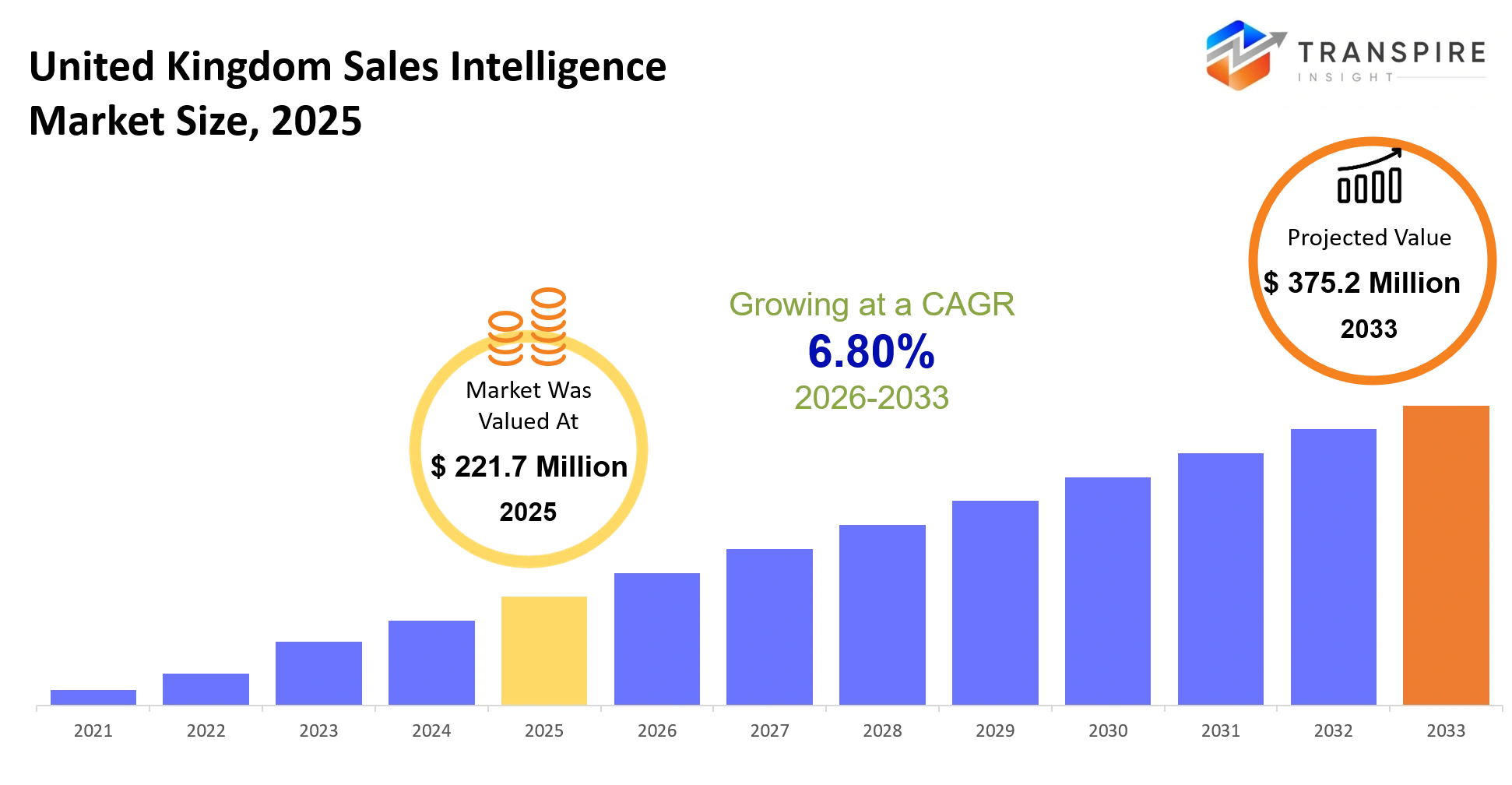
As per Transpire Insight Analysis the United Kingdom Sales Intelligence Market size is estimated at USD 221.7 Million in 2025 and is anticipated to reach USD 375.2 Million by 2033, growing at a CAGR of 6.80% from 2026 to 2033.
The United Kingdom sales intelligence market kind of helps businesses find decent, qualified prospects, watch how buyers behave, and give their sales teams solid company and contact details that really helps them make quicker and more informed commercial calls. Instead of just using piecemeal or fragmented info, companies lean on these platforms to level up lead prioritization, reduce the sales cycle time, and make account based selling work better across different industries , like financial services, technology, manufacturing, and professional services.
In the last three, or maybe five years, the whole space shifted from kind of static contact lists toward AI enabled platforms that offer predictive perspectives, intent signals, and some automated workflow hookups. The big jump in digital selling right after the COVID-19 pandemic made this transition happen faster because remote engagement meant the data had to be cleaner, and the intelligence had to feel more real time.
And since more businesses are putting extra weight on revenue efficiency and trackable sales results, the push to invest in advanced intelligence platforms keeps growing. That means more enterprises are adopting them, and it also creates better recurring software revenue chances, which is sort of the point for a lot of stakeholders too.
United Kingdom Sales Intelligence Market Size & Forecast:
- United Kingdom Sales Intelligence Market Size 2025: USD 221.7 Million
- Expected Market Value 2033: USD 375.2 Million
- Forecast CAGR: 6.80%
- Leading region in 2025: England
- Fastest Growing region: Scotland
- Key Profile: ZoomInfo, LinkedIn, Dun & Bradstreet, HubSpot, Salesforce, Apollo.io, Cognism, LeadIQ, Demandbase, Clearbit, Lusha, Seamless.AI, Oracle, Microsoft, Freshworks
Key Market Insights
- In 2025, England basically dominated the United Kingdom Sales Intelligence Market , with roughly 84% market share. This was kind of backed by London- based enterprise headquarters and extra technology investment , you know the usual story.
- Scotland meanwhile is projected to become the fastest-growing regional market over 2025–2032, largely because technology firms are expanding and there’s a lot of digital transformation happening across financial and business services.
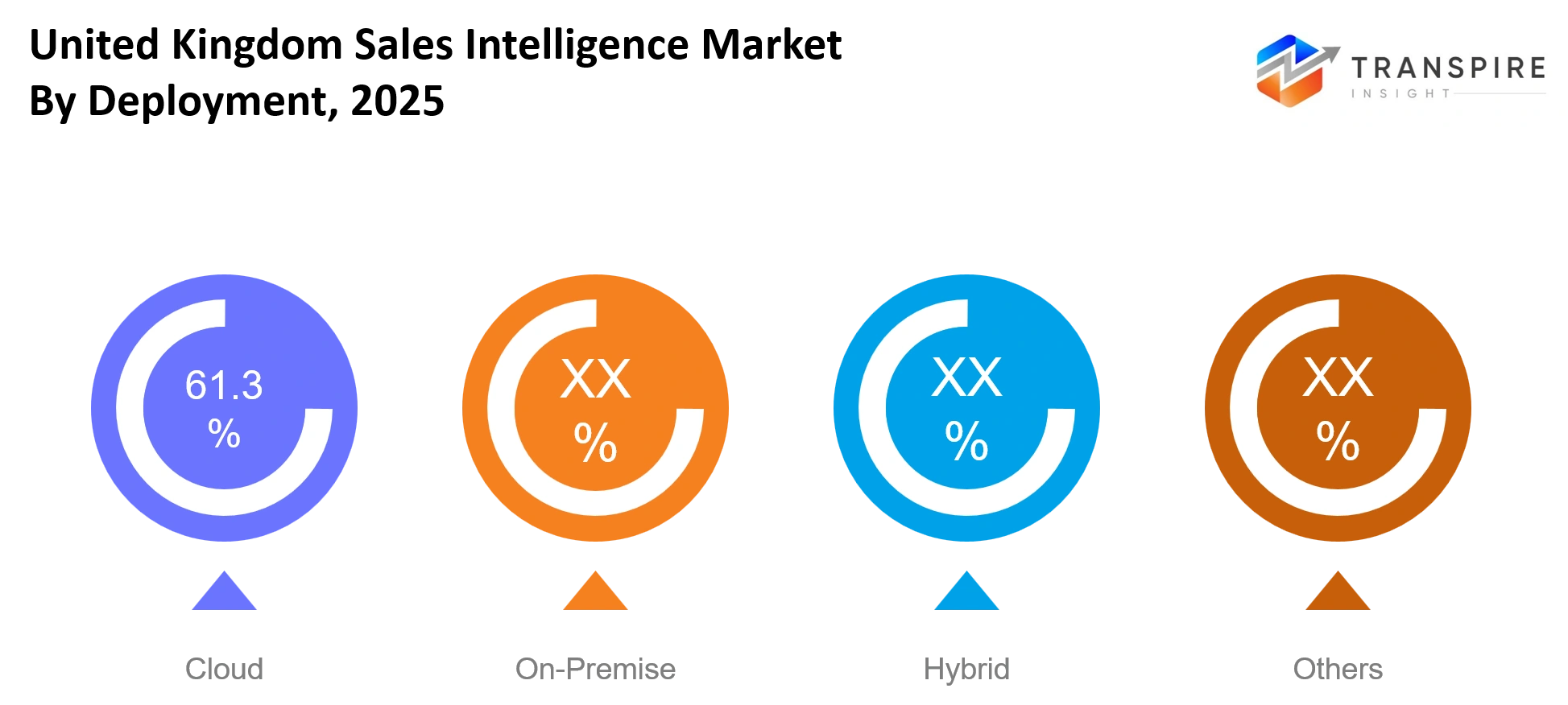
- When it comes to products, cloud-based sales intelligence platforms led the way , holding about 68% share in 2025. This suggests enterprises are leaning toward scalable subscription software, plus faster rollout timelines.
- Professional and managed services showed up as the second-largest slice, as companies broaden platform integration, employee training, and even CRM tuning projects.
- Looking at solutions, AI-enabled revenue intelligence is forecast to grow the quickest through 2032 , powered by predictive analytics, intent data, and workflow automation.
- For applications, lead generation and account prospecting took the lead with around 39% market share in 2025, helping improve conversion rates thanks to more enriched customer intelligence.
- Sales forecasting and pipeline optimization are expected to keep moving fastest during the forecast period, mainly as predictive models get better for commercial planning accuracy.
- On company size, large enterprises accounted for nearly 64% market share in 2025, supported by bigger software budgets and complex multi-channel sales operations.
- Small and medium-sized enterprises are likely to see the quickest growth through 2032, because subscription pricing is lowering the adoption barrier for many teams and that sort of thing.
What are the Key Drivers, Restraints, and Opportunities in the United Kingdom Sales Intelligence Market?
The main force pushing the United Kingdom Sales Intelligence Market forward, is the pretty broad adoption of AI-enabled digital selling and those integrated customer relationship management platforms. After the pandemic, hybrid selling models basically stuck around and changed how commerce works, for good. Sales organizations now lean on real-time buyer intent signals more than those static contact lists. AI helps with lead qualification, it does automating prospect research, and it also sorts and prioritizes accounts with more solid conversion potential. When targeting gets sharper , acquisition costs usually drop while sales productivity goes up. And because the benefits are measurable, people are more willing to fund larger software deployments, which then supports bigger recurring subscription revenue across financial services , technology, manufacturing, and business services.
The biggest structural issue is data privacy compliance, mixed with fragmented enterprise data setups. Under UK data protection rules, companies can’t just collect, validate, and use commercial contact information the way they used to. On top of that, older CRM systems make integration harder with the newer intelligence platforms. According to a Transpire Insight review of regional procurement announcements and launch schedules, supply chain concentration still looks like the main execution risk. Integration efforts often drag implementation timelines out by six to twelve months, so enterprise rollouts get delayed, near-term software revenue gets squeezed, and mid-sized organizations tend to adopt slower.
The most durable, long-range win is probably in mixing generative AI with their own customer records plus revenue intelligence platforms. In practice, companies are putting more money into predictive purchase signals, conversational analytics sort of things, and automated opportunity scoring too. Also, as cloud infrastructure matures, and AI spending keeps rising across the United Kingdom, the overall setup starts to look pretty good for enterprise-wide rollout. Vendors that can provide explainable AI, while also keeping privacy-compliant data governance in place will end up with stronger competitive advantage. At the same time, they should unlock fresh subscription and consulting revenue streams, without too much friction.
What Has the Impact of Artificial Intelligence Been on the United Kingdom Sales Intelligence Market?
Artificial intelligence has kind of fundamentally reshaped sales intelligence platforms, by automating prospect identification, contact enrichment , lead scoring, and the whole sales workflow management aspect. The modern solutions keep watch on customer signals nonstop, plus company announcements, hiring activity, and digital engagement, so commercial teams can stay on high value opportunities instead of doing all that manual research. When AI integrates with CRM and marketing automation platforms it chops off a lot of repetitive administrative work, and also helps data stay more consistent across departments.
Now, machine learning models go through historical purchasing behavior, engagement patterns, and firmographic details, and then they try to predict buying intent, estimate pipeline performance, and suggest next best actions. With these predictive capabilities organizations can place sales resources in a more sensible way, improve conversion rates, and shorten the sales cycles somewhat. Also the AI powered analytics can surface revenue risks earlier, by spotting declining customer engagement or noticeable changes in purchasing behavior. Many businesses that adopt advanced analytics report higher sales productivity, better forecast accuracy, and lower customer acquisition costs, mostly because targeting improves and automated decision support becomes actually usable.
However, even with all those benefits, adoption can be slowed by practical limitations. Bringing AI into legacy enterprise systems takes real money, specialized technical expertise, and a lot of data cleansing. If customer records are inconsistent, or just incomplete, prediction accuracy takes a hit. At the same time, strict UK data privacy requirements add even more governance complexity. As a result, these issues still delay implementation, especially for smaller organizations that have limited technology budgets and less room to maneuver.
Key Market Trends
- Since 2022, AI lead scoring has kind of replaced the older rule-based qualification stuff in a lot of enterprise setups, and that helped with pipeline prioritization plus overall commercial output.
- In the last few years cloud-native deployments have overtaken traditional on-premises, mostly because teams wanted quicker integration with CRM , and marketing platforms too, like right away rather than waiting.
- After 2021, buyer intent information turned into a pretty major competitive edge, since digital engagement took over a lot of what used to be face to face prospecting.
- Then during 2024 and 2025, generative AI adoption really sped up , so it could handle automated email creation, meeting recap summaries, and even more tailored account research.
- Because regulation got stricter, privacy-friendly first-party data approaches started mattering a lot more, especially compared with third-party commercial contact databases that suddenly looked riskier.
- Salesforce, ZoomInfo, and HubSpot also ramped up funding for built-in AI features, aiming to improve forecasting accuracy and to tighten workflow automation across teams.
- Meanwhile account-based marketing platforms leaned into more strategic partnerships with CRM providers between 2023 and 2025, with the goal of syncing customer intelligence more smoothly.
- Small and medium-sized businesses increasingly chose subscription based intelligence platforms, mainly because the lower setup effort kept things easier to access during the forecast timeline.
- Finally, revenue intelligence platforms are now pairing conversational analytics with predictive forecasting , which tends to improve opportunity scoring and gives cleaner sales performance measurement overall.
United Kingdom Sales Intelligence Market Segmentation
By Component :
Software still takes the biggest share, mostly because companies lean on “smart” apps to make prospect identification , customer profiling, and sales planning way more practical. Ongoing improvements driven by artificial intelligence plus automation, and analytics, have really upped the worth of software across a range of industries. Platforms stay a common pick too, since having centralized access to customer data lets teams move on commercial decisions quicker. Meanwhile wider digital transformation efforts keep nudging organizations to invest in more advanced business solutions.
Services also keep a major footprint, because implementation , consulting, integration and training still matter for a smooth rollout. Managed services demand meanwhile climbed , since many firms want continuous optimization and technical backing after go-live. The remaining categories add extra benefit through specialized tools, which in turn handle industry tailored business needs. When investment gets balanced across every component, it tends to support long term market growth and those ongoing recurring revenue chances.
By Deployment :
Cloud deployment, it kinda leads the market as flexible subscription models cut down on that up front spending and help teams roll out things fast. Regular software updates, remote accessibility, and smoother connection with customer relationship management platforms keep pushing cloud adoption even further. At the enterprise level, digital strategies are leaning toward cloud infrastructure for scaling that feels more natural, and for operational efficiency that stays consistent. Less maintenance work also boosts the long run business value, not just in theory but in daily execution.
Hybrid deployment is also getting more traction, especially for organizations that are trying to hold onto security, while still keeping operational flexibility. On-premise installations are still relevant for companies handling sensitive commercial information and meeting strict compliance requirements. Some other deployment models fit niche operational needs, where customized infrastructure is basically a must, not a nice to have. With so many deployment options, organizations can align their technology spending with their operational priorities and the regulatory expectations in a more on target way.
By Application :
Lead management sits as the biggest application slice, partly because spot on prospect identification kinda lines up with revenue creation and sales productivity, you know. With automated lead scoring plus customer profiling, the conversion chances go up while the usual manual burden gets dialed down. Also when data quality is better, campaign performance gets a boost across several sales channels, not just one. Commercial teams then get to make quicker decisions, thanks to near real time customer intelligence.
On the account management side it stays pretty strong, mainly because it helps with customer retention and building long term relationships over time. Meanwhile data analytics and sales forecasting keep growing, since those predictive insights make business planning and resource allocation more dependable. The other applications still matter too, offering extra support for specialized commercial actions across different industries. And during the forecast period, ongoing innovation should keep widening the range of applications, sort of expanding diversity in a steady way.
By Enterprise Size :
Large enterprises usually end up with the highest market share, mostly because complex sales operations need advanced analytics, some customer intelligence, and integrated software platforms. Their higher tech budgets also help them put more money into artificial intelligence and those predictive sales solutions, you know. When you have multi location operations , there’s a bigger push for centralized customer data plus ongoing performance monitoring. And honestly strong digital transformation strategies keep tightening the grip on leadership in this segment.
Meanwhile small and medium sized enterprises tend to adopt faster , mostly because subscription pricing makes things more affordable and cuts down on the implementation hurdles. Cloud based platforms then let teams access enterprise grade capabilities without having to pour a lot into infrastructure. Other enterprise categories still matter too, they bring extra openings across more specialized business environments. Plus wider technology accessibility helps organizations of different sizes grow in a steadier way.
By End User :
BFSI still turns out to be the top end user thing, mostly because financial institutions rely on precise customer signals, regulatory adherence, and day to day relationship management, sort of. Advanced analytics help with cross selling openings and also, it supports more focused customer engagement tactics. At the same time big customer repositories add extra value to smart sales platforms. And the ongoing funding in digital banking keeps pushing tech adoption all over the sector, not just here or there.
Retail, IT and telecom, manufacturing, and healthcare keep moving ahead too, mainly through customer engagement programs and digital sales overhaul. More accurate demand forecasting along with account intelligence makes commercial planning smoother across those industries. The other end user groups also end up boosting budgets, since data driven selling becomes almost a must have, competitively speaking. Overall, wider industry involvement basically widens the business chances, which sounds obvious but it really matters.
By Data Source :
Internal data drives this segment since first party customer information gives higher accuracy , stronger compliance and also more practical business relevance. Like , customer relationship management systems , transaction logs , and service interactions create those valuable commercial insights . With improved data governance , decision quality across sales operations gets better too. In general organizations keep investing in more robust internal data management capabilities .
External and third party data, meanwhile expand market value by enriching customer profiles and spotting new business opportunities that are kinda outside what existing databases already cover. When datasets are combined it helps with prospect qualification and market intelligence , plus it supports more effective targeting approaches . Some other data sources also bring specialized details for industry specific use cases. Better integration across several data sources should keep boosting analytical performance and overall commercial outcomes.
What are the Key Use Cases Driving the United Kingdom Sales Intelligence Market?
The strongest use case honestly comes from lead management, where large enterprises end up using sales intelligence platforms to spot qualified prospects and then sort of prioritize high value accounts, you know like the ones that really matter. Financial services , technology, and business service providers put money into these solutions because customer insights that are actually accurate can shorten sales cycles. They also help boost conversion rates, and support more efficient revenue generation over time.
Account management and sales forecasting keep spreading across retail and manufacturing as customer relationships become more data driven. Healthcare organizations too, start adopting analytical tools to strengthen business development, while IT and telecom companies lean on predictive insights to refine pipeline planning and improve customer retention , especially in competitive markets where everyone is watching everyone else.
Newer directions include AI powered buying intent analysis, plus automated opportunity scoring for small and medium sized enterprises that want scalable growth without adding too much internal overhead. Privacy focused data enrichment and compliance monitoring also look promising, as stricter data governance standards push organizations to invest in transparent and secure commercial intelligence solutions throughout the forecast period.
|
Report Metrics |
Details |
|
Market size value in 2025 |
USD 221.7 Million |
|
Market size value in 2026 |
USD 236.7 Million |
|
Revenue forecast in 2033 |
USD 375.2 Million |
|
Growth rate |
CAGR of 6.80% from 2026 to 2033 |
|
Base year |
2025 |
|
Historical data |
2021 - 2024 |
|
Forecast period |
2026 - 2033 |
|
Report coverage |
Revenue forecast, competitive landscape, growth factors, and trends |
|
Regional scope |
United Kingdom (England, Scotland, Wales, Northern Ireland) |
|
Key company profiled |
ZoomInfo, LinkedIn, Dun & Bradstreet, HubSpot, Salesforce, Apollo.io, Cognism, LeadIQ, Demandbase, Clearbit, Lusha, Seamless.AI, Oracle, Microsoft, Freshworks . |
|
Customization scope |
Free report customization (country, regional & segment scope). Avail customized purchase options to meet your exact research needs. |
|
Report Segmentation |
By Component (Software, Services, Platforms, Others); By Deployment (Cloud, On-Premise, Hybrid, Others); By Application (Lead Management, Account Management, Data Analytics, Sales Forecasting, Others); By Enterprise Size (Large Enterprises, SMEs, Others); By End User (BFSI, Retail, IT & Telecom, Manufacturing, Healthcare, Others); By Data Source (Internal Data, External Data, Third-Party Data, Others) |
Which Regions are Driving the United Kingdom Sales Intelligence Market Growth?
England sits at around 84% of the market revenue and it is still the main regional arena, mostly because a lot of big enterprises, and the technology firms operate out of London and various other major business centers. There is also solid digital infrastructure , plus data governance frameworks that really help , and widespread cloud technologies use, which together make things favorable for commercial software spend. Add in a fairly dense web of software vendors, consulting firms, financial institutions, and tech partners, and you get stronger innovation plus smoother enterprise rollout across different verticals . Looking ahead, ongoing investment in artificial intelligence , enterprise software modernization, and digital sales transformation should keep England in the lead for most of the forecast horizon.
Scotland meanwhile gives a fairly steady contribution , driven by a business climate that’s shaped by financial services, technology companies, and public sector digital investment. Regulatory habits stay consistent and long term enterprise technology planning helps encourage steady uptake, rather than just quick, short term buying cycles. There is more and more collaboration between technology businesses and research institutions too, which supports practical innovation and also improves commercial software capabilities. With investment trends that remain stable and business activity that keeps up well , Scotland is seen as a dependable source of recurring software and service revenue.
Northern Ireland is expected to see the fastest expansion between 2026 and 2033, mostly because there’s been continued investment in digital business infrastructure and in technology led economic development. Lately, there’s also been more support for innovation programs, plus stronger cloud adoption within small and medium sized businesses, and that has really sped up commercial software roll outs. As the technology clusters grow, and local businesses team up more closely with international software providers, new chances are forming, especially for smart sales platforms. With that momentum holding through the whole forecast period, technology vendors, implementation partners, and investors are likely to find it a pretty attractive time to enter emerging regional markets.
Who are the Key Players in the United Kingdom Sales Intelligence Market and How Do They Compete?
Competition is still pretty moderately consolidated because, you know, global software providers run in the same arena as specialist data intelligence firms, but they do it with slightly different commercial offers. So in practice, competition comes down to tech innovation, data quality , the level of artificial intelligence they can use and also how smoothly everything integrates with customer relationship management platforms. The older vendors keep beefing up their product catalogues via continuous innovation. Meanwhile the more specialist players tend to push on faster implementation, broader regional data coverage, and industry-focused capabilities, kinda like the “we do this one thing really well” angle.
ZoomInfo stands out thanks to broad business intelligence databases, but also because its artificial intelligence helps sharpen prospect identification and makes account prioritization more systematic. LinkedIn Sales Navigator, on the other hand, gains strength from professional network data and a really deep integration with enterprise sales workflows, which lets sales teams find decision-makers more quickly, with less faffing around. Salesforce keeps its edge by bringing Einstein AI directly into the customer relationship management software, so businesses get predictive insights without needing a separate analytical tool sitting somewhere else.
HubSpot leans into integrated marketing and sales automation, which tends to appeal to growing businesses that want one unified commercial platform, and also prefer lower implementation complexity. Cognism, meanwhile, strengthens its market position with compliant business data built around European regulatory requirements, so it looks especially good for organizations working across multiple jurisdictions . And then the ongoing investment— in artificial intelligence, platform integration, and strategic partnerships— helps these firms keep customers for longer , while also opening up more commercial opportunities across the United Kingdom.
Company List
- ZoomInfo
- Dun & Bradstreet
- HubSpot
- Salesforce
- Apollo.io
- Cognism
- LeadIQ
- Demandbase
- Clearbit
- Lusha
- Seamless.AI
- Oracle
- Microsoft
- Freshworks
Recent Development News
In February 2025, MarketsandMarkets launched Sales IQ, an AI-powered sales intelligence platform. The platform combined proprietary research, third-party data, and AI-driven insights to help enterprise sales teams improve account research and opportunity identification.
Source https://www.prnewswire.co.uk/
In May 2026, ZoomInfo launched GTM.AI, a headless go-to-market context layer for AI agents. The product enabled AI systems used by sales teams to access continuously verified B2B intelligence, strengthening automated prospect research, account analysis, and revenue workflows. Sourcehttps://zoominfotechnologiesinc.gcs-web.com/
What Strategic Insights Define the Future of the United Kingdom Sales Intelligence Market?
In the United Kingdom, the Sales Intelligence Market is likely to drift toward AI-led , predictive revenue platforms in the next 5–7 years. Basically businesses are going to push harder on data-driven selling, more automation, and faster customer insights that feel almost real time. The main thing underneath it is the change away from manual prospecting, toward integrated intelligence systems that help sales teams run cleaner and make decisions with better accuracy.
Still there is a kind of quieter risk, regulatory tightening around data privacy and AI governance. That can end up restricting access to useful customer information, and yes, compliance costs can climb, even if everyone is doing “the right thing.”
But there is also an opportunity that’s starting to show. It will come from sector-specific AI sales agents, kind of tuned for regulated spaces like finance and healthcare , not just generic tools. Market players should aim for privacy-first product development, build smart data partnerships, and keep AI capabilities scalable, so they stay strong over the long run. If they invest early in ethical AI frameworks and localized data approaches, they can get more noticeable differentiation across different competitive groups, rather than looking like everyone else.
United Kingdom Sales Intelligence Market Report Segmentation
By Component
- Software
- Services
- Platforms
By Deployment
- Cloud
- On-Premise
- Hybrid
By Application
- Lead Management
- Account Management
- Data Analytics
- Sales Forecasting
By Enterprise Size
- Large Enterprises
- SMEs
By End User
- BFSI
- Retail
- IT & Telecom
- Manufacturing
- Healthcare
By Data Source
- Internal Data
- External Data
- Third-Party Data
Frequently Asked Questions
Find quick answers to common questions.
The expected United Kingdom Sales Intelligence Market size for the market will be USD 375.2 Million in 2033.
Key segments for the United Kingdom Sales Intelligence Market are By Component (Software, Services, Platforms, Others); By Deployment (Cloud, On-Premise, Hybrid, Others); By Application (Lead Management, Account Management, Data Analytics, Sales Forecasting, Others); By Enterprise Size (Large Enterprises, SMEs, Others); By End User (BFSI, Retail, IT & Telecom, Manufacturing, Healthcare, Others); By Data Source (Internal Data, External Data, Third-Party Data, Others).
Major United Kingdom Sales Intelligence Market players are ZoomInfo, LinkedIn, Dun & Bradstreet, HubSpot, Salesforce, Apollo.io, Cognism, LeadIQ, Demandbase, Clearbit, Lusha, Seamless.AI, Oracle, Microsoft, Freshworks.
The United Kingdom Sales Intelligence Market size is USD 221.7 Million in 2025.
The United Kingdom Sales Intelligence Market CAGR is 6.80% from 2026 to 2033.
- ZoomInfo
- Dun & Bradstreet
- HubSpot
- Salesforce
- Apollo.io
- Cognism
- LeadIQ
- Demandbase
- Clearbit
- Lusha
- Seamless.AI
- Oracle
- Microsoft
- Freshworks
About the Authors

Mayur Shinde
I am Mayur Shinde, a Senior Research Analyst at Transpire Insight, specializing in the Automotive & Transportation and Information & Communication Technology (ICT) Industry. My work focuses on analyzing emerging market trends, technological advancements, competitive landscapes, and industry developments to deliver accurate, data-driven insights. I am passionate about transforming complex market information into clear, actionable content that helps businesses, professionals, and decision-makers stay informed and make confident strategic decisions.

Chakradhar Khansole
Chakradhar serves as the Research Director at Transpire Insight, bringing over 8 years of experience in technology, innovation, and strategic market intelligence. He specializes in transforming complex market data into actionable business insights that enable organizations to make informed, growth-oriented decisions. Recognized for his strategic vision and analytical expertise, Chakradhar leads high-impact research initiatives, delivering comprehensive market assessments, competitive intelligence, and forward-looking industry analysis.
Recently Published Reports
-
Apr 2026
3D Optical Profiler Market
3D Optical Profiler Market Size, Share & Analysis Report By Type (Desktop 3D Optical Profiler, and Portable 3D Optical Profiler), By Technology (Confocal Technology, and White Light Interference), By End-Use Industry (Manufacturing, Research Institutions, Automotive, Aerospace and Defense, Medical Devices, and Other), and Geography (North America, Europe, Asia-Pacific, Middle East and Africa, South and Central America), 2021 - 2031
-
Apr 2026
Depth Sensor Market
Depth Sensor Market Size, Share & Analysis Report By Type (Infrared Depth Sensors, Time-of-Flight (ToF) Sensors, Stereo Vision Sensors, Structured Light Sensors, Ultrasonic Depth Sensors), By Application (Automotive, Robotics, Gaming, Consumer Electronics, Industrial Automation, Healthcare, Security & Surveillance, Others), By End Users (Automotive Manufacturers, Consumer Electronics Companies, Healthcare Providers, Industrial Companies, Security Agencies, Gaming Companies, Robotics Companies, Others), and Geography (North America, Europe, Asia-Pacific, Middle East and Africa, South and Central America), 2021 – 2031
-
Apr 2026
Digital Manufacturing Market
Digital Manufacturing Market Size, Share & Analysis Report By Component (Hardware, Software, and Services), By Technology (Robotics, 3D Printing, Internet of Things (IoT), and Others), By Application (Automotive and Transportation, Aerospace and Defense, Consumer Electronics, Industrial Machinery, and Others), By Process Type (Computer-Based Designing, Computer-Based Simulation, Computer 3D Visualization, Analytics, and Others), and Geography (North America, Europe, Asia-Pacific, Middle East and Africa, South and Central America), 2021 – 2031
-
Apr 2026
Digital Visa Services Market
Digital Visa Services Market Size, Share & Analysis Report By Type (Individual Travelers, Group Travelers), By Application (Tourism, Business Travel, Others), and Geography (North America, Europe, Asia-Pacific, Middle East and Africa, South and Central America), 2021 – 2031