

United Kingdom Reinforcement Learning Market Summary
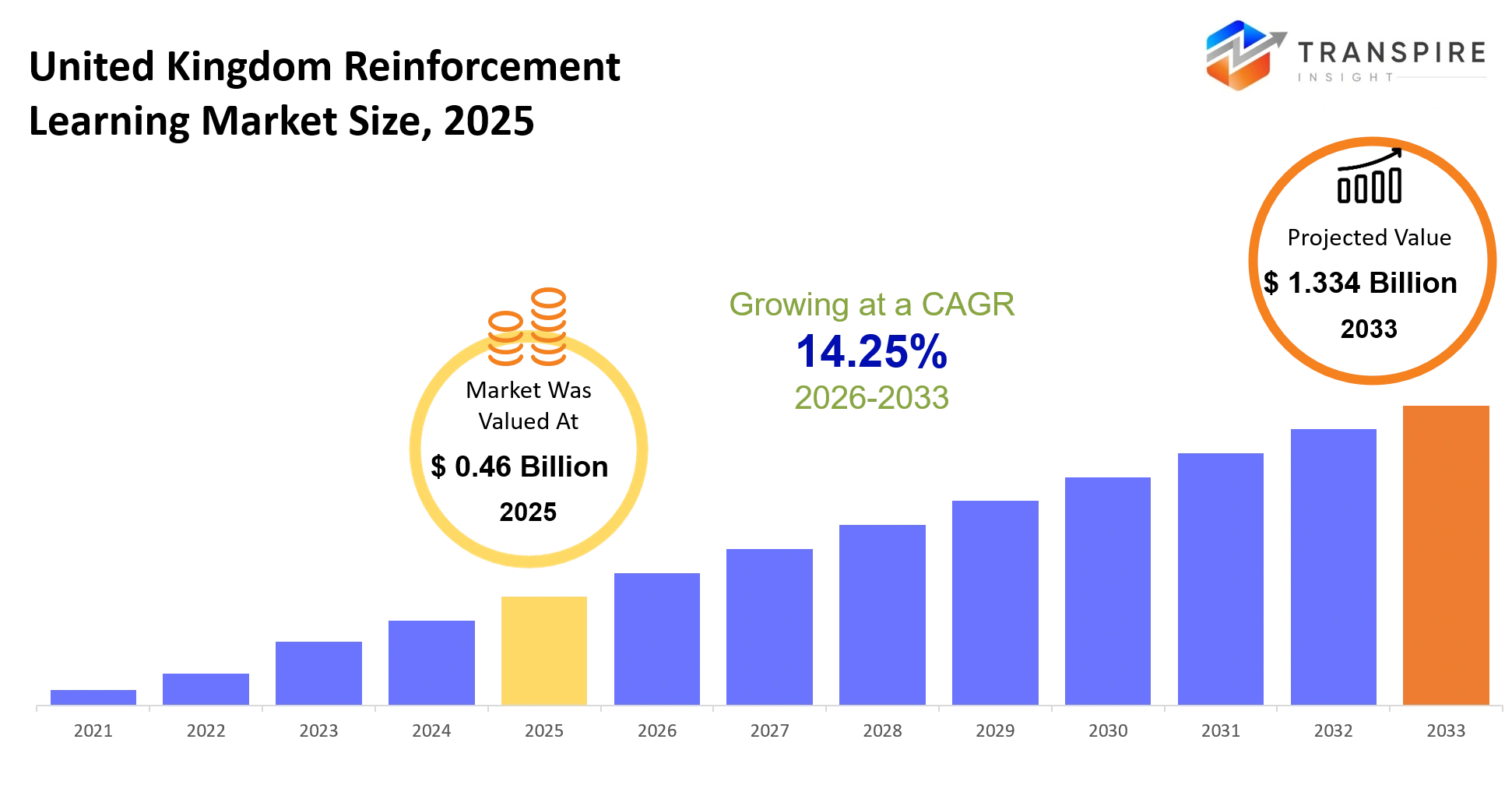
As per Transpire Insight Analysis the United Kingdom Reinforcement Learning Market size is estimated at USD 0.46 Billion in 2025 and is anticipated to reach USD 1.334 Billion by 2033, growing at a CAGR of 14.25% from 2026 to 2033.
The United Kingdom reinforcement learning market, kind of helps industrial operators make better calls in thorny settings, by letting systems learn how to optimize stuff like energy stewardship, robotic work, freight movement, and independent activities through ongoing feedback. In the last 3–5 years, it seems the market moved away from mostly research driven AI trials, toward solutions that are deployment minded, and that plug into industrial data platforms, plus automation systems. That change was backed by improvements in compute infrastructure, simulation tools , and also by broader enterprise AI adoption. One major trigger was the supply chain disruption, and the energy price volatility that followed geopolitical tensions, which basically nudged businesses to look for sharper optimization techniques for both efficiency and resilience. As companies drift past older analytics approaches, reinforcement learning is spreading too, because it can produce clear operational gains. That, in turn, opens doors for software providers , systems integrators, and industrial AI services companies as well.
United Kingdom Reinforcement Learning Market Size & Forecast:
- United Kingdom Reinforcement Learning Market Size 2025: USD 0.46 Billion
- Expected Market Value 2033: USD 1.334 Billion
- Forecast CAGR: 14.25%
- Leading region in 2025: England
- Fastest Growing region: Scotland
- Key Profile: OpenAI, Google DeepMind, Microsoft, IBM, NVIDIA, Amazon Web Services, DataRobot, H2O.ai, SAS Institute, Intel, Salesforce, SAP, Oracle, Scale AI, Anyscale
Key Market Insights
- England pretty much takes over, with about 75% market share in 2026, and i mean it’s largely fueled by London–based AI hubs, research centers, and enterprise investments.
- Meanwhile, Scotland and Wales show up as the quickest growing regions during 2026–2030, helped along by industrial automation work, plus public AI innovation funding, in a more widespread way.
- When it comes to product segments, software solutions come out on top, holding nearly 60% share, and this really tracks with the appetite for scalable reinforcement learning platforms and those algorithms that just keep getting tweaked.
- Services land in the second-largest segment spot too, since consulting, and integration support keeps spreading across enterprises that are rolling out AI systems, step by step.
- For segment growth, cloud-based reinforcement learning platforms will become the fastest moving one from 2026–2030, mainly because flexible deployment models make adoption easier, for different organizations, not just the big ones.
- Autonomous decision-making applications are the dominant use-case in 2026, with around 45% share, and they’re mostly driven by optimization needs inside industrial operations, where every minute costs something.
- On the applications side, robotics and autonomous systems are fastest-growing, especially as manufacturers integrate adaptive AI controls between 2026, and 2030.
- For end users, financial services lead with nearly 30% share, leaning on reinforcement learning for trading strategies and risk optimization.
- And by 2030, healthcare and life sciences end up as the fastest-growing end-user categories, largely due to AI-enabled diagnostics plus better operational efficiency, across day to day workflows.
What are the Key Drivers, Restraints, and Opportunities in the United Kingdom Reinforcement Learning Market?
Artificial intelligence adoption, automation demand, and rising computing capacity are speeding up the United Kingdom Reinforcement Learning Market, in a sort of “well, it just moves faster” way. The main driver is a tech shift toward autonomous decision systems, after enterprises started bringing in AI for operational efficiency. UK manufacturers, logistics providers, and financial firms are rolling out reinforcement learning models to cut down manual intervention and improve resource utilization. So you get a kinda direct adoption chain, where investments in automation increase AI platform spending , and that in turn accelerates enterprise deployments.
The strongest constraint is the limited availability of high-quality industrial datasets , plus the complex integration needs that come with them. A lot of organizations can’t quickly connect reinforcement learning models with existing infrastructure because legacy systems often demand expensive upgrades. That pushes deployment timelines out, it raises implementation costs, and it kinda suppresses the revenue potential for smaller technology providers. Based on Transpire Insight review of regional procurement announcements and launch schedules, supply chain concentration still looks like the primary execution risk, not the only one, but the biggest for now.
The biggest opportunity is in mixing reinforcement learning with edge computing and digital twins. UK industrial clusters are putting money into smart factories and connected infrastructure, which makes it easier for real-time AI optimization to actually happen. Wider adoption of simulation platforms, along with cloud-based AI environments , should unlock new uses across manufacturing, transportation, and energy sectors.
What Has the Impact of Artificial Intelligence Been on the United Kingdom Reinforcement Learning Market?
Artificial intelligence and digital tech are, like, changing the United Kingdom Reinforcement Learning Market in a big way. They make autonomous monitoring possible, support adaptive control systems, and even streamline automated compliance procedures. Industrial teams are already leaning on AI powered reinforcement learning models to tune production routines , control energy usage more carefully, and modify operating settings without someone constantly watching over everything. Also, digital twins plus sensor networks are giving much clearer visibility since they feed real time information into the whole decision flow.
At the same time, machine learning approaches are being used more and more for predictive maintenance plus performance tuning. Manufacturing and logistics firms often rely on past operational records to anticipate equipment breakdowns, re-balance resource allocation, and cut down on those annoying surprises that cause downtime. In general, these methods can help businesses raise asset utilization and get clear efficiency benefits, especially when automated decision cycles start running smoothly.
AI enabled reinforcement learning offerings are backing better operational uptime, quicker reaction times, and more consistent process accuracy. Still, the uptake is not effortless because the integration expenses stay high. On top of that, industry specific datasets are not always easy to find, and it can be tricky to validate models when conditions get complicated in the real world. Businesses therefore need to build stronger data infrastructure, and also bring in specialized know-how, just to get dependable, AI driven results across different industrial setups.
Key Market Trends
- From 2024 to 2026 AI investments went up and it kinda pushed more reinforcement learning into actual use, especially as UK enterprises started prioritizing automation and that sort of intelligent process refinement thing.
- Cloud computing adoption also spread after 2025, which basically let teams run reinforcement learning at scale, without needing to buy a ton of enterprise hardware upfront.
- In 2026 manufacturing firms moved faster with AI automation efforts, and they began weaving reinforcement learning directly into robotics plus industrial control frameworks, not just pilots.
- Meanwhile UK government AI initiatives starting from 2025, boosted research funding, and nudged the commercial side toward adopting more advanced learning technologies.
- Financial institutions leaned into reinforcement learning after 2024, focusing on things like portfolio optimization, fraud recognition, and automated decision workflows that can keep running day to day.
- Digital twin adoption picked up steam during 2025–2026, and it helped reinforcement learning models get tested more safely, before anything hits real industrial deployment.
- Then in 2026 edge AI integration became a notable trend, cutting down latency for autonomous operational use cases, which is pretty important in practice.
- Healthcare organizations looked into reinforcement learning starting in 2025, aiming for personalized treatment planning as well as resource optimization for clinical operations.
- After 2025, partnerships between technology providers and enterprises grew wider, and that sped up the development of tailored AI platform capabilities.
- Still, data availability challenges stayed a major market trend through 2026, so investment decisions were heavily influenced by synthetic data generation technologies, and how quickly those can be produced.
United Kingdom Reinforcement Learning Market Segmentation
By Component :
Software solutions represent a major component as organizations adopt advanced algorithms , automation tools, and decision making systems. Software platforms will support model development , testing, and deployment across industrial, financial, and healthcare applications. Demand will rise as businesses look for adaptable AI systems to improve daily operations.
Services also matter, because they support implementation through consulting, integration, maintenance, and technical support activities. Platform providers will expand their service menus to make adoption smoother for enterprises that have limited AI know how. Other pieces, including specialized tools and supporting technologies, will help move things forward for wider uptake across different sectors.
By Deployment :
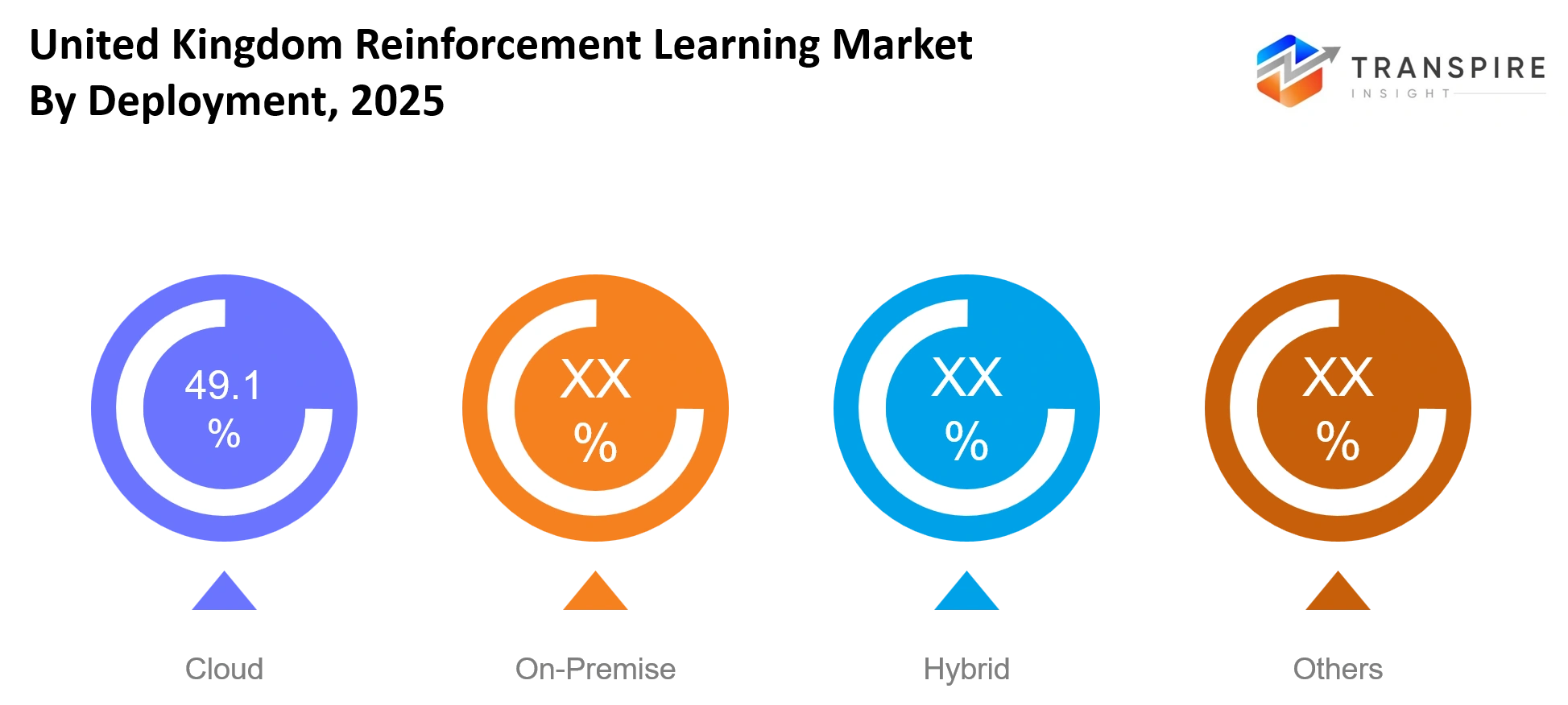
Cloud deployment is getting more attention due to lower infrastructure costs, quicker scalability, and easier access to advanced computing resources. Cloud based solutions will let organizations develop and run reinforcement learning applications without big hardware investments. Growth should keep going since many businesses are prioritizing flexible AI infrastructure.
On premise deployment still matters for industries that need tight data control, strict security standards, and customized systems. Hybrid deployment models will gain steam by mixing cloud flexibility with local processing capabilities. Meanwhile, other deployment approaches will still be useful for niche applications that need a more specialized operational environment.
By Application :
Robotics applications are a pretty big deal for adoption, because industries are pushing reinforcement learning into automation, process tuning, and kind of adaptive machine control. In manufacturing, facilities will likely put more money into intelligent robots so they can boost output, and also cut down on operational errors, in a more steady way. Meanwhile autonomous vehicle development will get a lift from better decision making algorithms, which helps with safer and faster choices, especially when things get messy on the road.
Also, recommendation systems, finance, healthcare, and gaming will keep growing, driven by richer data analysis and more personalized solutions. Financial orgs, for example, will lean on reinforcement learning for risk handling and trading optimization. In healthcare, these methods can help with treatment planning, while other uses will open up extra opportunities across multiple technology-driven industries.
By Enterprise Size :
Right now, big enterprises still stay the main adopters, mostly because they have bigger tech budgets, mature data infrastructure, and broader AI deployment programs. Large organizations will keep funding automation projects that raise efficiency and improve decision accuracy, even when the requirements change. Manufacturing, finance, and tech companies should remain among the biggest contributors overall.
For SMEs, adoption will rise bit by bit, mainly because cloud platforms lower the initial effort and give more affordable AI functions. Smaller businesses can use ready-to-go platforms, and they can also rely on service-based models, without building everything from scratch. Other enterprise types will also chip in through specialized applications, but those usually need customized reinforcement learning solutions, so setup can look a little different.
By End User :
BFSI is basically seen as a major end-user segment, because it shows up in fraud detection, portfolio optimization and those more or less automated financial decisions. Financial institutions will keep adopting AI solutions that are AI-driven, to bump up operational efficiency and customer services. Also Healthcare, and manufacturing sectors will probably have strong adoption too, not just light experiments.
Meanwhile IT and telecom companies are likely to put money into reinforcement learning for network optimization, automation, and service enhancement, that’s kind of the theme. Retail organizations will use AI technologies for demand forecasting and for improving the whole customer experience. Other end users will also look at various applications across logistics, energy, and industrial operations, even if the use cases are a bit different.
By Technology :
Deep reinforcement learning drives tech adoption because it performs well in those hard, complex decision-making situations, where it is not so easy. Advanced neural networks will back applications that need continuous learning along with large-scale data processing. Overall, industries will expand their use of deep learning approaches for automation, and optimization, in a steady way.
Model-based and model-free reinforcement learning will keep evolving too, mainly as computing power grows and algorithm efficiency gets better. Model-based techniques will enable simulation-based applications, while model-free approaches will tackle dynamic operational hurdles. There will be other technologies as well, ones that support niche scenarios where adaptive learning is a must, not optional.
What are the Key Use Cases Driving the United Kingdom Reinforcement Learning Market?
In the United Kingdom Reinforcement Learning Market, demand is kinda mostly steered by industrial automation, where manufacturers pick up AI systems for adaptive control, robotics optimization and production efficiency. In other words, factories are using reinforcement learning to push better output quality, cut down on downtime ,and handle those complex operations more smoothly
At the same time, financial services and healthcare keep growing their use through risk optimization and fraud detection, plus more careful treatment planning and resource management. Banks and hospitals (with technology providers too) are putting money into AI solutions that boost how accurate decisions are, and also how well operations run
And then there are the new, emerging uses like smart energy management and autonomous systems. Utilities and transport technology companies are exploring reinforcement learning for real time optimization, predictive control, and this future style infrastructure management, you know, the kind that runs on AI more heavily over time
|
Report Metrics |
Details |
|
Market size value in 2025 |
USD 0.46 Billion |
|
Market size value in 2026 |
USD 0.525 Billion |
|
Revenue forecast in 2033 |
USD 1.334 Billion |
|
Growth rate |
CAGR of 14.25% from 2026 to 2033 |
|
Base year |
2025 |
|
Historical data |
2021 - 2024 |
|
Forecast period |
2026 - 2033 |
|
Report coverage |
Revenue forecast, competitive landscape, growth factors, and trends |
|
Regional scope |
United Kingdom (England, Scotland, Wales, Northern Ireland) |
|
Key company profiled |
OpenAI, Google DeepMind, Microsoft, IBM, NVIDIA, Amazon Web Services, DataRobot, H2O.ai, SAS Institute, Intel, Salesforce, SAP, Oracle, Scale AI, Anyscale . |
|
Customization scope |
Free report customization (country, regional & segment scope). Avail customized purchase options to meet your exact research needs. |
|
Report Segmentation |
By Component (Software, Services, Platforms, Others); By Deployment (Cloud, On-Premise, Hybrid, Others); By Application (Robotics, Autonomous Vehicles, Recommendation Systems, Finance, Healthcare, Gaming, Others); By Enterprise Size (Large Enterprises, SMEs, Others); By End User (BFSI, Healthcare, Manufacturing, IT & Telecom, Retail, Others); By Technology (Deep Reinforcement Learning, Model-Based RL, Model-Free RL, Others) |
Which Regions are Driving the United Kingdom Reinforcement Learning Market Growth?
London and South East England kind of dominate the United Kingdom Reinforcement Learning Market, with around 45% share because AI research stays concentrated there, along with venture funding and that enterprise tech adoption, it all stacks up. On top of that there are government backed AI programs, digital infrastructure build out, and solid university research communities that quietly hold up the regional lead. You can also see the advantage when tech firms, financial institutions, and AI startups keep pouring investment into advanced machine learning solutions. Overall leadership should stay in place up to 2033 since high value sectors keep pulling demand for automation and more intelligent decision making systems.
Scotland brings steadier growth, mostly from consistent public sector spending, good academic research ability, and industrial modernization programs. It’s different in practice though , with tighter connections to engineering , energy, and manufacturing use cases rather than a big fintech pull. Regulatory support for new ideas, plus steady funding habits, helps make demand feel dependable for industrial buyers. In the forecast window, this kind of stability should keep reinforcing learning adoption growing across niche and specialized applications too, at a measured pace.
The North West region looks like the fastest grower, as manufacturing modernization and industrial automation spending keeps speeding up adoption. More recently, smart factory programs, digital transformation initiatives, and broader robotics use have opened new chances for reinforcement learning solutions. As manufacturing players increase their interest, technology vendors are likely to deepen regional partnerships and deployment services. Between 2026 and 2033, the area should draw investors chasing industrial AI growth, so the pipeline feels fuller going forward.
Who are the Key Players in the United Kingdom Reinforcement Learning Market and How Do They Compete?
Competition in the United Kingdom Reinforcement Learning Market is still pretty moderately fragmented, with technology providers, cloud companies, research organizations, and specialized AI firms running into each other—mostly via innovation not price only. The edge usually comes down to algorithm performance, computing groundwork, how well things integrate, plus industry specific solutions. Older tech players are holding onto enterprise relationships, meanwhile newer AI companies are rolling out more specialized platforms for industrial and commercial uses.
DeepMind kind of competes by leaning hard into advanced reinforcement learning research and algorithm development, aiming at complex AI models that sharpen decision making. They also keep differentiation going through research know-how, and by collaborating with academic institutions, which makes sense. Microsoft increases the fight through cloud based AI services, giving enterprise buyers scalable infrastructure, and bundled machine learning tools that are actually used.
NVIDIA goes another route with high performance computing solutions, speeding up reinforcement learning workloads using specialized AI hardware and software platforms. IBM, on the other hand, targets enterprise adoption via AI consulting, automation solutions, and deployment support that’s tuned to particular industries. And Amazon Web Services competes through cloud AI capabilities, letting organizations build, test, and ship reinforcement learning applications with flexible computing resources and, yes, the usual practical scaling approach.
Company List
- OpenAI
- Google DeepMind
- Microsoft
- IBM
- NVIDIA
- Amazon Web Services
- DataRobot
- H2O.ai
- SAS Institute
- Intel
- Salesforce
- SAP
- Oracle
- Scale AI
- Anyscale
Recent Development News
In April 2026, Ineffable Intelligence secured investment support from the UK Government’s Sovereign AI Fund and British Business Bank. The investment will help scale a UK-based self-learning AI company developing reinforcement learning systems that learn through experience and support advanced AI applications in science and engineering.
Source https://www.gov.uk/
In May 2026, NVIDIA partnered with Ineffable Intelligence to build reinforcement-learning AI agents and develop infrastructure for large-scale reinforcement learning workloads. The collaboration will strengthen computing capabilities for advanced AI models by combining NVIDIA hardware platforms with reinforcement learning research from the UK startup.
Source https://uk.marketscreener.com/
What Strategic Insights Define the Future of the United Kingdom Reinforcement Learning Market?
The United Kingdom Reinforcement Learning Market is likely to drift toward more specialized self directing decision systems within the next 5–7 years, as organizations keep pushing for AI driven efficiency, real time optimization and flexible automation. Beneath that shift sits a bigger pull towards deeper reinforcement learning, cloud computing, edge AI, and industrial data platforms actually being tied together in practice. At the same time, there is a kind of less obvious risk around heavy market concentration with just a handful of AI infrastructure providers, and that could raise deployment costs, plus it may curb experimentation by smaller developers.
Still, an emerging chance is showing up in a more hybrid direction: pairing reinforcement learning with digital twins, especially across the UK manufacturing clusters. That combo can make it easier to rehearse decisions in a safer virtual setup before anything touches real production lines. Going forward, market players should craft solutions that are focused on specific sectors, tighten partnerships with the infrastructure providers ,and also keep investing in clean and well labeled training data, so the resulting apps stay dependable and deliver industrial value you can actually measure.
United Kingdom Reinforcement Learning Market Report Segmentation
By Component
- Software
- Services
- Platforms
By Deployment
- Cloud
- On-Premise
- Hybrid
By Application
- Robotics
- Autonomous Vehicles
- Recommendation Systems
- Finance
- Healthcare
- Gaming
By Enterprise Size
- Large Enterprises
- SMEs
By End User
- BFSI
- Healthcare
- Manufacturing
- IT & Telecom
- Retail
By Technology
- Deep Reinforcement Learning
- Model-Based RL
- Model-Free RL
Frequently Asked Questions
Find quick answers to common questions.
The expected United Kingdom Reinforcement Learning Market size for the market will be USD 1.334 Billion in 2033.
Key segments for the United Kingdom Reinforcement Learning Market are By Component (Software, Services, Platforms, Others); By Deployment (Cloud, On-Premise, Hybrid, Others); By Application (Robotics, Autonomous Vehicles, Recommendation Systems, Finance, Healthcare, Gaming, Others); By Enterprise Size (Large Enterprises, SMEs, Others); By End User (BFSI, Healthcare, Manufacturing, IT & Telecom, Retail, Others); By Technology (Deep Reinforcement Learning, Model-Based RL, Model-Free RL, Others).
Major United Kingdom Reinforcement Learning Market players are OpenAI, Google DeepMind, Microsoft, IBM, NVIDIA, Amazon Web Services, DataRobot, H2O.ai, SAS Institute, Intel, Salesforce, SAP, Oracle, Scale AI, Anyscale.
The United Kingdom Reinforcement Learning Market size is USD 0.46 Billion in 2025.
The United Kingdom Reinforcement Learning Market CAGR is 14.25% from 2026 to 2033.
- OpenAI
- Google DeepMind
- Microsoft
- IBM
- NVIDIA
- Amazon Web Services
- DataRobot
- H2O.ai
- SAS Institute
- Intel
- Salesforce
- SAP
- Oracle
- Scale AI
- Anyscale
About the Authors

Mayur Shinde
I am Mayur Shinde, a Senior Research Analyst at Transpire Insight, specializing in the Automotive & Transportation and Information & Communication Technology (ICT) Industry. My work focuses on analyzing emerging market trends, technological advancements, competitive landscapes, and industry developments to deliver accurate, data-driven insights. I am passionate about transforming complex market information into clear, actionable content that helps businesses, professionals, and decision-makers stay informed and make confident strategic decisions.

Chakradhar Khansole
Chakradhar serves as the Research Director at Transpire Insight, bringing over 8 years of experience in technology, innovation, and strategic market intelligence. He specializes in transforming complex market data into actionable business insights that enable organizations to make informed, growth-oriented decisions. Recognized for his strategic vision and analytical expertise, Chakradhar leads high-impact research initiatives, delivering comprehensive market assessments, competitive intelligence, and forward-looking industry analysis.
Recently Published Reports
-
Apr 2026
3D Optical Profiler Market
3D Optical Profiler Market Size, Share & Analysis Report By Type (Desktop 3D Optical Profiler, and Portable 3D Optical Profiler), By Technology (Confocal Technology, and White Light Interference), By End-Use Industry (Manufacturing, Research Institutions, Automotive, Aerospace and Defense, Medical Devices, and Other), and Geography (North America, Europe, Asia-Pacific, Middle East and Africa, South and Central America), 2021 - 2031
-
Apr 2026
Depth Sensor Market
Depth Sensor Market Size, Share & Analysis Report By Type (Infrared Depth Sensors, Time-of-Flight (ToF) Sensors, Stereo Vision Sensors, Structured Light Sensors, Ultrasonic Depth Sensors), By Application (Automotive, Robotics, Gaming, Consumer Electronics, Industrial Automation, Healthcare, Security & Surveillance, Others), By End Users (Automotive Manufacturers, Consumer Electronics Companies, Healthcare Providers, Industrial Companies, Security Agencies, Gaming Companies, Robotics Companies, Others), and Geography (North America, Europe, Asia-Pacific, Middle East and Africa, South and Central America), 2021 – 2031
-
Apr 2026
Digital Manufacturing Market
Digital Manufacturing Market Size, Share & Analysis Report By Component (Hardware, Software, and Services), By Technology (Robotics, 3D Printing, Internet of Things (IoT), and Others), By Application (Automotive and Transportation, Aerospace and Defense, Consumer Electronics, Industrial Machinery, and Others), By Process Type (Computer-Based Designing, Computer-Based Simulation, Computer 3D Visualization, Analytics, and Others), and Geography (North America, Europe, Asia-Pacific, Middle East and Africa, South and Central America), 2021 – 2031
-
Apr 2026
Digital Visa Services Market
Digital Visa Services Market Size, Share & Analysis Report By Type (Individual Travelers, Group Travelers), By Application (Tourism, Business Travel, Others), and Geography (North America, Europe, Asia-Pacific, Middle East and Africa, South and Central America), 2021 – 2031