United Kingdom Medical Imaging Market & Forecast:
- United Kingdom Medical Imaging Market 2025: USD 4089.8 Mn
- United Kingdom Medical Imaging Market 2033: USD 6413.7 Mn
- United Kingdom Medical Imaging Market CAGR: 5.80%
- United Kingdom Medical Imaging Market Segments: By Imaging Modality (X-ray, Computed Tomography, Magnetic Resonance Imaging, Ultrasound, Nuclear Imaging), By Application (Cardiology, Oncology, Neurology, Orthopedics), By End-User (Hospitals, Diagnostic Imaging Centers, Research Institutes).
To learn more about this report,  Download Free Sample Report
United Kingdom Medical Imaging Market Summary:
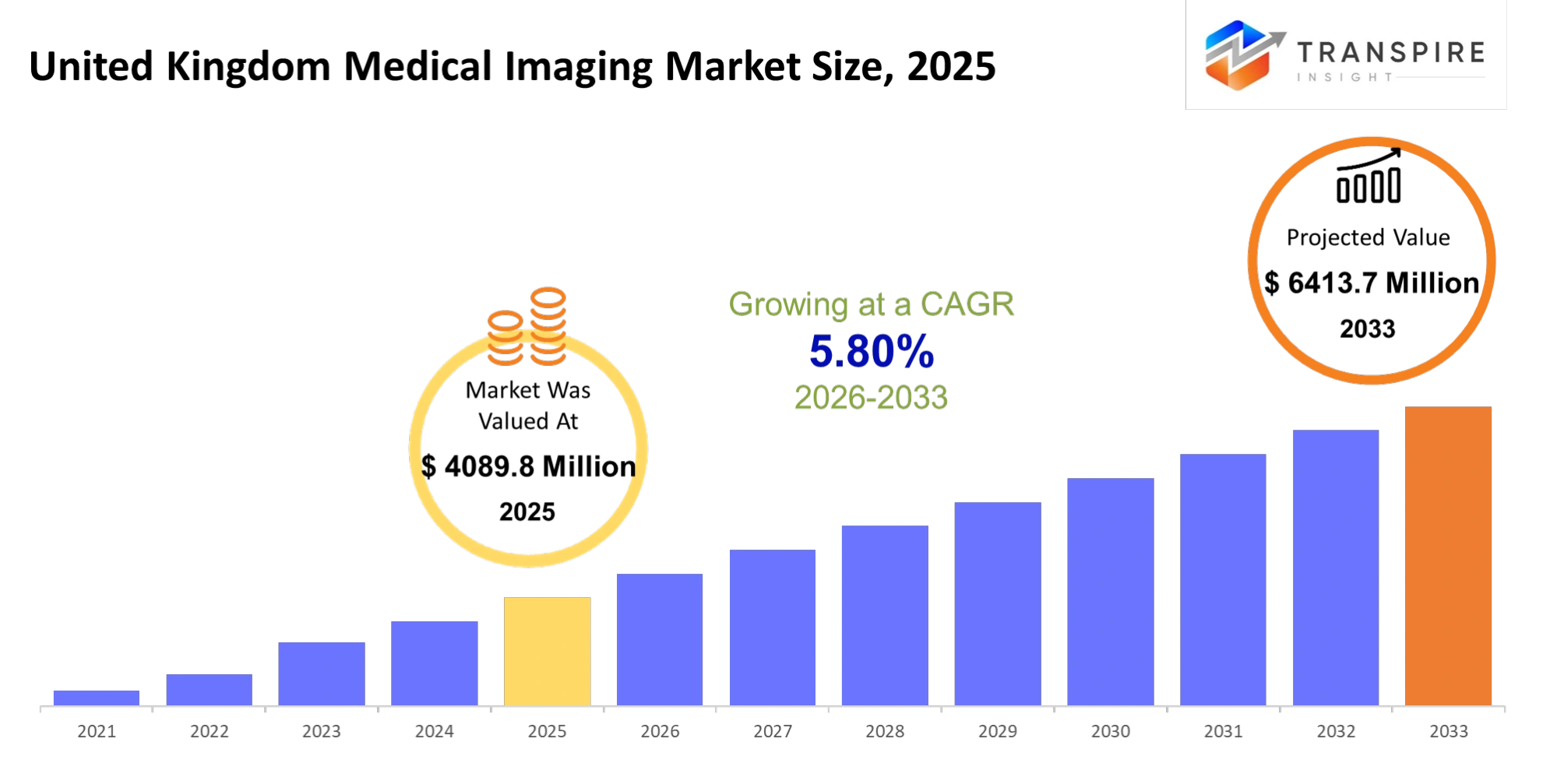
The United Kingdom Medical Imaging Market size is estimated at USD 4089.8 Mn in 2025 and is anticipated to reach USD 6413.7 Mn by 2033, growing at a CAGR of 5.80% from 2026 to 2033. The essential function of imaging technologies which include MRI, CT scans and X-rays and ultrasound systems for discovering diseases in their initial stages and aiding doctors in their treatment decisions shows an upward trend in market demand.The growing need for diagnostic tests which requires regular imaging studies drives market development because chronic diseases especially cancer and cardiovascular diseases have become more common. The UK performs tens of millions of imaging procedures annually, with demand continuing to rise because of an aging population and the establishment of new screening programs. Government funding for healthcare development especially through community diagnostic centre creation and imaging technology upgrades has improved access to sophisticated diagnostic capabilities throughout the nation.
Key Market Trends & Insights:
- The United Kingdom is facing its most serious diagnostic backlog problem because more patients arrive at hospitals while hospitals cannot keep up with their needs for medical imaging. The healthcare systems face increased pressure because millions of patients require essential scans which include MRI and CT. Diagnostic delays create treatment problems because they hinder doctors from determining the appropriate treatment for patients who have critical conditions like cancer and cardiovascular diseases. Healthcare providers now work to solve this problem through three main strategies which include better workflow systems and extended operating times and improved speed of medical imaging machines.
- The National Health Service and private imaging providers established partnerships to address the growing need for diagnostic testing. The partnerships enable faster patient service Because they use external providers to handle imaging tasks which include scan interpretation and report creation. Private businesses deliver additional operational capacity together with cutting-edge technology and specialized knowledge to support public health systems.
- The United Kingdom experiences increasing popularity of hybrid imaging systems which include PET-CT and SPECT-CT because these systems provide combined functional and anatomical imaging capabilities through one scanning process. The advanced systems deliver enhanced diagnostic capabilities which enable better detection of medical conditions in oncology, cardiology and neurology fields. Hybrid imaging shows both structural and functional details which help doctors to find diseases at an earlier stage and create better treatment strategies.
- The demand for outpatient imaging services has grown because healthcare systems need to decrease hospital traffic while making it easier for patients to obtain services. Patients now prefer standalone diagnostic centres and clinics which offer faster access to routine imaging tests. Hospitals can use this new system to treat critical patients while all routine diagnostic work takes place at outpatient facilities.
- The United Kingdom has seen a rise in preventive healthcare which has led to more people using imaging-based screening programs. The government medical programs which aim to identify breast cancer and lung cancer and cardiovascular diseases at earlier stages have created a major increase in imaging demand. Through regular screening people can get tested early which leads to better treatment outcomes and decreases total healthcare expenses.
United Kingdom Medical Imaging Market Segmentation
By Imaging Modality
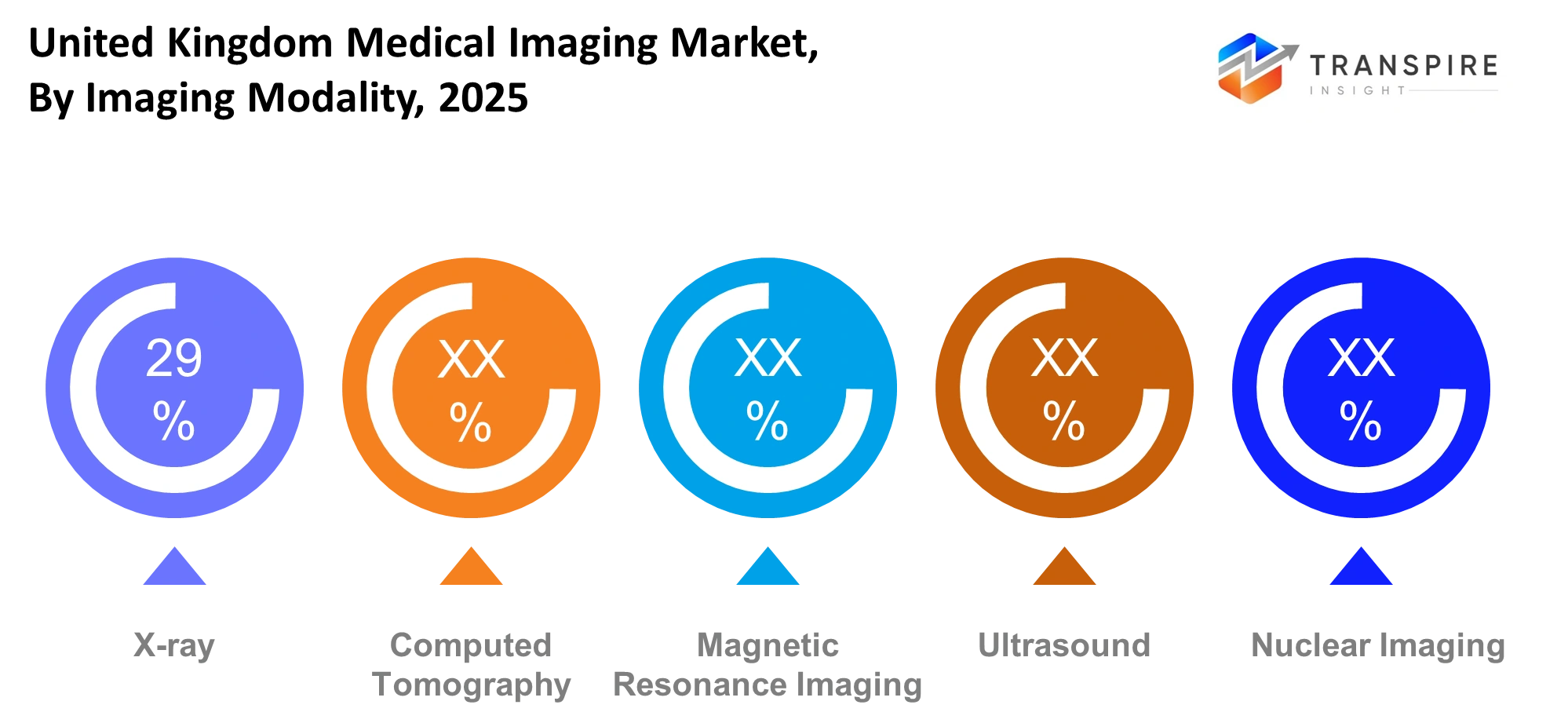
- X-ray : The United Kingdom uses X-ray imaging because it provides fast and affordable diagnostic tests which all healthcare facilities can access. The First-line diagnostic tool functions as a primary medical test in emergency situations and routine medical examinations. Digital X-ray systems provide superior image quality while decreasing radiation exposure and enabling immediate image sharing between different locations. The cost-effective solution of X-ray technology remains the prevailing method for medical imaging because it delivers efficient results across outpatient and primary care environments.
- Computed Tomography (CT): provides detailed cross-sectional body images which enable doctors to diagnose complex medical conditions including cancers and internal injuries and vascular diseases. The United Kingdom emergency departments use CT scans because they provide fast and accurate results during critical situations such as trauma and stroke. The development of low-dose CT technology together with quicker scanning systems enables greater patient safety while increasing hospital capacity for patient care. The high demand for CT scans exists because they provide better accuracy than X-rays even though CT scans cost more than X-rays.
- Magnetic Resonance Imaging (MRI): The United Kingdom healthcare system uses Magnetic Resonance Imaging (MRI) because it provides superior detailed imaging of soft tissues which serves essential purposes in diagnosing neurological and musculoskeletal and cardiovascular disorders. MRI serves as an important diagnostic tool which enables medical professionals to identify brain disorders and spinal complications and joint problems while keeping patients safe from harmful radiation exposure. The high costs and extended scanning times of MRI systems make them less accessible than other imaging methods but technical developments in quick imaging and better patient comfort have increased their usage. The demand for MRI services rises because medical professionals need precise diagnostic tools which do not require invasive procedures.
- Ultrasound: Operates as a secure and non-destructive imaging method which medical professionals in the United Kingdom use for various purposes which include prenatal monitoring and abdominal assessments and cardiac evaluationsThe healthcare industry benefits from the increasing availability of portable ultrasound devices which healthcare providers can use in both community health centers and distant areas. The ongoing enhancements in image quality and diagnostic capabilities make ultrasound tests more essential for both standard medical treatment and specialized health assessments.
- Nuclear Imaging: Nuclear imaging through PET and SPECT scans functions as a sophisticated diagnostic method which medical professionals in the United Kingdom use to assess organ functionality and identify diseases through molecular examination. The medical field uses this technique in oncology and cardiology and neurology to identify diseases in their initial stage and to monitor patient progress throughout their treatment. The clinical field benefits from nuclear imaging which provides operational data that aids doctors in their decision making process. The medical imaging market experiences growth from nuclear imaging systems which demand expensive equipment and specialized facilities because personalized medicine and targeted therapies become more prevalent in the industry.
To learn more about this report, Download Free Sample Report
By Application
- Cardiology: The United Kingdom medical field relies on medical imaging technologies to diagnose and treat heart diseases which include coronary artery disease and heart failure. Physicians use CT, MRI, and ultrasound (echocardiography) to examine cardiac structure and function. The increasing demand for early cardiovascular disease detection together with advanced technologies brings about higher adoption of imaging systems which now produce more accurate results that assist in treatment planning and improve patient outcomes.
- Oncology: Medical imaging serves a vital function in oncology because it enables cancer detection and staging together with treatment progress assessment throughout the United Kingdom. The medical field uses CT and MRI and PET and X-ray systems to find tumors and assess how well treatments work. The rising number of cancer cases together with government screening initiatives has created a significant increase in need for medical imaging procedures. The new imaging technologies enable doctors to discover tumors at early stages while locating tumors with high accuracy which helps doctors create personalized treatment plans that increase patient survival rates.
- Neurology: The United Kingdom medical field uses neurological imaging technology to identify various disorders which include stroke and brain tumors and epilepsy and neurodegenerative diseases. Doctors use MRI and CT scans to create images of brain structures which help them find brain abnormalities. The increasing number of elderly people along with rising neurological disorder cases creates a greater need for advanced medical imaging technologies. Technological advancements lead to better diagnostic accuracy which enables doctors to detect health problems at early stages while they manage intricate neurological conditions.
- Orthopedics: The United Kingdom uses medical imaging to diagnose bone fractures and joint disorders and musculoskeletal injuries through its applications in orthopedics. The primary imaging method for medical use remains X-rays while MRI and CT scans provide detailed imaging solutions for soft tissues and complex medical conditions. The increasing number of sports injuries and arthritis cases together with age-related bone disorders create higher demand for orthopedic imaging services. Imaging technologies achieve better accuracy through their advancements which enable clinicians to create successful treatment programs and rehabilitation strategies.
By End-User
- Hospitals: The United Kingdom medical imaging market sees its highest end-user segment through hospitals which manage both diagnostic and emergency medical cases. The hospitals use their advanced imaging systems which include MRI and CT and X-ray machines, to provide complete patient treatment. Hospitals use imaging services to obtain precise results, which enable them to develop treatment strategies and observe patient progress. The increasing number of patients and government funding for hospital development work together to create stronger requirements for imaging services within this sector.
- Diagnostic imaging centers: They are rapidly growing in the United Kingdom as they offer specialized and efficient imaging services outside hospital settings. The centers deliver service with faster appointment times and shorter patient waiting periods and affordable diagnostic tests. The center uses advanced imaging equipment to perform both standard medical procedures and research-based patient assessments. Urban and semi-urban areas are witnessing a rise in imaging centers because of two growing trends which include increased outpatient medical treatment and need for simple-to-use diagnostic facilities.
- Research institutes: In the United Kingdom use medical imaging technologies to conduct clinical research work and develop drugs and study disease diagnosis and treatment methods. The institutions use advanced imaging technology to develop new diagnostic methods which help them understand complex medical conditions. Imaging technology serves as the vital force behind medical breakthroughs which drive progress in oncology and neurology research fields. The sector expands because of increased funding healthcare research and the partnerships between academic institutions and industry organizations.
Country Insights
The public healthcare system which the National Health Service operates drives the United Kingdom medical imaging market because it handles most diagnostic tests.The country's increasing need for medical imaging services results from its aging population together with the growing number of people who develop chronic diseases including cancer and cardiovascular diseases. The government responded to rising patient demands which exceeded existing diagnostic capabilities by establishing Community Diagnostic Centres and funding advanced imaging equipment.
Urban regions such as London and the South East enjoy superior access to advanced imaging technology and private diagnostic facilities, whereas northern and rural areas experience restricted capacity together with extended wait times. Mobile imaging units and decentralized diagnostic hubs serve as solutions to combat these access problems. The UK is experiencing increased use of digital health solutions which include AI-based imaging and teleradiology systems that connect various regions while enhancing diagnostic processes throughout the country.
Recent Development News
- Expansion of AI-Enabled Imaging Infrastructure (2026) Current UK policy changes demonstrate strong governmental support for implementing AI-based imaging systems. Scotland has introduced new initiatives that will use AI-powered scanners to enhance both diagnostic speed and accuracy while dedicating resources to modernize national imaging systems. The current situation shows that organizations increasingly depend on automated systems to solve their staffing problems while fulfilling their rising requirements for imaging services.
- AI Improving Patient Understanding of Scan Reports (2026) A recent study in the UK found that artificial intelligence can make radiology reports nearly twice as easy for patients to understand. AI tools simplify complex medical language to enhance patient engagement while maintaining accurate information delivery. This marks a shift toward more patient-centric imaging services.
|
Report Metrics |
Details |
|
Market size value in 2025 |
USD 4089.8 Mn |
|
Market size value in 2026 |
USD 4322.8 Mn |
|
Revenue forecast in 2033 |
USD 6413.7 Mn |
|
Growth rate |
CAGR of 5.80% from 2026 to 2033 |
|
Base year |
2025 |
|
Historical data |
2021 – 2024 |
|
Forecast period |
2026 – 2033 |
|
Report coverage |
Revenue forecast, competitive landscape, growth factors, and trends |
|
Country scope |
United Kingdom |
|
Key company profiled |
Siemens Healthineers AG, GE HealthCare Technologies Inc., Philips Healthcare, Canon Medical Systems Corporation, Fujifilm Holdings Corporation, Hitachi Medical Systems, Carestream Health Inc., Hologic Inc., Samsung Medison Co. Ltd., Esaote S.p.A., Shimadzu Corporation, Agfa-Gevaert Group, Konica Minolta Inc., Neusoft Medical Systems Co. Ltd., Mindray Medical International Ltd. |
|
Customization scope |
Free report customization (country, regional & segment scope). Avail customized purchase options to meet your exact research needs. |
|
Report Segmentation |
By Imaging Modality (X-ray, Computed Tomography, Magnetic Resonance Imaging, Ultrasound, Nuclear Imaging), By Application (Cardiology, Oncology, Neurology, Orthopedics), By End-User (Hospitals, Diagnostic Imaging Centers, Research Institutes). |
Key United Kingdom Medical Imaging Market Company Insights
The United Kingdom medical imaging market exists through the operation of international technology companies which include Siemens Healthineers AG and GE HealthCare Technologies Inc. and Philips Healthcare. The companies control the market through their complete collection of advanced imaging systems which includes MRI and CT and ultrasound and AI-enabled solutions. The companies maintain their long-term relationships with the National Health Service by providing advanced medical equipment and complete software solutions which improve diagnostic processes and patient care. Through their ongoing funding of research and development activities which focus on digital imaging and artificial intelligence the company maintains its position as the industry leader.
The main companies, which include Canon Medical Systems Corporation and Fujifilm Holdings Corporation, Hitachi Medical Systems and Carestream Health Inc and Hologic Inc are expanding their market presence through their affordable medical imaging products and their unique diagnostic equipment, and their systems which improve operational efficiency. The companies develop their business through dedicated research of women's health imaging and digital radiography, and portable systems which enable them to respond to changing needs within the healthcare sector. The UK competitive environment develops through technological advancements which create opportunities for organizations to collaborate while they respond to the growing need for imaging solutions which focus on patient requirements.
Company List
- Siemens Healthineers AG
- GE HealthCare Technologies Inc.
- Philips Healthcare
- Canon Medical Systems Corporation
- Fujifilm Holdings Corporation
- Hitachi Medical Systems
- Carestream Health Inc.
- Hologic Inc.
- Samsung Medison Co. Ltd.
- Esaote S.p.A.
- Shimadzu Corporation
- Agfa-Gevaert Group
- Konica Minolta Inc.
- Neusoft Medical Systems Co. Ltd.
- Mindray Medical International Ltd.
United Kingdom Medical Imaging Market Report Segmentation
By Imaging Modality
- X-ray
- Computed Tomography
- Magnetic Resonance Imaging
- Ultrasound
- Nuclear Imaging
By Application
- Cardiology
- Oncology
- Neurology
- Orthopedics
By End-User
- Hospitals
- Diagnostic Imaging Centers
- Research Institutes
Frequently Asked Questions
Find quick answers to common questions.
The approximate United Kingdom Medical Imaging Market size for the market will be USD 6413.7 Million in 2033.
Key segments for the United Kingdom Medical Imaging Market are By Imaging Modality (X-ray, Computed Tomography, Magnetic Resonance Imaging, Ultrasound, Nuclear Imaging), By Application (Cardiology, Oncology, Neurology, Orthopedics), By End-User (Hospitals, Diagnostic Imaging Centers, Research Institutes).
Major United Kingdom Medical Imaging Market players are Nestlé SA, Danone SA, Unilever PLC, PepsiCo Inc., Kellogg Company, General Mills Inc., Mondelez International, The Coca-Cola Company, Arla Foods, DMK Group, Müller Group, FrieslandCampina, Hain Celestial Group, Nature’s Path Foods, Glanbia PLC.
The United Kingdom Medical Imaging Market size is USD 4089.8 Million in 2025.
The United Kingdom Medical Imaging Market CAGR is 5.80%.
- Siemens Healthineers AG
- GE HealthCare Technologies Inc.
- Philips Healthcare
- Canon Medical Systems Corporation
- Fujifilm Holdings Corporation
- Hitachi Medical Systems
- Carestream Health Inc.
- Hologic Inc.
- Samsung Medison Co. Ltd.
- Esaote S.p.A.
- Shimadzu Corporation
- Agfa-Gevaert Group
- Konica Minolta Inc.
- Neusoft Medical Systems Co. Ltd.
- Mindray Medical International Ltd.
Recently Published Reports
-
Apr 2026
AI in Diabetic Retinopathy Market
AI in Diabetic Retinopathy Market Size, Share & Analysis Report By Type (Screening AI Systems, Diagnostic AI Systems, and Predictive AI Models), By Application Segment (Hospitals, Ophthalmology Clinics, Diagnostic Centers, and Research and Development), and Geography (North America, Europe, Asia-Pacific, Middle East and Africa, South and Central America), 2021 - 2031
-
Apr 2026
Psychometric Tests Market
Psychometric Tests Market Size, Share & Analysis Report By Type (Personality Tests, Ability/Aptitude Tests, Skill/Knowledge Tests, and Others), By Application (Talent Acquisition and Talent Management), and Geography (North America, Europe, Asia-Pacific, Middle East and Africa, South and Central America), 2021 – 2031
-
Apr 2026
Rare Biological Sample Collection Market
Rare Biological Sample Collection Market Size, Share & Analysis Report By Type (Isolation Kits & Reagent, Blood Collection Tubes, and Others), By Application (Oncology, Transcriptomics, Pharmacogenomics, and Others), and Geography (North America, Europe, Asia-Pacific, Middle East and Africa, South and Central America), 2021 – 2031
-
Apr 2026
Patient Lift Pendant Market
Patient Lift Pendant Market By Product Type (Wired Pendants, Wireless, Programmable), By Operation Type(Manual, Electric), By End-Users (Healthcare Professionals, Patients), By Application (Hospitals, Homecare, Rehabilitation Centers, Others), By Industry Analysis, Size, Share, Growth, Trends, and Forecasts 2021-2033
Our Clients
.jpg)