
United Kingdom Energy as a Service Market Summary
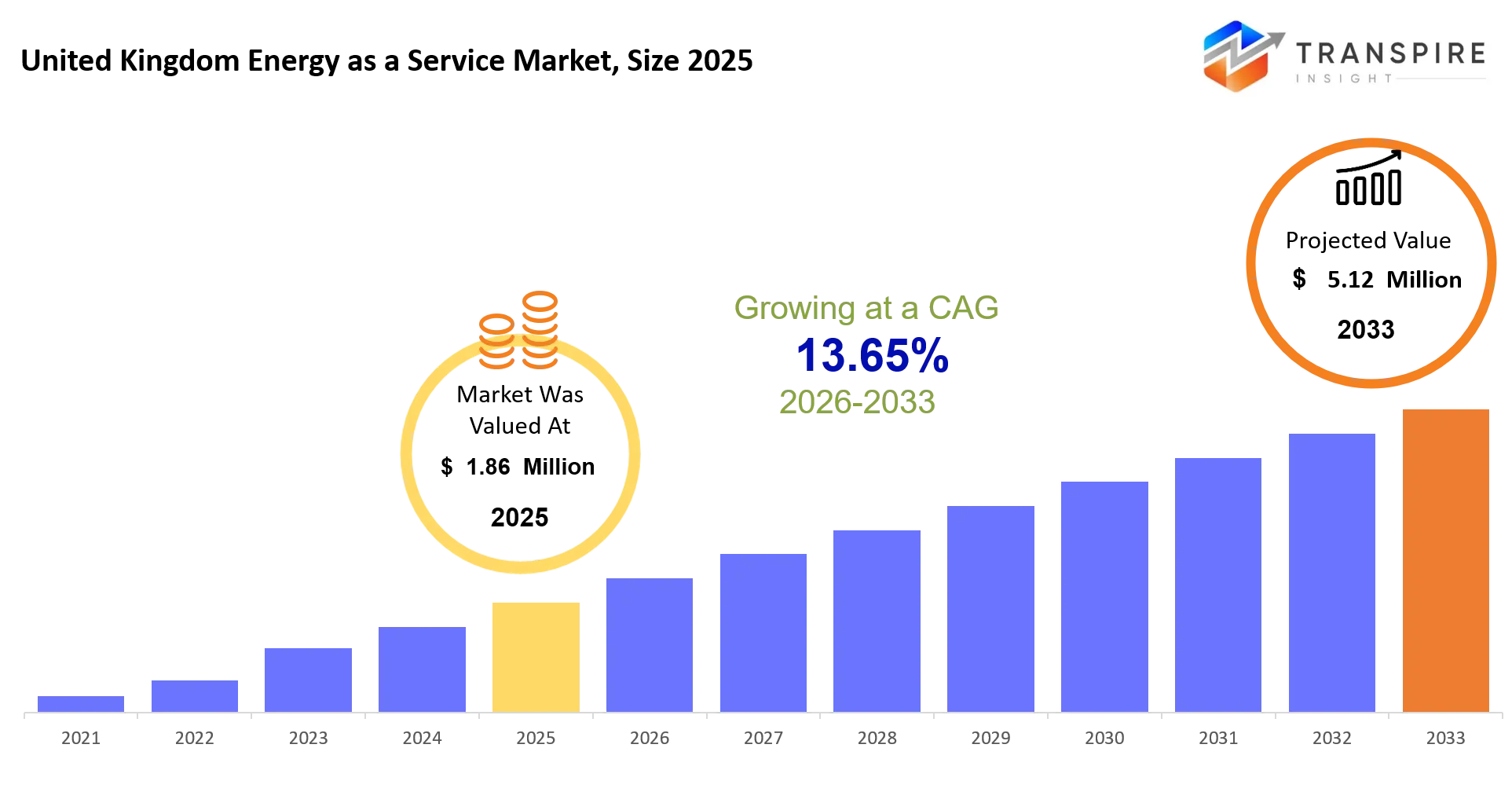
As per Transpire Insight Analysis, the United Kingdom Energy as a Service Market size is estimated at USD 1.86 Billion in 2025 and is anticipated to reach USD 5.12 Billion by 2033, growing at a CAGR of 13.65% from 2026 to 2033.
The United Kingdom Energy as a Service market kind of helps industrial sites, commercial buildings, and infrastructure operators manage energy expenses without having to deal with every efficiency step or low-carbon investment all internally. Basically, the service providers can sort out financing, installation, day to day operation, and ongoing monitoring of assets like heat pumps, energy management systems, batteries, and renewable generation. Then customers usually pay using service agreements or performance linked contracts, which is less messy than paying for everything upfront.
Over the last 3–5 years, things moved away from the more classic “standalone” efficiency projects, and more toward integrated, data-led energy management plus these low-carbon assets. UK energy use data also points to steady improvements in industrial energy intensity. At the same time, heat pump adoption has gone up very fast, noticeably sharper than before.
The Russia-Ukraine war, and the energy price shock that followed in 2022, pushed the transition along even quicker. It showed everyone the financial exposure, especially the volatile gas and electricity costs. So Energy as a Service, in practice, gives a workable route to lower upfront capital needs, put clearer bounds on operating costs, comply with efficiency requirements like ESOS, and keep moving toward decarbonisation goals.
United Kingdom Energy as a Service Market Size & Forecast:
- United Kingdom Energy as a Service Market Size 2025: USD 1.86 Billion
- Expected Market Value 2033: USD 5.12 Billion
- Forecast CAGR: 13.65%
- Leading region in 2025: England
- Fastest Growing region: Scotland
- Key Profile: Schneider Electric, Siemens AG, Honeywell International, ENGIE, Centrica plc, Veolia, EDF Energy, Johnson Controls, ABB Ltd., Hitachi Energy, Enel X, Eaton Corporation, Capgemini, IBM Corporation, GridBeyond
Key Market Insights
- England basically dominates the UK market, it’s bolstered by a lot of commercial work plus infrastructure investment, and as reported 74% of battery output was recorded in 2025.
- Scotland looks like the fastest growing regional opportunity , since renewable generation and flexibility projects just keep rolling out through the 2025–2030 forecast window.
- On the services side , demand services lead the mix with a big 44.56% revenue share in 2024, so flexibility stays pretty central to market growth, or at least that’s the sense of it.
- Supply services still sit as the second biggest service segment, and many businesses combine energy procurement with managed generation , and also efficiency contracts to keep things under control.
- Demand services are also the fastest growing segment through 2030 , powered by flexible tariffs, smart meters, storage, plus automated load management .
- When adoption is considered , commercial applications are the most visible , like offices , retail sites, and other facilities outsourcing energy optimization to cut operating costs and also reduce capital requirements.
- Industrial applications feel like the fastest-growing opportunity too, because energy-intensive facilities are pursuing flexible loads, onsite generation, storage, and tighter energy controls.
- In end users, commercial customers hold the leading role, while industrial buyers are the ones capturing the emerging demand via energy-intensive processes and decarbonization investments.
- Industrial users are the fastest-growing end-user category as electrification, energy volatility, and ESOS action plans push forward managed efficiency investments.
- Centrica also expanded its energy services platform, partnering with NIBE in 2025, to strengthen UK heat-pump servicing and maintenance capabilities.
What are the Key Drivers, Restraints, and Opportunities in the United Kingdom Energy as a Service Market?
Regulatory pressure is basically the main growth driver. ESOS Phase 3 seemed to strengthen audit, reporting, action plan, and disclosure expectations for large undertakings , so there’s kind of a straight line from a mandatory energy assessment to outsourced efficiency work. The government estimate is £1.12 billion in extra business savings tied to ESOS changes from 2023 through 2037 . And that economic argument pushes customers to take the savings they found and turn them into governed , managed projects, which in turn backs recurring service income.
At the same time, grid and data fragmentation still look like the toughest structural brakes. Energy-as-a-service programmes increasingly need smart-meter data, visibility across distributed assets, interoperable controls, and also network information. When interfaces are fragmented, integration gets slow and engineering costs rise , since providers have to connect several older legacy platforms before any optimization can start properly. Government and Ofgem actually flagged these missing bits as blockers to scaling digital services. And from a Transpire Insight review of regional procurement notices and go-to-market timing , supply chain concentration is still the most obvious execution risk.
Looking forward, flexible energy infrastructure might be the clearest next stage opening. UK grid-scale battery capacity reached 7.5 GW in 2025, after 2.3 GW got energized during the year. Providers can bundle batteries, demand response, optimization software, and financing into performance-based contracts. In other words, that approach can convert grid flexibility into ongoing service revenue while helping commercial and industrial customers handle volatile electricity costs more calmly.
What Has the Impact of Artificial Intelligence Been on the United Kingdom Energy as a Service Market?
AI is now kind of shifting energy‑as‑a‑service operations away from periodic watching and more toward nonstop optimization. Machine‑learning tools can study smart meter readings, equipment information, weather signals and even market prices, to spot strange consumption patterns and then trigger automated responses. Also, the Government along with Ofgem basically talks about digitalization as a groundwork for AI‑enabled forecasting, energy administration, and real time decisions, not just optional tech.
For the provider's side, automation may lower the amount of manual monitoring and lift asset utilization at the same time. AI‑assisted forecasting can help predict electricity demand, renewable output, and how equipment behaves, so operators can arrange flexible loads, storage, and on‑site generation a bit more precisely. Then there is predictive maintenance, which can flag weird equipment trends before any real failure, so you get fewer unnecessary visits to site, and better uninterrupted service. Ofgem has, in particular, flagged AI uses across planning, management, forecasting, grid operations, and data analytics.
But the big snag is still data quality together with interoperability. The 2026 Energy Digitalisation Framework points at inconsistent interfaces, plus missing data areas as blockers for both innovation and scaling. AI really cannot produce trustworthy predictions when customer assets run incompatible setups, or when the historical dataset is incomplete, even if everything else looks perfect.
Key Market Trends
- Demand services have been gaining more strategic weight, because flexible tariffs, smart meters , and automated load control keep spreading across the UK energy system, more or less piece by piece.
- By 2025, grid-scale battery capacity will hit 7.5 GW, which basically strengthens storage-led flexibility chances for energy-as-a-service providers, even if it’s still uneven in practice.
- In 2025 alone, a record 2.3 GW of battery capacity was energized, which sped up commercial momentum for managed storage and optimization contract types.
- By June 2026, more than 11.3 million smart meters had moved to half-hourly settlement, and this is enabling flexibility services that are increasingly automated.
- ESOS Phase 3 also tightened reporting and action-plan expectations from 2024, which in turn nudged bigger organizations toward energy-efficiency investments they can actually measure.
- Energy digitalization, then, accelerated in 2026: the government and Ofgem rolled out a coordinated framework aimed at interoperable data and system-wide automation.
- AI adoption is no longer just “try it and see”, because Ofgem is now developing regulatory guidance and technical sandboxes for responsible deployment across the energy sector.
- Heat-pump service models expanded in 2025 too, as British Gas teamed up with NIBE to broaden nationwide maintenance, plus stronger technical support.
- Onsite generation is starting to matter more strategically, with Centrica and Ceres aiming at multi-gigawatt grid-independent power for UK commercial, and industrial customers.
- Finally, data quality is turning into a competitive differentiator, since fragmented interfaces increasingly act like constraints on AI forecasting, asset optimization, and digital services that are supposed to scale.
United Kingdom Energy as a Service Market Segmentation
By Service Type :
Energy Supply Services keep on mattering for orgs that want steady procurement and a tighter grip on how much energy costs. Energy Efficiency Services, on the other hand, allow commercial and industrial sites to cut out waste by doing upgrades to the equipment, setting up building controls and also improving day to day operating practices. Meanwhile Demand Response Services plus Energy Optimization Services are getting more attention, since shifting when electricity is used can lower peak charges and also help grid stability, even if the changes feel small.
At the same time Renewable Energy Services, Microgrid Services and Energy Storage Services are being picked up more and more, especially as distributed power investments continue. Managed Energy Services show up with ongoing monitoring and operational support, while Carbon Management Services help companies follow emissions and work toward decarbonization targets. In the future, service providers will likely mix multiple offerings into one contract, and that tends to build recurring revenue through long term energy management arrangements, rather than one off projects.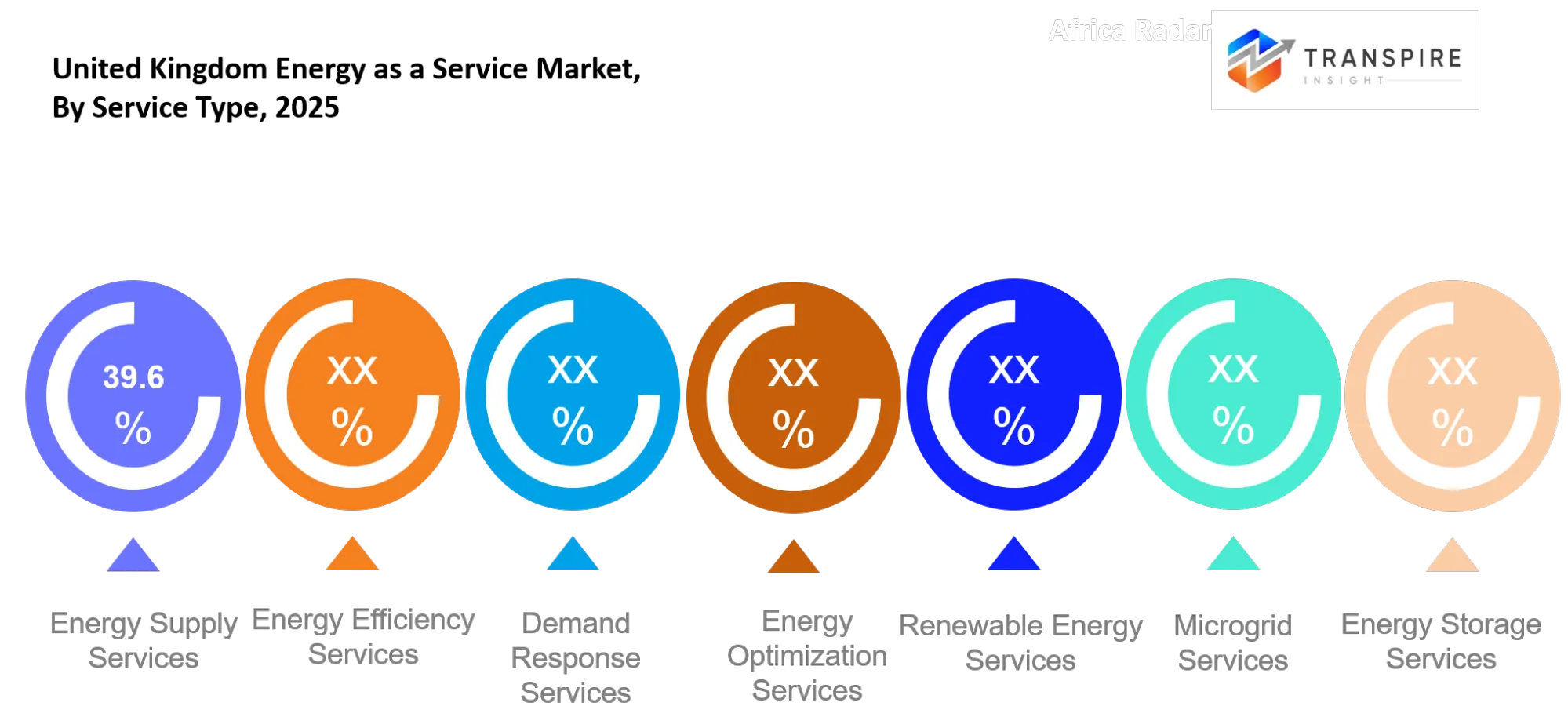
By End User :
Commercial Buildings are a big customer group, largely because office properties, shopping facilities ,and big commercial sites just need tighter control on electricity, heating , cooling and even the equipment costs too. Industrial Facilities, and manufacturing sites, also bring serious openings, since energy use really ties into production expenses. Government, Healthcare, and Educational Institutions are rolling out managed energy services to push efficiency up while keeping that early capital outlay more limited than before.
Data Centers are getting even more attention as a growth area, because you must keep electricity available without interruptions, and the cooling requirements are intense, so there are solid opportunities for energy optimization, energy storage, and backup generation. Retail locations are installing monitoring and efficiency systems across several branches ,while residential use stays pretty fragmented. Energy service providers will go after clients with large energy loads and where the chances for measurable savings are clear and easy to show.
By Deployment :
On site deployment still really matters for facilities that are working with solar generation, batteries, microgrids and these local energy controls. The off site models are more about letting customers buy renewable electricity , without having to put the generation assets in place at the customers own locations. Hybrid deployment, kind of ties everything together, meaning local generation , storage, grid electricity, plus digital controls, and that whole setup gives commercial and industrial facilities better flexibility
Meanwhile, cloud based energy management, AI enabled platforms, and IoT based systems are seeing more adoption, mainly because connected monitoring gives better energy visibility , and helps with daily operational control. Edge energy systems help make faster local decisions, whereas smart grid integration lets different assets react to network conditions and changing electricity prices. With digital deployment, service coverage can expand too, and the whole thing reduces the manual energy management work that people otherwise have to do.
By Energy Source :
Solar Energy is still pulling in investment, partly because distributed generation can reduce what you pay for grid electricity, and it also helps with that long term cost plan. Wind Energy stays useful especially when you are looking at off-site renewable procurement, and Natural Gas is still kind of the steady option for certain facilities that need dependable generation. Battery Energy Storage is getting more attention because being able to store electricity lets you shift when you use it, cut peak exposure, and also cover backup needs, when things get messy.
Then there is Biomass and Hydrogen, which open extra routes for a lower-carbon energy supply, but only when the industrial application is a good fit. Grid Electricity still feels central though, since most energy service contracts are, even today, built around reliable network supply. Hybrid Energy Systems will likely gather more traction over time, mixing renewable generation, storage, grid electricity and other sources, so you end up with better reliability and more operational flexibility.
By Business Model :
Subscription based models can give you those predictable, recurring payments and let customers reach energy management services without having to make a big upfront investment, you know. Pay per Use models tend to fit folks who want to pay in step with real consumption, while performance based arrangements tie the provider’s returns to verifiable operational gains. Energy savings agreements also make adoption easier by aligning payments with confirmed reductions in energy spending.
Leasing approaches and shared savings models help lower the capital barrier for customers who want to deploy equipment like solar systems , batteries or efficiency technologies. Fixed service contracts still matter especially for organizations that prefer stable operating costs and clear service coverage. In general, providers will probably lean more toward flexible commercial frameworks to draw customers with different investment capacity, risk tolerance , and specific energy needs.
What are the Key Use Cases Driving the United Kingdom Energy as a Service Market?
Demand services are basically the leading bit in the United Kingdom Energy as a Service market, with commercial and industrial buyers leaning on outsourced solutions , to cut energy costs, keep consumption in check, and nudge operational efficiency. You see the effect in offices, healthcare facilities, retail sites, and manufacturing operations too, where demand management, building controls, and efficiency upgrades can roll out without the full upfront investment weight.
Public-sector decarbonisation is getting more attention these days, mostly through energy efficiency upgrades, solar PV installations, battery storage, heat pumps, and heat networks across government estates, schools and healthcare facilities. On the industrial side, users are also moving toward on-site generation and energy optimisation, and their reliability plus predictable energy costs really matter for keeping production steady
New chances are showing up as flexible energy services too, sort of mixing battery storage, thermal storage, smart controls, and demand response. Heat-as-a-Service for commercial buildings and heat networks looks promising as well, especially as policy support and private financing grow, and low-carbon heating deployment starts moving faster.
|
Report Metrics |
Details |
|
Market size value in 2025 |
USD 1.86 Billion |
|
Market size value in 2026 |
USD 2.09 Billion |
|
Revenue forecast in 2033 |
USD 5.12 Billion |
|
Growth rate |
CAGR of 13.65% from 2026 to 2033 |
|
Base year |
2025 |
|
Historical data |
2021 - 2024 |
|
Forecast period |
2026 - 2033 |
|
Report coverage |
Revenue forecast, competitive landscape, growth factors, and trends |
|
Regional scope |
United Kingdom (England, Scotland, Wales, Northern Ireland) |
|
Key company profiled |
Schneider Electric, Siemens AG, Honeywell International, ENGIE, Centrica plc, Veolia, EDF Energy, Johnson Controls, ABB Ltd., Hitachi Energy, Enel X, Eaton Corporation, Capgemini, IBM Corporation, GridBeyond . |
|
Customization scope |
Free report customization (country, regional & segment scope). Avail customized purchase options to meet your exact research needs. |
|
Report Segmentation |
By Service Type (Energy Supply Services, Energy Efficiency Services, Demand Response Services, Energy Optimization Services, Renewable Energy Services, Microgrid Services, Energy Storage Services, Managed Energy Services, Carbon Management Services, Others); By End User (Commercial Buildings, Industrial Facilities, Government, Healthcare, Educational Institutions, Data Centers, Retail, Manufacturing, Residential, Others); By Deployment (On-Site, Off-Site, Hybrid, Cloud-Based Energy Management, AI-Enabled Platforms, IoT-Based Systems, Edge Energy Systems, Smart Grid Integration, Others); By Energy Source (Solar Energy, Wind Energy, Natural Gas, Battery Energy Storage, Biomass, Hydrogen, Grid Electricity, Hybrid Energy Systems, Others); By Business Model (Subscription-Based, Pay-Per-Use, Performance-Based Contracts, Energy Savings Agreements, Leasing Model, Shared Savings Model, Fixed Service Contracts, Others) |
Which Regions are Driving the United Kingdom Energy as a Service Market Growth?
London stays the biggest regional market , with a rough share of about 20% of UK Energy as a Service activity . You get this partly because there’s a high commercial density, plus pretty ambitious net-zero policies and initiatives like London’s Zero Carbon Accelerator, which back building decarbonisation and finance models that are more energy-as-a-service, sort of in practice. Also, there’s a heavy gathering of corporate buyers, energy-service providers, finance institutions, and tech suppliers, and that mix really helps project delivery and capital deployment. Leadership should keep going through 2033 as well, since dense offices and commercial buildings, the push for electrification, and low-carbon infrastructure keep generating solid service agreements.
South East England, though, has a different kind of revenue bed. It’s more dispersed, with commercial estates spread out, logistics facilities , healthcare sites, and business parks instead of London’s tight urban demand . There’s still consistent public-sector purchasing, well-established infrastructure, and a comparatively steady level of business activity, which together support recurring energy-management programmes and efficiency contracts. Government data also indicates regional electricity consumption looks relatively stable versus several other areas . All in all, diversified end users and fairly predictable investment needs make South East England a dependable contributor across the whole forecast span.
North West England is basically set up as the quickest-growing regional opportunity, largely aided by this recent rollout of subscription style low-carbon energy setups , like solar panels, batteries, and heat pumps. The E.ON-Heatio pilot went after roughly 350 households, and it kind of shows how financing innovation can lower the upfront friction for wider, distributed energy adoption. If the plan keeps pushing outward across industrial , commercial, and residential assets then there should be room for new players, especially those that bundle financing, optimisation and energy-management services, over 2026–2033.
Who are the Key Players in the United Kingdom Energy as a Service Market and How Do They Compete?
The United Kingdom Energy as a Service Market is still pretty fragmented , with rivalry stretching across utilities, energy-service companies, tech providers , and those more specialist financing setups. A lot of the competition is basically on financing flexibility, digital optimisation, energy procurement, and also the ability to stitch together generation, storage, efficiency, and maintenance into one running contract, you know. Older incumbents keep a leg up because they already have customer ties and the infrastructure, while newer , more focused players are pushing at the usual approach with zero up-front cost propositions.
Schneider Electric stands out by leaning on integrated energy plus sustainability management, and it’s bolstered by energy procurement and compliance capabilities it picked up through the M&C Energy Group heritage, which is kind of the point. Siemens Energy competes using wide energy-system know-how across generation, transmission, storage, and decarbonisation technologies, so they can bundle several services for complicated industrial projects without too much drama. Centrica, on the other hand, leans into optimisation and flexibility, plus renewable PPAs and biomethane sourcing, and it tends to create value through a more market-based approach to asset management rather than just being a standalone energy supplier.
SSE Energy Solutions differentiates via Energy-as-a-Service setups that can effectively fund client energy assets while bundling generation, storage, demand flexibility, and trading optimization into a single motion. eEnergy targets multi-site public sector and commercial portfolios, using funded LED, solar, battery, and EV infrastructure, backed by dedicated project finance and access to procurement frameworks. Overall, this plan gives eEnergy a small niche advantage with customers who want energy upgrades without having to spend capital up front.
Company List
- Schneider Electric
- Siemens AG
- Honeywell International
- ENGIE
- Centrica plc
- Veolia
- EDF Energy
- Johnson Controls
- ABB Ltd.
- Hitachi Energy
- Enel X
- Eaton Corporation
- Capgemini
- IBM Corporation
- GridBeyond
Recent Development News
In March 2026, SSE Energy Solutions partnered with Transport for London (TfL) to develop and operate new solar installations supplying renewable electricity to London Underground. SSE will finance, design, build, and operate the assets without upfront capital from TfL, strengthening demand for financed energy infrastructure and long-term service models.
Source https://www.sse.com/
In February 2025, Sustainable Development Capital LLP (SDCL) partnered with Schneider Electric to provide energy-as-a-service solutions across the UK and Ireland. The venture targets energy-intensive sites such as data centres, industrial facilities, business parks, and universities, expanding access to decentralised energy without upfront customer financing.
Source https://realassets.ipe.com/
What Strategic Insights Define the Future of the United Kingdom Energy as a Service Market?
Over the next five to seven years, the United Kingdom Energy as a Service Market is probably going to move away from efficiency led contracts, and more toward bundled flexibility services, think energy supply, storage, smart controls, and demand response together, kinda like one package. The main underlying driver seems to be electricity-system decentralisation, backed by half hourly settlement and Ofgem’s “build and flex” stance on network investment. ([GOV.UK][1]) Still, there’s a sneaky downside too, like regulation that ends up being split and hard to coordinate, plus interoperability issues between suppliers, aggregators, and the network side, and that kind of friction could slow scaling even while hardware deployment ramps up.
On the other hand, there is also a real opportunity that’s starting to show up, namely aggregator-led flexibility for commercial buildings, batteries, EVs, and heat pumps. This looks especially promising as the government works on more explicit pathways for flexible tariffs and local flexibility markets. So market players should focus on platforms that actually work together, and can handle several distributed assets at once, while also keeping secure, reliable long-term access to flexible income. With that setup, providers may reduce reliance on older conventional energy margins and be better positioned to join in expanding flexibility purchasing through 2033.
United Kingdom Energy as a Service Market Report Segmentation
By Service Type
- Energy Supply Services
- Energy Efficiency Services
- Demand Response Services
- Energy Optimization Services
- Renewable Energy Services
- Microgrid Services
- Energy Storage Services
- Managed Energy Services
- Carbon Management Services
By End User
- Commercial Buildings
- Industrial Facilities
- Government
- Healthcare
- Educational Institutions
- Data Centers
- Retail
- Manufacturing
- Residential
By Deployment
- On-Site
- Off-Site
- Hybrid
- Cloud-Based Energy Management
- AI-Enabled Platforms
- IoT-Based Systems
- Edge Energy Systems
- Smart Grid Integration
By Energy Source
- Solar Energy
- Wind Energy
- Natural Gas
- Battery Energy Storage
- Biomass
- Hydrogen
- Grid Electricity
- Hybrid Energy Systems
By Business Model
- Subscription-Based
- Pay-Per-Use
- Performance-Based Contracts
- Energy Savings Agreements
- Leasing Model
- Shared Savings Model
- Fixed Service Contracts
Frequently Asked Questions
Find quick answers to common questions.
The Expected United Kingdom Energy as a Service Market size for the Market will be USD 5.12 Billion in 2033.
Key segments for the United Kingdom Energy as a Service Market are By Service Type (Energy Supply Services, Energy Efficiency Services, Demand Response Services, Energy Optimization Services, Renewable Energy Services, Microgrid Services, Energy Storage Services, Managed Energy Services, Carbon Management Services, Others); By End User (Commercial Buildings, Industrial Facilities, Government, Healthcare, Educational Institutions, Data Centers, Retail, Manufacturing, Residential, Others); By Deployment (On-Site, Off-Site, Hybrid, Cloud-Based Energy Management, AI-Enabled Platforms, IoT-Based Systems, Edge Energy Systems, Smart Grid Integration, Others); By Energy Source (Solar Energy, Wind Energy, Natural Gas, Battery Energy Storage, Biomass, Hydrogen, Grid Electricity, Hybrid Energy Systems, Others); By Business Model (Subscription-Based, Pay-Per-Use, Performance-Based Contracts, Energy Savings Agreements, Leasing Model, Shared Savings Model, Fixed Service Contracts, Others.
Major United Kingdom Energy as a Service Market players are Schneider Electric, Siemens AG, Honeywell International, ENGIE, Centrica plc, Veolia, EDF Energy, Johnson Controls, ABB Ltd., Hitachi Energy, Enel X, Eaton Corporation, Capgemini, IBM Corporation, GridBeyond.
The Current United Kingdom Energy as a Service Market size is USD 1.86 Billion in 2025.
The United Kingdom Energy as a Service Market CAGR is 13.65% from 2026 to 2033.
- Schneider Electric
- Siemens AG
- Honeywell International
- ENGIE
- Centrica plc
- Veolia
- EDF Energy
- Johnson Controls
- ABB Ltd.
- Hitachi Energy
- Enel X
- Eaton Corporation
- Capgemini
- IBM Corporation
- GridBeyond
About the Authors

Avinash Kumar
I’m Avinash Kumar, a Senior Research Analyst at Transpire Insight, with expertise in the Electronics and Semiconductor and Energy & Power industry. My work focuses on analyzing emerging technologies, market trends, industry developments, and innovation across these sectors. I specialize in transforming complex technical and market insights into clear, research-backed content that helps professionals, businesses, and decision-makers stay informed. Through continuous industry research and data-driven analysis, I strive to deliver accurate, reliable, and practical perspectives on the latest advancements shaping the semiconductor and energy landscape.

Chakradhar Khansole
Chakradhar serves as the Research Director at Transpire Insight, bringing over 8 years of experience in technology, innovation, and strategic market intelligence. He specializes in transforming complex market data into actionable business insights that enable organizations to make informed, growth-oriented decisions. Recognized for his strategic vision and analytical expertise, Chakradhar leads high-impact research initiatives, delivering comprehensive market assessments, competitive intelligence, and forward-looking industry analysis.
Recently Published Reports
-
Apr 2026
Active Power Filter Market
Active Power Filter Market Size, Share & Analysis Report By Type (Shunt Active Power Filters, Series Active Power Filter, Hybrid Active Power Filter), By Application (Harmonics Mitigation, Reactive Power Compensation, Voltage Regulation, Power Factor Correction), By Phase (Single Phase, Three Phase), By End-User Industry (Manufacturing, Healthcare, Commercial, Automotive, Oil and Gas, Others), and Geography (North America, Europe, Asia-Pacific, Middle East and Africa, South and Central America), 2021 - 2031
-
Apr 2026
Electrical Transformer Market
Electrical Transformer Market Size, Share & Analysis Report By Core (Closed, Shell, and Berry), By Insulation (Gas, Oil, Solid, Air, and Other), By Phase (Single, and Three), By Rating (100 MVA to 500 MVA, 501 MVA to 800 MVA, and 801 MVA to 1200 MVA), and Geography (North America, Europe, Asia-Pacific, Middle East and Africa, South and Central America), 2021 – 2031
-
Apr 2026
Hydraulic Piston Pumps Market
Hydraulic Piston Pumps Market Size, Share & Analysis Report By Type (Axial Piston Pumps, Radial Piston Pumps), By Operating Pressure (Low Pressure, Medium Pressure, High Pressure), By Application (Construction, Mining, Agriculture, Automotive, Oil & Gas, Industrial Machinery, Others), By End-User (OEMs, Aftermarket), and Geography (North America, Europe, Asia-Pacific, Middle East and Africa, South and Central America), 2021 – 2031
-
Apr 2026
Laboratory Gas Generators Market
Laboratory Gas Generators Market Size, Share & Analysis Report By Product (Nitrogen Gas Generator, Hydrogen Gas Generator, Zero Air Gas Generator, Purge Gas Generator, TOC Gas Generators, Others), By Application (Gas Chromatography, Liquid Chromatography-mass Spectrometry (LC-MS), Gas Analyzers, Others), By End-user (Life Science, Chemical & Petrochemical, Food & Beverage, Others), and Geography (North America, Europe, Asia-Pacific, Middle East and Africa, South and Central America), 2021 – 2031