

United Kingdom Data Center Rack Market Summary
As per Transpire Insight Analysis the United Kingdom Data Center Rack Market size is estimated at USD 235.1 Million in 2025 and is anticipated to reach USD 467.3 Million by 2033, growing at a CAGR of 8.97% from 2026 to 2033.
The United Kingdom Data Center Rack Market kinda supports the physical backbone of digital infrastructure by giving secure, organized, and scalable spots for servers, networking gear, and storage systems. In practice these rack setups let operators use the floor space better, boost airflow, make upkeep easier, and handle high-density computing spaces that run cloud services, banking and trading platforms, healthcare uses, and public sector digital workflows. If the rack infrastructure is weak or inefficient, then facilities end up with higher operating costs, less reliable equipment, and fewer ways to expand, later on.
In the last three to five years, the market has slowly moved toward higher density rack designs that can work with artificial intelligence workloads and newer, heavier computing hardware, even though it brings higher power draw and cooling needs. This change really picked up after the COVID-19 pandemic, when digital service adoption jumped , so cloud providers, colocation operators, and enterprises pushed to add more data center capacity. As the computing density keeps rising, operators start investing in racks built for cleaner cable routing, liquid cooling compatibility, and more modular deployments. That shift helps increase infrastructure use, shortens rollout schedules, and opens up better revenue paths for suppliers offering advanced rack solutions that fit next-generation data center expectations.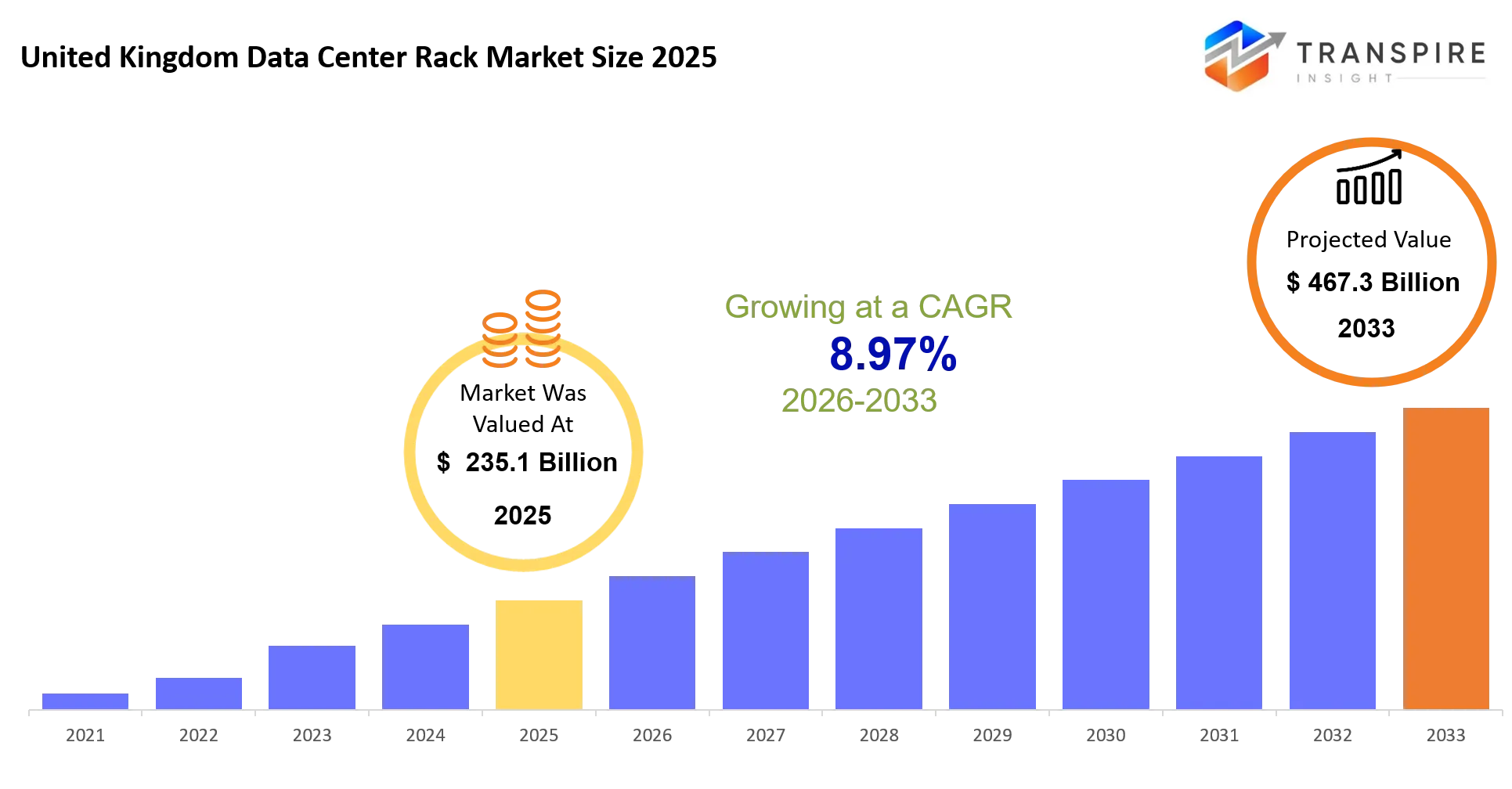
United Kingdom Data Center Rack Market Size & Forecast:
- United Kingdom Data Center Rack Market Size 2025: USD 235.1 Million
- Expected Market Value 2033: USD 467.3 Million
- Forecast CAGR: 8.97%
- Leading region in 2025: England
- Fastest Growing region: Scotland
- Key Profile: Schneider Electric, Vertiv, Eaton, Rittal, Legrand, Dell Technologies, Hewlett Packard Enterprise, Cisco, IBM, Panduit, Chatsworth Products, Black Box, Tripp Lite, APC, Oracle
Key Market Insights
- England sort of dominated the market in 2025, with around 82% share, kind of backed by clustered hyperscale builds near London and quite a lot of big colocation investments.
- Scotland is projected to be the fastest-growing regional market across 2025–2032, mainly because renewable energy is more available and fresh digital infrastructure projects keep landing.
- For the product side, Standard racks led the way in 2025, taking close to 58% of the market, largely due to wide rollouts across both enterprise and colocation sites. Open frame racks stayed in the second spot too, since telecommunications setups and edge computing placements kept expanding through regional facilities.
- Looking ahead, High-density AI-ready racks should grow the quickest into 2032, with deployments increasingly centered on GPU-heavy computing infrastructure.
- As for deployment type, colocation data centers held roughly 47% market share in 2025. That happened because enterprises started outsourcing infrastructure to gain better scalability, and also more operational leeway.
- On the application front, hyperscale cloud facilities are forecast to be the fastest-growing by 2032, supported by the ongoing expansion of AI plus cloud service capacity.
- Meanwhile cloud service providers represented about 43% of end-user revenue in 2025, since they kept investing in large-scale digital infrastructure.
- And finally, artificial intelligence infrastructure providers are expected to become the fastest-growing end-user category from 2025 to 2032, as GPU deployments speed up even more.
What are the Key Drivers, Restraints, and Opportunities in the United Kingdom Data Center Rack Market?
Artificial intelligence infrastructure expansion is kinda the main force, really, that accelerates market growth. The fast rollout of GPU clusters and high-performance computing environments has pushed power density past what older rack designs were built for. So operators now want stronger rack frames, better airflow management strategies, and yes liquid-cooling compatibility. These investments end up improving server utilization too and they can also shorten the deployment cycle. With hyperscale and colocation places expanding AI capacity, suppliers tend to land higher-value deals and those premium rack configurations, which then helps revenue generation across the whole value chain.
Still, the big structural obstacle is high capital expenditure. Retrofitting existing buildings for high-density setups often means upgrading cooling systems, power distribution, and even the floor loading limits. And these adjustments usually cannot be done swiftly, because planning approvals, equipment procurement, and engineering upgrades take longer timelines than everyone wishes. From a Transpire Insight review of regional procurement notes and release calendars, supply chain concentration still shows up as the top execution risk. When deliveries get delayed, and project schedules stretch out, near-term revenue gets muted, while the commissioning of new facilities gets postponed.
The most durable, long term window of opportunity lives in edge computing along with regional AI infrastructure. In practice, financial services , healthcare , manufacturing, and public sector groups still keep moving computing capacity nearer to the people using it, mainly to cut down latency. So modular rack systems built for smaller edge sites, like compact rooms or enclosures, are likely to profit from that ongoing shift. At the same time , investment spreading across northern England, Scotland, and several regional digital hubs opens fresh chances for suppliers who can deliver intelligent monitoring , liquid cooling integration, and rack architectures that scale without drama.
What Has the Impact of Artificial Intelligence Been on the United Kingdom Data Center Rack Market?
Artificial intelligence is reshaping data center infrastructure, in a way that makes rack environments feel more alive, you know, smarter and heavily automated… and it can also support substantially higher computing densities than before. With AI-powered management platforms, the system just keeps watching temperature, airflow, power consumption, and even equipment utilization across rack installations, all the time. Then automated control systems kind of step in, they adjust cooling resources in real time. That helps reduce wasted energy while still keeping stable operating conditions for the critical computing hardware. On top of that, machine learning models forecast equipment failures by looking at streams from sensors, so maintenance teams can replace components ahead of time, before the whole “surprise downtime” thing happens.
Those predictive bits end up improving infrastructure planning and, honestly, optimizing rack utilization as cloud operators and hyperscale sites expand AI workloads. Intelligent analytics allow operators to anticipate capacity needs, balance workloads, and distribute power more efficiently across cabinets. A lot of facilities report measurable wins like better uptime, lower cooling expenses, and improved energy efficiency after they tie AI-driven monitoring platforms into digital infrastructure management software. Still though, broad adoption is not totally smooth because there are practical limits. Dropping AI into legacy facilities usually means lots of sensor upgrades, software interoperability work, and specialized engineering skills. Plus, the implementation costs can get high, and older infrastructure often has inconsistent data quality, and that keeps adoption slower especially for mid-sized enterprise data centers, they have to weigh modernization spending against operating budgets, carefully.
Key Market Trends
- High density rack deployments kinda kicked off faster after 2023 as AI servers started pulling noticeably more power than what the old school enterprise cabinet layouts were really built for, so teams had to rethink the whole setup a bit.
- Liquid cooling ready rack architectures got a lot more traction during 2024–2025, which lines up with the quick rollout of GPU heavy computing infrastructure at scale.
- Modular rack systems cut deployment timeframes by as much as 30% in several big colocation expansion efforts wrapped up during 2025 , honestly that speed mattered.
- Intelligent rack monitoring platforms are now blending in predictive analytics more and more, so equipment utilization improves and operational visibility feels much clearer across enterprise sites.
- Edge computing investments also moved further out beyond London during 2024–2025, backing stronger regional demand for compact rack infrastructure that still performs.
- Vertiv, Schneider Electric, and Rittal have been widening their AI focused infrastructure catalogs, bringing in more advanced rack and thermal management technologies.
- Operators increasingly lock in consistent rack dimensions across new facilities, which makes maintenance simpler, inventory management cleaner, and future capacity adds less pain later.
- Sustainability targets basically sped up the shift toward energy efficient rack layouts, especially those that tune airflow and lower cooling power consumption.
- Digital twin technologies are showing up more often during facility planning, helping operators fine tune where racks should go before construction even begins.
United Kingdom Data Center Rack Market Segmentation
By Rack Type :
Open Frame Racks sit in a pretty solid place across many facilities that want quick equipment access, plus less cable mess overall. In big networking spaces, testing environments, and telecom setups, teams often pick this kind of rack because maintenance folks can reach items fast, like without much fuss. On top of that, the whole cost efficiency angle and the ability to install gear in a more flexible way help it spread across medium to large deployments, even when plans change.
Enclosed racks take the biggest share, mainly because certain environments really, really need stronger safeguards, like better resistance against dust, unauthorized entry, and even airflow loss. Wall-Mounted Racks fit smaller installations where usable floor space stays tight, especially in branch offices and edge facilities. The Others category is basically for specialized rack styles, built around unusual operating conditions and custom infrastructure layouts, which supports more niche deployment requirements, sometimes better than the standard options do.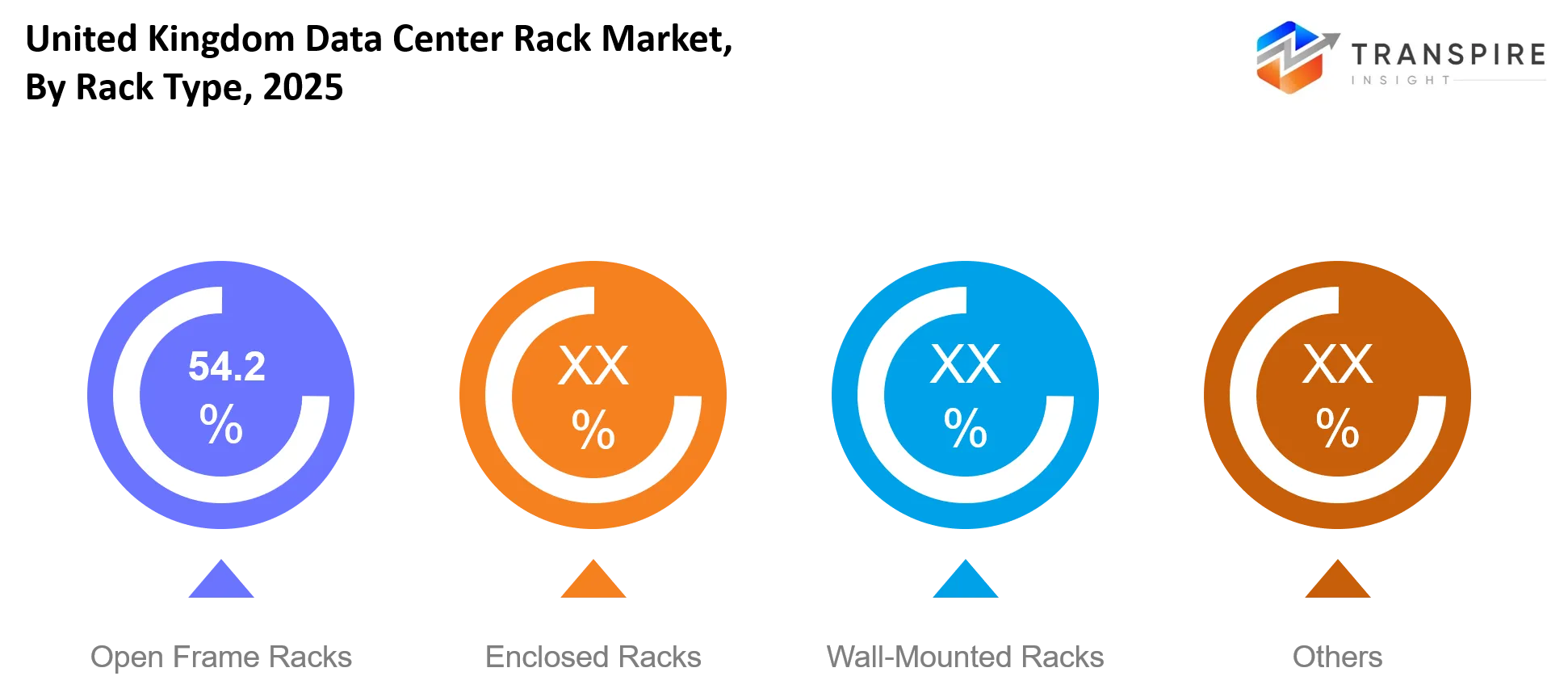
By Component :
Solutions are sort of the main segment, mainly because operators keep on investing in end to end rack systems that help with cooling, better cable arrangement ,and also more equipment per footprint. When new facilities get built ,or modernization projects show up, there's a steady need for unified rack platforms that can carry future capacity expansion. With standardized solutions, setups become easier too, and deployment time drops across enterprise and colocation spots.
Services come in at the second-largest spot, since installation, upkeep, and infrastructure advising are still basically required across the full equipment lifecycle. Accessories are getting more notice as well, especially intelligent power distribution units, cable management systems, and monitoring devices that raise operational efficiency. The Others bucket covers niche hardware plus supporting products for tailored infrastructure needs, so it kinda fits custom environments.
By Rack Size :
The 42U segment is basically leading the market because the size hits that sweet spot, balancing equipment capacity with access, and it also fits standard data center layouts pretty well. A lot of enterprise setups and colocation providers still pick this particular arrangement for new deployments , and for infrastructure upgrades as well. And the wide-ranging equipment compatibility helps make the whole thing stick longer term across multiple industries too.
After 42U, the racks are still growing , especially when artificial intelligence computing is involved and when high-density servers need more usable capacity inside the same floor space. Meanwhile, anything under 42U stays quite workable for smaller server rooms, edge sites, and branch operations, where a more compact installation can feel like an advantage in practice. The “Others” group covers custom rack dimensions, which are crafted for specialized applications, or for project-specific needs, depending on what the deployment requires.
By End User :
Colocation Providers are the biggest end-user group , largely because companies keep moving their infrastructure into professionally managed locations with room to scale. In a way it feels continuous, you know, shared data center growth keeps creating steady needs for advanced rack setups, these racks maximize the usable floor area and also help day to day operations run more smoothly. And the longer customer agreements stay in place, the more consistently buyers can fund newer rack infrastructure too.
Cloud Providers show the quickest expansion , mainly because AI workloads and digital platforms are always asking for more computing power. At the same time , enterprises keep modernizing their own internal environments so reliability improves and business continuity is less risky. Telecom Operators are also tightening their networks, they build the infrastructure for 5G services and edge computing rollouts. The Others group includes research institutions, educational bodies, and specialized service providers , each one tends to require their own kind of dedicated infrastructure.
By Data Center Type :
Colocation facilities take up the largest share, simply because many organizations are, in practice, leaning more toward outsourced infrastructure, with a kind of flexible growth plan and professional facility management. In the newest colocation endeavors, people keep pushing rack density, cooling that actually works efficiently, and standardized equipment layouts, which in turn helps day to day operational performance. With ongoing capital coming from domestic and international operators, the long term market momentum stays stronger, and more consistent.
Hyperscale facilities are the fastest-growing segment because cloud computing and artificial intelligence infrastructure keep expanding all around the country. Enterprise facilities continue with steady investment, mainly via modernization initiatives, while Edge data centers back low latency applications that need to be closer to users in regional areas. The Others bucket covers specialized facilities, built for dedicated operational goals, or research oriented requirements, depending on what’s needed.
By Industry Vertical :
IT & Telecom stay the leading vertical, because digital services , cloud infrastructure, and communication networks need steady high capacity computing setups. People keep investing in newer infrastructure so teams can deploy advanced rack systems that manage higher equipment density. And the stronger the digital shift programs get, the more it fuels long term purchasing.
BFSI still shows major pull thanks to secure computing infrastructures for financial exchanges and regulatory compliance. In Healthcare, rack deployments grow to back digital health records, diagnostic systems, and connected medical services. Government agencies are still modernizing public digital infrastructure, step by step. Others think manufacturing, education, retail, and a few more industries putting money into safe , scalable data center environments.
What are the Key Use Cases Driving the United Kingdom Data Center Rack Market?
The biggest use case is usually tied to colocation data centers, which need a fairly standardized rack setup so they can juggle multiple customer environments within the same building. Colocation operators tend to buy more advanced rack systems because space utilization gets better, equipment is kept in a secure enclosure, and deployment tends to happen faster—those things basically boost facility capacity and help with customer onboarding. Financial institutions, software houses, and public sector organizations lean on these facilities so they don't have to build dedicated infrastructure from scratch.
Cloud providers and telecom operators are now pushing more rack deployments to handle artificial intelligence workloads, 5G services, and edge computing. In parallel, healthcare organizations are adopting modern rack infrastructure for digital imaging workflows, electronic health records, and secured data storage, all while meeting national information governance rules and cybersecurity expectations.
One emerging angle is regional edge infrastructure that supports connected manufacturing plants, autonomous logistics operations, and smart transport networks. Another still developing thing involves high-density racks made for liquid-cooled AI clusters, so research organizations and advanced technology companies can put powerful computers in place, while keeping power draw and thermal behavior under control a bit more efficiently over the forecast period.
|
Report Metrics |
Details |
|
Market size value in 2025 |
USD 235.1 Million |
|
Market size value in 2026 |
USD 256.2 Million |
|
Revenue forecast in 2033 |
USD 467.3 Million |
|
Growth rate |
CAGR of 8.97% from 2026 to 2033 |
|
Base year |
2025 |
|
Historical data |
2021 - 2024 |
|
Forecast period |
2026 - 2033 |
|
Report coverage |
Revenue forecast, competitive landscape, growth factors, and trends |
|
Regional scope |
United Kingdom (England, Scotland, Wales, Northern Ireland) |
|
Key company profiled |
Schneider Electric, Vertiv, Eaton, Rittal, Legrand, Dell Technologies, Hewlett Packard Enterprise, Cisco, IBM, Panduit, Chatsworth Products, Black Box, Tripp Lite, APC, Oracle . |
|
Customization scope |
Free report customization (country, regional & segment scope). Avail customized purchase options to meet your exact research needs. |
|
Report Segmentation |
By Rack Type (Open Frame Racks, Enclosed Racks, Wall-Mounted Racks, Others); By Component (Solutions, Services, Accessories, Others); By Rack Size (Below 42U, 42U, Above 42U, Others); By End User (Colocation Providers, Enterprises, Cloud Providers, Telecom Operators, Others); By Data Center Type (Enterprise, Colocation, Hyperscale, Edge, Others); By Industry Vertical (BFSI, IT & Telecom, Healthcare, Government, Others) |
Which Regions are Driving the United Kingdom Data Center Rack Market Growth?
England makes up roughly 82% of market revenue, so it basically runs the show as the main regional contributor. The whole thing seems pushed along by policies for digital infrastructure, dependable power networks, and ongoing planning help for big data center roll outs that keep rack infrastructure investment moving. London plus the nearby technology corridors also pull in hyperscale operators, colocation providers, equipment vendors , and engineering specialists, all of which thicken the regional supply chain. On top of that you have continuing cloud growth, artificial intelligence build outs in the infrastructure layer, and enterprise modernization efforts, which should keep the region in a strong position across the forecast period.
Wales comes next as the second most important regional market , but the growth story there is more “steadiness” than “hyperscale clustering.” It benefits from stable infrastructure development rather than heavy concentration in giant campuses. There’s also ongoing public spending on digital connectivity, dependable energy networks, and business friendly policies, giving developers predictable conditions for data center projects. Regional companies, public sector organizations, and telecom operators keep putting money into updated facilities, and those upgrades still need reliable rack deployments. Because this approach is more balanced, it creates steady revenue openings without having to lean on huge volumes of hyperscale construction.
Scotland is expected to see the quickest growth between 2026 and 2033 as renewable energy investments, and regional digital infrastructure projects, pick up pace and new data center development speeds up. There’s also growing interest in eco-friendly facilities and lower-carbon operations, so operators are looking a little further than the usual metropolitan hubs. As edge computing rollouts grow and AI infrastructure keeps expanding , demand for more capable rack systems across the region keeps getting stronger. All that momentum, really, turns into attractive opportunities for equipment manufacturers , engineering firms, and infrastructure investors who want a role in the next phase of this regional expansion.
Who are the Key Players in the United Kingdom Data Center Rack Market and How Do They Compete?
Competition across the United Kingdom Data Center Rack Market seems fairly moderately consolidated, not fully, but in a way where global infrastructure suppliers still go head to head with specialized enclosure manufacturers plus integrated solution providers. In practice, technology capability , energy efficiency, high-density performance, and service support are what really drive the rivalry, not price alone. Most established players keep tightening their market stance via product innovation, and meanwhile the more specialized firms try to carve out space by meeting artificial intelligence infrastructure needs, edge computing demands , and modular deployment requirements.
Schneider Electric leans into intelligent rack systems, tying them to power management and monitoring platforms so operators can nudge operational efficiency upward. Vertiv differentiates by building high-density infrastructure intended for more demanding cooling environments, and it backs facilities running heavy artificial intelligence workloads. Rittal puts the spotlight on modular enclosure designs that make installation smoother, scaling easier, and deployment timelines shorter for data center projects that keep expanding.
Legrand stays competitive by pairing rack infrastructure with intelligent power distribution and cable management technologies , which is supposed to boost operational reliability in the day to day. nVent develops enclosure systems that are compatible with thermal management expectations that keep shifting, especially for facilities moving toward higher-density computing setups. Ongoing investment in new product development, plus strategic partnerships and broader solution portfolios, helps these organizations respond to changing customer needs while also reinforcing their positions across enterprise, colocation, hyperscale, and edge infrastructure initiatives.
Company List
Octapharma
Takeda
LFB Group
Biotest
Bio Products Laboratory
Sanquin
Baxter
Pfizer
Fresenius Kabi
GC Biopharma
SK Plasma
Recent Development News
In March 2026, Vertiv completed the acquisition of ThermoKey. The transaction expanded Vertiv's heat exchange and thermal management portfolio, strengthening support for high-density AI infrastructure and advanced rack-based cooling solutions.
Source https://www.datacenterdynamics.com/
In November 2025, Schneider Electric launched new data center solutions for high-density AI and accelerated computing applications, including upgraded NetShelter rack systems and advanced rack PDUs. The launch strengthened support for heavier AI server deployments and direct-to-chip liquid cooling, reinforcing next-generation rack infrastructure capabilities.
Source https://www.se.com/
What Strategic Insights Define the Future of the United Kingdom Data Center Rack Market?
Over the next five to seven years, the United Kingdom Data Center Rack Market will drift toward intelligent, high density infrastructure, made for artificial intelligence computing, advanced cloud platforms, and more distributed edge facilities. In a way this structural shift is caused by higher computing intensity , not just by plain expansion of server capacity, so the demand is getting real for rack systems that can handle liquid cooling, higher power loads, and modular placement . There is also a risk that is a bit less noticeable , kind of quiet, meaning supply chain concentration for specialized steel enclosures , cooling components, and power accessories, which might slow down big projects even while investment activity looks healthy.
At the same time, a newer opportunity is showing up: regional AI infrastructure beyond the old London style clusters, supported by renewable power availability and growing digital investment. Market players can do well by tightening domestic supplier relationships, extending modular product lines , and putting money early into rack platforms designed for next generation cooling technologies , before deployment standards become common and widely accepted.
United Kingdom Data Center Rack Market Report Segmentation
By Rack Type
- Open Frame Racks
- Enclosed Racks
- Wall-Mounted Racks
By Component
- Solutions
- Services
- Accessories
By Rack Size
- Below 42U
- 42U
- Above 42U
By End User
- Colocation Providers
- Enterprises
- Cloud Providers
- Telecom Operators
By Data Center Type
- Enterprise
- Colocation
- Hyperscale
- Edge
By Industry Vertical
- BFSI
- IT & Telecom
- Healthcare
- Government
Frequently Asked Questions
Find quick answers to common questions.
The Expected United Kingdom Data Center Rack Market size for the Market will be USD 467.3 Million in 2033.
Key Segments for the United Kingdom Data Center Rack Market are By Rack Type (Open Frame Racks, Enclosed Racks, Wall-Mounted Racks, Others); By Component (Solutions, Services, Accessories, Others); By Rack Size (Below 42U, 42U, Above 42U, Others); By End User (Colocation Providers, Enterprises, Cloud Providers, Telecom Operators, Others); By Data Center Type (Enterprise, Colocation, Hyperscale, Edge, Others); By Industry Vertical (BFSI, IT & Telecom, Healthcare, Government, Others).
Major United Kingdom Data Center Rack Market Players are Schneider Electric, Vertiv, Eaton, Rittal, Legrand, Dell Technologies, Hewlett Packard Enterprise, Cisco, IBM, Panduit, Chatsworth Products, Black Box, Tripp Lite, APC, Oracle.
The Current United Kingdom Data Center Rack Market size is USD 235.1 Million in 2025.
The United Kingdom Data Center Rack Market CAGR is 8.97% from 2026 to 2033.
- CSL Behring
- Octapharma
- Grifols
- Takeda
- Kedrion Biopharma
- LFB Group
- Biotest
- Bio Products Laboratory
- Sanquin
- Emergent BioSolutions
- Baxter
- Pfizer
- Fresenius Kabi
- GC Biopharma
- SK Plasma
About the Authors

Mayur Shinde
I am Mayur Shinde, a Senior Research Analyst at Transpire Insight, specializing in the Automotive & Transportation and Information & Communication Technology (ICT) Industry. My work focuses on analyzing emerging market trends, technological advancements, competitive landscapes, and industry developments to deliver accurate, data-driven insights. I am passionate about transforming complex market information into clear, actionable content that helps businesses, professionals, and decision-makers stay informed and make confident strategic decisions.

Chakradhar Khansole
Chakradhar serves as the Research Director at Transpire Insight, bringing over 8 years of experience in technology, innovation, and strategic market intelligence. He specializes in transforming complex market data into actionable business insights that enable organizations to make informed, growth-oriented decisions. Recognized for his strategic vision and analytical expertise, Chakradhar leads high-impact research initiatives, delivering comprehensive market assessments, competitive intelligence, and forward-looking industry analysis.
Recently Published Reports
-
Apr 2026
3D Optical Profiler Market
3D Optical Profiler Market Size, Share & Analysis Report By Type (Desktop 3D Optical Profiler, and Portable 3D Optical Profiler), By Technology (Confocal Technology, and White Light Interference), By End-Use Industry (Manufacturing, Research Institutions, Automotive, Aerospace and Defense, Medical Devices, and Other), and Geography (North America, Europe, Asia-Pacific, Middle East and Africa, South and Central America), 2021 - 2031
-
Apr 2026
Depth Sensor Market
Depth Sensor Market Size, Share & Analysis Report By Type (Infrared Depth Sensors, Time-of-Flight (ToF) Sensors, Stereo Vision Sensors, Structured Light Sensors, Ultrasonic Depth Sensors), By Application (Automotive, Robotics, Gaming, Consumer Electronics, Industrial Automation, Healthcare, Security & Surveillance, Others), By End Users (Automotive Manufacturers, Consumer Electronics Companies, Healthcare Providers, Industrial Companies, Security Agencies, Gaming Companies, Robotics Companies, Others), and Geography (North America, Europe, Asia-Pacific, Middle East and Africa, South and Central America), 2021 – 2031
-
Apr 2026
Digital Manufacturing Market
Digital Manufacturing Market Size, Share & Analysis Report By Component (Hardware, Software, and Services), By Technology (Robotics, 3D Printing, Internet of Things (IoT), and Others), By Application (Automotive and Transportation, Aerospace and Defense, Consumer Electronics, Industrial Machinery, and Others), By Process Type (Computer-Based Designing, Computer-Based Simulation, Computer 3D Visualization, Analytics, and Others), and Geography (North America, Europe, Asia-Pacific, Middle East and Africa, South and Central America), 2021 – 2031
-
Apr 2026
Digital Visa Services Market
Digital Visa Services Market Size, Share & Analysis Report By Type (Individual Travelers, Group Travelers), By Application (Tourism, Business Travel, Others), and Geography (North America, Europe, Asia-Pacific, Middle East and Africa, South and Central America), 2021 – 2031