
Supply Chain Financing Market Summary:
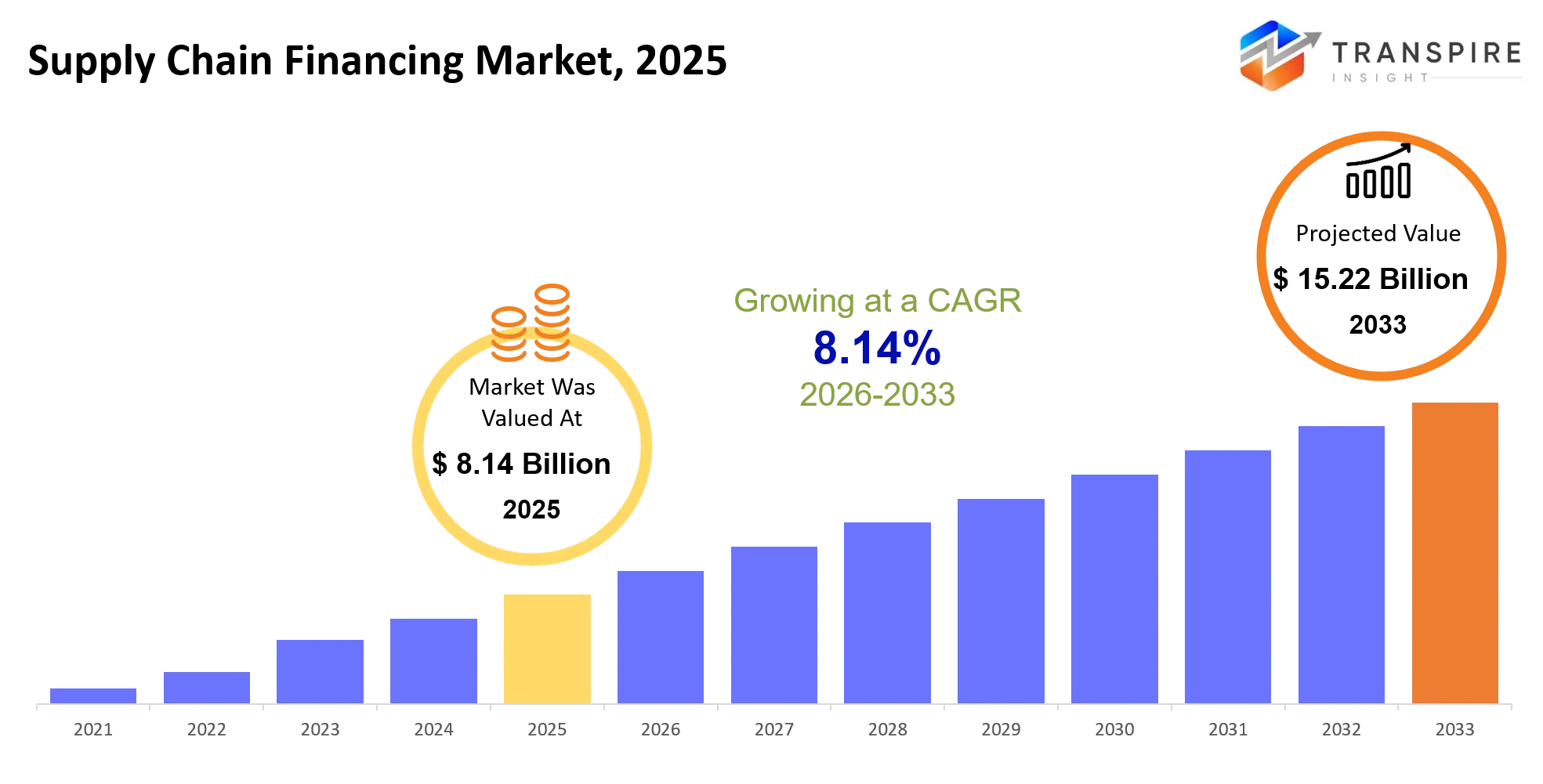
As per the Transpire Insight Analysis, The Supply Chain Financing Market size is estimated at USD 8.14 billion in 2025 and is anticipated to reach USD 15.22 billion by 2033, growing at a CAGR of 8.14% from 2026 to 2033.
Supply chain finance also helps businesses pay their suppliers faster, unlocks cash in their accounts receivable, and sustains production without fully relying on traditional borrowing. The market evolved from a buyer-driven bank program to a digital ecosystem connecting buyers, suppliers, lenders, and enterprise systems over the past three to five years. With this new structure, financing remains accessible, and transactions are processed more efficiently. Supply chain diversification driven by tariff uncertainty and rising input costs has been a key factor behind change, spurring companies to diversify their supplier base while maintaining working capital. Citi's February 2026 report pinpointed supply chain diversification and liquidity management as top priorities, with receivables financing, automated credit decisions, and integrated payments playing a larger role. Growth depends on providers' ability to leverage transaction data to facilitate faster financing decisions while ensuring credit risk, fraud, and cross-border compliance can be effectively mitigated.
Supply Chain Financing Market Size & Forecast:
- Market Size 2025: USD 8.14 Billion
- Expected Market Value (2033): USD 15.22 Billion
- Forecast CAGR (2026–2033): 8.14%
- Leading Region in 2025: North America
- Fastest Growing Region: Asia Pacific
- Key Company Profiles: HSBC, Citi, JPMorgan Chase, BNP Paribas, Santander, Standard Chartered, Deutsche Bank, Wells Fargo, Bank of America, MUFG, Taulia, C2FO, PrimeRevenue, Kyriba, SAP
Key Supply Chain Financing Market Insights:
The market is moving away from invoice-based lending and towards liquidity management that is connected and data-driven. The ability to bring financing power, trusted transaction data, automation, and supplier access is the new key to competitive advantage.
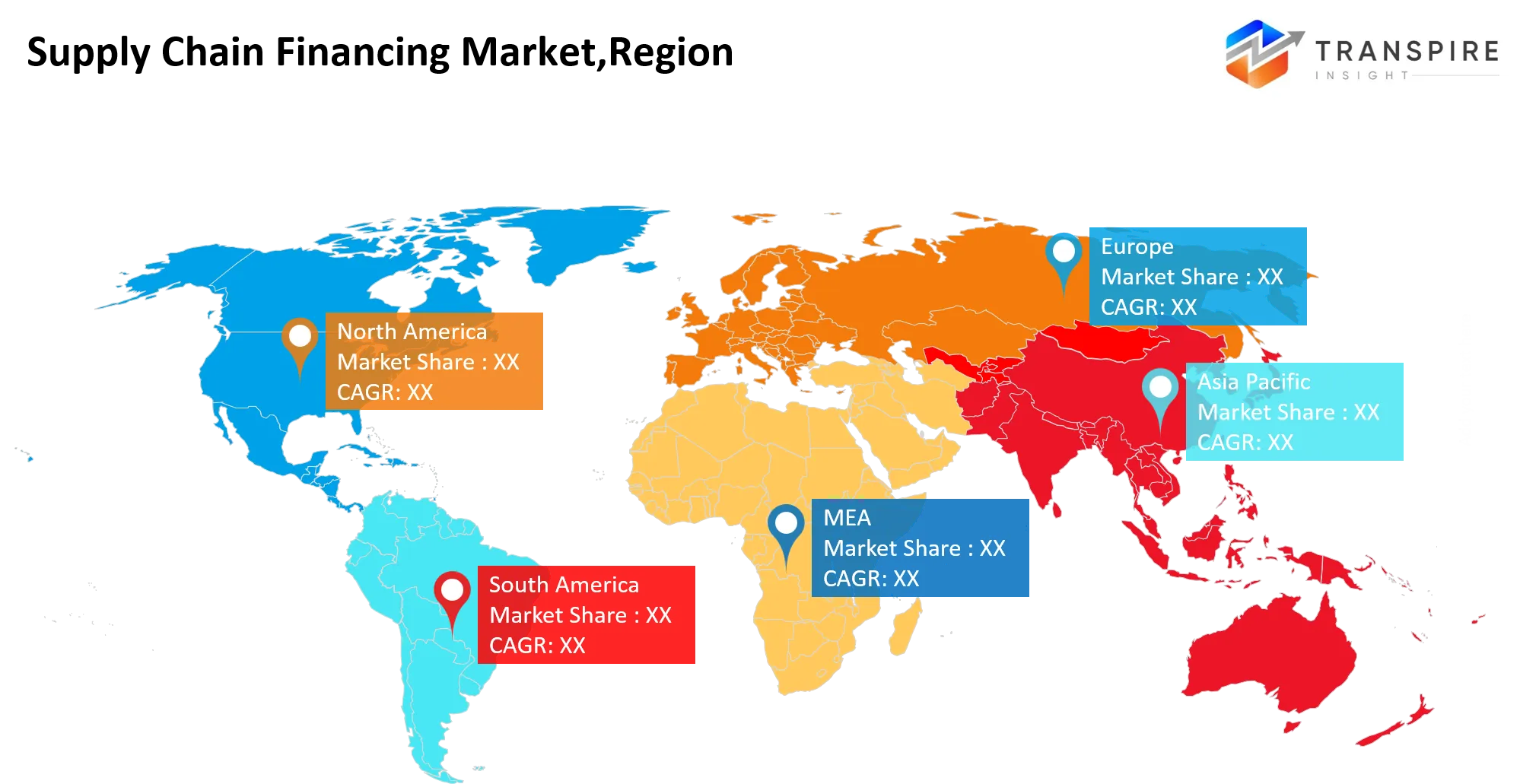
- North America holds a 34.6% market share, owing to well-established banking systems and programs by multinational suppliers.
- There are 29.4% of ESG-linked SCF programs in Europe, with BNP Paribas in the lead.
- The Asia Pacific region is the fastest-growing, with a 13.9% CAGR and is expected to account for 24.0% of the market, owing to the digitisation of SMEs and manufacturing trade across the border.
- Latin America accounts for 6.7%, and the growth is driven by both the growth of digital payment rails and regional bank partnerships.
- Middle East & Africa represents 5.3%, with C2FO launching its working capital marketplace in five additional African markets in January 2026.
- In February 2026, Taulia enhanced the ERP-integrated financing by adding dynamic discounting to SAP S/4HANA Cloud.
- PrimeRevenue facilitated over USD 300 billion in commerce, and payments were made on average 86 days ahead of time to suppliers.
- Kyriba introduced TAI agentic AI and rolled out a working-capital platform in 20 countries for Bank of Africa Group.
- JPMorgan enhanced its Kinexys blockchain-powered ecosystem to deliver a more efficient real-time settlement platform and access to corporate liquidity.
What are the Key Drivers, Restraints, and Opportunities in the Supply Chain Financing Market?
Driver:
Supply chain diversification and working-capital pressures are encouraging businesses to adopt financing programmes backed by verified trade transactions. In 2026, the Asian Development Bank highlighted a trade finance gap of US$2.5 trillion, underscoring persistent funding constraints. This shortfall is creating opportunities for banks and specialist providers to expand receivables financing, payables programmes, and supplier funding solutions. As adoption grows, providers can generate transaction-based revenue, strengthen corporate relationships, and improve liquidity access across increasingly complex supply networks.
Restraint:
Limited financial records, weak collateral, fragmented documentation, and inconsistent legal frameworks make smaller suppliers difficult to assess. These problems persist because many SMEs lack integrated accounting systems and reliable transaction histories, raising verification costs and perceived default risk. Cross-border programmes add complexity through different currencies, tax rules, enforcement procedures, and compliance requirements.
Opportunity:
Digital trade-data infrastructure can help lenders reach suppliers previously excluded from formal financing. The Hong Kong Monetary Authority launched its CargoX pilot involving 21 banks to test cargo-data integration and improve SME trade-finance access. Similar initiatives across Asia-Pacific could combine shipment records, invoices, and payment histories to strengthen credit decisions. Providers that integrate these data sources with ERP systems and API-based lending can reduce processing delays, expand supplier participation, and generate recurring platform revenue. Sustainability-linked financing also offers scope for differentiated pricing when suppliers meet verifiable environmental or social performance criteria.
Driver Impact Analysis – Supply Chain Financing Market
|
Driver |
Relative Impact on Growth (%) |
Geographic Relevance |
Impact Timeline |
Demand Strength |
Growth Mechanism |
Key Beneficiaries |
Major Constraint |
|
Working-capital shortages and SME financing gaps |
28% |
Asia-Pacific, North America, Europe |
Short-term (≤2 years) |
High |
Enables early payments against approved invoices. |
SME suppliers, corporate buyers, banks, factoring providers |
Supplier creditworthiness and buyer concentration risks. |
|
Expansion of digital supply chain finance platforms |
23% |
North America, Europe, Asia-Pacific |
Medium-term (2–4 years) |
High |
Automates invoice validation, onboarding, and financing workflows. |
Fintech platforms, banks, software vendors, corporate treasuries |
Legacy-system integration and fragmented data standards. |
|
Growth in cross-border trade and supply-chain diversification |
20% |
Asia-Pacific, Europe, North America |
Medium-term (2–4 years) |
High |
Financing transactions across increasingly diversified supplier networks. |
Exporters, importers, trade banks, logistics-linked financiers |
Geopolitical instability and cross-border compliance complexity. |
|
AI-driven credit assessment and financial process automation |
16% |
North America, Europe, Asia-Pacific |
Long-term (≥4 years) |
High |
Uses transaction data to accelerate credit decisions. |
AI vendors, banks, fintech lenders, underserved suppliers |
Inconsistent data quality and model-risk concerns. |
|
Regulatory support and alternative capital mobilisation |
13% |
Asia-Pacific, Europe, emerging markets |
Long-term (≥4 years) |
Medium |
Expands receivables financing and deep-tier supplier access. |
Development banks, institutional investors, SMEs, factoring firms |
Regulatory differences and limited risk-sharing mechanisms. |
|
Total |
100% |
— |
— |
— |
— |
— |
— |
What Has the Impact of Artificial Intelligence Been on the Supply Chain Financing Market?
AI could enable supply chain finance to evolve from a reactive lender's service into a fast, data-based working-capital solution. Advanced machine-learning algorithms can automate invoice matching, onboarding, fraud detection, and document examination to eliminate manual review and accelerate funding decisions. Meanwhile, the use of commercial data for cash-flow forecasting and risk modelling- such as the probability of default, a supplier's likelihood of deteriorating, or the right time to extend early payment or dynamic discounting-can improve the timeliness of decisions and drive down the cost of servicing. On the front end, underwriting on platforms that use AI to examine invoices, purchase orders, transaction histories, and logistics signals in near real time can enable a lender to fund a wider set of suppliers, for whom collateral or legacy credit history may be less available. Leading to more expedient approvals, lower servicing costs and more accurate risk-based pricing. Adoption remains limited, however, owing to the difficulty of integrating multiple processes, poor data quality and inconsistent data across banks' legacy infrastructure, which can also create compliance issues. In the near term, hybrid models-using AI for case prioritisation, with human credit officers still engaged-may represent the most tangible value.
In September 2026, Finastra its cloud, AI, and API-enabled Finastra Supply Chain Finance platform. This deployment accelerates bank working capital programs and integrates native risk distribution across trade networks.
Key Supply Chain Financing Market Trends:
The market is transitioning to connected financing ecosystems that leverage real-time commercial data to accelerate and improve the speed of the financing process. The availability of financing is no longer the key competitive element; rather, it is the ability to use trusted data, access to flexible capital, and risk management controls.
- The banks and fintechs are moving from invoice discounting to embedded finance within ERP, procurement, and treasury systems.
- Financial statements are being phased out and replaced by real-time invoice and payment information as the foundation for supplier credit assessment.
- The multi-funder platforms are scaling up capacity by enabling banks, NBFCs, and private-credit investors to fund varying risk profiles of suppliers.
- E-invoicing mandates and digital trade documentation are minimising friction in the reconciliation process and increasing auditability.
- Anomaly detection is increasingly a key element of fraud control, duplicate-invoice prevention and supplier-risk monitoring, powered by artificial intelligence.
- Dynamic discounting is becoming a treasury-led liquidity instrument, where the buyers can invest their excess cash and receive returns in exchange for supporting the suppliers.
- More disclosure of SCF liability is driving a more transparent program structure, as is the regulatory focus on payment terms.
- A new trend is sustainability-linked financing, which will incentivise suppliers whose emissions, traceability, or ethical-sourcing targets are met.
- Cloud platforms are making it easier for emerging-market SMEs to participate, with reduced onboarding and distribution costs.
Supply Chain Financing Market Segmentation
Financing Type:
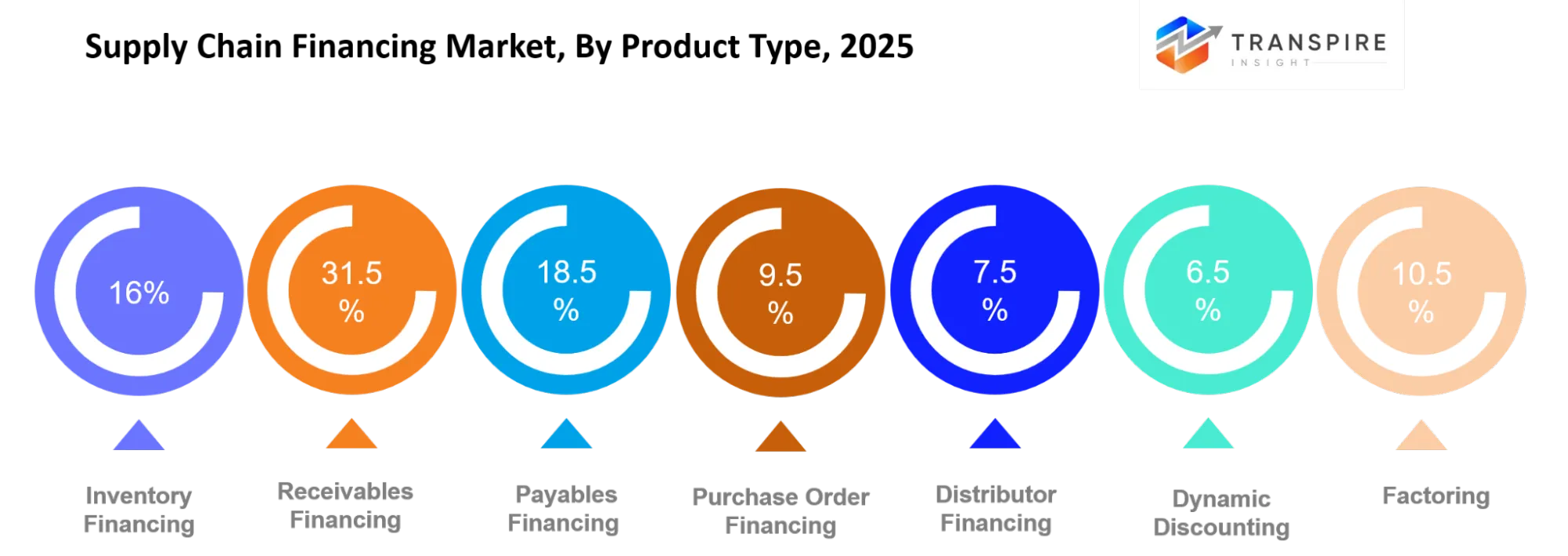
Receivables financing accounts for 31.5% of the market, supported by businesses converting outstanding invoices into immediate liquidity without waiting for contractual payment dates. Payables financing represents 18.5%, helping buyers extend payment terms while enabling suppliers to receive earlier payment. Inventory financing contributes 16.0%, supporting stock purchases and seasonal requirements, while purchase order financing accounts for 9.5% by funding orders before delivery. Distributor financing holds 7.5%, dynamic discounting 6.5%, factoring 7.0%, and other financing structures 3.5%. Each addresses different funding gaps across the commercial cycle.
Provider Type:
Banks benefit from established corporate relationships, extensive funding capacity, and international payment networks, enabling them to serve large borrowers and complex transactions. FinTech companies compete through faster onboarding, automated underwriting, and embedded lending integrated with business workflows. NBFCs address financing gaps for underserved businesses, while insurance companies support risk mitigation. Trade finance firms, supply chain platforms, credit unions, and other providers serve specific industries, borrower categories, and financing requirements, strengthening competition through specialised products, flexible eligibility criteria, and alternative funding structures.
Enterprise Size:
Large enterprises benefit from established credit profiles, substantial transaction volumes, and extensive supplier networks, making them suitable anchors for structured financing programmes. Multinational corporations use these arrangements to coordinate liquidity across countries, currencies, and business units. SMEs, micro enterprises, startups, and mid-sized firms represent opportunities for providers offering accessible, transaction-based credit. Public-sector entities and other organisations create additional demand through procurement activities and supplier-payment obligations. Digital underwriting and verified transaction records can help lenders assess smaller borrowers with limited collateral.
Application:
Domestic trade financing supports routine procurement, supplier payments, distribution, and inventory replenishment, helping businesses manage operating cash flows without disrupting purchasing schedules. International trade financing addresses longer payment cycles, currency exposure, documentation requirements, and counterparty risks across borders. Working-capital solutions help companies bridge the gap between paying suppliers and collecting customer revenue, while inventory management financing supports stock availability during seasonal fluctuations. As supply networks become more geographically dispersed, providers must strengthen compliance screening, transaction verification, and foreign-exchange risk management to maintain reliable funding access.
Platform Type:
Bank-based platforms retain credibility through established lending relationships, regulated operations, and access to institutional funding. FinTech-based financing is projected to grow at a 12.7% CAGR, supported by automated onboarding, digital underwriting, and faster transaction processing. Cloud-based platforms improve scalability, while API-integrated and ERP-integrated systems connect financing directly with procurement, invoicing, and treasury workflows. Blockchain-based solutions can improve transaction traceability, whereas marketplace-based platforms connect businesses with multiple funding providers. Future adoption will depend on interoperability, cybersecurity, data accuracy, and integration costs.
Industry:
Manufacturing uses supply chain financing to fund raw materials, production inputs, and supplier payments while managing extended customer-payment cycles. Retailers apply these solutions to seasonal inventory purchases and distributor settlements, while automotive and electronics companies use them to support complex, multi-tier supplier networks. Healthcare businesses benefit from financing for medical supplies and equipment, whereas food and beverage companies manage procurement cycles and inventory turnover. Construction firms use funding to bridge payment delays across contractors and material suppliers. Industry-specific platforms and verified transaction data will improve risk assessment and financing efficiency.
What are the Key Use Cases Driving the Supply Chain Financing Market?
Receivables financing is a core use case, accounting for 31.5% of the market. Manufacturers, distributors, and service providers use it to unlock cash from unpaid invoices, fund payroll and procurement, and avoid production delays while waiting for buyers to pay. Factoring provides a related route to immediate liquidity.
Expanding applications include payables financing, inventory funding, and distributor financing across retail, automotive, electronics, and food and beverage supply chains. These solutions help buyers preserve liquidity while suppliers receive timely funds, particularly during seasonal purchasing or extended payment cycles.
Emerging use cases include AI-assisted invoice verification, financing linked to live shipment data, and sustainability-linked supplier programmes. API-connected and cloud-based platforms can help lenders assess smaller suppliers using transaction histories, while digital trade infrastructure supports cross-border funding. These applications could widen SME participation and improve financing decisions, provided data quality and fraud controls remain reliable.
|
Report Metrics |
Details |
|
Market size value in 2025 |
USD 8.14 Billion |
|
Market size value in 2026 |
USD 8.80 Billion |
|
Revenue forecast in 2033 |
USD 15.22 Billion |
|
Growth rate |
CAGR of 8.14% from 2026 to 2033 |
|
Base year |
2025 |
|
Historical data |
2021 - 2024 |
|
Forecast period |
2026 - 2033 |
|
Report coverage |
Revenue forecast, competitive landscape, growth factors, and trends |
|
Regional scope |
United States; Canada; Mexico; United Kingdom; Germany; France; Italy; Spain; Denmark; Sweden; Norway; China; Japan; India; Australia; South Korea; Thailand; Brazil; Argentina; South Africa; Saudi Arabia; United Arab Emirates |
|
Key companies profiled |
HSBC, Citi, JPMorgan Chase, BNP Paribas, Santander, Standard Chartered, Deutsche Bank, Wells Fargo, Bank of America, MUFG, Taulia, C2FO, PrimeRevenue, Kyriba, SAP. |
|
Customization scope |
Free report customization (country, regional & segment scope). Avail customized purchase options to meet your exact research needs. |
|
Report Segmentation |
Financing Type (Inventory Financing, Receivables Financing, Payables Financing, Purchase Order Financing, Distributor Financing, Dynamic Discounting, Factoring, Others)Provider Type (Banks, FinTech Companies, NBFCs, Insurance Companies, Trade Finance Firms, Supply Chain Platforms, Credit Unions, Others)Enterprise Size (Large Enterprises, SMEs, Micro Enterprises, Startups, Multinational Corporations, Mid-Sized Firms, Public Sector, Others)Application (Domestic Trade, International Trade, Procurement, Distribution, Working Capital, Inventory Management, Supplier Payments, Others)Platform Type (Bank-Based, FinTech-Based, Blockchain-Based, Cloud-Based, ERP-Integrated, API-Based, Marketplace-Based, Others)Industry (Manufacturing, Retail, Automotive, Healthcare, Food & Beverage, Electronics, Construction, Others) |
Which Regions are Driving the Supply Chain Financing Market Growth?
North America holds a 34.6% share because leading companies, banks, and technology providers have rolled out mature working-capital programs in the region. North America's stronghold is receivables finance, dynamic discounting and treasury integration, thanks to a large foreign-currency buyer population, more advanced cloud and ERP infrastructure and a solid base of supplier-resilience investments. Governments are also pushing companies to document these arrangements through supply chain transparency and ESG reporting, which often drives up the number of companies that participate in a program. This drove banks and fintechs to bring liquidity directly to corporate payables.
In April 2026, JP Morgan Payments launched its unified working capital digital platform named the Working Capital Accelerator. This centralised system directly integrates the bank's core liquidity offerings—including dynamic discounting, supply chain finance, and receivables financing into a single digital dashboard to eliminate corporate systemic isolation.
https://www.jpmorgan.com/payments/solutions/trade-and-working-capital/accelerator
Europe, 29.4%, and with a stronger dependence on mandated adoption of e-invoicing, real-time payments, sustainability reporting and banking compliance requirements drive companies to improve how they see into their invoices and pay their suppliers. The region benefits from senior universal banks including BNP Paribas, Santander, Deutsche Bank and HSBC, with one foot in trade finance, which have the ability to marry a trade-finance capability with digital platforms for a more stable, compliant growth environment than North America's technology-oriented approach.
In June 2026, HSBC launched a paperless digital post-shipment financing tool called HSBC TradeCash, which enables corporate clients to upload sales invoice data directly to its digital platform and draw down loans without submitting traditional physical trade documentation.
https://www.gtreview.com/news/global/hsbc-launches-trade-document-free-digital-financing-product/
Asia Pacific is the fastest-growing region, with a CAGR of 13.9% and a market share of 24.0%. The growth has recently been driven by manufacturing moves, the growth of SME ecosystems, digital trade corridors, and collaborations between banks and fintechs to ease onboarding pain points. HSBC has, for example, used automated supplier onboarding and credit decisioning within Asia-Pacific trade corridors to overcome the challenge of fragmented supplier bases. Opportunities to extend financial coverage beyond tier-one suppliers to lower tiers of the supply chain exist through the use of invoice, logistics and platform data.
In September 2026, Mizuho Bank and the International Finance Corporation (IFC) launched a US$1 billion risk-sharing facility. This partnership directly addresses working capital barriers across the Asia-Pacific region by expanding access to supply chain finance—including payables, receivables, and pre-shipment financing.
Who are the Key Players in the Supply Chain Financing Market, and how do they compete?
Competition is shifting from balance-sheet capacity to platform reach, data quality, and the capacity to finance suppliers through multiple sources. Banks still hold the advantage in terms of credit capacity, cross-border payments, and regulator trust; fintech companies now compete on speed, experience, and ERP integration. The most successful models today combine bank funding with fintech distribution and analytics. JPMorgan, HSBC and Citi lead in this regard.
HSBC, Citi, JPMorgan Chase, BNP Paribas, Santander, Standard Chartered, Deutsche Bank, Wells Fargo, Bank of America and MUFG compete using trade networks, corporate relationships and digital trade infrastructure: HSBC leads in automated supplier onboarding and credit decisioning in Asia-Pacific corridors; JPMorgan is further developing blockchain-based settlement via Kinexys; Citi and BNP Paribas are piloting ESG-linked supplier finance, to align early-payment programs with sustainability goals. Taulia leads with end-to-end SAP S/4HANA integration and buyer-controlled early-payment options; C2FO is capitalising on an AI-powered marketplace for dynamic discounting and SME liquidity; Prime Revenue draws on a multi-funder model and wide ERP connectivity; Kyriba builds on treasury-grade AI and multi-country rollout. These providers' expansion strategy focuses on embedding finance within procurement, ERP, and treasury platforms, not as a stand-alone product.
Key Players are:
- HSBC
- Citi
- JPMorgan Chase
- BNP Paribas
- Santander
- Standard Chartered
- Deutsche Bank
- Wells Fargo
- Bank of America
- MUFG
- Taulia
- C2FO
- PrimeRevenue
- Kyriba
- SAP
Supply Chain Financing Market — Enhanced Competitive Benchmarking
|
Company |
Est. Revenue Share Range |
Key Offerings |
Strategic Positioning |
Geographic Strength |
Technology Focus |
|
HSBC |
Estimated 3–6% |
Payables finance, supplier finance, receivables finance, trade finance |
banking scale with integrated trade finance |
Europe, Asia Pacific, Middle East |
Digital trade platforms, API integration, liquidity analytics |
|
Citi |
Estimated 3–6% |
Citi Supplier Finance, payables finance, receivables finance, cross-border trade services |
Multinational corporate reach with cross-border liquidity expertise |
North America, Europe, Asia Pacific |
Digital banking, transaction automation, cross-border payment connectivity |
|
JPMorgan Chase |
Estimated 3–6% |
Supply chain finance, payables finance, dynamic discounting, Working Capital Accelerator |
Enterprise working-capital optimization with integrated funding |
North America, Europe, Asia Pacific |
ERP integration, automated onboarding, real-time working-capital visibility |
|
Standard Chartered |
Estimated 2–5% |
Supplier finance, payables finance, receivables finance, trade and working-capital solutions |
Emerging-market trade corridors and international banking specialization |
Asia Pacific, Middle East, Africa |
Digital trade workflows, transaction monitoring, cross-border connectivity |
|
BNP Paribas |
Estimated 2–5% |
Supply chain finance, reverse factoring, receivables finance, trade finance |
European corporate banking with international supplier-finance reach |
Europe, Asia Pacific, North America |
Digital banking platforms, automated processing, cash-flow optimization |
|
SAP Taulia |
Estimated 1–4% |
Payables finance, receivables finance, dynamic discounting, virtual cards |
ERP-embedded financing and multi-funder ecosystem differentiation |
North America, Europe, Asia Pacific |
SAP ERP integration, cloud financing workflows, AI-enabled cash-flow insights |
|
PrimeRevenue |
Estimated 1–3% |
Payables finance, supplier finance, multi-funder financing, B2B payment solutions |
multi-funder network with broad supplier reach |
North America, Europe, Asia Pacific |
Cloud-based SCF platform, funder connectivity, automated invoice processing |
|
C2FO |
Estimated 1–3% |
Dynamic discounting, Dynamic Supplier Finance, early-payment solutions, receivables funding |
Supplier-led liquidity access with flexible early-payment pricing |
North America, Europe, Asia Pacific |
Data-driven pricing, digital funding marketplace, invoice-level optimization |
|
FIS (Demica) |
Estimated 1–3% |
Supply chain finance software, receivables finance, securitization, white-label lending platforms |
Financial-institution enablement and configurable financing infrastructure |
Europe, North America, Asia Pacific |
White-label platforms, financing workflow automation, portfolio analytics |
|
DBS Bank |
Estimated 1–3% |
Supplier financing, payables finance, receivables finance, digital trade services |
Asia-focused transaction banking with strong regional trade networks |
Asia Pacific, Middle East |
Digital trade finance, electronic documentation, integrated cash management |
Recent Development News
In September 2026, Finastra launched its Supply Chain Finance platform at Sibos 2026, integrating cloud technology, AI and APIs to help banks scale payables and receivables financing, improve operational efficiency and expand working capital solutions for corporate clients.
In October 2026, the International Finance Corporation (IFC) partnered with Sumitomo Mitsui Banking Corporation (SMBC) to establish a US$500 million supply chain finance facility, combining funding from both institutions to improve affordable working capital access for small and medium-sized businesses in emerging markets.
In May 2026, FIS announced that its Supply Chain Finance Platform had been selected by Glencore to support a US$2.55 billion oil and gas trade receivables securitisation program, strengthening liquidity management, real-time receivables monitoring and financial reporting across multiple jurisdictions.
What Strategic Insights Define the Future of the Supply Chain Financing Market?
The market is heading for embedded, multi-funder and AI-assisted supply chain finance, with credit decisions incorporated into procurement tools and enterprise resource planning (ERP) systems. This improves the speed of approvals, provides greater cash-flow clarity, and reduces manual processing in supplier ecosystems. However, there is an unseen hazard in model and data governance. For models relying on automation and underwriting, incomplete invoice and ESG disclosure data, or supplier data, could lead to incorrect credit risk pricing and decisions. An emerging opportunity is deep-tier supplier finance, particularly in the Asia Pacific markets, where digital trade records may unlock liquidity not only for direct suppliers but for smaller companies down supply chains. Providers could focus on interoperable APIs, managed data standards, and bank–fintech partnerships to reduce onboarding friction, improve transaction transparency, and widen the supplier base while maintaining rigorous risk assessment, strong fraud controls, and regulatory confidence in more automated finance ecosystems.
Key Segmentations are:
Financing Type
- Inventory Financing
- Receivables Financing
- Payables Financing
- Purchase Order Financing
- Distributor Financing
- Dynamic Discounting
- Factoring
- Others
Provider Type
- Banks
- FinTech Companies
- NBFCs
- Insurance Companies
- Trade Finance Firms
- Supply Chain Platforms
- Credit Unions
- Others
Enterprise Size
- Large Enterprises
- SMEs
- Micro Enterprises
- Startups
- Multinational Corporations
- Mid-Sized Firms
- Public Sector
- Others
Application
- Domestic Trade
- International Trade
- Procurement
- Distribution
- Working Capital
- Inventory Management
- Supplier Payments
- Others
Platform Type
- Bank-Based
- FinTech-Based
- Blockchain-Based
- Cloud-Based
- ERP-Integrated
- API-Based
- Marketplace-Based
- Others
Industry
- Manufacturing
- Retail
- Automotive
- Healthcare
- Food & Beverage
- Electronics
- Construction
- Others
Frequently Asked Questions
Find quick answers to common questions.
The supply chain financing market size was valued at USD 8.14 billion in 2025 and is poised to reach USD 15.22 billion by 2033, expanding at an 8.14% CAGR
Key segments for the supply chain financing market are Financing Type (Inventory Financing, Receivables Financing, Payables Financing, Purchase Order Financing, Distributor Financing, Dynamic Discounting, Factoring, Others)Provider Type (Banks, FinTech Companies, NBFCs, Insurance Companies, Trade Finance Firms, Supply Chain Platforms, Credit Unions, Others)Enterprise Size (Large Enterprises, SMEs, Micro Enterprises, Startups, Multinational Corporations, Mid-Sized Firms, Public Sector, Others)Application (Domestic Trade, International Trade, Procurement, Distribution, Working Capital, Inventory Management, Supplier Payments, Others)Platform Type (Bank-Based, FinTech-Based, Blockchain-Based, Cloud-Based, ERP-Integrated, API-Based, Marketplace-Based, Others)Industry (Manufacturing, Retail, Automotive, Healthcare, Food & Beverage, Electronics, Construction, Others).
Growth is primarily driven by working-capital pressures, supply chain diversification, digital lending platforms, and rising demand for faster supplier payments.
The supply chain financing market is led by major manufacturers, including HSBC, Citi, JPMorgan Chase, BNP Paribas, Santander, Standard Chartered, Deutsche Bank, Wells Fargo, Bank of America, MUFG, Taulia, C2FO, PrimeRevenue, Kyriba, and SAP.
North America holds a 34.6% market share, supported by established banking networks, advanced financial technology, strong corporate relationships, and widespread digital treasury adoption.
Key opportunities include AI-driven credit assessment, deep-tier supplier financing, API-integrated lending, digital trade documentation, and SME financing across emerging markets.
- HSBC
- Citi
- JPMorgan Chase
- BNP Paribas
- Santander
- Standard Chartered
- Deutsche Bank
- Wells Fargo
- Bank of America
- MUFG
- Taulia
- C2FO
- PrimeRevenue
- Kyriba
- SAP
About the Authors

Mayur Shinde
I am Mayur Shinde, a Senior Research Analyst at Transpire Insight, specializing in the Automotive & Transportation and Information & Communication Technology (ICT) Industry. My work focuses on analyzing emerging market trends, technological advancements, competitive landscapes, and industry developments to deliver accurate, data-driven insights. I am passionate about transforming complex market information into clear, actionable content that helps businesses, professionals, and decision-makers stay informed and make confident strategic decisions.

Chakradhar Khansole
Chakradhar serves as the Research Director at Transpire Insight, bringing over 8 years of experience in technology, innovation, and strategic market intelligence. He specializes in transforming complex market data into actionable business insights that enable organizations to make informed, growth-oriented decisions. Recognized for his strategic vision and analytical expertise, Chakradhar leads high-impact research initiatives, delivering comprehensive market assessments, competitive intelligence, and forward-looking industry analysis.
Recently Published Reports
-
Apr 2026
3D Optical Profiler Market
3D Optical Profiler Market Size, Share & Analysis Report By Type (Desktop 3D Optical Profiler, and Portable 3D Optical Profiler), By Technology (Confocal Technology, and White Light Interference), By End-Use Industry (Manufacturing, Research Institutions, Automotive, Aerospace and Defense, Medical Devices, and Other), and Geography (North America, Europe, Asia-Pacific, Middle East and Africa, South and Central America), 2021 - 2031
-
Apr 2026
Depth Sensor Market
Depth Sensor Market Size, Share & Analysis Report By Type (Infrared Depth Sensors, Time-of-Flight (ToF) Sensors, Stereo Vision Sensors, Structured Light Sensors, Ultrasonic Depth Sensors), By Application (Automotive, Robotics, Gaming, Consumer Electronics, Industrial Automation, Healthcare, Security & Surveillance, Others), By End Users (Automotive Manufacturers, Consumer Electronics Companies, Healthcare Providers, Industrial Companies, Security Agencies, Gaming Companies, Robotics Companies, Others), and Geography (North America, Europe, Asia-Pacific, Middle East and Africa, South and Central America), 2021 – 2031
-
Apr 2026
Digital Manufacturing Market
Digital Manufacturing Market Size, Share & Analysis Report By Component (Hardware, Software, and Services), By Technology (Robotics, 3D Printing, Internet of Things (IoT), and Others), By Application (Automotive and Transportation, Aerospace and Defense, Consumer Electronics, Industrial Machinery, and Others), By Process Type (Computer-Based Designing, Computer-Based Simulation, Computer 3D Visualization, Analytics, and Others), and Geography (North America, Europe, Asia-Pacific, Middle East and Africa, South and Central America), 2021 – 2031
-
Apr 2026
Digital Visa Services Market
Digital Visa Services Market Size, Share & Analysis Report By Type (Individual Travelers, Group Travelers), By Application (Tourism, Business Travel, Others), and Geography (North America, Europe, Asia-Pacific, Middle East and Africa, South and Central America), 2021 – 2031