

Submarine Optical Fiber Cable Market Summary:
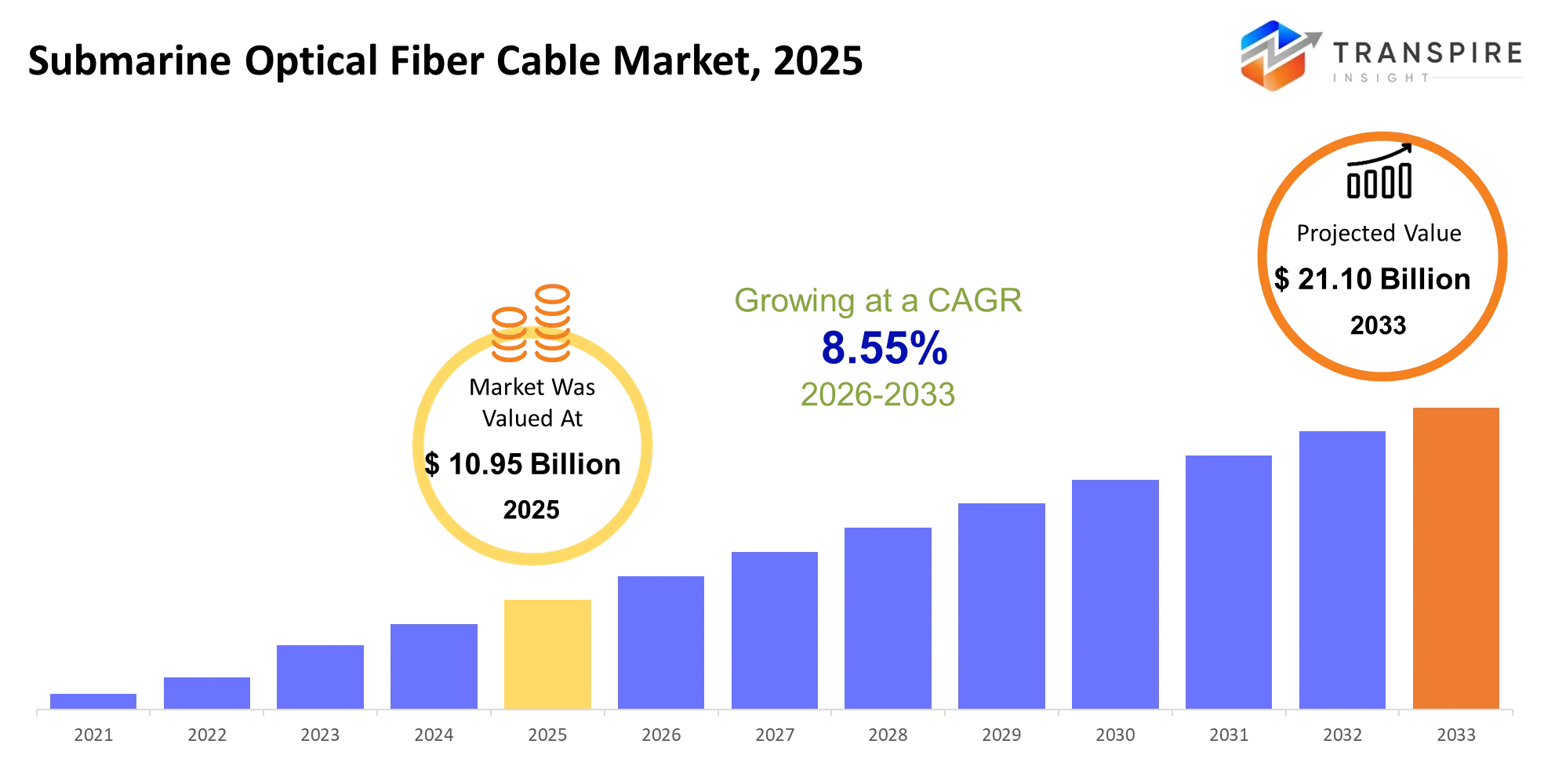
The Submarine Optical Fiber Cable Market size is estimated at USD 10.95 billion in 2025 and is anticipated to reach USD 21.10 billion by 2033, growing at a CAGR of 8.55% from 2026 to 2033.
The submarine optical fibre cable market links continents, cloud regions, data centres, telecom networks, and mission-critical services through high-capacity terrestrial and subsea networks. Over the last three to five years, capital investment has migrated from bare capacity to a more diverse, resilient, and strategically managed route. The major structural shift that is driving growth in this space is the rapid expansion of AI data centres. Distributed computing and large-scale model training require new requirements for low-latency connectivity and low-cost transport links between geographically dispersed facilities. Meanwhile, submarine cable faults, geopolitical concerns, and shipping-related risks have led to a focus on cable redundancy, monitoring and faster repair. The EU's strategy allocated millions for strategic subsea cable projects and repair capacity, supporting this shift. Growth therefore comes from data-centre expansion, international bandwidth demand, routing diversity, and resilience spending: investment in the cable, cable upgrades, cable landing infrastructure, and cable maintenance services.
Submarine Optical Fiber Cable Market Size & Forecast:
- Market Size 2025: USD 10.95 Billion
- Expected Market Value (2033): USD 21.10 Billion
- Forecast CAGR (2026–2033): 8.55%
- Leading Region in 2025: Asia Pacific
- Fastest-Growing Region: Europe
- Key Company Profiles: SubCom, NEC Corporation, Alcatel Submarine Networks, HMN Tech, Prysmian Group, Nexans, Fujitsu, Huawei Marine Networks, Xtera, Ocean Networks, TE SubCom, NTT, Sumitomo Electric, Hengtong Group, ZTT.
Key Submarine Optical Fiber Cable Market Insights:
The market is shifting from capacity growth to connectivity, route diversification, and infrastructure resilience for AI. Today, investments in company systems are increasingly integrating systems with greater capacity, smarter monitoring, specialised installation skills, and geographically diverse routes.
- Asia Pacific holds 33.21% of the market, with SubCom and HMN Tech building up manufacturing presence in the region to reduce lead times and localise supply chains.
- North America accounts for 24% of the market, and NEC and Alcatel Submarine Networks are installing transatlantic systems based on SDM to support hyperscaler AI traffic.
- Europe accounts for 27% of the market, and Prysmian and Nexans are joining fiber with HVDC for offshore wind, making hybrid power–data corridors.
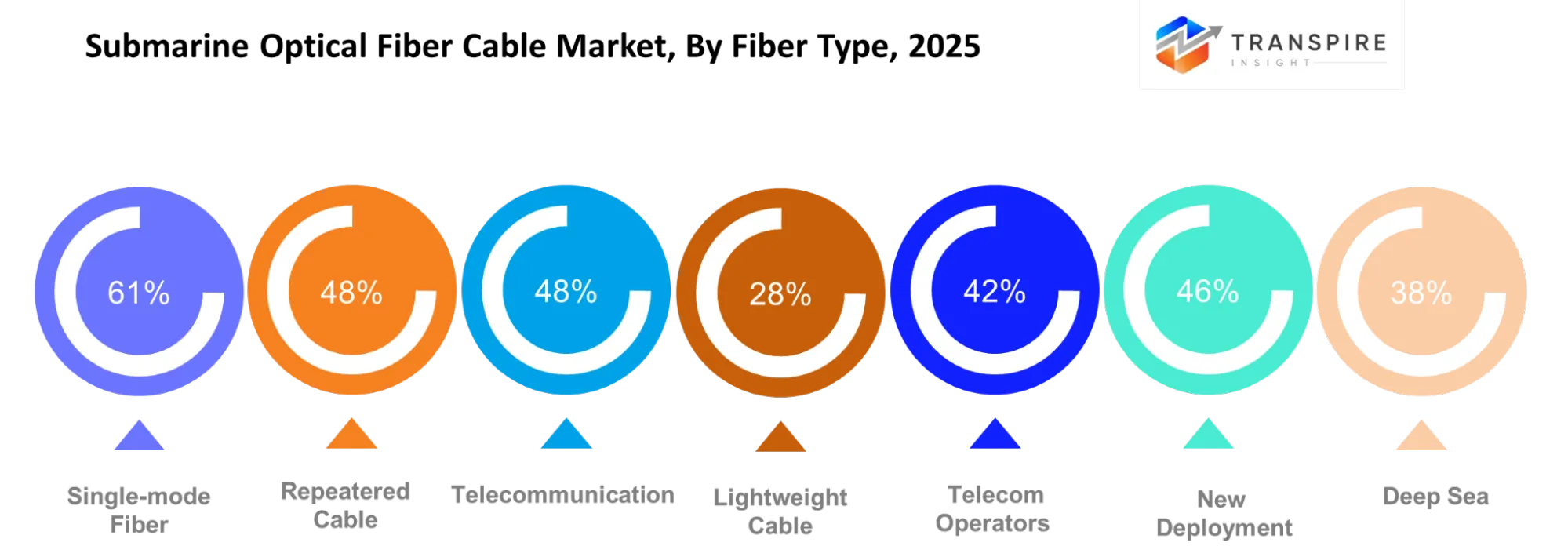
- Fujitsu and Sumitomo are developing single-mode fibre that can be upgraded to ultra-low-loss and hollow-core fibres for next-generation coherent optics, at 61%.
- Repeatered cable is still the dominant technology at 48%, with Xtera and Ocean Networks pushing ahead with repeaterless designs for regional and island links.
- The private-route leasing model is being offered by NTT and Huawei Marine, as the telecom operators at 42% are feeling the competition from cloud providers.
- New deployment at 46% is supported by TE SubCom and ZTT investing in repair vessels and cable-replacement programs to minimise downtime.
- For deep-sea applications, Hengtong and Alcatel are launching rock-armoured and special protection cable solutions for trench and seismic areas at 38%.
- Lightweight cable (28%) is becoming more popular in ultra-deep trunks, and Nexans and Prysmian are working on reducing weight-to-strength ratios for increased span.
What are the Key Drivers, Restraints, and Opportunities in the Submarine Optical Fiber Cable Market?
Driver:
AI, cloud-driven shifts in cable economics. Cloud-AI-centric workloads involve moving data, often between data centres, cloud regions, and users. And operators increasingly are locating new facilities outside their established connectivity Hot Spots. TeleGeography estimates nearly $17 billion of submarine cables are planned for completion through 2030, including nearly $6 billion of cable investments just to secure capacity and geographic diversity, or to support revenues from cable manufacturing, marine installation, local landing stations, or capacity services.
Restraint:
Deployment remains constrained by long permitting cycles, specialized vessels, limited repair capacity, complex permitting, and difficult marine conditions. This problem persists because cable routes cross multiple jurisdictions and repairs require scarce ships, specialised equipment, trained crews, and suitable port facilities. The ITU identified physical exposure, longer repair times, and geographic concentration as persistent resilience challenges, increasing downtime risk and project complexity and cost.
Opportunity:
Smart cables and regional resilience infrastructure can set up a new investment cycle. In 2026, the EU allocated 347 million to strategic submarine cables and repair capacity, while regional cable hubs in the Baltic and Mediterranean were funded. By combining sensing, automated condition monitoring, route diversity and pre-positioned repair modules, restoration times can be reduced, and demand can grow for premium cable systems, surveillance equipment and lifecycle services worldwide.
What Has the Impact of Artificial Intelligence Been on the Submarine Optical Fiber Cable Market?
Submarine cables are being impacted by artificial intelligence mainly through capacity planning, route optimisation, monitoring and predictive maintenance. AI-based traffic forecasts can pinpoint where future bandwidth pressure will be caused by data-centre interconnection, enabling operators to invest in fibre-pair upgrades, new routes and landing capacity before reaching a breakdown point. Optical performance data, alarms, environmental data and historic fault records can be fed into machine-learning models that detect unusual patterns and enable earlier intervention, which helps to optimise operational planning by reducing unnecessary inspections and scheduling repairs more effectively. AI is also increasing the value of low-latency, geographically diverse routes, since training and inference tasks can be distributed between multiple data centres. TeleGeography reports that AI-related infrastructure investment is driving upgrades to both long-haul and data-centre interconnection networks; however, their use is constrained by the difficulty of incorporating diverse legacy monitoring systems and incomplete datasets, as well as the possibility that false alarms or poor-quality data may undermine trust in automated predictions. High implementation and integration costs are another major barrier to adoption among smaller network owners and operators.
In July 2026, Lightstorm, alongside consortium partners Microsoft, Singtel, and Tata Communications, signed official contracts to initiate the physical build of the 3,600-kilometre India-Southeast Asia (I-2SEA) Submarine Cable System.https://www.submarinenetworks.com/en/systems/intra-asia/i-2sea/consortium-launches-i-2sea-cable-system
Key Submarine Optical Fiber Cable Market Trends:
The shift from capacity expansion to AI connectivity, resilience, route diversity, and intelligent monitoring is driving submarine cable development, and investment is increasingly tied to data centre geography and national infrastructure security.
- New cables are focused on cloud and AI corridors, being deployed away from traditional telecom corridors and toward direct data-centre interconnection.
- Content providers have shifted from being big buyers of bandwidth to cable owners, providing them with more control over routes, landing points, and capacity planning.
- With the frequent failures of cables, governments and operators have mandated resilience as a design criterion.
- Smart-cable features are becoming a topic of interest because operators are looking for proactive maintenance instead of reactive maintenance, and for earlier fault detection, network visibility, and restoration.
- The repair strategy is moving from a centralised response to a regional readiness with dedicated hubs, modular equipment and pre-positioned repair resources.
- Geography influences cable projects as AI facilities require secure international connections to link compute clusters and cloud regions.
- Regulatory review is growing, including in the areas of ownership, security, landing stations, and cable supply-chain reliance for strategically critical cable infrastructure.
- For new deployment, upgrades and route expansion are becoming more common, enabling operators to increase capacity or resilience without having to replace entire systems.
Submarine Optical Fiber Cable Market Segmentation
By Fiber Type:
Single-mode Fiber leads at 61%, supported by low attenuation and efficient long-distance transmission across intercontinental routes. Multimode Fiber serves shorter, localised connections where high bandwidth over limited distances is sufficient. Dispersion-shifted Fiber and Non-zero Dispersion Fiber support wavelength management, while Bend-insensitive Fiber improves installation flexibility. Ultra-low-loss Fiber enhances transmission efficiency, and Hollow-core Fiber offers future potential through lower latency and reduced signal propagation losses across advanced networks.
By Cable Type:
Repeatered Cable accounts for 48%, as repeaters maintain optical signal strength across long submarine distances and support high-capacity international systems. Repeaterless Cable remains suitable for shorter routes with simpler infrastructure requirements. Branching Cable enables multiple landing points, improving network reach, while Double-armoured and Heavyweight Cable provide greater physical protection. Lightweight Cable represents 28%, benefiting projects where reduced cable weight, efficient handling, and faster marine installation are priorities.
By Application:
Telecommunication holds 48%, reflecting its established role in international voice, mobile, internet, and backbone traffic. Internet Connectivity supports cross-border digital services, while Data Centres and Cloud Services are expanding as distributed computing requires reliable intercontinental links. Data-centre connectivity records a 13.4% CAGR, supported by AI workloads and cloud expansion. Defence & Security, Oil & Gas, Scientific Research, and Others create specialised opportunities requiring secure, resilient, and application-specific subsea connectivity.
By Armoring:
Lightweight, Lightweight Protected, Single Armoured, Double Armored, Rock Armored, Special Protection, Deep-water Cable, and Others address different seabed and installation conditions. Lightweight designs support deeper-water deployment where external hazards are limited, while protected and armoured configurations provide additional resistance against fishing activity, anchors, abrasion, and challenging seabed conditions. Rock Armored and Special Protection solutions are particularly relevant near landing zones, coastal sections, and areas requiring stronger mechanical protection during operation.
By Depth:
Deep Sea represents 38%, reflecting extensive deployment across long intercontinental ocean routes where specialised cable engineering and installation vessels are required. Shallow Water and Coastal systems face greater exposure to fishing, anchoring, and human activity, increasing protection requirements. Continental Shelf routes require careful seabed assessment, while Ultra-deep Sea and Oceanic deployments demand advanced installation capabilities. Trench Areas and Others serve specialised routes where depth, geology, and environmental conditions influence cable design.
By End User:
Telecom Operators account for 42%, supported by their established international backbone networks and continuing requirements for route diversity. Cloud Providers are expanding ownership and capacity to connect distributed computing infrastructure, while Governments emphasise secure and resilient communications. Content Providers and Data Centers increasingly participate in subsea projects to control capacity and latency. Enterprises and Research Organizations use specialised connectivity for international operations, scientific collaboration, and data-intensive applications, while Others serve niche requirements.
By Installation:
New Deployment leads at 46%, reflecting investment in additional routes, landing points, and international capacity. Cable Replacement addresses ageing infrastructure and restores networks where systems approach operational limits, while Cable Repair supports resilience after subsea faults. Route Expansion extends existing connectivity corridors, and Branching adds access to additional markets. Maintenance preserves network reliability, while Upgrade activities improve capacity and transmission performance without requiring complete replacement. Others cover specialised installation requirements.
What are the Key Use Cases Driving the Submarine Optical Fiber Cable Market?
Telecommunication remains the core use case, accounting for 48% in the supplied segmentation, as submarine cables carry international voice, mobile, internet, and enterprise traffic. The segment benefits from continued cross-border bandwidth growth and the need for route redundancy.
Data center connectivity is an expanding use case, with the supplied data showing a 13.4% CAGR. AI training, cloud replication, distributed storage, and inference workloads are pushing operators to connect geographically separated facilities through high-capacity, low-latency subsea routes.
Emerging use cases include defense and security, scientific research, offshore energy operations, and specialized private networks. Smart-cable sensing can add monitoring value beyond communications, while new corridors such as India–Southeast Asia are being developed around data-center and AI connectivity requirements.
|
Report Metrics |
Details |
|
Market size value in 2025 |
USD 10.95 Billion |
|
Market size value in 2026 |
USD 11.88 Billion |
|
Revenue forecast in 2033 |
USD 21.10 Billion |
|
Growth rate |
CAGR of 8.55% from 2026 to 2033 |
|
Base year |
2025 |
|
Historical data |
2021 - 2024 |
|
Forecast period |
2026 - 2033 |
|
Report coverage |
Revenue forecast, competitive landscape, growth factors, and trends |
|
Regional scope |
United States; Canada; Mexico; United Kingdom; Germany; France; Italy; Spain; Denmark; Sweden; Norway; China; Japan; India; Australia; South Korea; Thailand; Brazil; Argentina; South Africa; Saudi Arabia; United Arab Emirates |
|
Key company profiled |
SubCom, NEC Corporation, Alcatel Submarine Networks, HMN Tech, Prysmian Group, Nexans, Fujitsu, Huawei Marine Networks, Xtera, Ocean Networks, TE SubCom, NTT, Sumitomo Electric, Hengtong Group, ZTT |
|
Customization scope |
Free report customization (country, regional & segment scope). Available customized purchase options to meet your exact research needs. |
|
Report Segmentation |
By Fiber Type (Single-mode Fiber, Multimode Fiber, Dispersion-shifted Fiber, Non-zero Dispersion Fiber, Bend-insensitive Fiber, Ultra-low-loss Fiber, Hollow-core Fiber, Others); By Cable Type (Repeatered Cable, Repeaterless Cable, Branching Cable, Double-armored Cable, Lightweight Cable, Heavyweight Cable, Flexible Cable, Others); By Application (Telecommunication, Internet Connectivity, Data Centers, Cloud Services, Defense & Security, Oil & Gas, Scientific Research, Others); By Armoring (Lightweight, Lightweight Protected, Single Armored, Double Armored, Rock Armored, Special Protection, Deep-water Cable, Others); By Depth (Shallow Water, Continental Shelf, Deep Sea, Ultra-deep Sea, Coastal, Oceanic, Trench Areas, Others); By End User (Telecom Operators, Cloud Providers, Governments, Content Providers, Data Centers, Enterprises, Research Organizations, Others); By Installation (New Deployment, Cable Replacement, Cable Repair, Route Expansion, Branching, Maintenance, Upgrade, Others) |
Which Regions are Driving the Submarine Optical Fiber Cable Market Growth?
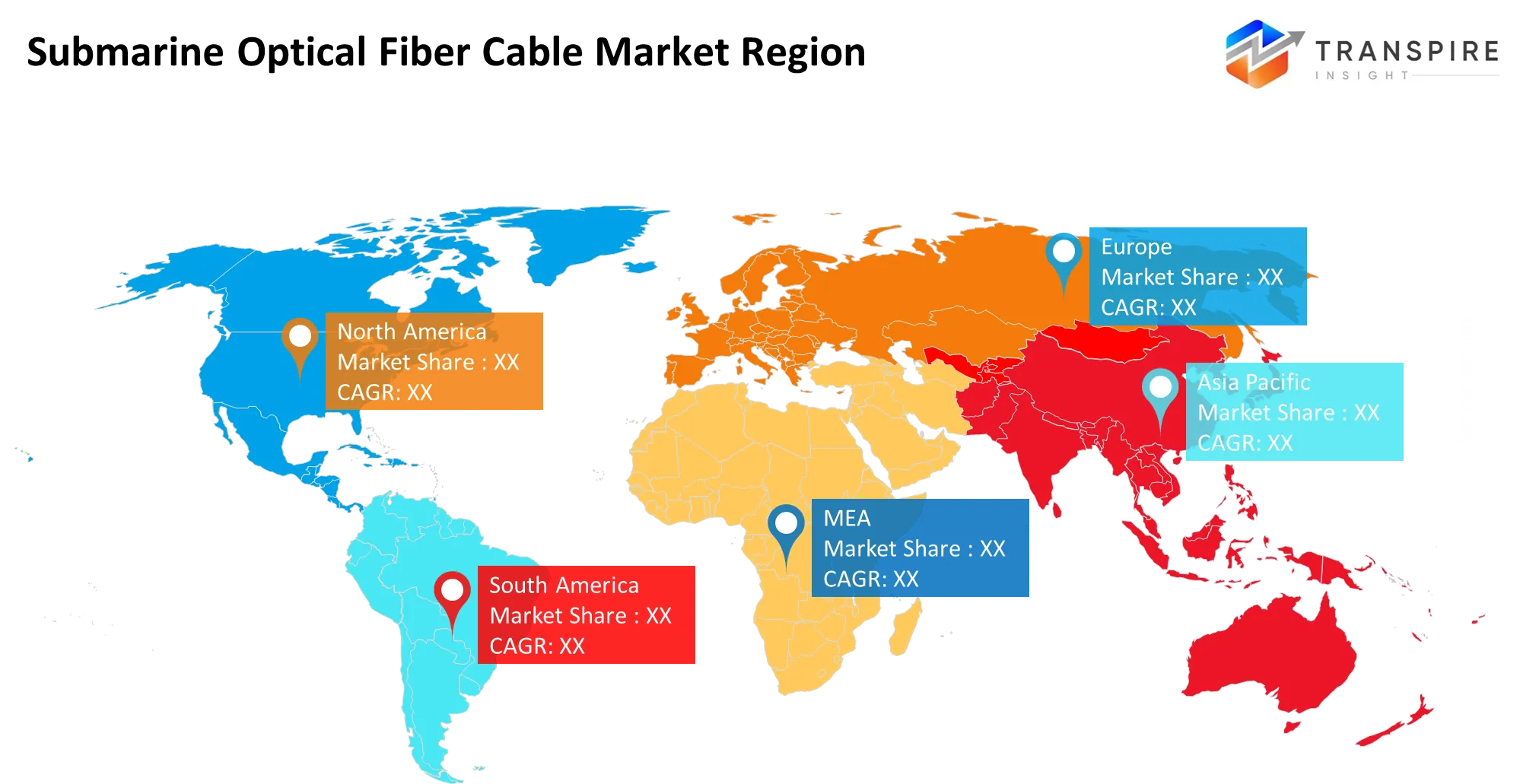
Asia Pacific, with 33.21% of activity, dominates due to dense coastal populations, rapid 5G/6G rollouts, and government-backed digital corridors across China, India, Japan, and Southeast Asia. Supportive policies, streamlined landing approvals, and aggressive data centre expansion create a self-reinforcing ecosystem that attracts hyperscaler investment and local manufacturing. This concentration of demand, infrastructure, and regulatory momentum keeps the region at the centre of new capacity planning and route diversification.
In May 2026, the Asian Development Bank (ADB) launched a $70 billion funding plan for energy and digital infrastructure, which includes mobilising $20 billion specifically for the Asia-Pacific Digital Highway initiative.https://www.reuters.com/sustainability/climate-energy/adb-launches-70-billion-plan-energy-digital-infrastructure-asia-pacific-2026-05-03/
North America, at 24%, lags Asia Pacific in market share but adds predictability thanks to more mature regulations, existing landing stations, and IRU agreements with cloud providers. While Asia's growth can be rapid and led by policies, growth in North America is driven by predictable permitting, cybersecurity requirements, and private cables funded by hyperscalers that focus on latency and resilience rather than volume.
In September 2026, Amazon Web Services (AWS) announced the deployment of its new "Sta'O'Nuk" private subsea cable connecting Washington state to Japan. This development establishes the first international subsea link to land in Washington.https://www.datacenterdynamics.com/en/news/amazon-plots-new-subsea-cable-linking-us-and-japan/
Europe, with a significant share of 27% and the highest announced regional growth rate of 11.83%, represents a move towards resilience, strategic autonomy, and smart-cable infrastructure. In 2026, the European Commission invested 347 million in strategic submarine cable projects, repair services, and various other dedicated projects, such as smart monitoring and sensing. This is paving the way for regional cable hubs, open-access networks, repair infrastructure and smart-cable components; PISCES and SEA-SPINE demonstrate investment in diversified European routes.
In March 2026, the European Commission published details on PISCES as an open-access multi-fibre subsea cable system linking Ireland, Portugal, Spain, and France. This infrastructure initiative reinforces regional resilience and digital connectivity across the European Atlantic seaboard.https://www.submarinenetworks.com/en/nv/insights/eu-funds-regional-cable-hubs
Who are the Key Players in the Submarine Optical Fiber Cable Market, and how do they compete?
Competition is also developing around turnkey capability, route engineering, fibre capacity, installation resources, security, and proximity to hyperscaler markets rather than manufacturing alone. Sub Com, NEC Corporation, Alcatel Submarine Networks, HMN Tech, Huawei Marine Networks, Xtera, TE Sub Com, and NTT compete on system integration and long-haul network operation, while Prysmian Group, Nexans, Sumitomo Electric, Hengtong Group, and ZTT provide manufacturing scale, cable engineering, or regional supply. NEC is expanding its Asia-Pacific role through I-2SEA and has fully completed the EMCS Pacific system.
Prysmian continues to vertically expand by acquiring Xtera to add turnkey submarine telecom capability to its existing subsea capability, via an 80%-owned joint venture with Fincantieri. Nexans combines manufacturing with a focus on specialised subsea engineering and TAM-1 production for the Americas. Fujitsu and Ocean Networks are more selectively focused on technology, network, or specialised connectivity opportunities, while Sumitomo Electric, Hengtong, and ZTT draw on manufacturing and regional supply advantages. Huawei Marine Networks and HMN Tech are more strongly competing through integrated systems and cost-effective international projects, while Xtera is more focused on turnkey solutions.
Key Players are:
- SubCom
- NEC Corporation
- Alcatel Submarine Networks
- HMN Tech
- Prysmian Group
- Nexans
- Fujitsu
- Huawei Marine Networks
- Xtera
- Ocean Networks
- TE SubCom
- NTT
- Sumitomo Electric
- Hengtong Group
- ZTT
Recent Development News
- In March 2026, NTT Corporation officially launched its pioneering 192-core submarine cable system utilising next-generation multicore optical fibre technology. This product deployment effectively scales physical transmission capacity fourfold without altering standard subsea cable dimensions, dramatically reducing infrastructure costs per terabit for upcoming oceanic network layouts.https://group.ntt/en/newsrelease/2026/03/13/260313a.html
- In September 2026, the United States and India solidified a strategic bilateral partnership under the Transforming Relationship Utilising Strategic Technologies (TRUST) initiative framework. The collaborative workshop establishes a joint infrastructure directive to enhance the physical security, route diversification, and landing station resilience of critical subsea cable networks traversing the Indo-Pacific.https://m.economictimes.com/news/india/us-india-partner-to-secure-undersea-cable-networks-and-expand-digital-connectivity-under-trust-initiative/articleshow/134101107.cms
- In September 2026, Firmus Technologies invested US$300 million in SUBCO’s APX East submarine cable system, securing 150 Tbps of capacity for at least 25 years. The agreement strengthens connectivity for Firmus’ planned AI data-centre infrastructure and supports the development of a direct Australia–United States subsea route.https://www.submarinenetworks.com/en/systems/trans-pacific/apx-east/firmus-commits-usd300m-to-subco-apx-east-cable
What Strategic Insights Define the Future of the Submarine Optical Fiber Cable Market?
The drive will be toward geographically diverse, actively managed, AI-linked cable networks, where route architecture will matter as much as capacity. The hidden risk will be the undersea cable equivalent of high-density urban traffic: physical cable concentration, too few repair vessels, delays in permits, and specialised installation constraints can turn a local problem into a multi-day connectivity failure. Europe is already playing out the consequences with dedicated undersea cable hubs, allocating repair funds and equipping cable-laying ships with early warning systems, bringing something that was once a cost of commercial operations into the realm of investment risk. The opportunity will be in smart cable that delivers communications, sensing, environmental, and early warning information; EU-funded programs are explicitly designed to do this. Strategy, at least for now, should focus on diversified routes, interoperable landing sites, proactive monitoring, and long-term repair capacity, not simply the greatest capacity on the fewest routes.
Key Segmentations are:
By Fiber Type
- Single-mode Fiber
- Multimode Fiber
- Dispersion-shifted Fiber
- Non-zero Dispersion Fiber
- Bend-insensitive Fiber
- Ultra-low-loss Fiber
- Hollow-core Fiber
- Others
By Cable Type
- Repeatered Cable
- Repeaterless Cable
- Branching Cable
- Double-armored Cable
- Lightweight Cable
- Heavyweight Cable
- Flexible Cable
- Others
By Application
- Telecommunication
- Internet Connectivity
- Data Centers
- Cloud Services
- Defense & Security
- Oil & Gas
- Scientific Research
- Others
By Armoring
- Lightweight
- Lightweight Protected
- Single Armored
- Double Armored
- Rock Armored
- Special Protection
- Deep-water Cable
- Others
By Depth
- Shallow Water
- Continental Shelf
- Deep Sea
- Ultra-deep Sea
- Coastal
- Oceanic
- Trench Areas
- Others
By End User
- Telecom Operators
- Cloud Providers
- Governments
- Content Providers
- Data Centers
- Enterprises
- Research Organizations
- Others
By Installation
- New Deployment
- Cable Replacement
- Cable Repair
- Route Expansion
- Branching
- Maintenance
- Upgrade
- Others
By Regional Analysis
North America
- US
- Canada
- Mexico
Europe
- Germany
- UK
- France
- Italy
- Spain
- Russia
- Rest of Europe
Asia Pacific
- China
- Japan
- India
- South Korea
- Australia
- Rest of Asia Pacific
South America
- Brazil
- Argentina
- Rest of South America
Middle East & Africa
- UAE
- Saudi Arabia
- Qatar
- South Africa
- Rest of the Middle East & Africa
Frequently Asked Questions
Find quick answers to common questions.
The submarine optical fiber cable market size was valued at USD 10.95 billion in 2025 and is poised to reach USD 21.10 billion by 2033, expanding at an 8.55% CAGR.
Key segments for the submarine optical fiber cable market are By Fiber Type (Single-mode Fiber, Multimode Fiber, Dispersion-shifted Fiber, Non-zero Dispersion Fiber, Bend-insensitive Fiber, Ultra-low-loss Fiber, Hollow-core Fiber, Others); By Cable Type (Repeatered Cable, Repeaterless Cable, Branching Cable, Double-armored Cable, Lightweight Cable, Heavyweight Cable, Flexible Cable, Others); By Application (Telecommunication, Internet Connectivity, Data Centers, Cloud Services, Defense & Security, Oil & Gas, Scientific Research, Others); By Armoring (Lightweight, Lightweight Protected, Single Armored, Double Armored, Rock Armored, Special Protection, Deep-water Cable, Others); By Depth (Shallow Water, Continental Shelf, Deep Sea, Ultra-deep Sea, Coastal, Oceanic, Trench Areas, Others); By End User (Telecom Operators, Cloud Providers, Governments, Content Providers, Data Centers, Enterprises, Research Organizations, Others); By Installation (New Deployment, Cable Replacement, Cable Repair, Route Expansion, Branching, Maintenance, Upgrade, Others)
Growth is primarily driven by AI and cloud data-centre expansion, international bandwidth requirements, route diversification, digital infrastructure investment, and rising focus on network resilience and cable security.
The submarine optical fiber cable market is led by major manufacturers including SubCom, NEC Corporation, Alcatel Submarine Networks, HMN Tech, Prysmian Group, Nexans, Fujitsu, Huawei Marine Networks, Xtera, Ocean Networks, TE SubCom, NTT, Sumitomo Electric, Hengtong Group, and ZTT.
Asia Pacific holds 33.21% of the market and influences dynamics through expanding data centres, cross-border digital traffic, AI infrastructure, new international routes, and strong investment in regional connectivity.
Commercial opportunities include smart cables, AI-oriented data-center routes, regional cable hubs, route diversification, predictive monitoring, cable repair infrastructure, and new connectivity corridors across emerging markets.
- SubCom
- NEC Corporation
- Alcatel Submarine Networks
- HMN Tech
- Prysmian Group
- Nexans
- Fujitsu
- Huawei Marine Networks
- Xtera
- Ocean Networks
- TE SubCom
- NTT
- Sumitomo Electric
- Hengtong Group
- ZTT
About the Authors

Avinash Kumar
I’m Avinash Kumar, a Senior Research Analyst at Transpire Insight, with expertise in the Electronics and Semiconductor and Energy & Power industry. My work focuses on analyzing emerging technologies, market trends, industry developments, and innovation across these sectors. I specialize in transforming complex technical and market insights into clear, research-backed content that helps professionals, businesses, and decision-makers stay informed. Through continuous industry research and data-driven analysis, I strive to deliver accurate, reliable, and practical perspectives on the latest advancements shaping the semiconductor and energy landscape.

Chakradhar Khansole
Chakradhar serves as the Research Director at Transpire Insight, bringing over 8 years of experience in technology, innovation, and strategic market intelligence. He specializes in transforming complex market data into actionable business insights that enable organizations to make informed, growth-oriented decisions. Recognized for his strategic vision and analytical expertise, Chakradhar leads high-impact research initiatives, delivering comprehensive market assessments, competitive intelligence, and forward-looking industry analysis.
Recently Published Reports
-
Apr 2026
Fiber Optic Faceplates Market
Fiber Optic Faceplates Market Size, Share & Analysis Report By Type (< 300 mm2, 300-350 mm2, and > 350 mm2, By Application (Night Vision, Holographic Imaging, Medical, and Others), and Geography (North America, Europe, Asia-Pacific, Middle East and Africa, South and Central America), 2021 - 2031
-
Apr 2026
High Temperature Superconductors Market
High Temperature Superconductors Market Size, Share & Analysis Report By Type (1G HTS, and 2G HTS), By Application (Power Cable, Fault Current Limiter, and Transformer), and Geography (North America, Europe, Asia-Pacific, Middle East and Africa, South and Central America), 2021 - 2031
-
Apr 2026
Industrial Plugs and Socket Market
Industrial Plugs and Socket Market Size, Share & Analysis Report By Type (Industrial Plugs, Industrial Sockets), By Current (Up to 32 A, 32 to 125 A, Above 125 A), By Protection (Dustproof and Splash Proof, Waterproof, Explosion Proof), By End User (Heavy Industries, Oil and Gas, Chemicals and Pharmaceuticals, Power Generation, Others), and Geography (North America, Europe, Asia-Pacific, Middle East and Africa, South and Central America), 2021 - 2031
-
Apr 2026
InGaAs Avalanche Photodiodes Market
InGaAs Avalanche Photodiodes Market Size, Share & Analysis Report By Type (1100 - 1700 nm, and 1000 - 1600 nm), By Application (Missile Warning System, Muzzle Flash Detection, Wafer Defect Inspection, Laser Rangefinders, and Others), and Geography (North America, Europe, Asia-Pacific, Middle East and Africa, South and Central America), 2021 - 2031