
Market for SSD For Business Market
According to Transpire Insights, a detailed research report on the market reflects that the enterprise data center and cloud storage application segment dominates the SSD For Business Market, accounting for approximately 74% of the total share worldwide. Samsung Electronics Co., Ltd. leads the market with approximately (around USD 220.1 billion) in annual revenue and an estimated 19–23% market share, making it the leading contributor to market development, innovation, advanced enterprise solid-state drive technologies, expanding high-performance data storage and business computing capabilities, and growth dynamics.
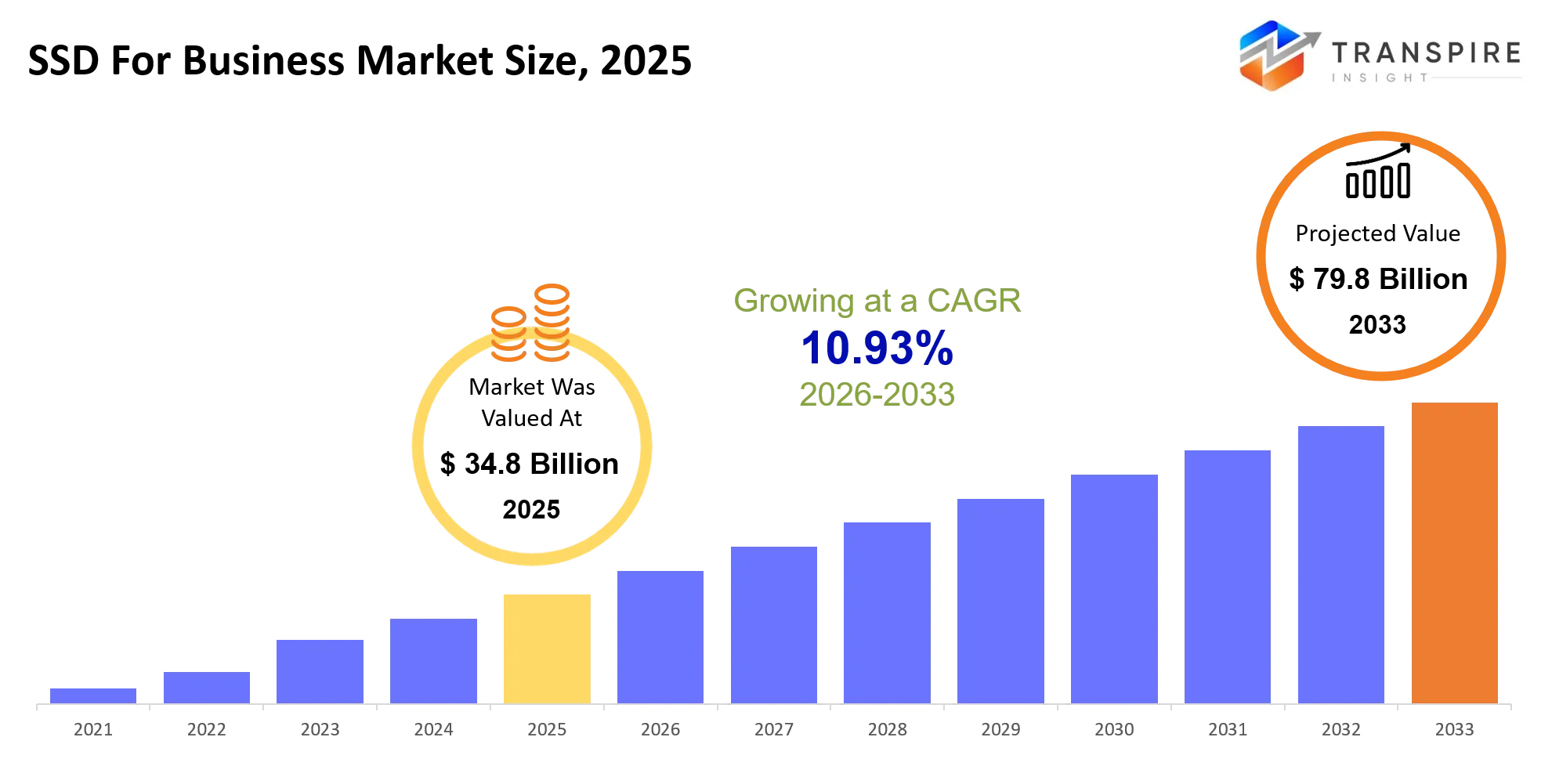
Market Snapshot SSD For Business Market
- Market Value (2025): USD 34.8 Billion.
- Expected Market Value (2026): USD 38.6 Billion.
- Estimated Market Value (2033): USD 79.8 Billion.
- Forecast CAGR (2026–2033): 10.93%
- Leading Region in 2025: Asia Pacific
- Second-largest Region: Europe
- Fastest Growing Region: North America
Introduction
Advanced solid-state storage technologies and high-performance enterprise storage solutions that facilitate faster data processing, improved storage reliability, enhanced system responsiveness, optimized operational efficiency, and scalable data management across data centers, enterprises, cloud service providers, financial institutions, healthcare organizations, IT companies, and other commercial and industrial applications comprise the market for SSD For Business. Advanced enterprise SSDs, business-class solid-state drives, high-capacity storage solutions, NVMe SSDs, SATA SSDs, and next-generation enterprise storage technologies are examples of SSD For Business solutions that address the evolving requirements of businesses, IT departments, data center operators, cloud service providers, enterprise technology providers, and commercial organizations.
• Advanced enterprise SSD technologies, NVMe storage solutions, high-capacity solid-state drives, business-class SSDs, high-performance storage systems, data center SSD solutions, and innovative enterprise storage technologies are examples of product innovations that improve data access speed, storage performance, system reliability, energy efficiency, and operational productivity. SSD For Business innovation improves data processing, storage efficiency, application performance, system responsiveness, and long-term enterprise storage performance through the use of advanced flash memory technologies, optimized storage architectures, high-speed interfaces, energy-efficient storage systems, and advanced data management technologies. Improved read and write performance, faster data access, reduced latency, lower energy consumption, enhanced system reliability, more efficient business operations, and broader applications across interconnected enterprise and commercial ecosystems are all made possible by product innovation. Data security requirements, enterprise IT standards, storage performance specifications, cybersecurity requirements, data management policies, and regulatory compliance criteria are all adhered to.
• The demand for SSD For Business is being driven by a number of factors, including the growing adoption of high-performance enterprise storage technologies, increasing demand for faster data processing and reliable storage solutions, rapid expansion of cloud computing and data center infrastructure, growing volumes of enterprise data, increasing demand for low-latency storage, rapid digital transformation across businesses, growing applications of SSDs in data centers, enterprise computing, cloud platforms, financial services, healthcare, IT infrastructure, and business applications, and ongoing developments in NVMe technologies, flash memory, high-capacity SSDs, storage architectures, energy-efficient storage systems, data management technologies, and advanced enterprise storage solutions.
Market Highlights: -
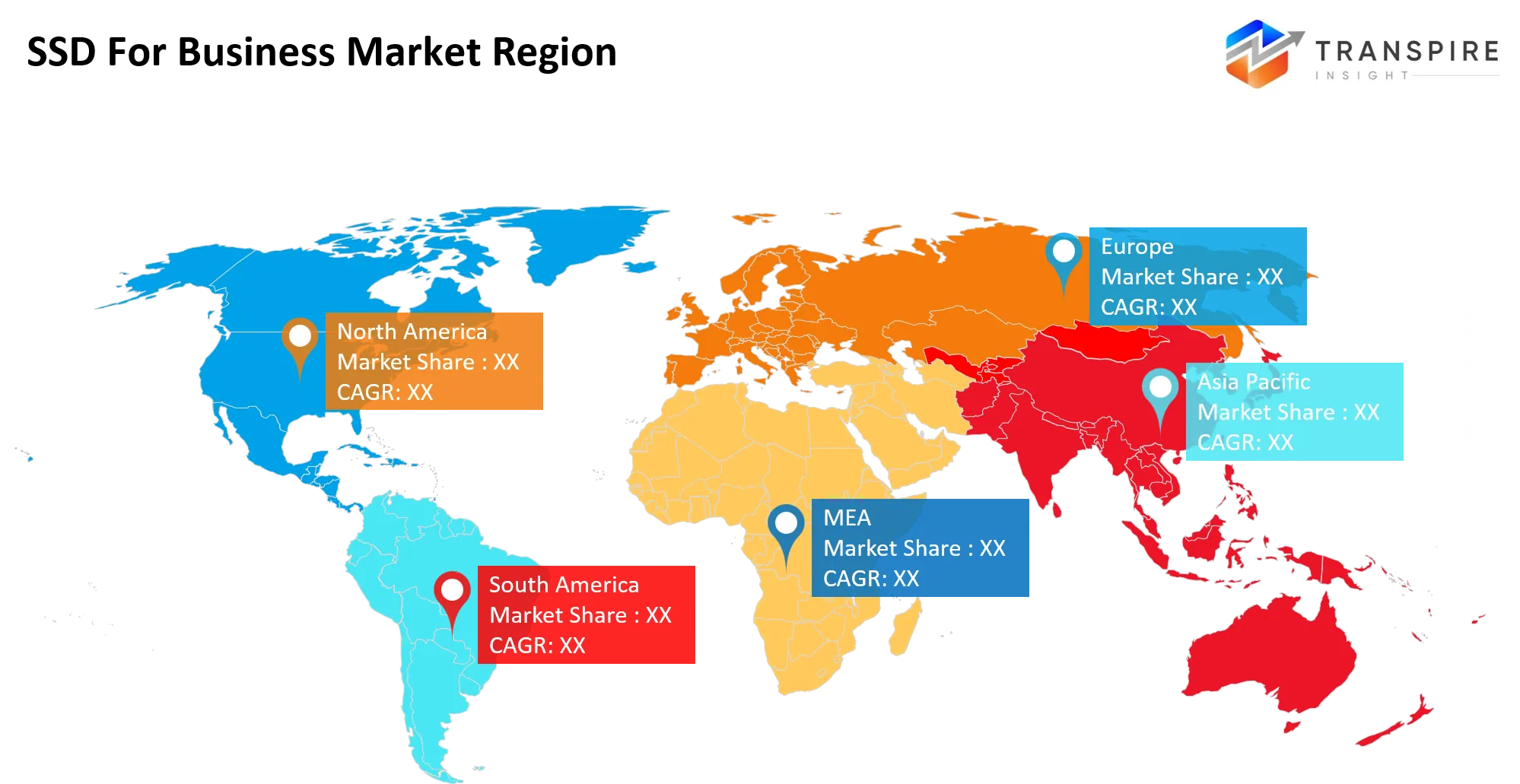
- Asia Pacific is expected to grow at a rapid CAGR in the SSD For Business Market by holding nearly 42% of the share during the forecast period.
- North America is the fastest-growing region in the SSD For Business Market during the period, holding around 31% share.
- Europe is anticipated to hold approximately 24% share of the SSD For Business Market over the predicted timeframe.
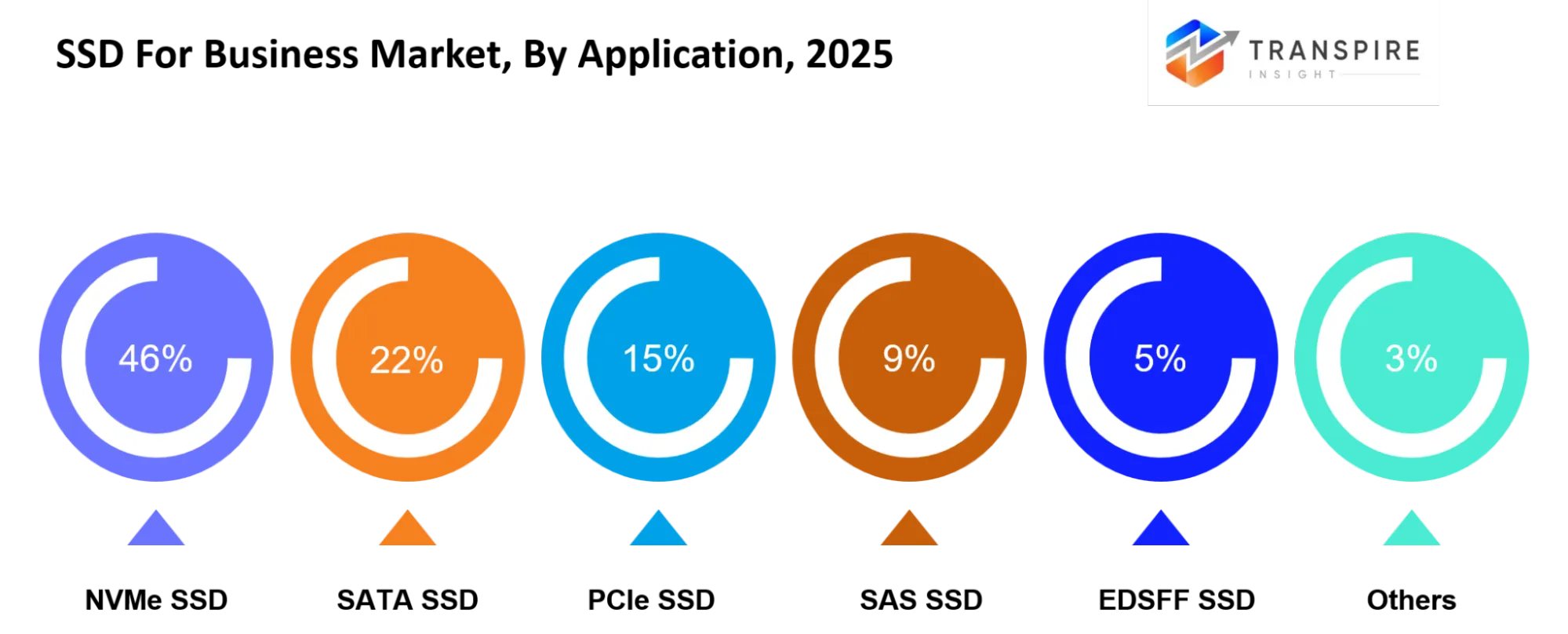
- By Interface, the NVMe SSD segment dominated the market and holds nearly 47.3% share in 2025 and is projected to grow at a substantial CAGR during the forecast period.
- By Storage Capacity, the 2–4 TB segment dominated the market and holds almost 48.6% share in 2025 and is projected to grow at a substantial CAGR during the forecast period.
- By End User, the Data Centers segment dominated the market and holds approximately 36.8% share in 2025 and is projected to grow at a substantial CAGR during the forecast period.
- By Application, the Servers segment dominated the market and holds roughly 41.4% share in 2025 and is projected to grow at a substantial CAGR during the forecast period.
- By Form Factor, the 2.5-inch segment dominated the market and holds around 44.1% share in 2025 and is projected to grow at a substantial CAGR during the forecast period.
- Growing Adoption of Enterprise SSDs, High-Speed Storage Technologies, and Advanced Business Storage Solutions: Data centers, enterprises, cloud service providers, BFSI organizations, healthcare providers, government institutions, IT companies, and other commercial and industrial businesses across Asia Pacific, North America, and Europe are increasing investments in enterprise SSDs, NVMe storage technologies, PCIe SSDs, high-capacity storage solutions, advanced data center infrastructure, AI workload storage, edge computing systems, database management platforms, and high-performance enterprise storage technologies to improve data processing speed, enhance storage reliability, reduce latency, optimize energy efficiency, support digital transformation, and strengthen the transition toward scalable, high-performance, and reliable business storage solutions.
How is the SSD For Business Market Growing Due to Technology?
The market for SSD For Business is growing as a result of ongoing developments in solid-state storage technologies, enterprise storage architectures, high-speed data interfaces, advanced flash memory technologies, and high-performance business storage solutions. Superior data processing speed, optimized storage efficiency, enhanced system responsiveness, improved reliability, low latency, scalability, and long-term enterprise storage performance are provided by contemporary solutions such as advanced NVMe SSDs, PCIe SSDs, SATA SSDs, SAS SSDs, high-capacity enterprise SSDs, and advanced data center storage platforms. Innovations in NVMe technology, PCIe interfaces, high-density flash memory, enterprise storage architectures, energy-efficient storage systems, automated data management, high-speed data processing, advanced storage infrastructure, and AI-optimized storage technologies allow businesses, data centers, cloud service providers, and enterprise IT organizations to develop storage solutions that are faster, more reliable, scalable, energy-efficient, and cost-effective while still meeting strict international data security requirements, enterprise IT standards, storage performance specifications, cybersecurity requirements, data management policies, and regulatory compliance criteria. In addition to improving data access speed, storage efficiency, system responsiveness, operational reliability, energy performance, scalability, and innovation across the SSD For Business Market, these technological advancements are promoting broader adoption across data centers, enterprises, cloud service providers, BFSI organizations, healthcare providers, government institutions, IT companies, and other commercial and industrial applications.
Market Drivers
The SSD For Business Market is being driven by the growing demand for high-performance, reliable, scalable, and energy-efficient enterprise storage solutions and the increasing adoption of solid-state storage technologies by data centers, enterprises, cloud service providers, BFSI organizations, healthcare providers, government institutions, IT companies, and other commercial and industrial users. The increasing use of NVMe SSDs, SATA SSDs, PCIe SSDs, SAS SSDs, high-capacity enterprise SSDs, and advanced storage architectures is driving up demand for solutions that improve data processing speed, enhance storage performance, reduce latency, increase system reliability, optimize energy consumption, support AI workloads, and address the growing business preference for high-speed and scalable storage technologies. These advancements are encouraging businesses and technology organizations to make investments in next-generation SSD technologies, advanced flash memory solutions, high-speed storage interfaces, data center infrastructure, energy-efficient storage systems, and expanded SSD For Business product and technology portfolios. Companies in the worldwide SSD For Business Market are expanding their technology portfolios, improving storage performance and capacity capabilities, increasing research and development activities, and creating new growth opportunities.
• For example, leading SSD manufacturers and enterprise storage technology companies continue to strengthen innovation in solid-state storage technologies by developing advanced NVMe SSD solutions, high-capacity enterprise storage drives, PCIe-based storage technologies, energy-efficient SSD platforms, AI-optimized storage solutions, and next-generation enterprise storage technologies that improve data access speed, enhance system reliability, reduce latency, optimize energy efficiency, accelerate data processing, and expand applications across data centers, enterprises, cloud service providers, BFSI organizations, healthcare providers, government institutions, IT companies, and the SSD For Business Market.
Rstraine
The primary challenges facing the SSD For Business Market are increasing manufacturing and operational costs, complex solid-state storage technology and integration requirements, and strict regulations related to data security, cybersecurity, storage reliability, energy efficiency, data privacy, product quality, and regulatory compliance standards. The use of advanced NVMe SSD technologies, PCIe interfaces, high-capacity flash memory, enterprise storage architectures, energy-efficient storage systems, advanced data center infrastructure, and continuous research and development initiatives all raise manufacturing and operational costs.
Analysis of Prices and Consumer Behaviour
The pricing dynamics of the SSD For Business Market are influenced by fluctuations in NAND flash memory costs, advanced storage technologies, high-speed interface requirements, manufacturing expenses, storage capacity, data center infrastructure requirements, energy efficiency considerations, and evolving data security and regulatory standards. Premium SSD solutions, including NVMe SSDs, PCIe SSDs, SAS SSDs, high-capacity enterprise SSDs, and advanced business-class solid-state drives, generally command higher prices due to their superior performance characteristics, advanced storage architectures, high-speed data transfer capabilities, durability, scalability, reliability, and enterprise-grade benefits. Manufacturers are increasingly focusing on cost optimization, efficient production processes, advanced flash memory technologies, optimized storage architectures, energy-efficient SSD solutions, and scalable manufacturing capabilities to maintain competitive pricing while improving storage performance and product quality.
Consumer behaviour in the SSD For Business Market is increasingly shaped by demand for high-performance, reliable, scalable, energy-efficient, and cost-effective storage solutions. Data centers, enterprises, cloud service providers, BFSI organizations, healthcare providers, government institutions, and IT companies are increasingly prioritizing products that provide faster data access, low latency, enhanced storage capacity, improved system responsiveness, high endurance, reduced energy consumption, and greater operational efficiency. Purchasing decisions are also influenced by storage performance, product quality, total cost of ownership, data security, compatibility, reliability, supplier reputation, scalability, warranty support, and technological innovation. As businesses increasingly adopt advanced SSD technologies to improve data processing efficiency, support AI workloads, optimize enterprise storage infrastructure, and meet growing data management requirements, demand for high-value, reliable, and performance-oriented SSD For Business solutions is expected to increase throughout the forecast period.
Top Companies in the SSD For Business Market
- Samsung Electronics
- Micron Technology
- Kioxia
- Western Digital
- Solidigm
- SK hynix
- Kingston Technology
- Seagate Technology
- Dell Technologies
- Hewlett Packard Enterprise
- Lenovo
- Intel
- Transcend Information
- ADATA
- NetApp
Market Segmentation
The SSD For Business Market share is divided into five categories: Interface, Storage Capacity, End User, Application, Form Factor.
The NVMe SSDdominated the market, accounting for nearly 47.3% in 2025, and is expected to rise at a significant CAGR during the forecast period.
The SSD For Business Market is segmented. By Interface SATA SSD, NVMe SSD, PCIe SSD, SAS SSD, U.2 SSD, Others Among these the NVMe SSD dominated the market, accounting for nearly 47.3% in 2025 and expected to increase at a significant CAGR during the forecast period.due to superior data transfer speeds, low latency, high performance, scalability, energy efficiency, and growing adoption in data centers, enterprise servers, AI workloads, and advanced storage systems.
The 2–4 TB segmentheld the greatest share of approximately 49.1% in 2025 and is expected to increase at a substantial CAGR over the forecast period.
The SSD For Business Market is segmented By Storage Capacity Below 1 TB, 1–2 TB, 2–4 TB, Above 4 TB, Others Among these, the 2–4 TB segment held the greatest share of approximately 49.1% in 2025 and is expected to increase at a substantial CAGR over the forecast period.due to increasing enterprise data volumes, balanced storage capacity, cost efficiency, high performance, scalability, and widespread adoption across servers, data centers, and business applications.
The Data Centers segmentheld the greatest share of approximately 45.4%in 2025 and is expected to increase at a high CAGR over the forecast period.
The SSD For Business Market is segmentedBy End User Data Centers, Enterprises, Cloud Service Providers, BFSI, Healthcare, Government, Others. Among these the Data Centers segment held the greatest share of approximately 44.9% in 2025 and is expected to increase at a considerable CAGR over the projected period.due to increasing enterprise data volumes, balanced storage capacity, cost efficiency, high performance, scalability, and widespread adoption across servers, data centers, and business applications.
Regional Segment Analysis of the Immune Cells In Grey Hepatization Market
- North America (U.S., Canada, Mexico)
- Europe (Germany, France, U.K., Italy, Spain, Rest of Europe)
- Asia-Pacific (China, Japan, India, Rest of APAC)
- South America (Brazil and the Rest of South America)
- The Middle East and Africa (UAE, South Africa, Rest of MEA)
Asia Pacific is expected to grow at a rapid CAGR in the SSD For Business Market by holding nearly 42% of the share during the forecast period.
Over the forecast period, the market for SSD For Business is anticipated to expand rapidly in Asia Pacific. It makes up about 42% of the market. The region dominates this market due to a number of factors, including expanding data center and enterprise IT infrastructure, rising demand for high-performance and reliable storage solutions, increasing adoption of solid-state storage technologies, growing demand for high-speed data processing and low-latency storage, rapid development of cloud computing, AI workloads, enterprise servers, database management, edge computing, and digital transformation, and strong technology and infrastructure growth in countries like China, India, Japan, South Korea, Singapore, Indonesia, Thailand, and the Philippines. The demand is driven by advancements in NVMe SSDs, PCIe SSDs, SATA SSDs, SAS SSDs, high-capacity enterprise SSDs, advanced flash memory, high-speed storage interfaces, and energy-efficient storage technologies, growing investments in data centers, enterprises, cloud service providers, BFSI organizations, healthcare providers, government institutions, and IT companies, expanding deployment across servers, enterprise storage systems, AI workloads, edge computing, database management, and advanced business applications, and supportive government initiatives promoting digital transformation, cloud infrastructure, data center development, high-performance computing, and advanced IT infrastructure. The rising use of enterprise SSDs, expanding data generation and storage requirements, increasing availability of high-capacity and high-performance storage solutions, greater adoption of NVMe and PCIe technologies, and increasing public and private investments in digital infrastructure, data centers, and enterprise computing further support regional market growth.
Europe is anticipated to hold approximately 24% share of the SSD For Business Market over the predicted timeframe.
Over the course of the projected period, Europe is expected to hold a 24% market share for the SSD For Business Market. The region's growth is primarily driven by strong demand for high-performance enterprise storage solutions, advanced data center infrastructure, reliable and scalable solid-state storage technologies, increasing adoption of NVMe and PCIe SSDs, and rising utilization of SSDs across business and technology applications, including servers, enterprise storage systems, AI workloads, edge computing, database management, and cloud infrastructure. Germany, France, the UK, Italy, and Spain are among the countries that are prioritizing advanced NVMe SSD technologies, PCIe storage solutions, high-capacity enterprise SSDs, energy-efficient storage systems, high-speed data processing technologies, and innovative enterprise storage solutions. Partnerships involving data centers, enterprises, cloud service providers, BFSI organizations, healthcare providers, government institutions, IT companies, and technology research organizations are accelerating the development, commercialization, distribution, and adoption of innovative SSD technologies in order to promote long-term market growth throughout Europe.
North America is anticipated to hold approximately 31% share of the SSD For Business Market over the predicted timeframe.
North America is anticipated to hold around 31% of the worldwide market for SSD For Business throughout the forecast period. A well-established enterprise technology and data center sector, growing investments in digital transformation and advanced IT infrastructure, increasing demand for high-performance and scalable storage solutions, and strong adoption of enterprise solid-state storage technologies are all likely to contribute to the region's sustained rise. Growing investments in data centers, enterprises, cloud service providers, BFSI organizations, healthcare providers, government institutions, IT companies, and advanced enterprise storage infrastructure, increased demand for NVMe SSDs, PCIe SSDs, high-capacity enterprise SSDs, high-speed storage interfaces, and energy-efficient storage solutions, and continuous advancements in solid-state storage, data center infrastructure, AI workloads, cloud computing, edge computing, database management, and enterprise storage systems are all contributing to the market's expansion. Additionally, efforts to improve storage performance, expand high-speed enterprise storage capabilities, meet evolving data management requirements, and develop innovative SSD technologies are driving innovation, technology adoption, and commercialization in North America.
Strategies for Market Growth in Non-Leading Regions
By creating scalable and cost-effective enterprise storage infrastructure utilizing advanced NVMe SSD technologies, PCIe SSD solutions, high-capacity enterprise storage drives, energy-efficient solid-state storage systems, high-speed storage interfaces, AI-optimized storage solutions, and integrated enterprise storage platforms, non-leading regions can promote growth. Through the development of local data center capabilities, innovative enterprise storage solutions, and value-added SSD deployment and data management services, this would strengthen regional digital infrastructure ecosystems and reduce dependency on imported storage technologies and specialized enterprise IT services. Commercialization and market penetration will be accelerated by strategic partnerships with data centers, enterprises, cloud service providers, BFSI organizations, healthcare providers, government institutions, IT companies, technology research organizations, regulatory bodies, and storage technology providers. To increase storage technology availability and operational efficiency, investments in workforce training, R&D, advanced SSD technologies, data center infrastructure, enterprise storage facilities, specialized storage equipment, data management capabilities, technology innovation, energy-efficient systems, and compliance with data security, cybersecurity, enterprise IT, and storage performance standards are required. Government support for digital transformation initiatives, data center modernization, cloud infrastructure, high-performance computing, advanced enterprise storage adoption, cybersecurity, digital infrastructure development, and public technology investments can all increase technology adoption, attract investment, and accelerate the long-term growth of the SSD For Business Market in emerging economies.
Recent Development
- On February 18, 2026, a leading enterprise storage and data center technology company announced advancements in its SSD portfolio with enhanced solid-state storage solutions, advanced NVMe technologies, and expanded enterprise storage capabilities. The innovation supports next-generation business storage, improves data access speed and storage performance, promotes efficient data management, and enhances reliability, scalability, energy efficiency, and overall storage performance across data centers, enterprise servers, cloud infrastructure, and business applications.
- May 27, 2026: A leading storage technology and enterprise solutions company: Expanded its SSD portfolio with improved enterprise solid-state drives, advanced NVMe and PCIe storage technologies, optimized storage architectures, and enhanced data center storage capabilities for data centers, enterprises, cloud service providers, BFSI organizations, healthcare providers, government institutions, IT companies, and other commercial and industrial applications. The development supports advanced business storage applications, improves data processing performance, enhances storage capacity and reliability, and increases the adoption of high-performance SSD solutions.
Future Market Trends for the SSD For Business Market:
- Growing Adoption of Enterprise SSDs and Advanced Business Storage Solutions: As data centers, enterprises, cloud service providers, and technology organizations place a higher priority on data processing speed, storage performance, reliability, scalability, energy efficiency, and low-latency data access, companies are expanding their SSD portfolios, which include NVMe SSDs, SATA SSDs, PCIe SSDs, SAS SSDs, high-capacity enterprise SSDs, advanced flash storage solutions, and next-generation business storage technologies.
- Growing Need for Advanced Enterprise Storage Solutions: To improve data access speed, enhance storage reliability, optimize system performance, and support data centers, enterprises, cloud service providers, BFSI organizations, healthcare providers, government institutions, IT companies, and other commercial applications, organizations are progressively adopting advanced NVMe technologies, PCIe storage systems, high-capacity SSDs, high-speed storage interfaces, energy-efficient storage solutions, AI-optimized storage platforms, and comprehensive enterprise storage technologies.
- In order to improve storage performance, data processing efficiency, operational reliability, scalability, energy efficiency, cybersecurity, and regulatory compliance, and support next-generation digital infrastructure ecosystems, organizations are investing in advanced enterprise SSD technologies, innovative flash memory solutions, high-speed PCIe interfaces, NVMe storage architectures, high-capacity storage systems, energy-efficient SSD platforms, AI workload storage technologies, advanced data center infrastructure, innovative business storage solutions, and high-performance enterprise storage platforms.
Market Segment
This study forecasts revenue at global, regional, and country levels from 2020 to 2033. Transpire Insights has segmented the SSD For Business Market based on the below-mentioned segments.
SSD For Business Market, By Interface
- SATA SSD
- NVMe SSD
- PCIe SSD
- SAS SSD
- U.2 SSD
- Others
SSD For Business Market, By Storage Capacity
- Below 1 TB
- 1–2 TB
- 2–4 TB
- Above 4 TB
- Others
SSD For Business Market, By End User
- Data Centers
- Enterprises
- Cloud Service Providers
- BFSI
- Healthcare
- Government
- Others
SSD For Business Market, By Application
- Servers
- Enterprise Storage Systems
- AI Workloads
- Edge Computing
- Database Management
- Others
SSD For Business Market, By Form Factor
- 2.5-inch
- M.2
- U.2
- EDSFF
- Others
SSD For Business Market, By Regional Analysis
North America
- US
- Canada
- Mexico
- US
- Canada
Europe
- Germany
- UK
- France
- Italy
- Spain
- Rest of Europe
Asia Pacific
- China
- Japan
- India
- South Korea
- Australia
- Rest of Asia Pacific
South America
- Brazil
- Argentina
- Rest of South America
Middle East & Africa
- UAE
- Saudi Arabia
- Qatar
- South Africa
- Rest of the Middle East & Africa
Frequently Asked Questions
Find quick answers to common questions.
The SSD For Business Market is driven by increasing demand for high-performance, reliable, scalable, and energy-efficient storage solutions, growing enterprise data volumes, rapid cloud and data center expansion, digital transformation, AI workloads, and demand for low-latency data processing.
The NVMe SSD segment dominates due to superior data transfer speeds, low latency, high performance, scalability, energy efficiency, and increasing adoption across data centers, enterprise servers, AI workloads, and advanced business storage systems.
The 2–4 TB segment leads due to increasing enterprise data volumes, balanced storage capacity, cost efficiency, high performance, scalability, and widespread adoption across servers, data centers, enterprise storage systems, and business applications.
Data Centers represent a major end-user segment because of growing data generation, increasing cloud adoption, AI workloads, demand for high-speed storage, low-latency processing, scalability, reliability, and expanding investments in advanced digital infrastructure
Asia Pacific is expected to lead the SSD For Business Market, holding nearly 42% share during the forecast period. Growth is supported by expanding data center infrastructure, enterprise IT investment, cloud computing, digital transformation, and adoption of advanced SSD technologies.
- Samsung Electronics
- Micron Technology
- Kioxia
- Western Digital
- Solidigm
- SK hynix
- Kingston Technology
- Seagate Technology
- Dell Technologies
- Hewlett Packard Enterprise
- Lenovo
- Intel
- Transcend Information
- ADATA
- NetApp
About the Authors

Mayur Shinde
I am Mayur Shinde, a Senior Research Analyst at Transpire Insight, specializing in the Automotive & Transportation and Information & Communication Technology (ICT) Industry. My work focuses on analyzing emerging market trends, technological advancements, competitive landscapes, and industry developments to deliver accurate, data-driven insights. I am passionate about transforming complex market information into clear, actionable content that helps businesses, professionals, and decision-makers stay informed and make confident strategic decisions.

Chakradhar Khansole
Chakradhar serves as the Research Director at Transpire Insight, bringing over 8 years of experience in technology, innovation, and strategic market intelligence. He specializes in transforming complex market data into actionable business insights that enable organizations to make informed, growth-oriented decisions. Recognized for his strategic vision and analytical expertise, Chakradhar leads high-impact research initiatives, delivering comprehensive market assessments, competitive intelligence, and forward-looking industry analysis.
Recently Published Reports
-
Apr 2026
3D Optical Profiler Market
3D Optical Profiler Market Size, Share & Analysis Report By Type (Desktop 3D Optical Profiler, and Portable 3D Optical Profiler), By Technology (Confocal Technology, and White Light Interference), By End-Use Industry (Manufacturing, Research Institutions, Automotive, Aerospace and Defense, Medical Devices, and Other), and Geography (North America, Europe, Asia-Pacific, Middle East and Africa, South and Central America), 2021 - 2031
-
Apr 2026
Depth Sensor Market
Depth Sensor Market Size, Share & Analysis Report By Type (Infrared Depth Sensors, Time-of-Flight (ToF) Sensors, Stereo Vision Sensors, Structured Light Sensors, Ultrasonic Depth Sensors), By Application (Automotive, Robotics, Gaming, Consumer Electronics, Industrial Automation, Healthcare, Security & Surveillance, Others), By End Users (Automotive Manufacturers, Consumer Electronics Companies, Healthcare Providers, Industrial Companies, Security Agencies, Gaming Companies, Robotics Companies, Others), and Geography (North America, Europe, Asia-Pacific, Middle East and Africa, South and Central America), 2021 – 2031
-
Apr 2026
Digital Manufacturing Market
Digital Manufacturing Market Size, Share & Analysis Report By Component (Hardware, Software, and Services), By Technology (Robotics, 3D Printing, Internet of Things (IoT), and Others), By Application (Automotive and Transportation, Aerospace and Defense, Consumer Electronics, Industrial Machinery, and Others), By Process Type (Computer-Based Designing, Computer-Based Simulation, Computer 3D Visualization, Analytics, and Others), and Geography (North America, Europe, Asia-Pacific, Middle East and Africa, South and Central America), 2021 – 2031
-
Apr 2026
Digital Visa Services Market
Digital Visa Services Market Size, Share & Analysis Report By Type (Individual Travelers, Group Travelers), By Application (Tourism, Business Travel, Others), and Geography (North America, Europe, Asia-Pacific, Middle East and Africa, South and Central America), 2021 – 2031