
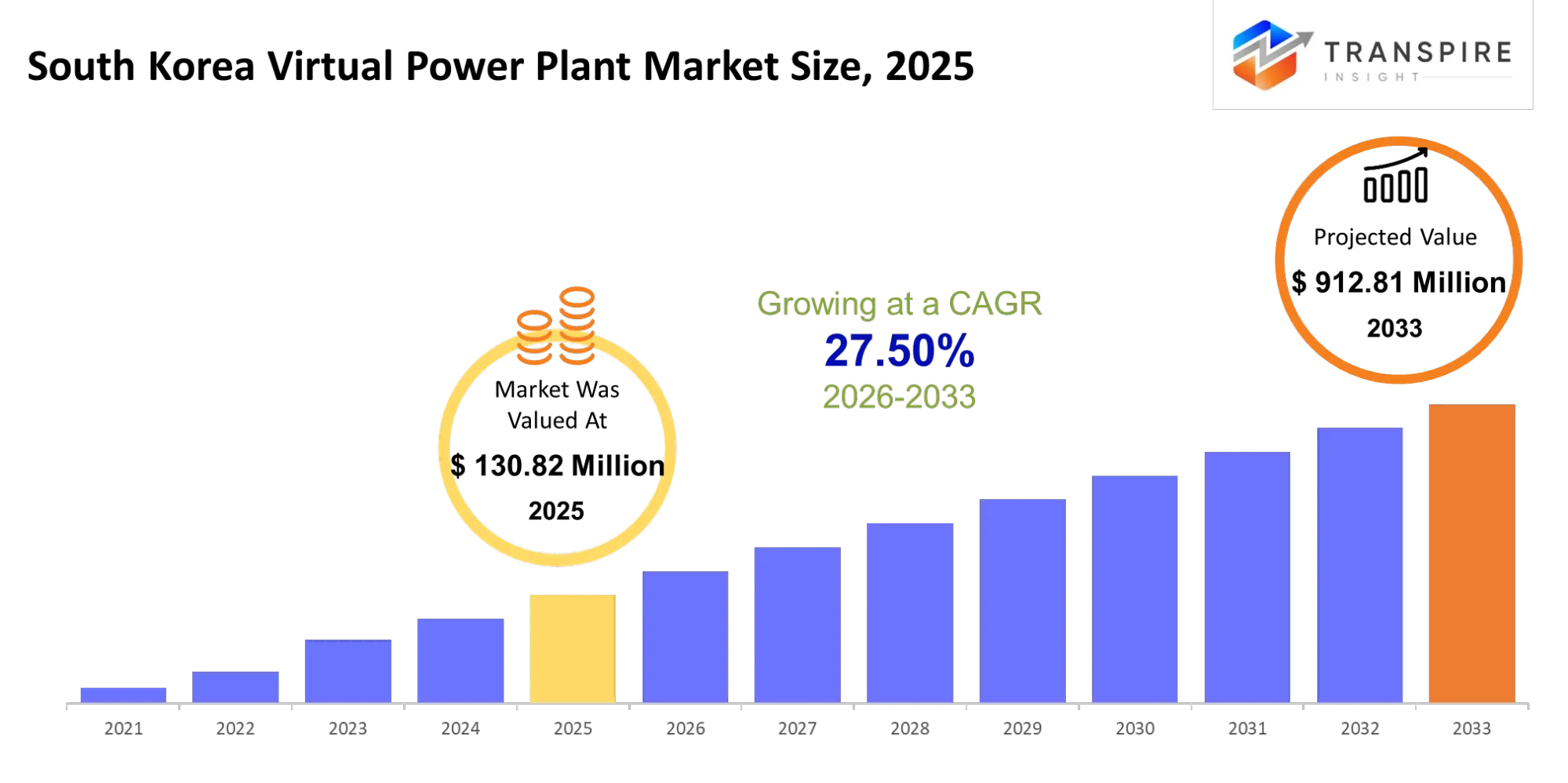
South Korea Virtual Power Plant Market Size & Forecast:
- South Korea Virtual Power Plant Market Size 2025: USD 130.82 Million
- South Korea Virtual Power Plant Market Size 2033: USD 912.81 Million
- South Korea Virtual Power Plant Market CAGR:27.50%
- South Korea Virtual Power Plant Market Segments: By Technology (Demand Response Systems, Distributed Energy Resource Management Systems, Cloud-based Energy Platforms, AI-based Energy Optimization, Others); By Source (Solar Power Systems, Wind Power Systems, Battery Energy Storage Systems, EV Charging Systems, Others); By Application (Grid Stability Management, Peak Load Management, Energy Trading, Renewable Energy Integration, Others); By End User (Utilities, Commercial Buildings, Industrial Facilities, Residential Users, Others); By Deployment (Centralized VPP, Decentralized VPP, Hybrid VPP, Others)
To learn more about this report,  Download Free Sample Report
South Korea Virtual Power Plant Market Summary
The South Korea Virtual Power Plant Market was valued at USD 130.82 Million in 2025. It is forecast to reach USD 912.81 Million by 2033. That is a CAGR of 27.50% over the period.
The South Korea Virtual Power Plant market helps balance electricity supply and demand. It connects energy resources like battery storage systems, renewable power assets, electric vehicles and flexible industrial loads into a coordinated network. In reality Virtual Power Plants help grid operators manage changes in power generation. They also let businesses and energy asset owners make money from flexibility.
Over the five years the market has changed a lot. It moved from managing power in one place to using tools for distributed energy systems. This change was helped by improvements in intelligence, cloud-based energy management platforms and making the grid more digital. A big push for this change was South Korea’s plans to use renewable energy and reduce carbon emissions. These plans showed that the old grid infrastructure had limitations and that flexible balancing mechanisms were needed.
As renewable energy is used, keeping the grid stable gets harder. This has created opportunities for Virtual Power Plant operators, software providers and energy aggregators. As a result more demand response programs and distributed energy optimization solutions are
being used across the country. The South Korea Virtual Power Plant market is growing because of these changes. Virtual Power Plants are becoming more important for managing the grid.
Key Market Insights
- The South Korea Virtual Power Plant Market is getting bigger fast because utilities are using distributed energy resources and battery storage systems to make the grid more flexible and reliable.
- The South Korea Virtual Power Plant Market will probably keep growing until 2033 because of the use of energy and the modernization of the digital grid and software-driven energy aggregation.
- In 2024 the Seoul Metropolitan Area made up 42 percent of the South Korea Virtual Power Plant Market revenue because people in this area use a lot of electricity and there are many smart grid investments.
- Gyeonggi Province has the biggest share of the South Korea Virtual Power Plant Market because it has a strong industrial base and many people are using distributed energy resources.
- The Chungcheong region will probably grow the fastest from 2025 to 2033 because of energy projects and grid modernization initiatives in the South Korea Virtual Power Plant Market.
- In 2024 Demand Response services made up 38 percent of the South Korea Virtual Power Plant Market revenue because many industries are participating in grid balancing programs.
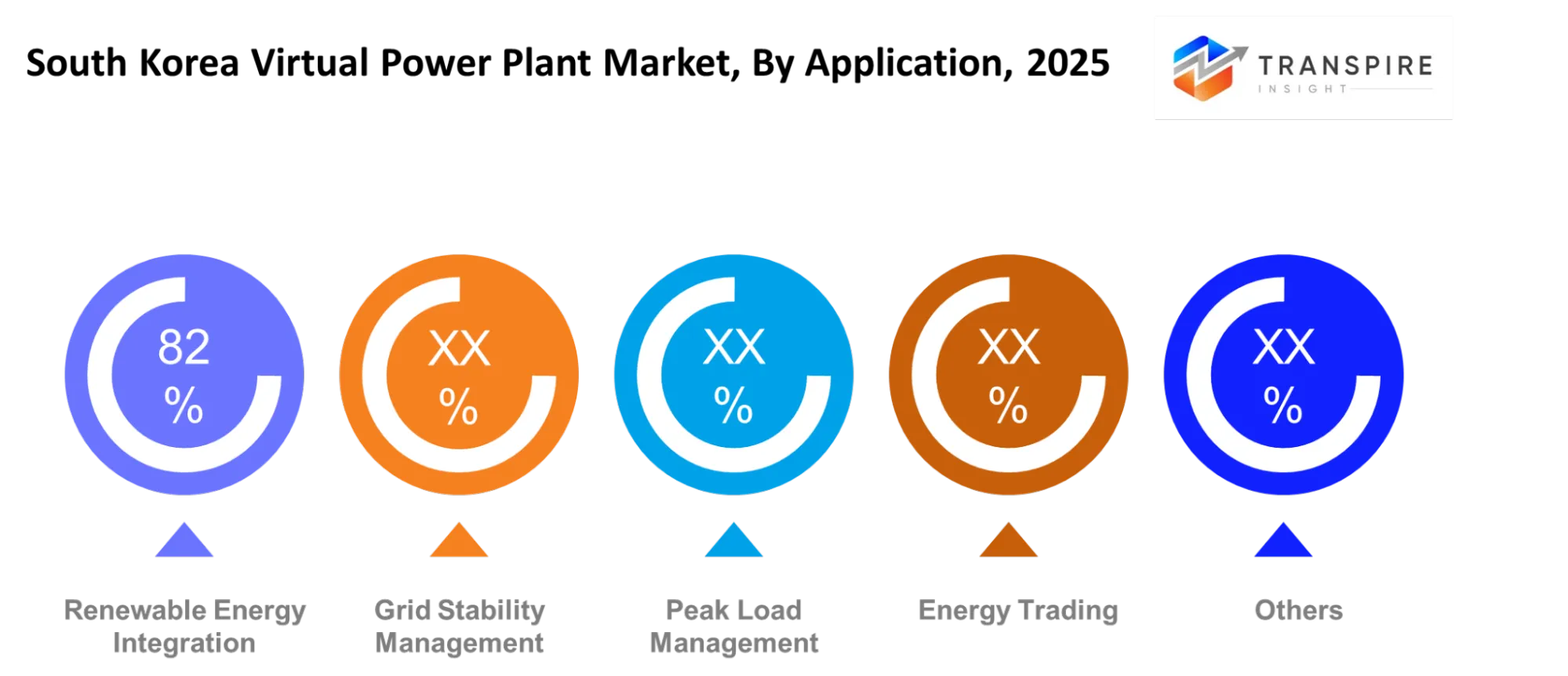
- Grid balancing and peak load management made up 45 percent of the South Korea Virtual Power Plant Market in 2024 so it is the biggest application segment in the South Korea Virtual Power Plant Market.
- The South Korea Virtual Power Plant Market will probably see growth in Battery Energy Storage System-integrated VPP platforms until 2033 because energy storage deployments are getting bigger.
- Utilities and power grid operators made up 48 percent of the South Korea Virtual Power Plant Market revenue in 2024 because many virtual power plants are being deployed across the country in the South Korea Virtual Power Plant Market.
- Some key companies in the South Korea Virtual Power Plant Market include Siemens Energy, ABB, Schneider Electric, General Electric, Hitachi Energy and Honeywell.
- They are focusing on energy management with the help of artificial intelligence cloud-based grid orchestration and partnerships, in the South Korea Virtual Power Plant Market.
What are the Key Drivers, Restraints, and Opportunities in the South Korea Virtual Power Plant Market?
Driver
The main reason South Korea's Virtual Power Plant Market is growing fast is because renewable energy is increasing quickly. The government is also helping to modernize the grid. As solar and wind power is used it becomes harder to manage the power supply. This is because solar and wind power produce electricity in a way. So we need resources that can adjust to changes in electricity demand and supply. Virtual power plants help solve this problem. They connect small energy resources, batteries and demand response systems into one network. This helps utilities and energy companies make money by trading energy providing extra services and managing peak demand.The growth of energy is making the power supply more unpredictable.Virtual power plants help manage this unpredictability.
Restraint
The biggest problem is that it's hard to connect small energy resources to the existing grid. The current grid was designed for power plants and doesn't have the right digital system for managing many small resources. Upgrading the grid requires a lot of money and time. This slows down projects, makes it hard for small energy owners to join and delays making money.The grid needs to be modernized to support power plants.This modernization requires a lot of investment.
Opportunity
A big opportunity is to combine battery storage with energy management systems. These systems use intelligence to optimize energy use, predict energy needs and use assets more efficiently. As more batteries are used in buildings and factories, smart virtual power plants can make the grid more flexible and efficient. This can create ways to make money and help the market grow.Combining batteries with systems can improve efficiency. This can lead to business opportunities and market growth.
What Has the Impact of Artificial Intelligence Been on the South Korea Virtual Power Plant Market?
South Korea is making a lot of progress with power plants. Artificial intelligence is playing a role in this. The people who run these power plants are using artificial intelligence to manage energy better. They use intelligence to control things like battery storage and solar panels.
Artificial intelligence looks at the condition of the grid and the price of electricity. It also looks at how much electricity people're using. Then it makes decisions about how to use the energy. This helps balance the energy and makes things easier to run.
Machine learning is also very useful. It helps predict how much energy will be made from panels and wind. It also predicts how much energy people will use. This helps the people who run the power plants. They can plan better. Make sure they have enough energy.
They also use machine learning to check the condition of batteries and other equipment. This helps them find problems before they cause trouble. This means the equipment is available when it is needed. It also reduces the cost of maintenance.Using intelligence and advanced analytics is very helpful. It helps use energy and makes the grid respond faster. It also reduces costs. Helps with trading energy. Artificial intelligence makes the grid more reliable. This is important because more people are using energy.
There is a problem. It costs a lot of money to make all the systems work together. Many systems use standards. So it takes a lot of money to make them work with intelligence. They need to invest in software and cybersecurity. This is before artificial intelligence can be used on a scale.
Key Market Trends
- Since 2020 utilities have started to move from managing the grid from one central place. Now they are using a system that distributes energy in a way. This system uses batteries, solar panels and other resources to manage energy demand.
- The use of energy has grown fast and this has led to more people using virtual power plants. The people who run these plants are using different assets together to manage energy from solar and wind sources.
- From 2021 to 2025 companies started to use intelligence to predict energy demand. This helped them to make decisions about how to use energy in real time.
- Battery storage systems are not just used as systems anymore. Now they are a part of virtual power plants. They help to manage energy use during peak hours, regulate the frequency of the grid and even trade energy.
- Many businesses and factories are now taking part in programs that help to balance the grid. This means that they are not just using energy but also helping to manage the grid.
- The people who run the grid have invested in systems that help them to see what is happening on the grid. This includes meters and digital control systems.
- Companies like Siemens Energy, ABB and Schneider Electric are working with utilities to make the grid smarter. They are helping to deploy power plants and make the grid more efficient.
- Energy aggregators are getting stronger by combining different energy sources into one big portfolio. This allows them to sell energy on the market.
- Since 2022 many companies have started to use cloud-based systems to manage energy. This has made things more efficient. Helped them to respond faster to problems.
- The government is supporting efforts to reduce carbon emissions and modernize the grid. This has encouraged people to use virtual power plants, in industries and businesses. Virtual power plants are becoming more popular because they help to manage energy in a way.
South Korea Virtual Power Plant Market Segmentation
By Technology
Demand Response Systems support efficient energy management by adjusting electricity consumption during periods of high demand. Utilities and energy operators increasingly rely on these systems to improve grid performance and reduce pressure on infrastructure. Distributed Energy Resource Management Systems help coordinate multiple energy assets and improve visibility across connected networks. Better control of distributed resources supports operational efficiency and strengthens energy balancing capabilities.
Cloud-based Energy Platforms continue to gain importance because centralized data access improves monitoring and decision-making processes. AI-based Energy Optimization solutions enhance forecasting accuracy and support real-time adjustments based on changing energy conditions. Other technologies contribute to system flexibility and help manage complex energy environments. Continuous digitalization across energy networks will support adoption of advanced technology solutions and improve overall system performance.
By Source
Solar Power Systems remain a major source because renewable electricity generation continues to expand across residential, commercial, and utility-scale installations. Growing investment in clean energy projects supports wider integration of solar resources into energy networks. Wind Power Systems contribute additional renewable generation capacity and help diversify electricity supply sources. Strong focus on sustainable energy development continues to support deployment of wind-based infrastructure.
Battery Energy Storage Systems play a critical role by storing excess electricity and supporting reliable energy availability during peak demand periods. EV Charging Systems are becoming increasingly important as electric vehicle adoption creates new opportunities for flexible energy participation. Other sources contribute additional capacity and strengthen system resilience. A diversified energy mix will help improve reliability and support long-term energy transition goals.
By Application
Grid Stability Management remains a key application because energy systems require balanced electricity supply and demand to maintain reliable operation. Advanced management solutions help reduce disruptions and improve network performance. Peak Load Management supports efficient handling of periods with elevated electricity consumption. Better demand balancing reduces stress on infrastructure and improves operational efficiency.
Energy Trading applications create opportunities for energy resources to participate in electricity markets and generate additional value. Renewable Energy Integration supports the inclusion of solar, wind, and other clean energy sources within broader power systems. Other applications contribute to improved flexibility and energy optimization. Expanding use cases continue to strengthen the value of advanced energy management solutions across modern electricity networks.
To learn more about this report, Download Free Sample Report
By End User
Utilities represent a major end-user category because reliable energy distribution requires effective management of generation and consumption resources. Ongoing modernization efforts encourage investment in advanced energy management solutions. Commercial Buildings use these systems to improve energy efficiency and reduce operational costs. Better energy visibility supports more informed consumption decisions and resource planning.
Industrial Facilities require reliable electricity supply to maintain production activities and operational continuity. Residential Users increasingly participate through distributed energy resources and smart energy technologies. Other end users include institutions and service providers seeking improved energy performance. Broad adoption across end-user categories supports continued market expansion and operational innovation.
By Deployment
Centralized VPP models provide coordinated management of multiple distributed energy resources through a single control structure. Strong visibility and streamlined decision-making support efficient operation across connected assets. Decentralized VPP models allow greater flexibility by enabling local resource participation and distributed control functions. Growing interest in localized energy management supports adoption of decentralized deployment strategies.
Hybrid VPP models combine features of centralized and decentralized approaches to create balanced operational structures. This deployment method supports scalability while maintaining flexibility across different energy environments. Other deployment models address specialized requirements based on infrastructure and operational objectives. Continued growth in distributed energy resources will encourage wider adoption of diverse deployment strategies across the energy sector.
What are the Key Use Cases Driving the South Korea Virtual Power Plant Market?
The main thing that people are using power plants for in South Korea is to balance the grid and manage peak loads. This is because utilities and the people who run the grid need to make sure the electricity network is stable when a lot of people are using power and when the amount of energy being made is changing.This is really important because it helps make the grid more reliable and means we do not need to use backup systems.There are ways that virtual power plants are being used too. For example, big factories, data centers and office buildings are starting to take part in programs that help them use electricity when it is not needed. This is good for the grid. It is also good for the companies because they can save money.
We are also seeing solar and wind power being used and virtual power plants are helping to make this work.Some new things that people are starting to use power plants for include charging electric vehicles and special platforms that use artificial intelligence to trade energy.As more people start using vehicles, the places where we charge them can also be used to help balance the grid.There are also tools that can help predict how much energy we will need and automatically make adjustments, which could create new ways for people to make money by selling energy when it is needed.
|
Report Metrics |
Details |
|
Market size value in 2025 |
USD 130.82 Million |
|
Market size value in 2026 |
USD 166.67 Million |
|
Revenue forecast in 2033 |
USD 912.81 Million |
|
Growth rate |
CAGR of 27.50% from 2026 to 2033 |
|
Base year |
2025 |
|
Historical data |
2021 - 2024 |
|
Forecast period |
2026 - 2033 |
|
Report coverage |
Revenue forecast, competitive landscape, growth factors, and trends |
|
Regional scope |
South Korea |
|
Key company profiled |
Siemens Energy, ABB, Schneider Electric, General Electric, Tesla Energy, Next Kraftwerke, Enel X, Hitachi Energy, Mitsubishi Electric, LG Energy Solution, Samsung SDI, AutoGrid, Honeywell, Oracle Utilities, Doosan Enerbility |
|
Customization scope |
Free report customization (country, regional & segment scope). Avail customized purchase options to meet your exact research needs. |
|
Report Segmentation |
By Technology (Demand Response Systems, Distributed Energy Resource Management Systems, Cloud-based Energy Platforms, AI-based Energy Optimization, Others); By Source (Solar Power Systems, Wind Power Systems, Battery Energy Storage Systems, EV Charging Systems, Others); By Application (Grid Stability Management, Peak Load Management, Energy Trading, Renewable Energy Integration, Others); By End User (Utilities, Commercial Buildings, Industrial Facilities, Residential Users, Others); By Deployment (Centralized VPP, Decentralized VPP, Hybrid VPP, Others) |
Which Regions are Driving the South Korea Virtual Power Plant Market Growth?
The Seoul Metropolitan Area is still the region in South Korea's virtual power plant market. This is because it has a lot of people using electricity, good smart grid systems and the government supports energy digitalization. Big office buildings, data centers and factories can provide energy resources for virtual power plant programs. Large commercial complexes have a lot of energy needs.Data centers use a lot of power.Industrial facilities can adjust their energy use.
Regional authorities have invested in modernizing the grid, metering systems and integrating distributed energy. The area has major utilities and energy technology providers, which helps it stay ahead.
Gyeonggi Province is the biggest market. It has manufacturing clusters, logistics facilities and industrial parks. These create demand for energy optimization and demand response. Companies in the province have invested in energy management systems. This has helped the province grow steadily over the years.
The Chungcheong region is growing fast. It has invested in energy and energy storage. New solar projects and grid improvements have increased the need for balancing solutions. Local efforts to improve energy infrastructure have helped power plants. Growth in this region will create opportunities for technology providers, aggregators and investors from 2026, to 2033.
Who are the Key Players in the South Korea Virtual Power Plant Market and How Do They Compete?
Competition in the South Korea virtual power plant market is not very intense. Many global energy technology providers are competing with software and energy management companies.
The main thing that matters now is technology capability. Customers want forecasting, real-time asset optimization and easy integration of distributed energy resources. Established companies are strengthening their positions by developing platforms.
New companies are focusing on analytics and energy aggregation services. Companies that combine software expertise with grid infrastructure knowledge are doing well. Siemens Energy stands out with its integrated grid management platforms. These platforms combine distributed energy resource coordination with grid automation capabilities.
The company focuses on technology innovation and partnerships with utilities and smart grid developers.ABB competes with its automation expertise and digital energy management solutions.
These solutions help operators improve asset visibility and operational efficiency.ABB invests in cloud-based monitoring and control platforms to support energy networks.
Schneider Electric focuses on software-driven energy optimization and demand-side management solutions. These solutions help commercial and industrial customers reduce energy costs. Hitachi Energy differentiates itself with grid digitalization technologies and energy storage integration capabilities.
These capabilities support large-scale balancing operations. Honeywell focuses on building and industrial energy management systems. The company creates value through real-time analytics and automated control technologies. Collaborations with utilities, renewable energy developers and infrastructure providers support expansion opportunities for these companies across emerging power plant projects.
Company List
- Siemens Energy
- ABB
- Schneider Electric
- General Electric
- Tesla Energy
- Next Kraftwerke
- Enel X
- Hitachi Energy
- Mitsubishi Electric
- LG Energy Solution
- Samsung SDI
- AutoGrid
- Honeywell
- Oracle Utilities
Recent Development News
In March 2026, Haejum secured 248 MW of renewable energy resources for participation in South Korea’s semi-central power generation system. The development strengthened Haejum’s position in the virtual power plant sector and expanded aggregated renewable capacity available for grid balancing and power market participation.https://www.venturesquare.net
In December 2025, Nuvve Holding Corp. and Volt launched the NuvveVolt joint venture to participate in South Korea’s national-scale ESS auction. The venture combines Nuvve’s vehicle-to-grid energy management technology with local market expertise to support large-scale battery storage and virtual power plant operations.https://battery-tech.net
In September 2025, Solar On Care and POSTECH launched a joint research partnership for the development of a next-generation intelligent virtual power plant platform. The five-year collaboration is designed to accelerate AI-enabled VPP technologies and support innovation in distributed energy management systems.https://cm.asiae.co.
What Strategic Insights Define the Future of the South Korea Virtual Power Plant Market?
In March 2026 Haejum got 248 MW of energy resources to take part in South Korea's semi-central power generation system. This made Haejum stronger in the power plant sector and it also expanded Haejum's position in the South Korea virtual power plant market. The South Korea virtual power plant market is changing to a digitized system where everything is controlled by software and all the different energy sources work together like one big flexible power pool. This is happening because more renewable energy is being used and it is getting harder to predict when electricity will be available so utilities have to make decisions in real time instead of just planning ahead. Over the 5 to 7 years the companies that will do well are the ones that can bring together storage, industrial demand response and electric vehicle loads into one system.
There is a problem that's not so easy to see and that is that the old grid infrastructure and the new digital energy platforms may not be able to work together very well. If all the devices and protocols are not standardized it could slow down the growth of power plants even though there is a lot of demand for them.
There is also an opportunity to make money from electric vehicle charging networks by using them as flexible grid assets especially in cities like Seoul and Incheon where more and more people are using electric vehicles. The companies that can make electric vehicles charge and discharge electricity will have an advantage.
Companies that want to do business in this market should work with utilities and electric vehicle infrastructure providers to build platforms that are open and can work with all the different systems so they can have an advantage in the long term. They should focus on Haejum and the South Korea virtual power plant market to make sure they are ready for the changes that are coming.
South Korea Virtual Power Plant Market Report Segmentation
By Technology
- Distributed Energy Resource Management Systems (DERMS)
- Demand Response
- Energy Storage Integration
- Virtual Power Plant Software Platforms
- Advanced Metering Infrastructure
By Component
- Hardware
- Software
- Services
By Source Type
- Renewable Energy Sources
- Conventional Backup Sources
- Energy Storage Systems
- Electric Vehicles (V2G-enabled assets)
By Application
- Grid Balancing
- Peak Load Management
- Frequency Regulation
- Energy Trading
- Renewable Energy Integration
By End User
- Utilities
- Commercial & Industrial Facilities
- Residential Users
- Energy Aggregators
Frequently Asked Questions
Find quick answers to common questions.
The expected South Korea Virtual Power Plant Market size for the market will be USD 912.81 Million in 2033.
Key segments for the South Korea Virtual Power Plant Market are Type By Technology (Demand Response Systems, Distributed Energy Resource Management Systems, Cloud-based Energy Platforms, AI-based Energy Optimization, Others); By Source (Solar Power Systems, Wind Power Systems, Battery Energy Storage Systems, EV Charging Systems, Others); By Application (Grid Stability Management, Peak Load Management, Energy Trading, Renewable Energy Integration, Others); By End User (Utilities, Commercial Buildings, Industrial Facilities, Residential Users, Others); By Deployment (Centralized VPP, Decentralized VPP, Hybrid VPP, Others).
Major South Korea Virtual Power Plant Market players are Siemens Energy, ABB, Schneider Electric, General Electric, Tesla Energy, Next Kraftwerke, Enel X, Hitachi Energy, Mitsubishi Electric, LG Energy Solution, Samsung SDI, AutoGrid, Honeywell, Oracle Utilities, Doosan Enerbility.
The South Korea Virtual Power Plant Market size is USD 130.82 Million in 2025.
The South Korea Virtual Power Plant Market CAGR is 27.50% from 2026 to 2033.
- Siemens Energy
- ABB
- Schneider Electric
- General Electric
- Tesla Energy
- Next Kraftwerke
- Enel X
- Hitachi Energy
- Mitsubishi Electric
- LG Energy Solution
- Samsung SDI
- AutoGrid
- Honeywell
- Oracle Utilities
About the Authors

Avinash Kumar
I’m Avinash Kumar, a Senior Research Analyst at Transpire Insight, with expertise in the Electronics and Semiconductor and Energy & Power industry. My work focuses on analyzing emerging technologies, market trends, industry developments, and innovation across these sectors. I specialize in transforming complex technical and market insights into clear, research-backed content that helps professionals, businesses, and decision-makers stay informed. Through continuous industry research and data-driven analysis, I strive to deliver accurate, reliable, and practical perspectives on the latest advancements shaping the semiconductor and energy landscape.

Chakradhar Khansole
Chakradhar serves as the Research Director at Transpire Insight, bringing over 8 years of experience in technology, innovation, and strategic market intelligence. He specializes in transforming complex market data into actionable business insights that enable organizations to make informed, growth-oriented decisions. Recognized for his strategic vision and analytical expertise, Chakradhar leads high-impact research initiatives, delivering comprehensive market assessments, competitive intelligence, and forward-looking industry analysis.
Recently Published Reports
-
Apr 2026
Active Power Filter Market
Active Power Filter Market Size, Share & Analysis Report By Type (Shunt Active Power Filters, Series Active Power Filter, Hybrid Active Power Filter), By Application (Harmonics Mitigation, Reactive Power Compensation, Voltage Regulation, Power Factor Correction), By Phase (Single Phase, Three Phase), By End-User Industry (Manufacturing, Healthcare, Commercial, Automotive, Oil and Gas, Others), and Geography (North America, Europe, Asia-Pacific, Middle East and Africa, South and Central America), 2021 - 2031
-
Apr 2026
Electrical Transformer Market
Electrical Transformer Market Size, Share & Analysis Report By Core (Closed, Shell, and Berry), By Insulation (Gas, Oil, Solid, Air, and Other), By Phase (Single, and Three), By Rating (100 MVA to 500 MVA, 501 MVA to 800 MVA, and 801 MVA to 1200 MVA), and Geography (North America, Europe, Asia-Pacific, Middle East and Africa, South and Central America), 2021 – 2031
-
Apr 2026
Hydraulic Piston Pumps Market
Hydraulic Piston Pumps Market Size, Share & Analysis Report By Type (Axial Piston Pumps, Radial Piston Pumps), By Operating Pressure (Low Pressure, Medium Pressure, High Pressure), By Application (Construction, Mining, Agriculture, Automotive, Oil & Gas, Industrial Machinery, Others), By End-User (OEMs, Aftermarket), and Geography (North America, Europe, Asia-Pacific, Middle East and Africa, South and Central America), 2021 – 2031
-
Apr 2026
Laboratory Gas Generators Market
Laboratory Gas Generators Market Size, Share & Analysis Report By Product (Nitrogen Gas Generator, Hydrogen Gas Generator, Zero Air Gas Generator, Purge Gas Generator, TOC Gas Generators, Others), By Application (Gas Chromatography, Liquid Chromatography-mass Spectrometry (LC-MS), Gas Analyzers, Others), By End-user (Life Science, Chemical & Petrochemical, Food & Beverage, Others), and Geography (North America, Europe, Asia-Pacific, Middle East and Africa, South and Central America), 2021 – 2031