
South Korea Tooth Regeneration Market Summary:
According to Transpire Insights, a detailed research report on the South Korea Tooth Regeneration Market reflects that the hard tissue segment dominates the market, accounting for approximately 59.43% of total market revenue in 2023. The South Korea dental regeneration market generated approximately USD 125.7 million in 2023 and is projected to reach USD 199.6 million by 2030, expanding at a 6.8% CAGR from 2024 to 2030. Dentium Co., Ltd. is among the leading companies contributing to the market through dental bone graft substitutes and regenerative materials, while the broader competitive landscape includes OSSTEM Implant, MegaGen Implant, NIBEC, Cowellmedi, DENTIS, GENOSS, Neobiotech, and Purgo Biologics, supporting market development, regenerative-material innovation, advanced dental tissue-regeneration technologies, expanding product capabilities, and overall market growth dynamics.
Market Snapshot
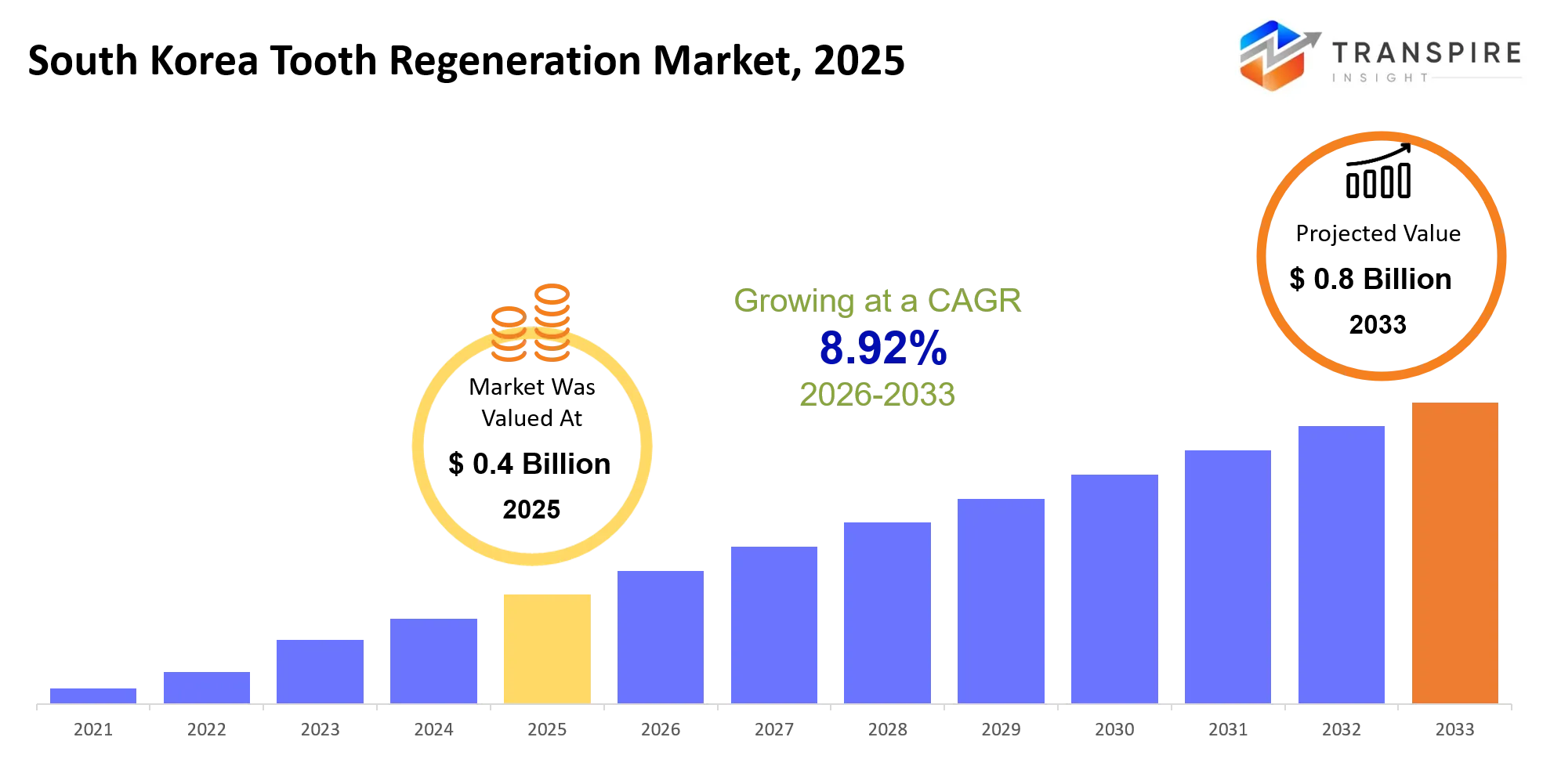
- Market Value (2025): USD 0.4 Billion.
- Expected Market Value (2026): USD 0.44 Billion.
- Estimated Market Value (2033): USD 0.8 Billion.
- Forecast CAGR (2026–2033): 8.92%.
Introduction
The South Korea Tooth Regeneration Market covers advanced technologies for regenerative dentistry, which aim at repairing, restoration, and regeneration of damaged tissues in the mouth area through biological and biomaterial solutions. The South Korea Tooth Regeneration Market includes such categories as stem cell therapy, bioactive materials, tissue engineered scaffolds, growth factor delivery platforms, resorbable membranes, and biomaterials, which target dental pulp, dentin, periodontal tissues, and alveolar bone. South Korea’s well-developed biotechnology innovation ecosystem, dental infrastructure, research capabilities, and the demand for minimally invasive technologies are fueling innovation in regenerative dentistry. The research on dissolving microneedles, bioactive delivery platforms, stem cell platforms, and 3D tissue engineering is also contributing to innovation trends in this space.
Key Market Highlights: -
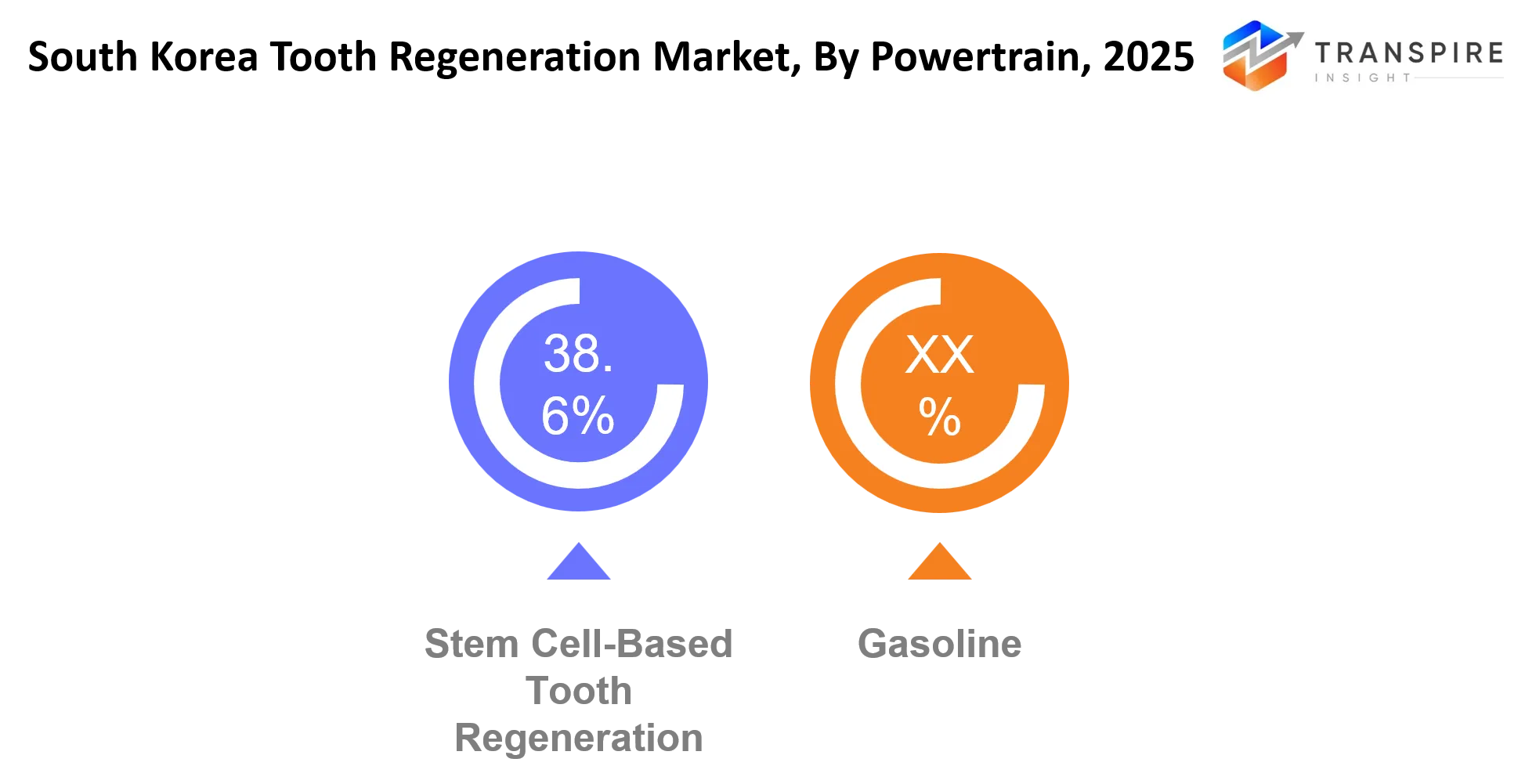
- By Technology, the Cell therapy dominated the market and holds approximately 49% share in 2025 and is projected to grow at a substantial CAGR during the forecast period.
- By Product Type, the regenerative materials dominated the market and holds approximately 60% share in 2025 and is projected to grow at a substantial CAGR during the forecast period.
- By Application, the Enamel Regeneration Manufacturers segment dominated the market and holds approximately 38.2% share in 2025 and is projected to grow at a substantial CAGR during the forecast period.
- Market development in South Korea’s tooth regeneration field is being facilitated through developments in regenerative biomaterials, stem cell studies, bioactive delivery platforms, tissue engineering, and minimally invasive dental technologies within a growing biomedical innovation ecosystem.
How is Technology Driving Growth in the South Korea Tooth Regeneration Market?
The South Korea Tooth Regeneration Market is witnessing rapid advancements owing to innovations in terms of biomaterials, tissue engineering, stem cell technology, and the minimal invasive drug delivery methods. Dissolvable microneedles can deliver therapeutic agents directly to the periodontal tissue site. Bioactive scaffolds, growth factor systems, and regenerative membranes will help achieve tissue regeneration. The ongoing research in dental stem cells and engineered tooth structure can bring new biological restoration options other than conventional implants. In addition, South Korea's superior dental facilities and digital treatment technology will assist in the conduct of clinical research and innovative tooth regeneration solutions.
Market Drivers
The South Korea Tooth Regeneration Market is fueled by growing geriatric populations, periodontal and tooth loss-related treatment requirements, advancements in regenerative biomaterials, and well-developed dental infrastructure. Increasing use of bone graft alternatives, collagen-based membranes, synthetic biomaterials, and minimally invasive periodontal regeneration is helping in the development of the market. The South Korean dental bone graft market, in particular, is aided by aging demographics, demand for restorative and cosmetic dentistry, advanced clinical infrastructure, and rising usage of regenerative materials. Additionally, emerging biotechnology innovations such as bioactive delivery and tissue engineering are providing future growth opportunities to the market, while increased dental care awareness helps in adopting advanced dental regeneration techniques.
Restrain
Regulatory complexities, expensive treatment and research and development costs, lack of large scale clinical verification, and biological limitations related to the regeneration of structurally complicated dental tissues are some of the major factors hampering the South Korea Tooth Regeneration Market. The newly emerging technologies related to stem cells, bioactive patches, and tissue engineering have not yet been developed fully, thereby limiting their commercial implementation in the near future.
|
Driver |
Relative Impact on Growth (%) |
Geographic Relevance |
Impact Timeline |
Demand Strength |
Growth Mechanism |
Key Beneficiaries |
Major Constraint |
|
Driver 1: Advances in Dental Stem-Cell and Tissue-Engineering Technologies |
27% |
Seoul, Gyeonggi, Daejeon |
Long-term (≥4 years) |
High |
Stem cells enable biological replacement of damaged dental tissues |
Dental biotech firms; research hospitals; biomaterial suppliers; patients |
Limited clinical evidence delays widespread commercialization |
|
Driver 2: Government Support for Advanced Regenerative Medicine |
23% |
Nationwide; Seoul and major biomedical clusters |
Medium-term (2–4 years) |
High |
Regulatory support accelerates regenerative dental clinical research |
Regenerative-medicine companies; hospitals; universities; investors |
Complex approvals increase development timelines and costs |
|
Driver 3: 3D Bioprinting and Advanced Scaffold Development |
20% |
Seoul, Gyeonggi, Daejeon |
Medium-term (2–4 years) |
High |
Bioprinted scaffolds enable precise patient-specific tissue regeneration |
3D-printing firms; biomaterial developers; dental laboratories; clinics |
Printing complexity and biomaterial compatibility remain challenging |
|
Driver 4: Rapidly Aging Population and Tooth-Loss Burden |
17% |
Nationwide; Busan, Daegu, Gyeongnam |
Long-term (≥4 years) |
High |
Aging increases demand for durable biological tooth-replacement solutions |
Dental clinics; regenerative-therapy providers; elderly patients; insurers |
Treatment affordability may restrict adoption among elderly patients |
|
Driver 5: Rising Investment in Korean Biohealth and Dental R&D |
13% |
Seoul, Gyeonggi, Daejeon |
Medium-term (2–4 years) |
Medium |
Capital expands translational research and commercialization pipelines |
Biotech startups; universities; CROs; technology vendors |
High R&D costs and uncertain commercial returns constrain investment |
Analysis of Prices and Consumer Behaviour
Dental regeneration market shares are dominated by hard tissue regeneration which accounts for 59.43% of total market revenue (in 2023, majorly driven by demand for bone graft substitutes, periodontal regeneration materials, and more advanced tissue-repairing therapies). South Korea dental regeneration market revenue is estimated at USD 143.3 million in 2025 and is forecast to grow up to USD 250.1 million by 2033, experiencing a CAGR of 7.29%. The demand for dental regenerative products is driven by the increasing uptake of regenerative biomaterials such as bone grafts, collagen membranes, bioactive scaffolds, and tissue engineering solutions. Advanced dental regenerative therapies are valued higher owing to their sophisticated use of biomaterials, controlled delivery of therapies, validated results, and advanced manufacturing techniques. Aging population coupled with an increased number of tooth loss and periodontal diseases drives the demand for regenerative dental therapies, while patients and dentists alike value clinical efficacy, biocompatibility, minimal invasiveness, and tissue regeneration.
|
Company |
Est. Revenue Share Range |
Key Offerings |
Strategic Positioning |
Geographic Strength |
Technology Focus |
|
OSSTEM Implant |
15–21% (Estimated) |
A-Oss; OssGuide; OssMem; implant-linked bone regeneration |
Integrated implant-regeneration ecosystem leadership |
Asia Pacific; North America; Europe |
Xenografts; collagen membranes; implant osseointegration |
|
Dentium |
12–17% (Estimated) |
OSTEON Xeno; OSTEON synthetic grafts; collagen grafts; GBR solutions |
Integrated implant and biomaterial platform |
Asia Pacific; Middle East; Europe |
Bone grafts; collagen biomaterials; digital implant workflows |
|
MegaGen Implant |
9–14% (Estimated) |
Mega-Oss; i-Gen; Meg-CoL; Bone Matrix I |
Premium regeneration and implant integration |
Asia Pacific; Europe; North America |
Collagen membranes; grafts; digital-guided regeneration |
|
NIBEC |
7–11% (Estimated) |
PeptiCol EZgraft; OCS-B; periodontal-regeneration technologies; peptide biomaterials |
Peptide-driven regenerative technology specialist |
South Korea; Europe; North America |
Bioactive peptides; collagen; periodontal regeneration |
|
Cowellmedi |
6–10% (Estimated) |
CowellBMP; rhBMP-2 bone grafting; regenerative implants; tissue-engineering R&D |
Growth-factor-led regenerative differentiation |
South Korea; Asia; North America; Europe |
rhBMP-2; growth factors; tissue engineering |
|
T&R Biofab |
5–9% (Estimated) |
3D bioprinting systems; bioinks; bioresorbable scaffolds; tissue-engineering platforms |
3D-bioprinting innovation-led specialization |
South Korea; North America; Asia |
3D bioprinting; bioinks; bioresorbable scaffolds |
|
DENTIS |
4–8% (Estimated) |
OVIS XENO-P II; OVIS membranes; GBR solutions; implant systems |
Value-oriented integrated regeneration portfolio |
South Korea; Asia; Europe |
HA xenografts; collagen membranes; GBR |
|
GENOSS |
3–7% (Estimated) |
OSTEON Xeno; OSTEON 2/3; OSTEON Xeno Collagen; collagen membranes |
Dental biomaterial portfolio diversification |
South Korea; Asia; international export markets |
BCP grafts; xenografts; collagen biomaterials |
|
Neobiotech |
2–5% (Estimated) |
Regenoss; CTi-mem; GBR components; sinus-lift systems |
Procedure-focused regenerative specialization |
South Korea; Asia; Europe; Middle East |
Titanium membranes; GBR; bone augmentation |
|
Purgo Biologics |
2–4% (Estimated) |
THE Graft; THE BCP; THE Allo; THE Cover; OpenTex |
Specialty bone-and-membrane biomaterial provider |
South Korea; Asia; international markets |
Hydroxyapatite; collagen; PTFE membranes |
Who are the Key Players in the South Korea Tooth Regeneration Market and how do they compete?
The competitiveness of the South Korea Tooth Regeneration Market is provided by the companies that specialize in innovations of regenerative technologies, dental solutions for clinical uses, and the development of distribution channels at a global scale. Being competitive in the field not via price but due to advanced biomaterials, regenerative technologies, tissue-engineering solutions, and integration with clinical and digital dental technologies, ligament diagnosis such a competitive strategy results in continuous improvement of products and also allows companies to reach greater treatment precision, tissue reconstruction, efficiency, and patient care.
Dentium's competitive advantage is provided by its innovations in the field of dental biomaterials, regenerative solutions, and tissue regenerating technologies. The competitive advantage of the company Osstem Implant is due to its high-performance dental implants, bone grafting materials, regenerative membranes, and dental restoration and tissue regeneration solutions. The competitive advantage of the company MegaGen Implant is provided by its advanced dental implant, regenerative biomaterials, bone regeneration, and advanced dental treatments technologies.
Top Companies in the South Korea Tooth Regeneration Market
- Dentium
- Osstem Implant
- MegaGen Implant
- Straumann
- Dentsply Sirona
- Nobel Biocare
- GC Corporation
- Kolon Life Science
- Medytox
- CellSeed
- Raphas
- LG Chem
- Samsung Biologics
- CHA Biotech
- Yonsei University Dental Research
South Korea Tooth Regeneration Market Segmentation
The South Korea Tooth Regeneration Market share is divided into six categories: By Technology, By Product Type, By Application, By Cell Type, By End User, By Material
The Cell therapy dominated the market, accounting for nearly 49% in 2025 and is expected to rise at a significant CAGR during the forecast period.
The South Korea Tooth Regeneration Market is segmented by technology into stem cell therapy, tissue engineering, growth factors, biomaterials, gene therapy, 3d bioprinting, scaffold technology, cell-based regeneration. Among these, the Cell therapy segment dominated the market, accounting for nearly 49% in 2025 and expected to increase at a significant CAGR during the forecast period. The cell therapy category took the leading market position in 2025 with almost 49% share due to superior regenerative properties and the increasing application of stem cell dental therapy.
The regenerative materials dominated the market, accounting for nearly 60% in 2025, and is expected to rise at a significant CAGR during the forecast period.
The South Korea Tooth Regeneration Market is segmented by product type into dental scaffolds, regenerative materials, growth factor products, stem cell products, bioactive materials, regenerative membranes, tissue-engineered constructs, 3d-printed products. Among these, the regenerative materials dominated the market, accounting for nearly 60% in 2025 and expected to increase at a significant CAGR during the forecast period. The regenerative material category led the market with almost 60% share in 2025 owing to increasing requirement for biocompatible scaffold, membrane, and other dental tissue regeneration material.
The Enamel Regeneration dominated the market, accounting for nearly 38.2% in 2025 and is expected to rise at a significant CAGR during the forecast period.
The South Korea Tooth Regeneration Market is segmentedby application into dentin regeneration, enamel regeneration, pulp regeneration, periodontal regeneration, whole-tooth regeneration, bone regeneration, root regeneration, implant-site regeneration. Among these, the Enamel Regeneration dominated the market, accounting for nearly 38.2% in 2025 and expected to increase at a significant CAGR during the forecast period. The enamel regeneration category dominated the market owing to increasing dental restoration needs and advances in the field of regenerative dentistry.
Future Market Trends for the South Korea Tooth Regeneration Market: -
Developing Bioactive Material for Teeth Regeneration: Bioactive scaffolds, collagen membranes, growth factor system, and biomaterials for tooth tissue regeneration, periodontal tissue regeneration, and bone regeneration applications are developing.
Research into Stem-Cell and Tissue Engineering for Dental Applications: Researching dental stem cells, engineered scaffolds, and cellular therapy is creating long-term opportunities for biological teeth and tissue regeneration.
Digital Approaches to Regenerative Dentistry: CAD/CAM systems, 3D imaging, and treatment planning are becoming increasingly integrated with regenerative dental treatments.
Recent Development
In August 20, 2026 – Research Development: Scientists from Seoul National University made advancements in tooth regeneration research through the discovery of immune and stem cell interactions that promote pulp-dentin regeneration and vascularization.
In November 18, 2025 – Research Launch: Researchers in South Korea made advancements in the study of biodegradable microneedle patches for dentin regeneration and dental tissue regeneration.
Market Segmentation
This study forecasts revenue at Japan, regional and country levels from 2020 to 2033. Transpire Insights has segmented the South Korea Tooth Regeneration Market based on the below-mentioned segments:
South Korea Tooth Regeneration Market, By Technology
- Stem Cell Therapy
- Tissue Engineering
- Growth Factors
- Biomaterials
- Gene Therapy
- 3D Bioprinting
- Scaffold Technology
- Cell-Based Regeneration
South Korea Tooth Regeneration Market, By Product Type
- dental scaffolds
- regenerative materials
- growth factor products
- stem cell products
- bioactive materials
- regenerative membranes
- tissue-engineered constructs
- 3d-printed products
South Korea Tooth Regeneration Market, By Application
- Dentin Regeneration
- Enamel Regeneration
- Pulp Regeneration
- Periodontal Regeneration
- Whole-Tooth Regeneration
- Bone Regeneration
- Root Regeneration
- Implant-Site Regeneration
South Korea Tooth Regeneration Market, By Cell Type
- Dental Pulp Stem Cells
- Mesenchymal Stem Cells
- Dental Follicle Stem Cells
- Periodontal Ligament Stem Cells
- Induced Pluripotent Stem Cells
- Embryonic Stem Cells
- Autologous Cells
- Allogeneic Cells)
South Korea Tooth Regeneration Market, By End User
- Dental Clinics
- Hospitals
- Research Institutes
- Universities
- Biotechnology Companies
- Dental Laboratories
- Specialty Clinics
- Academic Medical Centers
South Korea Tooth Regeneration Market, By Material
- Hydroxyapatite
- Collagen
- Chitosan
- Calcium Phosphate
- Bioceramics
- Polymers
- Hydrogels
- Composite Biomaterials
Frequently Asked Questions
Find quick answers to common questions.
Aging demographics, regenerative biomaterials, stem-cell research, tissue engineering, advanced dental infrastructure, and minimally invasive technologies are driving market growth.
Cell therapy dominates, supported by superior regenerative properties and increasing applications of stem-cell-based dental therapies across regenerative dentistry.
Regenerative materials lead demand, driven by increasing requirements for biocompatible scaffolds, membranes, and advanced dental tissue regeneration materials.
Key trends include bioactive materials, stem-cell tissue engineering, cellular therapies, CAD/CAM integration, three-dimensional imaging, and personalized regenerative dental treatments.
Recent developments include stem-cell research, pulp-dentin regeneration, vascularization studies, and biodegradable microneedle technologies targeting advanced dental tissue regeneration.
- Dentium
- Osstem Implant
- MegaGen Implant
- Straumann
- Dentsply Sirona
- Nobel Biocare
- GC Corporation
- Kolon Life Science
- Medytox
- CellSeed
- Raphas
- LG Chem
- Samsung Biologics
- CHA Biotech
- Yonsei University Dental Research
About the Authors

Pankaj Ghogare Patil
I am Pankaj Ghogare Patil, a Senior Research Analyst at Transpire Insight, specializing in the Pharmaceutical, Chemicals & Materials, Healthcare IT, and Biotechnology industry. My expertise lies in conducting comprehensive market research, analyzing industry trends, evaluating competitive landscapes, and translating complex data into actionable insights. At Transpire Insight, I closely follow emerging technologies, regulatory developments, and market innovations to create accurate, well-researched, and informative content that helps businesses and professionals make informed decisions. I am committed to producing credible, evidence-based articles that reflect industry best practices while making technical topics accessible and valuable for a broad audience.

Chakradhar Khansole
Chakradhar serves as the Research Director at Transpire Insight, bringing over 8 years of experience in technology, innovation, and strategic market intelligence. He specializes in transforming complex market data into actionable business insights that enable organizations to make informed, growth-oriented decisions. Recognized for his strategic vision and analytical expertise, Chakradhar leads high-impact research initiatives, delivering comprehensive market assessments, competitive intelligence, and forward-looking industry analysis.
Recently Published Reports
-
Apr 2026
AI in Diabetic Retinopathy Market
AI in Diabetic Retinopathy Market Size, Share & Analysis Report By Type (Screening AI Systems, Diagnostic AI Systems, and Predictive AI Models), By Application Segment (Hospitals, Ophthalmology Clinics, Diagnostic Centers, and Research and Development), and Geography (North America, Europe, Asia-Pacific, Middle East and Africa, South and Central America), 2021 - 2031
-
Apr 2026
Psychometric Tests Market
Psychometric Tests Market Size, Share & Analysis Report By Type (Personality Tests, Ability/Aptitude Tests, Skill/Knowledge Tests, and Others), By Application (Talent Acquisition and Talent Management), and Geography (North America, Europe, Asia-Pacific, Middle East and Africa, South and Central America), 2021 – 2031
-
Apr 2026
Rare Biological Sample Collection Market
Rare Biological Sample Collection Market Size, Share & Analysis Report By Type (Isolation Kits & Reagent, Blood Collection Tubes, and Others), By Application (Oncology, Transcriptomics, Pharmacogenomics, and Others), and Geography (North America, Europe, Asia-Pacific, Middle East and Africa, South and Central America), 2021 – 2031
-
Jul 2026
Diabetic Retinopathy Market
Diabetic Retinopathy Market Size, Share & Analysis Report By Type (Proliferative Diabetic Retinopathy, and Diabetic Macular Edema (DME)), By Treatment Type (Anti VEGF Drug, Steroid Implants, Laser Surgeries, and Vitrectomy), and Geography (North America, Europe, Asia-Pacific, Middle East and Africa, South and Central America), 2021 – 2031
Our Clients







