

South Korea Swine Feed Market Summary:
According to Transpire Insight, a detailed research report on the market reflects that the grower feed application segment is a significant segment of the South Korea Swine Feed Market, supported by commercial pig production and demand for nutritionally optimized feed formulations. Nonghyup Feed Inc. leads the South Korean animal-feed industry with approximately 14.5% of total industry production value in 2025, making it a leading contributor to South Korea market development, innovation, advanced swine feed production, expanding manufacturing capabilities, and growth dynamics.
Market Snapshot
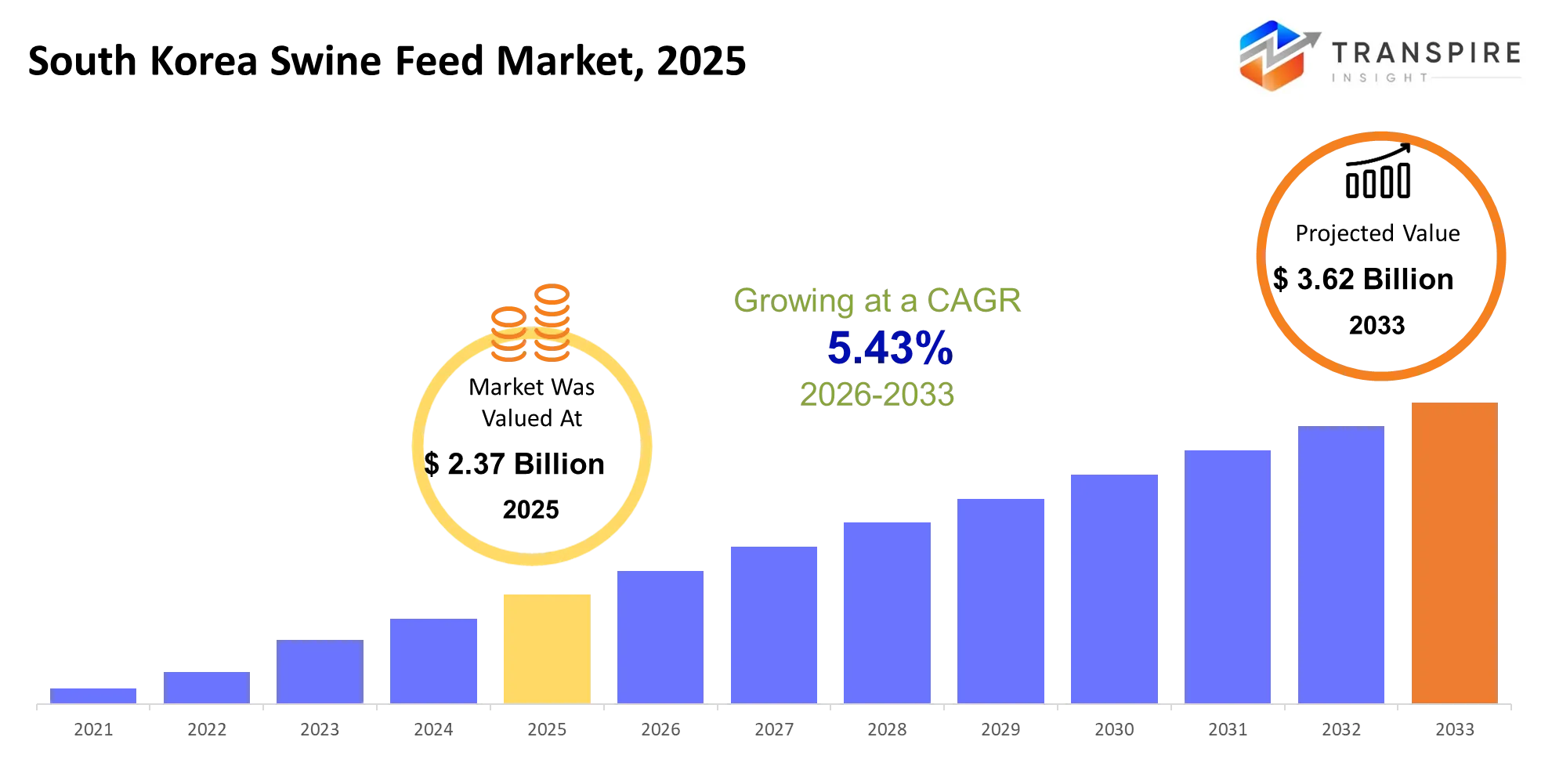
- Market Value (2025): USD 2.37 Billion.
- Expected Market Value (2026): USD 2.50 Billion.
- Estimated Market Value (2033): USD 3.62 Billion.
- Forecast CAGR (2026–2033): 5.43%
Introduction
The swine feed industry refers to the business component involved in manufacturing, marketing, and selling of commercial nutritional feeds that have been prepared for pigs at different stages of development. The swine feed products include complete feeds, concentrated feeds, and feed additives such as amino acids, vitamins, enzymes, and probiotics meant to improve health and feed conversion rates of the animals. Swine feed a blend of grains, proteins, vitamins, minerals, and additives intended to ensure healthy productivity of pigs at different life stages (pigs, growers, sows, and finishers). The South Korea Swine Feed Market enjoys the advantage of being well-equipped with infrastructure such as an established supply chain, automated dosing systems, and localized feed manufacturing. Safety and high standards in the market are assured through regulations on the quality of the feeds, traceability, biosecurity, and disease prevention. Productivity in the market is also increased through precision nutrition as well as functional feed additives such as probiotics and enzymes that increase the health and growth of the animals. Domestic demand in the market is another factor that gives the market a competitive advantage due to already established pork consumption and commercial swine farming.
Key Market Highlights: -
- By additive, the Amino Acids segment dominated the market and holds nearly 21% share in 2025 and is projected to grow at a substantial CAGR during the forecast period.
- By feed type, the Starter segment dominated the market and holds nearly 62% share in 2025 and is projected to grow at a substantial CAGR during the forecast period.
- By ingredient, the Corn segment dominated the market and holds nearly 34% share in 2025 and is projected to grow at a substantial CAGR during the forecast period.
- Feed safety and biosecurity regulations: Strict regulations are imposed by South Korea concerning feed safety and biosecurity in order to prevent the spread of diseases along the swine feed chain. The threat of African Swine Fever has tightened regulations on feed ingredients, manufacturing, importation, and distribution of feeds, with sanitary regulations on animal proteins guaranteeing traceability, contamination control, and feed biosecurity.
How is Technology Driving Growth in the South Korea Swine Feed Market?
The feed market in South Korea's swine sector is becoming more influenced by the concept of precision nutrition, improved feeds, IoT, automation, and smart farming. Functional feed additives, including probiotics, enzymes, amino acids, and Immunomodulators, help in improving digestion, nutrition uptake, disease resistance, and animal performance. Smart feed formulation based on artificial intelligence allows for data-driven nutrition optimization in various stages of development, helping in minimizing feed wastage and cutting down on feed production expenses. IoT sensors, cloud platforms, RFID technology, and automated feeding systems allow for feed intake and other data to be collected in real time.
Market Drivers
The South Korea Swine Feed Market is governed by a number of structural drivers. Premium Protein Demand Growing consumers' income levels and their need for safe, high-quality pork meat is driving the consumption of nutrient-rich swine feed. Antibiotic Control Laws Control laws pertaining to the use of antibiotic growth promoters are leading to increased usage of probiotics, phytogenic, enzymes, and other functional feed additives. Precision Feeding & Technologies Precision livestock feeding practices and use of advanced feed management technologies such as Internet-of-Things are helping in improving feed efficiency and herd performance. Sustainability & Biosecurity Environmental considerations and strict biosecurity norms are prompting feed manufacturers to produce efficient and sustainable swine feeds. The South Korea Swine Feed Market enjoys fast integration with high-tech developments due to the fact that more and more commercial farms start using IoT sensors and automated feeding systems to ensure efficient distribution of feed and minimize the risk of wastage. Agricultural development programs by the government also promote precision livestock farming, digitalization, and biosecurity measures. High biosecurity and safety standards, especially in view of recent African Swine Fever (ASF) cases, increase the focus on the controlled environment for animal production, traceability, disease prevention, and contamination risks. Premium feed requirements favor the use of functional feed additives like probiotics and enzymes.
Restrain
Obstacles in the South Korea Swine Feed Market include ASF and PRRS outbreaks, which could affect herd numbers and swine feed demand. Fluctuating prices of corn and soybean meals cause higher costs of production. Environmental laws call for the adoption of sustainable technologies and development. Moreover, shifting consumer preferences, such as an increased desire for plant protein sources, could limit pork consumption and swine-feed market expansion in the future.
|
Driver |
Relative Impact on Growth (%) |
Geographic Relevance |
Impact Timeline |
Demand Strength |
Growth Mechanism |
Key Beneficiaries |
Major Constraint |
|
Rising Pork Consumption and Commercial Swine Production |
27% |
Nationwide; major commercial pig-producing regions |
Medium-term |
High |
Expands herd nutrition requirements and commercial feed volumes. |
Feed manufacturers, pig farms, ingredient suppliers |
Pork price volatility can reduce herd expansion. |
|
Growing Adoption of Precision Feeding and Smart Livestock Technologies |
23% |
Gyeonggi, Chungcheong, Jeolla, Gyeongsang |
Medium-term |
High |
Improves feed efficiency through data-driven nutrient optimization. |
Feed producers, smart-farming vendors, commercial farms |
High technology investment and implementation costs. |
|
ASF Biosecurity and Feed Safety Requirements |
20% |
Nationwide, especially ASF-affected regions |
Short-term |
High |
Increases demand for controlled, traceable, biosecure feed. |
Certified feed manufacturers, testing firms, farms |
Higher compliance and feed-quality assurance costs. |
|
Demand for Functional Additives and Precision Nutrition |
17% |
Nationwide intensive swine-farming clusters |
Medium-term |
High |
Enhances growth, immunity, digestion, and feed conversion. |
Additive suppliers, nutrition companies, feed manufacturers |
Premium formulations increase production costs. |
|
Sustainability and Feed-Efficiency Initiatives |
13% |
Nationwide; technology-oriented livestock farms |
Long-term |
Medium |
Reduces feed waste, emissions, and resource consumption. |
Sustainable-feed suppliers, technology firms, progressive farms |
Limited adoption among smaller farms and high transition costs. |
Analysis of Prices and Consumer Behaviour
The South Korea swine feed market is one that is characterized by the high demand for balanced formulations as well as efficient use of such feeds in promoting the performance of the animals. Commercial pig farmers focus on issues of feed efficiency, animal health, growth, and meat production. The South Korea Swine Feed Market had revenue of around USD 2,049.8 million in 2022 and is expected to grow to USD 3,116.4 million by 2030 at a CAGR of 5.4% from 2023 to 2030. Premium formulations of feed are charged higher prices due to their unique formulations of nutrition, functional additives, amino acids, enzymes, and ingredients that improve feed conversion and animal performance. Official data of Korean livestock distribution is used to monitor swine feed production and pricing where monthly figures for production and prices of 16 swine feed categories are provided. The South Korea Swine Feed market is majorly B2B-oriented with B2B spending making up 99.1% of South Korea's total demand for pet food and animal feed in 2025. Livestock producers purchase feed on the basis of quality, nutritional value, animal performance, stable prices, and regular supply.
Who are the Key Players in the South Korea Swine Feed Market and how do they compete?
Competitive advantages in the South Korea Swine Feed Market include specialization in nutritional formula, species-specific feed solutions, efficiency of feed production and effective distribution channels. The competition is based not just on price but also on feed quality, animal health, productivity improvement, biosecurity, technical support and specialized nutrition solutions that help producers to enhance pigs' growth and farm performance.
Specialized pig feeds and close contacts with livestock producers make NongHyup Feed competitive through its specialized swine nutrition and farm support solutions. De Heus Korea after acquiring CJ Feed&Care benefits from its local experience in the feed market and global knowledge in animal nutrition and concentrates on farm productivity, technical support and innovative feed solutions. Cargill is competitive with Purina and Nutrena branded feed products, four feed mills in Korea, premixes and feed additives, specialized formula, technical services for livestock producers. Harim Group companies like Farmsco, Jeil Feed, and Sunjin compete with their integrated livestock and feed production and species-specific formulations.
Top Companies in the South Korea Swine Feed Market
- CJ CheilJedang
- Nonghyup Feed
- Daehan Feed
- Easy Bio
- Harim
- Farmsco
- Purina Korea
- Cargill
- ADM
- Nutreco
- De Heus
- Alltech
- DSM-Firmenich
- Kemin Industries
- BASF
|
Company |
Est. Revenue Share Range |
Key Offerings |
Strategic Positioning |
Geographic Strength |
Technology Focus |
|
Nonghyup Feed Inc. |
10–14% |
Swine compound feed, specialty nutrition, farm-management programs, livestock feed solutions |
Nationwide cooperative-led feed supply and farmer support |
Asia Pacific |
Precision nutrition and feed formulation |
|
De Heus Korea (formerly CJ Feed & Care) |
8–12% |
Swine feed, piglet nutrition, breeding feed, farm-support solutions |
Local expertise combined with global nutrition capabilities |
Asia Pacific, Europe |
Precision feeding and nutritional optimization |
|
Cargill Agri Purina Korea |
8–12% |
Purina feeds, Nutrena feeds, Provimi premixes, additives, customized formulations |
Integrated nutrition portfolio with strong feed manufacturing network |
Asia Pacific, North America |
Feed formulation and nutrition analytics |
|
Farmsco Co., Ltd. |
7–10% |
Pig feed, specialty livestock feed, integrated farm solutions, animal-welfare feed |
Vertical integration across feed, livestock, and food production |
Asia Pacific |
Precision nutrition and sustainable feed |
|
Jeil Feed Co., Ltd. |
5–8% |
Swine feed, piglet feed, breeder feed, livestock nutrition programs |
Integrated Harim Group livestock ecosystem |
Asia Pacific |
Stage-specific nutrition and feed efficiency |
|
EASY BIO, Inc. |
4–7% |
I-feed piglet feed, specialty feed, feed additives, formulation software |
Piglet specialization and additive-driven differentiation |
Asia Pacific, Europe |
Feed formulation software and functional nutrition |
|
Daehan Feed Co., Ltd. |
3–6% |
Swine feed, piglet feed, DCT nutrition, metabiotics |
Specialized digestive-health and precision-nutrition positioning |
Asia Pacific |
Digestive-care and precision nutrition |
|
Woosung Feed Co., Ltd. |
3–5% |
Compound swine feed, livestock nutrition, customized feed programs |
Regional feed manufacturing and customer-focused formulations |
Asia Pacific |
Feed formulation and production efficiency |
|
Sajo Donga One Co., Ltd. |
2–4% |
Piglet feed, grower feed, finisher feed, sow feed |
Vertical integration with domestic livestock operations |
Asia Pacific |
Stage-specific formulation and HACCP production |
|
Sunjin Co., Ltd. |
2–4% |
Swine feed, premixes, specialty nutrition, livestock solutions |
Integrated livestock and specialized nutrition strategy |
Asia Pacific, Southeast Asia |
Premix technology and precision nutrition |
South Korea Swine Feed Market Segmentation
The South Korea Swine Feed Market share is divided into five categories: By additive, feed, form, ingredient and farm stage.
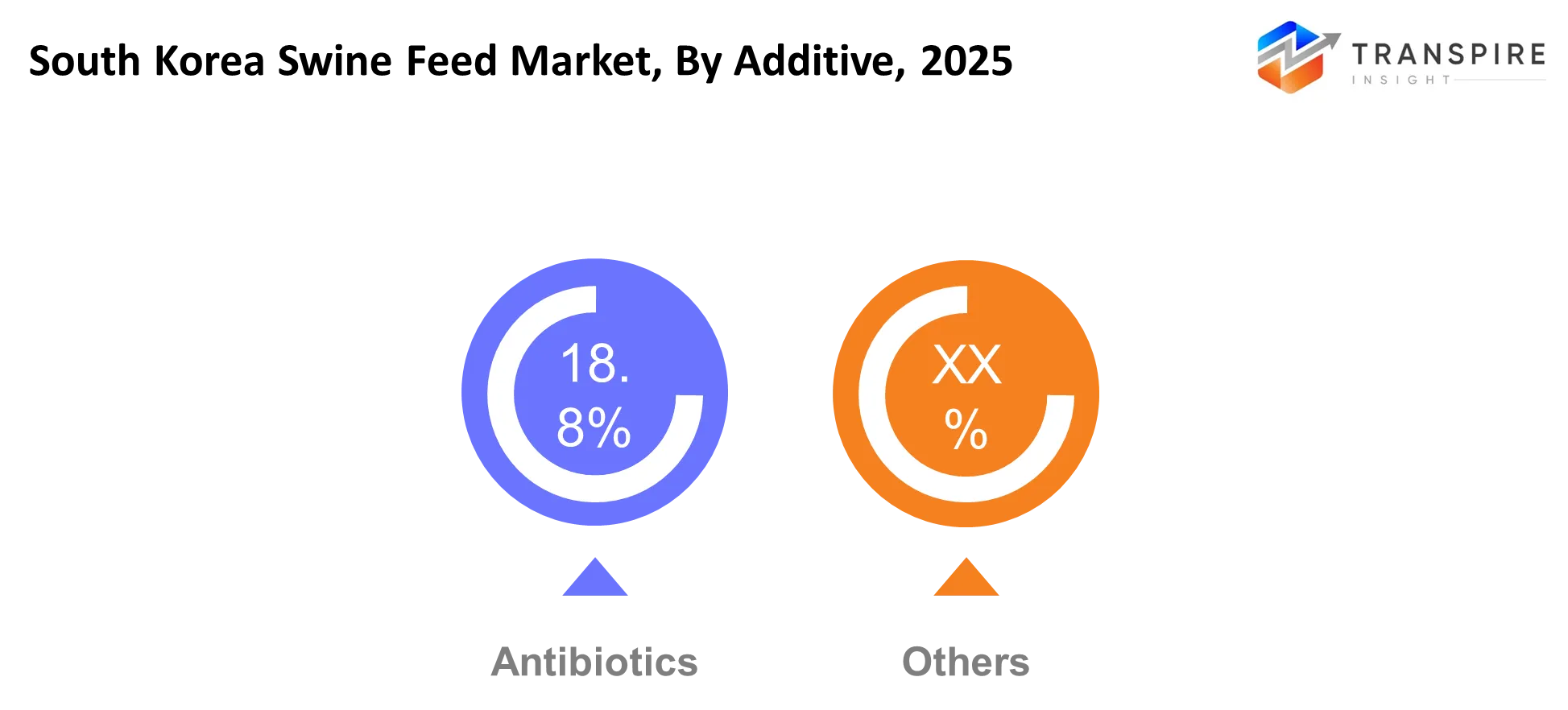
The Amino Acids dominated the market, accounting for nearly 21% in 2025 and is expected to rise at a significant CAGR during the forecast period.
The South Korea Swine Feed Market is segmented by additive into Other Additives, Antibiotics, Vitamins, Antioxidants, Amino Acids, Feed Enzymes, Feed Acidifiers. Among these, the Amino Acids segment dominated the market, accounting for nearly 21% in 2025 and expected to increase at a significant CAGR during the forecast period. Amino Acids category had the largest share of around 21% in 2025, mainly attributed to its key importance in making the animals more nutritionally efficient, enhancing protein metabolism, increasing feed efficiency, and development of healthy animals. Higher demand for affordable and sustainable feed formulation and livestock production is further contributing to the adoption of amino acids, resulting in market growth.
The Starter dominated the market, accounting for nearly 62% in 2025, and is expected to rise at a significant CAGR during the forecast period.
The South Korea Swine Feed Market is segmented by feed type into Starter, Grower, Finisher, Sow Feed, Lactation Feed, Gestation Feed, Piglet Feed. Among these, the Starter segment dominated the market, accounting for nearly 62% in 2025 and expected to increase at a significant CAGR during the forecast period. Segmentation based on product type shows that the “Starter” segment led the market, occupying almost 62% of the market share by 2025, mainly because of its relevance in the proper development, immune system strength, digestion, and performance in growth of piglets. The use of balanced starter feed along with precise nutrition is enhancing feed utilization and minimizing early-stage health concerns.
The Corn dominated the market, accounting for nearly 34% in 2025 and is expected to rise at a significant CAGR during the forecast period.
The South Korea Swine Feed Market is segmented by ingredient into Corn, Soybean Meal, Wheat, Barley, Fishmeal, Vegetable Protein, Animal Protein. Among these, the Corn segment dominated the market, accounting for nearly 34% in 2025 and expected to increase at a significant CAGR during the forecast period. Corn accounted for almost 34% of the market share in 2025 owing to its rich energy value and easy digestibility. It is widely used as a source of carbohydrates in pig feed due to the low cost of production. Growth in commercial pigs along with demand for balanced nutrition drives its market growth.
Future Market Trends for the South Korea Swine Feed Market: -
- Precision Nutrition and Automation: Farmers are increasingly implementing automation and Internet-of-Things (IoT) technology into dosing and tracking the nutritional status of animals in real time.
- Functional and Natural Additives: The focus of the industry has begun moving towards enzyme/probiotics mixtures, amino acid additives and feed enzymes, which help in enhancing immunity and efficiency of feed conversion, and substitute the traditional antibiotics.
- Sustainability and Eco-Friendly Ingredient Source: More stringent environment rules are encouraging the farmers to opt for sustainable sources of ingredients, digital traceability, and valorization of waste.
- Organic and Specialty Feeds: Consumer education is fueling the market towards organic and special feeds, aimed at the production of superior quality pork.
- Government-Biotech Collaboration: The government sector of South Korea continues to reward agricultural modernization and collaboration with biotech companies in the production of immunomodulatory feeds.
Recent Development
- In April 2026: “STRONGER TOGETHER,” an enhanced productivity campaign for the livestock industry of South Korea, specifically for the swine sector in South Korea, has been rolled out by De Heus Korea. This campaign underscores the importance of piglet nutrition, immunity, performance, and efficiency, thus enhancing De Heus Korea’s position in the South Korea Swine Feed Market.
- In March 2026: The emphasis on biosecure and specialized piglet feed formulations in the swine feed industry in South Korea gained prominence due to challenges posed by the ASF threat. The EASY BIO Piggy G series is customized according to the nutritional needs of piglets at different stages of development as well as according to their body weight.
Market Segment
This study forecasts revenue at South Korea, regional and country levels from 2020 to 2033. Transpire Insight has segmented the South Korea Swine Feed Market based on the below-mentioned segments:
South Korea Swine Feed Market, By Additive
- Other Additives
- Antibiotics
- Vitamins
- Antioxidants
- Amino Acids
- Feed Enzymes
- Feed Acidifiers
South Korea Swine Feed Market, By Feed Type
- Starter
- Grower
- Finisher
- Sow Feed
- Lactation Feed
- Gestation Feed
- Piglet Feed
South Korea Swine Feed Market, By Form
- Pellets
- Mash
- Crumbles
- Meal
- Liquid Feed
- Extruded Feed
- Granulated Feed
South Korea Swine Feed Market, By Ingredient
- Corn
- Soybean Meal
- Wheat
- Barley
- Fishmeal
- Vegetable Protein
- Animal Protein
South Korea Swine Feed Market, By Farm Stage
- Piglets
- Nursery Pigs
- Growers
- Finishers
- Sows
- Gilts
- Boars
Frequently Asked Questions
Find quick answers to common questions.
The market is projected to grow at a 5.43% CAGR from 2026 to 2033, reaching USD 3.62 billion.
Amino Acids dominate with approximately 21% share in 2025, supported by improved feed efficiency, protein synthesis, and animal nutrition.
Starter feed dominates with approximately 62% share in 2025, driven by improved piglet growth, digestion, immunity, and development.
Corn dominates with approximately 34% share in 2025, supported by high energy content, digestibility, affordability, and widespread feed usage.
Key trends include precision nutrition, IoT feeding, functional additives, sustainable ingredients, automation, digital traceability, and specialized piglet feed formulations.
- CJ CheilJedang
- Nonghyup Feed
- Daehan Feed
- Easy Bio
- Harim
- Farmsco
- Purina Korea
- Cargill
- ADM
- Nutreco
- De Heus
- Alltech
- DSM-Firmenich
- Kemin Industries
- BASF
About the Authors

Chetan Dhatrak
I’m Chetan Dhatrak, a Senior Research Analyst at Transpire Insight, specializing in the Consumer Goods, Foods and Beverages industry. I focus on analyzing market trends, consumer behavior, competitive landscapes, and industry developments to deliver accurate, data-driven insights. My research at Transpire Insight is built on credible sources and in-depth analysis, helping businesses and readers better understand market dynamics, emerging opportunities, and evolving consumer preferences. I’m committed to creating reliable, well-researched content that supports informed decision-making and reflects the latest developments in the consumer goods and food & beverage sectors.

Chakradhar Khansole
Chakradhar serves as the Research Director at Transpire Insight, bringing over 8 years of experience in technology, innovation, and strategic market intelligence. He specializes in transforming complex market data into actionable business insights that enable organizations to make informed, growth-oriented decisions. Recognized for his strategic vision and analytical expertise, Chakradhar leads high-impact research initiatives, delivering comprehensive market assessments, competitive intelligence, and forward-looking industry analysis.
Recently Published Reports
-
Apr 2026
Baby Infant Formula Market
Baby Infant Formula Market Size, Share & Analysis Report By ype (Infant Milk, Follow On Milk, Specialty Baby Milk, Growing-Up Milk), By Ingredient (Carbohydrate, Fat, Protein, Minerals, Vitamins, and Others), By Product Form (Powder, Liquid, and Ready-to-feed), By Distribution Channels (Supermarket/Hypermarket, Specialty Store, Pharmacies, Online Retail, and Others), and Geography (North America, Europe, Asia-Pacific, Middle East and Africa, South and Central America), 2021 - 2031
-
Apr 2026
Edible Insects for Animal Feed Market
Edible Insects for Animal Feed Market Size, Share & Analysis Report By Type (Insect Powder, Insect Meal, Insect Bar, Insect Paste, Insect Oil, and Others), By Insect Type (Beetles, Cricket, Caterpillar, Hymenoptera, Orthoptera, Tree Bugs, and Others), By Application (Livestock, Pet Food, and Aquaculture), By Livestock Type (Poultry, Swine, and Others), and Geography (North America, Europe, Asia-Pacific, Middle East and Africa, South and Central America), 2021 - 2031
-
Apr 2026
Food Industry Disinfection and Bacterial Control Market
Food Industry Disinfection and Bacterial Control Market Size, Share & Analysis Report By Type (Chemical Disinfectants, Physical Disinfectants, and Biocides and Antimicrobials), By Application (Food Processing Equipment Surface Disinfection, Food Preparation Areas Surface Disinfection, Storage Areas Surface Disinfection, Anti-microbial Coatings Food Preservation, and Preservative Solutions Food Preservation), By End User (Meat and Poultry Processing, Dairy Processing, Seafood Processing, Bakery and Confectionery, Restaurants and Commercial Kitchens, and Food Service Providers), By Sales Channel (Online, Offline), and Geography (North America, Europe, Asia-Pacific, Middle East and Africa, South and Central America), 2021 - 2031
-
May 2026
Freeze Dried Food Market
Freeze Dried Food Market Size, Share & Analysis Report By Product Type (Fruits, Vegetables, Freeze-Dried Dairy Products, Freeze-Dried Meat and Seafood, Freeze-Dried Pet Food, and Prepared Meal), By Nature (Organic, and Conventional), By Form (Powdered, Granules, and Diced), By End Use (Breakfast Cereals, Dairy Products, Bakery & Confectionery, Nutritional Bars & Supplements, Powdered Beverages, Snacks, and Retail (Household)), and Geography (North America, Europe, Asia-Pacific, Middle East and Africa, South and Central America), 2021 - 2031