
South Korea Storage Area Network Market Size & Forecast:
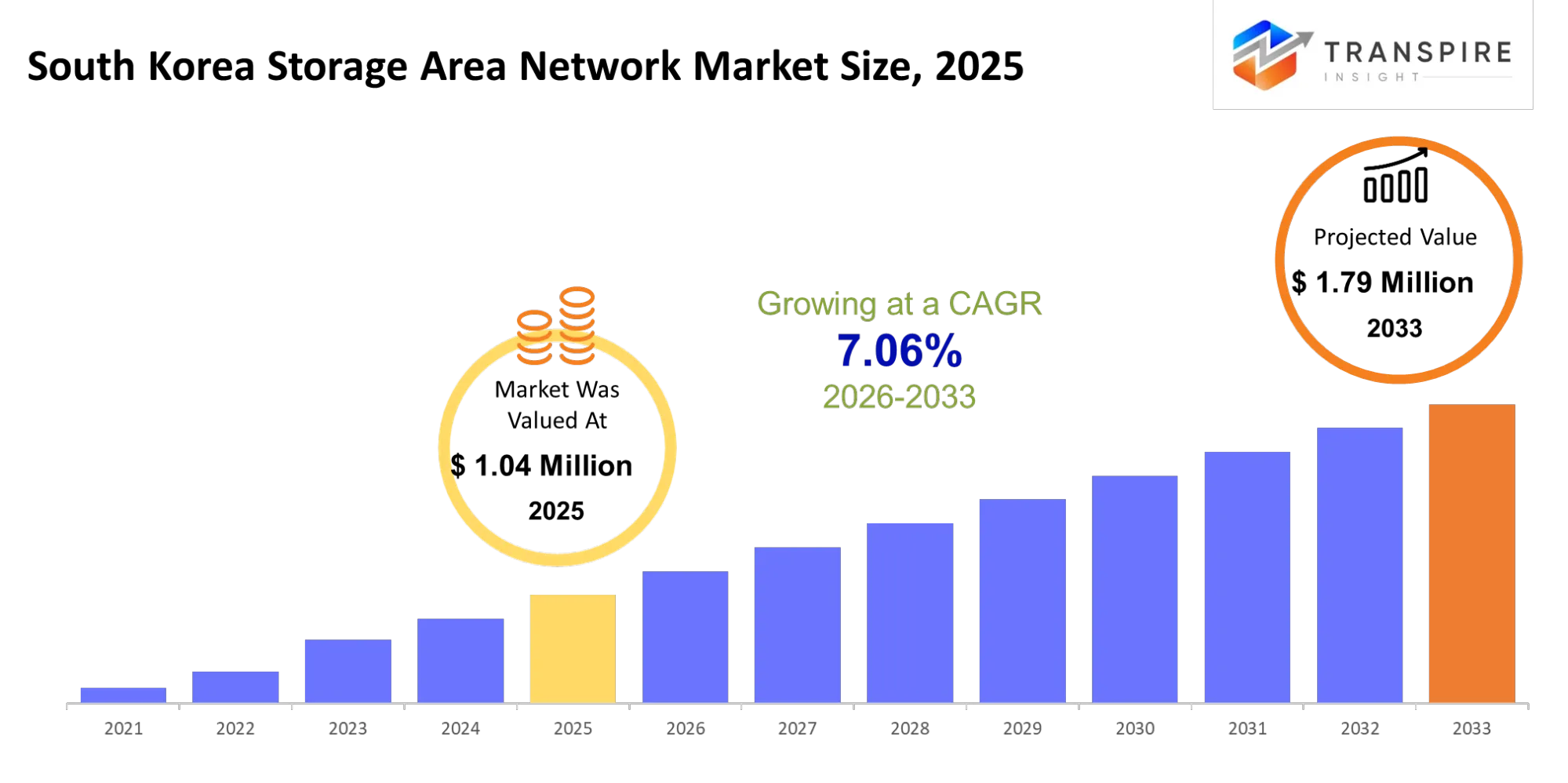
- South Korea Storage Area Network Market Size 2025: USD 1.04 Million
- South Korea Storage Area Network Market Size 2033: USD 1.79 Million
- South Korea Storage Area Network Market CAGR: 7.06%
- South Korea Storage Area Network Market Segments: By Component (Switches, HBAs, Controllers, Storage Arrays, Others); By Technology (Fibre Channel SAN, iSCSI SAN, FCoE SAN, NVMe-over-Fabrics SAN, Others); By Application (Data Backup & Recovery, Virtualization, Database Management, Cloud Storage, Others); By End User (IT & Telecom, BFSI, Healthcare, Government, Manufacturing, Others); By Deployment (On-premise SAN, Cloud-integrated SAN, Hybrid SAN, Others)
To learn more about this report,  Download Free Sample Report
South Korea Storage Area Network Market Summary
The South Korea Storage Area Network Market was valued at USD 1.04 billion in 2025. It is forecast to reach USD 9.0 billion by 2033. That is a CAGR of 7.57% over the period.
In South Korea the Storage Area Network (SAN) market, kinda enables secure and fast movement as well as keeping of big amounts of enterprise data between data centers, cloud environments, and business systems that can’t really afford failure. Most of the time, SAN offerings let organizations keep steady access to databases, virtualized workloads, core financial systems, and analytics tools while lowering downtime risks and also boosting storage efficiency a bit.
Over the last five years, the whole market seems to be moving away from older Fibre Channel oriented setups, and toward hybrid plus software-defined storage models, that blend cloud resources and NVMe performance upgrades. At the same time AI workloads are growing quickly, and hyperscale data center investments have been speeding up infrastructure modernization across the country. Enterprises are now handling larger datasets and asking for quicker application responses, so older storage designs are becoming less effective. That situation is pushing budgets into newer SAN platforms that can deliver lower latency, more reliable scalability, and centralized control, and it also opens fresh revenue streams for storage vendors, system integrators, and data center operators.
Key Market Insights
- The Seoul Capital Area is really big in the market it has sixty percent of the value in 2025.
- Seoul is the place because it has a lot of data centers and companies that do information technology.
- The area around Busan is growing fast.
- More cloud facilities are being built in cities and that is good for companies that make storage equipment.
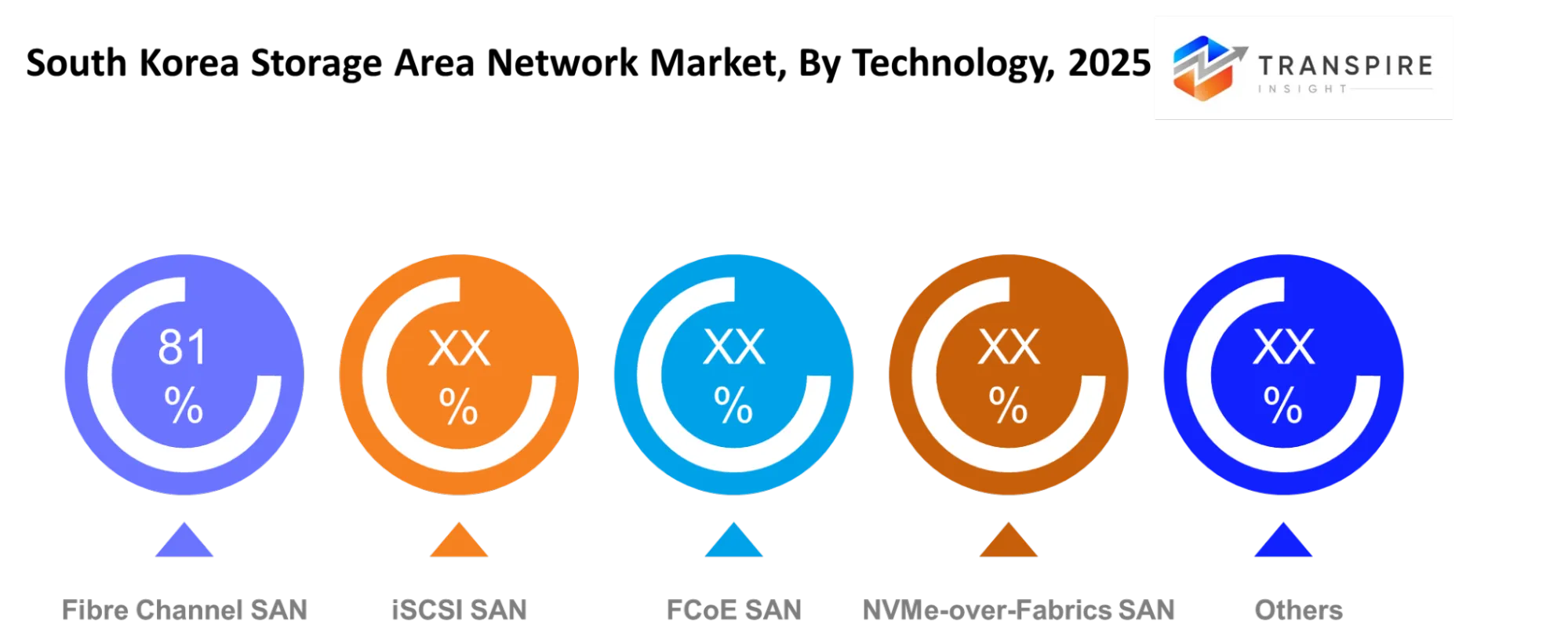
- Fibre Channel SAN is the used it has about forty percent of the market in 2025 and this is because big companies need it.
- ISCSI SAN is the second most used because it is cheaper and easier to use.
- NVMe-, over-Fabrics SAN is growing the fastest from 2025 to 2030 because companies want things to happen faster.
- Some companies use a mix of storage systems because they need both speed and space.
- Database management is the use of storage it has about thirty percent of the market in 2025.
- Data backup and recovery is also very important because companies need to be safe and always working.
What are the Key Drivers, Restraints, and Opportunities in the South Korea Storage Area Network Market?
The main force pushing the South Korea Storage Area Network Market forward is kinda the rapid spread of data-heavy workloads tied to artificial intelligence, cloud computing, and enterprise digital platforms. In the last few years, big investments in hyperscale data centers along with more advanced compute infrastructure have really raised the bar for low latency, high throughput storage settings. So, as companies end up handling bigger datasets and also run more complicated applications, older storage blueprints don’t really keep up with the performance expectations. That’s why many enterprises are now leaning into newer SAN offerings, especially NVMe-enabled setups and hybrid storage networks, which in turn helps boost infrastructure spending and also lifts vendor revenue, pretty directly.
That said, the biggest obstacle is still the expensive part and the overall complexity of SAN modernization. A lot of enterprises still run legacy storage environments that need major capital outlays just to swap in or properly integrate with newer architectures. This is sort of structural, since storage infrastructure is tangled into the everyday business backbone, making any migration effort long, and also operationally sensitive. On top of that, there’s an ongoing shortage of skilled people in storage networking and data center management, which then drags out deployment timelines. Because of this, some organizations delay upgrades, which ends up capping adoption levels and postponing the market revenue they could otherwise generate.
There’s a big growth opening right now, where hybrid cloud strategies kind of meet NVMe over Fabrics deployment. In South Korea, many enterprises are getting more interested in storage architectures that, basically, connect on-premise systems with cloud resources in a smooth way, without friction or delay. At the same time, people are putting more money into next-generation data centers and AI-ready infrastructure. That, in turn, creates favorable conditions for SAN vendors to offer scalable high performance solutions, not just in theory but in practice. And the organizations that go down the hybrid path sooner rather than later, they are expected to become major contributors to the market’s next phase of expansion.
What Has the Impact of Artificial Intelligence Been on the South Korea Storage Area Network Market?
Artificial intelligence along with more advanced digital technologies is, right now, reshaping storage area network environments in South Korea, pushing enterprise storage infrastructure toward being more autonomous, resilient, and efficient. A bunch of leading storage vendors embed AI-driven management platforms that keep watching network traffic, storage usage, latency levels and even hardware well-being across multiple data centers. In practice, these tools automatically shuffle resources, spread workloads more evenly, and spot performance bottlenecks early, before they start messing with critical applications.
Also, machine learning models are getting used for predictive maintenance in storage networks. Instead of waiting for failure, they look at recurring signals from controller performance, drive behavior, temperature swings, and signs of network congestion. Then they can catch early symptoms of component trouble and suggest corrective actions. As a result, it lowers the chance of unplanned downtime, so organizations can sustain stronger service availability for databases, virtualization platforms, and cloud workloads. Beyond that, AI powered analytics helps with storage capacity planning—so enterprises can raise utilization rates and avoid needless hardware investments, which is kind of the whole point.
Advanced automation helps with quicker incident response and makes cybersecurity stronger, because it can spot odd access patterns and abnormal data movement in real time, kinda like a constant watch. Because of that, operational efficiency tends to rise, recovery times can get shorter, and it also supports compliance with data governance rules, even when things get messy.
Still, there’s a major snag. The complexity of plugging AI tools into older storage environments is tough. A lot of organizations run mixed, heterogeneous infrastructure that grew over several years, so getting the data collection right, keeping system interoperability stable, and maintaining model accuracy becomes more complicated than expected. And yes, the integration costs that come with this can definitely slow adoption, even though the long term operational benefits are pretty clear.
Key Market Trends
- Since 2021 companies have been moving away from storage environments and towards hybrid architectures that connect the storage they have on site with public cloud platforms.
- The use of NVMe-over-Fabrics has grown a lot since 2023 because companies want to reduce the time it takes to process information for things like intelligence training and real-time processing workloads.
- People who run data centers have been replacing storage systems that use hard disk drives with new ones that use flash storage, which makes applications work better and reduces problems with the infrastructure.
- Between 2022 and 2025 storage management platforms that use intelligence have become more popular because they can automatically balance workloads and detect when something is likely to go wrong.
- Big companies like Dell Technologies, HPE, IBM and NetApp have been expanding their software-defined storage options to help companies use cloud platforms.
- When companies buy storage they are now looking for things that will make their applications work better keep their information automate tasks, rather than just looking for a lot of storage space.
- After some big companies had their information stolen they have been working to make their backup systems and disaster recovery plans stronger.
- Telecom operators and cloud service providers have been investing more in data centers, which has created a bigger demand for storage area networks that can grow and change as needed.
- Companies that use intelligence and machine learning are using storage networks that can handle a lot of information and process it quickly so they can manage big datasets and fast processing cycles.
- Since 2023 storage vendors and cloud providers have been working together often which shows that they are trying to create systems that work well together and meet the needs of companies that use multiple cloud platforms and storage systems which is often referred to as hybrid infrastructure ecosystems or hybrid architectures that connect on-premise infrastructure, with public cloud platforms and also include artificial intelligence and machine learning applications and storage management platforms and software-defined storage offerings.
South Korea Storage Area Network Market Segmentation
By Component:
Switches kind of play the main role in getting servers and storage resources to work together, especially in enterprise setups. High-speed data moving and dependable connectivity keep making switches a really big deal inside storage infrastructure. And, as data traffic keeps growing, with bigger workloads showing up too, orgs tend to invest in more advanced switching solutions. When the network performance stays strong, storage operations usually run more efficiently across multiple applications.
HBAs support a direct conversation between servers and storage systems, so data exchange happens faster and more reliably. Controllers, meanwhile, manage storage resources and basically steer the data stream, which helps keep overall system performance and availability. Storage arrays are still the core way to handle the rising volumes of enterprise information while also meeting scalability needs. Other pieces—like supporting hardware and certain specialized components—also quietly boost storage network efficiency.
Modernizing enterprise infrastructure is still pushing the demand across all those component categories. Organizations are now, more than before, leaning toward performance, reliability, and scalability when they pick storage networking equipment. Plus, cloud-connected environments are expanding, and that further strengthens the reasons to keep investing in advanced storage components.
By Technology:
Fibre Channel SAN still stays pretty widely used, mainly because it keeps a very solid level of reliability, usually low latency, and overall strong performance in mission critical situations. Big companies tend to keep leaning on Fibre Channel networks for database work and also for high volume transaction processing. There’s also the whole matter of established infrastructure, meaning the money already spent makes it hard to just move away, so long term adoption stays likely. On top of that strong security,and the fact it is stable, helps it stay relevant in the market.
iSCSI SAN keeps a notable footprint, because you can deploy it over existing IP networks, so the setup can cost less. FCoE SAN feels more integrated, since it merges storage traffic and data traffic onto one network foundation. A lot of organizations that want easier administration sometimes look at it for day to day operational efficiency. And honestly cost optimization stays a big driver behind why it keeps getting chosen.
NVMe-over-Fabrics SAN looks like the fastest moving piece right now, as enterprises push for more speed and better workload results. Alongside that, there are other options too, like emerging, and more specialized storage networking approaches meant for particular operational needs. Plus the increasing use of artificial intelligence, analytics, and real time processing keeps pushing teams to invest in updated storage architectures.
To learn more about this report, Download Free Sample Report
By Application:
Data Backup and Recovery still kind of remains essential as organizations strengthen business continuity strategies and protect their valuable information assets, but you know, it really does matter. Reliable backup systems help reduce operational disruptions and also support a swifter recovery process when unexpected events happen. Strong regulatory requirements and cybersecurity concerns keep influencing where the investment is going, in a practical way. Secure data retention stays a key priority across many industries too.
Virtualization helps with efficient use of computing resources and makes it easier for organizations to improve infrastructure flexibility, sort of. Database Management continues to hold a significant role because everyday business operations depend on rapid access to structured information. High-performance storage environments support transaction processing, analytics, and operational applications. As data complexity keeps growing, organizations are encouraged to modernize their storage infrastructure in response.
Cloud Storage continues to expand as enterprises integrate cloud resources with existing systems. Other options include specialized applications that require scalable and dependable storage environments, and honestly that part is often overlooked. Broader digital transformation efforts also keep supporting adoption across application categories, in the long run.
By End User:
IT & Telecom keeps showing up as a top end-user segment because of all the data center investments and the expanding needs for digital services. For big network operations you also need dependable storage infrastructure, which can keep continuous data access going, pretty much all the time. As cloud services grow, and connectivity solutions keep spreading, that spending for infrastructure seems to get stronger too. Still, technology modernization is a big deal across the whole sector.
BFSI organizations really rely on secure storage environments so they can handle sensitive financial information and also keep regulatory compliance steady. In healthcare, providers are still pushing ahead with digital records, medical imaging systems, and data-driven services, almost without pause. Government agencies, meanwhile, need reliable storage systems to run public services and manage information. Across all of them, security, availability, and operational continuity stay as the main priorities.
Manufacturing companies are increasingly deploying advanced storage solutions to support automation and those connected production systems. Others in the mix include industries that adopt modern data management practices, to improve efficiency and decision-making. And as digital operations keep increasing, the storage networking requirements rise across most end-user groups, often faster than expected.
By Deployment:
On-premise SAN is still pretty important for organizations that need direct control over their infrastructure, security policies, and the way data is handled day to day. A lot of enterprises keep running key workloads inside dedicated environments, mainly so they can preserve performance, and also meet compliance expectations. Also, the initial infrastructure spending already in place helps justify continuing with on-premise deployments. Reliability basically stays the big advantage here.
Cloud-integrated SAN is getting more attention, too, because teams are tying older storage systems into cloud based resources. There’s a lot of upside with flexible scaling, plus better resource utilization which in turn supports wider adoption across different sectors. More businesses are hunting for a setup that sort of balances operational efficiency with the performance demands they still have. And the integration side keeps getting easier as new technology improvements keep rolling out.
Hybrid SAN feels like a growing deployment model where on-premise infrastructure stays in place, but it’s also connected to cloud resources. Some people also use other specialized deployment approaches, designed around specific business needs and unique operational environments. As digital transformation continues, it will support the adoption of flexible storage deployment strategies, even as requirements shift later on.
What are the Key Use Cases Driving the South Korea Storage Area Network Market?
Database management, as the main use case, remains the primary driver of storage area network adoption in South Korea. Big financial institutions, telecom providers, and enterprise data centers lean on high performance storage networks so they can run transactions, hold customer information, and keep critical applications up without interruption. Because low latency matters and availability has to stay high, this particular setup is the biggest driver of infrastructure spending year over year.
At the same time, virtualization and data backup functions are getting more traction, especially across healthcare, manufacturing, and government organizations. Hospitals often prefer centralized storage environments to handle medical imaging and patient records, but manufacturers tend to back automation systems and operational data using more scalable storage architectures. And, frankly, the strong business continuity needs are also pulling organizations toward better backup and recovery capabilities that feel more advanced than before.
More recently, new use cases are showing up, mainly around artificial intelligence workloads, real time analytics, and hybrid cloud operations. Teams deploying machine learning models want quicker access to huge datasets, so the demand shifts toward next generation storage environments. Also, as cloud connected enterprise applications keep growing, that is expected to bring along additional storage networking requirements across the forecast window.
|
Report Metrics |
Details |
|
Market size value in 2025 |
USD 1.04 Billion |
|
Market size value in 2026 |
USD 1.11 Billion |
|
Revenue forecast in 2033 |
USD 1.79 Billion |
|
Growth rate |
CAGR of 7.06% from 2026 to 2033 |
|
Base year |
2025 |
|
Historical data |
2021 - 2024 |
|
Forecast period |
2026 - 2033 |
|
Report coverage |
Revenue forecast, competitive landscape, growth factors, and trends |
|
Regional scope |
South Korea |
|
Key company profiled |
Dell Technologies, Hewlett Packard Enterprise, IBM, Cisco Systems, NetApp, Huawei, Broadcom, Fujitsu, Hitachi Vantara, Pure Storage, Oracle, Lenovo, NEC Corporation, Inspur, Samsung SDS |
|
Customization scope |
Free report customization (country, regional & segment scope). Avail customized purchase options to meet your exact research needs. |
|
Report Segmentation |
By Component (Switches, HBAs, Controllers, Storage Arrays, Others); By Technology (Fibre Channel SAN, iSCSI SAN, FCoE SAN, NVMe-over-Fabrics SAN, Others); By Application (Data Backup & Recovery, Virtualization, Database Management, Cloud Storage, Others); By End User (IT & Telecom, BFSI, Healthcare, Government, Manufacturing, Others); By Deployment (On-premise SAN, Cloud-integrated SAN, Hybrid SAN, Others) |
Which Regions are Driving the South Korea Storage Area Network Market Growth?
The Seoul Capital Area still stays the most dominant zone, for storage area network deployment in South Korea. You can see a high density of enterprise headquarters, financial institutions, telecommunications operators, and hyperscale data centers, that keeps the pressure on continued investments in advanced storage infrastructure. National digital transformation initiatives and solid connectivity networks have nudged early adoption of higher performance storage technologies. There is also a pretty mature ecosystem, made up of cloud providers, technology vendors, system integrators, and research institutions, and it basically keeps reinforcing the regional leadership, in day to day reality.
The central region, including Daejeon and nearby technology clusters, keeps acting as a stable driver of market revenue, or something like that. Unlike the Seoul area, the expansion there is supported less by commercial data center density and more by research organizations, public-sector undertakings, and day to day technology development work. There are consistent government-backed innovation programs, plus long-term infrastructure planning that basically gives a dependable base for new investment. This kind of balanced demand profile makes it easier to keep steady adoption, even when the bigger economy is being uncertain, and you know, a bit shaky.
Meanwhile the southeastern region led by Busan is showing the fastest growth momentum. Lately, the expansion of cloud facilities, industrial digitalization initiatives, and smart manufacturing investments has pushed up demand for scalable storage infrastructure. As data generation keeps growing from logistics, industrial operations, and connected business platforms, enterprises are speeding up modernization. That shift makes real opportunities for vendors, cloud service providers, and infrastructure investors who are hunting for expansion prospects between 2026 and 2033, especially in that timeframe.
Who are the Key Players in the South Korea Storage Area Network Market and How Do They Compete?
Competition in the South Korea Storage Area Network Market is kinda moderately consolidated, with global infrastructure providers taking up a big chunk of enterprise deployments . You see the main fight around technology performance, hybrid cloud integration, workload optimization, and service capabilities, not really price only, you know. The older vendors still defend their ground via steady product development, while newer specialists seem to lean hard into high-performance storage and software-defined architectures. On the enterprise side, buyers are increasingly judging vendors by scalability, automation features, cybersecurity strength, and even readiness for artificial intelligence workloads.
Dell Technologies kinda stands out thanks to tightly integrated storage, networking, and infrastructure solutions. It’s meant to make deployment feel simpler across complicated enterprise environments. Dell also keeps pushing hybrid cloud capabilities through partnerships and software-driven management platforms, so customers can manage data across multiple environments without too much friction. Hewlett Packard Enterprise leans more into cloud operating models, especially with its GreenLake platform. That lets organizations consume storage infrastructure with more flexibility, but still keep control over workloads that matter most. This kind of service-driven approach gives customers a noticeable edge when operational efficiency is the priority.
NetApp kind of puts a spotlight on data management and cloud-linked storage services, so workloads can move more smoothly between on-premise and the cloud. Then Cisco Systems leans on its usual networking know-how, by tying storage connectivity into wider data center architecture, which kind of helps businesses boost performance and get better operational visibility. Pure Storage, meanwhile, stands out with all-flash platforms built for low latency and a more streamlined way of handling day to day management. And yeah, by keep investing in automation, AI-assisted operations, and cloud partnerships, these companies can better hang on to customers while also catching the new chances that come with next-generation data center expansion .
Company List
- Dell Technologies
- Hewlett Packard Enterprise (HPE)
- IBM
- Cisco Systems
- NetApp
- Huawei
- Broadcom
- Fujitsu
- Hitachi Vantara
- Pure Storage
- Oracle
- Lenovo
- NEC Corporation
- Inspur
- Samsung SDS
Recent Development News
In May 2026, Dell Technologies launched Dell PowerStore Elite. The new enterprise storage platform delivers up to three times higher performance than previous PowerStore generations and introduces AI-driven automation, strengthening data center modernization and high-performance storage deployments. [https://www.dell.com
In April 2026, NetApp entered a partnership with Nutanix. The alliance integrates NetApp ONTAP data management capabilities with Nutanix Cloud Platform to support hybrid multicloud operations, expanding enterprise storage flexibility and strengthening infrastructure modernization strategies. [https://www.nutanix.com
What Strategic Insights Define the Future of the South Korea Storage Area Network Market?
Over the next five to seven years, the South Korea Storage Area Network Market is probably going to drift toward more automated, software-defined, and AI-optimized storage ecosystems, not just keep piling on additional capacity. The main force behind this is the increasing need to handle and run through huge amounts of data that are being produced by artificial intelligence, more advanced analytics, edge computing, and hybrid cloud setups. And you can already see that future rivalry will lean more heavily on workload awareness, automation strength, and smooth data mobility across distributed infrastructure, rather than only raw performance numbers.
There is also a less visible risk, sort of in the background, technology substitution. As cloud-native architectures keep getting better, along with hyperconverged infrastructure and direct-attached high-performance storage solutions, some older SAN implementations might end up lasting longer than expected. That is especially true for mid-sized enterprises that want less infrastructure friction, and they may prefer lower complexity. So, vendors that are still heavily tied to conventional hardware-first business models could feel extra pressure over time.
On the upside, there’s an emerging opportunity in rolling out AI-ready storage infrastructure in regional data center clusters outside the Seoul Capital Area, especially near industrial and logistics hubs. Market participants should, like, place priority on software-defined platforms and cloud-integrated management tooling. Because future customer spend will likely tilt toward flexible, service-oriented storage architectures, compared with standalone hardware solutions.
South Korea Storage Area Network Market Report Segmentation
-
By Component
- Switches
- HBAs (Host Bus Adapters)
- Controllers
- Storage Arrays
- Others
-
By Technology
- Fibre Channel SAN
- iSCSI SAN
- FCoE SAN (Fibre Channel over Ethernet)
- NVMe-over-Fabrics SAN
- Others
-
By Application
- Data Backup & Recovery
- Virtualization
- Database Management
- Cloud Storage
- Others
-
By End User
- IT & Telecom
- BFSI
- Healthcare
- Government
- Manufacturing
- Others
-
By Deployment
- On-premise SAN
- Cloud-integrated SAN
- Hybrid SAN
- Others
Frequently Asked Questions
Find quick answers to common questions.
The expected South Korea Storage Area Network Market size for the market will be USD 1.79 Billion in 2033.
Key segments for the South Korea Storage Area Network Market are By Component (Switches, HBAs, Controllers, Storage Arrays, Others); By Technology (Fibre Channel SAN, iSCSI SAN, FCoE SAN, NVMe-over-Fabrics SAN, Others); By Application (Data Backup & Recovery, Virtualization, Database Management, Cloud Storage, Others); By End User (IT & Telecom, BFSI, Healthcare, Government, Manufacturing, Others); By Deployment (On-premise SAN, Cloud-integrated SAN, Hybrid SAN, Others).
Major South Korea Storage Area Network Market players are Dell Technologies, Hewlett Packard Enterprise, IBM, Cisco Systems, NetApp, Huawei, Broadcom, Fujitsu, Hitachi Vantara, Pure Storage, Oracle, Lenovo, NEC Corporation, Inspur, Samsung SDS.
The South Korea Storage Area Network Market size is USD 1.04 Million in 2025.
The South Korea Storage Area Network Market CAGR is 7.06% from 2026 to 2033.
- Dell Technologies
- Hewlett Packard Enterprise (HPE)
- IBM
- Cisco Systems
- NetApp
- Huawei
- Broadcom
- Fujitsu
- Hitachi Vantara
- Pure Storage
- Oracle
- Lenovo
- NEC Corporation
- Inspur
- Samsung SDS
About the Authors

Mayur Shinde
I am Mayur Shinde, a Senior Research Analyst at Transpire Insight, specializing in the Automotive & Transportation and Information & Communication Technology (ICT) Industry. My work focuses on analyzing emerging market trends, technological advancements, competitive landscapes, and industry developments to deliver accurate, data-driven insights. I am passionate about transforming complex market information into clear, actionable content that helps businesses, professionals, and decision-makers stay informed and make confident strategic decisions.

Chakradhar Khansole
Chakradhar serves as the Research Director at Transpire Insight, bringing over 8 years of experience in technology, innovation, and strategic market intelligence. He specializes in transforming complex market data into actionable business insights that enable organizations to make informed, growth-oriented decisions. Recognized for his strategic vision and analytical expertise, Chakradhar leads high-impact research initiatives, delivering comprehensive market assessments, competitive intelligence, and forward-looking industry analysis.
Recently Published Reports
-
Apr 2026
3D Optical Profiler Market
3D Optical Profiler Market Size, Share & Analysis Report By Type (Desktop 3D Optical Profiler, and Portable 3D Optical Profiler), By Technology (Confocal Technology, and White Light Interference), By End-Use Industry (Manufacturing, Research Institutions, Automotive, Aerospace and Defense, Medical Devices, and Other), and Geography (North America, Europe, Asia-Pacific, Middle East and Africa, South and Central America), 2021 - 2031
-
Apr 2026
Depth Sensor Market
Depth Sensor Market Size, Share & Analysis Report By Type (Infrared Depth Sensors, Time-of-Flight (ToF) Sensors, Stereo Vision Sensors, Structured Light Sensors, Ultrasonic Depth Sensors), By Application (Automotive, Robotics, Gaming, Consumer Electronics, Industrial Automation, Healthcare, Security & Surveillance, Others), By End Users (Automotive Manufacturers, Consumer Electronics Companies, Healthcare Providers, Industrial Companies, Security Agencies, Gaming Companies, Robotics Companies, Others), and Geography (North America, Europe, Asia-Pacific, Middle East and Africa, South and Central America), 2021 – 2031
-
Apr 2026
Digital Manufacturing Market
Digital Manufacturing Market Size, Share & Analysis Report By Component (Hardware, Software, and Services), By Technology (Robotics, 3D Printing, Internet of Things (IoT), and Others), By Application (Automotive and Transportation, Aerospace and Defense, Consumer Electronics, Industrial Machinery, and Others), By Process Type (Computer-Based Designing, Computer-Based Simulation, Computer 3D Visualization, Analytics, and Others), and Geography (North America, Europe, Asia-Pacific, Middle East and Africa, South and Central America), 2021 – 2031
-
Apr 2026
Digital Visa Services Market
Digital Visa Services Market Size, Share & Analysis Report By Type (Individual Travelers, Group Travelers), By Application (Tourism, Business Travel, Others), and Geography (North America, Europe, Asia-Pacific, Middle East and Africa, South and Central America), 2021 – 2031