
South Korea Solar PV Market Summary:
According to Transpire Insights, a detailed research report on the South Korea Solar PV Market reflects that the utility-scale solar PV segment dominates the market, accounting for a significant share of total installations nationwide. Hanwha Qcells leads the domestic solar PV market with an estimated 15–20% share of South Korea’s rooftop solar PV module market, contributing to market development, innovation, advanced high-efficiency solar module production, expanding manufacturing capabilities, integrated solar solutions, and overall market growth dynamics.
Market Snapshot
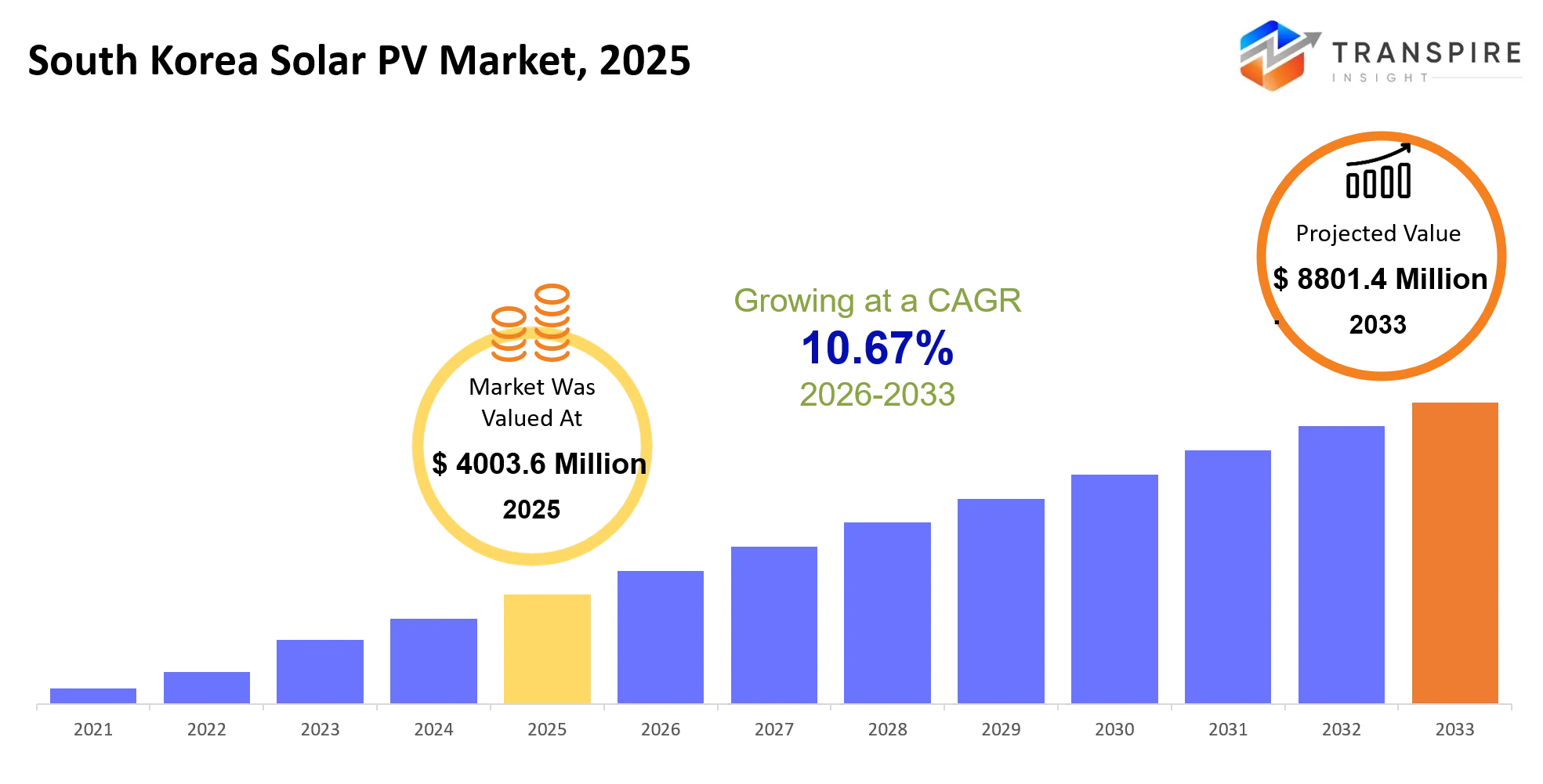
- Market Value (2025): USD 4003.6 Million.
- Expected Market Value (2026): USD 4326.25 Million.
- Estimated Market Value (2033): USD 8801.4 Million.
- Forecast CAGR (2026–2033): 10.67 %.
Introduction
The South Korea Solar PV Market represents the design, manufacturing, installation, and implementation of photovoltaic systems to produce renewable energy. It covers the production of solar products and components, engineering, procurement, and construction (EPC), and power generation processes. South Korea’s solar energy sector is driven by decarbonization goals, energy security considerations, renewable electricity purchasing by companies, and high-efficiency solar panels technology. Ground-mounted solar plants, roof-top, floating PV, and building integrated PV technologies facilitate market growth despite limitations on land availability. Innovations in technology, grid infrastructure, storage, and perovskite solar cells are other factors affecting the market environment in the country.
Key Market Highlights: -
- By Technology, theOverarching Crystalline Silicon (c-Si)dominated the market and holds approximately 84.6 % share in 2025 and is projected to grow at a substantial CAGR during the forecast period.
- By Installation, the GROUND-MOUNTED dominated the market and holds approximately 61.5 % share in 2025 and is projected to grow at a substantial CAGR during the forecast period.
- By Application, the Utility-scale Manufacturers segment dominated the market and holds approximately 72 % share in 2025 and is projected to grow at a substantial CAGR during the forecast period.
- The solar PV industry in South Korea is evolving as a result of renewables policies, installation of rooftop PV systems, community initiatives, floating photovoltaic technology, and innovation in solar technology.
How is Technology Driving Growth in the South Korea Solar PV Market?
The South Korea Solar PV Market is growing due to technology in the form of highly efficient photovoltaic modules, real-time monitoring, and effective integration with the power grid. Monocrystalline, bifacial, and the new generation of tandem solar modules offer improved energy conversion efficiency. Artificial intelligence for monitoring along with the Internet of Things (IoT) enables performance analysis, predictive maintenance, and optimization. Advanced smart inverters and battery energy storage systems are used to ensure grid stability and increased utilization of renewable sources of energy. Also, automation along with advanced manufacturing technologies improve the local production capacity of solar modules.
Market Drivers
The South Korea Solar PV Market is motivated by various factors like renewable energy policies, corporate commitments towards sustainability, and the increasing need for renewable electricity. Government policies and measures on the promotion of the use of renewable energy and solar power are contributing significantly to investment in PV power. The commitment towards the use of RE100 by corporations is making it possible for more manufacturers to embrace solar power in their activities in order to lower carbon footprint. Technology development in terms of higher efficiency PV modules, smart inverters, and energy storage systems enhances the performance of solar PV power plants. In addition, limited availability of land is promoting the use of roof-top PV, floating PV, and building integrated PV.
Restrain
Several restraining factors affect the South Korea Solar PV Market. These include insufficient land resources owing to mountains and densely populated regions, which make it difficult to create solar farms. Local zoning and setback rules may cause delays in approving projects. The use of imported solar parts makes investors vulnerable to potential disruptions in the supply chain and fluctuating prices. Moreover, there is the problem of congested grids and the inability to integrate renewables into the grid.
|
Driver |
Relative Impact on Market Growth (%) |
Geographic Relevance |
Impact Timeline |
Demand Strength |
Growth Mechanism |
Key Beneficiaries |
Major Constraint |
|
1. Government Renewable Energy Expansion and Auction-Based Procurement |
28% |
Nationwide; South Jeolla, South Gyeongsang, Jeju, and Chungcheong regions |
Short-term (≤2 years) |
High |
Competitive auctions and long-term contracts improve project revenue certainty. |
Solar developers, EPC contractors, module suppliers |
Grid connection delays and permitting bottlenecks constrain deployment. |
|
2. Corporate RE100 Commitments and Renewable Electricity Procurement |
24% |
Seoul Capital Area, Gyeonggi, Chungcheong, and major industrial clusters |
Medium-term (2–4 years) |
High |
Corporate PPAs and RE100 targets increase demand for solar electricity. |
Commercial rooftop developers, PPA providers, corporate energy buyers |
Limited renewable supply and high procurement costs restrict adoption. |
|
3. Rising Electricity Demand from AI Data Centers and Semiconductor Manufacturing |
19% |
Gyeonggi, Chungcheong, and industrial corridors near major data centers |
Medium-term (2–4 years) |
High |
Growing electricity consumption accelerates renewable capacity procurement. |
Utility-scale developers, energy investors, storage providers |
Interconnection capacity and renewable supply intermittency limit expansion. |
|
4. Distributed Solar Adoption and Rooftop Deployment |
16% |
Seoul, Gyeonggi, industrial complexes, and rural communities nationwide |
Short-term (≤2 years) |
High |
Rooftop installations and local generation expand distributed solar capacity. |
Rooftop installers, building owners, local communities |
Rooftop suitability, structural limitations, and complex permitting. |
|
5. High-Efficiency PV Technologies and Low-Carbon Domestic Manufacturing |
13% |
Chungcheong, Gyeonggi, and domestic PV manufacturing and industrial hubs |
Long-term (≥4 years) |
Medium |
High-efficiency modules and low-carbon production improve project competitiveness. |
PV manufacturers, technology vendors, project developers |
Higher production costs and global module price competition. |
|
Total |
100% |
— |
— |
— |
— |
— |
— |
Analysis of Prices and Consumer Behaviour
South Korea Solar PV Market features rising demand for premium solar modules that have high energy conversion efficiency and increased durability. The premium solar modules that use advanced cell technology are likely to fetch a premium price compared to the existing modules since they will feature high energy conversion efficiency and performance. Around 45% of the total installed solar PV systems are estimated to be comprised of rooftop and distributed solar PV systems that will benefit from corporate self-consumption and lack of space. Utility scale and commercial projects form a major part of the demand side. Efficiency, reliability, and long-term performance are important considerations for purchasing. Around 33% of the buyers are likely to prefer long-term procurement arrangements.
|
Company |
Est. Revenue Share Range |
Key Offerings |
Strategic Positioning |
Geographic Strength |
Technology Focus |
|
1. Hanwha Solutions – Qcells |
Estimated 20–35% |
PV cells and modules; solar systems; project development; EPC and energy solutions |
Domestic manufacturing scale with integrated solar solutions and premium positioning |
South Korea, North America, Europe |
High-efficiency silicon PV, tandem cells, integrated energy systems |
|
2. Hyundai Energy Solutions |
Estimated 5–15% |
Solar modules; rooftop PV systems; utility-scale PV solutions; project support |
Domestic module supplier targeting residential, commercial, and utility projects |
South Korea, Asia Pacific |
High-efficiency crystalline silicon modules, bifacial PV |
|
3. LONGi Green Energy Technology |
Estimated 5–15% |
Monocrystalline PV modules; high-efficiency solar cells; utility-scale modules; distributed PV products |
Cost-competitive global supplier leveraging manufacturing scale and product efficiency |
Asia Pacific, Europe, North America |
HPBC back-contact cells, high-efficiency monocrystalline silicon |
|
4. JinkoSolar |
Estimated 3–10% |
Tiger Neo modules; utility-scale PV modules; commercial rooftop modules; project supply |
Global volume supplier competing through product efficiency and price |
Asia Pacific, Europe, North America |
TOPCon cells, bifacial modules, high-power PV architectures |
|
5. Trina Solar |
Estimated 3–10% |
Vertex modules; utility-scale PV modules; distributed PV solutions; solar trackers |
Integrated PV supplier combining modules, project solutions, and system components |
Asia Pacific, Europe, North America |
TOPCon, bifacial modules, smart trackers |
|
6. OCI Holdings / OCI Power |
Estimated 2–8% |
Solar project development; PV power generation; solar-related materials and supply-chain solutions |
Domestic renewable energy platform with upstream supply-chain relationships |
South Korea, North America, Asia Pacific |
PV project integration, polysilicon supply-chain expertise |
|
7. LS ELECTRIC |
Estimated 2–7% |
Solar power conversion systems; electrical equipment; grid integration; energy management |
Electrical infrastructure specialist supporting PV plant integration and grid connectivity |
South Korea, Asia Pacific |
Power conversion, smart-grid systems, energy management |
|
8. S-Energy |
Estimated 1–5% |
PV modules; solar power systems; project development; operations and maintenance |
Domestic-focused solar specialist serving distributed and project-based demand |
South Korea, Asia Pacific |
Crystalline silicon modules, PV system engineering |
|
9. Shinsung E&G |
Estimated 1–5% |
Solar modules; PV systems; renewable energy project solutions; clean-energy equipment |
Domestic solar manufacturer with engineering and project capabilities |
South Korea, Asia Pacific |
High-efficiency PV modules, solar system integration |
|
10. Topsun |
Estimated 1–4% |
PV modules; solar power systems; project supply and installation |
Smaller-scale supplier competing through localized project execution and customer relationships |
South Korea, Asia Pacific |
Crystalline silicon PV modules, system deployment |
Who are the Key Players in the South Korea Solar PV Market and how do they compete?
In the South Korea Solar PV Market, competitiveness in the international market will depend on companies focused on innovation, industry-related solar solutions, and creating global distribution channels. Competing both by price and by durable equipment, advanced photovoltaic technologies, intelligent and connected solutions, as well as integration into digital platforms and energy systems allows companies to constantly develop their products while helping organizations to increase energy efficiency, resource efficiency, reliability, and visibility of operations.
Hanwha Qcells creates its competitive advantage by producing energy-efficient solar modules, advanced photovoltaic technologies, and integrated solar energy solutions. LG Electronics creates its competitive advantage by producing energy-efficient solar technologies, smart energy management solutions, and integrated renewable energy solutions. Hyundai Energy Solutions creates its competitive advantage by producing high-performance solar modules, photovoltaic solutions, and renewable energy solutions.
Top Companies in the South Korea Solar PV Market
- Hanwha Qcells
- LG Electronics
- Hyundai Energy Solutions
- OCI Holdings
- LS Electric
- HD Hyundai Energy Solutions
- Samsung SDI
- Sungrow
- LONGi
- JA Solar
- Trina Solar
- JinkoSolar
- Canadian Solar
- First Solar
- Enel Green Power
South Korea Solar PV Market Segmentation
The South Korea Solar PV Market share is divided into five categories: By Technology, By Installation, By Application, By Component, By End User.
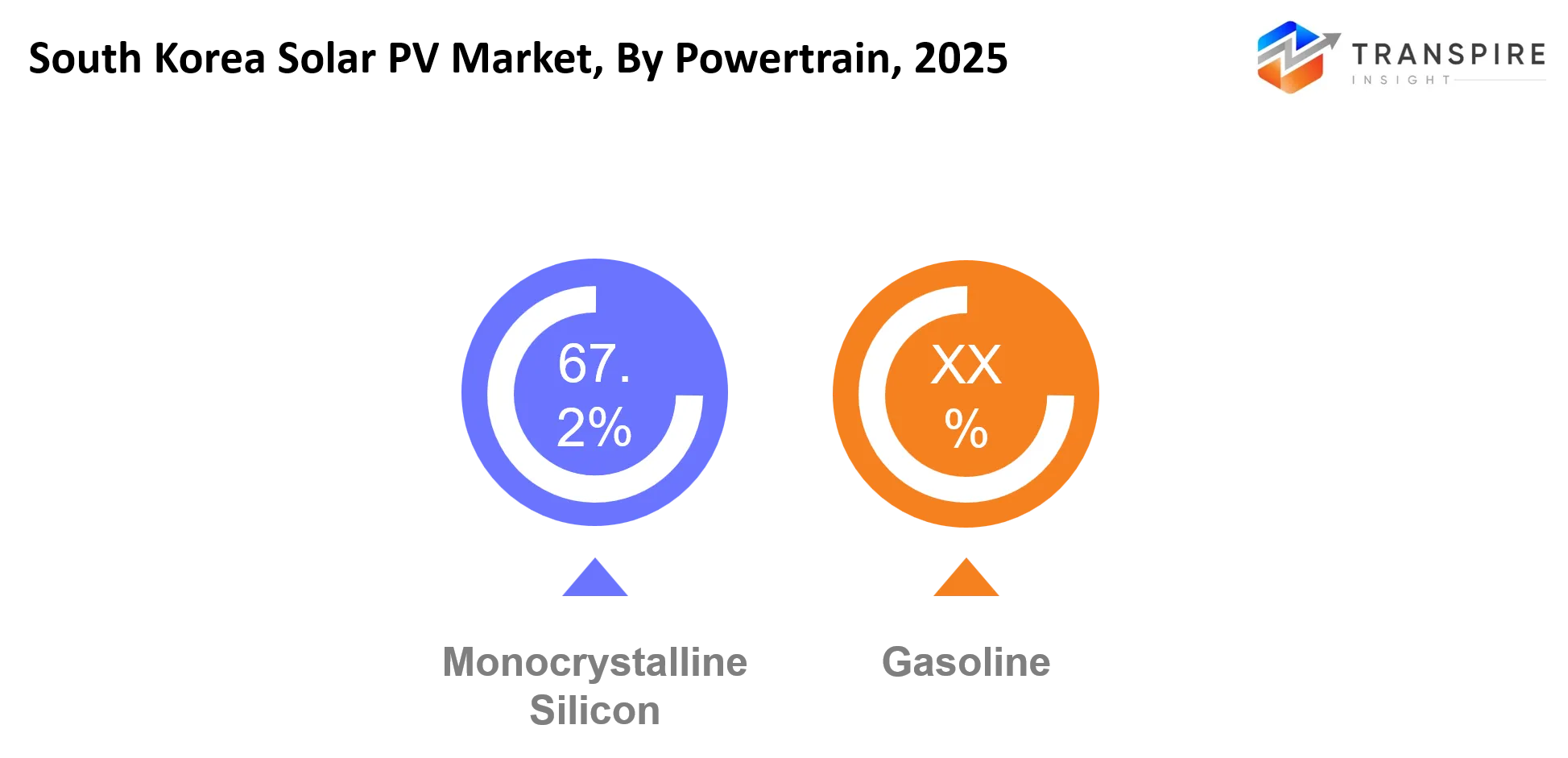
The Overarching Crystalline Silicon (c-Si) dominated the market, accounting for nearly 84.6% in 2025 and is expected to rise at a significant CAGR during the forecast period.
The South Korea Solar PV Market is segmented by technology into monocrystalline silicon, polycrystalline silicon, thin film, perc, topcon, hjt, ibc, perovskite, tandem solar cells, others. Among these, theOverarching Crystalline Silicon (c-Si)segment dominated the market, accounting for nearly 84.6% in 2025 and expected to increase at a significant CAGR during the forecast period. The South Korea Solar PV Market is dominated by Crystalline Silicon (c-Si) owing to its efficiency, longevity, cost-effectiveness, and existing photovoltaic manufacturing base.
The Ground-Mounted dominated the market, accounting for nearly 61.5% in 2025, and is expected to rise at a significant CAGR during the forecast period.
The South Korea Solar PV Market is segmented by installation into ground-mounted, rooftop, floating solar, building-integrated pv, utility-scale, community solar, carport solar, others. Among these, the GROUND-MOUNTED dominated the market, accounting for nearly 61.5% in 2025 and expected to increase at a significant CAGR during the forecast period. Ground-Mounted installations dominate the South Korea Solar PV Market with backing from large-scale project deployment, utility applications, and efficient use of land area for power generation.
The Utility-scale dominated the market, accounting for nearly 72% in 2025 and is expected to rise at a significant CAGR during the forecast period.
The South Korea Solar PV Market is segmentedby application into residential, commercial, industrial, utility, agricultural, government, off-grid, others. Among these, the Utility-scale dominated the market, accounting for nearly 72% in 2025 and expected to increase at a significant CAGR during the forecast period. Utility-Scale solar PV systems dominate the South Korea Solar PV Market owing to large capacity renewable energy projects and grid-based power generation.
Future Market Trends for the South Korea Solar PV Market: -
Expansion of Solar Capacity: South Korea’s 11th Basic Plan will add up to 55.7 GW of solar capacity in 2030 and 77.2 GW in 2038. This will help in the market's future growth.
Advanced Photovoltaic Technologies: The adoption of high-efficiency mono-crystalline and bi-facial modules is contributing to enhanced yield efficiency due to limited availability of lands in optimizing solar power generation.
Solar and Energy Storage: The integration of solar PV systems with energy storage system and smart inverters is becoming increasingly crucial.
Recent Development
In August 7, 2026: The launch of the 400 MW Haenam solar complex signaled a move toward increasing utility-scale capacity in the South Korea Solar PV Market, with the project scheduled for completion in 2028.
In August 12, 2026: Shinsung E&G launched 350 MW PV module production line, enhancing local manufacturing capacity and fostering supply-chain development in South Korea Solar PV Market.
In September 11, 2026: South Korea accelerated the launch of a solar industry competitiveness committee, with the goal of strengthening local supply chains and improving the long-term resilience of the South Korea solar PV market.
Market Segmentation
This study forecasts revenue at Japan, regional and country levels from 2020 to 2033. Transpire Insights has segmented the South Korea Solar PV Market based on the below-mentioned segments:
South Korea Solar PV Market, By Technology
- Monocrystalline Silicon
- Polycrystalline Silicon
- Thin Film
- PERC
- TOPCon
- HJT
- IBC
- Perovskite
- Tandem Solar Cells
- Others
South Korea Solar PV Market, By Installation
- Ground-Mounted
- Rooftop
- Floating Solar
- Building-Integrated PV
- Utility-Scale
- Community Solar
- Carport Solar
- Others
South Korea Solar PV Market, By Application
- Residential
- Commercial
- Industrial
- Utility
- Agricultural
- Government
- Off-Grid
- Others
South Korea Solar PV Market, By Component
- Solar Modules
- Inverters
- Mounting Systems
- Batteries
- Trackers
- Cables
- Monitoring Systems
- Others
South Korea Solar PV Market, By End User
- Households
- Commercial Buildings
- Industrial Facilities
- Utilities
- Government Agencies
- Solar Developers
- Agricultural Operators
- Others
Frequently Asked Questions
Find quick answers to common questions.
The market is projected to grow significantly through 2033, driven by renewable energy policies, corporate sustainability commitments, and technological advancements.
Crystalline silicon dominates, accounting for approximately 84.6% of the market in 2025, supported by efficiency, durability, and cost-effectiveness.
Ground-mounted installations lead with approximately 61.5% market share in 2025, supported by large-scale projects and utility-driven solar deployment.
Renewable energy policies, corporate RE100 commitments, rising electricity demand, and advances in photovoltaic technologies are supporting market growth.
Key trends include high-efficiency modules, expanded solar capacity, smart inverters, and integration of photovoltaic systems with energy storage.
- Hanwha Qcells
- LG Electronics
- Hyundai Energy Solutions
- OCI Holdings
- LS Electric
- HD Hyundai Energy Solutions
- Samsung SDI
- Sungrow
- LONGi
- JA Solar
- Trina Solar
- JinkoSolar
- Canadian Solar
- First Solar
- Enel Green Power
About the Authors

Avinash Kumar
I’m Avinash Kumar, a Senior Research Analyst at Transpire Insight, with expertise in the Electronics and Semiconductor and Energy & Power industry. My work focuses on analyzing emerging technologies, market trends, industry developments, and innovation across these sectors. I specialize in transforming complex technical and market insights into clear, research-backed content that helps professionals, businesses, and decision-makers stay informed. Through continuous industry research and data-driven analysis, I strive to deliver accurate, reliable, and practical perspectives on the latest advancements shaping the semiconductor and energy landscape.

Chakradhar Khansole
Chakradhar serves as the Research Director at Transpire Insight, bringing over 8 years of experience in technology, innovation, and strategic market intelligence. He specializes in transforming complex market data into actionable business insights that enable organizations to make informed, growth-oriented decisions. Recognized for his strategic vision and analytical expertise, Chakradhar leads high-impact research initiatives, delivering comprehensive market assessments, competitive intelligence, and forward-looking industry analysis.
Recently Published Reports
-
Apr 2026
Active Power Filter Market
Active Power Filter Market Size, Share & Analysis Report By Type (Shunt Active Power Filters, Series Active Power Filter, Hybrid Active Power Filter), By Application (Harmonics Mitigation, Reactive Power Compensation, Voltage Regulation, Power Factor Correction), By Phase (Single Phase, Three Phase), By End-User Industry (Manufacturing, Healthcare, Commercial, Automotive, Oil and Gas, Others), and Geography (North America, Europe, Asia-Pacific, Middle East and Africa, South and Central America), 2021 - 2031
-
Apr 2026
Electrical Transformer Market
Electrical Transformer Market Size, Share & Analysis Report By Core (Closed, Shell, and Berry), By Insulation (Gas, Oil, Solid, Air, and Other), By Phase (Single, and Three), By Rating (100 MVA to 500 MVA, 501 MVA to 800 MVA, and 801 MVA to 1200 MVA), and Geography (North America, Europe, Asia-Pacific, Middle East and Africa, South and Central America), 2021 – 2031
-
Apr 2026
Hydraulic Piston Pumps Market
Hydraulic Piston Pumps Market Size, Share & Analysis Report By Type (Axial Piston Pumps, Radial Piston Pumps), By Operating Pressure (Low Pressure, Medium Pressure, High Pressure), By Application (Construction, Mining, Agriculture, Automotive, Oil & Gas, Industrial Machinery, Others), By End-User (OEMs, Aftermarket), and Geography (North America, Europe, Asia-Pacific, Middle East and Africa, South and Central America), 2021 – 2031
-
Apr 2026
Laboratory Gas Generators Market
Laboratory Gas Generators Market Size, Share & Analysis Report By Product (Nitrogen Gas Generator, Hydrogen Gas Generator, Zero Air Gas Generator, Purge Gas Generator, TOC Gas Generators, Others), By Application (Gas Chromatography, Liquid Chromatography-mass Spectrometry (LC-MS), Gas Analyzers, Others), By End-user (Life Science, Chemical & Petrochemical, Food & Beverage, Others), and Geography (North America, Europe, Asia-Pacific, Middle East and Africa, South and Central America), 2021 – 2031