
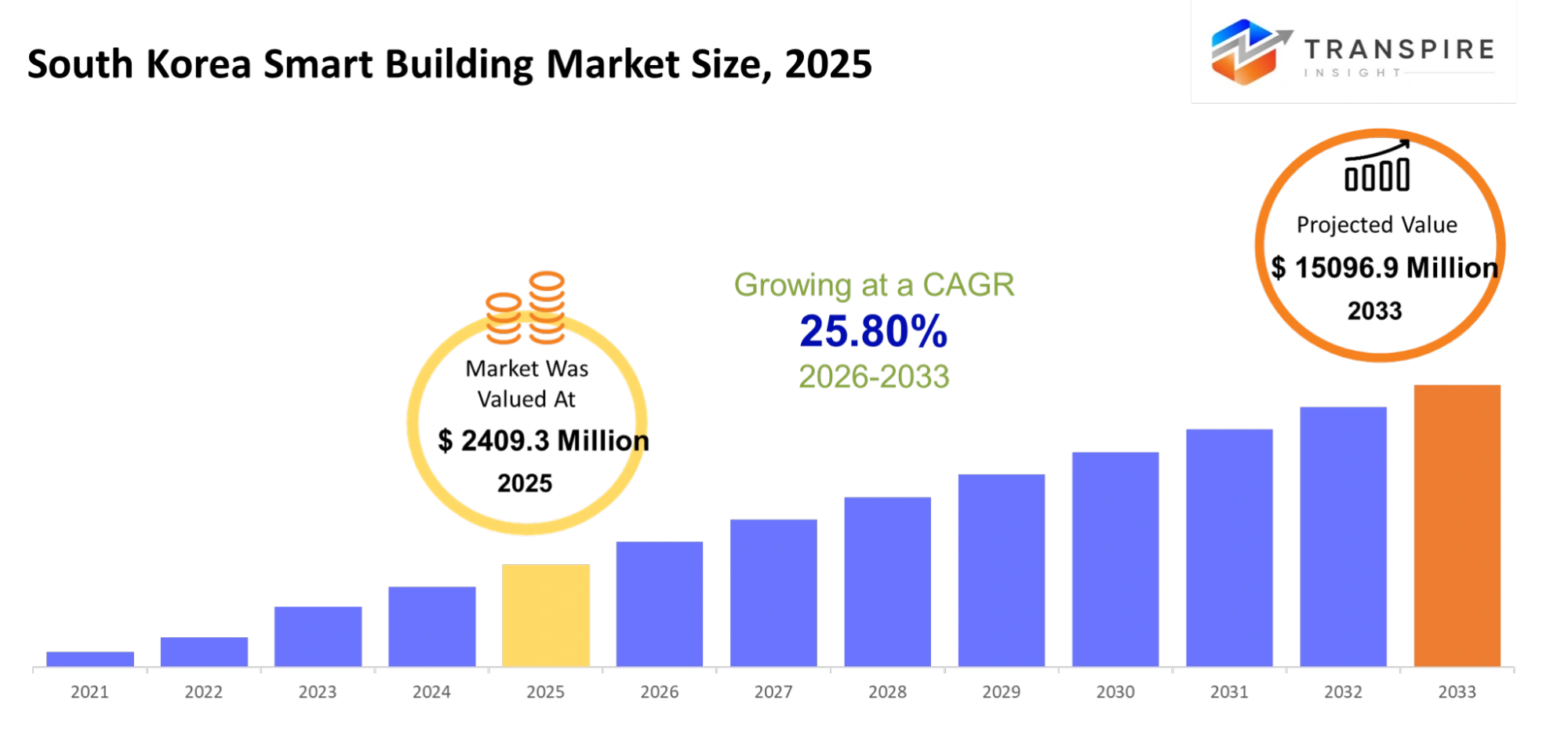
South Korea Smart Building Market Size & Forecast:
- South Korea Smart Building Market Size 2025: USD 2409.3 Million
- South Korea Smart Building Market Size 2033: USD 15096.9 Million
- South Korea Smart Building Market CAGR: 25.80%
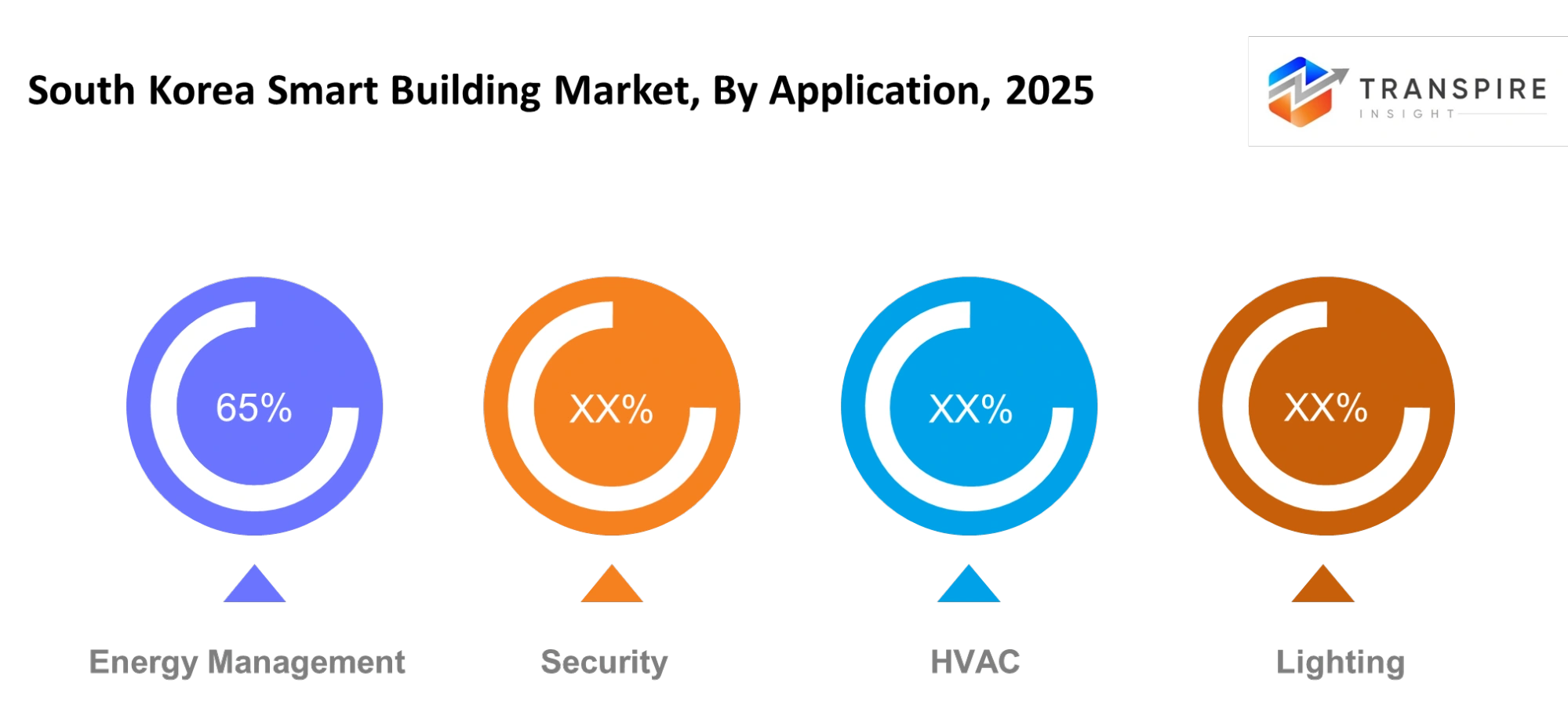
- South Korea Smart Building Market Segments: By Component (Hardware, Software, Services, Platforms), By Application (Energy Management, Security, HVAC, Lighting), By End-User (Commercial Buildings, Residential, Industrial, Government)
To learn more about this report,  Download Free Sample Report
South Korea Smart Building Market Summary:
South Korea Smart Building Market size was estimated at USD 2409.3 Millionin 2025 and is anticipated to reach USD 15096.9 Million by 2033, growing at a CAGR of 25.80% from 2026 to 2033.
The smart building market in South Korea will serve as a point where construction work meets digital infrastructure development, which will enable property developers and telecom companies and software developers to determine urban space operations. The industry will evolve from its current state of basic automation to establish complete systems that enable real-time monitoring of three operational areas: energy consumption, safety measures, and user comfort. Residents will drive demand because they want buildings to predict their daily requirements, which includes both air quality control and customized lighting solutions that deliver effortless convenience.
Future sensor development and edge computing progress and AI-based platform advancements will enhance building systems abilities to detect human activity, while South Korean government regulations will maintain their support for energy optimization and carbon footprint reduction initiatives. The current environment creates a demand for building upgrades of existing structures which competes with new building projects. The south korea smart building market will shift because people now expect companies to provide complete information about their data practices, which requires developers to create intelligent systems that users can trust while delivering new experiences in residential and business environments.
Key Market Trends & Insights:
- The South Korean Smart Building Market shows ongoing development through its adoption of unified systems which manage illumination, safety measures, and temperature control through a single operational platform. The property developers will work to create systems which enable users to operate their buildings with less human involvement. The systems will enable better control of building operations while decreasing the need for ongoing upkeep throughout commercial and residential establishments.
- Building owners will treat energy conservation as an essential requirement which will drive expansion of the South Korean Smart Building Market. The combination of smart sensors and automated controls will decrease electricity usage while maintaining user comfort. The government will establish efficiency targets which will drive system adoption because people will consider their actual energy consumption and operational patterns.
- The South Korean Smart Building Market will experience growth through the increasing adoption of connected devices which gather and distribute live operational data. Building managers can use these devices to identify system problems and make necessary improvements to their operations. The building operations will achieve better reliability through continuous data transmission which enables predictive maintenance to operate and decrease equipment failure time.
- The South Korean Smart Building Market will experience growth because people now demand customized spaces for their professional and residential areas. The automated temperature control system works together with lighting control and air quality monitoring to establish improved conditions for both work and home environments. Builders will fulfill this demand by integrating intelligent technologies which enhance user comfort while maintaining building operational efficiency.
- The South Korea Smart Building Market will experience high demand for advanced safety solutions which include access control systems and real-time surveillance capabilities. Smart security systems will enhance security through their ability to deliver immediate notifications and enable remote system observation. Building owners will invest in such solutions to ensure safety while also improving response time during emergencies."
South Korea Smart Building Market Segmentation
By Component :
- Hardware: The hardware components of South Korea Smart Building Market include sensors, controllers, cameras and connected devices which work together to automate building operations. The need for real-time monitoring and control systems has resulted in strong market adoption. The increasing establishment of modern infrastructure projects enables cities to install new technologies which will boost their operational efficiency and safety standards and building performance throughout their urban areas.
- Software: The software component of South Korea Smart Building Market provides management systems which analyze device data to generate practical business recommendations. The solutions enable organizations to manage their operations through two main functions which include energy consumption management and security operations. Organizations will need intelligent building platforms to improve their decision-making capabilities because they will face challenges from digital transformation initiatives.
- Services: The South Korea Smart Building Market provides services which include system installation and maintenance and consulting and system integration work. Service providers maintain smart systems through their essential functions which ensure those systems operate correctly. Building owners will demand more service support because they need technical expertise to maintain their integrated technologies under proper operation conditions.
- Platforms: The South Korea Smart Building Market platforms serve as centralized systems which enable different hardware and software elements to work together. The platforms allow building systems to share data while maintaining complete operational control. The need for interoperability will increase platform adoption because building systems will operate more efficiently through integrated platforms which help streamline their processes.
By Application :
- Energy Management: The South Korea Smart Building Market uses energy management systems to achieve energy efficiency through their systems which track energy use and implement automatic control systems. The smart systems enable companies to cut waste while they spend less on operations. The rise of energy issues together with sustainability targets will drive organizations to implement efficient management systems which enable them to monitor their electricity consumption and environmental effects.
- Security: The South Korea Smart Building Market security applications provide surveillance systems together with access control systems and alarm systems. The demand for security solutions will increase because of rising public safety concerns. The building security system will use smart technology to improve its ability to identify threats and respond to them which results in better protection for people and their property inside buildings.
- HVAC: The South Korea Smart Building Market uses HVAC systems to handle their automated systems which control heating and ventilation and air conditioning functions. The systems create comfortable indoor spaces while they decrease energy usage. The growing need for energy-efficient solutions will drive the market which requires smart HVAC systems to create optimal conditions using fewer resources.
- Lighting: The South Korea Smart Building Market uses automated systems together with sensor-based systems for their lighting applications. The systems adjust brightness based on occupancy and natural light availability. The rising demand for energy-efficient solutions will drive the establishment of intelligent lighting systems which provide users with convenience while reducing their electricity usage.
To learn more about this report, Download Free Sample Report
By End-User :
- Commercial Buildings: South Korea Smart Building Market commercial buildings segment includes offices, retail spaces, and hotels. The need for operational efficiency together with better user experience drives the market for smart building solutions. Companies will spend money on smart technologies which will help them decrease expenses while boosting their ability to deliver sustainable business operations through intelligent building management systems.
- Residential: South Korea Smart Building Market residential segment covers smart homes and apartment complexes. The market experiences growth because people want to have more comfortable and convenient and secure environments. Homeowners will adopt smart technologies that simplify daily activities and improve energy efficiency, leading to increased penetration in urban housing developments.
- Industrial: South Korea Smart Building Market industrial segment includes factories and warehouses where automation improves efficiency. Smart systems help monitor operations and manage resources effectively. Industrial facilities will adopt modern technologies because they want to boost productivity through smart building solutions which decrease operational hazards.
- Government: South Korea Smart Building Market government segment includes public infrastructure such as offices, hospitals, and educational institutions. Authorities will focus on energy efficiency and smart city initiatives. Advanced systems will enhance service delivery while decreasing operational costs which will lead to widespread adoption of public sector building solutions.
Country Insights
- The Smart Building Market in South Korea demonstrates consistent development because of its advanced digital systems and its extensive urban development. The government-operated smart city initiatives in Seoul and Busan have promoted the adoption of smart technologies for both commercial and residential buildings. The extensive 5G network system together with its advanced connectivity features enables users to monitor systems in real time while applying automated processes that enhance energy efficiency and building performance. The growing public understanding of sustainability has motivated property developers to make smart technology investments for their new construction projects which require energy-efficient systems and automated management functions.
- The Smart Building Market in South Korea keeps growing because major technology companies maintain their presence while they invest in automated building systems and artificial intelligence and Internet of Things technologies. The partnership between construction companies and technology vendors has produced better building designs which provide enhanced safety and improved user comfort and increased operational productivity. Urban areas with restricted space are turning to modernize existing buildings through smart system installations instead of constructing new facilities. The demand for better resource management and enhanced user experience has driven corporate offices and healthcare facilities and educational institutions to adopt these systems.
- The Smart Building Market in South Korea gets affected by two factors which include environmental regulations and energy standards that mandate decreased carbon emissions and better energy management. Modern infrastructure projects now include smart lighting and climate control systems and security solutions as their standard components. Building owners are now funding waste reduction projects because of rising energy costs which help them achieve better operational results. Local authorities continue to promote green building certifications, which support long-term growth of smart infrastructure. The implementation of digital technologies will ensure that smart building solutions become essential components of urban planning and sustainable development in South Korea.
Recent Development News
Hyundai’s “AI City” Vision Integrating Smart Buildings
February 2026, Hyundai Motor Group revealed plans for a multi-billion-dollar “hydrogen and AI city” in Saemangeum. The project includes AI data centers, robotics, and smart infrastructure, which are key components of next-generation intelligent buildings and urban systems.
Busan Eco Delta Smart City Driving Smart Building Innovation
January 2026, Busan’s Eco Delta Smart City continues to gain global attention for combining advanced architecture with digital technologies, including energy-efficient buildings, IoT integration, and smart living environments.
|
Report Metrics |
Details |
|
Market size value in 2025 |
USD 2409.3 Million |
|
Market size value in 2026 |
USD 3028.6 Million |
|
Revenue forecast in 2033 |
USD 15096.9 Million |
|
Growth rate |
CAGR of 25.80% from 2026 to 2033 |
|
Base year |
2025 |
|
Historical data |
2021 - 2024 |
|
Forecast period |
2026 - 2033 |
|
Report coverage |
Revenue forecast, competitive landscape, growth factors, and trends |
|
Country scope |
South Korea |
|
Key company profiled |
Samsung, LG Electronics, Siemens, Schneider Electric, Honeywell, Johnson Controls, ABB, Bosch, Cisco, IBM, Hitachi, Mitsubishi Electric, Delta Electronics, Legrand, Huawei |
|
Customization scope |
Free report customization (country, regional & segment scope). Avail customized purchase options to meet your exact research needs. |
|
Report Segmentation |
By Component (Hardware, Software, Services, Platforms), By Application (Energy Management, Security, HVAC, Lighting), By End-User (Commercial Buildings, Residential, Industrial, Government) |
Key South Korea Smart Building Company Insights
- The South Korea Smart Building market shows strong participation from technology-driven firms that focus on automation, energy management, and digital infrastructure. The companies achieve building efficiency improvements through their use of integrated systems which connect three core components: lighting, security, and climate control. The organization will achieve advanced solutions together with ongoing business expansion through its dedication to research investment.
- The South Korea Smart Building market requires market players to establish partnerships with construction firms and software providers so they can create complete market solutions. The team maintains primary objectives which include achieving user comfort and environmental sustainability while reducing operational expenses. The companies will improve their operations through smart sensor technologies and cloud-based systems which deliver better control mechanisms and enhance system performance while providing ongoing benefits throughout their operational lifespan.
South Korea Smart Building Market Companies:
- Samsung
- LG Electronics
- Siemens
- Schneider Electric
- Honeywell
- Johnson Controls
- ABB
- Bosch
- Cisco
- IBM
- Hitachi
- Mitsubishi Electric
- Delta Electronics
- Legrand
- Huawei
South Korea Smart Building Market Segmentation
By Component
- Hardware
- Software
- Services
- Platforms
By Application
- Energy Management
- Security
- HVAC
- Lighting
By End-User
- Commercial Buildings
- Residential
- Industrial
- Government
Frequently Asked Questions
Find quick answers to common questions.
The approximate South Korea Smart Building Market size for the market will be USD 15096.9 Million in 2033.
Key segments for the South Korea Smart Building Market are By Component (Hardware, Software, Services, Platforms), By Application (Energy Management, Security, HVAC, Lighting), By End-User (Commercial Buildings, Residential, Industrial, Government).
Major South Korea Smart Building Market players are Samsung, LG Electronics, Siemens, Schneider Electric, Honeywell, Johnson Controls, ABB, Bosch, Cisco, IBM, Hitachi, Mitsubishi Electric, Delta Electronics, Legrand, Huawei.
The South Korea Smart Building Market size is USD 2409.3 Million in 2025.
What is the CAGR in the South Korea Smart Building Market?
- Samsung
- LG Electronics
- Siemens
- Schneider Electric
- Honeywell
- Johnson Controls
- ABB
- Bosch
- Cisco
- IBM
- Hitachi
- Mitsubishi Electric
- Delta Electronics
- Legrand
- Huawei
Recently Published Reports
-
Apr 2026
3D Optical Profiler Market
3D Optical Profiler Market Size, Share & Analysis Report By Type (Desktop 3D Optical Profiler, and Portable 3D Optical Profiler), By Technology (Confocal Technology, and White Light Interference), By End-Use Industry (Manufacturing, Research Institutions, Automotive, Aerospace and Defense, Medical Devices, and Other), and Geography (North America, Europe, Asia-Pacific, Middle East and Africa, South and Central America), 2021 - 2031
-
Apr 2026
Depth Sensor Market
Depth Sensor Market Size, Share & Analysis Report By Type (Infrared Depth Sensors, Time-of-Flight (ToF) Sensors, Stereo Vision Sensors, Structured Light Sensors, Ultrasonic Depth Sensors), By Application (Automotive, Robotics, Gaming, Consumer Electronics, Industrial Automation, Healthcare, Security & Surveillance, Others), By End Users (Automotive Manufacturers, Consumer Electronics Companies, Healthcare Providers, Industrial Companies, Security Agencies, Gaming Companies, Robotics Companies, Others), and Geography (North America, Europe, Asia-Pacific, Middle East and Africa, South and Central America), 2021 – 2031
-
Apr 2026
Digital Manufacturing Market
Digital Manufacturing Market Size, Share & Analysis Report By Component (Hardware, Software, and Services), By Technology (Robotics, 3D Printing, Internet of Things (IoT), and Others), By Application (Automotive and Transportation, Aerospace and Defense, Consumer Electronics, Industrial Machinery, and Others), By Process Type (Computer-Based Designing, Computer-Based Simulation, Computer 3D Visualization, Analytics, and Others), and Geography (North America, Europe, Asia-Pacific, Middle East and Africa, South and Central America), 2021 – 2031
-
Apr 2026
Digital Visa Services Market
Digital Visa Services Market Size, Share & Analysis Report By Type (Individual Travelers, Group Travelers), By Application (Tourism, Business Travel, Others), and Geography (North America, Europe, Asia-Pacific, Middle East and Africa, South and Central America), 2021 – 2031