
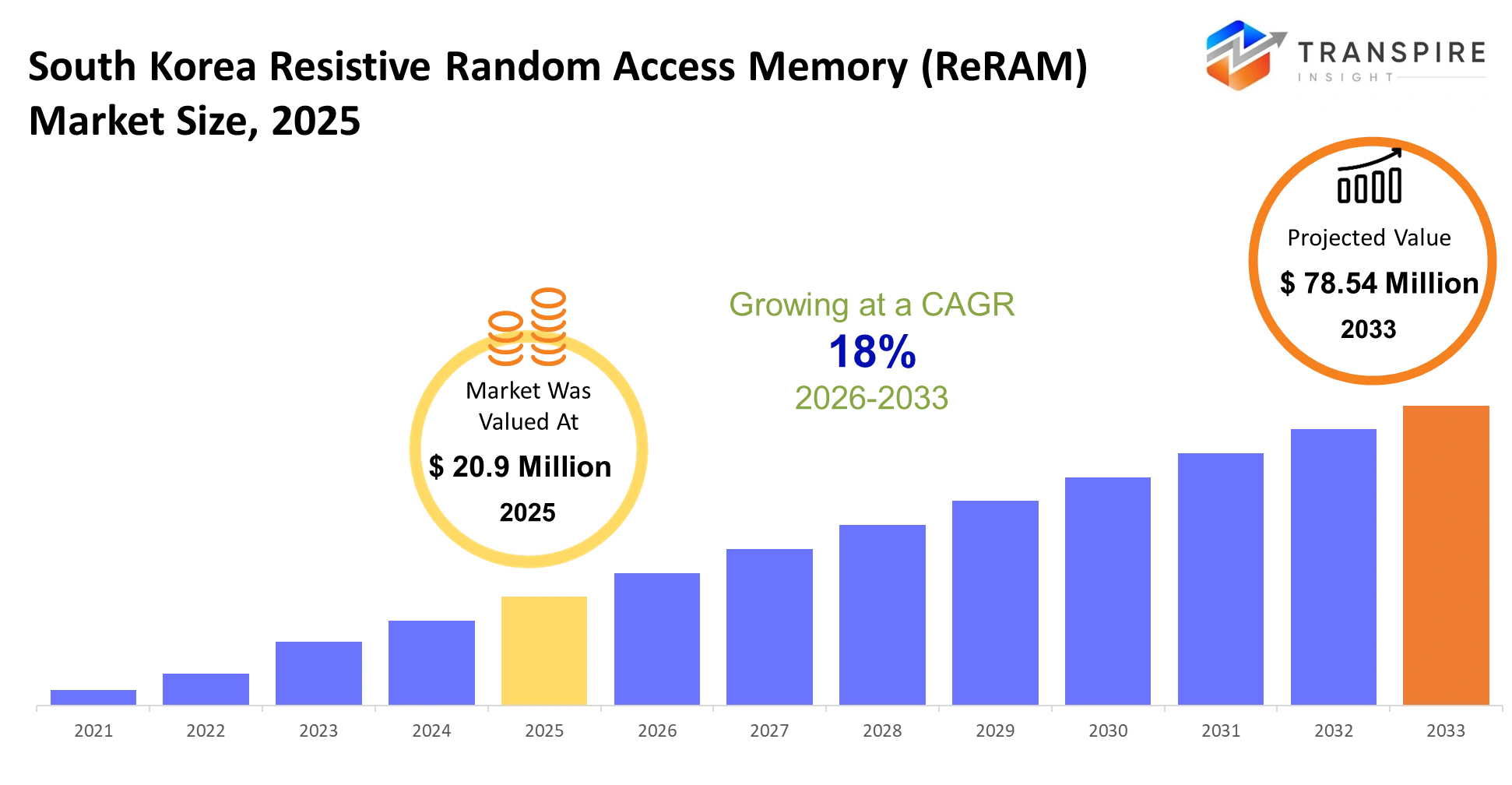
South Korea Resistive Random Access Memory (ReRAM) Market Size & Forecast:
- South Korea Resistive Random Access Memory (ReRAM) Market Size 2025: USD 20.9 Million
- South Korea Resistive Random Access Memory (ReRAM) Market Size 2033: USD 78.54 Million
- South Korea Resistive Random Access Memory (ReRAM) Market CAGR: 18%
- South Korea Resistive Random Access Memory (ReRAM) Market Segments: By Type (Standalone ReRAM, Embedded ReRAM), By Application (Consumer Electronics, Industrial, Automotive, IT & Telecom), By End-User (Electronics Manufacturers, Automotive Industry)
To learn more about this report,  Download Free Sample Report
South Korea Resistive Random Access Memory (ReRAM) Market Summary:
South Korea Resistive Random Access Memory (ReRAM) Market size was estimated at USD 20.9 Millionin 2025 and is anticipated to reach USD 78.54 Million by 2033, growing at a CAGR of 18% from 2026 to 2033.
The South Korea Resistive Random Access Memory (ReRAM) Market will emerge as a specialized sector which semiconductor manufacturers and advanced memory producers create through their engineering work and their changing needs. The market will reflect a steady move toward compact, energy-efficient memory suited for artificial intelligence hardware, automotive electronics, and edge devices. Companies will need to develop switching materials which achieve faster data processing and reduced energy consumption because consumer demand requires these technological advancements.
Technological progress will continue to reshape fabrication methods, with South Korean firms aligning closely with next-generation chip design standards. The development of memory solutions will depend on data security regulations and energy consumption regulations which shape the design process and implementation methods. The market will develop specialized applications which replace mass adoption as device ecosystems grow, thus establishing an environment which focuses on specific technological advancements and systematic integration into existing semiconductor supply chains.
Key Market Trends & Insights:
- The South Korea Resistive Random Access Memory (ReRAM) market experiences steady development because artificial intelligence and edge computing technologies require increased data storage capacity. The growing number of connected devices requires manufacturers to develop high-speed energy-efficient memory solutions which they need for their advanced storage systems.
- The South Korea Resistive Random Access Memory (ReRAM) market displays strong demand for technologies that consume less energy. ReRAM provides lower power consumption compared to conventional memory systems which makes it appropriate for use in portable electronic devices and smart technology. The ongoing industrial push for better energy efficiency drives the implementation of these memory solutions.
- Modern electronic systems increasingly use South Korea Resistive Random Access Memory (ReRAM) technology which benefits the market. ReRAM technology is being investigated by smartphone manufacturers and wearable device makers and embedded system developers. The technology enables designers to create lightweight and energy-efficient products because of its small size and rapid switching abilities which bring better design possibilities.
- South Korea Resistive Random Access Memory (ReRAM) Market gains momentum through consistent research efforts by technology firms and academic institutions. Researchers have obtained funding to create stable scalable ReRAM structures which will enhance their operational capacity and market potential. Research organizations and industrial partners work together to establish stronger technological advancement pathways.
- The ReRAM market of South Korea faces certain restrictions which emerge from its two main challenges of enduring performance and industrial production capacity. The technology needs additional development to solve issues related both to resistance state fluctuations and to its endurance capabilities. The solution of these problems will establish a vital foundation which enables extended commercial use and adoption throughout important industrial sectors.
South Korea Resistive Random Access Memory (ReRAM) Market Segmentation
By Type :
- Standalone ReRAM: Standalone ReRAM within the South Korea Resistive Random Access Memory (ReRAM) Market will represent independent memory units designed for high-speed data storage without integration into processing chips. The demand will increase because the technology provides both low power consumption and fast switching abilities. Adoption will increase for devices that need dedicated memory to maintain efficient operations while ensuring data reliability.
- Embedded ReRAM: The South Korea Resistive Random Access Memory (ReRAM) Market will use Embedded ReRAM to create embedded systems for both microcontrollers and system-on-chip designs. The market will expand because demand for compact devices needs processing efficiency improvements. Industries will choose embedded solutions because they require less space and deliver superior energy performance which enables advanced electronics and smart system development across multiple applications.
By Application :
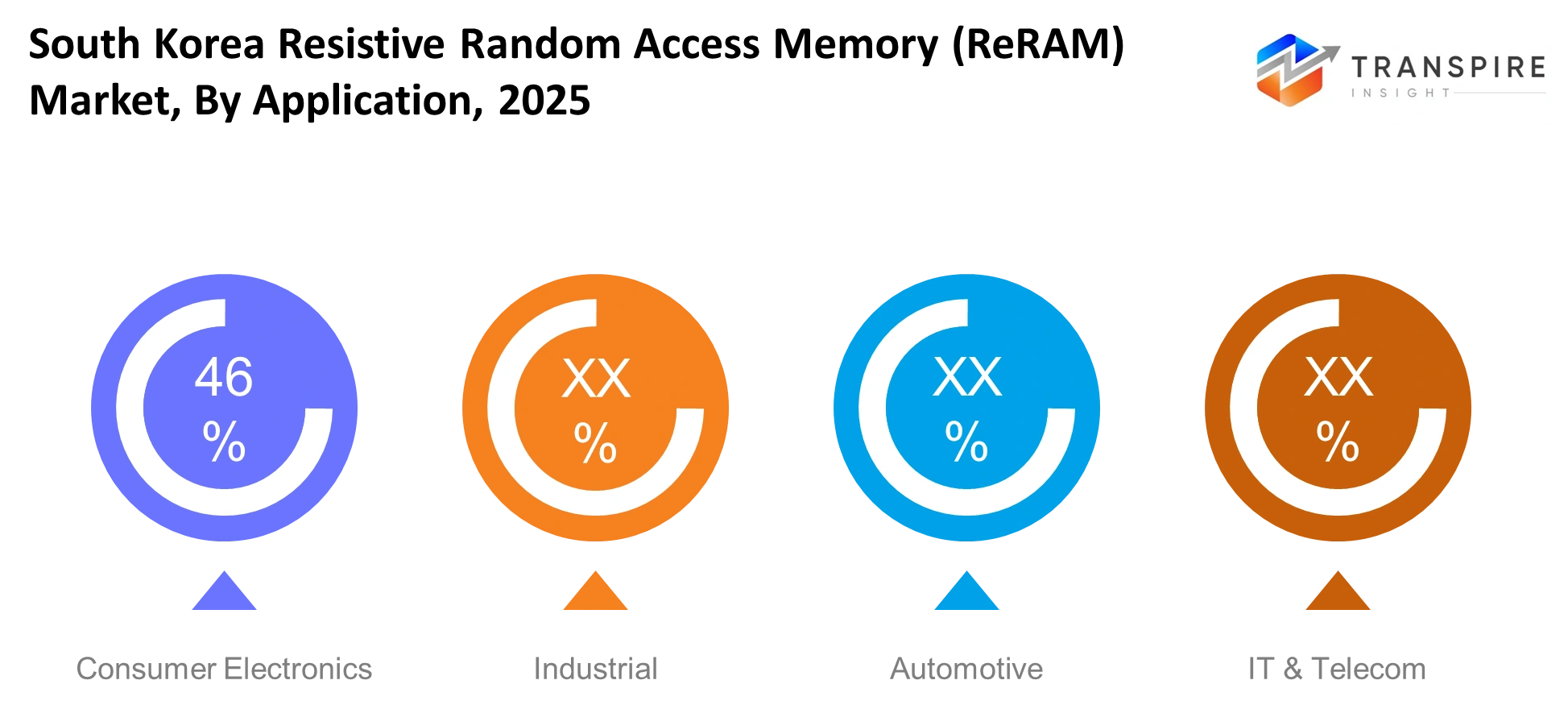
- Consumer Electronics: The South Korean market for Resistive Random Access Memory (ReRAM) will experience growth in consumer electronics usage because of increased demand for smartphones and wearables and smart home devices. The system will deliver better user experience because it provides quicker data retrieval and consumes less power. Electronics manufacturers will use ReRAM technology to create devices which respond faster and store data more efficiently and last longer during regular use.
- Industrial: The South Korean market for Resistive Random Access Memory (ReRAM) will experience industrial application growth because companies adopt more automated technologies and smart manufacturing methods. Machine operations and system monitoring depend on reliable data storage which functions under extreme environmental conditions. ReRAM technology will increase system stability because it decreases system downtime while enabling industrial systems to process data in real time.
- Automotive: The South Korean market for Resistive Random Access Memory (ReRAM) in automotive applications will grow because of connected vehicle development and autonomous vehicle development. High-speed memory performance will support advanced driver assistance systems and in-vehicle computing. ReRAM delivers automotive electronics with durability and efficiency which enables operation under different environmental conditions.
- IT & Telecom: The South Korean market for Resistive Random Access Memory (ReRAM) in IT and telecom will grow because users need faster data processing and better network performance. Data centers and communication systems will benefit from low latency and high endurance memory solutions. ReRAM technology will enhance cloud services, networking infrastructure, and data-intensive operations performance.
To learn more about this report, Download Free Sample Report
By End-User :
- Electronics Manufacturers: The South Korea Resistive Random Access Memory (ReRAM) Market will see electronics manufacturers adopt superior memory technologies to enhance their product performance while decreasing their power usage. The ReRAM technology will enable the development of more efficient devices that deliver high-speed and small-size performance capabilities. The continuous need for better electronic devices will lead manufacturers to develop more effective memory solutions.
- Automotive Industry: The South Korea Resistive Random Access Memory (ReRAM) Market will see automotive industry growth because of increasing electronic system usage in vehicles. The automotive industry needs memory solutions that offer high endurance and stability to ensure vehicle safety and performance operation. The adoption of ReRAM technology will help automotive designers create modern vehicles that meet changing technological requirements.
Country Insights
- The South Korean Resistive Random Access Memory market experiences continuous development because of its semiconductor production capabilities and government-supported research initiatives. The progress of memory technology depends on the combination of advanced manufacturing facilities and ongoing investment in memory research activities. Domestic technology companies develop their production operations and future business plans according to their commitment to developing effective data storage technologies.
- The South Korean Resistive Random Access Memory market will experience growth because of increasing demand for small memory solutions that consume less power. The expansion of artificial intelligence and consumer electronics markets and automotive electronics sector creates a continuous demand for enhanced data processing capabilities. Academic institutions and industry partners collaborate to establish technical expertise which enables them to implement practical solutions.
- The South Korean semiconductor industry which focuses on export markets drives ReRAM technology acceptance in international markets. The company increases its global market presence through its combination of affordable products and superior quality. The development of next-generation memory technologies will continue through stable progress which results from infrastructure readiness and skilled workforce availability and ongoing dedication to research.
Recent Development News
Samsung pushes long-term chip strategy amid AI-driven memory demand
In March 2026, Samsung announced plans to secure multi-year semiconductor contracts (3–5 years) with global clients to stabilize demand amid AI growth. This reflects a broader shift toward advanced memory technologies, including emerging architectures like ReRAM that support AI workloads.
AI boom reshapes South Korea’s memory strategy
In April 2026, South Korean chipmakers are shifting focus toward high-performance and AI-optimized memory, with supply discipline amplifying pricing power. This shift supports development of next-generation non-volatile memory like ReRAM, crucial for AI acceleration.
|
Report Metrics |
Details |
|
Market size value in 2025 |
USD 20.9 Million |
|
Market size value in 2026 |
USD 24.66 Million |
|
Revenue forecast in 2033 |
USD 78.54 Million |
|
Growth rate |
CAGR of 18% from 2026 to 2033 |
|
Base year |
2025 |
|
Historical data |
2021 - 2024 |
|
Forecast period |
2026 - 2033 |
|
Report coverage |
Revenue forecast, competitive landscape, growth factors, and trends |
|
Country scope |
South Korea |
|
Key company profiled |
Panasonic Corporation, Fujitsu Limited, Samsung Electronics Co. Ltd., SK Hynix Inc., Toshiba Corporation, Crossbar Inc., Micron Technology Inc., Intel Corporation, Adesto Technologies Corporation, Weebit Nano Ltd., Renesas Electronics Corporation, Sony Corporation, IBM Corporation, Infineon Technologies AG, NXP Semiconductors N.V. |
|
Customization scope |
Free report customization (country, regional & segment scope). Avail customized purchase options to meet your exact research needs. |
|
Report Segmentation |
By Type (Standalone ReRAM, Embedded ReRAM), By Application (Consumer Electronics, Industrial, Automotive, IT & Telecom), By End-User (Electronics Manufacturers, Automotive Industry) |
Key South Korea Resistive Random Access Memory (ReRAM) Company Insights
- The main semiconductor companies which develop advanced memory systems dominate the South Korean market for Resistive Random Access Memory (ReRAM). The major companies in the industry continue to fund their research efforts on materials development and device miniaturization to achieve better switching performance and longer product life. The current research focuses on developing power-efficient solutions which provide high storage capacity to meet the requirements of artificial intelligence systems and portable electronic devices.
- The South Korean market for Resistive Random Access Memory (ReRAM) demonstrates how chip manufacturing companies collaborate with research institutions to speed up their product development process. The companies aim to enhance product reliability while minimizing production expenses through process improvements. The increasing demand for advanced computing technologies such as neuromorphic systems drives research activities which help companies establish their competitive advantage in the international memory technology market.
South Korea Resistive Random Access Memory (ReRAM) Market Companies:
- Panasonic Corporation
- Fujitsu Limited
- Samsung Electronics Co. Ltd.
- SK Hynix Inc.
- Toshiba Corporation
- Crossbar Inc.
- Micron Technology Inc.
- Intel Corporation
- Adesto Technologies Corporation
- Weebit Nano Ltd.
- Renesas Electronics Corporation
- Sony Corporation
- IBM Corporation
- Infineon Technologies AG
- NXP Semiconductors N.V
South Korea Resistive Random Access Memory (ReRAM) Market Segmentation
By Type
- Standalone ReRAM
- Embedded ReRAM
By Application
- Consumer Electronics
- Industrial
- Automotive
- IT & Telecom
By End-User
- Electronics Manufacturers
- Automotive Industry
Frequently Asked Questions
Find quick answers to common questions.
The Approximate South Korea Resistive Random Access Memory (ReRAM) Market size for the Market will be USD 78.54 Million in 2033.
Key Segments for the South Korea Resistive Random Access Memory (ReRAM) Market are By Type (Standalone ReRAM, Embedded ReRAM), By Application (Consumer Electronics, Industrial, Automotive, IT & Telecom), By End-User (Electronics Manufacturers, Automotive Industry).
Major South Korea Resistive Random Access Memory (ReRAM) Market Players are Panasonic Corporation, Fujitsu Limited, Samsung Electronics Co. Ltd., SK Hynix Inc., Toshiba Corporation, Crossbar Inc., Micron Technology Inc., Intel Corporation, Adesto Technologies Corporation, Weebit Nano Ltd., Renesas Electronics Corporation, Sony Corporation, IBM Corporation, Infineon Technologies AG, NXP Semiconductors N.V.
the Current South Korea Resistive Random Access Memory (ReRAM) Market size is USD 20.9 Million in 2025.
The South Korea Resistive Random Access Memory (ReRAM) Market CAGR is 18%.
- Panasonic Corporation
- Fujitsu Limited
- Samsung Electronics Co. Ltd.
- SK Hynix Inc.
- Toshiba Corporation
- Crossbar Inc.
- Micron Technology Inc.
- Intel Corporation
- Adesto Technologies Corporation
- Weebit Nano Ltd.
- Renesas Electronics Corporation
- Sony Corporation
- IBM Corporation
- Infineon Technologies AG
- NXP Semiconductors N.V
Recently Published Reports
-
Apr 2026
Fiber Optic Faceplates Market
Fiber Optic Faceplates Market Size, Share & Analysis Report By Type (< 300 mm2, 300-350 mm2, and > 350 mm2, By Application (Night Vision, Holographic Imaging, Medical, and Others), and Geography (North America, Europe, Asia-Pacific, Middle East and Africa, South and Central America), 2021 - 2031
-
Apr 2026
High Temperature Superconductors Market
High Temperature Superconductors Market Size, Share & Analysis Report By Type (1G HTS, and 2G HTS), By Application (Power Cable, Fault Current Limiter, and Transformer), and Geography (North America, Europe, Asia-Pacific, Middle East and Africa, South and Central America), 2021 - 2031
-
Apr 2026
Industrial Plugs and Socket Market
Industrial Plugs and Socket Market Size, Share & Analysis Report By Type (Industrial Plugs, Industrial Sockets), By Current (Up to 32 A, 32 to 125 A, Above 125 A), By Protection (Dustproof and Splash Proof, Waterproof, Explosion Proof), By End User (Heavy Industries, Oil and Gas, Chemicals and Pharmaceuticals, Power Generation, Others), and Geography (North America, Europe, Asia-Pacific, Middle East and Africa, South and Central America), 2021 - 2031
-
Apr 2026
InGaAs Avalanche Photodiodes Market
InGaAs Avalanche Photodiodes Market Size, Share & Analysis Report By Type (1100 - 1700 nm, and 1000 - 1600 nm), By Application (Missile Warning System, Muzzle Flash Detection, Wafer Defect Inspection, Laser Rangefinders, and Others), and Geography (North America, Europe, Asia-Pacific, Middle East and Africa, South and Central America), 2021 - 2031