

South Korea Rennet Market Size & Forecast:
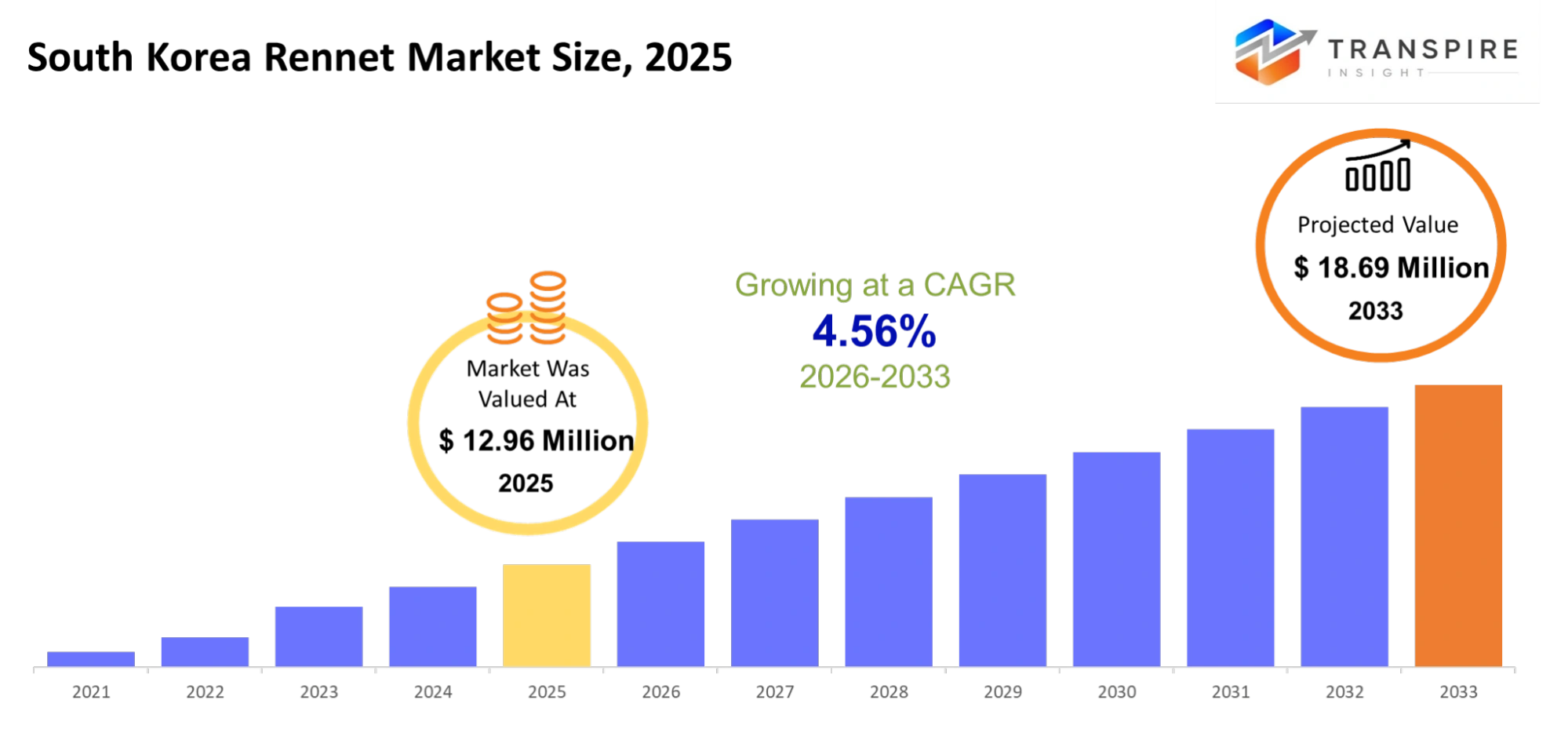
- South Korea Rennet Market Size 2025: USD 12.96 Million
- South Korea Rennet Market Size 2033: USD 18.69 Million
- South Korea Rennet Market CAGR: 4.56%
- South Korea Rennet Market Segments: By Type (Animal-based, Microbial, Vegetable, Fermentation-produced), By Application (Cheese Production, Dairy Processing, Food Industry), By End-User (Dairy Companies, Food Manufacturers, Cheesemakers)
To learn more about this report,  Download Free Sample Report
South Korea Rennet Market Summary:
The South Korea Rennet Market size is estimated at USD 12.96 Million in 2025 and is anticipated to reach USD 18.69 Million by 2033, growing at a CAGR of 4.56% from 2026 to 2033.
The rennet market in South Korea operates within the dairy ingredients sector because traditional cheese-making methods will keep producing cheese according to present-day processing requirements. Local producers will depend on both animal-sourced and fermentation-based rennet as consumer awareness about ingredient sourcing and dietary needs progresses through time. Product selection will increasingly follow clean-label standards which will push manufacturers to implement transparent product labeling and supply chain systems that allow tracking of their products. The demand for imported specialty cheeses will create consumption patterns that differ from the way people in South Korea consume food.
Processing facilities will achieve better product quality through upcoming advancements in enzyme manufacturing because these technologies will enhance their ability to produce uniform results from different milk sources. Food safety and origin disclosure regulations will become stricter which will require importers and domestic suppliers to comply with more demanding standards. The growing popularity of western diets will create new ways to use rennet while small artisanal businesses will develop their own unique enzyme mixtures to stand out from their competitors.
What Has the Impact of Artificial Intelligence Been on the South Korea Rennet Market?
The South Korean rennet market experiences rapid changes through artificial intelligence which provides both data-based accuracy and better operational functions throughout the market system. The South Korean rennet market uses artificial intelligence to create advanced market research tools which help companies analyze large datasets that contain information about dairy consumption patterns and enzyme consumption needs and changing customer behavior. The combination of machine learning models with predictive analytics tools enables businesses to track market developments while they determine optimal pricing methods and predict future customer demand patterns.
The South Korean rennet market uses artificial intelligence technology to enhance production productivity through its capability to automate processes. AI-powered systems control all stages of fermentation and enzyme extraction to produce identical product standards while they reduce material loss and operational interruptions. The process of forecasting demand depends on predictive analytics which helps manufacturers create production plans that match actual market requirements. Artificial intelligence solutions use AI tools to track inventory levels and transportation activities and supplier performance which results in cost savings and disruption prevention through supply chain optimization.
AI brings operational efficiency benefits to the South Korean rennet market while it creates new business opportunities that help companies gain market leadership. Businesses use advanced systems to create specialized rennet products which meet the particular requirements of different cheese types and changing consumer preferences. AI brings companies better operational flexibility which leads to them becoming essential elements for sustainable development and technological progress in the South Korean rennet market.
Key Market Trends & Insights:
- The Seoul metropolitan region maintains its position as the primary market of South Korea rennet because it operates through well-established dairy processing facilities which hold 45% of the market share for 2025.
- Gyeonggi Province emerges as the fastest-growing region, expected to expand at over 6.5% CAGR through 2030, driven by industrial food manufacturing clusters.
- The South Korea rennet market remains dominated by animal-derived rennet because traditional cheese production methods prefer this type of rennet which will account for 52% of the market in 2025.
- Microbial rennet constitutes the second-largest market share which delivers approximately 30percent of total market share because its production costs less while its supply chains remain dependable.
- The fermentation-based chymosin production process stands as the most rapidly expanding market sector which will experience 7.2percent CAGR growth until 2030 because of biotechnology research progress.
- The south korea rennet market experiences its highest demand from cheese production which accounts for almost 70percent of total market usage because more people adopt Western eating habits.
- The growth from convenience food consumption is pushing a 6 percent CAGR into the domain of processed dairy products which are producing the widest demand.
- On a large scale, the use of enzymes is a particular market domain, capturing over 60% of the share in 2025 of end-users.
- Some of the leading players in the rennet market in South Korea are Chr. Hansen Holding A/S, DSM-Firmenich, DuPont (IFF), Kerry Group, and Novozymes.
South Korea Rennet Market Segmentation
By Type :
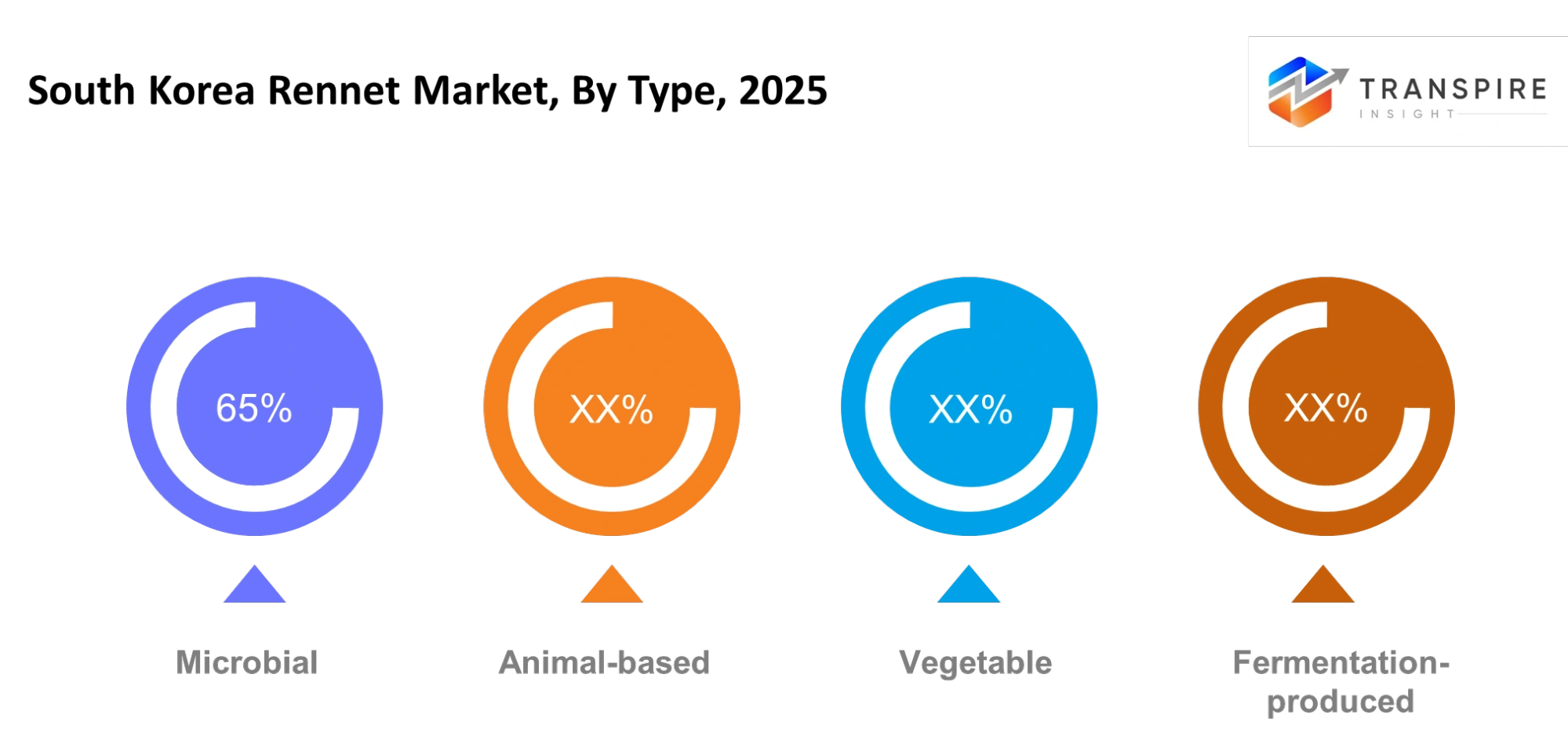
The historical value of animal-based rennet derives from its ancient use in traditional cheese-making which produces textures and flavors that established cheese makers prefer. People now focus on alternative solutions because of dietary preferences and supply restrictions. The industrial applications and large-scale production systems of these options become better because the microbial and fermentation-produced variants deliver dependable performance and uniform quality and they can handle increasing production demands.
Vegetable rennet maintains a niche presence, often associated with specific regional or artisanal cheese varieties. People increasingly choose plant-based products because their knowledge about food choices and their ethical values increases. The fermentation-produced rennet system provides rennet production through precise control which maintains consistent output across various processing methods. The market structure achieves equilibrium through different types of products which customers choose based on their functional performance together with their personal preferences.
To learn more about this report, Download Free Sample Report
By Application :
The cheese industry serves as the primary market for rennet because processed cheeses and specialty cheeses are experiencing growing demand. Rennet serves as the essential ingredient that enables milk to transform into cheese because it determines the final cheese product's texture and taste and production efficiency. The western diet trend has created stable demand growth for this market because manufacturers now use their capacity to create new products that fulfill current consumer needs.
Rennet functions as a vital component for cheese production while enabling dairy processors to create value-added products. Food manufacturers use rennet in their recipes to create products that benefit from the enzyme's ability to improve product performance. Food processing technology has reached its present state because various methods of processing food have developed through time while essential product performance and end product quality standards remain crucial for all processing methods.
By End-User :
Dairy companies need stable enzyme supplies to sustain their production processes and maintain their product quality. Companies base their procurement choices on operational efficiency and cost control needs which leads them to prefer rennet sources that provide both reliability and production capacity.
Food manufacturers use rennet in specialized formulations, where controlled enzymatic activity supports product consistency. Artisanal cheesemakers choose particular rennet varieties because they want to produce specific flavor and texture results while using traditional cheese-making techniques. The South Korea Gellan Gum Market shows different user types from industrial facilities and craft businesses, which create various demand patterns throughout its market segments.
What are the Main Challenges for the South Korea Rennet Market Growth?
The South Korea rennet market experiences major technical and operational obstacles which restrict its potential for development. The South Korea rennet market development faces its primary obstacle through the need to sustain enzyme stability while delivering uniform results during diverse dairy processing situations. The product efficiency of the system depends on raw material quality and temperature sensitivity, which results in variable cheese production and cheese quality.
The South korea rennet market expansion faces obstacles through manufacturing and commercialization constraints. The process of producing high-quality rennet requires multiple biotechnological steps which demand facilities to follow Good Manufacturing Practices (GMP) and food safety standards. The high costs of advanced fermentation-produced rennet create barriers for small and mid-sized manufacturers who need this product which results in delayed market expansion of the south korea rennet industry.
The industry encounters two primary obstacles because of insufficient infrastructure and the absence of skilled workers who specialize in enzyme biotechnology and dairy research. Smaller dairy producers usually lack two essential components which include necessary technical knowledge and funding to adopt modern rennet technologies. The South Korea rennet market faces two major obstacles which include market restrictions and research funding shortages which prevent new developments from occurring while research progress remains stagnant.
The industry faces new challenges because of rising competition from alternative coagulants and plant-based enzyme solutions. The south korea rennet market companies must adjust their operations because of two main factors which include pricing pressures and changing regulatory standards to remain competitive.
Country Insights
The South Korea Rennet Market will expand because people in South Korea are drinking more cheese and processed dairy products. The rising demand for pizza and bakery products and ready-to-eat meals has increased cheese production, which in turn created a higher requirement for rennet. The domestic dairy processing facilities are expanding and consumers are showing more interest in specialty cheeses, which will lead to continuous product demand throughout the years.
The South Korea Rennet Market distributes its market share between three types of rennet, which include animal-based rennet, microbial rennet and fermentation-produced chymosin. The dietary preferences of people and the cost-effectiveness of microbial and fermentation-based alternatives have created more interest in these two types of rennet. Food manufacturers currently adopt these alternative ingredients to maintain consistent supply chains while satisfying emerging consumer demands for sustainable ingredient sourcing.
The South Korea Rennet Market uses rennet mostly for cheese production because it maintains constant demand for mozzarella cheddar and processed cheese products. The artisanal cheese segment and premium cheese segment will create new opportunities for cheese production. The small-scale producers will develop new rennet applications through their experiments with various textures and flavors.
The South Korea Rennet Market features global ingredient suppliers and regional distributors who compete through their product quality, price and delivery reliability. Companies are forming partnerships with dairy processors while they work on developing better product performance. The business relationships now depend on technical support and customized enzyme solutions as essential elements for sustaining long-term partnerships.
The South Korea Rennet Market exists mainly in urban areas and industrial zones which host established dairy processing facilities. Production levels increase in areas that possess both efficient cold chain systems and consistent access to unprocessed milk. The cheese market persists in cities with high population density which results in increased rennet usage.
The government intends to promote economic growth through regional development initiatives and food processing industry support which will create business opportunities in areas outside major urban centers. The dairy value chain now extends into smaller areas because of improved logistics and the growth of retail distribution networks. The coming years will see constant demand for rennet due to equal regional development across the different areas.
Recent Development News
In January 2026, South Korean food company Pulmuone strengthened its plant-based food portfolio. The expansion supports increasing demand for non-animal enzyme alternatives which indirectly affects the domestic market for microbial rennet.
Sourcehttps://www.pulmuone.co.kr/
In March 2026, The DSM-Firmenich company progressed its business operations which provide food enzymes and fermentation solutions. The company developed environmentally friendly production methods for animal-free enzymes which included rennet substitutes to meet the increasing needs of Asian dairy processors.
Source https://www.dsm-firmenich.com/
|
Report Metrics |
Details |
|
Market size value in 2025 |
USD 12.96 Million |
|
Market size value in 2026 |
USD 13.68 Million |
|
Revenue forecast in 2033 |
USD 18.69 Million |
|
Growth rate |
CAGR of 4.56% from 2026 to 2033 |
|
Base year |
2025 |
|
Historical data |
2021 - 2024 |
|
Forecast period |
2026 - 2033 |
|
Report coverage |
Revenue forecast, competitive landscape, growth factors, and trends |
|
Regional scope |
United States; Canada; Mexico; United Kingdom; Germany; France; Italy; Spain; Denmark; Sweden; Norway; China; Japan; India; Australia; South Korea; Thailand; Brazil; Argentina; South Africa; Saudi Arabia; United Arab Emirates |
|
Key company profiled |
Chr Hansen, DSM, DuPont, Kerry Group, Sacco System, Meito Sangyo, Amano Enzyme, Novozymes, Danisco, Biocatalysts, SternEnzym, AB Enzymes, Advanced Enzymes, Specialty Enzymes, Enmex |
|
Customization scope |
Free report customization (country, regional & segment scope). Avail customized purchase options to meet your exact research needs. |
|
Report Segmentation |
By Type (Animal-based, Microbial, Vegetable, Fermentation-produced), By Application (Cheese Production, Dairy Processing, Food Industry), By End-User (Dairy Companies, Food Manufacturers, Cheesemakers) |
How Can New Companies Establish a Strong Foothold in the South Korea Rennet Market?
New entrants can establish a strong foothold in the south korea rennet market by targeting underserved niches and aligning offerings with evolving dairy consumption patterns.Through its focus on specialty cheese producers and plant-based alternatives and premium artisanal segments companies can create unique market positions.
Technology differentiation is critical for success in the south korea rennet market.Companies that invest in advanced fermentation techniques and precision enzyme engineering and smart automation will achieve higher yield efficiency together with product consistency. The emerging biotech startups Archeon Biotech and EnzyNext Solutions develop next-generation microbial rennet with enhanced stability and scalability which shows how innovation creates competitive advantage in the south korea rennet market.
Strategic partnerships and localized supply chain development are equally important. The company can achieve faster market entry and regulatory alignment through collaborations with regional dairy processors and research institutions and food technology hubs. The joint ventures will help companies decrease commercialization risks while they expand their distribution networks.
Key South Korea Rennet Market Company Insights
The South Korean rennet market will experience continuous growth because of increasing cheese demand and processed dairy product requirements. Rennet will remain essential for food manufacturers who need to achieve stable product texture and taste. The market will grow because people in urban areas adopt Western food customs which include cheese as their consumption pattern.
The South Korean market will require rennet because people eat more pizza and bakery products and ready-to-eat meals. The growing number of food service chains and local dairy processing units will create ongoing demand for enzyme-based products. Manufacturers will need to use reliable rennet options because they need high-quality dairy components for their products.
The South Korean production sector will face financial difficulties because it depends on imported raw materials to operate. The limited availability of traditional rennet from domestic sources will create restrictions on rennet supply operations. Small companies that want to establish market presence will face higher operational expenses because they must meet strict food safety regulations.
Microbial and fermentation-produced rennet will gain attention as alternatives to traditional animal-based sources. Food manufacturers will show preference for options that offer consistent performance and align with dietary preferences. Clean-label demand will further encourage adoption of modern rennet solutions that meet consumer expectations without compromising quality.
Market competition will remain moderately consolidated with presence of global enzyme suppliers and selected regional distributors.Companies will focus on product consistency together with their pricing strategies and long-term supply agreements with dairy processors. The main players will use strategic partnerships and technical support services to enhance their market power while maintaining their current business connections.
Company List
- Chr Hansen
- DSM
- DuPont
- Kerry Group
- Sacco System
- Meito Sangyo
- Amano Enzyme
- Novozymes
- Danisco
- Biocatalysts
- SternEnzym
- AB Enzymes
- Advanced Enzymes
- Specialty Enzymes
- Enmex
What are the Key Use-Cases Driving the Growth of South Korea Rennet Market?
The rennet market in South Korea depends on its essential function for cheese production because this application serves as the primary and most reliable use. The rising consumer demand for Western-style diets has led industrial dairy processors to use high-quality rennet products which help them achieve better coagulation results and greater production output. The application supports market growth because it enables production expansion while decreasing operational costs and maintaining consistent product standards throughout South Korean rennet manufacturing facilities.
The South Korean rennet market has moved beyond its main use of traditional cheese production to serve processed and functional dairy products. Rennet serves as a key ingredient in yogurt-based cheese production and dairy snack manufacturing and ready-to-eat product creation because it provides essential texture and consistency. The demand for premium dairy products and convenience foods has led to increased popularity of these particular applications.
The South Korean rennet market benefits from new biotechnology applications and food innovation developments which create new market opportunities. Advanced fermentation-derived rennet is being utilized to support plant-based and hybrid dairy alternatives, which meet the evolving consumer demand for sustainable products and diverse dietary options. The South Korean rennet market benefits from cross-sector adoption and enzyme engineering advancements because these factors increase its capacity for long-term growth.
South Korea Rennet Market Report Segmentation
By Type
- Animal-based
- Microbial
- Vegetable
- Fermentation-produced
By Application
- Cheese Production
- Dairy Processing
- Food Industry
By End-User
- Dairy Companies
- Food Manufacturers
- Cheesemakers
Frequently Asked Questions
Find quick answers to common questions.
The approximate South Korea Rennet Market size for the market will be USD 18.69 Million in 2033.
Key segments for the South Korea Rennet Market are By Type (Animal-based, Microbial, Vegetable, Fermentation-produced), By Application (Cheese Production, Dairy Processing, Food Industry), By End-User (Dairy Companies, Food Manufacturers, Cheesemakers).
Major South Korea Rennet Market players are Chr Hansen, DSM, DuPont, Kerry Group, Sacco System, Meito Sangyo, Amano Enzyme, Novozymes, Danisco, Biocatalysts, SternEnzym, AB Enzymes, Advanced Enzymes, Specialty Enzymes, Enmex.
The South Korea Rennet Market size is USD 12.96 Million in 2025.
The South Korea Rennet Market CAGR is 4.56%.
- Chr Hansen
- DSM
- DuPont
- Kerry Group
- Sacco System
- Meito Sangyo
- Amano Enzyme
- Novozymes
- Danisco
- Biocatalysts
- SternEnzym
- AB Enzymes
- Advanced Enzymes
- Specialty Enzymes
- Enmex
Recently Published Reports
-
Apr 2026
Baby Infant Formula Market
Baby Infant Formula Market Size, Share & Analysis Report By ype (Infant Milk, Follow On Milk, Specialty Baby Milk, Growing-Up Milk), By Ingredient (Carbohydrate, Fat, Protein, Minerals, Vitamins, and Others), By Product Form (Powder, Liquid, and Ready-to-feed), By Distribution Channels (Supermarket/Hypermarket, Specialty Store, Pharmacies, Online Retail, and Others), and Geography (North America, Europe, Asia-Pacific, Middle East and Africa, South and Central America), 2021 - 2031
-
Apr 2026
Edible Insects for Animal Feed Market
Edible Insects for Animal Feed Market Size, Share & Analysis Report By Type (Insect Powder, Insect Meal, Insect Bar, Insect Paste, Insect Oil, and Others), By Insect Type (Beetles, Cricket, Caterpillar, Hymenoptera, Orthoptera, Tree Bugs, and Others), By Application (Livestock, Pet Food, and Aquaculture), By Livestock Type (Poultry, Swine, and Others), and Geography (North America, Europe, Asia-Pacific, Middle East and Africa, South and Central America), 2021 - 2031
-
Apr 2026
Food Industry Disinfection and Bacterial Control Market
Food Industry Disinfection and Bacterial Control Market Size, Share & Analysis Report By Type (Chemical Disinfectants, Physical Disinfectants, and Biocides and Antimicrobials), By Application (Food Processing Equipment Surface Disinfection, Food Preparation Areas Surface Disinfection, Storage Areas Surface Disinfection, Anti-microbial Coatings Food Preservation, and Preservative Solutions Food Preservation), By End User (Meat and Poultry Processing, Dairy Processing, Seafood Processing, Bakery and Confectionery, Restaurants and Commercial Kitchens, and Food Service Providers), By Sales Channel (Online, Offline), and Geography (North America, Europe, Asia-Pacific, Middle East and Africa, South and Central America), 2021 - 2031
-
May 2026
Freeze Dried Food Market
Freeze Dried Food Market Size, Share & Analysis Report By Product Type (Fruits, Vegetables, Freeze-Dried Dairy Products, Freeze-Dried Meat and Seafood, Freeze-Dried Pet Food, and Prepared Meal), By Nature (Organic, and Conventional), By Form (Powdered, Granules, and Diced), By End Use (Breakfast Cereals, Dairy Products, Bakery & Confectionery, Nutritional Bars & Supplements, Powdered Beverages, Snacks, and Retail (Household)), and Geography (North America, Europe, Asia-Pacific, Middle East and Africa, South and Central America), 2021 - 2031