

South Korea Photoresist Ancillaries Market Size & Forecast:
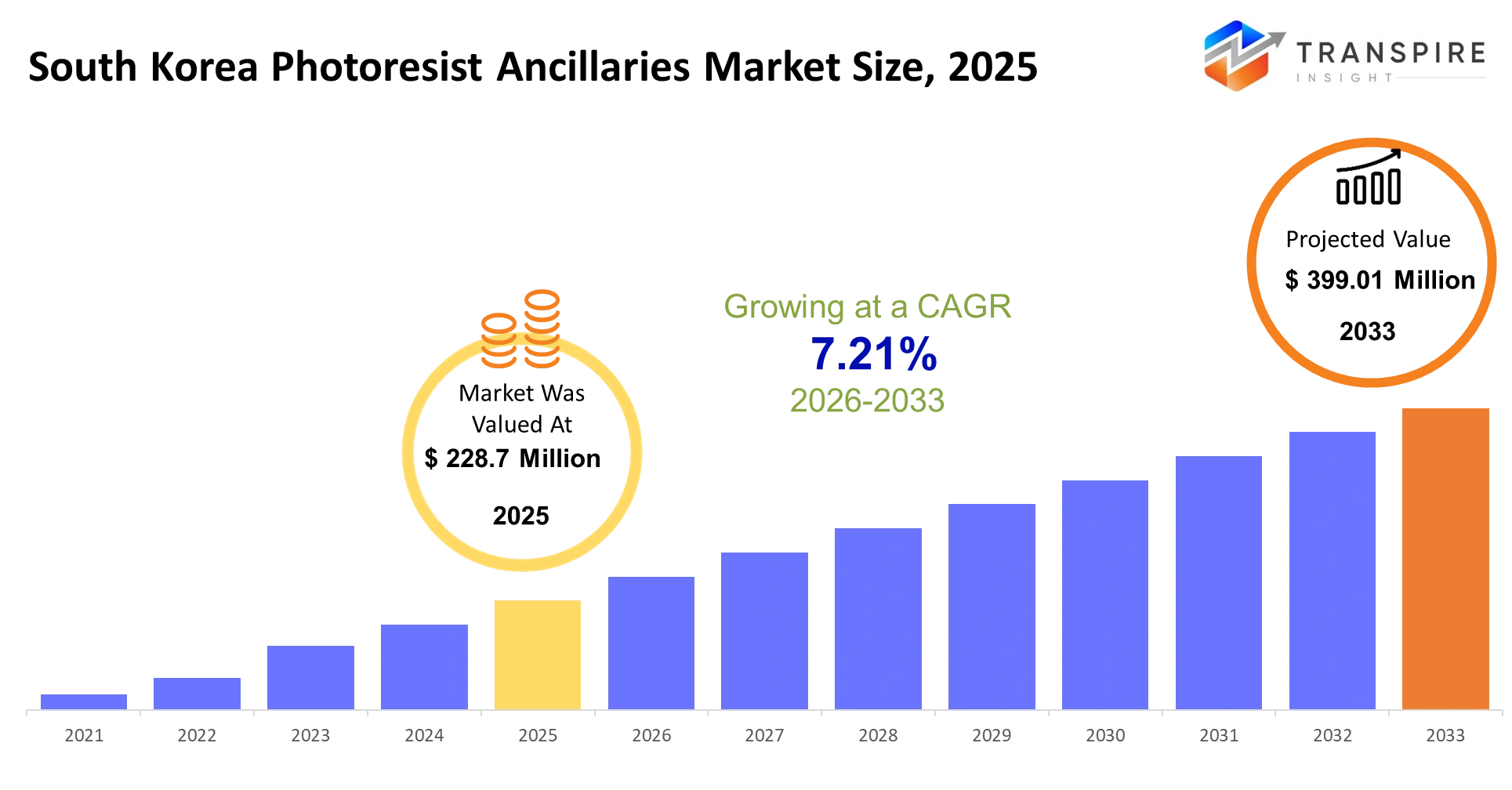
- South Korea Photoresist Ancillaries Market Size 2025: USD 228.7 Million
- South Korea Photoresist Ancillaries Market Size 2033: USD 399.01 Million
- South Korea Photoresist Ancillaries Market CAGR: 7.21%
- South Korea Photoresist Ancillaries Market Segments: By Type (Developers, Thinners, Strippers, Edge Bead Removers), By Application (Semiconductors, PCBs, Displays, MEMS), By End-User (Semiconductor Firms, Electronics Companies, Foundries)
To learn more about this report,  Download Free Sample Report
South Korea Photoresist Ancillaries Market Summary:
The South Korea Photoresist Ancillaries Market size is estimated at USD 228.7 Million in 2025 and is anticipated to reach USD 399.01 Million by 2033, growing at a CAGR of 7.21% from 2026 to 2033.
The South Korea photoresist ancillaries market operates under the larger semiconductor materials industry to provide essential materials that enable advanced chip manufacturing processes. The process continues to execute its important function as fabrication lines progress to smaller nodes and develop more complex architectures.
Chipmakers will need better coating materials which will force suppliers to create chemical solutions that meet increased requirements for purity and stability. Manufacturers will need materials which improve product quality through defect reduction at the microscopic level because they will implement stricter production standards.
The manufacturing and handling processes of these materials will face South Korean regulatory requirements which focus on chemical safety and environmental impact assessment. Companies will likely invest in greener alternatives and improved waste management practices to align with evolving standards.
Extreme ultraviolet lithography needs additional solution development which must withstand intense operational environments while preserving its initial performance standards. Customers will select suppliers who deliver dependable supply chains with steady product quality because they recognize semiconductor manufacturing as essential for their business operations.
What Has the Impact of Artificial Intelligence Been on the South Korea Photoresist Ancillaries Market?
The South Korea Photoresist Ancillaries Market undergoes rapid change because artificial intelligence technology improves decision-making processes and enables businesses to acquire better market information. The South Korea Photoresist Ancillaries Market uses artificial intelligence technology to assist businesses in their data analysis process, which enables them to analyze extensive datasets with high precision, thus enhancing their market research and competitive assessment capabilities.
Artificial intelligence technology in the South Korea Photoresist Ancillaries Market enables organizations to enhance their manufacturing capabilities while they manage their supply networks. The implementation of smart automation technologies in photoresist ancillary manufacturing enables companies to enhance their production processes while minimizing resource waste and boosting their production standards.
The South Korea Photoresist Ancillaries Market uses AI technology to create new products while developing customized solutions that semiconductor manufacturers can use. AI implementation in South Korea Photoresist Ancillaries Market business strategies improves product development processes while enhancing customer relationships, which enables companies to achieve continuous growth in a market that becomes more competitive.
Key Market Trends & Insights:
- The South Korea photoresist ancillaries market is growing because the semiconductor industry is expanding which creates a higher need for high-purity processing chemicals and advanced materials.
- AI technologies combined with smart automation systems improve production efficiency by providing predictive analytics and quality control capabilities while decreasing operational expenses throughout the entire value chain.
- The increasing use of EUV lithography creates a demand for advanced ancillaries which will significantly impact market size and future growth rates.
- South Korea dominates the regional landscape through its semiconductor manufacturing clusters which provide the country with more than 85% market share in 2025.
- The Seoul metropolitan area leads in production and R&D while Gyeonggi Province becomes the most rapidly developing hub until 2030.
- The south korea photoresist ancillaries market sees its dominant share of 35% through anti-reflective coatings which serve an essential purpose in lithography accuracy.
- Edge bead removers are the fastest-growing segment, expected to expand significantly during 2025–2030 due to advanced chip manufacturing needs.
- Semiconductor fabrication dominates with over 70% share in 2025 because memory and logic chip production create strong demand for this process.
- Integrated device manufacturers (IDMs) lead the market with around 60% market share because they possess extensive in-house manufacturing capabilities.
- The south korea photoresist ancillaries market features Samsung Electronics, SK Hynix, Dongjin Semichem, JSR Corporation, and TOKYO OHKA KOGYO as its main competitors.
South Korea Photoresist Ancillaries Market Segmentation
By Type :
Developers support image creation through their process of dissolving exposed photoresist areas which allows them to transfer patterns with precision. Thinners use their ability to change viscosity levels which enables them to produce consistent coating results that achieve uniform film thickness throughout wafer surfaces. The process of stripping removes photoresist materials from surfaces after processing which results in clean surfaces. Edge bead removers eliminate excess material at wafer edges which prevents defects during subsequent steps while it increases yield.
The combination of developers and thinners helps achieve exact results during lithography because any small variations will affect the final results. Strippers and edge bead removers contribute to post-processing efficiency because they keep surfaces free from contamination. Fabrication environments experience rising demand for all types of products because node sizes decrease while performance needs increase.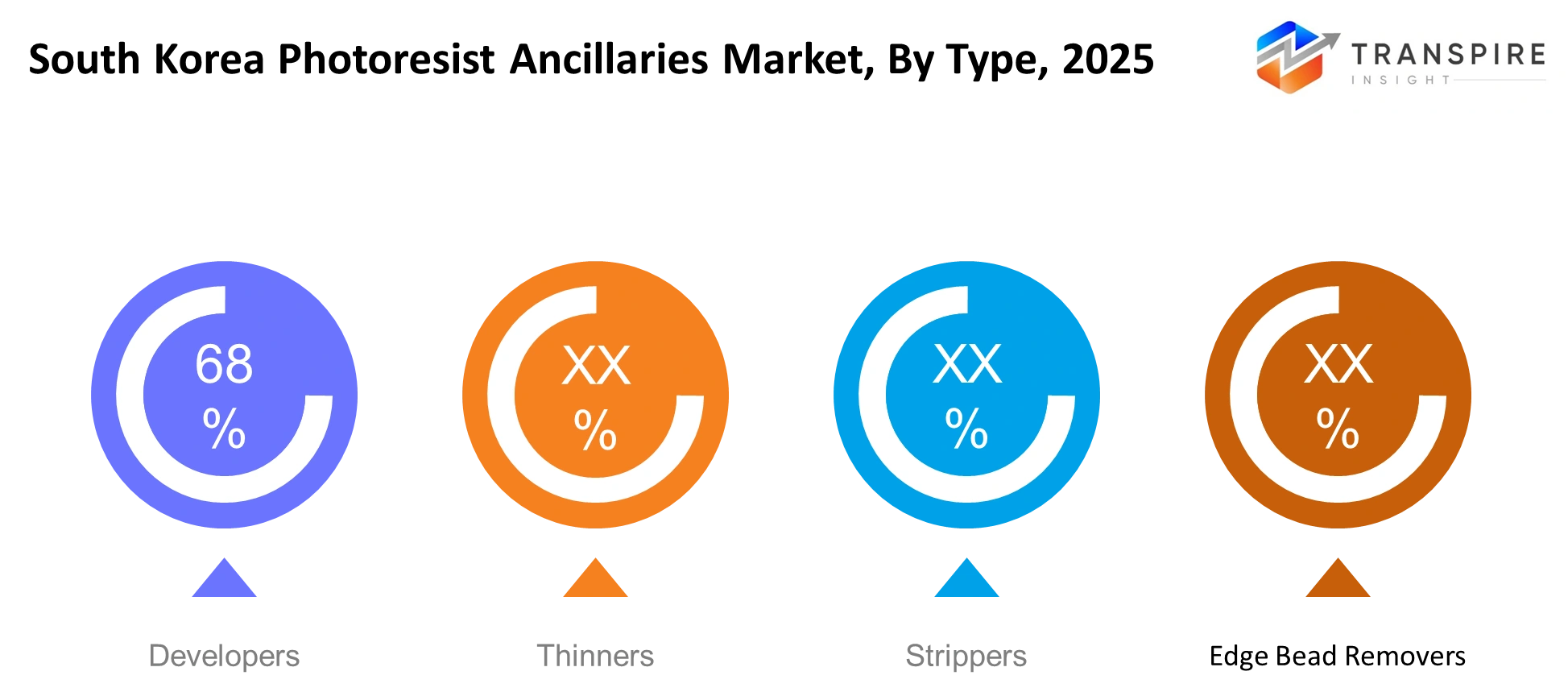
To learn more about this report, Download Free Sample Report
By Application :
Semiconductors are the primary component used in various applications because they require substantial chip manufacturing and advanced technological specifications. PCB manufacturing requires additional materials to create circuit patterns which are needed for the etching operation. Display production, including OLED and LCD panels, uses these materials for fine pattern definition. MEMS applications need precise cleaning methods and patterning techniques to create small mechanical components.
Current technological improvements combined with strong export capacities create the highest demand for semiconductor and display industries. The demand for PCB applications remains constant because consumer electronics and industrial equipment require their use. The field of MEMS applications experiences incremental growth because sensors and automotive electronics require precise and dependable material selection methods.
By End-User :
The biggest end-user segment of the market consists of semiconductor companies which experience growth because of ongoing innovations in chip technology and their efforts to build additional manufacturing facilities. Electronics companies use ancillary materials in component manufacturing and assembly processes. The foundries rely on these materials to provide their clients with high-quality wafer fabrication services which they deliver to their global client base.
The semiconductor industry and foundries require high purchasing activity because they need advanced manufacturing technology for their production processes. The electronics industry maintains constant product demand because companies manufacture both consumer electronics and industrial equipment. The current trajectory of end-user behavior shows that companies increasingly partner with material suppliers to achieve process consistency while decreasing product defects and meeting requirements for upcoming manufacturing technologies.
What are the Main Challenges for the South Korea Photoresist Ancillaries Market Growth?
The South Korea photoresist ancillaries market operating capacity faces severe technological and operational difficulties. The semiconductor industry requires manufacturers to achieve high product stability and purity standards because any product defect will degrade semiconductor performance. The development of EUV lithography systems requires exact chemical mixtures which create major obstacles for system development.
The South korea photoresist ancillaries market expansion faces restrictions because of manufacturing and commercialization challenges. The production process requires specialized methods that combine strict quality control with regulatory compliance which results in increased operational expenses. The semiconductor industry requires companies to complete extensive testing and qualification processes before they can start manufacturing new materials.
The South korea photoresist ancillaries market faces additional limitations due to adoption challenges and infrastructure constraints. Small businesses face adoption challenges because they require both expert personnel and advanced manufacturing resources to operate. The requirement of high initial investments and the restricted availability of funding for research projects create obstacles that emerging market players must overcome.
The South korea photoresist ancillaries market growth faces challenges because of fierce competition and technological threats which exist in the market. Global suppliers and alternative materials create pricing pressure for companies while semiconductor technologies demand constant product development which generates uncertain business conditions and increased investment threats.
Country Insights
The South Korea Photoresist Ancillaries Market shows continuous expansion because semiconductor manufacturing operations are thriving and companies are investing in modern lithography technologies.
The market will expand through development of technologies which must match requirements of upcoming generation nodes that possess high process sensitivity. Manufacturers will select materials based on three main factors which include material purity and stability and compatibility with photoresist materials. The industry will expand because semiconductor manufacturing facilities in South Korea will build new wafer fabrication capacity while existing fabrication plants undergo modernization.
The competitive environment will consist of both domestic chemical manufacturers and international companies who want to establish permanent agreements with semiconductor manufacturers. The security of supply will improve through partners who work together to produce goods at local facilities. Product development will receive direction from environmental regulations and waste management standards which will promote development of safer chemical solutions and their efficient application in manufacturing operations.
The South Korean semiconductor supply chain maintains global importance through its major fabrication centers which operate from Gyeonggi Province and Chungcheong region. The industrial zones in these areas enable companies to manage their business activities which include material supply and chip design and manufacturing.
Government-supported programs that develop local semiconductor manufacturing capabilities will create economic advantages for regional development. The local chemical manufacturing industry will grow through three main drivers which include investment incentives and research funding and infrastructure development. The major chip manufacturers in the area will create steady demand for their products while local suppliers concentrate on maintaining product quality and meeting their exact manufacturing standards.
Recent Development News
In February 2026, Fujifilm Holdings Corporation launched new semiconductor material solutions at SEMICON Korea 2026. The company introduced advanced photoresist-related materials and supporting products which included photosensitive insulating films and color filter materials that support future semiconductor manufacturing processes.
Source https://www.fujifilm.com/
|
Report Metrics |
Details |
|
Market size value in 2025 |
USD 228.7 Million |
|
Market size value in 2026 |
USD 245.17 Million |
|
Revenue forecast in 2033 |
USD 399.01 Million |
|
Growth rate |
CAGR of 7.21% from 2026 to 2033 |
|
Base year |
2025 |
|
Historical data |
2021 - 2024 |
|
Forecast period |
2026 - 2033 |
|
Report coverage |
Revenue forecast, competitive landscape, growth factors, and trends |
|
Regional scope |
United States; Canada; Mexico; United Kingdom; Germany; France; Italy; Spain; Denmark; Sweden; Norway; China; Japan; India; Australia; South Korea; Thailand; Brazil; Argentina; South Africa; Saudi Arabia; United Arab Emirates |
|
Key company profiled |
Tokyo Ohka Kogyo, JSR Corporation, Shin-Etsu Chemical, Fujifilm, Merck, DuPont, Sumitomo Chemical, Samsung SDI, LG Chem, Dongjin Semichem, SK Materials, Kanto Chemical, Avantor, BASF, Cabot Microelectronics |
|
Customization scope |
Free report customization (country, regional & segment scope). Avail customized purchase options to meet your exact research needs. |
|
Report Segmentation |
By Type (Developers, Thinners, Strippers, Edge Bead Removers), By Application (Semiconductors, PCBs, Displays, MEMS), By End-User (Semiconductor Firms, Electronics Companies, Foundries) |
How Can New Companies Establish a Strong Foothold in the South Korea Photoresist Ancillaries Market?
New companies entering the South Korean photoresist ancillary market should focus on niche markets that support advanced semiconductor manufacturing requirements.Companies can achieve product differentiation by concentrating on specialized EUV-compatible ancillaries and eco-friendly formulation products. The innovation strategies use precise chemical processes and high-purity materials to achieve consistent product performance which helps solve major industry problems that include defect reduction and yield optimization.
Merger and acquisition activities serve as essential elements for organizations seeking to expand their operations within the South Korean photoresist ancillary sector. The company achieves faster product validation and market launch through its partnerships with semiconductor manufacturers and research institutes and equipment suppliers. The two parties can expedite their market entry process through joint development agreements and pilot
projects which also establish their trustworthiness. The emerging companies, including Dongjin Semichem, demonstrate that companies create better market presence through strong partnerships with chip manufacturers while ENF Technology shows that businesses need to prioritize ongoing research and development and local manufacturing capabilities.
In the South Korean photoresist ancillary market technology differentiation represents a critical element that determines a company's ability to maintain success. The implementation of AI-powered quality control systems together with automated systems and predictive analytics will enable companies to enhance their manufacturing performance.
Key South Korea Photoresist Ancillaries Market Company Insights
The semiconductor manufacturing market continues to move forward because of the strong demand for semiconductor fabrication which exists together with ongoing investments in advanced chip manufacturing and lithography technologies. Chemical suppliers maintain their focus on product purity and consistent performance levels which enable them to fulfill the rigorous manufacturing requirements that they must meet.
The manufacturing process requires stable supply chains because production schedules have recently faced disruptions from material shortages and delivery system problems. Local manufacturers increase self-reliance through their partnerships which they combine with their efforts to build domestic production capacity. The combination of government support with specific financial investments will create new innovations while providing manufacturers with essential materials required for semiconductor processing.
Technological progress drives product refinement through its focus on achieving better resolution and stronger adhesion and improved defect management for photolithography applications. Research centers and industry players work together to create advanced ancillary equipment which meets the needs of extreme ultraviolet processes.
The market competition includes both international chemical corporations and established domestic vendors who compete through their product quality improvements and binding supply contracts. The organization establishes its pricing framework based on both the expenses of raw materials and the volume of products being manufactured. The competitive position of semiconductor material companies will emerge through their research activities and partnerships and their ability to build customer relationships.
Company List
- Tokyo Ohka Kogyo
- JSR Corporation
- Shin-Etsu Chemical
- Fujifilm
- Merck
- DuPont
- Sumitomo Chemical
- Samsung SDI
- LG Chem
- Dongjin Semichem
- SK Materials
- Kanto Chemical
- Avantor
- BASF
- Cabot Microelectronics
What are the Key Use-Cases Driving the Growth of South Korea Photoresist Ancillaries Market?
The South Korea photoresist ancillaries market depends on its essential function for semiconductor manufacturing which requires advanced materials to operate high-tech lithography systems. Memory and logic chip production needs anti-reflective coatings and developers and removers as necessary components for achieving accurate patterning results.
The South korea photoresist ancillaries market experiences growth because advanced packaging technologies undergo fast development which creates demand for these materials. The need for smaller and faster and more energy-efficient devices has led industries to use ancillaries for improving their wafer-level packaging and 3D integration systems. This situation applies to both consumer electronics and enterprise computing because both fields require high performance and compact designs.
South Korea photoresist ancillaries market expansion occurs because both the automotive sector and industrial sector adopt electric vehicles and smart manufacturing systems which become more popular. The healthcare electronics market expands through new applications in medical imaging and diagnostic devices which provide opportunities for market growth while creating new ways to meet customer needs.
South Korea Photoresist Ancillaries Market Report Segmentation
By Type
- Developers
- Thinners
- Strippers
- Edge Bead Removers
By Application
- Semiconductors
- PCBs
- Displays
- MEMS
By End-User
- Semiconductor Firms
- Electronics Companies
- Foundries
Frequently Asked Questions
Find quick answers to common questions.
The Approximate South Korea Photoresist Ancillaries Market size for the Market will be USD 399.01 Million in 2033.
Key Segments for the South Korea Photoresist Ancillaries Market are By Type (Developers, Thinners, Strippers, Edge Bead Removers), By Application (Semiconductors, PCBs, Displays, MEMS), By End-User (Semiconductor Firms, Electronics Companies, Foundries).
Major South Korea Photoresist Ancillaries Market Players are Tokyo Ohka Kogyo, JSR Corporation, Shin-Etsu Chemical, Fujifilm, Merck, DuPont, Sumitomo Chemical, Samsung SDI, LG Chem, Dongjin Semichem, SK Materials, Kanto Chemical, Avantor, BASF, Cabot Microelectronics.
The Current South Korea Photoresist Ancillaries Market size is USD 228.7 Million in 2025.
The South Korea Photoresist Ancillaries Market CAGR is 7.21%.
- Tokyo Ohka Kogyo
- JSR Corporation
- Shin-Etsu Chemical
- Fujifilm
- Merck
- DuPont
- Sumitomo Chemical
- Samsung SDI
- LG Chem
- Dongjin Semichem
- SK Materials
- Kanto Chemical
- Avantor
- BASF
- Cabot Microelectronics
Recently Published Reports
-
Apr 2026
Fiber Optic Faceplates Market
Fiber Optic Faceplates Market Size, Share & Analysis Report By Type (< 300 mm2, 300-350 mm2, and > 350 mm2, By Application (Night Vision, Holographic Imaging, Medical, and Others), and Geography (North America, Europe, Asia-Pacific, Middle East and Africa, South and Central America), 2021 - 2031
-
Apr 2026
High Temperature Superconductors Market
High Temperature Superconductors Market Size, Share & Analysis Report By Type (1G HTS, and 2G HTS), By Application (Power Cable, Fault Current Limiter, and Transformer), and Geography (North America, Europe, Asia-Pacific, Middle East and Africa, South and Central America), 2021 - 2031
-
Apr 2026
Industrial Plugs and Socket Market
Industrial Plugs and Socket Market Size, Share & Analysis Report By Type (Industrial Plugs, Industrial Sockets), By Current (Up to 32 A, 32 to 125 A, Above 125 A), By Protection (Dustproof and Splash Proof, Waterproof, Explosion Proof), By End User (Heavy Industries, Oil and Gas, Chemicals and Pharmaceuticals, Power Generation, Others), and Geography (North America, Europe, Asia-Pacific, Middle East and Africa, South and Central America), 2021 - 2031
-
Apr 2026
InGaAs Avalanche Photodiodes Market
InGaAs Avalanche Photodiodes Market Size, Share & Analysis Report By Type (1100 - 1700 nm, and 1000 - 1600 nm), By Application (Missile Warning System, Muzzle Flash Detection, Wafer Defect Inspection, Laser Rangefinders, and Others), and Geography (North America, Europe, Asia-Pacific, Middle East and Africa, South and Central America), 2021 - 2031