South Korea Manned-Unmanned Teaming Market Size & Forecast:
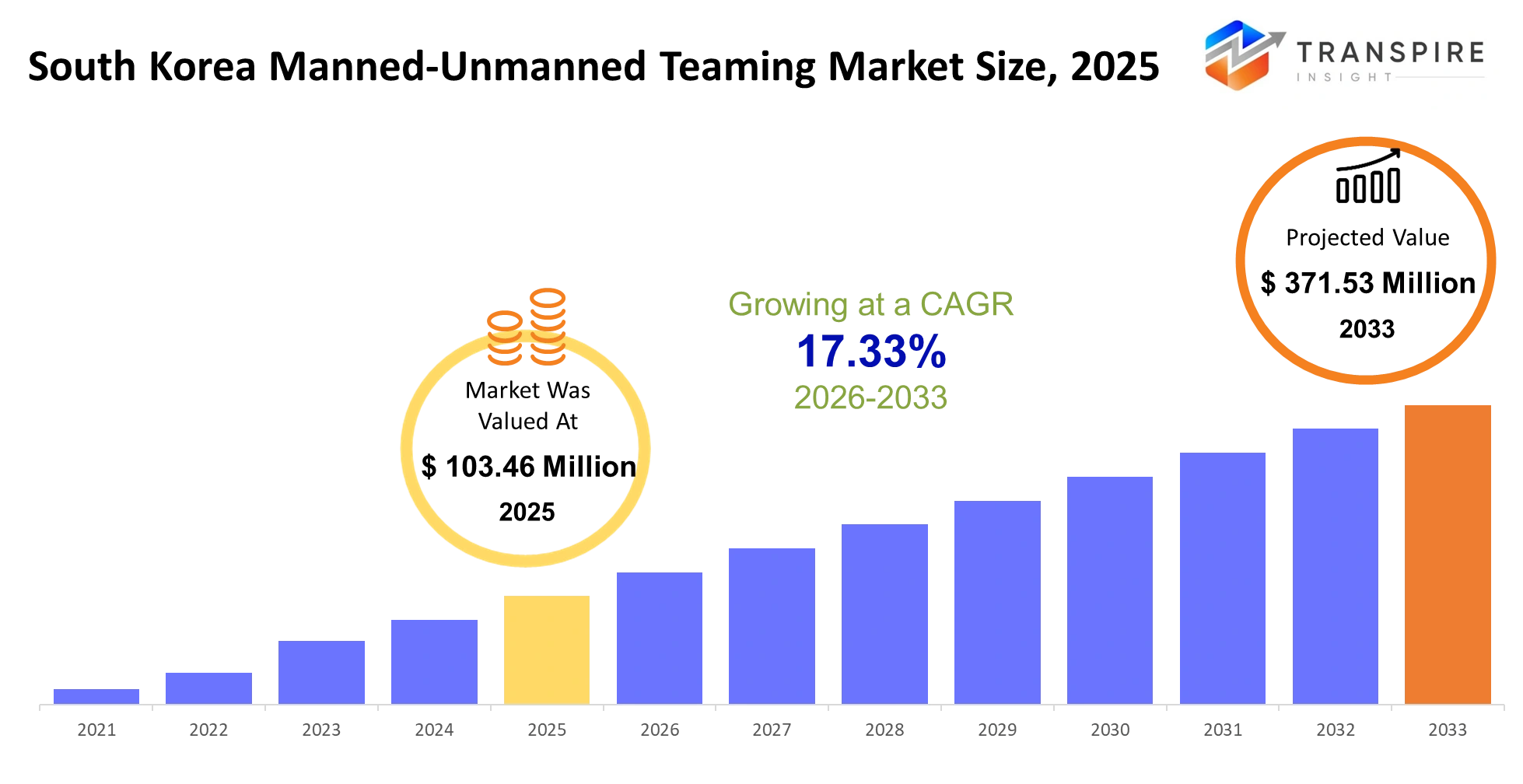
- South Korea Manned-Unmanned Teaming Market Size 2025: USD 103.46 Million
- South Korea Manned-Unmanned Teaming Market Size 2033: USD 371.53 Million
- South Korea Manned-Unmanned Teaming Market CAGR: 17.33%
- South Korea Manned-Unmanned Teaming Market Segments: By Platform Type (Combat Aircraft Teaming, Ground Vehicle Teaming, Naval Teaming Systems, UAV Teaming Systems, Others); By Technology (AI-enabled Systems, Autonomous Navigation, Sensor Fusion, Swarm Intelligence, Secure Communication Systems, Others); By Application (Defense Operations, Surveillance Missions, Border Security, Search & Rescue, Others); By End User (Defense Forces, Homeland Security Agencies, Aerospace Companies, Others).
To learn more about this report,  Download Free Sample Report
South Korea Manned-Unmanned Teaming Market Summary
The South Korea Manned-Unmanned Teaming Market was valued at USD 103.46 Million in 2025. It is forecast to reach USD 371.53 Million by 2033. That is a CAGR of 17.33% over the period.
South Korea Manned-Unmanned Teaming Market really kinda supports coordinated operations between crewed military platforms and autonomous systems, like unmanned aerial vehicles, robotic ground platforms and maritime drones. In practice these pieces let armed forces stretch surveillance range, cut down personnel exposure in contested areas and also speed up mission execution across border monitoring, naval patrol, reconnaissance, and electronic warfare work. Defense planners in South Korea are leaning more and more toward teaming architectures , to deal with manpower limits while boosting real time battlefield choices.
Over the past five years the market has moved away from standalone unmanned systems into integrated combat networks where AI enabled drones work next to fighter aircraft, armored vehicles, and naval assets. This shift kinda got a bigger push after the regional security tensions rose and after repeated North Korean missile launches, which made Seoul set more priority on next generation defense modernization. At the same time, increased defense budgets plus domestic drone development helped build steadier procurement channels for local contractors. And as military agencies move from small pilot attempts to full operational integration, suppliers end up earning more through software integration, higher levels of mission autonomy, secure communications, and lifecycle support services.
Key Market Insights
- The Seoul metropolitan defense manufacturing cluster basically ran the South Korea Manned-Unmanned Teaming Market, with almost 45% market share in 2025 because aerospace production facilities were so concentrated there.
- Southern coastal regions are becoming the quickest deployment hubs through 2033, since naval surveillance and autonomous maritime safety investments grew a lot after 2023 , it seems.
- Unmanned aerial systems made up over 40% share in 2025, leading product demand for reconnaissance, border monitoring, and real time tactical intelligence missions.
- Autonomous maritime teaming platforms moved into the second biggest segment too, as naval modernization programs sped up purchases of unmanned surface and underwater surveillance technologies.
- AI enabled swarm coordination systems are the fastest-growing segment between 2026 and 2033, backed by more battlefield automation trials and also simulation driven military exercises.
- Intelligence surveillance and reconnaissance use cases held roughly 48% market share in 2025, since defense agencies leaned into persistent observation across high risk border environments.
- Electronic warfare plus autonomous combat support applications showed the quickest adoption increase after 2024, because military planners expanded multi domain operational capabilities , along with threat response automation.
- Defense and homeland security agencies stayed the top end user segment, bringing in more than 60% revenue contribution in 2025, mostly driven by rising autonomous battlefield integration programs.
- Firms in the South Korea Manned-Unmanned Teaming Market are now looking harder at semiconductor partnerships, encrypted communication technologies, and edge AI improvements, to secure a clearer strategic edge during autonomous battlefield operations .
What are the Key Drivers, Restraints, and Opportunities in the South Korea Manned-Unmanned Teaming Market?
The main thing pushing growth in the South Korea Manned-Unmanned Teaming Market is the country’s fast defense modernization path, and yes, it links to regional security threats that keep shifting. South Korea’s Ministry of National Defense has been pouring more money into AI-enabled command structures, autonomous reconnaissance drones, plus cooperative combat technologies, after a run of missile demonstrations and ongoing border frictions across Northeast Asia. So, this policy change basically lit up procurement for integrated surveillance platforms, and tactical unmanned systems that can back manned aircraft as well as naval groups. Defense contractors are seeing bigger development funding, while system integrators are pulling in more repeat income through software upgrades, sensor fusion, and the rollout of communications infrastructure.
The largest limiting factor is kind of the integration headache, turning autonomous units into older military infrastructure. A lot of existing combat platforms weren’t built for interoperable autonomous work from day one, so deployments take longer and redesign costs rise. Then cybersecurity issues show up too, because unmanned platforms depend heavily on encrypted links, plus real time data sharing. These same structural problems tend to delay procurement approvals and also raise the testing bar, which ends up slowing down how quickly domestic suppliers can scale commercially.
One big opportunity shows up in AI-led naval teaming setups, along with autonomous maritime surveillance programs. South Korea keeps increasing investment in smarter naval defense platforms, so the environment looks good for unmanned surface craft and underwater drones that can support destroyers and coastal defense objectives.
What Has the Impact of Artificial Intelligence Been on the South Korea Manned-Unmanned Teaming Market?
Artificial intelligence has, sort of changed how South Korea uses coordinated defense platforms that are sometimes manned and sometimes autonomous. The AI powered mission systems basically automate things like target recognition, route planning, how threats are ranked, and the ongoing battlefield coordination between crewed aircraft and unmanned drones. Defense operators now more and more lean on machine learning methods to digest surveillance footage coming from many sensors at once. That tends to cut down response time during reconnaissance and border monitoring work even when the situation gets busy or unclear
At the same time predictive analytics tools are getting better for readiness. Machine learning models look at vibration signatures, engine performance readings, and the surrounding conditions to guess maintenance needs for unmanned aerial vehicles and maritime assets before a real failure shows up. In practice that helps avoid sudden downtime and supports stronger fleet availability during long defense tasks. There is also AI assisted navigation and autonomous formation control which helps fuel efficiency and mission endurance, mostly by tuning the flight paths and avoiding unnecessary backtracking across multiple platforms working together
Meanwhile advanced digital command systems have improved situational awareness by bringing satellite imagery, radar feeds, and unmanned sensing networks into one combined operational view. Still, AI adoption is not fully smooth, because interoperability gaps and data reliability issues keep appearing. In messy real world combat settings, datasets can be inconsistent, and even secure communications can get stressed by signal disruption plus electronic warfare interference. That combination raises integration costs and makes it slower to reach full scale deployment across multi domain operations
Key Market Trends
- Since 2022 South Korea has been speeding up these AI enabled drone integration programs, like, defense AI and autonomous systems funding went up by more than 20% across a lot of modernization stuff.
- Hanwha Aerospace and Korea Aerospace Industries upped their investment in autonomous combat support systems after South Korea’s 2024 defense budget hit over USD 45 billion, which is pretty big.
- Meanwhile the naval defense programs kind of shifted toward unmanned surface and underwater surveillance platforms, with South Korea aiming for multiple autonomous naval systems to be deployed before 2030.
- On the procurement side, strategies are leaning more and more into interoperable software architectures, and a bit more than 60% of the new battlefield programs now stress multi domain integration, plus network centric warfare compatibility.
- AI based target recognition systems also got wider deployment after field trials showed that surveillance analysis time improved by nearly 30% versus the older conventional monitoring workflows.
- And the demand for secure tactical communication networks jumped hard too, because autonomous systems need low latency coordination, so military comms spending growth is now above 15% every year since 2023.
- Between 2023 and 2025 South Korean defense agencies expanded simulation based testing environments, which helps validation of drone swarm operations that involve more than 20 coordinated unmanned assets at the same time.
- Also local manufacturers started replacing imported subsystems with domestically developed sensors, navigation modules, and encrypted communication technologies, and that reduced selected foreign component dependency by almost 25% since 2021.
- Autonomous maritime reconnaissance projects gained momentum as regional naval tensions encouraged investment in persistent coastal surveillance systems that can run continuously for over 24 hours.
South Korea Manned-Unmanned Teaming Market Segmentation
By Platform Type
UAV Teaming Systems keep the dominant position because they’ve been rolled out a lot in reconnaissance, tactical surveillance and coordinated battlefield intelligence tasks. Military agencies tend to favor unmanned aerial coordination, basically because aerial platforms give broader operational coverage with less personnel risk than most ground or naval setups. Combat Aircraft Teaming sits in the second-largest spot as fighter modernization efforts increasingly fold autonomous wingman drones into air combat doctrines. Naval Teaming Systems and Ground Vehicle Teaming keep stretching out too through border patrol, mine detection, and logistics support, while the other platform categories stay pretty narrow, mostly staying as experimental fielding and small-scale operational jobs.
UAV Teaming Systems continue picking up momentum, since autonomous aerial coordination helps improve real time intelligence collection and mission endurance over contested regions. Combat Aircraft Teaming also benefits from spending tied to next generation fighter programs that really want AI-enabled collaborative mission support, more than before. Naval Teaming Systems are getting traction through maritime security efforts aimed at persistent coastal observation and autonomous threat monitoring. Over the forecast timeframe, Ground Vehicle Teaming is expected to accelerate, as defense forces start asking for robotic logistics and unmanned tactical mobility solutions in high risk battlefield environments.
By Technology
AI-enabled Systems keep the leading position, mostly because autonomous decision support, target recognition, and mission coordination functions rely rather a lot on machine learning integration. Sensor Fusion sits at the second-largest segment, partly tied to the growing need for consolidated operational awareness across air , land , and naval platforms, and that unified view matters. Autonomous Navigation technologies keep widening too, since military operators want less dependence on direct human control while they operate in contested areas. Meanwhile Secure Communication Systems plus Swarm Intelligence stay as key enabling technologies for synchronized autonomous missions and for keeping battlefield connectivity resilient, even when conditions get messy.
AI-enabled Systems are seeing strong uptake because defense organizations need swifter interpretation of incoming data and real-time operational response during multi-domain activities. Sensor Fusion solutions boost targeting accuracy by merging radar, satellite, optical, and electronic intelligence feeds into one centralized command framework, not scattered across different screens. Swarm Intelligence is also picking up pace, in particular through military test programs that explore coordinated drone formations, able to do distributed surveillance alongside electronic warfare tasks. Over the forecast period , Secure Communication Systems are expected to show solid growth, because autonomous operations need encrypted low-latency networks that can resist signal interference, plus cyber disruption.
By Application
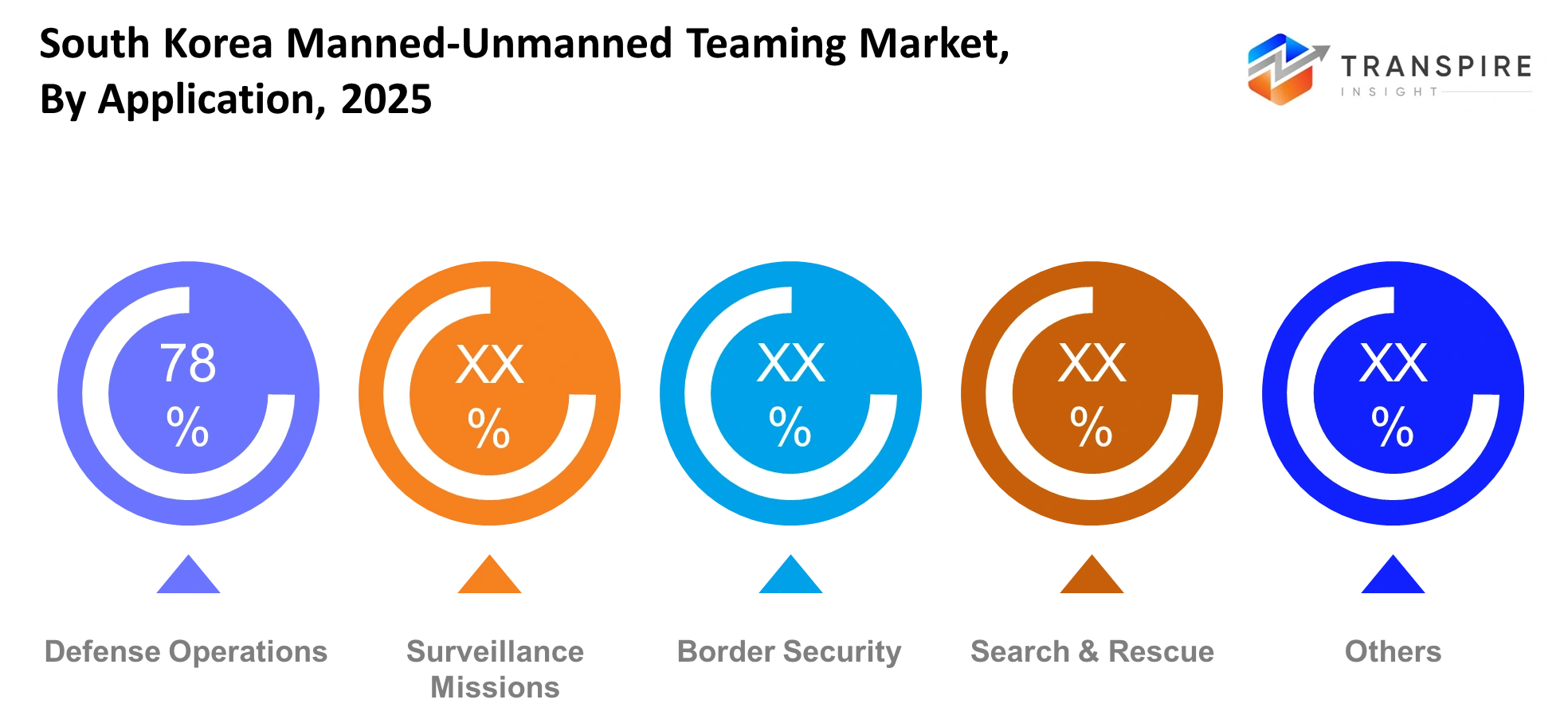
Defense Operations take the biggest slice of the market share, largely because autonomous teaming platforms are getting better at combat coordination, tactical intelligence, and force multiplication approaches, so, well the money tends to follow. Surveillance Missions sit in the second position, since deployment keeps rising for border monitoring, maritime patrol, and reconnaissance tasks—yeah, those are the usual drivers. Border Security programs are still expanding, too, mostly because unmanned systems bring improved persistent observation, even where the ground is complicated or the region is high tension, and that kind of endurance matters. Search & Rescue looks smaller in comparison, but it is slowly becoming more relevant, especially when disaster response ramps up and emergency recovery efforts kick in.
In more direct terms, Defense Operations keep pushing procurement, since defense organizations need autonomous support systems that cut down on how much personnel are put in harm's way, while also speeding up the tempo of operations. Surveillance Missions are getting a lift from wider adoption of AI-enabled reconnaissance drones that keep collecting intelligence continuously, often with a lower operating cost than older manned missions. Border Security is gaining traction as more investment flows into autonomous monitoring solutions, the ones built for coastal oversight and demilitarized zone surveillance. Through the forecast window, Search & Rescue is forecast to grow in a steady way, because emergency agencies are adopting autonomous aerial systems for faster terrain evaluation and near real-time situational coordination when natural disasters occur.
To learn more about this report, Download Free Sample Report
By End User
Defense Forces keep the strongest position, since their military modernization programs make up most of procurement spend across autonomous combat plus surveillance platforms. Homeland Security Agencies still land in the second-largest slice, mainly because more unmanned systems are getting used for border monitoring, coastal observation, and emergency response coordination. Aerospace Companies continue showing up here through platform development, autonomous software tie-in, and AI-enabled defense system trials. All the other end users stay pretty narrow, mostly specialized research institutions and pilot-stage operational efforts.
Defense Forces keep pushing deployment forward, because regional security worries call for advanced battlefield coordination tools that can back multi-domain warfare operations. Homeland Security Agencies end up benefiting from unmanned platforms that raise monitoring efficiency, and at the same time reduce manpower reliance across sensitive security zones. Aerospace Companies gain more strategic weight as military agencies increasingly shift toward outsourcing autonomous software development, sensor integration, and mission testing work. Through the forecast period, Aerospace Companies are expected to see meaningful growth, as demand keeps rising for domestically built autonomous tech, AI mission software, and interoperable defense networking solutions.
What are the Key Use Cases Driving the South Korea Manned-Unmanned Teaming Market?
The dominant use case is really about military surveillance and reconnaissance, where unmanned aerial systems work kind of together with crewed aircraft, plus ground command units . In these deployments , demand goes up the most since they help border monitoring, keep people away from high risk areas, and also speed up intelligence gathering when things get tactical
Then there are the adjacent applications that are slowly spreading into naval defense and electronic warfare activity . Unmanned surface vessels , along with underwater drones , are getting used to support destroyers and coastal patrol fleets for maritime surveillance roles. At the same time, ground based robotic systems are picking up steam for logistics assistance, explosive ordnance disposal tasks, and battlefield communication relay work, especially inside army modernization initiatives
More emerging use cases cover autonomous drone swarms and AI powered cooperative combat missions. Defense teams are currently testing coordinated unmanned formations that can handle electronic disruption, decoy deployment , and precision strike support. Right now these applications are still in early deployment stages, but they are expected to become strategically important as South Korea moves forward with multi domain warfare capabilities during the forecast period
|
Report Metrics |
Details |
|
Market size value in 2025 |
USD 103.46 Million |
|
Market size value in 2026 |
USD 121.39 Million |
|
Revenue forecast in 2033 |
USD 371.53 Million |
|
Growth rate |
CAGR of 17.33% from 2026 to 2033 |
|
Base year |
2025 |
|
Historical data |
2021 - 2024 |
|
Forecast period |
2026 - 2033 |
|
Report coverage |
Revenue forecast, competitive landscape, growth factors, and trends |
|
Regional scope |
South Korea |
|
Key company profiled |
Korea Aerospace Industries, Hanwha Aerospace, LIG Nex1, Boeing, Lockheed Martin, Northrop Grumman, BAE Systems, Leonardo, Saab, Elbit Systems, General Atomics, Airbus Defence and Space, Thales Group, Raytheon Technologies, Israel Aerospace Industries. |
|
Customization scope |
Free report customization (country, regional & segment scope). Avail customized purchase options to meet your exact research needs. |
|
Report Segmentation |
By Platform Type (Combat Aircraft Teaming, Ground Vehicle Teaming, Naval Teaming Systems, UAV Teaming Systems, Others); By Technology (AI-enabled Systems, Autonomous Navigation, Sensor Fusion, Swarm Intelligence, Secure Communication Systems, Others); By Application (Defense Operations, Surveillance Missions, Border Security, Search & Rescue, Others); By End User (Defense Forces, Homeland Security Agencies, Aerospace Companies, Others). |
Which Regions are Driving the South Korea Manned-Unmanned Teaming Market Growth?
South Korea’s southeastern defense corridor still feels like the top regional hub for manned unmanned teaming, mainly because it kind of stitches together aerospace manufacturing capacity, naval infrastructure, and that direct military procurement kind of support. In practice, cities like Sacheon, Busan and Changwon carry major production lines for Korea Aerospace Industries, Hanwha Aerospace, and multiple naval defense suppliers that are working on autonomous combat systems. The whole area also gets a big nudge from policy, via South Korea’s Defense Acquisition Program Administration and a set of long running military modernization plans that put emphasis on AI enabled battlefield integration. With this kind of setup, testing can move faster, suppliers stay more aligned, and defense engineering talent is more reliably accessible, so the region can keep leading on both deployment activity and manufacturing throughput.
Meanwhile the Seoul metropolitan region plays a more command, software, and defense electronics centered role, rather than acting as the main manufacturing base. Here the demand momentum is supported by fairly steady government research funding, continuous cybersecurity spending, and more advanced AI development, especially when it links to military communications and ISR platforms. Firms around Seoul tend to focus on sensor fusion, tactical data networks, and autonomous mission software that essentially connects unmanned systems with crewed assets, across several operational domains. Compared with the southeastern industrial corridor, the capital region’s edge comes from digital infrastructure, semiconductor capability, and close collaboration among defense organizations, universities and AI software developers. So in the end it shows up as a steady contributor to long-term market revenue.
Who are the Key Players in the South Korea Manned-Unmanned Teaming Market and How Do They Compete?
The competitive landscape of the South Korea Manned Unmanned Teaming Market is kind of moderately consolidated, in the sense that domestic defense manufacturers tend to hold the key strategic military relationships while international contractors usually step in with advanced autonomy technologies and combat system integration expertise. At the same time, competition is getting more centered on AI capability, interoperable battlefield networking, autonomous mission reliability, and secure communication systems, not only basic hardware production or manufacturing scale.
Korea Aerospace Industries focuses a lot on indigenous combat aircraft integration, and also on collaborative wingman systems that connect back to the KF-21 fighter program. The company differentiates itself via open architecture autonomous drone platforms—meant to allow flexible sensor integration, and coordinated combat missions that can adapt midstream. Hanwha Aerospace competes using multi domain defense integration, bringing unmanned ground vehicles, AI driven surveillance systems, and naval autonomy capabilities into one unified operational network. Its growing partnerships with NATO aligned firms and maritime autonomy specialists help solidify its export position, and also speed up technology transfer opportunities. LIG Nex1 specializes in missile systems, ISR electronics, and secure tactical communication technologies, enabling autonomous coordination in contested battlefield environments where reliability matters.
Globally, contractors are competing through technology partnerships and specialized combat systems rather than trying to win primarily through direct manufacturing inside South Korea. Lockheed Martin and Northrop Grumman tend to emphasize AI assisted battlefield management, advanced sensors, and interoperability with allied military systems. Meanwhile, Leonardo and Thales Group are strengthening their position through electronic warfare systems, radar integration, and tactical electronic support suites that help the overall teaming concept—especially when the environment is noisy or contested.
Company List
- Korea Aerospace Industries
- Hanwha Aerospace
- LIG Nex1
- Boeing
- Lockheed Martin
- Northrop Grumman
- BAE Systems
- Leonardo
- Saab
- Elbit Systems
- General Atomics
- Airbus Defence and Space
- Thales Group
- Raytheon Technologies
- Israel Aerospace Industries
Recent Development News
“In May 2026, Hanwha Aerospace showcased next-generation unmanned ground vehicle systems and AI-enabled ISR technologies at BSDA 2026 in Romania. The development expanded Hanwha’s European defense partnerships and strengthened its position in AI-driven manned-unmanned teaming systems.
Source: https://www.hanwha.com
“In March 2026, Korean Air Aerospace Division launched development acceleration for AI-powered high-speed unmanned target drones. The program strengthened South Korea’s autonomous swarm combat capabilities and supported localization of advanced defense drone technologies.
Source: https://www.koreatimes.co.kr
What Strategic Insights Define the Future of the South Korea Manned-Unmanned Teaming Market?
The South Korea Manned-Unmanned Teaming Market is kinda moving , steadily toward AI-centered multi domain warfare ecosystems, where autonomous systems not really just “help” anymore but act like full combat partners across air, land, naval, and also cyber operations. This change comes from regional security pressure, tight manpower constraints , and the military’s push for quicker battlefield choices that are backed by real-time data fusion. But one less obvious danger is the growing reliance on semiconductor supply chains, and those advanced communication chips needed for autonomous coordination. If there is any interruption in high-performance chip availability or secure network infrastructure , then fielding timelines can slip, and system expenses can rise too.
At the same time there is a real opening in autonomous maritime teaming platforms aimed at long duration coastal observation and naval logistics support. These efforts are still pretty early, yet defense spending is picking up , as maritime tensions around the region keep increasing. Market players should focus on open architecture software, and on secure interoperability norms, because procurement decisions are likely to reward platforms that can plug in smoothly across allied military networks, and keep working as AI command systems evolve.
South Korea Manned-Unmanned Teaming Market Report Segmentation
By Platform Type
- Combat Aircraft Teaming
- Ground Vehicle Teaming
- Naval Teaming Systems
- UAV Teaming Systems
- Others
By Technology
- AI-enabled Systems
- Autonomous Navigation
- Sensor Fusion
- Swarm Intelligence
- Secure Communication Systems
- Others
By Application
- Defense Operations
- Surveillance Missions
- Border Security
- Search & Rescue
- Others
By End User
- Defense Forces
- Homeland Security Agencies
- Aerospace Companies
- Others
Frequently Asked Questions
Find quick answers to common questions.
The estimated South Korea Manned-Unmanned Teaming Market size for the market will be USD 371.53 Million in 2033.
Key segments for the South Korea Manned-Unmanned Teaming Market are By Platform Type (Combat Aircraft Teaming, Ground Vehicle Teaming, Naval Teaming Systems, UAV Teaming Systems, Others); By Technology (AI-enabled Systems, Autonomous Navigation, Sensor Fusion, Swarm Intelligence, Secure Communication Systems, Others); By Application (Defense Operations, Surveillance Missions, Border Security, Search & Rescue, Others); By End User (Defense Forces, Homeland Security Agencies, Aerospace Companies, Others).
Major South Korea Manned-Unmanned Teaming Market players are Korea Aerospace Industries, Hanwha Aerospace, LIG Nex1, Boeing, Lockheed Martin, Northrop Grumman, BAE Systems, Leonardo, Saab, Elbit Systems, General Atomics, Airbus Defence and Space, Thales Group, Raytheon Technologies, Israel Aerospace Industries.
The South Korea Manned-Unmanned Teaming Market size is USD 103.46 Million in 2025.
The South Korea Manned-Unmanned Teaming Market CAGR is 17.33% from 2026 to 2033.
- Korea Aerospace Industries
- Hanwha Aerospace
- LIG Nex1
- Boeing
- Lockheed Martin
- Northrop Grumman
- BAE Systems
- Leonardo
- Saab
- Elbit Systems
- General Atomics
- Airbus Defence and Space
- Thales Group
- Raytheon Technologies
- Israel Aerospace Industries
Recently Published Reports
-
Apr 2026
Aerospace Fluoropolymers Market
Aerospace Fluoropolymers Market Size, Share & Analysis Report By Type (PTFE, FEP, PFA, ETFE, and Others), By Application (Electrical Insulation, Seals & Gaskets, Coatings, and Others), By End User (Commercial Aviation, Military Aviation, General Aviation, and Others), and Geography (North America, Europe, Asia-Pacific, Middle East and Africa, South and Central America), 2021 - 2031
-
Apr 2026
Airborne SATCOM System Market
Airborne SATCOM System Market Size, Share & Analysis Report By Type (SATCOM Terminals, Transceivers, Airborne Radio, Modems and Routers, SATCOM Radomes, and Other), By Application (Government and Defense and Commercial), and Geography (North America, Europe, Asia-Pacific, Middle East and Africa, South and Central America), 2021 – 2031
-
Apr 2026
Ship Leasing Market
Ship Leasing Market Size, Share & Analysis Report By Vessel Type (Container Ships, Bulk Carriers, Tankers, and Specialized Vessels), By Lease Duration (Short-Term Lease (Less than 1 year), Medium-Term Lease (1-5 years), and Long-Term Lease (More than 5 years)), By Lease Type (Bareboat Charter, Time Charter, Financial Lease, and Others), By End-User Industry (Oil and Gas, Manufacturing and Industrial, Automotive, Agriculture and Food, Retail and Consumer Goods, and Others), and Geography (North America, Europe, Asia-Pacific, Middle East and Africa, South and Central America), 2021 – 2031
-
Apr 2026
Thread Rolling Dies Market
Thread Rolling Dies Market Size, Share & Analysis Report By Type (Flat Thread Rolling Dies, Circular (Cylindrical) Dies, Tangential Thread Rolling Dies, Planetary Thread Rolling Dies, and Other Types), By Material Type (High-Speed Steel (HSS), Carbide, Tool Steel, Alloy Steel, and Other Specialized Alloys), By Distribution Channel (Direct Sales, Distributors and Dealers, and Online Platforms), By Application (Automotive Industry, Aerospace and Defense, Construction and Infrastructure, Industrial Machinery, Electronics and Electrical Components, Medical Devices, and Fastener Production), and Geography (North America, Europe, Asia-Pacific, Middle East and Africa, South and Central America), 2021 – 2031
Our Clients