
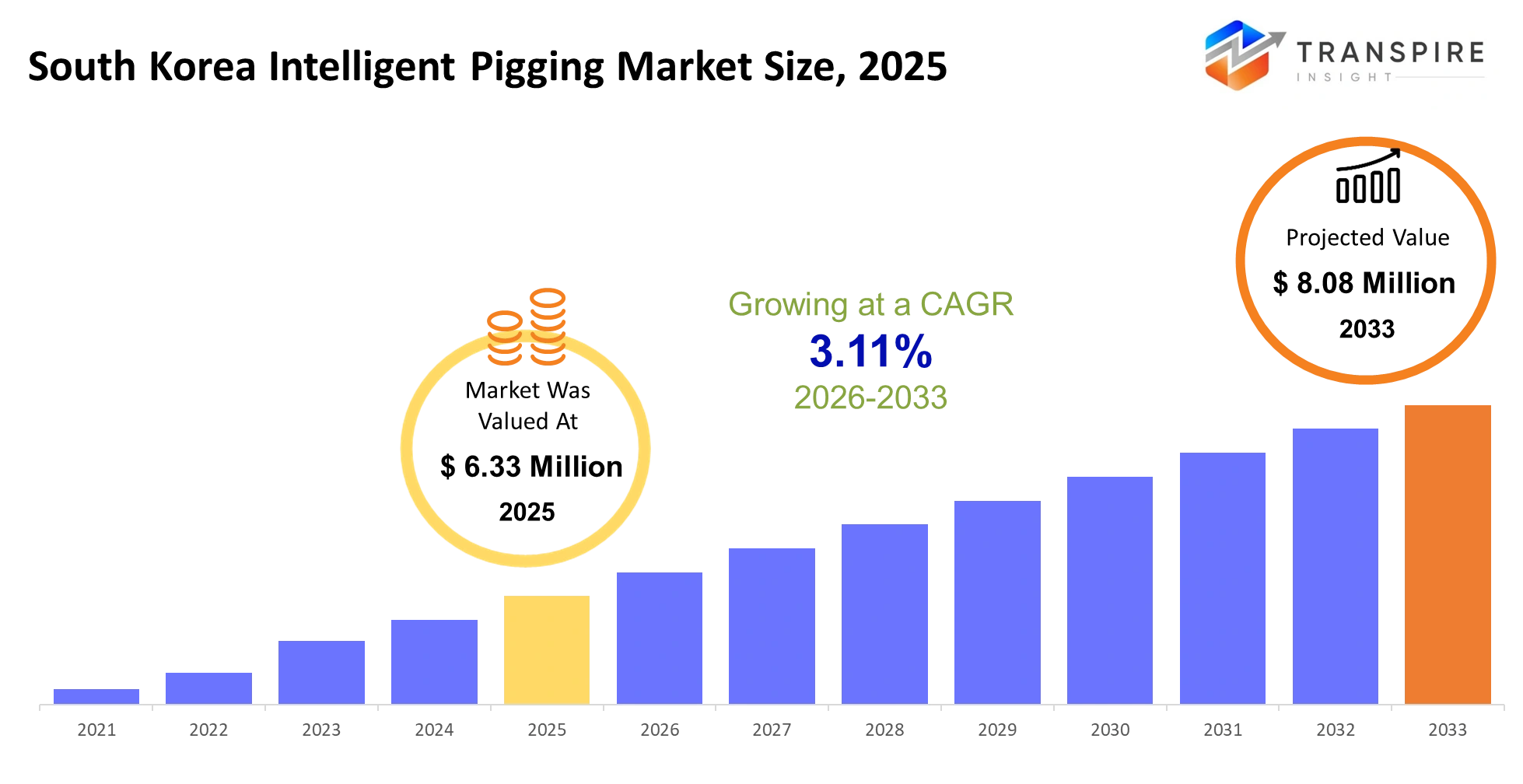
South Korea Intelligent Pigging Market Size & Forecast:
- South Korea Intelligent Pigging Market Size 2025: USD 6.33 Million
- South Korea Intelligent Pigging Market Size 2033: USD 8.08 Million
- South Korea Intelligent Pigging Market CAGR: 3.11%
- South Korea Intelligent Pigging Market Segments: By Technology (Magnetic Flux Leakage Pigging, Ultrasonic Pigging, Caliper Pigging, Smart Sensor Pigging, Others); By Application (Oil Pipelines, Gas Pipelines, Water Pipelines, Chemical Pipelines, Others); By Component (Inspection Tools, Sensors, Data Analytics Software, Communication Systems, Others); By End User (Oil & Gas Companies, Utility Companies, Chemical Industry, Others).
To learn more about this report,  Download Free Sample Report
South Korea Intelligent Pigging Market Summary
The South Korea Intelligent Pigging Market was valued at USD 6.33 Million in 2025. It is forecast to reach USD 8.08 Million by 2033. That is a CAGR of 3.11% over the period.
South Korea’s intelligent pigging market kind of supports safe pipeline operations where oil, gas, petrochemicals, and industrial fluids get moved around. Like, in reality intelligent pigs actually travel inside the pipelines to spot corrosion, cracks, metal loss, and also flow restrictions before failures end up disrupting refineries terminals or energy distribution networks. This role feels even more important now since South Korea is dealing with aging infrastructure while still placing new energy investments into the mix.
Over roughly the last three to five years, the market has tilted away from periodic mechanical inspection, and toward data-driven inline diagnostics that blend high resolution sensors with analytics and digital asset management platforms. A main trigger was the supply chain disruption and energy market volatility that followed the Russia-Ukraine conflict, which basically pushed many operators to guard their existing pipeline assets and keep away from unplanned shutdowns. That shift changed spending habits too. Operators now tend to prioritize predictive maintenance because catching early defects, lowers overall repair costs and improves regulatory alignment, plus it extends asset life. In turn this makes service adoption stronger and creates more recurring inspection revenue.
Key Market Insights
- The South Korea Intelligent Pigging Market is shifting, bit by bit, toward digital pipeline inspection , tougher integrity measures, and more predictive maintenance across energy infrastructure.
- Overall forecast outlook stays positive beyond 2030+, mostly because smart inspection systems keep improving and asset reliability requirements get stricter.
- The southeastern industrial corridor looks like the biggest driver, with an estimated 45%+ share in 2025, largely due to concentrated petrochemical plus gas infrastructure , so the installed base keeps growing.
- Coastal energy hubs are also moving fastest, powered by LNG terminal expansion and pipeline modernization investment programs.
- Magnetic Flux Leakage (MFL) technology is still leading the South Korea Intelligent Pigging Market with more than 40% share, largely since its corrosion detection accuracy is considered very high.
- Ultrasonic inspection sits as the second-largest segment, and it’s used widely for crack identification, plus for more precise wall-thickness evaluations on critical pipelines.
- Caliper pigging systems are the fastest-growing technology segment over 2025–2031, with momentum from geometry measurement needs and the broader push toward automation.
- On the application side, metal loss and corrosion detection commands demand with over 50% share, reflecting aging pipeline networks and the maintenance priorities that come with them.
- Oil and gas operators hold a major 60%+ end-user portion, while water and wastewater utilities are becoming an increasingly visible adoption group .
- Competitive pressure is shaping up with global names like ROSEN Group, Baker Hughes, T.D. Williamson, Schlumberger, Intertek, and Cokebusters, which try to win through AI analytics, sensor improvements , partnerships, and strategic geographic expansion.
What are the Key Drivers, Restraints, and Opportunities in the South Korea Intelligent Pigging Market?
The main force that keeps shaping the South Korea Intelligent Pigging Market is mostly this stronger focus on pipeline integrity, and not stopping industrial work—across oil, gas, and petrochemical corridors. That direction got even faster when operators started seeing sharper financial losses due to unplanned shutdowns and also tougher inspection expectations tied to industrial safety reforms , plus infrastructure modernization attempts. With intelligent pigging technologies, companies can find corrosion, cracks, and metal loss without actually halting pipeline operations, so maintenance becomes more surgical and frankly more cost efficient. In practice, it means more money going into predictive maintenance initiatives and longer horizon inspection agreements, and that helps service providers grow repeat revenue , while also pulling bigger infrastructure owners toward adoption.
The biggest limitation, on the other hand, is the stubborn structural headache from legacy pipeline infrastructure and the really high cost to roll out these tools. In South Korea, quite a few pipelines were never intended for advanced inline inspection systems, and they often need launcher upgrades , geometry changes, or other engineering tweaks before intelligent pigs can work properly. This problem does not go away easily, because retrofitting usually drags on through approvals, calls for specialized engineering know how, and demands major capital spending. So timelines still tend to stretch out, especially for smaller operators, which then reduces inspection frequency, and also dampens the near term revenue momentum for the market.
A big opportunity for the South Korea Intelligent Pigging Market feels like it is in weaving AI-enabled analytics into digital asset management platforms, so not just doing one thing at a time. South Korea’s coastal industrial and LNG infrastructure corridors are more and more putting money into smart monitoring systems that somehow link inspection data with predictive diagnostics, and also failure forecasting. From there, the whole shift opens doors for technology providers to step out of the standalone inspection services routine and instead provide integrated asset intelligence solutions, which helps teams make maintenance decisions sooner, and keeps operational reliability higher.
What Has the Impact of Artificial Intelligence Been on the South Korea Intelligent Pigging Market?
Artificial intelligence has sort of moved the South Korea Intelligent Pigging Market away from only periodic defect detection , and toward predictive pipeline intelligence. Before, intelligent pigging mostly meant collecting inspection evidence, then having engineers review it after the pipe run was done. Now AI changes that rhythm by chewing through huge inspection datasets quickly, and then pointing out corrosion patterns, crack propagation, and wall thickness irregularities with more accuracy . As a result, interpretation time drops , and operators can rank repairs earlier so small defects don’t turn into operational breakdowns.
You can see this most clearly in predictive maintenance approaches across South Korea’s oil , gas , and petrochemical network. AI powered analytics can match older pigging findings with what’s happening in operations right now, then project deterioration trajectories and approximate remaining useful life. That tends to cut emergency maintenance spend and also lowers the chances of sudden unplanned shutdowns, which makes intelligent pigging solutions feel more commercially compelling. Meanwhile, operators keep pushing for better asset utilization , and higher maintenance efficiency, so inspection cycles increasingly drift from rigid calendars to condition based scheduling.
AI also somehow bumped up the competitive standing of intelligent pigging providers. Now they don’t just muscle their way in with inspection hardware, instead they go at it with advanced analytics platforms, automated reporting systems and digital asset management integration, in a more layered way. That shift backs up higher-value service contracts and keeps money coming in through recurring software driven revenue models. In South Korea, where industrial operators seem to care a lot about operational continuity and infrastructure reliability, AI enabled intelligent pigging is turning into more of a strategic instrument for long term pipeline asset management, not merely a standalone inspection service.
Key Market Trends
- The South Korea Intelligent Pigging Market has kind of shifted away from periodic inspections and more toward predictive , data-driven pipeline asset management , supported by digital technologies that kinda “talk” with each other.
- Over the last five years , operators increased investment in AI diagnostics and advanced sensors so they can reduce operational disruptions and also stretch the infrastructure life longer than before.
- Since 2020, pipeline operators have been moving from fixed inspection schedules into condition-based maintenance, using intelligent pigging analytics alongside real-time performance data that gets updated constantly.
- Industrial safety reforms and tighter infrastructure oversight altered maintenance priorities, so early defect detection moved forward, instead of waiting for reactive repair approaches that are sometimes too late.
- Magnetic Flux Leakage systems got stronger uptake between 2021 and 2025, because corrosion monitoring became pretty critical across aging petrochemical pipelines, everywhere they look.
- Ultrasonic and high-resolution inspection technologies expanded beyond niche, specialized use cases as operators insisted on sharper crack and wall-thickness analysis, not vague estimates.
- The Russia-Ukraine energy disruption reworked procurement strategies after 2022, and that pushed operators to protect existing pipeline assets , and to avoid losses tied to shutdown related events.
- AI-enabled analytics are increasingly replacing manual inspection interpretation , which helps with faster data processing speed, and also improves how accurate maintenance decisions are on complex networks.
- Global companies such as ROSEN Group , Baker Hughes , and T.D. Williamson intensified competition by focusing on software integration and digital reporting capabilities , not just hardware.
- Competitive playbooks then leaned into integrated inspection and asset intelligence services, with providers bundling analytics, monitoring, and compliance support into longer-term contracts, kind of like one package deal.
South Korea Intelligent Pigging Market Segmentation
By Technology
Magnetic Flux Leakage pigging keeps showing up as the lead player in the South Korea Intelligent Pigging Market , mostly because pipeline operators trust it for reliable corrosion and metal loss detection across older oil gas , and petrochemical lines. It kind of fits big inspection programs because it runs efficiently without too much trouble , and it also helps teams schedule standardized maintenance. Ultrasonic pigging takes a smaller but still meaningful slice, particularly on higher-risk routes where operators want detailed crack detection and a more exact wall-thickness reading. Caliper pigging is tightly linked to geometry focused inspection work, so it helps spot dents or deformation before advanced inspection systems are even deployed. Meanwhile smart sensor pigging keeps getting more attention through integrated sensing ,plus digital diagnostics. The “others” bucket stays pretty fragmented , covering hybrid and specialized technologies for pipelines that have unique operating or engineering needs, so their adoption varies a lot.
The growth of Magnetic Flux Leakage pigging comes from stronger pipeline integrity plans, and honestly, the need for inspection approaches that “fit” big industrial networks, plus maintenance cycles that behave more or less predictably. Smart sensor pigging is also pushing ahead at a faster rate , mostly because operators want AI assisted analytics, digital documents, and predictive upkeep solutions, instead of just standalone inspection outputs. Ultrasonic along with caliper methods keep expanding too, where inspection precision and geometry validation really do affect operating safety and regulatory compliance. In the forecast window, MFL pigging is expected to keep its lead, while smart sensor technologies are projected to become even more relevant as South Korean operators move toward unified, data driven pipeline asset management, and build more advanced inspection environments.
By Application
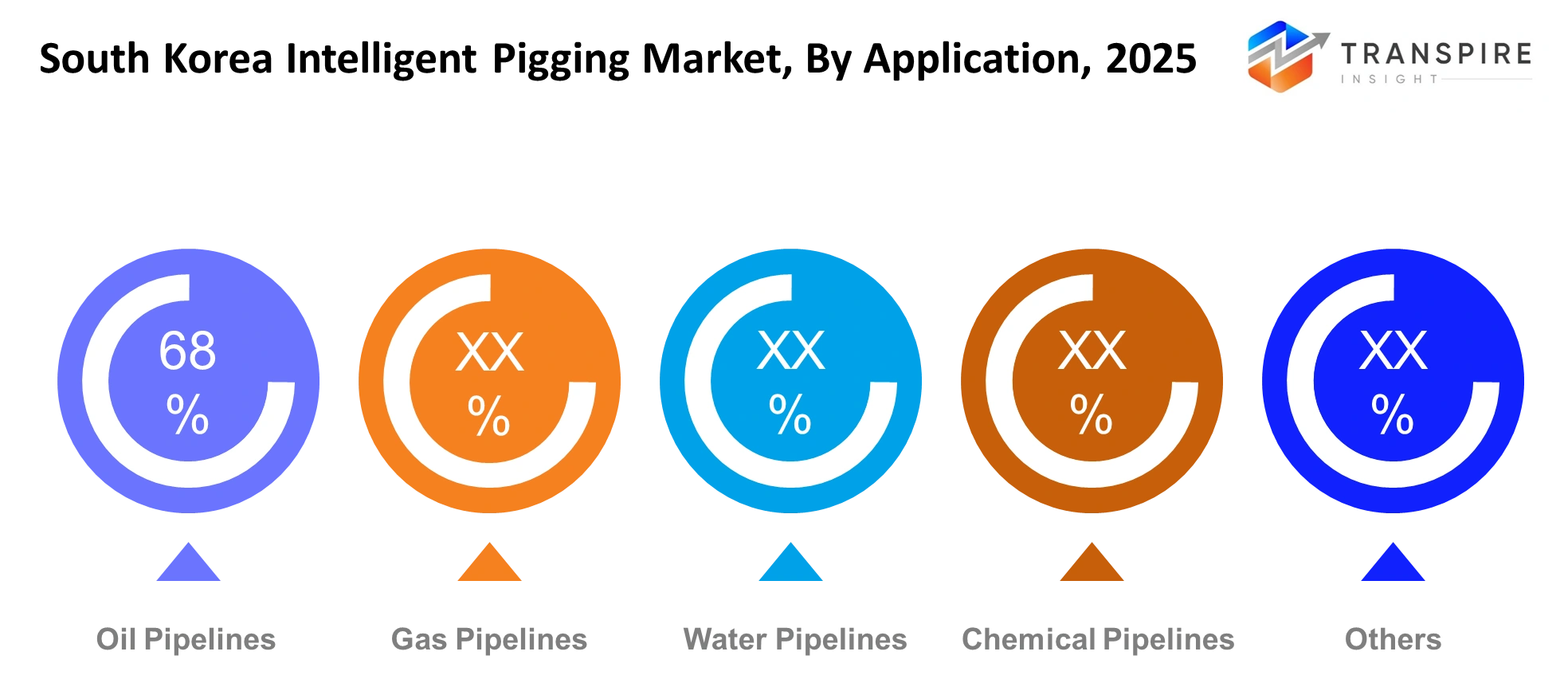
Oil pipelines keep a sort of dominant position in the South Korea Intelligent Pigging Market, since refinery networks and petroleum transport systems really need regular integrity monitoring to stop corrosion, leakage and those expensive operational disruptions. Big industrial players keep leaning on intelligent pigging in order to maintain aging pipeline infrastructure, and also to keep fuel distribution running without pauses. Gas pipelines stay as another key application area, pushed by LNG infrastructure expansion and more strict safety expectations for natural gas transportation. Water pipelines are slowly getting more relevant too, as municipal utilities modernize old systems and concentrate on leak prevention. Chemical pipelines also depend on intelligent pigging, especially when managing hazardous materials where contamination risks and structural failure can become serious operational hazards. The “others” segment is still comparatively scattered across industrial and very specific pipeline uses, with inspection needs that are basically tied to each individual project.
The growth of oil and gas pipeline applications is driven by tighter integrity standards, higher shutdown expenses, and a more intense focus on predictive maintenance strategies across industrial infrastructure . Water pipeline inspection keeps rising mainly because municipal bodies are investing in resilience for aging systems, plus they are trying to cut non- revenue water losses , which opens up room for inspection service providers to step in . Chemical pipeline adoption is also moving forward as manufacturers look for dependable monitoring setups , so they can handle safety requirements and compliance obligations with less uncertainty . In the forecast period, oil pipelines are expected to keep the lead, mostly because the inspection cycles are already in place, and because there’s a huge installed network, while water and gas pipeline applications are predicted to build stronger momentum as South Korea pushes utility modernization initiatives and energy infrastructure reliability programs.
To learn more about this report, Download Free Sample Report
By Component
Inspection tools keep hold of the bigger portion in the South Korea Intelligent Pigging Market, mostly because they still act as the main hardware needed for inline pipeline inspection and defect spotting. In practice, operators use these tools to catch corrosion , cracks, and geometry issues through oil , gas, as well as industrial pipeline networks. At the same time, sensors are becoming more and more important, since inspection needs shift toward finer precision and real-time data collection. Meanwhile data analytics software is getting real traction as teams want to move past plain defect detection and into predictive upkeep, along with digital asset handling. Communication systems also help with quicker transmission, and smoother integration of inspection outputs into central monitoring platforms. Where as the “others” bucket basically covers supporting technologies and customized components, built for specialized operating Growth inside the component segment is showing up more from software, and digital integration than from hardware by itself. Since 2020, operators have put more money into AI enabled analytics, plus connected inspection ecosystems, that reduce the interpretation delay and help maintenance schedule accuracy, overall. Inspection tools are still expected to keep a leading posture because they’re essential for pigging operations, but analytics software and smarter sensing technologies will probably grow faster as South Korea’s industrial backbone starts adopting more intelligent , and linked pipeline monitoring systems.
By End User
In South Korea, oil and gas firms still hold the main position with end users, and it’s kind of inevitable really, since huge pipeline networks and very strict operational reliability needs mean routine inspection is close to unavoidable. They lean on intelligent pigging to help stop leaks, lower the risk of unplanned shutdowns, and push asset life further across petroleum and gas transport corridors. Utility operators are also ramping up adoption, because water supply and power distribution systems are dealing with aging infrastructure, plus customers are asking for steadier service. Meanwhile the chemical sector turns to intelligent pigging, not just for convenience but to keep track of pipelines that move hazardous materials, because if the structure fails there are immediate safety issues and compliance worries.
The growth pattern among end users looks like it’s getting a bit different , especially in maintenance habits and in what infrastructure teams think is priority. Oil and gas operators keep creating the biggest inspection demand using scheduled integrity programs , still. Utility companies show up as a noticeable growth segment too, mostly because modernization investments and leak reduction initiatives are really moving forward. Meanwhile, the chemical industry keeps expanding its use of advanced inspection technologies, as manufacturers push for safer operations and tighter process control. That shift also opens up broader opportunities for intelligent pigging providers, not just the usual energy applications.
What are the Key Use Cases Driving the South Korea Intelligent Pigging Market?
The South Korea Intelligent Pigging Market is mostly pushed by pipeline integrity management, like operators using intelligent pigging to catch corrosion, metal loss, tiny cracks, and other structural weak points before anything goes wrong. In practice, oil and gas players lean on these inspections a lot, because their pipeline networks are getting older, so it helps them steer clear of surprise shutdowns, and also cut those expensive emergency fixes. Over time, regular inline inspection has turned into a must have routine, since pipeline incidents can stop fuel delivery, hurt industrial equipment, and even lead to regulatory penalties. So yeah the same use pattern keeps fueling demand, as infrastructure operators move away from reactive maintenance, and toward predictive asset control , or something closer to it.
A different big use case shows up in gas and LNG infrastructure monitoring, especially now that South Korea is trying harder with energy security and it keeps expanding gas transport routes. Intelligent pigging enables operators to measure pipeline wall thickness, check weld soundness, and spot deformation in high pressure systems where safety requirements stay extremely tight. Those checks support day to day operational stability, and they lower the chances of leaks, plus the risk of pressure related failures. Because of that, intelligent pigging feels more like a strategic instrument within LNG terminals, and across gas distribution corridors.
Then there is water and chemical pipeline inspection , which is also getting more attention lately. City utilities often use intelligent pigging to find where leaks are showing up, and to improve how efficiently the infrastructure runs. At the same time, chemical manufacturers deploy inspection tools to watch pipelines transporting hazardous materials. In these cases intelligent pigging supports compliance with rules, helps prevent contamination , and enables safer industrial operations overall. That combination is widening market potential beyond the usual oil and gas story, and it keeps opening new growth paths.
|
Report Metrics |
Details |
|
Market size value in 2025 |
USD 6.33 Million |
|
Market size value in 2026 |
USD 6.52 Million |
|
Revenue forecast in 2033 |
USD 8.08 Million |
|
Growth rate |
CAGR of 3.11% from 2026 to 2033 |
|
Base year |
2025 |
|
Historical data |
2021 - 2024 |
|
Forecast period |
2026 - 2033 |
|
Report coverage |
Revenue forecast, competitive landscape, growth factors, and trends |
|
Regional scope |
South Korea |
|
Key company profiled |
ROSEN Group, Baker Hughes, T.D. Williamson, NDT Global, Intertek, SGS, Emerson, Applus+, Quest Integrity, Penspen, Dacon Inspection Technologies, Entegra, Pipetel Technologies, LIN SCAN, Creaform. |
|
Customization scope |
Free report customization (country, regional & segment scope). Avail customized purchase options to meet your exact research needs. |
|
Report Segmentation |
By Technology (Magnetic Flux Leakage Pigging, Ultrasonic Pigging, Caliper Pigging, Smart Sensor Pigging, Others); By Application (Oil Pipelines, Gas Pipelines, Water Pipelines, Chemical Pipelines, Others); By Component (Inspection Tools, Sensors, Data Analytics Software, Communication Systems, Others); By End User (Oil & Gas Companies, Utility Companies, Chemical Industry, Others). |
Which Regions are Driving the South Korea Intelligent Pigging Market Growth?
The most solid growth in the South Korea Intelligent Pigging Market shows up in the southeastern industrial corridor , especially around Ulsan, Busan, and the nearby heavy industry belts. In practice these areas gather a lot of South Korea’s petrochemical setups, refining operations, and gas processing infrastructure, so demand for intelligent pigging keeps showing up regularly. Operators with pipelines in these zones lean on routine inline inspection, to deal with corrosion, avoid unplanned shutdowns , and hold up aging industrial assets. Big refinery clusters and petrochemical hubs also tend to stretch the inspection agreements, plus they help faster uptake of upgraded techniques like Magnetic Flux Leakage and AI enabled diagnostics.
At the same time, coastal LNG and energy infrastructure hubs are becoming a real push factor. The facilities connected to LNG import, gas transmission, and distribution networks are increasingly asking for very precise inspection tools, so safety stays protected and operations remain stable. Around the big ports and industrial shorelines, there has been noticeable extra spending on pipeline modernization and predictive maintenance programs, which moves adoption beyond the usual oil hauling systems.
Also, utility centric regions such as around Incheon, plus the wider metropolitan infrastructure corridors, are starting to add more weight to the market picture, mainly through water and municipal pipeline inspection programs. As public utilities modernize older networks, and prioritize leak prevention, intelligent pigging is slowly moving from the classic energy use case into wider industrial and public infrastructure management.
Who are the Key Players in the South Korea Intelligent Pigging Market and How Do They Compete?
The South Korea Intelligent Pigging Market gets shaped by a kind of blend global inspection technology providers, and a few specialized pipeline integrity companies too, so it can feel a bit layered in practice. In the mix you usually see names like ROSEN Group, Baker Hughes, T.D. Williamson, SLB (Schlumberger), Intertek, and Cokebusters. Together they tend to support pipeline operators across oil, gas, petrochemical, and also industrial infrastructure, mainly via inline inspection, corrosion assessment, and integrity management services. Their role stays especially noticeable along South Korea’s refinery zones and coastal energy corridors, where inspection accuracy and operational continuity end up affecting which contracts get picked.
At the same time competition has moved, not just around inspection hardware alone, but toward more integrated digital capabilities and longer term service value. Providers more and more try to stand out using AI-enabled analytics, high-resolution sensing, automated reporting, and digital asset management platforms. In that way operators can shift from “every so often” inspection activities to predictive maintenance, with a clearer rhythm. Strategic partnerships alongside localized technical support are also getting more attention, because global players want quicker response times, and they need to adapt to South Korean infrastructure needs, even when those needs differ between sites. Companies that look like they gain an advantage are the ones that combine inspection tools with analytics, continuous monitoring, and compliance support. That kind of approach makes recurring service relationships, rather than staying with one-time inspection engagements. Overall this competitive shift seems to favor technology integration, faster defect interpretation, and lifecycle asset management know-how, more than just the pigging mechanism itself.
Company List
- ROSEN Group
- Baker Hughes
- T.D. Williamson
- NDT Global
- Intertek
- SGS
- Emerson
- Applus+
- Quest Integrity
- Penspen
- Dacon Inspection Technologies
- Entegra
- Pipetel Technologies
- LIN SCAN
- Creaform
Recent Development News
T.D. Williamson (TDW) Received Strategic Investment from Apollo Funds (2025)
TDW secured strategic investment from Apollo-managed funds to strengthen pipeline integrity technologies and expand advanced inspection capabilities. This move is expected to support digital inspection and infrastructure service growth globally.
Link:TDW Investment Announcement
TDW and Onboard Dynamics Formed Emissions Reduction Partnership (2025)
TDW partnered with Onboard Dynamics to develop lower-emission pipeline maintenance and operational technologies, reflecting the industry shift toward cleaner infrastructure services.
Link:https://onboarddynamics.com
Baker Hughes Expanded Pipeline Integrity and Inline Inspection Solutions
Baker Hughes continues advancing digital inline inspection, corrosion monitoring, and predictive maintenance technologies to improve pipeline reliability and operational continuity.
Link:https://www.bakerhughes.com
What Strategic Insights Define the Future of the South Korea Intelligent Pigging Market?
The future of the South Korea Intelligent Pigging Market is likely to be shaped by that transition from a kind of standalone inspection job toward more integrated pipeline intelligence and predictive asset stewardship, I mean like not just checking things and then done, but actually using the results. Operators are also starting to see intelligent pigging as part of a wider infrastructure reliability approach, not just a periodic maintenance chore that shows up on a schedule. Because of that, the solutions that tend to win are the ones that bundle inspection equipment, AI-driven evaluation, and digital asset management platforms, so inspection outputs can turn into concrete maintenance calls. Firms that manage near continuous oversight and faster defect readout will probably lock in firmer long term agreements.
Also, one more strategic angle is the rising pressure to modernize aging infrastructure across oil, gas, petrochemical, and utility networks. A lot of pipelines in South Korea need integrity checks more often to keep safety levels up and satisfy regulatory expectations. With shutdown expenses climbing and operational dangers getting harder to tolerate, operators are shifting more spend into predictive maintenance and lifecycle extension initiatives. That pattern supports repeated inspection work, while opening doors for providers that can deliver sharper, higher-resolution diagnostics and more end-to-end integrity services, not just raw measurements.
In terms of competition, the playing field will increasingly favor technology convergence and locally grounded know-how. Big firms such as ROSEN Group, Baker Hughes, and T.D. Williamson are moving past a pure hardware race, and instead putting money into AI analytics, software frameworks, and cooperative service styles. In the coming years, market leadership may depend less on inspection tools by themselves and more on the capability to deliver insight based decisions, strong regional technical assistance, and full pipeline lifecycle management offerings.
South Korea Intelligent Pigging Market Report Segmentation
By Technology
- Magnetic Flux Leakage Pigging
- Ultrasonic Pigging
- Caliper Pigging
- Smart Sensor Pigging
- Others
By Application
- Oil Pipelines
- Gas Pipelines
- Water Pipelines
- Chemical Pipelines
- Others
By Component
- Inspection Tools
- Sensors
- Data Analytics Software
- Communication Systems
- Others
By End User
- Oil & Gas Companies
- Utility Companies
- Chemical Industry
- Others
Frequently Asked Questions
Find quick answers to common questions.
The estimated South Korea Intelligent Pigging Market size for the market will be USD 8.08 Million in 2033.
Key segments for the South Korea Intelligent Pigging Market are By Technology (Magnetic Flux Leakage Pigging, Ultrasonic Pigging, Caliper Pigging, Smart Sensor Pigging, Others); By Application (Oil Pipelines, Gas Pipelines, Water Pipelines, Chemical Pipelines, Others); By Component (Inspection Tools, Sensors, Data Analytics Software, Communication Systems, Others); By End User (Oil & Gas Companies, Utility Companies, Chemical Industry, Others).
Major South Korea Intelligent Pigging Market players are ROSEN Group, Baker Hughes, T.D. Williamson, NDT Global, Intertek, SGS, Emerson, Applus+, Quest Integrity, Penspen, Dacon Inspection Technologies, Entegra, Pipetel Technologies, LIN SCAN, Creaform.
The South Korea Intelligent Pigging Market size is USD 6.33 Million in 2025.
The South Korea Intelligent Pigging Market CAGR is 3.11% from 2026 to 2033.
- ROSEN Group
- Baker Hughes
- T.D. Williamson
- NDT Global
- Intertek
- SGS
- Emerson
- Applus+
- Quest Integrity
- Penspen
- Dacon Inspection Technologies
- Entegra
- Pipetel Technologies
- LIN SCAN
- Creaform
Recently Published Reports
-
Apr 2026
Active Power Filter Market
Active Power Filter Market Size, Share & Analysis Report By Type (Shunt Active Power Filters, Series Active Power Filter, Hybrid Active Power Filter), By Application (Harmonics Mitigation, Reactive Power Compensation, Voltage Regulation, Power Factor Correction), By Phase (Single Phase, Three Phase), By End-User Industry (Manufacturing, Healthcare, Commercial, Automotive, Oil and Gas, Others), and Geography (North America, Europe, Asia-Pacific, Middle East and Africa, South and Central America), 2021 - 2031
-
Apr 2026
Electrical Transformer Market
Electrical Transformer Market Size, Share & Analysis Report By Core (Closed, Shell, and Berry), By Insulation (Gas, Oil, Solid, Air, and Other), By Phase (Single, and Three), By Rating (100 MVA to 500 MVA, 501 MVA to 800 MVA, and 801 MVA to 1200 MVA), and Geography (North America, Europe, Asia-Pacific, Middle East and Africa, South and Central America), 2021 – 2031
-
Apr 2026
Hydraulic Piston Pumps Market
Hydraulic Piston Pumps Market Size, Share & Analysis Report By Type (Axial Piston Pumps, Radial Piston Pumps), By Operating Pressure (Low Pressure, Medium Pressure, High Pressure), By Application (Construction, Mining, Agriculture, Automotive, Oil & Gas, Industrial Machinery, Others), By End-User (OEMs, Aftermarket), and Geography (North America, Europe, Asia-Pacific, Middle East and Africa, South and Central America), 2021 – 2031
-
Apr 2026
Laboratory Gas Generators Market
Laboratory Gas Generators Market Size, Share & Analysis Report By Product (Nitrogen Gas Generator, Hydrogen Gas Generator, Zero Air Gas Generator, Purge Gas Generator, TOC Gas Generators, Others), By Application (Gas Chromatography, Liquid Chromatography-mass Spectrometry (LC-MS), Gas Analyzers, Others), By End-user (Life Science, Chemical & Petrochemical, Food & Beverage, Others), and Geography (North America, Europe, Asia-Pacific, Middle East and Africa, South and Central America), 2021 – 2031