
South Korea Helium-3 Market Size & Forecast:
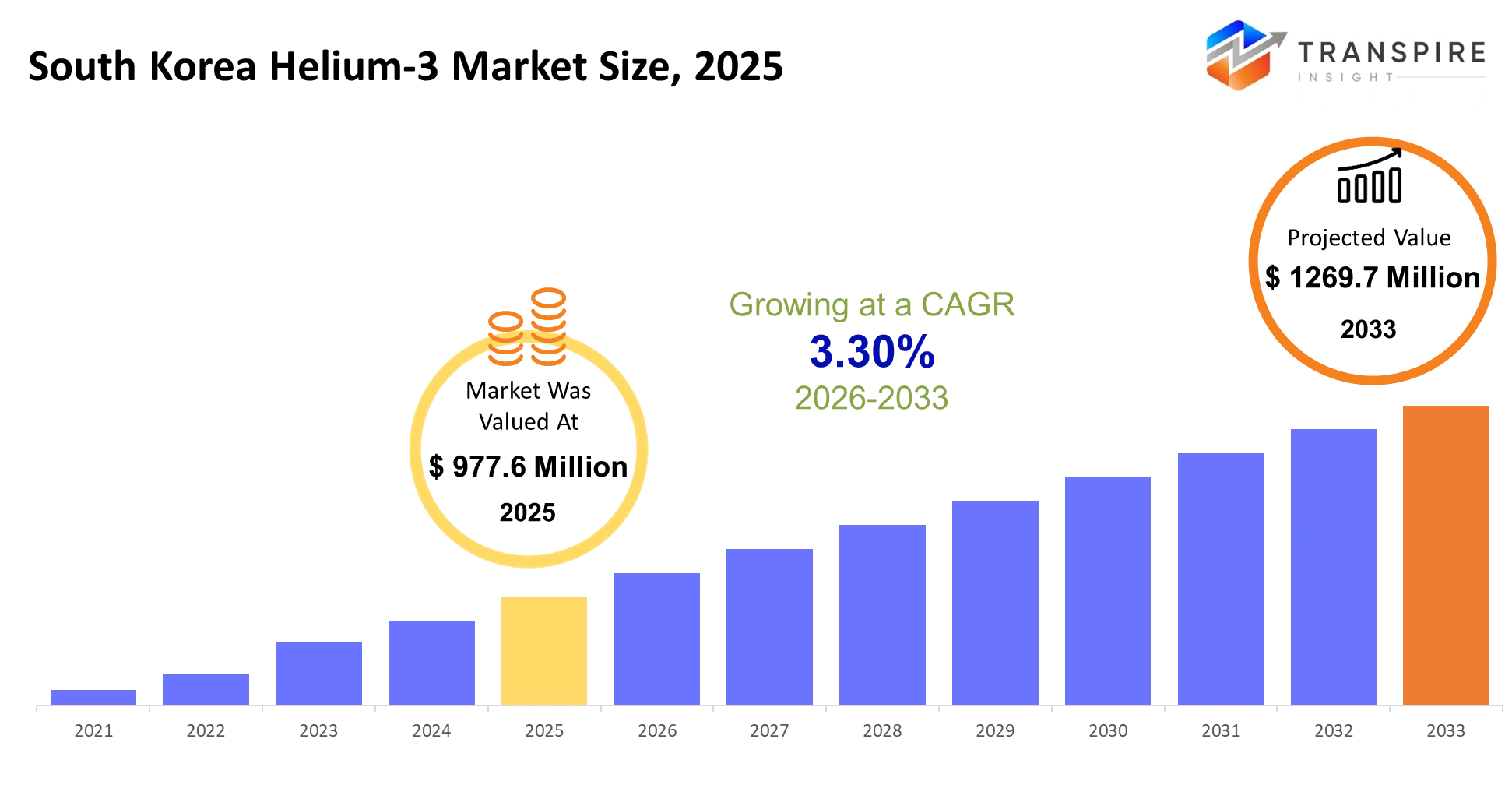
- South Korea Helium-3 Market Size 2025: USD 977.6 Million
- South Korea Helium-3 Market Size 2033: USD 1269.7 Million
- South Korea Helium-3 Market CAGR: 3.30%
- South Korea Helium-3 Market Segments: By Application (Cryogenics, Neutron Detection, Medical Imaging, Research), By End-User (Research Institutes, Healthcare, Defense), By Form (Gas, Liquid)
To learn more about this report,  Download Free Sample Report
South Korea Helium-3 Market Summary:
South Korea Helium-3 Market size was estimated at USD 977.6 Millionin 2025 and is anticipated to reach USD 1269.7 Million by 2033, growing at a CAGR of 3.30% from 2026 to 2033.
South Korea Helium-3 Market sits within the advanced energy and nuclear materials industry, scientific ambition together with resource planning created the present development. The country will continue to view helium-3 as a rare and valuable isotope which links directly to future-facing applications that include fusion research and quantum sensing and specialized detection systems. The demand will stay connected to government-funded research initiatives together with academic partnerships which prioritize accuracy and dependability above production output. South Korea will choose controlled sourcing together with long-term agreements as its primary method of acquiring rare isotopes because global supply chains for these materials remain restricted.
The development of technology will determine future methods used to manage helium-3 because research facilities will begin using better cryogenic systems and advanced detection equipment. Consumer demand will shift toward higher purity standards and traceability because scientific and defense needs create these expectations. Regulatory authorities will establish more rigorous standards which will include specific guidelines for import procedures and usage oversight together with environmental management. The market will grow through these changes which will create business opportunities while the sector remains small and important because of its innovation and policy development.
Key Market Trends & Insights:
- The Helium-3 market in South Korea demonstrates increasing interest because helium-3 resources become scarce worldwide. The supply chain depends on nuclear byproducts together with controlled reserves which creates ongoing supply uncertainty. The accelerating strategic talks about establishing permanent isotope sources will determine research funding allocation and international partnerships which research rare isotope access.
- The South Korean Helium-3 Market demonstrates increasing connections to quantum computing together with low-temperature physics research activities. Helium-3 serves as an essential component in dilution refrigerators which operate quantum systems. The domestic quantum research programs will create constant demand because academic institutions will collaborate with technology developers.
- The South Korean Helium-3 Market receives support from defense applications which include neutron detection systems. The security infrastructure modernization efforts create steady demand for border monitoring systems and nuclear detection technologies. The government-backed initiatives will keep demand stable even when commercial usage patterns change.
- Helium-3 research in fusion energy studies attracts interest from the South Korean Helium-3 Market because helium-3 is viewed as a possible clean fuel solution. Ongoing experimental work and international partnerships will continue to create limited interest in helium-3 because large-scale use remains unattainable which makes helium-3 a permanent element in research for alternative energy solutions.
- The South Korean helium-3 market depends entirely on imports creating a situation where geopolitical events and supply shortages directly affect pricing. The market participants use efficient recycling technologies to reduce their operational expenses. The organizations will base their procurement methods on this dependency while they invest in methods to optimize resource usage.
South Korea Helium-3 Market Segmentation
By Application
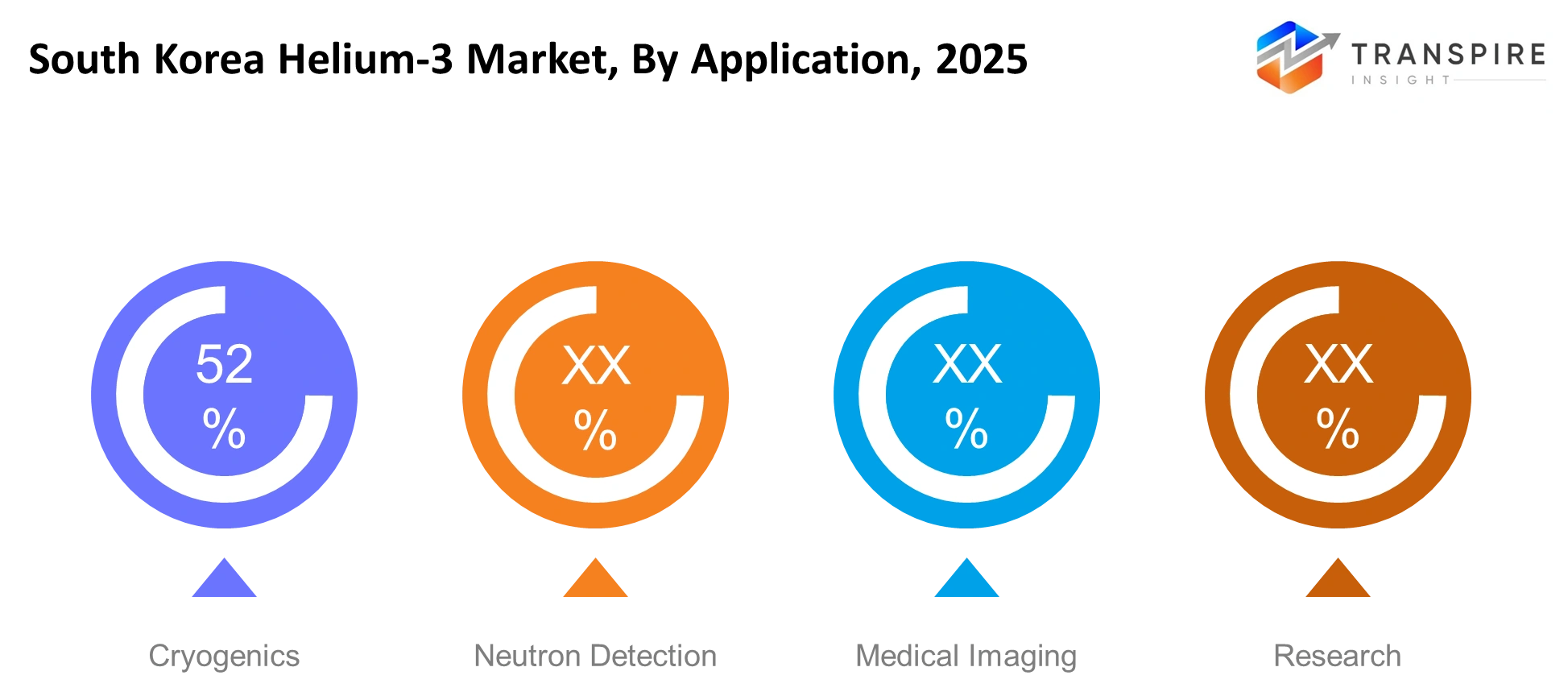
- Cryogenics: The South Korean Helium-3 Market maintains a strong connection to cryogenic systems because these systems require ultra-low temperatures for both scientific and industrial activities. Advanced laboratories use helium-3 to operate their dilution refrigeration systems. The need for stable cooling systems will increase because quantum computing research requires these systems to keep their operational standards through precise temperature control.
- Neutron Detection: The South Korean Helium-3 Market functions as a critical component for security and monitoring operations that depend on neutron detection technologies. Helium-3 gas enables accurate detection of neutron radiation in border control, nuclear facilities, and research setups. The growing need for nuclear security and monitoring systems will create constant demand for this specific application area.
- Medical Imaging: The South Korean Helium-3 Market supports medical imaging progress by advancing lung imaging techniques that use magnetic resonance methods. Helium-3 gas allows respiratory condition analysis through improved image quality which enables doctors to see detailed respiratory system structures. The ongoing growth of healthcare spending and public demand for non-invasive diagnostic approaches will sustain the use of specialized imaging techniques.
- Research: The South Korean Helium-3 Market maintains stable demand for scientific research work that includes physics experiments and energy research activities. Helium-3 serves as a critical material in nuclear fusion research and particle detection. The rise of academic and government-sponsored research initiatives will lead to ongoing laboratory consumption of resources needed for cutting-edge scientific research.
To learn more about this report, Download Free Sample Report
By End-User
- Research Institutes: Research institutes that require helium-3 for their experimental research and their low-temperature research work maintain strong control over the helium-3 market in South Korea. Advanced equipment which requires helium-3 exists at both national laboratories and universities. Scientific funding and innovation programs will drive ongoing research through institutional research facilities.
- Healthcare: In the healthcare sector South Korea Helium-3 Market supplies helium-3 for advanced imaging technologies used in medical facilities. Medical facilities use helium-3 for special procedures which include respiratory system evaluation. The healthcare sector will experience slow growth of helium-3 adoption due to increasing demand for early diagnosis methods and precision medicine.
- Defence: The South Korea Helium-3 Market delivers strategic value to defense operations through its role in radiation detection and national security systems. Helium-3 enables neutron detection systems which authorities use for monitoring and detecting potential threats. The defense sector will experience rising demand because of increased defense readiness and security infrastructure development.
By Form
- Gas: The South Korean Helium-3 market functions mainly through its gaseous state which serves as the primary detection method and medical imaging tool. The gas form provides simple handling capabilities which allow users to install it into their systems. The research and healthcare and defense sectors maintain a steady need for gaseous helium-3 which will keep demand at constant levels.
- Liquid: The South Korean Helium-3 market permits liquid helium-3 to be used in cryogenic applications which require extremely low temperatures. The scientific instruments and experimental systems use liquid helium-3 to provide their cooling requirements. The expansion of quantum research and advanced material studies will support gradual growth of this segment over time.
Country Insights
- The South Korean Helium-3 Market shows that the country values innovation and scientific progress according to its market development. The South Korean government maintains its financial support for advanced technology industries which leads to better access for research materials used in experimental studies. Research activities at academic institutions and national laboratories enable scientists to create new knowledge through their work on initial investigations. Government programs will promote research activities that focus on developing new energy technologies and conducting advanced physics studies.
- The industrial base of South Korea establishes a fundamental foundation which determines the development of the South Korean Helium-3 Market. The established fields of electronics and precision engineering supply the necessary technical resources which support helium-3 research activities. The combination of available funding resources with organized research initiatives creates a framework which enables research activities to continue their progress. Private enterprises and research facilities will work together to maintain research progress yet commercial applications will remain limited until further development occurs.
- The South Korean Helium-3 Market future development depends on international progress in nuclear fusion technology and space exploration initiatives. The South Korean government is expanding its research efforts in sustainable energy and alternative power sources which will create a permanent market for helium-3. International partnerships and scientific exchange will further influence development. The pace of technological progress and research findings will determine the speed at which functional uses will become available for use.
Recent Development News
March 2026 – Helium supply security stabilizes in South Korea (Reuters)
- South Korea’s semiconductor industry has secured 4–6 months of helium inventory, preventing immediate supply disruption despite geopolitical tensions.The issue arose after the Middle East conflict disrupted Qatar’s helium output, a major global supplier.Companies like Samsung and SK Hynix are paying premiums to secure helium, showing how strategic gases (including isotopes like Helium-3) are becoming critical inputs.
April 2026 – Industrial-scale lunar Helium-3 extraction tech emerges (Axios)
- Companies have developed prototype machines capable of processing 100 tons of lunar soil per hour.Helium-3 is gaining attention for fusion energy and national security applications, areas where South Korea is heavily investing.Commercial supply targets are being set as early as 2029.
|
Report Metrics |
Details |
|
Market size value in 2025 |
USD 977.6 Million |
|
Market size value in 2026 |
USD 1011.3 Million |
|
Revenue forecast in 2033 |
USD 1269.7 Million |
|
Growth rate |
CAGR of 3.30% from 2026 to 2033 |
|
Base year |
2025 |
|
Historical data |
2021 - 2024 |
|
Forecast period |
2026 - 2033 |
|
Report coverage |
Revenue forecast, competitive landscape, growth factors, and trends |
|
Country scope |
South Korea |
|
Key company profiled |
Linde plc, Air Liquide S.A., Air Products and Chemicals Inc., Messer Group GmbH, Praxair Inc., Taiyo Nippon Sanso Corporation, Matheson Tri-Gas Inc., Gazprom PJSC, Rosatom State Corporation, Cryomech Inc., Oxford Instruments plc, Sumitomo Seika Chemicals Co. Ltd., General Electric Company, Iwatani Corporation, American Gas Products LLC. |
|
Customization scope |
Free report customization (country, regional & segment scope). Avail customized purchase options to meet your exact research needs. |
|
Report Segmentation |
By Application (Cryogenics, Neutron Detection, Medical Imaging, Research), By End-User (Research Institutes, Healthcare, Defense), By Form (Gas, Liquid) |
Key South Korea Helium-3 Company Insights
- The Helium-3 market in South Korea has a specialized group of companies that collaborate with research institutes and government programs for their operations. The organization will conduct research activities to advance its studies in energy, quantum technology, and aerospace technology. The companies will develop their business strategies based on public funding which will become their primary resource while supply restrictions will guide their operational and financial choices.
- Market participants in South Korea Helium-3 will establish stable resource pathways through their global alliances and their development of new extraction techniques. The company will prioritize long-term research projects because commercial applications of their technology have not yet reached widespread use. The company will establish partnerships with universities to enhance research capabilities which will enable them to develop essential technical skills needed for future market requirements.
South Korea Helium-3 Market Companies:
- Linde plc
- Air Liquide S.A.
- Air Products and Chemicals Inc.
- Messer Group GmbH
- Praxair Inc.
- Taiyo Nippon Sanso Corporation
- Matheson Tri-Gas Inc.
- Gazprom PJSC
- Rosatom State Corporation
- Cryomech Inc.
- Oxford Instruments plc
- Sumitomo Seika Chemicals Co. Ltd.
- General Electric Company
- Iwatani Corporation
- American Gas Products LLC
South Korea Helium-3 Market Segmentation
By Application
- Cryogenics
- Neutron Detection
- Medical Imaging
- Research
By End-User
- Research Institutes
- Healthcare
- Defense
By Form
- Gas
- Liquid
Frequently Asked Questions
Find quick answers to common questions.
The Approximate South Korea Helium-3 Market size for the Market will be USD 1269.7 Million in 2033.
Key Segments for the South Korea Helium-3 Market are By Application (Cryogenics, Neutron Detection, Medical Imaging, Research), By End-User (Research Institutes, Healthcare, Defense), By Form (Gas, Liquid).
Major South Korea Helium-3 Market Players are Linde plc, Air Liquide S.A., Air Products and Chemicals Inc., Messer Group GmbH, Praxair Inc., Taiyo Nippon Sanso Corporation, Matheson Tri-Gas Inc., Gazprom PJSC, Rosatom State Corporation, Cryomech Inc., Oxford Instruments plc, Sumitomo Seika Chemicals Co. Ltd., General Electric Company, Iwatani Corporation, American Gas Products LLC.
The Current South Korea Helium-3 Market size is USD 977.6 Million in 2025.
The South Korea Helium-3 Market CAGR is 3.30%.
- Linde plc
- Air Liquide S.A.
- Air Products and Chemicals Inc.
- Messer Group GmbH
- Praxair Inc.
- Taiyo Nippon Sanso Corporation
- Matheson Tri-Gas Inc.
- Gazprom PJSC
- Rosatom State Corporation
- Cryomech Inc.
- Oxford Instruments plc
- Sumitomo Seika Chemicals Co. Ltd.
- General Electric Company
- Iwatani Corporation
- American Gas Products LLC
Recently Published Reports
-
May 2026
Healthcare Polymer Packaging Market
Healthcare Polymer Packaging Market Size, Share & Analysis Report By Packaging Type (Syringes, IV Bottles and Pouches, Clamshells, Blisters, Bottles & Jars, Containers, Tubes, IV Parental Packaging, Others), By Type (Regulated, Non-regulated), By Polymer Type (LDPE (Low-Density Polyethylene), HDPE (High-Density Polyethylene), Homo-polymer (Homo), Random Copolymer (Random), Block Copolymer (Block), PET, Polystyrene, Polyvinyl Chloride, Polyamide/EVOH, Others), and Geography (North America, Europe, Asia-Pacific, Middle East and Africa, South and Central America), 2021 - 2031
-
Apr 2026
Hydrophilic Tape (Waterstop) Market
Hydrophilic Tape (Waterstop) Market Size, Share & Analysis Report By Type (Bentonite-Based Hydrophilic Tape, Rubber-Based Hydrophilic Tape), By Application (Residential Buildings, Commercial Buildings, Infrastructure Projects), and Geography (North America, Europe, Asia-Pacific, Middle East and Africa, South and Central America), 2021 - 2031
-
Apr 2026
Metalens Market
Metalens Market Size, Share & Analysis Report By Type (Visible Light Metalens, and Infrared Metalens), By Application (Consumer Electronics, Automotive Electronics, Industrial, Medical, and Others), and Geography (North America, Europe, Asia-Pacific, Middle East and Africa, South and Central America), 2021 - 2031
-
Apr 2026
PBT Resin Market
PBT Resin Market Size, Share & Analysis Report By Type (Reinforced PBT Resin, Unreinforced PBT Resin), By Processing Method (Injection Molding, Extrusion, Blow Molding, Others), By End-User (Automotive, Electrical & Electronics, Consumer Appliances, Industrial Machinery, Medical Devices, Packaging, Others), and Geography (North America, Europe, Asia-Pacific, Middle East and Africa, South and Central America), 2021 - 2031