

South Korea Flaxseed Products Market Summary:
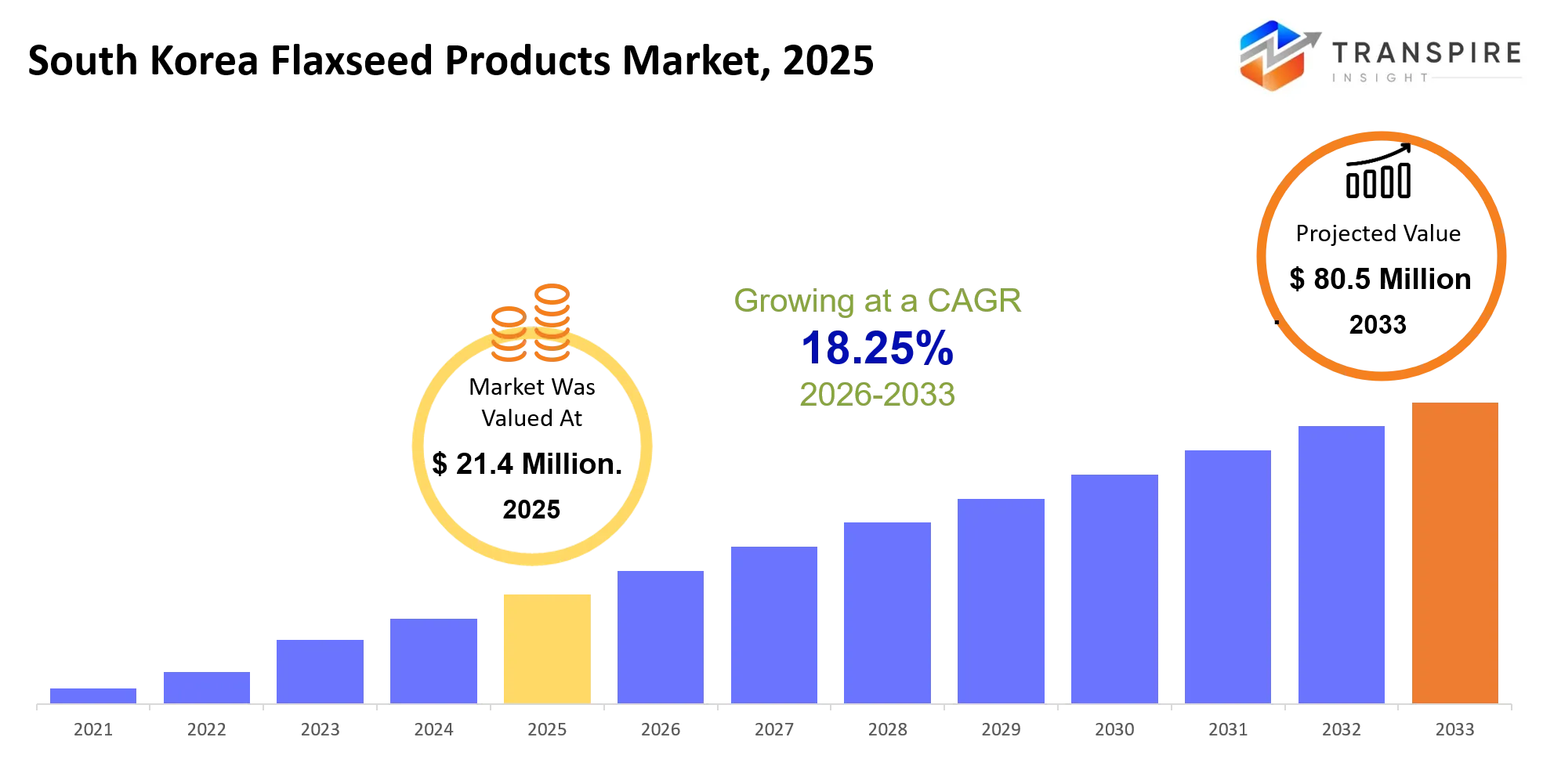
According to Transpire Insights, a detailed research report on the market reflects that the ground flaxseed products segment dominates the South Korea Flaxseed Products Market, accounting for approximately 70.56% of the total share nationwide. The market was valued at approximately USD 21.4 million in 2025 and is projected to reach USD 24.9 million in 2026 and USD 80.5 million by 2033, registering a CAGR of 18.2% during 2026–2033. Richardson International leads the competitive landscape with an estimated 3–8% market revenue share, making it a potential contributor to South Korea's flaxseed market development, innovation, advanced flaxseed processing, expanding supply capabilities, and growth dynamics.
Market Snapshot
- Market Value (2025): USD 21.4 Million.
- Expected Market Value (2026): USD 24.9 Million.
- Estimated Market Value (2033): USD 80.5 Million.
- Forecast CAGR (2026–2033): 18.25%.
- Introduction
South Korea Flaxseed Products Market Overview The South Korea Flaxseed Products Market consists of the processing, commercialization and distribution of flaxseed products such as whole flaxseeds, ground flaxseed, flaxseed oil and flaxseed-based ingredients. They are increasingly being added to functional foods, bakery products, dietary supplements and plant-based nutrition formulas. Flaxseed products contain omega 3 fatty acids, dietary fiber and plant-based protein, which are in line with South Korean consumers’ growing interest in health-conscious diets and functional nutrition. The market is driven by growing demand for plant-based ingredients, clean-label food products and convenient nutritional formats. Major industry players emphasize product innovation, quality assurance, sustainable sourcing and distribution development to propel market penetration. The growing applications in food manufacturing, health supplements and personal care continue to provide opportunities for South Korea’s flaxseed products industry.
Key Market Highlights: -
- By Product Type, the Ground Flaxseed dominated the market and holds approximately 66% share in 2025 and is projected to grow at a substantial CAGR during the forecast period.
- By Application, the FUNCTIONAL FOODS dominated the market and holds approximately 38% share in 2025 and is projected to grow at a substantial CAGR during the forecast period.
- By End User, the Food Manufacturers Manufacturers segment dominated the market and holds approximately 55% share in 2025 and is projected to grow at a substantial CAGR during the forecast period.
- The demand for foods with omega-3, plant based nutrition, functional ingredients and health conscious products is increasing in South Korea and it is driving the growth of the market for flaxseed products. Import compliance and quality assurance are influencing the development of the market.
How is Technology Driving Growth in the South Korea Flaxseed Products Market?
Technology utilization is driving the growth rate of the flaxseed products market in South Korea owing to the improvement in processing efficiency, product quality, and innovative food applications. With advanced milling and optical sorting, ingredient consistency is improved and heat sensitive nutrients are preserved through cold-press extraction. Encapsulation technologies may be used to enhance the stability of omega-3s in functional foods and dietary supplements. Processing and isolation of flaxseed mucilage for enzymatic treatment supports development of plant-based protein ingredients and egg substitutes. Digital traceability and quality-control systems enhance transparency and food safety of supply chains. However, high equipment investment, technical expertise requirements and raw-material import dependence may limit technology adoption among smaller processors.
Market Drivers
South Korea Flaxseed Products Market is anticipated to grow in forecast period owing to the increasing consumer awareness regarding preventive healthcare, cardiovascular health and digestive health which in turn supports demand for omega-3 rich flaxseed oil and fiber rich flaxseed products. “The increasing interest in plant-based and flexitarian diets offers opportunities for flaxseed-based protein ingredients and egg replacements. Besides, increasing demand for functional foods, dietary supplements, fortified bakery products and convenient nutritional formats further propels market growth. Technological advances in cold-press extraction, milling and ingredient processing improve product quality and functionality. Product innovation stimulates demand for sustainable, plant-derived ingredients but import dependence and processing costs remain relevant factors for market participants.
Restrain
The South Korea Flaxseed Products Market is confronted with challenges such as dependence on imported raw materials, fluctuations in international flaxseed prices, and disruptions in global supply chains. Procurement costs can also be driven higher by currency fluctuations and shipping costs. Stringent food safety and labeling requirements can raise the costs of compliance and retard the commercialization of products. Additionally, flax seed oil is susceptible to oxidation, necessitating specific storage and processing conditions, thus increasing operational costs. Furthermore, market growth may be impeded by limited consumer awareness, price sensitivity and cautious adoption of new flaxseed formulations by food manufacturers.
|
Driver |
Relative Impact on Growth (%) |
Geographic Relevance |
Impact Timeline |
Demand Strength |
Growth Mechanism (5–10 words) |
Key Beneficiaries (5–10 words) |
Major Constraint (5–10 words) |
|
1. Rising Health Awareness and Demand for Omega-3-Rich Foods |
28% |
Seoul Capital Area, Busan, Incheon |
Short-term (≤2 years) |
High |
Increases consumption of omega-3-rich seeds and oils. |
Flaxseed importers, oil processors, health-food retailers. |
Limited consumer awareness and concerns about oxidation. |
|
2. Growing Demand for Plant-Based, High-Fiber Functional Foods |
24% |
Seoul, Gyeonggi, Daejeon |
Medium-term (2–4 years) |
High |
Supports incorporation into plant-based and fiber-rich products. |
Functional food brands, ingredient suppliers, food manufacturers. |
Strong competition from chia, hemp, and other seeds. |
|
3. Expanding Bakery, Cereal, and Ready-to-Eat Food Applications |
19% |
Seoul, Gyeonggi, Busan, Daegu |
Short-term (≤2 years) |
High |
Expands flaxseed use in breads, cereals, and snacks. |
Bakeries, cereal producers, snack manufacturers, distributors. |
Flavor limitations and formulation challenges in processed foods. |
|
4. E-Commerce Expansion and Consumer Preference for Clean-Label Ingredients |
16% |
Seoul Capital Area and major urban centers |
Short-term (≤2 years) |
Medium |
Improves product accessibility through online specialty food channels. |
Online retailers, private-label brands, packaged food companies. |
Price competition and consumer skepticism toward health claims. |
|
5. Product Innovation, Sustainable Sourcing, and Value-Added Processing |
13% |
Gyeonggi, Chungcheong, Busan import and processing hubs |
Long-term (≥4 years) |
Medium |
Enables differentiated flaxseed oils, powders, and ingredient blends. |
Ingredient processors, sustainable suppliers, food innovation companies. |
Import dependence, raw-material price volatility, and oxidation risks. |
|
Total |
100% |
— |
— |
— |
— |
— |
— |
Analysis of Prices and Consumer Behaviour
Market Drivers Need for high-quality flaxseed products, especially from the functional food, dietary supplement, and nutraceutical industries. High omega-3 fatty acid, dietary fiber and plant based protein content premium flaxseed products may be priced higher due to sophisticated processing technologies, quality certification and consistent nutritional composition. Flaxseed products are sold in powdered or ground form and account for about 45% of all unit sales. The sales volume is driven by the range of applications in supplements and food and the ease of incorporation into a range of formulations. About 70% of the demand comes from the nutraceutical and functional food industries. 55% of consumers consider omega-3 levels, product purity and nutritional quality as most important, according to consumer buying habits. Again, 33% of purchasers favor bulk deals or long-term contracts to lower their procurement expenses and maintain a reliable supply.
|
Company |
Est. Revenue Share Range |
Key Offerings |
Strategic Positioning |
Geographic Strength |
Technology Focus |
|
Richardson International |
Estimated 3–8% |
Flaxseed, flaxseed oil, flax ingredients |
Integrated oilseed sourcing and bulk supply |
North America, Asia Pacific |
Oilseed cleaning, grading, and processing |
|
Bioriginal Food & Science Corp. |
Estimated 2–6% |
Flaxseed oil, omega-3 oils, specialty oil blends |
Specialty ingredient solutions for food and supplements |
North America, Europe, Asia Pacific |
Oil stabilization, blending, and ingredient formulation |
|
Scoular |
Estimated 2–5% |
Flaxseed, food-grade flax ingredients, oilseeds |
Commodity sourcing and ingredient distribution |
North America, Asia Pacific |
Grain handling, quality control, and traceability |
|
Shape Foods Inc. |
Estimated 1–4% |
Flaxseed, milled flax, plant-based ingredients |
Value-added plant ingredient specialization |
North America, Asia Pacific |
Seed cleaning, milling, and ingredient processing |
|
Linwoods Health Foods |
Estimated 1–4% |
Milled flaxseed, flaxseed blends, seed-based nutrition products |
Premium health-food and blended-seed positioning |
Europe, Asia Pacific |
Seed milling, blending, and nutritional product formulation |
|
Barlean’s |
Estimated 1–3% |
Flaxseed oil, omega-rich oils, flax-based supplements |
Premium oil and nutritional supplement differentiation |
North America, Asia Pacific |
Oil extraction, emulsification, and oxidation control |
|
Bob’s Red Mill |
Estimated 1–3% |
Flaxseed meal, whole flaxseed, ground flaxseed |
Branded natural-food and baking ingredient range |
North America, Asia Pacific |
Milling, packaging, and ingredient quality control |
|
NOW Foods |
Estimated 1–3% |
Flaxseed oil softgels, flaxseed oil, nutritional supplements |
Broad supplement distribution and accessible pricing |
North America, Asia Pacific |
Softgel manufacturing and oil quality testing |
|
Spectrum |
Estimated 1–3% |
Organic flaxseed oil, culinary flaxseed oils |
Organic and specialty culinary oil positioning |
North America, Asia Pacific |
Oil processing, filtration, and packaging |
|
NaturGreen |
Estimated 0.5–2% |
Organic flaxseed, flaxseed oil, plant-based food products |
Organic and sustainability-oriented niche positioning |
Europe, Asia Pacific |
Organic processing and product formulation |
Who are the Key Players in the South Korea Flaxseed Products Market and how do they compete?
The South Korea Flaxseed Products Market’s competitiveness in the international market relies on firms that specialize in ingredient innovation, flaxseed processing, product formulations, and the development of global distribution networks. Competing on price, product quality, processing technology, nutritional value and the integration of the supply chain. This form of competition is a catalyst for new product development. It helps organizations to improve production efficiency, maintain quality consistency, optimize resources and improve market presence.
Archer Daniels Midland is broadening its market position through the development of ingredients based on flaxseed, plant-based nutrition solutions and specialty oils. Cargill distinguishes itself from competitors by providing high-quality flaxseed products, edible oils and ingredient solutions for food and nutritional applications. The company Bunge creates its stance through the provision of oilseed processing, edible oils, and ingredients solutions which help food manufacturers increase quality and efficiency of their operations.
Top Companies in the South Korea Flaxseed Products Market
- Archer Daniels Midland
- Cargill
- Bunge
- Glanbia Nutritionals
- Aker BioMarine
- Linwoods
- Organic Denmark
- Henry Lamotte Oils
- Shape Foods
- Spectrum Organic Products
- Barlean’s
- Bob’s Red Mill
- NOW Foods
- Nature’s Way
- KTC Edibles
South Korea Flaxseed Products Market Segmentation
The South Korea Flaxseed Products Market share is divided into six categories: By Product Type, By Application, By End User, By Distribution Channel, By Form.
The Ground Flaxseed dominated the market, accounting for nearly 66% in 2025 and is expected to rise at a significant CAGR during the forecast period.
The South Korea Flaxseed Products Market is segmented by product type into whole flaxseed, ground flaxseed, flaxseed oil, flaxseed meal, flaxseed flour, flaxseed protein, flaxseed supplements, flaxseed-based snacks, others. Among these, the Ground Flaxseed segment dominated the market, accounting for nearly 66% in 2025 and expected to increase at a significant CAGR during the forecast period. Ground flaxseed is the leader, owing to its convenience, increased bioavailability of nutrients, versatility in functional foods and the increasing demand for nutritional ingredients rich in omega-3s.
The functional foods dominated the market, accounting for nearly 38% in 2025, and is expected to rise at a significant CAGR during the forecast period.
The South Korea Flaxseed Products Market is segmented by application into food & beverages, nutraceuticals, dietary supplements, bakery products, functional foods, animal feed, cosmetics, pharmaceuticals, others. Among these, the functional foods dominated the market, accounting for nearly 38% in 2025 and expected to increase at a significant CAGR during the forecast period. Functional foods are at the forefront as the demand for omega-3-enriched, fiber-enriched products supporting digestive wellness, cardiovascular health and convenient plant-based nutrition increases.
The Food Manufacturers dominated the market, accounting for nearly 55% in 2025 and is expected to rise at a significant CAGR during the forecast period.
The South Korea Flaxseed Products Market is segmentedby end user into food manufacturers, beverage companies, nutraceutical companies, supplement manufacturers, bakeries, cosmetic companies, pharmaceutical companies, consumers, others. Among these, the Food Manufacturers dominated the market, accounting for nearly 55% in 2025 and expected to increase at a significant CAGR during the forecast period. Food manufacturers are increasingly using flaxseed in bakery products, functional foods, cereals and plant-based formulations due to the steady demand for the ingredient.

Future Market Trends for the South Korea Flaxseed Products Market: -
- Health and Functional Nutrition: The South Korea flaxseed products market is anticipated to grow on the back of rising demand for plant-based omega-3 fatty acids, dietary fiber and lignans.
- Product Innovation and Diversification Increasing usage of flaxseed oil, ground flaxseed and flaxseed ingredients in functional foods, dietary supplements and plant-based formulations, creating opportunities for product innovation.
- Supply Chain and Digital Growth: The diversification of imports, the increase of domestic processing capacity and the growth of e-commerce distribution are expected to improve the availability of products and the competitiveness of the market.
Recent Development
In September 14, 2026: Strategic initiatives to explore flaxseed-based egg alternatives for the clean-label and plant-based food market in South Korea will be launched.
In September 9, 2026: Programs started to improve advanced flaxseed protein to enhance its solubility, flavor, and functional performance.
In September 8, 2026: Start of commercial feasibility projects for the integration of flax fibers in sustainable industrial biocomposites.
Market Segmentation
This study forecasts revenue at Japan, regional and country levels from 2020 to 2033. Transpire Insights has segmented the South Korea Flaxseed Products Market based on the below-mentioned segments:
South Korea Flaxseed Products Market, By Product Type
- Whole Flaxseed
- Ground Flaxseed
- Flaxseed Oil
- Flaxseed Meal
- Flaxseed Flour
- Flaxseed Protein
- Flaxseed Supplements
- Flaxseed-Based Snacks
- Others
South Korea Flaxseed Products Market, By Application
- Food & Beverages
- Nutraceuticals
- Dietary Supplements
- Bakery Products
- Functional Foods
- Animal Feed
- Cosmetics
- Pharmaceuticals
- Others
South Korea Flaxseed Products Market, By End User
- Food Manufacturers
- Beverage Companies
- Nutraceutical Companies
- Supplement Manufacturers
- Bakeries
- Cosmetic Companies
- Pharmaceutical Companies
- Consumers
- Others
South Korea Flaxseed Products Market, By Distribution Channel
- Supermarkets & Hypermarkets
- Online Retail
- Health & Wellness Stores
- Pharmacies
- Specialty Food Stores
- Foodservice Distributors
- Direct Sales
- Others
South Korea Flaxseed Products Market, By Form
- Whole Seeds
- Powder
- Oil
- Capsules
- Flour
- Meal
- Liquid Extracts
- Others
Frequently Asked Questions
Find quick answers to common questions.
Growing health awareness, demand for omega-3-rich foods, plant-based nutrition, and functional ingredients is supporting market growth across South Korea.
Ground flaxseed leads the market due to its convenience, nutritional value, versatility, and suitability for functional foods and bakery applications.
Functional foods dominate, supported by increasing demand for omega-3-enriched, fiber-rich products that promote digestive wellness and convenient plant-based nutrition.
Key challenges include imported raw-material dependence, price fluctuations, supply-chain disruptions, regulatory compliance costs, and flaxseed oil oxidation risks.
Advanced milling, cold-press extraction, encapsulation, and digital traceability improve processing efficiency, product quality, nutrient stability, and supply-chain transparency.
- Archer Daniels Midland
- Cargill
- Bunge
- Glanbia Nutritionals
- Aker BioMarine
- Linwoods
- Organic Denmark
- Henry Lamotte Oils
- Shape Foods
- Spectrum Organic Products
- Barlean’s
- Bob’s Red Mill
- NOW Foods
- Nature’s Way
- KTC Edibles
About the Authors

Chetan Dhatrak
I’m Chetan Dhatrak, a Senior Research Analyst at Transpire Insight, specializing in the Consumer Goods, Foods and Beverages industry. I focus on analyzing market trends, consumer behavior, competitive landscapes, and industry developments to deliver accurate, data-driven insights. My research at Transpire Insight is built on credible sources and in-depth analysis, helping businesses and readers better understand market dynamics, emerging opportunities, and evolving consumer preferences. I’m committed to creating reliable, well-researched content that supports informed decision-making and reflects the latest developments in the consumer goods and food & beverage sectors.

Chakradhar Khansole
Chakradhar serves as the Research Director at Transpire Insight, bringing over 8 years of experience in technology, innovation, and strategic market intelligence. He specializes in transforming complex market data into actionable business insights that enable organizations to make informed, growth-oriented decisions. Recognized for his strategic vision and analytical expertise, Chakradhar leads high-impact research initiatives, delivering comprehensive market assessments, competitive intelligence, and forward-looking industry analysis.
Recently Published Reports
-
Apr 2026
Baby Infant Formula Market
Baby Infant Formula Market Size, Share & Analysis Report By ype (Infant Milk, Follow On Milk, Specialty Baby Milk, Growing-Up Milk), By Ingredient (Carbohydrate, Fat, Protein, Minerals, Vitamins, and Others), By Product Form (Powder, Liquid, and Ready-to-feed), By Distribution Channels (Supermarket/Hypermarket, Specialty Store, Pharmacies, Online Retail, and Others), and Geography (North America, Europe, Asia-Pacific, Middle East and Africa, South and Central America), 2021 - 2031
-
Apr 2026
Edible Insects for Animal Feed Market
Edible Insects for Animal Feed Market Size, Share & Analysis Report By Type (Insect Powder, Insect Meal, Insect Bar, Insect Paste, Insect Oil, and Others), By Insect Type (Beetles, Cricket, Caterpillar, Hymenoptera, Orthoptera, Tree Bugs, and Others), By Application (Livestock, Pet Food, and Aquaculture), By Livestock Type (Poultry, Swine, and Others), and Geography (North America, Europe, Asia-Pacific, Middle East and Africa, South and Central America), 2021 - 2031
-
Apr 2026
Food Industry Disinfection and Bacterial Control Market
Food Industry Disinfection and Bacterial Control Market Size, Share & Analysis Report By Type (Chemical Disinfectants, Physical Disinfectants, and Biocides and Antimicrobials), By Application (Food Processing Equipment Surface Disinfection, Food Preparation Areas Surface Disinfection, Storage Areas Surface Disinfection, Anti-microbial Coatings Food Preservation, and Preservative Solutions Food Preservation), By End User (Meat and Poultry Processing, Dairy Processing, Seafood Processing, Bakery and Confectionery, Restaurants and Commercial Kitchens, and Food Service Providers), By Sales Channel (Online, Offline), and Geography (North America, Europe, Asia-Pacific, Middle East and Africa, South and Central America), 2021 - 2031
-
May 2026
Freeze Dried Food Market
Freeze Dried Food Market Size, Share & Analysis Report By Product Type (Fruits, Vegetables, Freeze-Dried Dairy Products, Freeze-Dried Meat and Seafood, Freeze-Dried Pet Food, and Prepared Meal), By Nature (Organic, and Conventional), By Form (Powdered, Granules, and Diced), By End Use (Breakfast Cereals, Dairy Products, Bakery & Confectionery, Nutritional Bars & Supplements, Powdered Beverages, Snacks, and Retail (Household)), and Geography (North America, Europe, Asia-Pacific, Middle East and Africa, South and Central America), 2021 - 2031