
South Korea DC-DC Converter Market Summary
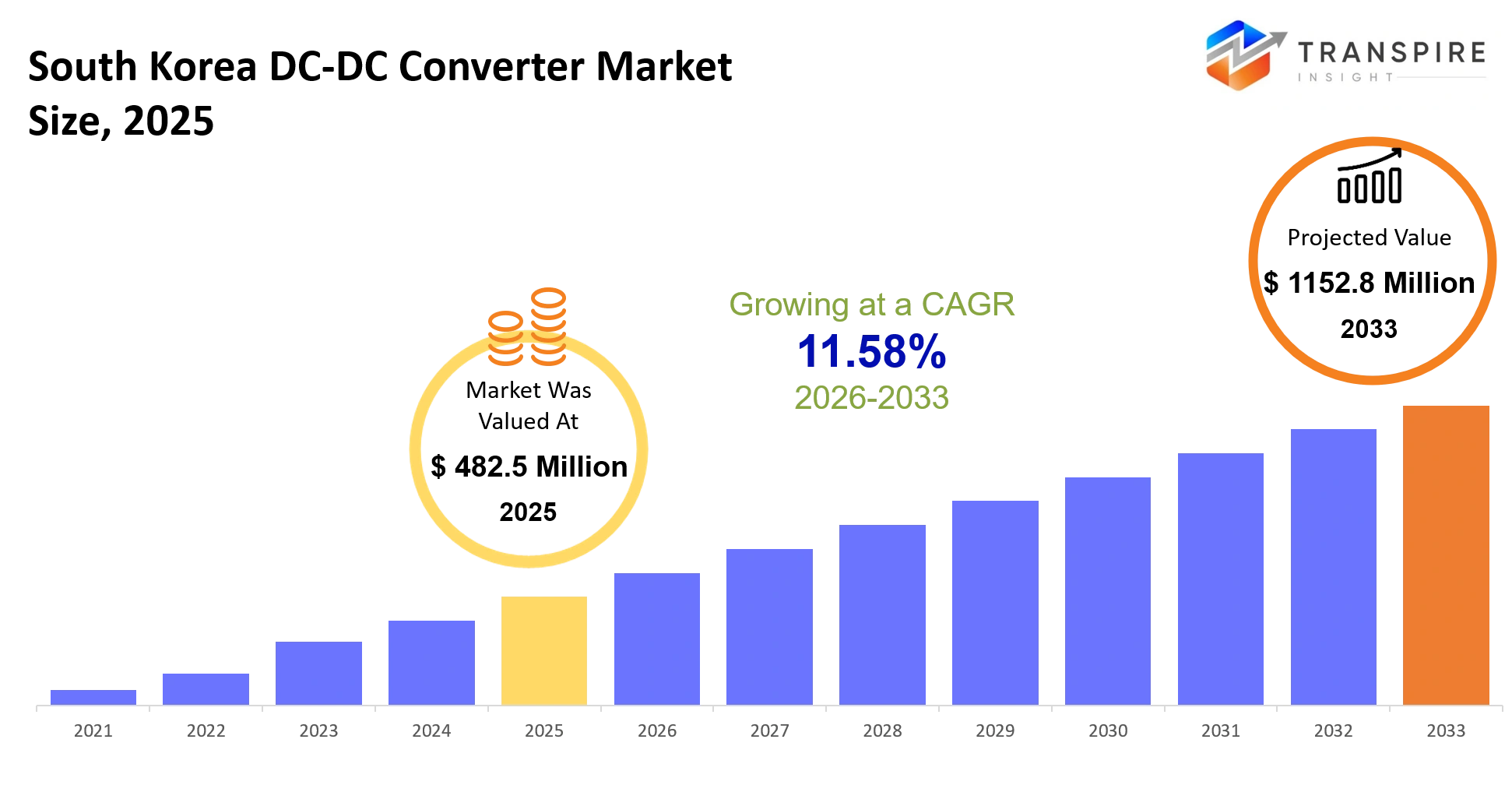
As per Transpire Insight Analysis the South Korea DC-DC Converter Market size is estimated at USD 482.5 Million in 2025 and is anticipated to reach USD 1152.8 Million by 2033, growing at a CAGR of 11.58% from 2026 to 2033.
A DC-DC converter transforms one direct current voltage level into another - and that relatively straightforward task is right at the heart of almost every modern electronic system created today. South Korea really relies on power electronics - from semiconductor plants to electric vehicle assembly lines - so the need for very efficient voltage conversion just keeps going up and up. Manufacturers are looking for converters that generate even less heat, will fit into much smaller spaces, and can handle constant switching loads a lot better.
Electric vehicles have actually driven this market forward the quickest. Battery packs require extremely accurate voltage regulation so they can supply motors, onboard electronics, and charging systems - and each additional EV on Korean roads requires another converter socket to fill. Telecom companies updating their 5G infrastructure also need similar reliability because base stations operate non-stop and simply can't afford any power outages.
Industrial automation provides yet another consistent flow of demand. Robotics, factory sensors, and control systems all depend on rock-steady low-voltage supplies - and South Korea's manufacturing industry is constantly expanding those product lines. Local consumer electronics companies also press converter suppliers to create even smaller, cooler-running designs. Put it all together, and these factors keep the market heading firmly upwards through 2033.
South Korea DC-DC Converter Market Size & Forecast:
- South Korea DC-DC Converter Market Size 2025: USD 482.5 Million
- Expected Market Value 2033: USD 1152.8 Million
- Forecast CAGR: 11.58%
- Leading region: Gyeonggi-do (Seoul Capital Area)
- Fastest Growing region: Chungcheong Region
- Key Profile: Vicor, TDK Lambda, Delta Electronics, Murata, RECOM, Infineon, Texas Instruments, Analog Devices, ABB, Siemens, Eaton, Bel Fuse, MEAN WELL, XP Power, Cosel
Key Market Insights
- Gyeonggi-do retains the biggest portion of national revenue - thanks to a very tight cluster of semiconductor fabrication facilities and electronics manufacturing plants located near Seoul.
- The Chungcheong region is actually expected to grow the fastest over our forecast period, as new investments in batteries and chips get situated in Cheongju and Asan.
- Isolated converters will have the largest type share in 2025, because galvanic isolation really protects sensitive circuits in electric vehicles and industrial settings from damage.
- Non-isolated converters, however, are gaining ground fast in consumer electronics - where there's often very little available space on the circuit board and isolation isn't always essential.
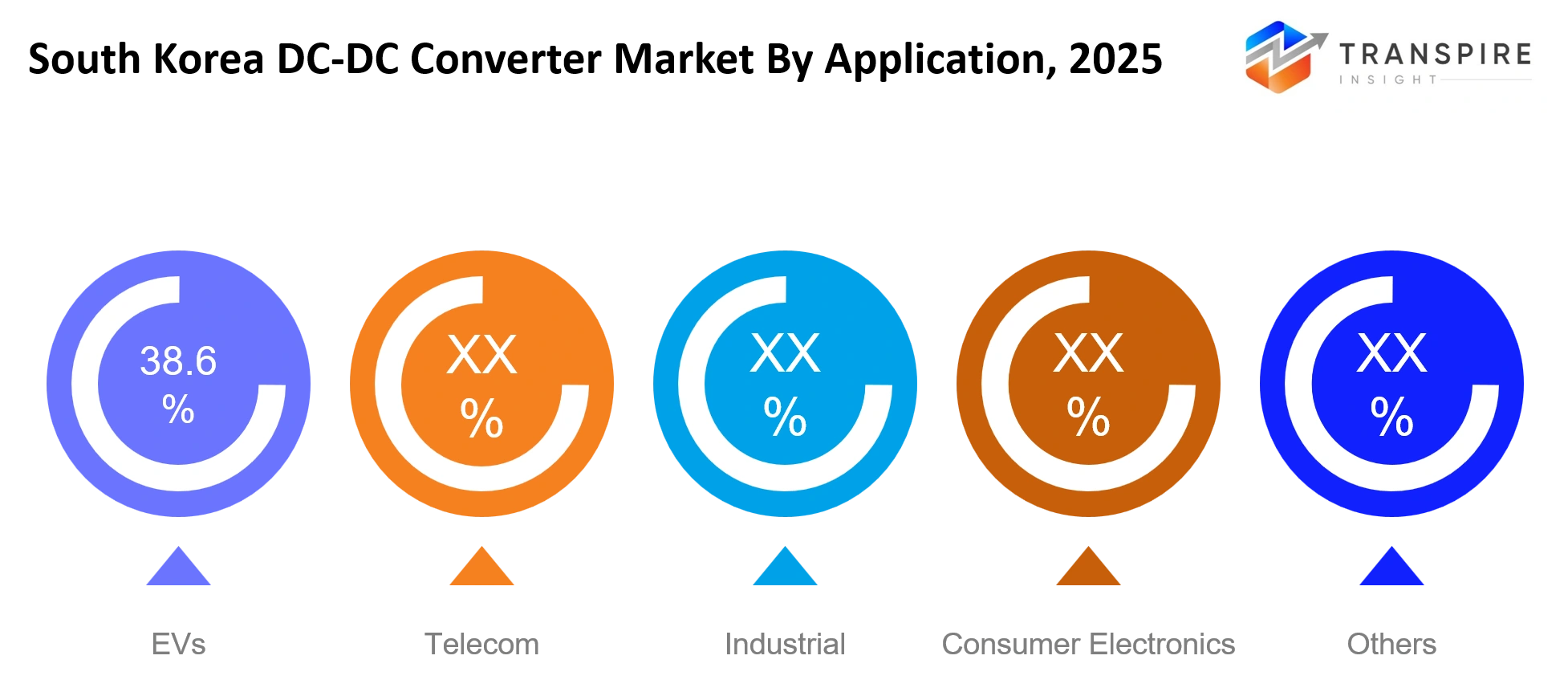
- EV applications remain number one across all use cases - holding about 38. 6% market share in 2025 - due to Korea's rapid expansion of domestic EV manufacturing facilities.
- Telecom demand continues to rise steadily even more so as 5G densification sets up even more base stations that need both extremely compact and quite efficient power modules.
- Industrial customers increasingly request converters certified for much broader temperature ranges - really showing how tough the conditions are on today's factory floors.
- Meanwhile, consumer electronics manufacturers try to persuade their suppliers to create even smaller parts, since slimmer devices give them even less space for power-related circuitry itself.
What are the Key Drivers, Restraints, and Opportunities in the South Korea DC-DC Converter Market?
Growth is mainly driven by South Korea's push into electric vehicle manufacturing. Hyundai, Kia - along with their battery partners - continually increase EV output, and each vehicle demands numerous converters to handle power between the battery, motor, and auxiliary systems. Besides that, the semiconductor industry continuously builds new fabrication plants (fabs) requiring very dense and efficient power delivery. Telecom carriers setting up 5G networks create additional stable demand because every new base station needs its own converter stack. Government backing for renewable energy sources and intelligent factories strengthens everything else, pushing even more manufacturers towards higher-efficiency designs.
Costs still deter some customers a bit. High-efficiency converters created using wide-bandgap materials such as silicon carbide and gallium nitride come at a higher price - which smaller manufacturers are hesitant to pay. Supply chains for special semiconductors are quite short, and any disruptions have a rapid impact on converter production. Thermal management becomes an extra layer of complexity because we're trying to pack even more power into smaller modules - which puts a strain on heat dissipation limits. These challenges might slow adoption amongst very budget-conscious industrial buyers, although the efficiency benefits are clear-cut.
There's a real opportunity emerging for the next generation of power architectures for EVs and data centers. When battery voltages reach approximately 800V systems, converter manufacturers who get started early in that area will gain significant market share. Renewable energy storage is opening another route, since solar and battery storage installations all require reliable DC-DC stages. Partnerships between South Korean converter manufacturers and international chip suppliers might also accelerate our access to wide-bandgap components - allowing domestic companies to compete based on efficiency instead of just price.
What Has the Impact of Artificial Intelligence Been on the South Korea DC-DC Converter Market?
Artificial intelligence really is changing the way converters are being designed and tested nowadays. Simulation tools, trained for years on both thermal and electrical data, enable engineers to forecast failure points even before a physical prototype has been constructed. This approach significantly reduces development time frames - and allows Korean manufacturers to react much more quickly to their customers' requests for EVs and telecommunications equipment.
On the shop floor itself, AI-assisted quality checks are picking up faults that a human inspector might miss - particularly on very densely packed multi-layer converter boards. Predictive maintenance algorithms also assist converter manufacturers in planning equipment maintenance before it's necessary - a matter of great importance in highly productive Korean electronics facilities working at or near full capacity all the time.
Despite this, adoption is still quite gradual indeed. Smaller suppliers frequently lack sufficient engineering information to create a useful model, while incorporating AI tools into existing production software demands significant investment itself. Data standardization across all suppliers remains somewhat uneven - thus limiting how widely these tools can actually be used throughout the industry. Most participants expect a very slow yet steady expansion - rather than an abrupt, dramatic change.
Key Market Trends
- Wide-bandgap semiconductor adoption really took off sharply after 2023 - as silicon carbide designs showed off their efficiency advantage in EV powertrains.
- Converter makers greatly expanded local production capacity between 2023 and 2025 so they could reduce their reliance on imported power modules even further.
- Modular converter designs started gaining a lot of traction, allowing manufacturers to reuse core platforms across EVs, telecommunications, and industrial products all over again.
- The rollout of 5G base stations throughout 2024 really pushed demand for small yet highly efficient telecommunications power modules even higher.
- Battery voltage architectures began shifting more towards 800V platforms in new EV models introduced in 2025 itself.
- Strategic partnerships between Korean assemblers and leading global chipmakers increased significantly across 2023 to 2025 - all to secure a reliable supply of components themselves.
- Innovations in thermal design really accelerated as converters managed to pack even more power into much smaller enclosures for everyday consumer devices.
South Korea DC-DC Converter Market Segmentation
By Type:
Isolated converters lead the type segment, since they separate input and output circuits electrically, which protects sensitive electronics in EVs and industrial equipment from voltage spikes. Buck converters follow closely, valued for stepping down voltage efficiently in battery-powered systems where every watt saved extends run time.
Non-isolated converters keep gaining share in space-constrained consumer devices, where isolation is not required and smaller size wins out. Boost converters serve applications needing voltage step-up, such as LED drivers and certain renewable energy setups. Other converter types, including buck-boost and multi-output designs, continue to fill specialized niches across the broader electronics landscape.
By Application:
EV applications dominate the application segment, driven by Korea's rapid buildout of domestic electric vehicle manufacturing and the growing complexity of onboard power systems. Telecom follows, propelled by continuous 5G network expansion that keeps adding converter-dependent base stations across the country.
Industrial applications hold a steady share, tied to automation and robotics lines that need dependable low-voltage power. Consumer electronics manufacturers demand ever smaller, cooler converters as devices keep shrinking. Other applications, spanning medical devices and aerospace electronics, add incremental demand that rounds out the market.
What are the Key Use Cases Driving the South Korea DC-DC Converter Market?
Electric vehicle power management is the leading use case, since every EV needs multiple converters to regulate power between battery packs, motors, and cabin electronics. As Korean automakers expand EV lineups, converter demand scales directly with vehicle output.
Telecom infrastructure upgrades form the second major use case. 5G base stations and data hubs need converters that run continuously without failure, and operators are investing heavily to densify coverage across urban and rural areas alike.
Looking ahead, energy storage systems and smart factory automation are emerging as fresh use cases. Both segments need precise, efficient power conversion, and as Korea pushes toward carbon-reduction targets, these segments should continue to open new demand channels for converter suppliers.
|
Report Metrics |
Details |
|
Market size value in 2025 |
USD 482.5 Million |
|
Market size value in 2026 |
USD 537.2 Million |
|
Revenue forecast in 2033 |
USD 1152.8 Million |
|
Growth rate |
CAGR of 11.58% from 2026 to 2033 |
|
Base year |
2025 |
|
Historical data |
2021 - 2024 |
|
Forecast period |
2026 - 2033 |
|
Report coverage |
Revenue forecast, competitive landscape, growth factors, and trends |
|
Regional scope |
South Korea |
|
Key company profiled |
Vicor, TDK Lambda, Delta Electronics, Murata, RECOM, Infineon, Texas Instruments, Analog Devices, ABB, Siemens, Eaton, Bel Fuse, MEAN WELL, XP Power, Cosel. |
|
Customization scope |
Free report customization (segment and application scope). Avail customized purchase options to meet your exact research needs. |
|
Report Segmentation |
By Type (Isolated, Non-Isolated, Buck, Boost, Others); By Application (EVs, Telecom, Industrial, Consumer Electronics, Others) |
Which Regions are Driving the South Korea DC-DC Converter Market Growth?
Gyeonggi-do remains the country's dominant hub, anchored by the dense concentration of semiconductor fabs and electronics assemblers surrounding Seoul. Strong logistics networks, skilled labor, and proximity to major OEMs keep converter demand concentrated here, and steady investment in chip manufacturing should keep this region in the lead through the forecast period.
The Chungcheong region is pulling ahead as the fastest growing area, largely because new battery and semiconductor plants have landed in Cheongju and Asan over the past few years. As these facilities ramp up production, local converter sourcing is expanding alongside them, giving the region real momentum through 2033.
Gyeongsang continues contributing steady demand through its shipbuilding and heavy industry base, where converters support automation and control systems. Jeolla and other regions add smaller but growing shares, tied to renewable energy installations and regional manufacturing expansion. Together, these areas round out a national market that leans heavily on its industrial core.
Who are the Key Players in the South Korea DC-DC Converter Market and How Do They Compete?
Competition stays fairly concentrated among global power electronics specialists, though Korean assemblers increasingly favor suppliers who can localize production. Product efficiency, thermal performance, and delivery reliability matter more than price alone, especially for EV and telecom customers who cannot afford downtime.
Vicor and TDK Lambda lead with strong high-density converter platforms suited to EV and industrial use. Delta Electronics and Murata keep expanding manufacturing footprint to serve Korean OEMs directly, while Infineon and Texas Instruments push wide-bandgap semiconductor integration into their converter lines.
Analog Devices and ABB continue investing in precision power management for industrial automation, and Siemens strengthens its position through smart factory partnerships. Smaller specialists like RECOM, Bel Fuse, MEAN WELL, XP Power, and Cosel compete on niche applications, filling gaps that larger suppliers move past.
Company List
- Vicor
- TDK Lambda
- Delta Electronics
- Murata
- RECOM
- Infineon
- Texas Instruments
- Analog Devices
- ABB
- Siemens
- Eaton
- Bel Fuse
- MEAN WELL
- XP Power
- Cosel
Recent Development News
In March 2026, Delta Electronics announced a new production line in South Korea dedicated to automotive-grade DC-DC converters, aimed at supplying local EV manufacturers directly. The investment strengthens Delta's regional supply chain and reduces lead times for Korean automakers scaling EV output.
In November 2025, Infineon expanded its silicon carbide component partnership with a major Korean battery manufacturer, targeting higher efficiency 800V converter platforms for next generation electric vehicles.
What Strategic Insights Define the Future of the South Korea DC-DC Converter Market?
Over the next five to seven years, the South Korea DC-DC Converter Market should lean further into wide-bandgap semiconductor adoption, supported by rising EV production and 800V battery architectures. This shift should lift overall conversion efficiency and open room for premium-priced converter platforms.
A quieter risk sits with component supply concentration, since specialty semiconductor materials still depend on a narrow set of global suppliers. Any disruption there could slow converter output even while demand stays strong.
At the same time, real opportunity is forming around energy storage and smart factory power systems, both of which need dependable DC-DC conversion. Manufacturers that invest early in wide-bandgap capability and local production capacity should be best placed to capture this growth as the market moves toward 2033.
South Korea DC-DC Converter Market Report Segmentation
By Type
- Isolated
- Non-Isolated
- Buck
- Boost
- Others
By Application
- EVs
- Telecom
- Industrial
- Consumer Electronics
- Others
Frequently Asked Questions
Find quick answers to common questions.
The expected South Korea DC-DC Converter Market size will reach USD 1152.8 Million by 2033.
Key segments are By Type (Isolated, Non-Isolated, Buck, Boost, Others) and By Application (EVs, Telecom, Industrial, Consumer Electronics, Others).
Major players include Vicor, TDK Lambda, Delta Electronics, Murata, RECOM, Infineon, Texas Instruments, Analog Devices, ABB, Siemens, Eaton, Bel Fuse, MEAN WELL, XP Power, and Cosel.
The South Korea DC-DC Converter Market size is USD 482.5 Million in 2025.
The South Korea DC-DC Converter Market CAGR is 11.58% from 2026 to 2033.
- Vicor
- TDK Lambda
- Delta Electronics
- Murata
- RECOM
- Infineon
- Texas Instruments
- Analog Devices
- ABB
- Siemens
- Eaton
- Bel Fuse
- MEAN WELL
- XP Power
- Cosel
About the Authors

Avinash Kumar
I’m Avinash Kumar, a Senior Research Analyst at Transpire Insight, with expertise in the Electronics and Semiconductor and Energy & Power industry. My work focuses on analyzing emerging technologies, market trends, industry developments, and innovation across these sectors. I specialize in transforming complex technical and market insights into clear, research-backed content that helps professionals, businesses, and decision-makers stay informed. Through continuous industry research and data-driven analysis, I strive to deliver accurate, reliable, and practical perspectives on the latest advancements shaping the semiconductor and energy landscape.

Chakradhar Khansole
Chakradhar serves as the Research Director at Transpire Insight, bringing over 8 years of experience in technology, innovation, and strategic market intelligence. He specializes in transforming complex market data into actionable business insights that enable organizations to make informed, growth-oriented decisions. Recognized for his strategic vision and analytical expertise, Chakradhar leads high-impact research initiatives, delivering comprehensive market assessments, competitive intelligence, and forward-looking industry analysis.
Recently Published Reports
-
Apr 2026
Active Power Filter Market
Active Power Filter Market Size, Share & Analysis Report By Type (Shunt Active Power Filters, Series Active Power Filter, Hybrid Active Power Filter), By Application (Harmonics Mitigation, Reactive Power Compensation, Voltage Regulation, Power Factor Correction), By Phase (Single Phase, Three Phase), By End-User Industry (Manufacturing, Healthcare, Commercial, Automotive, Oil and Gas, Others), and Geography (North America, Europe, Asia-Pacific, Middle East and Africa, South and Central America), 2021 - 2031
-
Apr 2026
Electrical Transformer Market
Electrical Transformer Market Size, Share & Analysis Report By Core (Closed, Shell, and Berry), By Insulation (Gas, Oil, Solid, Air, and Other), By Phase (Single, and Three), By Rating (100 MVA to 500 MVA, 501 MVA to 800 MVA, and 801 MVA to 1200 MVA), and Geography (North America, Europe, Asia-Pacific, Middle East and Africa, South and Central America), 2021 – 2031
-
Apr 2026
Hydraulic Piston Pumps Market
Hydraulic Piston Pumps Market Size, Share & Analysis Report By Type (Axial Piston Pumps, Radial Piston Pumps), By Operating Pressure (Low Pressure, Medium Pressure, High Pressure), By Application (Construction, Mining, Agriculture, Automotive, Oil & Gas, Industrial Machinery, Others), By End-User (OEMs, Aftermarket), and Geography (North America, Europe, Asia-Pacific, Middle East and Africa, South and Central America), 2021 – 2031
-
Apr 2026
Laboratory Gas Generators Market
Laboratory Gas Generators Market Size, Share & Analysis Report By Product (Nitrogen Gas Generator, Hydrogen Gas Generator, Zero Air Gas Generator, Purge Gas Generator, TOC Gas Generators, Others), By Application (Gas Chromatography, Liquid Chromatography-mass Spectrometry (LC-MS), Gas Analyzers, Others), By End-user (Life Science, Chemical & Petrochemical, Food & Beverage, Others), and Geography (North America, Europe, Asia-Pacific, Middle East and Africa, South and Central America), 2021 – 2031