
South Korea Cellulose Fiber Market Size & Forecast:
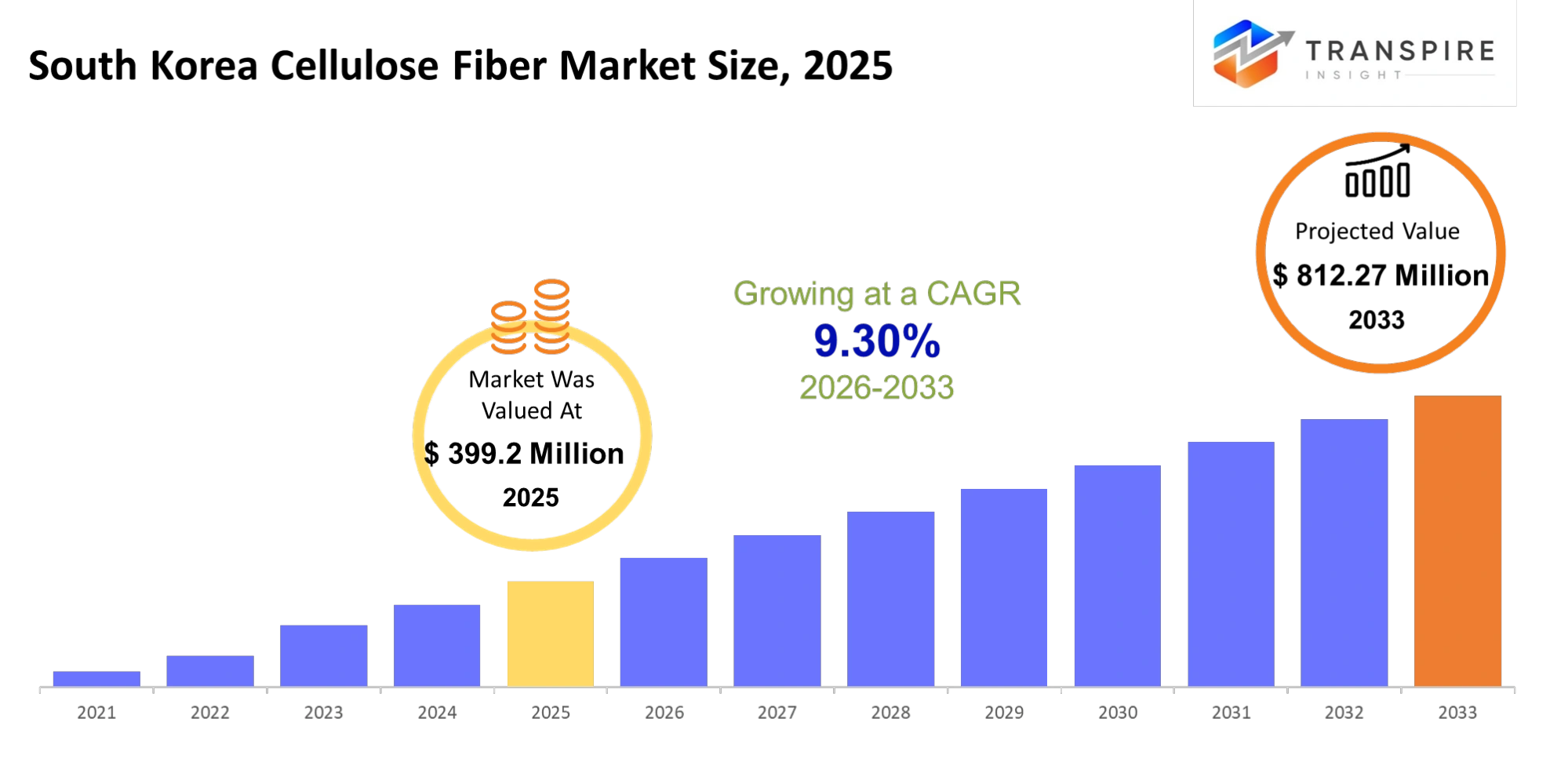
- South Korea Cellulose Fiber Market Size 2025: USD 399.2 Million
- South Korea Cellulose Fiber Market Size 2033: USD 812.27 Million
- South Korea Cellulose Fiber Market CAGR: 9.30%
- South Korea Cellulose Fiber Market Segments: By Type (Natural Cellulose Fiber, Regenerated Cellulose Fiber), By Application (Textiles, Paper & Pulp, Hygiene Products), By End-User (Textile Industry, Packaging Industry, Healthcare).
To learn more about this report,  Download Free Sample Report
South Korea Cellulose Fiber Market Summary:
South Korea Cellulose Fiber Market size was estimated at USD 399.2 Million in 2025 and is anticipated to reach USD 812.27 Million by 2033, growing at a CAGR of 9.30% from 2026 to 2033.
Your data training extends until the month of October in the year 2023. The south korea cellulose fiber market will stand as a vital part of the country’s advanced materials and textile industry, supplying bio-based fibers used in fashion apparel, hygiene goods, filtration media, and technical fabrics. The purchasing behavior of urban consumers who expect sustainable products will drive manufacturers to use wood-pulp and plant-based materials. Producers will develop new fabric solutions to meet demand for breathable materials and skin-friendly hygiene products and environmentally responsible packaging through their work on fiber softness and tensile strength and moisture absorption performance. Domestic brands will collaborate with design houses and lifestyle companies to align material innovation with modern aesthetics and comfort expectations, allowing cellulose-based materials to appear in premium clothing lines and functional home products rather than remaining limited to conventional textile uses.
The production ecosystems will experience changes because automated spinning systems and closed-loop chemical recovery processes and precision drying technologies will produce materials with better consistency and reduced industrial waste. The smart manufacturing facilities will use sensor-based monitoring systems to ensure that their operations produce consistent fiber thickness and texture which meets the performance standards required for medical dressings and specialty filters. The Ministry of Environment environmental policies will drive companies to adopt low-emission processing methods and responsible pulp sourcing because these policies will support their need for cleaner treatment facilities.
Key Market Trends & Insights:
- The South Korea Cellulose Fiber Market shows consistent progress because its material innovations meet the needs of textile and hygiene and specialty paper industries. The manufacturers pursue sustainable raw materials production methods which generate minimal emissions and create long-lasting products. Rising production standards which protect the environment together with performance fabrics and industrial filtration requirements will drive demand growth throughout domestic manufacturing and export-oriented supply chains.
- The South Korea Cellulose Fiber Market will experience increased demand because consumers now prefer biodegradable fibers for their fashion and personal care products. Local producers expand capacity to meet sustainable sourcing guidelines. Advanced spinning technologies enable fiber manufacturers to create stronger and softer and moisture-controlling fibers which can be used in apparel and wipes and medical-grade materials.
- The South Korea Cellulose Fiber Market benefits from government-supported eco-friendly production initiatives and carbon reduction goals. Industrial research centers allocate funding for the development of bio-based materials which substitute synthetic materials. Chemical processors and textile companies create partnerships which help secure consistent supply and enhance pulp conversion processes while decreasing their reliance on petroleum-based imported fibers.
- The production methods of the South Korea Cellulose Fiber Market undergo transformation because of advancements in technology. The automated processing lines create consistent results while producing less waste and decreasing the costs of running operations. High-performance materials found in automotive interiors and insulation materials and packaging applications which prioritize lightweight construction and recycling capabilities enable sustainable product design development.
- The South Korean cellulose fiber market will expand because of two factors which are rising exports and developing high-quality products. Domestic textile manufacturers need to achieve international certification standards because global demand for environmentally friendly textiles is increasing. The company will gain sustainable competitive advantages through its investment in three areas which include special fiber blending and moisture-resistant treatments and circular recycling systems.
South Korea Cellulose Fiber Market Segmentation
By Type :
- Natural Cellulose Fiber: Natural cellulose fiber serves as a vital component because South Korea possesses abundant wood pulp and cotton resources. The ongoing demand increase will occur because textile manufacturers select biodegradable materials as their primary raw material choice. Paper producers will need these fibers to achieve their strength requirements and print quality needs and to implement environmentally sustainable production methods.
- Regenerated Cellulose Fiber: Regenerated cellulose fiber plays a key role in the South Korea Cellulose Fiber Market because of controlled manufacturing and uniform quality. Fibers such as viscose and modal will support soft fabric production used in apparel and home furnishings. The industry will experience continuous adoption because people prefer products that have smooth textures and good absorbency at affordable prices.
By Application :
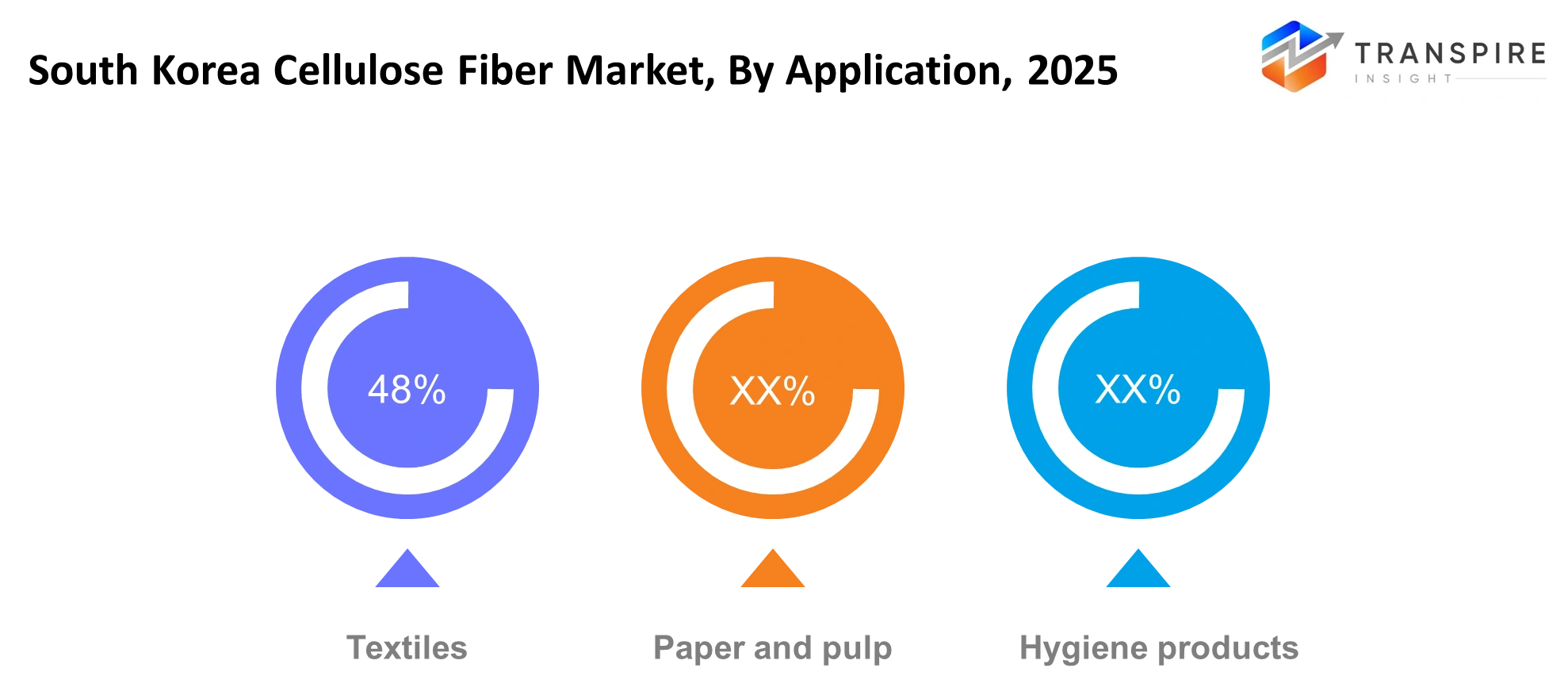
- Textiles: Textile applications dominate the South Korea Cellulose Fiber Market as apparel manufacturers focus on comfort, breathability, and sustainability. The production of casualwear, sportswear, and innerwear will utilize cellulose-based yarn. The increasing popularity of fashion and the growing need for skin-friendly fabrics together with environmentally sustainable material choices will drive continuous consumption patterns.
- Paper and pulp :Paper and pulp usage in the South Korea Cellulose Fiber Market maintains a consistent volume because domestic requirements for packaging and printing remain constant. The use of cellulose fibers will enhance paper products by increasing their durability, smoothness, and capacity to absorb ink. The e-commerce logistics industry will drive continuous industrial requirements because of its growth and the rising demand for sustainable packaging solutions.
- Hygiene products :Hygiene products manufacturing generates substantial revenue for the South Korea Cellulose Fiber Market because cellulose materials provide essential properties such as softness and liquid absorption and skin safety. Diaper producers and sanitary product manufacturers and wipe makers will choose these fibers because they provide comfortable wear and environmentally friendly disposal. The rising trend of health consciousness together with increased spending on premium personal care products will create sustained demand growth.
To learn more about this report, Download Free Sample Report
By End-User :
- Textile Industry: The South Korea cellulose fiber market operates as a major supplier to the textile industry because manufacturers now use sustainable materials for their production needs. The use of cellulose fibers will create lightweight fabrics which possess moisture retention abilities and breathability characteristics. The industry will maintain its operations through export-oriented garment production and technological fiber processing and the growing demand for sustainable clothing.
- Packaging Industry: The packaging industry requires recyclable and biodegradable materials which drives market demand for cellulose fibers in South Korea. Food delivery and retail wrapping and protective shipping solutions will use cellulose-based paper packaging instead of plastic packaging. The combination of corporate sustainability objectives and plastic reduction regulatory requirements will increase fiber consumption rates.
- Healthcare: The healthcare sector in South Korea supports the cellulose fiber market because medical product manufacturers need materials which provide safe and absorbent and disposable properties. The medical industry will use cellulose fibers to create surgical gowns and medical wipes and bandages and hospital bedding products. The combination of hygiene standards and infection control procedures and growing medical needs will maintain material requirements.
Country Insights
- The South Korean manufacturing industry maintains its sustainable material advancement because of its industrial strength and its environmental protection measures. The area supports eco-friendly fiber development through its manufacturing hubs and advanced textile processing facilities and research universities. The country experiences steady demand because domestic consumption and export production and biodegradable material innovation expand across various industrial sectors.
- Sustainability programs that receive government funding and carbon reduction goals drive industries to adopt plant-based fiber solutions. The market development process benefits from three components which include green manufacturing policy incentives and waste reduction regulations and recycling programs. Public organizations and private companies work together to enhance processing methods while developing new products and creating a dependable supply chain which meets environmental regulations.
- The textile and automotive and packaging sectors require lightweight biodegradable materials for their ongoing production needs. The growing demand for sustainable fashion and eco-friendly consumer habits and the shift of industries to use better materials help the trend to move forward. The country maintains its growth potential through strong export connections and advanced transportation systems and ongoing investment in material science research for both domestic and international markets.
Recent Development News
Human-Made Cellulosic Fibers Market Growth Signals Broader Industry Momentum
- A man-made cellulosic fibers market report notes the industry is expanding toward sustainable cellulosic fibers, including viscose and lyocell, driven by environmental demand and strategic partnerships globally.
South Korea’s Hyosung Expands Fiber Infrastructure Abroad
- South Korean conglomerate Hyosung (major textile and fiber producer) announced investment in a new polyester and industrial fiber plant in Đà Nẵng, Vietnam, reflecting broader capacity expansion strategies that relate to textile fibers (though not cellulose specifically, but indicative of industry investment trends).
|
Report Metrics |
Details |
|
Market size value in 2025 |
USD 399.2 Million |
|
Market size value in 2026 |
USD 435.98 Million |
|
Revenue forecast in 2033 |
USD 812.27 Million |
|
Growth rate |
CAGR of 9.30% from 2026 to 2033 |
|
Base year |
2025 |
|
Historical data |
2021 - 2024 |
|
Forecast period |
2026 - 2033 |
|
Report coverage |
Revenue forecast, competitive landscape, growth factors, and trends |
|
Country scope |
South Korea |
|
Key company profiled |
Lenzing AG, Birla Cellulose (Aditya Birla Group), Sappi Limited, Eastman Chemical Company, Daicel Corporation, Rayonier Advanced Materials Inc., Kelheim Fibres GmbH, Grasim Industries Ltd., Fulida Group Holding Co. Ltd., Tangshan Sanyou Group, Xinxiang Chemical Fiber Co. Ltd., Thai Rayon Public Company Ltd., Aditya Birla Chemicals, Mitsubishi Chemical Group Corporation, Asahi Kasei Corporation. |
|
Customization scope |
Free report customization (country, regional & segment scope). Avail customized purchase options to meet your exact research needs. |
|
Report Segmentation |
By Type (Natural Cellulose Fiber, Regenerated Cellulose Fiber), By Application (Textiles, Paper & Pulp, Hygiene Products), By End-User (Textile Industry, Packaging Industry, Healthcare). |
Key South Korea Cellulose Fiber Company Insights
- The South Korea Cellulose Fiber Market maintains its active operations through established producers and new manufacturers who concentrate on enhancing product quality and maintaining reliable supply systems. Companies will invest in advanced processing methods, sustainable raw material sourcing, and product consistency. Business strategies will include capacity expansion, regional partnerships, export planning, and technology upgrades that support competitive positioning and long-term operational stability.
- The South Korea Cellulose Fiber Market highlights structured competition where major companies maintain influence through diversified product lines and reliable distribution channels. Market participants will emphasize research investment, environmentally responsible production, and cost control measures to strengthen market presence. The development of industrial partnerships together with facility modernization and textile and nonwoven sector demand will drive business performance and organizational strategic direction.
South Korea Cellulose Fiber Market Companies:
- Lenzing AG
- Birla Cellulose (Aditya Birla Group)
- Sappi Limited
- Eastman Chemical Company
- Daicel Corporation
- Rayonier Advanced Materials Inc.
- Kelheim Fibres GmbH
- Grasim Industries Ltd.
- Fulida Group Holding Co. Ltd.
- Tangshan Sanyou Group
- Xinxiang Chemical Fiber Co. Ltd.
- Thai Rayon Public Company Ltd.
- Aditya Birla Chemicals
- Mitsubishi Chemical Group Corporation
- Asahi Kasei Corporation
South Korea Cellulose Fiber Market Segmentation
By Type
- Natural Cellulose Fiber
- Regenerated Cellulose Fiber
By Application
- Textiles
- Paper & Pulp
- Hygiene Products
By End-User
- Textile Industry
- Packaging Industry
- Healthcare
Frequently Asked Questions
Find quick answers to common questions.
The approximate South Korea Cellulose Fiber Market size for the market will be USD 812.27 Million in 2033.
Key segments for the South Korea Cellulose Fiber Market are By Type (Natural Cellulose Fiber, Regenerated Cellulose Fiber), By Application (Textiles, Paper & Pulp, Hygiene Products), By End-User (Textile Industry, Packaging Industry, Healthcare).
Major South Korea Cellulose Fiber Market players are Lenzing AG, Birla Cellulose (Aditya Birla Group), Sappi Limited, Eastman Chemical Company, Daicel Corporation, Rayonier Advanced Materials Inc., Kelheim Fibres GmbH, Grasim Industries Ltd., Fulida Group Holding Co. Ltd., Tangshan Sanyou Group, Xinxiang Chemical Fiber Co. Ltd., Thai Rayon Public Company Ltd., Aditya Birla Chemicals, Mitsubishi Chemical Group Corporation, Asahi Kasei Corporation.
The South Korea Cellulose Fiber Market size is USD 399.2 Million in 2025.
The South Korea Cellulose Fiber Market CAGR is 9.30%.
- Lenzing AG
- Birla Cellulose (Aditya Birla Group)
- Sappi Limited
- Eastman Chemical Company
- Daicel Corporation
- Rayonier Advanced Materials Inc.
- Kelheim Fibres GmbH
- Grasim Industries Ltd.
- Fulida Group Holding Co. Ltd.
- Tangshan Sanyou Group
- Xinxiang Chemical Fiber Co. Ltd.
- Thai Rayon Public Company Ltd.
- Aditya Birla Chemicals
- Mitsubishi Chemical Group Corporation
- Asahi Kasei Corporation
Recently Published Reports
-
Apr 2026
Healthcare Polymer Packaging Market
Healthcare Polymer Packaging Market Size, Share & Analysis Report By Packaging Type (Syringes, IV Bottles and Pouches, Clamshells, Blisters, Bottles & Jars, Containers, Tubes, IV Parental Packaging, Others), By Type (Regulated, Non-regulated), By Polymer Type (LDPE (Low-Density Polyethylene), HDPE (High-Density Polyethylene), Homo-polymer (Homo), Random Copolymer (Random), Block Copolymer (Block), PET, Polystyrene, Polyvinyl Chloride, Polyamide/EVOH, Others), and Geography (North America, Europe, Asia-Pacific, Middle East and Africa, South and Central America), 2021 - 2031
-
Apr 2026
Hydrophilic Tape (Waterstop) Market
Hydrophilic Tape (Waterstop) Market Size, Share & Analysis Report By Type (Bentonite-Based Hydrophilic Tape, Rubber-Based Hydrophilic Tape), By Application (Residential Buildings, Commercial Buildings, Infrastructure Projects), and Geography (North America, Europe, Asia-Pacific, Middle East and Africa, South and Central America), 2021 - 2031
-
Apr 2026
Metalens Market
Metalens Market Size, Share & Analysis Report By Type (Visible Light Metalens, and Infrared Metalens), By Application (Consumer Electronics, Automotive Electronics, Industrial, Medical, and Others), and Geography (North America, Europe, Asia-Pacific, Middle East and Africa, South and Central America), 2021 - 2031
-
Apr 2026
PBT Resin Market
PBT Resin Market Size, Share & Analysis Report By Type (Reinforced PBT Resin, Unreinforced PBT Resin), By Processing Method (Injection Molding, Extrusion, Blow Molding, Others), By End-User (Automotive, Electrical & Electronics, Consumer Appliances, Industrial Machinery, Medical Devices, Packaging, Others), and Geography (North America, Europe, Asia-Pacific, Middle East and Africa, South and Central America), 2021 - 2031