
South Korea Building-integrated Photovoltaics Market Size & Forecast:
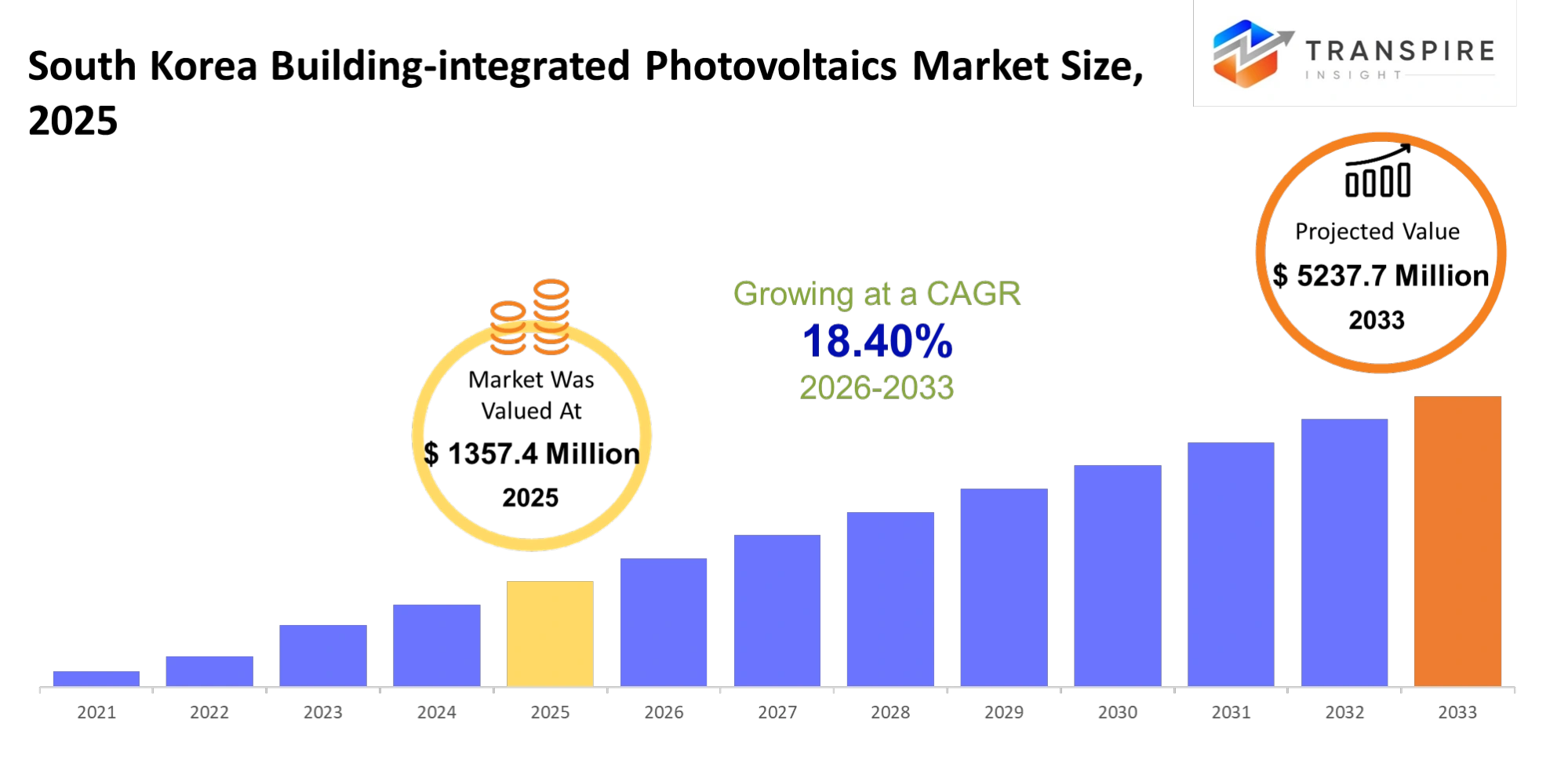
- South Korea Building-integrated Photovoltaics Market Size 2025: USD 1357.4 Million
- South Korea Building-integrated Photovoltaics Market Size 2033: USD 5237.7 Million
- South Korea Building-integrated Photovoltaics Market CAGR: 18.40%
- South Korea Building-integrated Photovoltaics Market Segments: By Technology (Crystalline Silicon, Thin Film), By Application (Roofing, Facades, Glass), By End-User (Residential, Commercial, Industrial)
To learn more about this report,  Download Free Sample Report
South Korea Building-integrated Photovoltaics Market Summary:
South Korea Building-integrated Photovoltaics Market size was estimated at USD 1357.4 Millionin 2025 and is anticipated to reach USD 5237.7 Million by 2033, growing at a CAGR of 18.40% from 2026 to 2033.
The market for building-integrated photovoltaics in South Korea operates within the clean energy sector and construction industry, which connects architectural design with power generation through both visible elements and practical applications. The building design will use glass facades and rooftops and exterior panels as active energy collection systems instead of basic architectural components. South Korean cities require solar systems which match modern building styles because their urban density and design requirements already determine their solar energy needs in commercial towers and luxury residential buildings where design matters as much as function.
Consumers will expect products which combine seamless design with durable performance and long-term cost savings, which will drive manufacturers to develop better aesthetic designs while achieving higher operational efficiency. The government will implement increasingly strict building energy standards through upcoming regulations which will promote energy-efficient building practices without having to provide financial incentives. The development of lightweight materials and transparent solar cells will enable new possibilities for architectural design because developers can now incorporate solar elements into their buildings as fundamental architectural components.
Key Market Trends & Insights:
- The South Korean Building-integrated Photovoltaics market is currently receiving increasing interest because urban areas require improved energy solutions which can be implemented within their restricted environments. The implementation of solar technologies allows buildings to generate electricity because these systems transform their walls and roofs into energy-producing elements. The new approach reduces need for outside electrical supply while supporting national environmental protection objectives.
- The South Korean Building-integrated Photovoltaics market receives strong support through government policies which provide financial incentives and green building certifications and renewable energy achievement requirements. The building codes mandate developers to include solar energy systems in their construction plans. The measures enable greater acceptance of clean energy solutions which have now developed into standard components of building operations.
- The South Korean Building-integrated Photovoltaics market profits from ongoing advancements in photovoltaic materials which seamlessly integrate with contemporary architectural designs. The solar functions of glass panels and facades and roofing components do not interfere with their visual attractiveness. The design enables architects to implement various architectural solutions in both residential and commercial settings.
- The South Korean Building-integrated Photovoltaics market receives high demand from office spaces and shopping centers and government infrastructure development because these sectors need energy-efficient solutions which will lower their operational expenses over time. The building's large exterior spaces enable seamless system implementation which assists building owners to boost their operational efficiency while improving their environmental performance.
- The South Korea Building-integrated Photovoltaics Market operates together with smart building systems which provide continuous energy consumption monitoring and management capabilities. The integration of energy storage systems with automation systems enables facilities to achieve superior power management capabilities which lead to enhanced operational efficiency and decreased waste throughout their daily activities.
South Korea Building-integrated Photovoltaics Market Segmentation
By Technology :
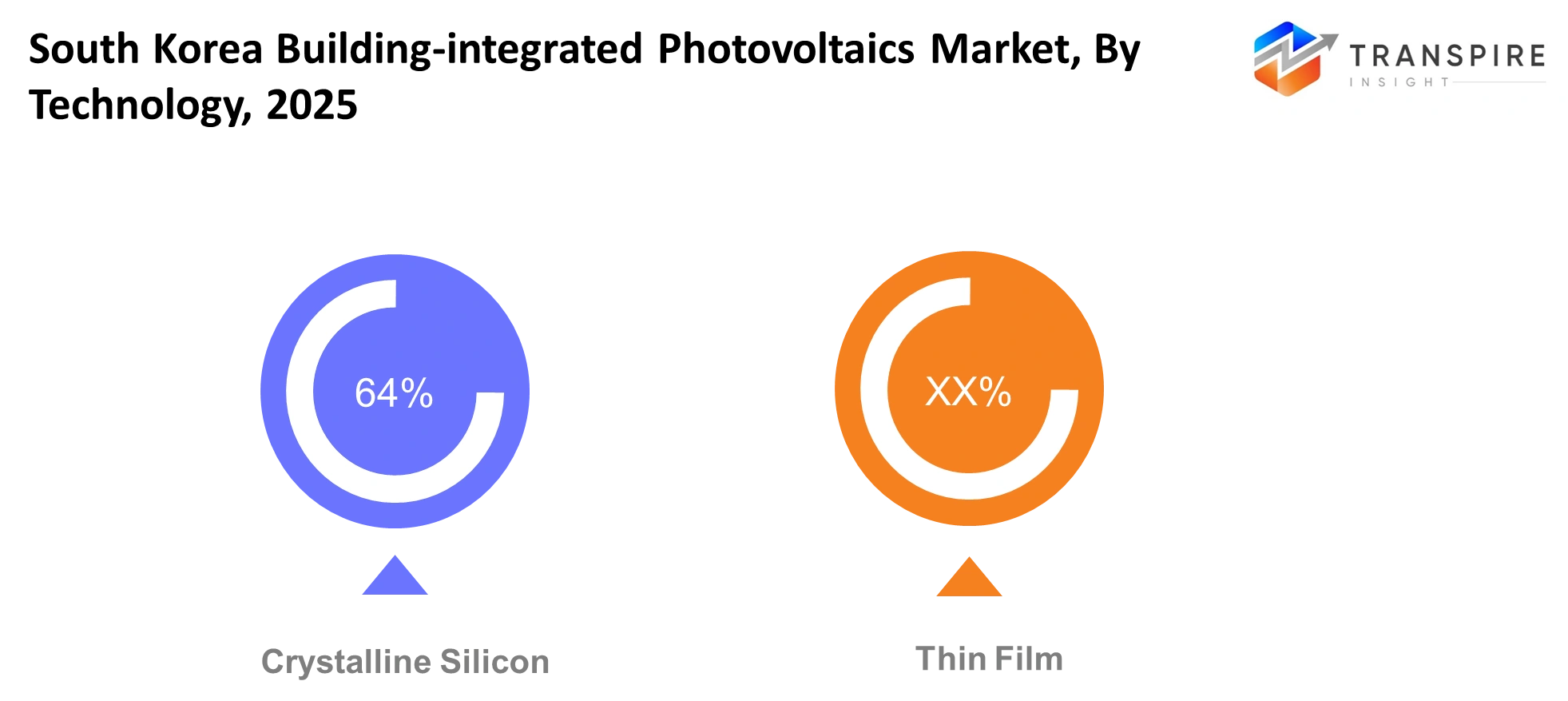
- Crystalline Silicon : The South Korea Building-integrated Photovoltaics Market maintains its focus on crystalline silicon technology because of its ability to deliver high efficiency with dependable performance. The structured cell design enables power production to continue throughout different weather conditions during its operational lifetime. Building materials that provide protection against extreme weather conditions have become essential for urban construction projects which need to deliver long-lasting energy solutions through their building exteriors.
- Thin Film : The South Korea Building-integrated Photovoltaics Market benefits from thin film technology which provides architects with flexible and lightweight materials for their design work. The design system permits architects to create designs which can be applied to both curved surfaces and transparent elements. Developers who want to produce energy through their buildings without affecting their architectural design find direct appeal in the solution which uses less materials while delivering better visual results.
To learn more about this report, Download Free Sample Report
By Application :
- Roofing : Rooftops serve as the primary solar energy collection points for South Korea Building-integrated Photovoltaics Market because they enable direct solar access. The use of roofing materials for building-integrated photovoltaic systems enables energy generation without requiring additional systems. The ongoing development of urban residential areas leads to increased adoption of building-integrated systems which benefit both residential and commercial establishments.
- Facades : The South Korea Building-integrated Photovoltaics Market develops Facade integration through its ability to use vertical surfaces which exist on high-rise buildings. Cities with high population density benefit from building exterior energy production which enables them to use their land more effectively. Modern architectural designs which merge practical use with energy-producing surfaces create greater architectural value.
- Glass : The South Korea Building-integrated Photovoltaics Market uses glass-based photovoltaic systems to enhance modern architectural development. The combination of transparent and semi-transparent solar glass provides both natural light and electricity production capabilities. Office buildings and commercial complexes show rising adoption of energy-efficient practices which allow natural light to enter their spaces.
By End-User :
- Residential : The South Korea Building-integrated Photovoltaics Market shows steady growth in residential adoption because people increasingly understand energy-saving methods and sustainable living practices. Home structures achieve energy efficiency through their design which eliminates the need for external power dependency. The combination of government incentives and urban housing development programs enables residential installations to expand into newly constructed housing projects.
- Commercial : The South Korean Building-integrated Photovoltaics Market depends on commercial buildings as a main market segment because these buildings offer full space access and they consume more energy than other types of structures. The integration of sustainable building solutions into offices and malls and institutional buildings enables these facilities to achieve their cost optimization objectives. Companies demand energy-saving building design solutions because of their environmental sustainability programs.
- Industrial : The South Korea Building-integrated Photovoltaics Market receives substantial contributions from industrial facilities because these sites offer sufficient space for large-scale photovoltaic systems. Operations that consume high amounts of energy gain advantages through the ability to generate electricity on their premises. The installation of systems throughout factory roofs and walls enables organizations to achieve ongoing energy cost reductions while meeting environmental protection requirements.
Country Insights
- South Korean construction projects use integrated solar materials because they receive strong regulatory backing from the country. The energy efficiency standards affect design choices which architects make for their new construction projects. Urban areas experience greater equipment requirements because they have less room to accommodate standard systems. The construction industry continues to fund research activities and manufacturing processes which result in stronger domestic supply chains essential for sustained expansion of energy solutions associated with construction projects.
- The construction industry expansion creates fundamental changes in consumer demand behavior. The growing need for integrated photovoltaic systems comes from both high-rise buildings and mixed-use development projects. Architects and developers choose materials which fulfill their design needs while maintaining energy efficiency requirements. The South Korea Building-integrated Photovoltaics Market experiences consistent demand because public infrastructure projects together with government buildings create permanent need for these systems.
- The advancement of technology enables photovoltaic materials to create new product development opportunities. The creation of transparent flexible solar panels increases their potential for use in various applications. Local manufacturers develop strategies to enhance their operational effectiveness while decreasing their manufacturing expenses to maintain market competitiveness. The worldwide demand for integrated solar solutions creates export prospects which help South Korea strengthen its status as a leader in modern building energy technologies.
Recent Development News
Growth Driven by Net-Zero and Carbon Neutrality Goals
- South Korea’s broader climate commitments are pushing construction sectors to adopt energy-producing building materials, including BIPV.
Technological Shift Toward Advanced Materials and Thin-Film Solutions
- South Korea is investing in thin-film and flexible photovoltaic technologies, which are more suitable for integration into glass, façades, and curved surfaces.
|
Report Metrics |
Details |
|
Market size value in 2025 |
USD 1357.4 Million |
|
Market size value in 2026 |
USD 1605.8 Million |
|
Revenue forecast in 2033 |
USD 5237.7 Million |
|
Growth rate |
CAGR of 18.40% from 2026 to 2033 |
|
Base year |
2025 |
|
Historical data |
2021 - 2024 |
|
Forecast period |
2026 - 2033 |
|
Report coverage |
Revenue forecast, competitive landscape, growth factors, and trends |
|
Country scope |
South Korea |
|
Key company profiled |
Hanwha Q CELLS Co. Ltd., First Solar Inc., Canadian Solar Inc., Trina Solar Ltd., JinkoSolar Holding Co. Ltd., LONGi Green Energy Technology Co. Ltd., SunPower Corporation, Sharp Corporation, Tesla Inc., Panasonic Corporation, LG Electronics Inc., REC Group, Solaria Corporation, Meyer Burger Technology AG, JA Solar Technology Co. Ltd. |
|
Customization scope |
Free report customization (country, regional & segment scope). Avail customized purchase options to meet your exact research needs. |
|
Report Segmentation |
By Technology (Crystalline Silicon, Thin Film), By Application (Roofing, Facades, Glass), By End-User (Residential, Commercial, Industrial) |
Key South Korea Building-integrated Photovoltaics Company Insights
- The South Korea Building-integrated Photovoltaics Market shows a steady shift toward combining energy generation with architectural purpose, where company strategies reflect a balance between technology and design. Market participants continue to align production with construction trends, ensuring that solar integration does not disrupt visual harmony. The company focuses on developing products which can be used in multiple building types that include commercial towers and residential complexes to achieve widespread use in urban environments.
- The South Korea Building-integrated Photovoltaics Market shows that companies active within this market have established a strong commitment to creating sustainable value which will last beyond their present operations. Companies will establish their market position through their investments in long-lasting materials and their use of effective installation techniques and their ability to meet energy standards. The success of market expansion will depend on how well companies adapt to policy changes and customer needs and their requirements for dependable energy systems which work seamlessly with contemporary infrastructure.
South Korea Building-integrated Photovoltaics Market Companies:
- Hanwha Q CELLS Co. Ltd.
- First Solar Inc.
- Canadian Solar Inc.
- Trina Solar Ltd.
- JinkoSolar Holding Co. Ltd.
- LONGi Green Energy Technology Co. Ltd.
- SunPower Corporation
- Sharp Corporation
- Tesla Inc.
- Panasonic Corporation
- LG Electronics Inc.
- REC Group
- Solaria Corporation
- Meyer Burger Technology AG
- JA Solar Technology Co. Ltd.
South Korea Building-integrated Photovoltaics Market Segmentation
By Technology
- Crystalline Silicon
- Thin Film
By Application
- Roofing
- Facades
- Glass
By End-User
- Residential
- Commercial
- Industrial
Frequently Asked Questions
Find quick answers to common questions.
The Approximate South Korea Building-integrated Photovoltaics Market size for the Market will be USD 5237.7 Million in 2033.
Key Segments for the South Korea Building-integrated Photovoltaics Market are By Technology (Crystalline Silicon, Thin Film), By Application (Roofing, Facades, Glass), By End-User (Residential, Commercial, Industrial).
Major South Korea Building-integrated Photovoltaics Market Players are Hanwha Q CELLS Co. Ltd., First Solar Inc., Canadian Solar Inc., Trina Solar Ltd., JinkoSolar Holding Co. Ltd., LONGi Green Energy Technology Co. Ltd., SunPower Corporation, Sharp Corporation, Tesla Inc., Panasonic Corporation, LG Electronics Inc., REC Group, Solaria Corporation, Meyer Burger Technology AG, JA Solar Technology Co. Ltd.
The Current South Korea Building-integrated Photovoltaics Market size is USD 1357.4 Million in 2025.
The South Korea Building-integrated Photovoltaics Market CAGR is 18.40%.
- Hanwha Q CELLS Co. Ltd.
- First Solar Inc.
- Canadian Solar Inc.
- Trina Solar Ltd.
- JinkoSolar Holding Co. Ltd.
- LONGi Green Energy Technology Co. Ltd.
- SunPower Corporation
- Sharp Corporation
- Tesla Inc.
- Panasonic Corporation
- LG Electronics Inc.
- REC Group
- Solaria Corporation
- Meyer Burger Technology AG
- JA Solar Technology Co. Ltd.
Recently Published Reports
-
Apr 2026
Active Power Filter Market
Active Power Filter Market Size, Share & Analysis Report By Type (Shunt Active Power Filters, Series Active Power Filter, Hybrid Active Power Filter), By Application (Harmonics Mitigation, Reactive Power Compensation, Voltage Regulation, Power Factor Correction), By Phase (Single Phase, Three Phase), By End-User Industry (Manufacturing, Healthcare, Commercial, Automotive, Oil and Gas, Others), and Geography (North America, Europe, Asia-Pacific, Middle East and Africa, South and Central America), 2021 - 2031
-
Apr 2026
Electrical Transformer Market
Electrical Transformer Market Size, Share & Analysis Report By Core (Closed, Shell, and Berry), By Insulation (Gas, Oil, Solid, Air, and Other), By Phase (Single, and Three), By Rating (100 MVA to 500 MVA, 501 MVA to 800 MVA, and 801 MVA to 1200 MVA), and Geography (North America, Europe, Asia-Pacific, Middle East and Africa, South and Central America), 2021 – 2031
-
Apr 2026
Hydraulic Piston Pumps Market
Hydraulic Piston Pumps Market Size, Share & Analysis Report By Type (Axial Piston Pumps, Radial Piston Pumps), By Operating Pressure (Low Pressure, Medium Pressure, High Pressure), By Application (Construction, Mining, Agriculture, Automotive, Oil & Gas, Industrial Machinery, Others), By End-User (OEMs, Aftermarket), and Geography (North America, Europe, Asia-Pacific, Middle East and Africa, South and Central America), 2021 – 2031
-
Apr 2026
Laboratory Gas Generators Market
Laboratory Gas Generators Market Size, Share & Analysis Report By Product (Nitrogen Gas Generator, Hydrogen Gas Generator, Zero Air Gas Generator, Purge Gas Generator, TOC Gas Generators, Others), By Application (Gas Chromatography, Liquid Chromatography-mass Spectrometry (LC-MS), Gas Analyzers, Others), By End-user (Life Science, Chemical & Petrochemical, Food & Beverage, Others), and Geography (North America, Europe, Asia-Pacific, Middle East and Africa, South and Central America), 2021 – 2031