
South Korea Biomaterial Wound Dressing Market Summary:
According to Transpire Insights, a detailed research report on the market reflects that the biomaterial product segment dominates the South Korea Biomaterial Wound Dressing Market, accounting for approximately USD 11.5 million in 2025 and projected to reach USD 18.7 million by 2033, registering a 6.3% CAGR from 2026 to 2033. Genewel Co., Ltd. leads the market with its prominent Medifoam® wound dressing portfolio and advanced biomaterial technologies, making it a leading contributor to market development, innovation, advanced biomaterial wound dressing production, expanding manufacturing capabilities, and growth dynamics.
Market Snapshot
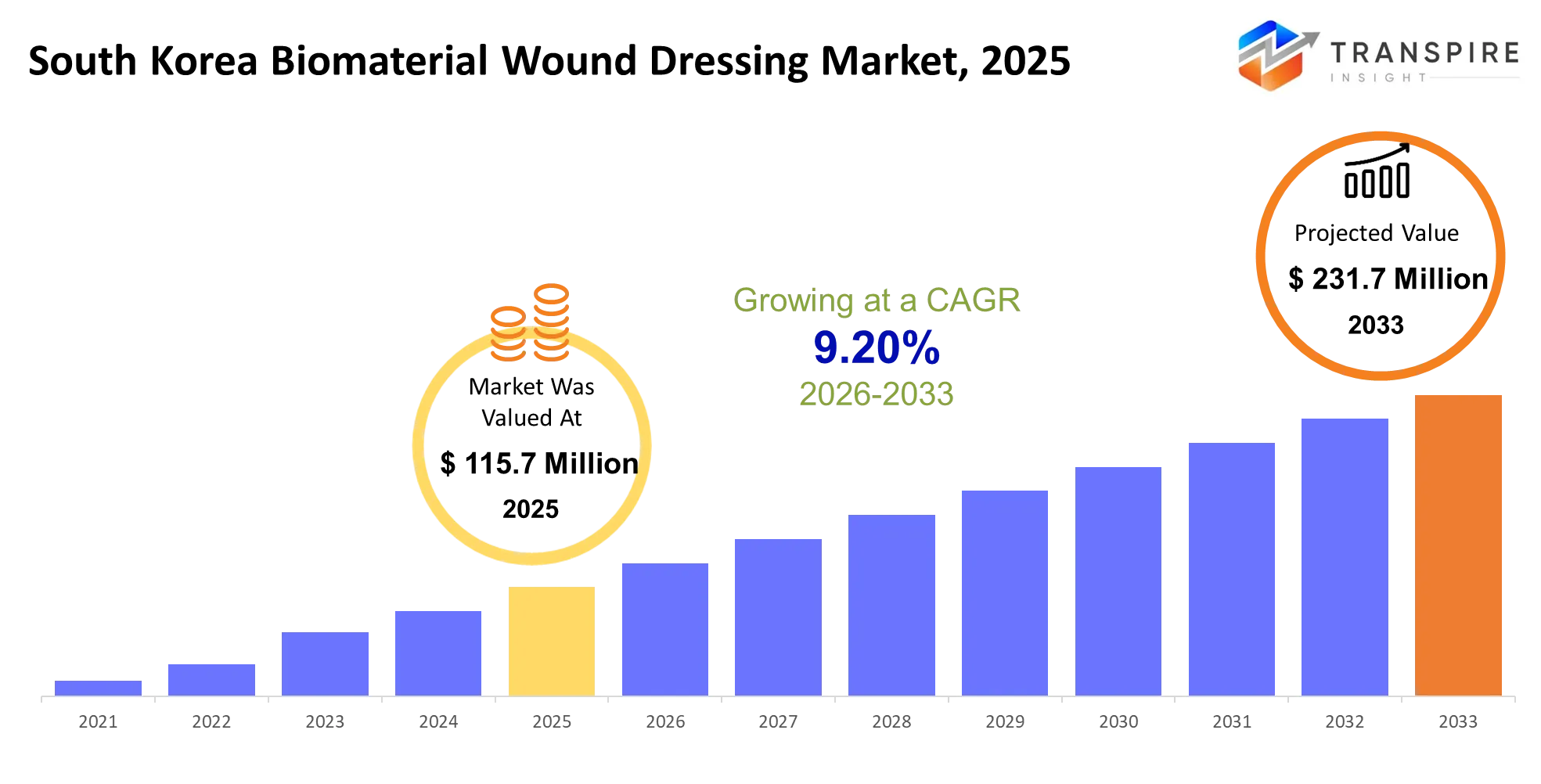
- Market Value (2025): USD 115.7 Million.
- Expected Market Value (2026): USD 125.1 Million.
- Estimated Market Value (2033): USD 231.7 Million.
- Forecast CAGR (2026–2033): 9.20%
Introduction
The South Korea Biomaterial Wound Dressing Market is undergoing rapid changes due to the adoption of advanced wound care products that help to promote efficient healing and regeneration of tissues. The use of biomaterial wound dressings involves the application of biocompatible materials such as collagen, alginate, chitosan, hyaluronic acid, hydrogels, and sophisticated synthetic polymers to achieve appropriate moisture control, wound exudate management, protection, and wound repair. The main factors that are boosting the market development include the aging population of South Korea, the prevalence of chronic wounds, healthcare infrastructural development, and advanced medical technologies. The use of biomaterial wound dressings by hospitals and specialized providers is being carried out for diabetic ulcers, pressure injuries, surgery wounds, burns, and trauma wounds.
Key Market Highlights: -
- By Material, the Synthetic Biomaterials dominated the market and holds approximately 68% share in 2025 and is projected to grow at a substantial CAGR during the forecast period.
- By Product, the foam dressings dominated the market and holds approximately 28% share in 2025 and is projected to grow at a substantial CAGR during the forecast period.
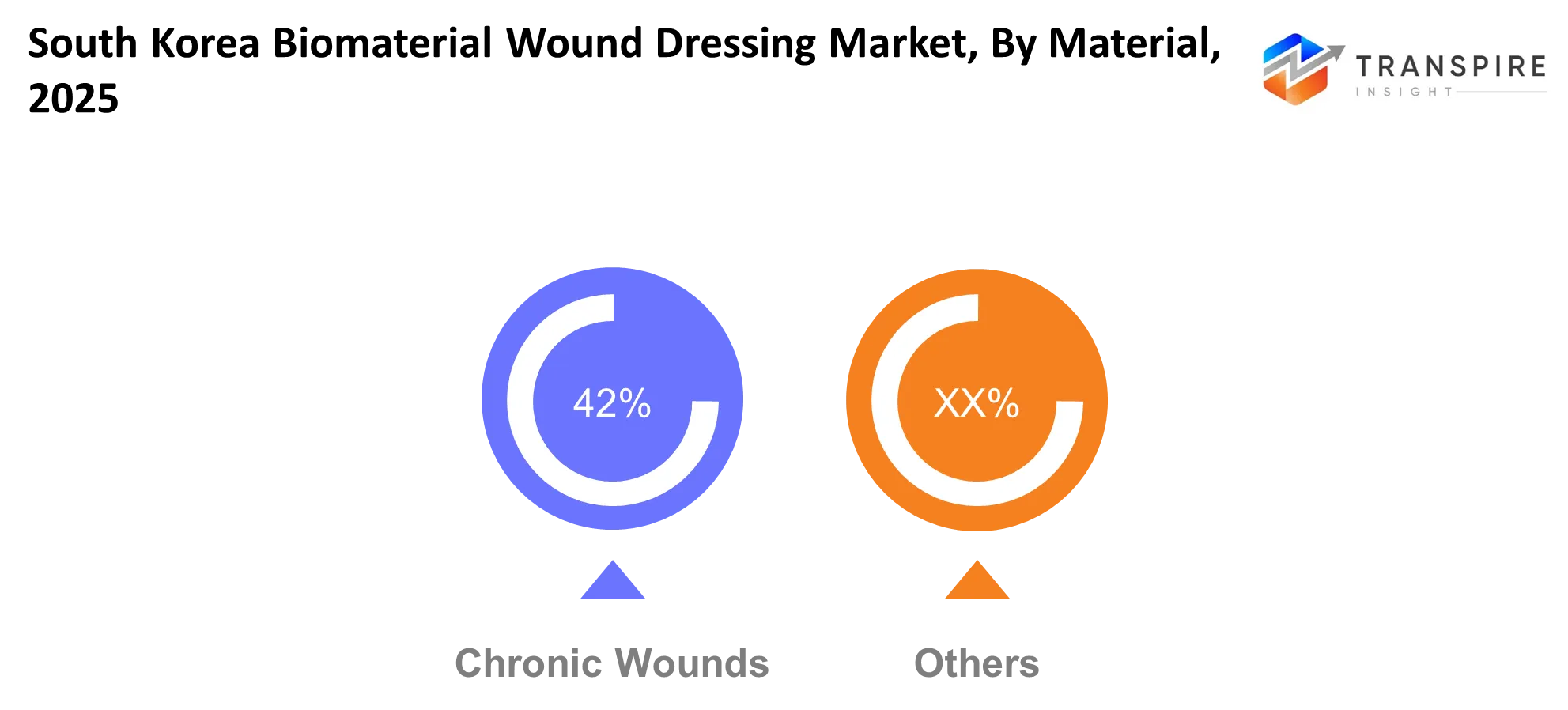
- By Wound Type, the Chronic Wounds Manufacturers segment dominated the market and holds approximately 68% share in 2025 and is projected to grow at a substantial CAGR during the forecast period.
- The South Korea biomaterial wound dressing market is growing due to the aging population, innovations in regenerative biomaterials, development of health care infrastructure, government-funded research on medical devices, and regulatory changes.
How is Technology Driving Growth in the South Korea Biomaterial Wound Dressing Market?
Innovation in technologies such as smart technology, bioactive technology, antimicrobial technology, and regenerative wound care technology is facilitating market growth in the South Korea Biomaterial Wound Dressing Market. Smart technology and sensor technology help monitor the moisture levels, wound, and risk of infections. Bioactive biomaterials such as collagen, chitosan, hydrogels, and antimicrobial formulation increase exudate management and facilitate tissue regeneration. Electrospun fiber technology, collagen technology, and regenerative scaffold technology are being developed for next generation wound healing technologies. Digital wound monitoring helps in the clinical and remote monitoring of wounds and patients whereas advanced manufacturing and processing helps in the commercialization of these biomaterial wound dressings.
Market Drivers
South Korea Biomaterial Wound Dressing Market is driven by its fast aging population and the prevalence of chronic wounds such as diabetic foot ulcers, pressure ulcers, and hard-to-treat wounds. Increasing use of innovative wound care technologies is pushing health care practitioners to adopt biomaterials that can provide better moisture control, exudate absorption, antimicrobial barriers, and biological benefits. The government-sponsored efforts in innovation in health care as well as investments by hospitals are promoting the uptake of regenerative and bioactive wound care technologies. Also, there are high levels of R&D activities in Korean biotech and medical devices companies for collagen, alginate, hydrogel, chitosan, and many more biomaterial dressing technologies.
Restrain
South Korea Biomaterial Wound Dressing Market restraints include low reimbursement for some high-end products, higher prices than traditional gauzes, and tough regulations. The expensive biomaterial dressings may hike up the costs of treatment and limit the use by smaller healthcare institutions and price-sensitive patients. Also, clinical testing and product approvals may delay the commercialization process especially for innovations such as collagen, hydrogel, alginate, chitosan, and regenerative biomaterial wound dressings.
|
Driver |
Relative Impact on Growth (%) |
Geographic Relevance |
Impact Timeline |
Demand Strength |
Growth Mechanism |
Key Beneficiaries |
Major Constraint |
|
Driver 1: Rising Chronic Wound and Aging-Related Care Demand |
27% |
Nationwide; Seoul Capital Area, Busan, Daegu |
Short-term |
High |
Aging population increases chronic wound-management requirements |
Biomaterial dressing manufacturers, hospitals, home-care providers |
Reimbursement limitations for premium dressings |
|
Driver 2: Adoption of Advanced Biomaterial and Bioactive Dressings |
24% |
Seoul, Gyeonggi, Daejeon; major tertiary hospitals |
Medium-term |
High |
Bioactive materials accelerate healing and improve wound environments |
Biomaterial developers, medical-device manufacturers, specialist clinics |
High development and clinical-validation costs |
|
Driver 3: Government Medical-Device R&D and Localization Investment |
20% |
Nationwide; technology and R&D clusters |
Medium-term |
High |
Public R&D funding accelerates domestic biomaterial commercialization |
Korean manufacturers, research institutes, technology suppliers |
Long commercialization and regulatory cycles |
|
Driver 4: Increasing Hospital Adoption of Advanced Wound Management |
16% |
Seoul, Gyeonggi, Busan, Incheon |
Short-term |
High |
Hospitals shift toward dressings supporting faster and efficient wound closure |
Hospitals, surgeons, wound-care specialists, dressing suppliers |
Clinical preference and procurement-price pressures |
|
Driver 5: Sustainable and Next-Generation Biomaterial Development |
13% |
Nationwide; Korean R&D and manufacturing hubs |
Long-term |
Medium |
Biodegradable and regenerative materials create differentiated dressing products |
Biomaterial companies, green-material suppliers, technology vendors |
Scale-up complexity and material-cost volatility |
|
Total |
100% |
— |
— |
— |
— |
— |
— |
Analysis of Prices and Consumer Behaviour
There is very high demand for advanced dressing products made using biomaterial technology among hospitals, chronic wound care, and specialized wound-care service providers. The advanced biomaterials represent about 11.5 million USD in 2025 due to the growing adoption of advanced technologies in wound care. Biomaterial dressings may be priced higher compared to normal gauzes because of the moisture management capabilities, absorbency of fluids, antiseptic and tissue regeneration properties. Foam dressings make up 40% of the overall advanced wound dressings, attributed to their flexible nature and exudate management capability. Hospitals account for about 55%, while chronic wounds account for nearly 50% of the applications. About 45% of the South Korean market is served by Seoul metropolitan area.
|
Company |
Est. Revenue Share Range |
Key Offerings |
Strategic Positioning |
Geographic Strength |
Technology Focus |
|
Genewel Co., Ltd. |
10–15% |
Medifoam®, Betafoam, moist wound dressings, biomaterial wound-care solutions |
Domestic biomaterial leadership and product diversification |
Asia Pacific, South Korea, selected export markets |
Moist wound healing, polyurethane foam, biocompatible biomaterials |
|
T&R Biofab Co., Ltd. |
3–6% |
Reprofoam, Bonofoam, VdECM hydrogel dressing, ECM-based wound products |
Regenerative medicine-led innovation and differentiation |
South Korea, Asia Pacific, emerging international markets |
ECM biomaterials, hydrogels, 3D bioprinting, regenerative scaffolds |
|
CGBio Inc. |
3–6% |
CG-PASTE, Easyfoam, CuraVAC, wound-management solutions |
Regenerative biomaterials and integrated wound management |
South Korea, Asia Pacific, Europe |
Acellular dermal matrix, foam dressings, NPWT, regenerative biomaterials |
|
L&C BIO Co., Ltd. |
2–5% |
MegaCure, MegaCare W, acellular dermal matrix products, skin-regeneration materials |
Tissue-regeneration specialization with biomaterial breadth |
South Korea, Asia Pacific, international markets |
Acellular dermal matrix, collagen, bioabsorbable materials |
|
HansBiomed Co., Ltd. |
2–4% |
ScarClinic™, Synthetic Biomaterials wound/scar dressings, tissue-regeneration biomaterials |
Specialty biomaterials and scar-management differentiation |
South Korea, Asia Pacific, Europe |
Medical-grade Synthetic Biomaterials, scar management, regenerative biomaterials |
|
ConvaTec Group Plc |
7–11% |
AQUACEL®, AQUACEL® Foam, AQUACEL® Ag+, DuoDERM®, Kaltostat® |
Advanced dressing technology and clinical differentiation |
Europe, North America, Asia Pacific |
Hydrofiber®, hydrocolloid, alginate, antimicrobial dressings |
|
Mölnlycke Health Care AB |
6–10% |
Mepilex®, Mepilex Ag®, Mepitel®, Exufiber® |
Premium wound-care performance and clinical specialization |
Europe, North America, Asia Pacific |
Safetac®, Synthetic Biomaterials foam, antimicrobial and exudate management |
|
Smith+Nephew Plc |
6–10% |
ALLEVYN®, ALLEVYN LIFE®, ALLEVYN Ag+, ALLEVYN COMPLETE CARE |
Innovation-led advanced wound-management portfolio |
North America, Europe, Asia Pacific |
Hydrocellular foam, Synthetic Biomaterials, antimicrobial, exudate-locking technology |
|
Solventum Corporation |
5–9% |
3M™ Tegaderm™, 3M™ Tegaderm™ Synthetic Biomaterials Foam, wound-care dressings |
Broad clinical portfolio and hospital-channel strength |
North America, Europe, Asia Pacific |
Transparent films, Synthetic Biomaterials foam, adhesive and barrier technologies |
|
B. Braun Melsungen AG |
3–6% |
Askina®, Askina® Foam, Askina® Hydro, Askina® Calgitrol® |
Integrated hospital supply and value-based wound care |
Europe, Asia Pacific, Latin America |
Foam, hydrogel, alginate, antimicrobial wound technologies |
Who are the Key Players in the South Korea Biomaterial Wound Dressing Market and how do they compete?
South Korea Biomaterial Wound Dressing Market competitiveness is provided by firms focused on innovations in the sphere of biomaterials, wound-care solutions, which are suitable for particular clinical application, and building up the distribution network worldwide. Competing not just due to low prices, but by means of developing wound dressings, biomaterial solutions, regenerative technology, and cooperation with the healthcare system, such type of competition results not only in continuous innovation of the product, but also enables to increase the healing efficiency, wound-management, effectiveness, and resource optimization in the healthcare organization.
With the help of developing advanced wound dressings, biomaterial solutions, regenerative technology, and wound-care products, Smith+Nephew becomes competitive in the market. With the help of producing high-performance wound-care products for chronic wounds, surgical wounds, exudate management, and other clinical applications, Mölnlycke Health Care distinguishes itself among its competitors. 3M positions itself by means of developing integrated solutions in advanced wound care, medical dressings, antimicrobial protection, and healthcare technologies.
Top Companies in the South Korea Biomaterial Wound Dressing Market
- Smith+Nephew
- Mölnlycke Health Care
- 3M
- Coloplast
- Convatec
- Integra LifeSciences
- Organogenesis
- B. Braun
- Medline Industries
- Hollister
- Cardinal Health
- Lohmann & Rauscher
- Daewoong Pharmaceutical
- Kolon Life Science
- Genewel
South Korea Biomaterial Wound Dressing Market Segmentation
The South Korea Biomaterial Wound Dressing Market share is divided into five categories: By Material, By Product, By Wound Type, By Application, By End User
The Synthetic Biomaterials dominated the market, accounting for nearly 68% in 2025 and is expected to rise at a significant CAGR during the forecast period.
The South Korea Biomaterial Wound Dressing Market is segmented by material into collagen, chitosan, hyaluronic acid, alginate, gelatin, silk fibroin, synthetic biomaterials. Among these, the Synthetic Biomaterials segment dominated the market, accounting for nearly 68% in 2025 and expected to increase at a significant CAGR during the forecast period. The Synthetic Biomaterials market was leading in the South Korea Biomaterial Wound Dressing Market with almost 68% share in 2025 due to better durability, controlled performance, economical nature, and widespread clinical application.
The foam dressings dominated the market, accounting for nearly 28% in 2025, and is expected to rise at a significant CAGR during the forecast period.
The South Korea Biomaterial Wound Dressing Market is segmented by product into foam dressings, hydrogel dressings, hydrocolloid dressings, alginate dressings, collagen dressings, film dressings, composite dressings. Among these, the foam dressings dominated the market, accounting for nearly 28% in 2025 and expected to increase at a significant CAGR during the forecast period. This growth is attributed to better exudate absorption, moisture management, cushioning, longer wearing duration, and chronic wound care.
The Chronic Wounds dominated the market, accounting for nearly 68% in 2025 and is expected to rise at a significant CAGR during the forecast period.
The South Korea Biomaterial Wound Dressing Market is segmentedby wound type into chronic wounds, acute wounds, diabetic foot ulcers, pressure ulcers, venous leg ulcers, surgical wounds, burns. Among these, the Chronic Wounds dominated the market, accounting for nearly 68% in 2025 and expected to increase at a significant CAGR during the forecast period. The factors driving the growth include increasing incidences of diabetes, aging wounds, healing needs, and the use of biomaterial dressings for effective chronic wound management.
Future Market Trends for the South Korea Biomaterial Wound Dressing Market:-
Intelligent and Bioactive Dressing: In South Korea, research on intelligent dressing that incorporates the use of sensors, bioactive materials, moisture sensing, antimicrobial properties, and drug delivery mechanisms is taking place.
Advanced Wound Treatment at Home: There has been an increased decentralization of healthcare, leading to higher demand for biomaterial wound dressing that can be used as outpatient care and home-based wound treatment.
Innovations with Biomaterials for Regeneration: Research and development within the country are becoming more centered on collagen, chitosan, hydrogels, composite biomaterials, and bioengineered skin.
Recent Development
In January-March 2026: South Korea fast-tracked the use of bioactive wound dressings, where innovations in collagen, chitosan, and alginate wound dressing became prominent for tissue regeneration and infections.
In April-June 2026: The research in smart wound dressings evolved due to the use of bioengineered materials that can track wound conditions and administer therapies accordingly.
In June 2026: There was an increase in the interest of healthcare professionals in home-based advanced wound dressing solutions, thus increasing demand for small and easy-to-use biomaterial dressings for chronic wounds.
In June 15, 2026: Launch of the Biomaterial Wound Dressing Market Size Report emphasizing the importance of natural and artificial biomaterials technologies and new market potentialities in the Asia-Pacific region.
Market Segmentation
This study forecasts revenue at Japan, regional and country levels from 2020 to 2033. Transpire Insights has segmented the South Korea Biomaterial Wound Dressing Market based on the below-mentioned segments:
South Korea Biomaterial Wound Dressing Market, By Material
- Collagen
- Chitosan
- Hyaluronic Acid
- Alginate
- Gelatin
- Silk Fibroin
- Synthetic Biomaterials
South Korea Biomaterial Wound Dressing Market, By Product
- Foam Dressings
- Hydrogel Dressings
- Hydrocolloid Dressings
- Alginate Dressings
- Collagen Dressings
- Film Dressings
- Composite Dressings
South Korea Biomaterial Wound Dressing Market, By Wound Type
- Chronic Wounds
- Acute Wounds
- Diabetic Foot Ulcers
- Pressure Ulcers
- Venous Leg Ulcers
- Surgical Wounds
- Burns
South Korea Biomaterial Wound Dressing Market, By Application
- Wound Healing
- Infection Prevention
- Hemostasis
- Tissue Regeneration
- Exudate Management
- Scar Management
- Drug Delivery
South Korea Biomaterial Wound Dressing Market, By End User
- Hospitals
- Specialty Clinics
- Ambulatory Surgical Centers
- Home Healthcare
- Long-Term Care Facilities
- Wound Care Centers
- Research Institut’
Frequently Asked Questions
Find quick answers to common questions.
An aging population, increasing chronic wounds, advanced biomaterial innovation, healthcare investments, and growing adoption of regenerative wound-care technologies drive market growth.
Synthetic biomaterials dominate due to their durability, controlled performance, cost efficiency, versatility, and broad clinical applicability across advanced wound-care settings.
Foam dressings offer superior exudate absorption, moisture management, cushioning, extended wear, and effective management of chronic and postoperative wounds.
Chronic wounds represent a major opportunity, supported by aging-related wounds, diabetes prevalence, prolonged healing requirements, and increasing advanced dressing adoption.
Smart dressings, bioactive biomaterials, sensor-enabled monitoring, regenerative scaffolds, antimicrobial technologies, and advanced hydrogels will increasingly influence future market development.
- Smith+Nephew
- Mölnlycke Health Care
- 3M
- Coloplast
- Convatec
- Integra LifeSciences
- Organogenesis
- B. Braun
- Medline Industries
- Hollister
- Cardinal Health
- Lohmann & Rauscher
- Daewoong Pharmaceutical
- Kolon Life Science
- Genewel
About the Authors

Pankaj Ghogare Patil
I am Pankaj Ghogare Patil, a Senior Research Analyst at Transpire Insight, specializing in the Pharmaceutical, Chemicals & Materials, Healthcare IT, and Biotechnology industry. My expertise lies in conducting comprehensive market research, analyzing industry trends, evaluating competitive landscapes, and translating complex data into actionable insights. At Transpire Insight, I closely follow emerging technologies, regulatory developments, and market innovations to create accurate, well-researched, and informative content that helps businesses and professionals make informed decisions. I am committed to producing credible, evidence-based articles that reflect industry best practices while making technical topics accessible and valuable for a broad audience.

Chakradhar Khansole
Chakradhar serves as the Research Director at Transpire Insight, bringing over 8 years of experience in technology, innovation, and strategic market intelligence. He specializes in transforming complex market data into actionable business insights that enable organizations to make informed, growth-oriented decisions. Recognized for his strategic vision and analytical expertise, Chakradhar leads high-impact research initiatives, delivering comprehensive market assessments, competitive intelligence, and forward-looking industry analysis.
Recently Published Reports
-
Apr 2026
AI in Diabetic Retinopathy Market
AI in Diabetic Retinopathy Market Size, Share & Analysis Report By Type (Screening AI Systems, Diagnostic AI Systems, and Predictive AI Models), By Application Segment (Hospitals, Ophthalmology Clinics, Diagnostic Centers, and Research and Development), and Geography (North America, Europe, Asia-Pacific, Middle East and Africa, South and Central America), 2021 - 2031
-
Apr 2026
Psychometric Tests Market
Psychometric Tests Market Size, Share & Analysis Report By Type (Personality Tests, Ability/Aptitude Tests, Skill/Knowledge Tests, and Others), By Application (Talent Acquisition and Talent Management), and Geography (North America, Europe, Asia-Pacific, Middle East and Africa, South and Central America), 2021 – 2031
-
Apr 2026
Rare Biological Sample Collection Market
Rare Biological Sample Collection Market Size, Share & Analysis Report By Type (Isolation Kits & Reagent, Blood Collection Tubes, and Others), By Application (Oncology, Transcriptomics, Pharmacogenomics, and Others), and Geography (North America, Europe, Asia-Pacific, Middle East and Africa, South and Central America), 2021 – 2031
-
Jul 2026
Diabetic Retinopathy Market
Diabetic Retinopathy Market Size, Share & Analysis Report By Type (Proliferative Diabetic Retinopathy, and Diabetic Macular Edema (DME)), By Treatment Type (Anti VEGF Drug, Steroid Implants, Laser Surgeries, and Vitrectomy), and Geography (North America, Europe, Asia-Pacific, Middle East and Africa, South and Central America), 2021 – 2031
Our Clients







