

Solid Sulphur Market Summary:
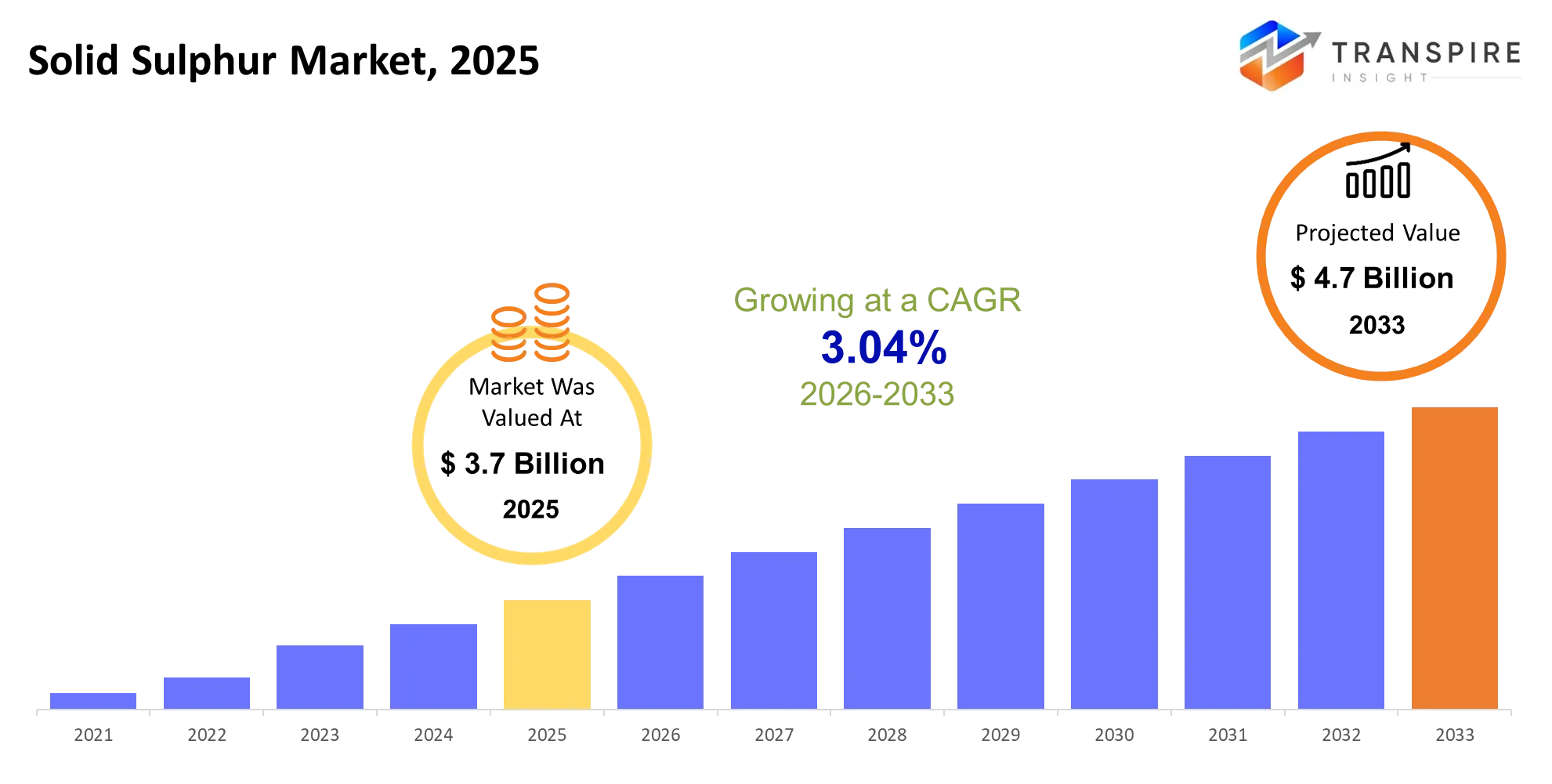
As per Transpire Insight Analysis, the Solid Sulphur Market size is estimated at USD 3.7 billion in 2025 and is anticipated to reach USD 4.7 billion by 2033, growing at a CAGR of 3.04% from 2026 to 2033.
The international solid sulphur market links sulphur recovery in oil and gas operations with downstream industries such as fertiliser, sulphuric acid, chemicals, mining, and rubber production. Over the past three to five years, market activity has changed. Sulphur supply is now closely tied to refinery output and natural gas processing. At the same time, demand for sulphur has grown beyond its traditional use in fertilisers. One big shift is the rising need for sulphur in high-pressure acid leach projects. These projects make nickel materials that are used in battery supply chains. This is a change in how sulphur is being used. A key real-world factor has been the expansion of refining capacity in the Middle East. Countries in that region have. Upgraded their refineries. This development is expected to increase sulphur supply. It also supports trade within the region. More sulphur is being produced and moved around.At the same time fertilizer production remains a steady source of demand. Sulphur is still needed to process rock. That means agriculture still relies on sulphur as an input. These two sectors-industrial and agricultural-are both driving growth in sulphur demand. Together, these uses keep sulphur demand linked to manufacturing. They also tie it to resource-processing activity around the world. So even though some uses have evolved sulphur stays important. Its market is shaped by both trends and ongoing agricultural needs.
Solid Sulphur Market Size & Forecast:
- Market Size 2025: USD 3.7 Billion
- Expected Market Value (2033): USD 4.7 Billion
- Forecast CAGR (2026–2033): 3.04%
- Leading Region in 2025: Asia-Pacific
- Fastest Growing Region: Middle East & Africa
- Key Company Profiles: Saudi Aramco, ADNOC, QatarEnergy, Kuwait Petroleum Corporation, ExxonMobil, Shell, TotalEnergies, Chevron, Sinopec, CNPC, Indian Oil Corporation, Reliance Industries, SABIC, Suncor Energy, OCP Group
Key Market Insights:
The industry is moving towards sulphur products for applications in fertiliser and industrial requirements. The granular sulphur segment continues to dominate, although powdered sulphur is becoming increasingly important with finer particles.
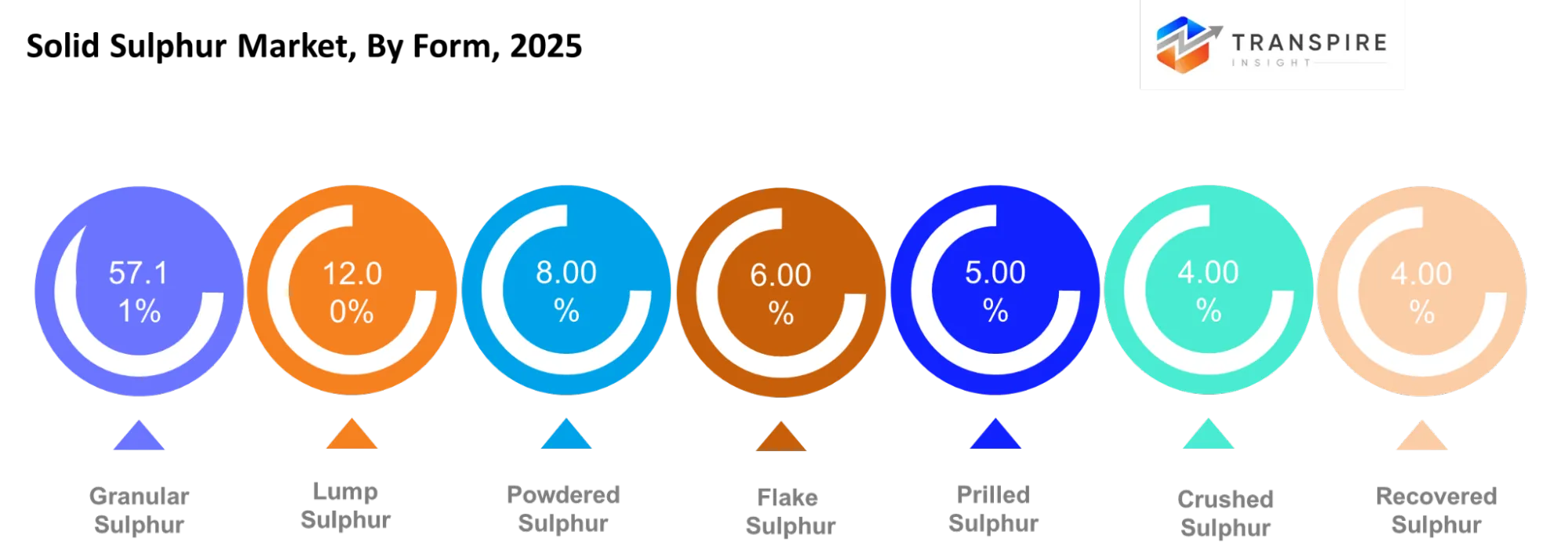
- Granular sulphur accounts for 57.11% of the market, as Shell continues to innovate sulphur products for fertilisers.
- Lump sulphur has 12.00% of the market, while producers are working on improving sulphur recovery, storage, and handling for industries.
- Powdered sulphur makes up 8.00% of the market and has a 5.25% CAGR, thanks to advancements in micronised sulphur technology in fertiliser products.
- Flake sulphur makes up 6.00% of the market, where industrial applications drive the demand for better product handling and processing.
- Crushed sulphur has 4.00% of the market, with particle size being critical for some processing applications in specific industries.
- Recovered sulphur accounts for 4.00% of the market, while Shell innovates in sulphur recovery, transportation, and processing into value-added products.
What are the Key Drivers, Restraints, and Opportunities in the Solid Sulphur Market?
Drivers
The increasing recovery of sulphur through the processing of oil and gas, where increasingly stringent regulations have made it economically viable to recover sulphur rather than releasing sulphur compounds into the environment. Shell has reported on several projects demanding recovery efficiency for sulphur, which adds to the volumes of recoverable sulphur.
Restraints
Structural limitations arise from the need for recovery, solidification, storage, transport, and handling facilities. The treatment of sulphur-containing hydrocarbons is complicated, while stricter environmental regulations can lead to greater investment in the recovery process. As stated by Shell, sulphur recovery and tail gas treatment technology are needed for strict emissions regulations.
Opportunities
Opportunity in value-added products for sulphur, particularly micronised and sulphur-rich fertilisers. The Thiogro products from Shell Technologies utilise micronised elemental sulphur in order to enhance sulphur oxidation and uptake throughout the growing season, thereby illustrating the potential that process technology can have in increasing product value. There are new opportunities emerging in Asia Pacific and the Middle East as fertilisers, gases, sulphur, and chemicals are all developed together.
What Has the Impact of Artificial Intelligence Been on the Solid Sulphur Market?
The use of Artificial intelligence will assist in the identification of abnormalities that may occur within the value chain of solid sulphur through forecasting, process optimisation, equipment monitoring, and decision-making. AI-enabled processes will be able to utilise production, temperatures, pressures, equipment, and processes in sulphur-producing plants to recognise any abnormalities that have occurred and might become problematic.AI will also aid in the optimisation of refinery processes and gas processing through historical production data and real-time data. This will assist in process control. For firms that deal with large amounts of solid sulphur, predictive models will enable them to know their demand and purchasing needs. Implementing AI will not be an easy task since it will need reliable data on the operations. It will also need the system to be integrated with industrial control systems and personnel.
Instance
In October 2025, Yokogawa Electric Corporation introduced AI-driven autonomous agents at the Fadhili Gas Plant of Aramco in Saudi Arabia to fine-tune the acid gas removal process. This intelligent solution was useful for increasing stability, decreasing resource usage, and reducing the interference of operators, indicating the potential of artificial intelligence in improving gas processing efficiency.https://www.yokogawa.com/news/press-releases/2025/2025-10-29/
Key Market Trends:
The trend in industry is shifting away from a commodity-based approach to an approach that is based on technology and application. There is increasing emphasis by manufacturers and downstream users on issues related to product form, efficiency, transportation, safety, and fertilisers.
- Increasing efficiency in the recovery process with reduced emissions is being emphasised by the refiners and gas processors.
- Granular sulphur remains dominant due to its ease of handling in storage, transportation, and processing operations.
- Fertilisers with fine and micronised sulphur are gaining importance in customised formulations.
- Enhanced sulphur-based fertilisers are widening the link between the sulphur industry and precision agriculture.
- Efforts are being made by producers to enhance solidification and granulation techniques.
- Digital monitoring is getting important for maintenance and productivity improvement.
- Environmental demands are prompting investment in enhanced sulphur recovery and tail-gas treatment processes.
Solid Sulphur Market Segmentation
By form
Granular sulfur occupies the leading format share with 57.11%, and it stands out as the main format of solid sulfur in the international market. This is because of its relative ease of storage, transportation, and applications, especially for fertilisers and industries. The share of lump sulfur is 12.00%, powdered sulfur holds 8.00% and is projected to register the fastest growth with a CAGR of 5.25%. Flake sulfur constitutes 6.00%, while prilled sulfur accounts for 5.00%, crushed sulfur accounts for 4.00%, recovered sulfur makes up 4.00%, and others account for 3.89%. The future format market will depend increasingly on the specific application needs.
By application
fertilisers and sulphuric acid continue to be significant markets because elemental sulphur can be used to produce goods that are beneficial to agricultural and chemical industries. Sulphur is employed by fertiliser producers in those blends that need extra sulphur in their diet. Sulphuric acid production is one of the largest applications for elemental sulphur in the industrial sector. Chemical processing, oil refining, mining, rubber and vulcanisation, and asphalt modification contribute further. Future expansion of this market would likely arise from more efficient applications rather than an increase of demand for this commodity itself. Specialized fertilizers, chemical intermediates, and industrial goods offer value-added solutions in this regard.
By source
oil refineries and natural gas plants constitute important channels for supplying because sulphur is extracted when sulphur compounds are separated from hydrocarbons. Oil sands, pyrites, smelters, recycled sulphur, and mining offer further sources. Increasing concern for environmental regulations makes sulphur recovery an important element of cost structures of refineries and gas processing facilities. Large sour gas developments are capable of producing large amounts of sulphur along with their energy product. Future development of supply would remain linked to investments in oil refining and gas processing industry.
By End user
Agriculture is a key area of demand for sulphur, as it is consumed not only directly but also via fertiliser products that contain sulphur. The consumption by chemical and petroleum industries occurs in significant amounts owing to the use of sulphuric acid, as well as via refining operations and conversion. Mining, rubber, construction, and pharmaceutical uses form a more specialised set of areas of application. Increased use of sulphur-enriched fertilisers can enhance the importance of agriculture, whereas chemical and petroleum demand users are expected to maintain importance due to their well-established processing needs.
By Grade
Industrial grade sulphur has wide applications in chemicals, petrochemicals, and manufacturing, whereas agricultural grade is utilised for fertilizer and soil-related applications. High purity and technical grades are applied in those areas that require higher quality standards of sulphur. There are also pharmaceutical, food, and polymer grades that target more specialised applications which need high quality and purity. Due to the specialisation of downstream industries, suppliers can earn more value by offering grades of sulphur appropriate for the requirements of particular applications.
What are the Key Use Cases Driving the Solid Sulphur Market?
Manufacture of fertilisers is one of the uses of solid sulfur because granulated sulfur forms the most common sulfur product. The incorporation of sulfur in fertilisers helps to add another nutrient to the fertiliser and helps with the cultivation of crops in sulfur-deficient soils. Production of sulphuric acid is also another use of solid sulfur, which links solid sulfur to phosphates and chemical fertilisers, mining, and industrial processing. This demand is supported by petroleum refining and chemical processing, as waste sulfur can be transformed into useful products. The new applications of solid sulfur include micronised sulphur, enhanced fertiliser, and specialised formulations. An example of this trend is the development of Thiogro by Shell, which utilises micronised elemental sulphur in fertiliser products.
|
Report Metrics |
Details |
|
Market size value in 2025 |
USD 3.7 Billion |
|
Market size value in 2026 |
USD 3.81 Billion |
|
Revenue forecast in 2033 |
USD 4.7 Billion |
|
Growth rate |
CAGR of 3.04% from 2026 to 2033 |
|
Base year |
2025 |
|
Historical data |
2021 - 2024 |
|
Forecast period |
2026 - 2033 |
|
Report coverage |
Revenue forecast, competitive landscape, growth factors, and trends |
|
Regional scope |
United States; Canada; Mexico; United Kingdom; Germany; France; Italy; Spain; Denmark; Sweden; Norway; China; Japan; India; Australia; South Korea; Thailand; Brazil; Argentina; South Africa; Saudi Arabia; United Arab Emirates |
|
Key company profiled |
Saudi Aramco, ADNOC, QatarEnergy, Kuwait Petroleum Corporation, ExxonMobil, Shell, TotalEnergies, Chevron, Sinopec, CNPC, Indian Oil Corporation, Reliance Industries, SABIC, Suncor Energy, OCP Group |
|
Customization scope |
Free report customization (country, regional & segment scope). Avail customized purchase options to meet your exact research needs. |
|
Report Segmentation |
Form (Granular Sulphur, Lump Sulphur, Powdered Sulphur, Flake Sulphur, Prilled Sulphur, Crushed Sulphur, Molten-to-Solid Sulphur, Others); Application (Fertilizers, Sulphuric Acid, Chemical Processing, Petroleum Refining, Mining, Rubber & Vulcanization, Asphalt Modification, Others); Source (Oil Refineries, Natural Gas Processing, Oil Sands, Pyrite Processing, Smelters, Recovered Sulphur, Mining, Others); End User (Agriculture, Chemicals, Petroleum, Mining, Rubber, Construction, Pharmaceuticals, Others); Grade (Industrial Grade, Agricultural Grade, High-Purity, Technical Grade, Pharmaceutical Grade, Food Grade, Polymer Grade, Others) |
Which Regions are Driving the Solid Sulphur Market Growth?
North America
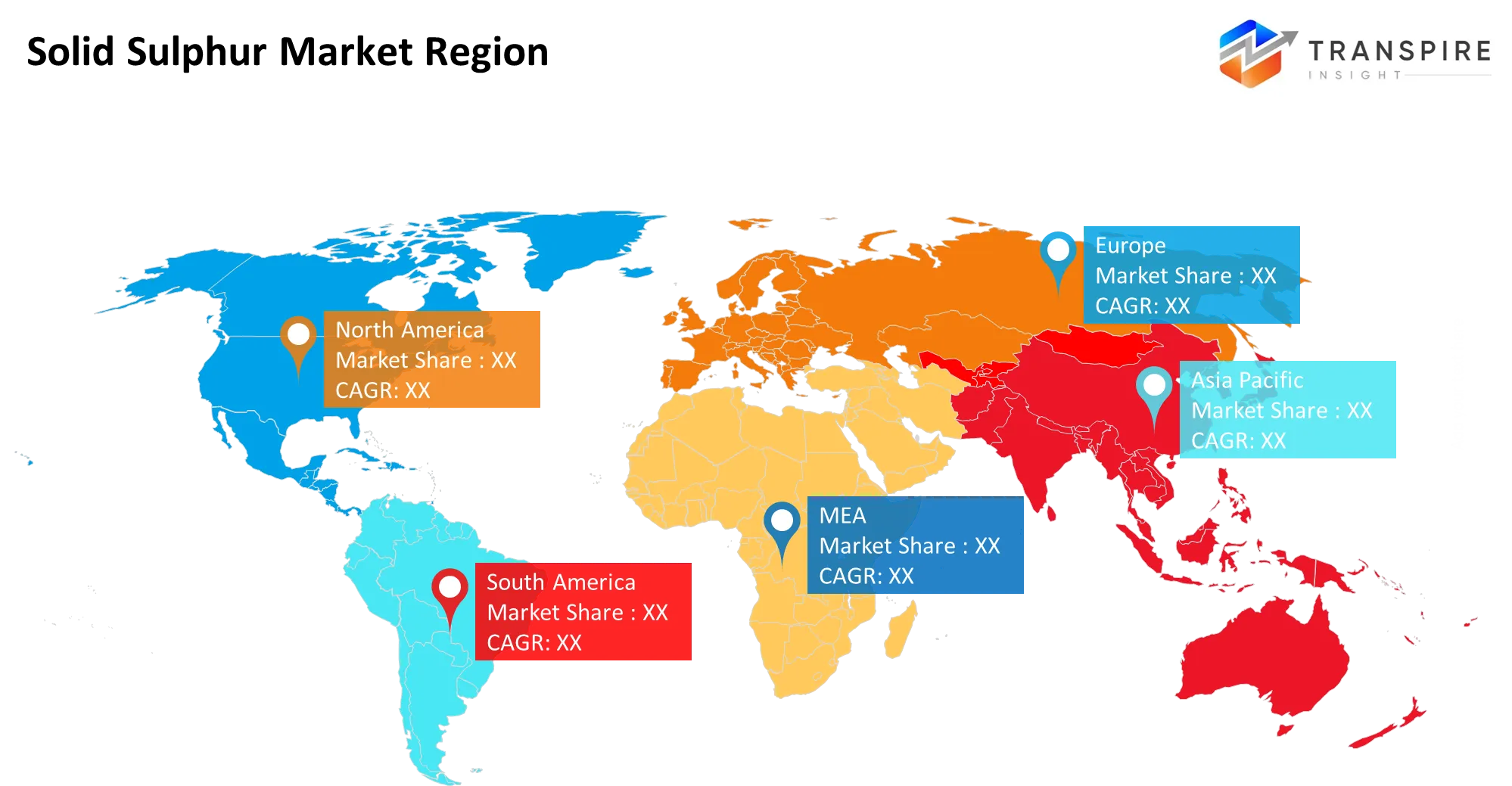
North America constitutes 15.00% of the solid sulphur market and enjoys the advantage of having an established base in refining, petrochemicals, chemicals, and agriculture. This is a region with well-developed infrastructure for sulphur recovery, storage, transport, and further downstream applications. Growth in demand comes from fertiliser production and existing chemical applications. The continued modernisation of production facilities will assist in sustaining the position of the region in the sulphur market.
In November 2025, The Canadian company CSV Midstream Solutions opened its Albright sulphur plant in the region of Alberta, Canada, with a daily sulphur recovery rate of 370 tonnes.https://www.csvmidstream.com/general/csv-midstream-solutions-brings-albright-plant-online-contributing-to-the-ongoing-evolution-of-canadas-midstream-infrastructure/
Europe
Europe constitutes 13.00% of the solid sulphur market and has the advantage of being supported by its highly developed chemical, refining, and industrial manufacturing ecosystem. In comparison to Asia-Pacific, this region has a more developed industrial base and hence market growth will increasingly be driven by efficiency and compliance considerations. Manufacturers and end-users are looking towards improving emissions control and efficiency of the processes. These factors bring in stability despite growth in the demand for traditional commodities.
In April 2025, BASF announced the construction of a new production facility for semiconductor-grade sulphuric acid in Ludwigshafen, Germany. This facility is expected to start operations, meeting the growing need for high-purity sulphuric acid in Europe.https://www.basf.com//en/media/news-releases/2025/04/p-25-091
Asia-Pacific
Asia-Pacific leads in the regional market with a share of 41.34%, owing to the presence of fertiliser production, refinery operations, the chemical industry, and large agricultural markets. The downstream industrial base of the region results in numerous applications of solid sulphur. Agricultural and chemical industries' consumption gives it an extensive consumption base in contrast to other regions where industries dominate.
In March 2025, Coromandel International opened its second sulphur-producing plant in Visakhapatnam, India, thereby doubling its sulphur-fertiliser producing capacity.https://www.coromandel.biz/press-release/coromandel-international-doubles-the-sulphur-manufacturing/
Who are the Key Players in the Solid Sulphur Market and how do they compete?
Competition in the solid sulphur market is driven by sulphur resources, production capacity, quality, logistical factors, relationships with downstream industries, and capabilities to serve international clients. Firms owning oil and gas assets as well as their downstream assets may derive an advantage from sulphur production in conjunction with hydrocarbon processing. Other firms may compete based on sulphur marketing, transportation, fertiliser production technologies, and customised products. Shell, for instance, runs its own sulphur business dealing with supply chain management, transportation, formed and molten sulphur management and utilization.ADNOC is able to compete because of its large-scale sour gas processing and integrated sulphur production facilities. The Shah Gas Plant has an annual sulphur production capacity of n tonnes. In addition, sulphur granulation plants of ADNOC help to handle export products. The development of the company is tightly associated with gas-processing and downstream sectors. It was stated that ADNOC Gas is developing its Ruwais terminal to accommodate new sulphur volumes related to the Hail and Ghasha projects.
Solid Sulphur Market companies
- Saudi Aramco
- ADNOC
- QatarEnergy
- Kuwait Petroleum Corporation
- ExxonMobil
- Shell
- TotalEnergies
- Chevron
- Sinopec
- CNPC
- Indian Oil Corporation
- Reliance Industries
- SABIC
- Suncor Energy
- OCP Group
Recent Development News
In July 2026, ADNOC, XRG and Mitsui inked a Strategic Collaboration Agreement for sulphur sourcing and logistics. This strategic collaboration is anticipated to improve reliability in sulphur sourcing and logistics in Asia.https://www.adnoc.ae/en/news-and-media/press-releases/2026/adnoc-xrg-and-mitsui-to-advance-new-opportunities-across-the-energy-value-chain
In October 2025, Shell Sulphur Solutions brought to light its enhanced capability in recovering and marketing sulphur for oil and gas companies. Shell Sulphur Solutions concentrates on sulphur recovery in bulk, safe transportation of sulphur, and sulphur-based fertilisers.https://www.shell.com/business-customers/shell-sulphur-solutions/supporting-upstream-operations.html
What Strategic Insights Define the Future of the Solid Sulphur Market?
The international solid sulphur market is shifting towards an approach where production scale no longer becomes the decisive criterion, but recovery efficiency, quality of production, logistics and downstream developments take precedence. The hidden risks of such a market include its dependency on refineries and gas-processing plants due to the fact that any changes in feedstocks, plant utilisation, and energy market conditions might have an influence on sulphur output despite the absence of changes in downstream demand. Another strategic challenge includes logistics since a high volume producer needs the appropriate infrastructure for storage, transport and exports to achieve efficient conversion of production into sales. The new opportunities lie within the creation of sulphur-enhanced and micronised fertiliser products as an example where the sulphur would become an advanced agricultural input instead of a commodity. Digital forecasts, predictive maintenance and process analysis can also become valuable tools for improving production and logistics performance of companies. Thus, the strategic priority for such a market lies within efficient sulphur recovery and production of a variety of sulfur-based products.
By Form
- Granular Sulphur
- Lump Sulphur
- Powdered Sulphur
- Flake Sulphur
- Prilled Sulphur
- Crushed Sulphur
- Molten-to-Solid Sulphur
- Others
By Application
- Fertilizers
- Sulphuric Acid
- Chemical Processing
- Petroleum Refining
- Mining
- Rubber & Vulcanization
- Asphalt Modification
- Others
By Source
- Oil Refineries
- Natural Gas Processing
- Oil Sands
- Pyrite Processing
- Smelters
- Recovered Sulphur
- Mining
- Others
By End User
- Agriculture
- Chemicals
- Petroleum
- Mining
- Rubber
- Construction
- Pharmaceuticals
- Others
By Grade
- Industrial Grade
- Agricultural Grade
- High-Purity
- Technical Grade
- Pharmaceutical Grade
- Food Grade
- Polymer Grade
- Others
By Regional Analysis
North America
- US
- Canada
- Mexico
Europe
- Germany
- UK
- France
- Italy
- Spain
- Russia
- Rest of Europe
Asia Pacific
- China
- Japan
- India
- South Korea
- Australia
- Rest of Asia Pacific
South America
- Brazil
- Argentina
- Rest of South America
Middle East & Africa
- UAE
- Saudi Arabia
- Qatar
- South Africa
- Rest of the Middle East & Africa
Frequently Asked Questions
Find quick answers to common questions.
The solid sulphur market size was valued at USD 3.7 Billion in 2025 and is poised to reach USD 4.7 Billion by 2033, expanding at a 3.04% CAGR.
Key segments for the solid sulphur market are Form (Granular Sulphur, Lump Sulphur, Powdered Sulphur, Flake Sulphur, Prilled Sulphur, Crushed Sulphur, Molten-to-Solid Sulphur, Others); Application (Fertilizers, Sulphuric Acid, Chemical Processing, Petroleum Refining, Mining, Rubber & Vulcanization, Asphalt Modification, Others); Source (Oil Refineries, Natural Gas Processing, Oil Sands, Pyrite Processing, Smelters, Recovered Sulphur, Mining, Others); End User (Agriculture, Chemicals, Petroleum, Mining, Rubber, Construction, Pharmaceuticals, Others); Grade (Industrial Grade, Agricultural Grade, High-Purity, Technical Grade, Pharmaceutical Grade, Food Grade, Polymer Grade, Others)
Growth is primarily driven by increasing requirements for fertilisers, increased sulphuric acid production, increased petroleum refining operations, increasing use of chemical processes, and industrialisation in developing countries.
The market is led by major manufacturers including Saudi Aramco, ADNOC, QatarEnergy, Kuwait Petroleum Corporation, ExxonMobil, Shell, TotalEnergies, Chevron, Sinopec, CNPC, Indian Oil Corporation, Reliance Industries, SABIC, Suncor Energy, OCP Group
The Asia-Pacific region constitutes 41.34% of the solid sulphur market, driven by high demand from fertiliser production, manufacture of sulfuric acid, chemical manufacturing and oil refining. Industrial growth and increased agricultural and oil refining activities have contributed significantly to the dominance of this market region.
Commercial opportunities within the solid sulphur industry consist of the growing requirement for fertilisers, increasing sulphuric acid manufacturing, increasing petroleum refining activities, and increased demand in the chemical processing sector. There are also commercial opportunities arising from emerging markets in the Asia-Pacific region and the development of effective sulphur processing techniques.
- Saudi Aramco
- ADNOC
- QatarEnergy
- Kuwait Petroleum Corporation
- ExxonMobil
- Shell
- TotalEnergies
- Chevron
- Sinopec
- CNPC
- Indian Oil Corporation
- Reliance Industries
- SABIC
- Suncor Energy
- OCP Group
About the Authors

Pankaj Ghogare Patil
I am Pankaj Ghogare Patil, a Senior Research Analyst at Transpire Insight, specializing in the Pharmaceutical, Chemicals & Materials, Healthcare IT, and Biotechnology industry. My expertise lies in conducting comprehensive market research, analyzing industry trends, evaluating competitive landscapes, and translating complex data into actionable insights. At Transpire Insight, I closely follow emerging technologies, regulatory developments, and market innovations to create accurate, well-researched, and informative content that helps businesses and professionals make informed decisions. I am committed to producing credible, evidence-based articles that reflect industry best practices while making technical topics accessible and valuable for a broad audience.

Chakradhar Khansole
Chakradhar serves as the Research Director at Transpire Insight, bringing over 8 years of experience in technology, innovation, and strategic market intelligence. He specializes in transforming complex market data into actionable business insights that enable organizations to make informed, growth-oriented decisions. Recognized for his strategic vision and analytical expertise, Chakradhar leads high-impact research initiatives, delivering comprehensive market assessments, competitive intelligence, and forward-looking industry analysis.
Recently Published Reports
-
May 2026
Healthcare Polymer Packaging Market
Healthcare Polymer Packaging Market Size, Share & Analysis Report By Packaging Type (Syringes, IV Bottles and Pouches, Clamshells, Blisters, Bottles & Jars, Containers, Tubes, IV Parental Packaging, Others), By Type (Regulated, Non-regulated), By Polymer Type (LDPE (Low-Density Polyethylene), HDPE (High-Density Polyethylene), Homo-polymer (Homo), Random Copolymer (Random), Block Copolymer (Block), PET, Polystyrene, Polyvinyl Chloride, Polyamide/EVOH, Others), and Geography (North America, Europe, Asia-Pacific, Middle East and Africa, South and Central America), 2021 - 2031
-
Apr 2026
Hydrophilic Tape (Waterstop) Market
Hydrophilic Tape (Waterstop) Market Size, Share & Analysis Report By Type (Bentonite-Based Hydrophilic Tape, Rubber-Based Hydrophilic Tape), By Application (Residential Buildings, Commercial Buildings, Infrastructure Projects), and Geography (North America, Europe, Asia-Pacific, Middle East and Africa, South and Central America), 2021 - 2031
-
Apr 2026
Metalens Market
Metalens Market Size, Share & Analysis Report By Type (Visible Light Metalens, and Infrared Metalens), By Application (Consumer Electronics, Automotive Electronics, Industrial, Medical, and Others), and Geography (North America, Europe, Asia-Pacific, Middle East and Africa, South and Central America), 2021 - 2031
-
Apr 2026
PBT Resin Market
PBT Resin Market Size, Share & Analysis Report By Type (Reinforced PBT Resin, Unreinforced PBT Resin), By Processing Method (Injection Molding, Extrusion, Blow Molding, Others), By End-User (Automotive, Electrical & Electronics, Consumer Appliances, Industrial Machinery, Medical Devices, Packaging, Others), and Geography (North America, Europe, Asia-Pacific, Middle East and Africa, South and Central America), 2021 - 2031