

Solar Power Window Market Summary:
According to Transpire Insights, a detailed research report on the market reflects that the commercial buildings application segment dominates the Solar Power Window Market, accounting for approximately 45% of the total share worldwide. SolarWindow Technologies, Inc. leads the market with a strong focus on transparent photovoltaic technologies and an expanding technology portfolio, making it a leading contributor to market development, innovation, advanced solar power window technologies, building-integrated photovoltaic solutions, and growth dynamics.
Market Snapshot
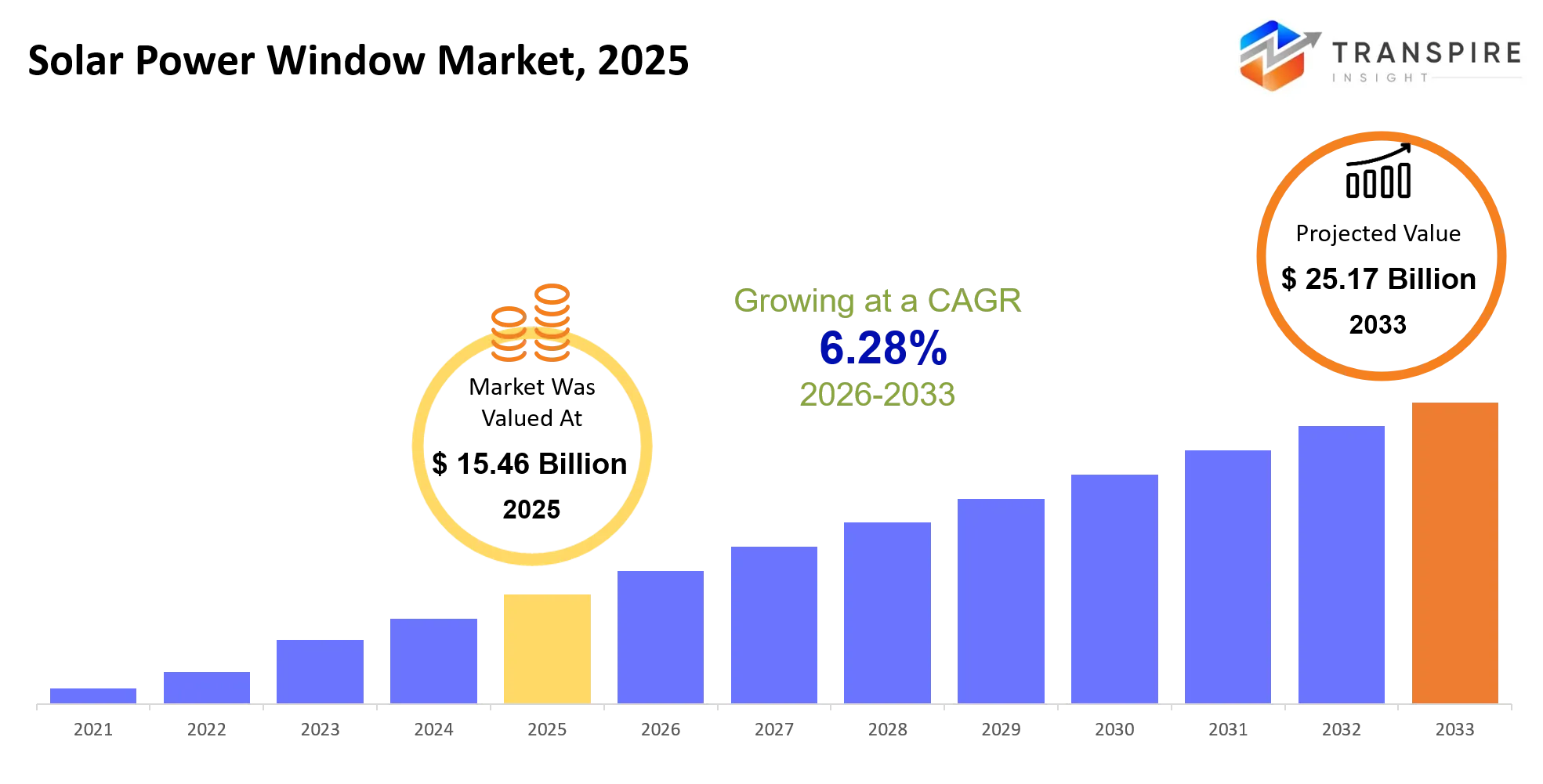
- Global Market Value (2025): USD 15.46 Billion.
- Expected Market Value (2026): USD 16.43 Billion.
- Estimated Market Value (2033): USD 25.17 Billion.
- Forecast CAGR (2026–2033): 6.28%
- Leading Region in 2025: Asia Pacific
- Second-largest Region: North America
- Fastest Growing Region: Europe
Introduction
The Solar Power Window Market includes the industry related to photovoltaic windows specialized architectural glass components that can absorb sun rays and utilize them to produce electricity while obtaining some transparency or semi-transparency in order to provide buildings with natural light. These systems are able to function as conventional windows such as insulating, lighting, and providing aesthetic value as well as serving for the purposes of energy generation within the framework of the green building concept. The Solar Power Window Industry provides numerous advantages for the construction of eco-friendly structures. Solar windows can create renewable energy by leveraging vertical walls and glass surfaces without requiring auxiliary empty spaces, which could typically be consumed by solar panels placed on rooftops and land. Also, local power production lowers the amount of electricity that users need to buy from traditional power providers. In addition, solar windows can be integrated into buildings harmoniously and are functional while remaining visually appealing. Furthermore, companies that produce solar glass can develop advanced glazing systems that can control UV radiation, heat, and glare. In addition, there are solar window technologies that allow the production of electricity from available light no matter the weather conditions, and thus contribute to clean energy generation.
For instance:-The solar power windows market in Europe is growing rapidly due to the stringent building decarbonization regulations and targets established by the EU. The investments made by both government entities and private companies also encourage the development of building-integrated photovoltaic technology.
Market Highlights: -
- Asia Pacific is anticipated to hold around 58% share of the Solar Power Window Market over the predicted timeframe.
- North America is expected to grow at a rapid CAGR in the Solar Power Window Market by holding around25% of the share during the forecast period.
- Europe is anticipated to hold around15% share of the Solar Power Window Market over the predicted timeframe.
- By technology, the Crystalline Silicon segment dominated the market and holds nearly 90% share in 2025 and is projected to grow at a substantial CAGR during the forecast period.
- By application, the Transportation segment dominated the market and holds nearly 46% share in 2025 and is projected to grow at a substantial CAGR during the forecast period.
- By end user, the Construction segment dominated the market and holds nearly 50% share in 2025 and is projected to grow at a substantial CAGR during the forecast period.
- PM Surya Ghar: Under the Muft Bijli Yojana, consumers can install residential rooftop solar systems with the Central Financial Assistance of about ₹78,000 for systems of 3 kw and above. Building Integrated Photovoltaic systems require biPV, thereby enabling solar windows to roll out. Consequently, consumers can adopt integrated photovoltaic technologies for increasing energy efficiency in buildings across India.
How is Technology Driving Growth in the Solar Power Window Market?
The Solar Power Window Market is growing through developments such as transparent photovoltaics, the use of tandem perovskite cells, the addition of advanced thin-film coatings, and the integration with smart building technology. Transparent solar technology such as organic photovoltaics or transparent crystalline silicon allows electricity generation without compromising natural daylight. Tandem perovskite configurations improve performance with their ability to absorb light in the UV and IR spectrum. The new application of advanced thin-film coating technology allows enhancing glass properties while increasing its usability in the construction industry. The combination with smart inverters, digital monitoring solutions, energy-management systems in buildings, and smart controls enables the optimization of the process in real-time.
|
Report Metrics |
Details |
|
Market size value in 2025 |
USD 15.46 Billion |
|
Market size value in 2026 |
USD 16.43 Billion |
|
Revenue forecast in 2033 |
USD 25.17 Billion |
|
Growth rate |
CAGR of 6.28% from 2026 to 2033 |
|
Base year |
2025 |
|
Historical data |
2021 - 2024 |
|
Forecast period |
2026 - 2033 |
|
Report coverage |
Revenue forecast, competitive landscape, growth factors, and trends |
|
Regional scope |
United States; Canada; Mexico; United Kingdom; Germany; France; Italy; Spain; Denmark; Sweden; Norway; China; Japan; India; Australia; South Korea; Thailand; Brazil; Argentina; South Africa; Saudi Arabia; United Arab Emirates |
|
Key company profiled |
AGC, NSG Group, Saint-Gobain, Onyx Solar, Ubiquitous Energy, SolarWindow Technologies, ClearVue Technologies, Physee, Polysolar, Heliatek, Scheuten, Guardian Glass, Panasonic, Sharp, Solaria |
|
Customization scope |
Free report customization (country, regional & segment scope). Avail customized purchase options to meet your exact research needs. |
|
Report Segmentation |
By Technology (Crystalline Silicon, Thin-film, Perovskite, Organic Photovoltaic, Dye-sensitized Solar Cells, Quantum Dot, Hybrid PV, Others); By Transparency (Fully Transparent, Semi-transparent, Tinted, Switchable, Low-transparency, Clear, Colored, Others); By Application (Commercial Buildings, Residential Buildings, Transportation, Automotive, Airports, Greenhouses, Infrastructure, Others); By Product (Solar Glass, Solar Window Panels, BIPV Windows, Smart Windows, Curtain Wall Windows, Skylight Windows, Facade Systems, Others); By Installation (New Construction, Retrofit, Renovation, Replacement, Modular, Prefabricated, Custom, Others); By End User (Construction, Automotive, Infrastructure, Real Estate, Government, Hospitality, Industrial, Others); By Power Output (Low Power, Medium Power, High Power, Ultra-high Power, Distributed Generation, Building-integrated, Vehicle-integrated, Others) |
Market Drivers
The market for solar power windows is being influenced by sustainable design, technological progress, demand for commercial buildings, and government support. The push for energy-saving standards and the increasing use of net-zero buildings has prompted construction companies to use building-integrated photovoltaics (BIPVs) in modern constructions. The new-generation transparent solar cells, thin-film coatings, and quantum dots have made it easier to generate power while keeping architectural clarity. Commercial buildings with extensive glass façades give a great possibility for solar energy generation. In addition to that, various governmental aids such as subsidies, tax incentives, grants for renewable energy, and various clean energy programs are leading to the increase of the use of solar windows and market growth in the area of sustainable architecture and building. The Solar Power Window Market provides substantial benefits through dual functionality, efficiency of space usage, decentralized electricity production, aesthetic flexibility, and ecological advantages. Solar power windows produce renewable energy and at the same time daylight is brought into the buildings which optimize energy-efficient designs. They can be used in façades and skyscrapers in terms of better use of every surface while avoiding the use of extra land and roofs. Such systems can generate electric power on-site thus allowing reducing the dependence on the power purchased from the grid and lower the building operational costs. See-through and semi-transparent technologies preserve the integrity of architecture while still producing solar energy.
For Instance: -
- Investment in the solar power window market in Russia is encouraged through state-sponsored building-integrated photovoltaic (BIPV) projects. Russian firms venture into manufacturing semi-transparent panels for urban settings, but local financing is considerably affected by stringent localization mandates and international restrictions.
- In South Africa, there is an increase in both commercial and telecommunications investments due to increased electrical prices and a need for energy independence. Solar PV glass that is built into the structure of the building, such as solar windows, is an effective solution of smart city engineering.
Restrain
The Solar Power Window Market has several hurdles to overcome; among them are high upfront costs, lower energy-converting efficiency than conventional solar panels, insufficient long-term performance data, and integration difficulties. Transparent photovoltaic technologies will require further testing in order to demonstrate their reliability and returns on investment. Moreover, glazing durability concerns, installation needs, and prerequisites for meeting rigorous building, safety, and structural requirements can make projects more complex and delay their implementation.
|
Driver |
Relative Impact on Growth (%) |
Geographic Relevance |
Impact Timeline |
Demand Strength |
Growth Mechanism |
Key Beneficiaries |
Major Constraint |
|
Building Decarbonization & BIPV Adoption |
28% |
Europe, North America, Asia Pacific |
Long-term |
High |
Integrates electricity generation directly into building façades |
BIPV manufacturers, glass producers, developers, architects |
High upfront costs and complex building integration |
|
Transparent PV Technology Advancements |
24% |
North America, Europe, Asia Pacific |
Medium-term |
High |
Improves transparency, efficiency, durability, and design flexibility |
PV technology firms, solar-glass manufacturers, building owners |
Efficiency remains below conventional opaque PV modules |
|
Government Solar & Energy-Efficiency Policies |
19% |
Europe, India, North America |
Short-term |
High |
Incentives and standards reduce adoption barriers and improve project economics |
Manufacturers, developers, installers, commercial building owners |
Policy eligibility and incentives vary across markets |
|
Commercial High-Rise & Smart Building Development |
16% |
Asia Pacific, North America, Middle East |
Medium-term |
High |
Converts large glazed surfaces into distributed electricity-generation assets |
Construction firms, real-estate developers, smart-building vendors |
Limited suitable façades and lengthy project cycles |
|
Growing Demand for Energy-Efficient Architectural Glazing |
13% |
Europe, Asia Pacific, North America |
Long-term |
Medium |
Combines daylighting, energy management, aesthetics, and renewable generation |
Glass manufacturers, architects, building owners, technology suppliers |
Premium pricing and limited consumer awareness |
|
Total |
100% |
— |
— |
— |
— |
— |
— |
Analysis of Prices and Consumer Behaviour
Commercial building applications dominate the solar power window industry (56.79% mainly because of the need for energy-wise façades, building-integrated photovoltaics and generation of renewable power). The cost of high-performing transparent solar glazing is expected to be higher than the cost of regular glazing because this type of glazing contains sophisticated photovoltaic technologies, special materials and power generation capabilities. Thin-film photovoltaic technology accounts for about 53.68% of the transparent solar glass market. The demand is driven by the flexibility of solar glazing as it can be used as window, façade and other architectural elements. Europe accounts for about 35.49% of the transparent solar glass market, while Asia Pacific holds around 32.70% (gaining popularity due to the green construction practices and building-integrated photovoltaic solutions). Consumers show preference for energy efficiency, durability, transparency and architectural integration in their purchasing decisions. Commercial building developers and construction professionals increasingly pay attention to energy costs over the life cycle of solar power windows.
|
Investment Factor |
Why It Matters to Investors |
Opportunity |
Investment Implication |
|
BIPV & Building Decarbonization |
Converts building envelopes into distributed-generation assets |
Commercial façades, curtain walls, skylights, high-rise buildings |
Long-term structural growth opportunity |
|
Transparent PV Technology Innovation |
Improves functionality while preserving architectural transparency |
OPV, perovskite, thin-film, selective-spectrum photovoltaics |
Technology-led differentiation potential |
|
Regulatory & Solar-Building Requirements |
Strengthens demand for solar-ready and solar-equipped buildings |
Europe, public buildings, commercial renovations |
Policy-driven project pipeline expansion |
|
Commercial Building Adoption |
Large glazed surfaces provide substantial generation area |
Offices, hotels, retail, airports, institutional buildings |
Scalable B2B deployment opportunity |
|
Strategic Glass-Industry Partnerships |
Enables manufacturing scale through established glazing infrastructure |
Co-development, licensing, OEM integration, fabrication partnerships |
Asset-light commercialization potential |
|
Smart & Energy-Efficient Glazing |
Combines power generation with thermal and daylight management |
Smart windows, energy-management systems, premium façades |
Higher-value integrated solutions |
Who are the Key Players in the Solar Power Window Market and how do they compete?
The level of competition among businesses operating in the global marketplace for solar power windows is determined by the companies that deal with transparent photovoltaic technology, building integrated photovoltaics (BIPV), advanced coatings for solar energy, and scalable manufacturing. Competitive advantage arises from not only the price of products but also the effectiveness of power output processes, degree of transparency, strength, integration into architecture, and compatibility of products with contemporary building technologies.
This gives rise to permanent product innovations enabling commercial and residential buildings to generate renewable energy, improve energy efficiency, and optimize sustainable design. While creating products based on the transparent photovoltaic coatings and the electricity-generating glass technologies SolarWindow Technologies gains its favorable position in the market. The companies that deal with advanced photovoltaic glass and building integrated solar technologies have distinguished products mainly aimed at commercial buildings, facades, skylights, and architects. The other companies work on integrated glazing solutions that combine power generation and efficiency with architectural design and effectiveness of buildings.
Top Companies in the Solar Power Window Market
- AGC
- NSG Group
- Saint-Gobain
- Onyx Solar
- Ubiquitous Energy
- SolarWindow Technologies
- ClearVue Technologies
- Physee
- Polysolar
- Heliatek
- Scheuten
- Guardian Glass
- Panasonic
- Sharp
- Solaria
|
Company |
Est. Revenue Share Range |
Key Offerings |
Strategic Positioning |
Geographic Strength |
Technology Focus |
|
Onyx Solar |
8–12% |
Photovoltaic glass, BIPV façades, curtain walls, skylights |
BIPV specialization with customized architectural solutions |
Europe, North America, Asia Pacific |
Crystalline and thin-film photovoltaic glass |
|
AGC Inc. |
6–10% |
SUNJOULE®, SunEwat®, photovoltaic glass, BIPV glazing |
Global glass leadership with integrated BIPV portfolio |
Asia Pacific, Europe, North America |
Laminated PV glass and customizable BIPV |
|
Saint-Gobain |
4–7% |
BIPV façade solutions, solar glazing, architectural glass |
Construction-material ecosystem with integrated BIPV solutions |
Europe, North America, Asia Pacific |
Translucent and aesthetic photovoltaic façades |
|
NSG Group |
3–6% |
Pilkington architectural glass, NSG TEC™, BIPV glazing |
Global glazing platform with solar technology partnerships |
Europe, North America, Asia Pacific |
Transparent conductive and photovoltaic glass |
|
Ubiquitous Energy |
2–4% |
UE Power™, transparent solar coatings, solar windows |
Technology-led differentiation through true transparency |
North America, Europe, Asia Pacific |
Selective UV/IR transparent photovoltaics |
|
ClearVue Technologies |
1–3% |
Solar vision glass, solar façades, skylights, greenhouse glazing |
Integrated BIPV technology for net-zero buildings |
Australia, North America, Europe |
Luminescent solar concentrators and PV glazing |
|
NEXT Energy Technologies |
1–3% |
NEXT OPV coatings, transparent PV windows, solar façades |
Scalable OPV coating integration through glass manufacturers |
North America, Europe |
Transparent organic photovoltaic coatings |
|
Physee |
1–3% |
PowerWindow, solar glazing, energy-generating façades |
Smart-window specialization for sustainable buildings |
Europe, Asia Pacific |
Silicon PV strips integrated into insulated glazing |
|
SolarWindow Technologies |
1–3% |
LiquidElectricity®, ElectroFlex® |
Innovation-led transparent and flexible solar development |
North America, selected global markets |
Transparent OPV coatings and flexible PV |
|
Polysolar |
0.5–2% |
PS-C transparent panels, BIPV glazing, glass laminates |
Niche specialization in lightweight transparent BIPV |
Europe, selected international markets |
Amorphous-silicon thin-film BIPV |
Market Segmentation
The Solar Power Window Market share is divided into seven categories: By technology, transparency, application, product, installation, end user and power output.
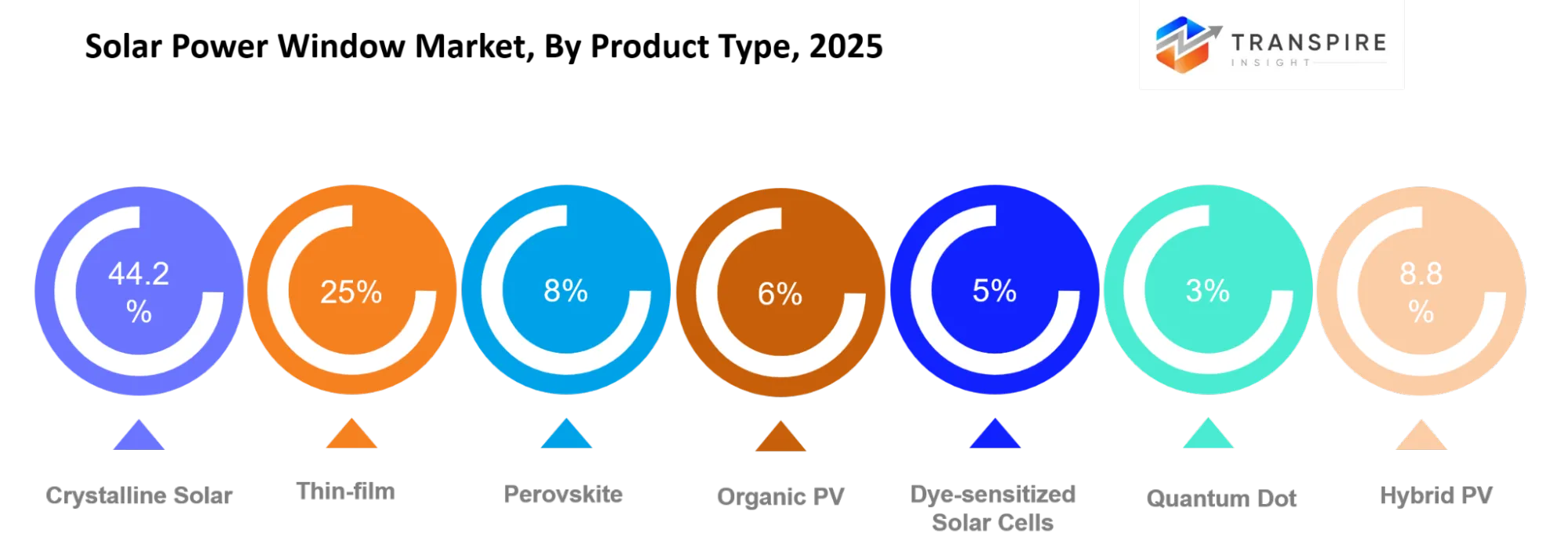
The Crystalline Silicon dominated the market, accounting for nearly 90% in 2025 and is expected to rise at a significant CAGR during the forecast period.
The Solar Power Window Market is segmented by technology into Crystalline Silicon, Thin-film, Perovskite, Organic Photovoltaic, Dye-sensitized Solar Cells, Quantum Dot, Hybrid PV, Others. Among these, the Crystalline Silicon segment dominated the market, accounting for nearly 90% in 2025 and expected to increase at a significant CAGR during the forecast period. Crystalline silicon will continue to dominate the market with around 90% of share in 2025 owing to its well established production ecosystem, high availability, reliability, and efficiency in converting power. The technology is also being deployed in a variety of photovoltaic systems, with cost reductions seen in production of the product as well as consistent technological advancements observed.
The Transportation dominated the market, accounting for nearly 46% in 2025, and is expected to rise at a significant CAGR during the forecast period.
The Solar Power Window Market is segmented by application into Commercial Buildings, Residential Buildings, Transportation, Automotive, Airports, Greenhouses, Infrastructure, Others. Among these, the Transportation segment dominated the market, accounting for nearly 46% in 2025 and expected to increase at a significant CAGR during the forecast period. Transportation was the market leader, capturing around 46% in 2025 due to increasing vehicle electrification, demand for lightweight, efficient products, and investment in increased mobility infrastructure. The increasing popularity of electric vehicles, stricter emissions regulations, and technological advancement are driving the deployment of the vehicle transportation market over the forecast period.
The Construction dominated the market, accounting for nearly 50% in 2025 and is expected to rise at a significant CAGR during the forecast period.
The Solar Power Window Market is segmented by end user into Construction, Automotive, Infrastructure, Real Estate, Government, Hospitality, Industrial, Others. Among these, the Construction segment dominated the market, accounting for nearly 50% in 2025 and expected to increase at a significant CAGR during the forecast period. The construction sector dominated the market, comprising close to half (50%) of the total market in 2025. This is attributed to fast urbanization, significant growth in infrastructure development, and increase in the demand for energy-efficient materials. The growth of investment in both commercial and residential construction, sustainability programs, and the advanced technologies used to penetrate the market are seen as conducive to the growth in demand. The factors are expected to promote the sustained demand and increased CAGR throughout the forecast period.
Regional Segment Analysis of the Solar Power Window Market:
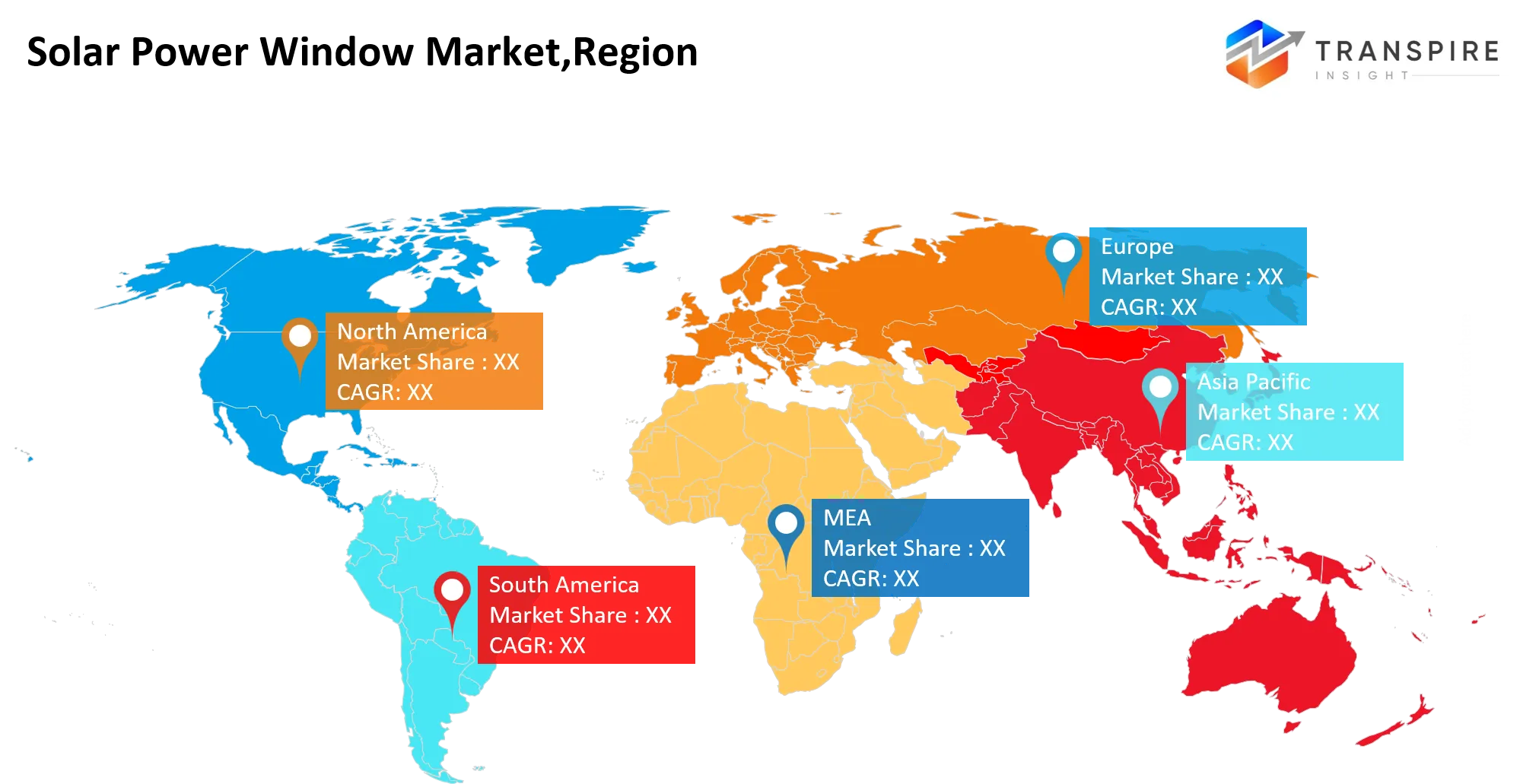
- North America (U.S., Canada, Mexico)
- Europe (Germany, France, U.K., Italy, Spain, Rest of Europe)
- Asia-Pacific (China, Japan, India, Rest of APAC)
- South America (Brazil and the Rest of South America)
- The Middle East and Africa (UAE, South Africa, Rest of MEA)
Asia Pacific is the fastest-growing region in the Solar Power Window Market during the period, holding around 58% share.
Asia Pacific is the fastest-growing region in the Solar Power Window Market during the forecast period, holding around 58% share during the forecast period. The Solar Power Window Market in Asia Pacific is on the rise due to rapid urbanization, the construction of high-rise buildings, and numerous green-building initiatives along with universal adoption of renewable energy. The increasing investments made in smart cities, energy-efficient infrastructures, and sustainable building technologies support the development of commercial buildings with BIPV systems being increasingly implemented. Government policies and rising demand for clean energy have given a push to the growth of the market in the region.
North America is the fastest-growing region in the Solar Power Window Market during the period, holding around 25% share.
North America is expected to grow at a rapid CAGR in the Solar Power Window Market holding around 25% share during the forecast period. North America Solar Power Window Market is experiencing tremendous growth propelled by green-building codes, renewable energy objectives and increased use of building-integrated photovoltaics. Rising investments in energy-efficient commercial buildings, smart infrastructure and sustainable construction is driving the demand for transparent solar technologies. Technological advancements and favorable clean energy policies contribute to the growth of the regional market.
Europe is expected to grow at a rapid CAGR in theSolar Power Window Market, holding around 15% of the share during the forecast period.
Europe is expected to grow at a rapid CAGR in the Solar Power Window Market holding around 15% share during the forecast period. Rapid growth is anticipated in the Solar Power Window Market in Europe, fuelled by tough laws regarding energy efficiency, net-zero building aims, and increasing use of photovoltaics integrated into buildings. Investments into eco-friendly construction, intelligent buildings, and renewable energy infrastructure are also creating possibilities for transparent solar technologies. Demand for low-carbon buildings and energy-efficient façades supports the growth of the regional market as well.
Strategies for Market Growth in Non-Leading Regions:
The growth of non-leading regions due to production technology of efficient and scalable solar power windows would be advantageous to small and medium-sized manufacturing firms. This will mean the establishment of local production sites for the production of photovoltaic glass, solar windows components, and solar power windows, which will help reduce the level of dependence on imports and cut down the cost of a product in general. The establishment of close cooperation with local manufacturers of glasses, construction companies, builders-developers, architects, and distributors of renewable energy equipment will improve market penetration. For better dissemination of knowledge regarding all processes associated with solar windows such as production, installation, BIPV integration, quality control, and standardization, the introduction of training programs and improvement of technical skills will be necessary. At the same time, efficient means of financing, long-term agreements for supplies, and manufacturing based on contracts would reduce prices for solar windows and motivate people and businesses to start using them. Collaborative programs with the government, construction, renewable energy sector, and smart buildings and software implementation would increase accessibility to solar windows and ensure sustainable development of the global market in developing countries.
Future Market Trends for the Solar Power Window Market: -
- Transparent Photovoltaics: New developments in the field of thin-film and polymer solar cells make it possible to produce windows that produce energy while also being transparent.
- Smart Building Integration: More and more solar windows are being integrated into automated management systems of buildings so that energy peaks could be reduced.
- Urban Retrofitting: Solar windows are being used where normal solar energy (from solar panels on the roofs) cannot be installed in tall skyscrapers that are made mainly of glass.
- Key Industry Players: Some major companies involved in the development of that technology are Physee, Brite Solar, and Onyx Solar Energy.
Recent Development
- In August 2026: SolarWindow Technologies, Inc. launched ElectroFlex® which is a thin solar technology product developed for use on flat as well as curved surfaces. The launched product adds more value to the company’s existing solar technology portfolio that includes transparent coatings generating electricity for the glass and plastics called LiquidElectricity®. This achievement will enable advancement in clear solar and building integrated solar products and has positive implications for growth of Solar Power Window Market.
- In April 2026: According to IEA PVPS, 2025 saw the installation of about 698 GW of new solar energy generation capacity globally, a clear pointer to significant growth related to solar energy generation and an increase in the need for flexible and decentralized energy generation. This growth will also promote Building-Integrated Photovoltaics (BIPVs), such as solar facades and solar windows, and will offer prospects for the development of solar windows in sustainable urban and commercial infrastructure.
This study forecasts revenue at global, regional and country levels from 2020 to 2033. Transpire Insights has segmented the Solar Power Window Market based on the below-mentioned segments:
Solar Power Window Market, By Technology
- Crystalline Silicon
- Thin-film
- Perovskite
- Organic Photovoltaic
- Dye-sensitized Solar Cells
- Quantum Dot
- Hybrid PV
- Others
Solar Power Window Market, By Transparency
- Fully Transparent
- Semi-transparent
- Tinted
- Switchable
- Low-transparency
- Clear
- Colored
- Others
Solar Power Window Market, By Application
- Commercial Buildings
- Residential Buildings
- Transportation
- Automotive
- Airports
- Greenhouses
- Infrastructure
- Others
Solar Power Window Market, By Product
- Solar Glass
- Solar Window Panels
- BIPV Windows
- Smart Windows
- Curtain Wall Windows
- Skylight Windows
- Facade Systems
- Others
Solar Power Window Market, By Installation
- New Construction
- Retrofit
- Renovation
- Replacement
- Modular
- Prefabricated
- Custom
- Others
Solar Power Window Market, By End User
- Construction
- Automotive
- Infrastructure
- Real Estate
- Government
- Hospitality
- Industrial
- Others
Solar Power Window Market, By Power Output
- Low Power
- Medium Power
- High Power
- Ultra-high Power
- Distributed Generation
- Building-integrated
- Vehicle-integrated
- Others
Solar Power Window Market, By Regional Analysis
North America
- US
- Canada
- Mexico
Europe
- Germany
- UK
- France
- Italy
- Spain
- Russia
- Rest of Europe
Asia Pacific
- China
- Japan
- India
- South Korea
- Australia
- Rest of Asia Pacific
South America
- Brazil
- Argentina
- Rest of South America
Middle East & Africa
- UAE
- Saudi Arabia
- Qatar
- South Africa
- Rest of the Middle East & Africa
Frequently Asked Questions
Find quick answers to common questions.
The market is valued at USD 15.46 billion in 2025 and is projected to reach USD 25.17 billion by 2033.
Crystalline Silicon dominates, accounting for nearly 90% in 2025, supported by reliability, established manufacturing, availability, and strong conversion efficiency.
Transportation dominates with nearly 46% in 2025, driven by vehicle electrification, lightweight technologies, emissions regulations, and mobility infrastructure investments.
Asia Pacific leads with approximately 58% share, supported by urbanization, high-rise construction, green buildings, smart cities, and renewable-energy adoption.
Growth is driven by sustainable architecture, BIPV adoption, transparent photovoltaics, commercial construction, government incentives, and smart-building integration
- AGC
- NSG Group
- Saint-Gobain
- Onyx Solar
- Ubiquitous Energy
- SolarWindow Technologies
- ClearVue Technologies
- Physee
- Polysolar
- Heliatek
- Scheuten
- Guardian Glass
- Panasonic
- Sharp
- Solaria
About the Authors

Avinash Kumar
I’m Avinash Kumar, a Senior Research Analyst at Transpire Insight, with expertise in the Electronics and Semiconductor and Energy & Power industry. My work focuses on analyzing emerging technologies, market trends, industry developments, and innovation across these sectors. I specialize in transforming complex technical and market insights into clear, research-backed content that helps professionals, businesses, and decision-makers stay informed. Through continuous industry research and data-driven analysis, I strive to deliver accurate, reliable, and practical perspectives on the latest advancements shaping the semiconductor and energy landscape.

Chakradhar Khansole
Chakradhar serves as the Research Director at Transpire Insight, bringing over 8 years of experience in technology, innovation, and strategic market intelligence. He specializes in transforming complex market data into actionable business insights that enable organizations to make informed, growth-oriented decisions. Recognized for his strategic vision and analytical expertise, Chakradhar leads high-impact research initiatives, delivering comprehensive market assessments, competitive intelligence, and forward-looking industry analysis.
Recently Published Reports
-
Apr 2026
Active Power Filter Market
Active Power Filter Market Size, Share & Analysis Report By Type (Shunt Active Power Filters, Series Active Power Filter, Hybrid Active Power Filter), By Application (Harmonics Mitigation, Reactive Power Compensation, Voltage Regulation, Power Factor Correction), By Phase (Single Phase, Three Phase), By End-User Industry (Manufacturing, Healthcare, Commercial, Automotive, Oil and Gas, Others), and Geography (North America, Europe, Asia-Pacific, Middle East and Africa, South and Central America), 2021 - 2031
-
Apr 2026
Electrical Transformer Market
Electrical Transformer Market Size, Share & Analysis Report By Core (Closed, Shell, and Berry), By Insulation (Gas, Oil, Solid, Air, and Other), By Phase (Single, and Three), By Rating (100 MVA to 500 MVA, 501 MVA to 800 MVA, and 801 MVA to 1200 MVA), and Geography (North America, Europe, Asia-Pacific, Middle East and Africa, South and Central America), 2021 – 2031
-
Apr 2026
Hydraulic Piston Pumps Market
Hydraulic Piston Pumps Market Size, Share & Analysis Report By Type (Axial Piston Pumps, Radial Piston Pumps), By Operating Pressure (Low Pressure, Medium Pressure, High Pressure), By Application (Construction, Mining, Agriculture, Automotive, Oil & Gas, Industrial Machinery, Others), By End-User (OEMs, Aftermarket), and Geography (North America, Europe, Asia-Pacific, Middle East and Africa, South and Central America), 2021 – 2031
-
Apr 2026
Laboratory Gas Generators Market
Laboratory Gas Generators Market Size, Share & Analysis Report By Product (Nitrogen Gas Generator, Hydrogen Gas Generator, Zero Air Gas Generator, Purge Gas Generator, TOC Gas Generators, Others), By Application (Gas Chromatography, Liquid Chromatography-mass Spectrometry (LC-MS), Gas Analyzers, Others), By End-user (Life Science, Chemical & Petrochemical, Food & Beverage, Others), and Geography (North America, Europe, Asia-Pacific, Middle East and Africa, South and Central America), 2021 – 2031