
Solar Energy Market Summary:
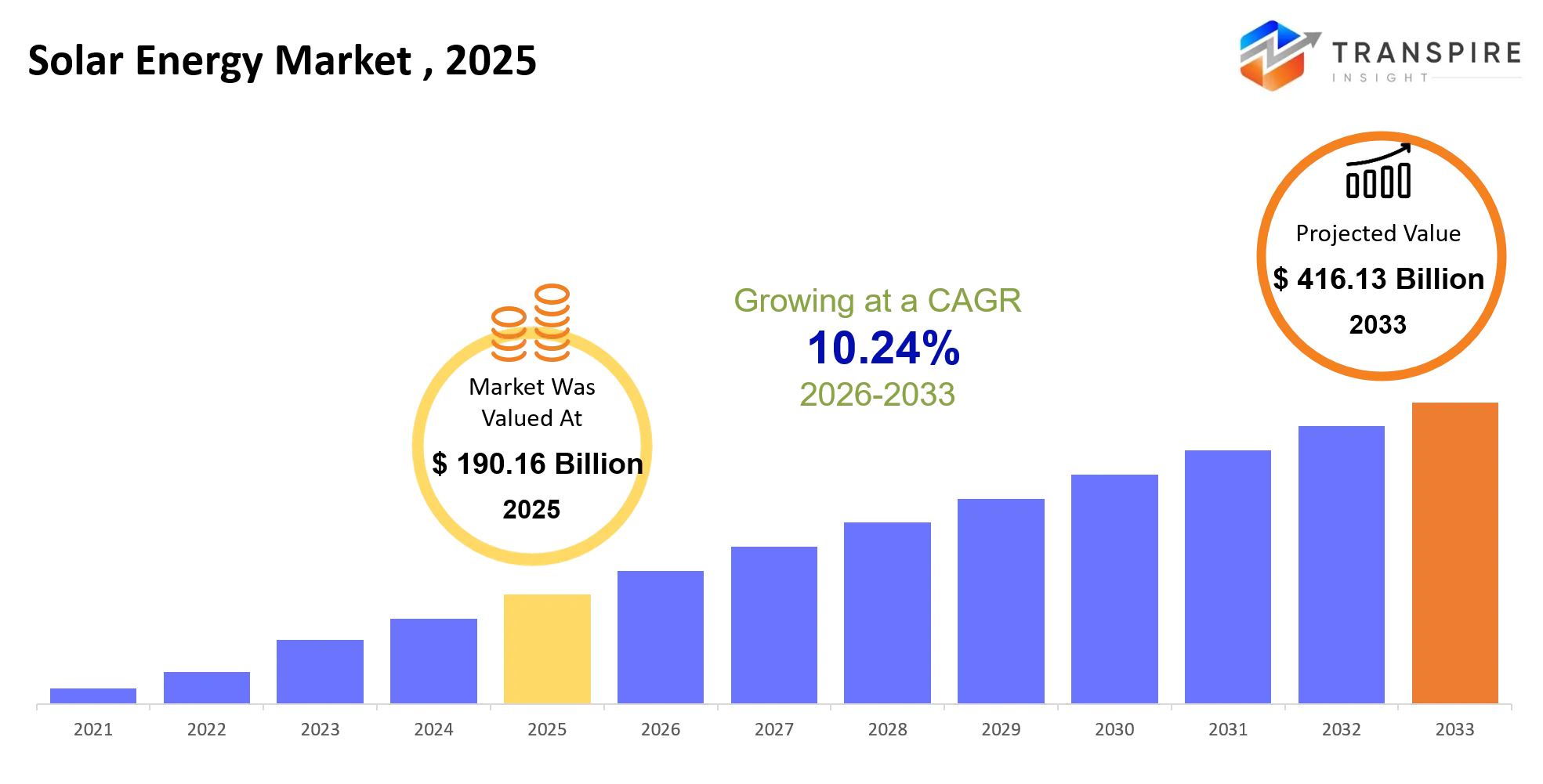
As per the Transpire Insight Analysis, The Solar Energy Market size is estimated at USD 190.16 billion in 2025 and is anticipated to reach USD 416.13 billion by 2033, growing at a CAGR of 10.24% from 2026 to 2033.
The solar energy market generates electricity and heat through photovoltaic panels and concentrated solar power (CSP) systems for homes, factories, businesses, utilities, and off-grid locations. During the past three to five years, the industry shifted from traditional panels to higher-efficiency modules, integrated batteries, and flexible installation, and a structural change is underway with more solar generation coupled with storage, digital controls, and grid integration. A real-world shock was the rise in energy prices triggered by Russia's attack on Ukraine, which raised concerns about national energy security and the need to reduce dependence on foreign fuel supplies. Meanwhile, increased economies of scale, competitive pricing, and government support improved project economics and helped developers fund, grow, and reach more consumers. Grid constraints and bottlenecks, a slow and inconsistent permitting process and low policy support, along with high prices and ongoing supply chain disruptions affect project development and revenue across different markets.
Solar Energy Market Size & Forecast:
- Market Size 2025: USD 190.16 Billion
- Expected Market Value (2033): USD 416.13 Billion
- Forecast CAGR (2026–2033): 10.24%
- Leading Region in 2025: Asia Pacific
- Fastest Growing Region: Middle East and Africa
- Key Company Profiles: LONGi, JinkoSolar, Trina Solar, JA Solar, Canadian Solar, First Solar, Adani Solar, Hanwha Qcells, REC Group, SunPower, Tongwei Solar, GCL-SI, Risen Energy, Astronergy, Talesun Solar.
Key Solar Energy Market Insights:
The solar market is transitioning from low-cost capacity growth to technology differentiation, grid integration, and revenue models tied to storage. As the standard for procurement shifts to high-efficiency modules, manufacturers who are not able to improve their efficiency are at risk of facing margin squeeze.
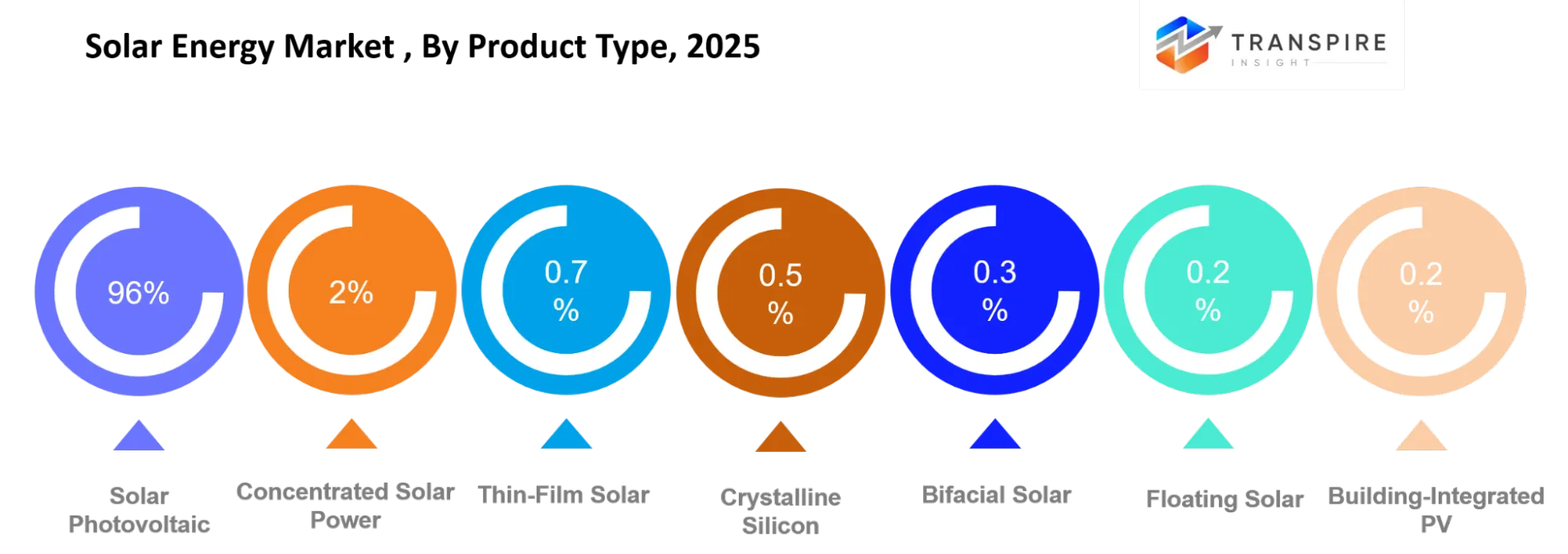
- Solar PVs represent 96.0% of the market, whereas Floating Solar is growing at 24.8% CAGR with the introduction of floating reservoirs and water bodies as generation assets.
- With the top 11 module manufacturers responsible for about 83% of the market’s shipments in H1 2026, TOPCon is seeing its share in the market grow, while back-contact modules make up approximately 16%, indicating a shift towards efficiency-driven purchases.
- JinkoSolar is continuing to scale its TOPCon platform with shipments exceeding 250 GW and Tiger Neo 5.0 reaching up to 25.91% efficiency.
- LONGi is distinguishing itself with its back-contact technology, with back-contact module shipments growing 125% year over year to 19.55 GW in H1 2026, representing more than 65% of all module shipments.
- JA Solar built a 15 GW TOPCon plant in Yunnan in February 2026, with an average cell efficiency of 24.8% and solar power on-site.
- Beyond modules, Trina Solar is linking high-power PV to energy storage, as projects where dispatchable impact on returns.
- Canadian Solar and First Solar are focusing on issues of supply-chain resilience and differentiated module platforms, reacting to the trade measures and regional production incentives.
- The new module efficiency standard for China moves 23.5% as the minimum for BC, helping to bring to an end lower-efficiency module capacity, and leading the race to tech value.
- Solar-plus-storage is an emerging design element that will play a major role in project design as developers work to minimize curtailment, maximize evening demand, and shore up project economics.
What are the Key Drivers, Restraints, and Opportunities in the Solar Energy Market?
Driver:
The principal driver is the collapse in the delivered cost of solar electricity, reinforced by policy mechanisms such as competitive auctions, tax credits, and renewable-purchase obligations. China’s shift from fixed tariffs to competitive auctions from June 2025 triggered a near-term installation surge as developers sought to secure earlier economics, illustrating how policy design can directly reshape project timing and revenue visibility. For utilities and industrial users, solar now functions as a hedge against fuel-price exposure and retail tariff inflation; for developers, lower levelized costs support larger project pipelines and more merchant-style business models.
Restraint:
Grid connection delays, limited transmission capacity and the mismatch between daytime solar output and evening electricity demand constrain project returns. In high-penetration markets, surplus midday generation can depress wholesale prices or lead to curtailment. These challenges persist because transmission upgrades, storage deployment and market reforms often progress more slowly than panel installation. Financing costs, land acquisition and dependence on concentrated manufacturing supply chains further complicate project delivery.
Opportunity:
The strongest opportunity lies in combining solar generation with battery storage, flexible demand and modern grid infrastructure. Hybrid projects can shift electricity into higher-value periods, reduce curtailment and improve supply reliability. India's expansion of rooftop solar and agricultural solar programmes offers additional potential, while floating solar can use existing reservoirs where land is constrained. Advances in TOPCon and heterojunction modules can improve output per unit of area. Together, these developments can unlock projects that would otherwise face land, grid, or economic limitations.
Solar Energy Market — Driver Impact Analysis
|
Driver |
Relative Impact on Growth (%) |
Geographic Relevance |
Impact Timeline |
Demand Strength |
Growth Mechanism |
Key Beneficiaries |
Major Constraint |
|
Declining Solar PV Costs and Improved Cost Competitiveness |
28% |
China, India, United States, Europe |
Short-term (≤2 years) |
High |
Lower module prices improve solar project economics. |
PV manufacturers, project developers, electricity consumers |
Manufacturing oversupply and volatile equipment prices. |
|
Government Renewable Energy Targets and Policy Incentives |
24% |
China, India, European Union, United States |
Medium-term (2–4 years) |
High |
Renewable targets and incentives accelerate solar capacity deployment. |
Solar developers, manufacturers, EPC contractors, investors |
Policy reversals, subsidy changes, permitting delays. |
|
Rising Electricity Demand and Corporate Decarbonization |
20% |
Asia-Pacific, North America, Europe, Middle East |
Medium-term (2–4 years) |
High |
Electrification and corporate PPAs increase clean electricity procurement. |
Independent power producers, commercial users, solar installers |
Grid access limitations and inconsistent power purchase terms. |
|
Expansion of Utility-Scale Projects and Solar-Plus-Storage Systems |
16% |
China, India, United States, Europe, Middle East |
Long-term (≥4 years) |
High |
Large solar farms and batteries improve renewable supply flexibility. |
Utility operators, battery suppliers, EPC firms, grid technology vendors |
Transmission bottlenecks and high storage investment costs. |
|
Advances in Solar Cell Efficiency and Distributed Solar Adoption |
12% |
China, India, Europe, Australia, United States |
Long-term (≥4 years) |
High |
Advanced cells and rooftop systems increase usable solar generation. |
Cell manufacturers, rooftop installers, households, technology vendors |
Roof suitability, financing barriers, and intermittency. |
|
Total |
100% |
Global |
— |
— |
— |
— |
— |
What Has the Impact of Artificial Intelligence Been on the Solar Energy Market?
AI is evolving solar from a static asset class to an evolving energy system. With respect to project development, machine-learning models leverage satellite imagery, irradiance data, terrain information, and land-use restrictions to detect profitable locations and improve yield estimates before spending a dollar. With respect to construction and operations, computer vision monitors modules for cracks, soiling, hot spots, and vegetation encroachment in order to lower labour costs and also to minimize downtime.
Prediction and optimization are the most important applications of AI in the field. At the plant level, forecasting engines predict cloud cover, temperature-related efficiency loss, and generation at the plant level, helping operators to better plan maintenance, adjust battery charging schedules, and optimize power market bidding. At the system level, predictive maintenance can identify weak strings early based on inverter, tracker, and weather data before failures lead to larger losses, protecting revenue and optimizing availability. On the grid, AI-supported dispatch combines distributed solar, storage and flexible loads to reduce curtailment and promote grid reliability. The main constraints are related more to integration than to the technology: Many plants still use distributed plant monitors, disparate data standards, and obsolete SCADA systems. AI models are also contingent on high-quality site-level data, which may lead to reduced accuracy in new markets or under extreme weather events. Until data pipelines, cybersecurity, and asset-management systems mature, value will be unequally distributed across utility-scale and distributed portfolios.
In January 2026, Enact Solar acquired PVComplete to unify PVComplete's AutoCAD-integrated software tools (such as PVCAD and PVSketch) with Enact’s proposal creation and cloud-based fleet monitoring infrastructure. This action resulted in the industry’s first end-to-end, AI-enabled solar software platform, allowing users to seamlessly transition from initial engineering design and permit-ready document generation straight into long-term asset management and performance analytics.
Key Solar Energy Market Trends:
Solar is transitioning from a low-cost generation technology to a coordinated electricity-system resource. Installed capacity, storage, grid flexibility, and higher-efficiency modules are increasingly critical to the economics of projects.
- In congested markets, solar-plus-storage is increasingly the standard configuration: developers look to sell at night to minimise curtailment exposure.
- Fixed-tariff contracts are being phased out in favour of merchant and hybrid revenue models for the utility-scale project, exposing them to power market volatility.
- As customers look for higher energy density and performance in smaller space, the older PERC designs have been ousted by other types such as TOPCon, heterojunction, and bifacial modules.
- Solar distributed by commercial and industrial generators is expanding, as the way energy is generated is considered an effective energy cost and a means of resilience rather than an energy conservation option.
- In addition to new generation, investment is being directed towards transmission upgrades, DLR (dynamic line ratings), and flexibility on the demand side due to grid congestion.
- Floating solar is growing on reservoirs, irrigation ponds and wastewater plants where land is scarce, and water conservation is a value-added benefit.
- Agrivoltaics is even making land usable for energy generation and crops, grazing or aquaculture.
- Manufacturers are shifting their supply chains and diversifying their production to minimize trade restrictions, transportation expenses, and country-based concentration risks.
- AI-powered forecasting, drone inspections, and automated performance diagnostics are enhancing the productivity of assets—all becoming the norm for digital plant management.
Solar Energy Market Segmentation
Technology:
Solar Photovoltaic at 96.0% due to the ability to produce scalable, modular, and fast-dispatchable power generation across utility, commercial, and residential applications. Concentrated Solar Power accounts for 2.0% and maintains its niche market where thermal storage allows for dispatchable power during the night. Thin-Film Solar makes up 0.7% and is limited to lightweight, flexible, and specialised power applications. Crystalline Silicon is 0.5%, Bifacial Solar 0.3%, Floating Solar 0.2%, and Building Integrated Photovoltaics 0.2%, and all focus on land productivity, dual-use or architectural integration, and not total volume. Floating Solar is forecasted to grow at 24.8% CAGR, as it utilises water reservoirs and lakes for placement when land is unavailable. Other technologies make up 0.1% of the market.
Module Type:
Monocrystalline remains the dominant technology in the industry, owing to its higher efficiency and falling manufacturing costs. Polycrystalline technology remains in use in applications where the cost is the primary concern. Thin film modules are used in flexible and building-integrated applications. Bifacial modules are used to improve yield by capturing reflected light; PERC remains the mainstream high-efficiency platform and, more recently, TOPCon and HJT are the leading segments as consumers are becoming more comfortable with the higher efficiency, temperature, and degradation values. Other options include next-generation architectures and specialised module formats.
Application:
The biggest revenue driver is utility-scale solar, which benefits from economies of scale and a closer relationship to power markets owing to its size. For residential and commercial users, the driver is the benefits of bill reductions and energy independence, while for industry users it's about using solar to mitigate manufacturing-related energy and emissions risks. Other applications provide greater access to off-grid and rural areas, provide electricity for solar farms, provide dedicated generation assets, along with infrastructure and transport applications.
Grid Type:
Most sites use on-grid systems as they enable them to export excess generation and reduce storage requirements on the site itself. Off-grid systems are more suitable for isolated communities and industrial sites where network access is unreliable. Hybrid systems combining solar with storage and/or traditional generation assets are increasingly popular. Microgrids, distributed generation, utility grids and community solar projects are a more general transition towards localised generation, shared assets and more resilient energy systems.
End User:
Utilities remain the biggest buyers of solar through procurement and grid-scale projects. Commercial and industrial owners are increasingly looking for on-site or contracted solar power to control costs, while local, regional, and national governments are deploying solar for public buildings, rural electrification, and climate policy. In agriculture, solar power is being used for pumps, irrigation, and cold storage; while in the transportation sector, solar-powered charging stations, depots, and mobility infrastructure are growing.
Installation:
Ground-mounted systems are preferred by the distributed generation sector as they can be easily installed at high capacity and are easy to service. Rooftop systems are the most common type in the distributed generation sector, while floating systems are installed in water bodies. Building-integrated systems generate energy in building facades or roofs. Carports generate energy in parking spaces; solar farms have dedicated energy farms, agrivoltaic installations in agriculture, etc.
What are the Key Use Cases Driving the Solar Energy Market?
The core use case is utility-scale solar generation, aligned with the dominant Solar Photovoltaic segment’s 96.0% share. Large solar farms supply utilities, corporate buyers, and power markets with low-cost electricity, increasingly paired with storage to shift output into evening demand periods and reduce curtailment risk.
Expanding applications include commercial and industrial rooftop systems, where manufacturers, warehouses, data centres, and retail operators use on-site generation to manage electricity costs and emissions obligations. Agricultural solar pumping and irrigation systems also support rural productivity, particularly in markets where diesel dependence raises operating costs.
Emerging use cases are land- and water-efficient: floating solar on reservoirs, canal-top systems, and agrivoltaic projects that combine energy with farming or aquaculture. Floating Solar’s 24.8% CAGR reflects this shift toward dual-use infrastructure, especially in land-constrained Asian markets.
|
Report Metrics |
Details |
|
Market size value in 2025 |
USD 190.16 Billion |
|
Market size value in 2026 |
USD 210.32 Billion |
|
Revenue forecast in 2033 |
USD 416.13 Billion |
|
Growth rate |
CAGR of 10.24% from 2026 to 2033 |
|
Base year |
2025 |
|
Historical data |
2021 - 2024 |
|
Forecast period |
2026 - 2033 |
|
Report coverage |
Revenue forecast, competitive landscape, growth factors, and trends |
|
Regional scope |
United States; Canada; Mexico; United Kingdom; Germany; France; Italy; Spain; Denmark; Sweden; Norway; China; Japan; India; Australia; South Korea; Thailand; Brazil; Argentina; South Africa; Saudi Arabia; United Arab Emirates |
|
Key companies profiled |
LONGi, JinkoSolar, Trina Solar, JA Solar, Canadian Solar, First Solar, Adani Solar, Hanwha Qcells, REC Group, SunPower, Tongwei Solar, GCL-SI, Risen Energy, Astronergy, Talesun Solar |
|
Customization scope |
Free report customization (country, regional & segment scope). Available customised purchase options to meet your exact research needs. |
|
Report Segmentation |
Technology (Solar Photovoltaic, Concentrated Solar Power, Thin-Film Solar, Crystalline Silicon, Bifacial Solar, Floating Solar, Building-Integrated PV, Others)Module Type (Monocrystalline, Polycrystalline, Thin-Film, Bifacial, PERC, TOPCon, HJT, Others)Application (Residential, Commercial, Industrial, Utility-Scale, Off-Grid, Agricultural, Solar Farms, Others)Grid Type (On-Grid, Off-Grid, Hybrid, Microgrid, Distributed Generation, Utility Grid, Community Solar, Others)End User (Residential, Commercial, Industrial, Utilities, Government, Agriculture, Transportation, Others)Installation (Ground-Mounted, Rooftop, Floating, Building-Integrated, Carport, Solar Farm, Agrivoltaic, Others). |
Which Regions are Driving the Solar Energy Market Growth?
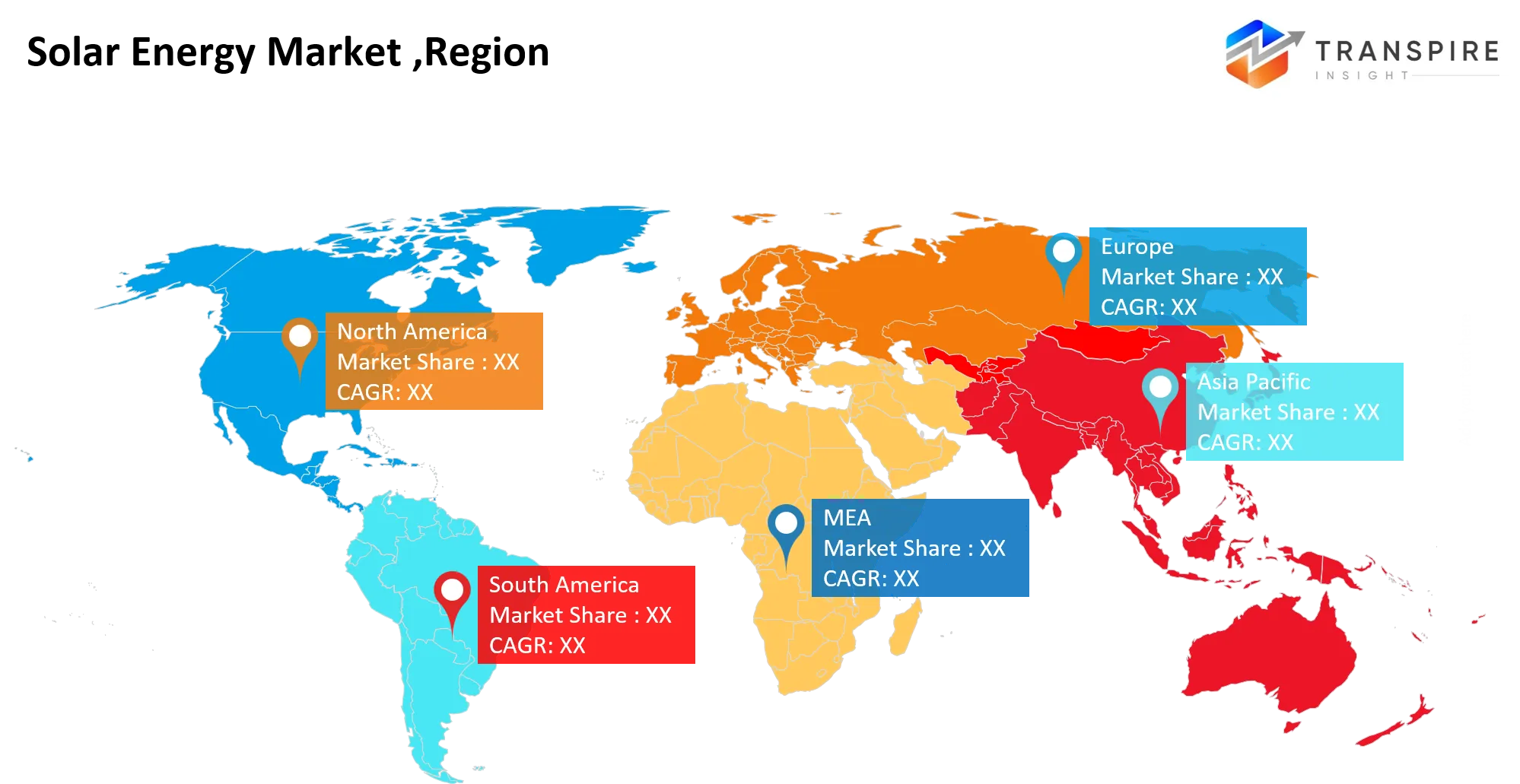
Asia-Pacific maintains the highest market share of 53.8% in the solar energy market. This is supported by strong manufacturing and a huge installed capacity in the country. China's local manufacturing prowess, deployed capacity, and integrated supply chain are reducing equipment prices and quickening the project development process. Over 56 GW of solar energy capacity was added in India in 2025 from utility-based procurement, rooftop, and renewable energy targets. Its manufacturing depth, rising power demand, and government incentives for deployment are keeping it as a leading region in the solar energy market.
In February 2026,published its updated Tier 1 solar panel manufacturer rankings, highlighting leading producers like Jinko Solar and LONGi with massive 120,000 MW annual production capacities. This further reinforced the region's manufacturing scale and lower equipment pricing across supply chains.
https://www.vicoexport.com/en/65510/tier-1-list-of-solar-panel-manufacturers-q1-2026/
Europe has an 18.6% share and has different generation market configurations than Asia-Pacific: Existing electricity markets, corporate procurements, and distributed rooftop projects; regions benefit from grid limitations and policy developments, but face challenges in areas such as policy and grid changes. North America's market share relies heavily on utility-scale, high-value, federal and state incentives, in-state manufacturing investments, and long-term corporate PPAs. Storage, grid access, and supply chains are emerging priorities for both regions alongside new generation.
In October 2026, LG Energy Solution signed a memorandum of understanding with renewable energy developer Energix-Renewable Energies to supply up to 4.5 GWh of battery energy storage systems (BESS). This deployment allocates 3 GWh of storage to Europe and 1.5 GWh to North America, helping both regions scale up their grid-connected capacity and mitigate escalating grid congestion.
Middle East and Africa accounts for 7.0% of the current market and is projected to grow at a CAGR of 13.4%. Most of the development of solar in this region is driven by utility-scale tender awards and investments in large solar parks in countries such as Saudi Arabia and the United Arab Emirates. Strong solar irradiation, coupled with rising demand for electricity, yields attractive project economics, and batteries could be used to improve supply certainty. The rest of the market share attributed to Latin America is 4.7%, which is mainly characterized by opportunities in distributed solar, industrial power procurement, and renewable infrastructure.
In February 2026, the Turkish Energy Ministry and the Saudi Arabian government signed a major $2 billion renewable energy partnership. This funding and strategic collaboration will enable Saudi companies to build two massive solar farms in Turkey's Sivas and Karaman provinces during its first phase, generating a combined 2,000 MW of clean electricity to power more than 2.1 million households.
Who are the Key Players in the Solar Energy Market, and how do they compete?
The competitive landscape is mainly in terms of module price, conversion efficiency, manufacturing capacity, product reliability, and regional supply chain access. Chinese manufacturers benefit from rich manufacturing capacity, while other foreign players may leverage thin film, domestic production, and complete project service as differentiators. Since shipment volume is used to assess competitiveness, and the oversupply of modules crushes margins, this metric becomes less reliable.
LONGi, Jinko Solar, Trina Solar, JA Solar and Tongwei Solar compete through high-efficiency cells, TOPCon and back-contact technologies, large-scale manufacturing capacities and cost efficiencies. LONGi claimed 28.29% efficiency for its HIBC cell in September 2026, while Jinko Solar launched a 700 W Tiger Neo 5.0 module, designed to deliver higher yield for the same installation footprint. First Solar applies its thin-film technology and United States manufacturing. Canadian Solar integrates module supply with project development and battery storage; Adani Solar focuses on vertically integrated manufacturing in India, Hanwha Qcells on advanced cell technologies and regional manufacturing; REC Group and Sun Power focus on differentiated residential and premium applications; while other companies such as GCL-SI, Risen Energy, Astronergy and Talesun Solar compete through cost efficiencies, diversified product portfolios and sales channels. Consumers are also beginning to examine lifecycle costs, bankability, warranties, and compatibility with storage alongside module pricing.
Key Players are:
- LONGi
- JinkoSolar
- Trina Solar
- JA Solar
- Canadian Solar
- First Solar
- Adani Solar
- Hanwha Qcells
- REC Group
- SunPower
- Tongwei Solar
- GCL-SI
- Risen Energy
- Astronergy
- Talesun Solar
Solar Energy Market — Enhanced Competitive Benchmarking
|
Company |
Est. Revenue Share Range |
Key Offerings |
Strategic Positioning |
Geographic Strength |
Technology Focus |
|
JinkoSolar |
11–14% |
Tiger Neo modules, TOPCon cells, utility-scale PV modules |
Cost leadership through scale and vertical integration |
Asia Pacific, Europe, North America |
High-efficiency TOPCon and advanced cell architecture |
|
LONGi Green Energy |
11–14% |
Hi-MO modules, BC modules, silicon wafers, solar cells |
Premium efficiency leadership with integrated manufacturing |
Asia Pacific, Europe, North America |
Back-contact cells and high-efficiency silicon photovoltaics |
|
JA Solar |
8–11% |
DeepBlue modules, PV cells, silicon wafers, utility modules |
High-volume manufacturing with balanced product performance |
Asia Pacific, Europe, Middle East |
TOPCon, back-contact cells and high-power module design |
|
Trina Solar |
8–11% |
Vertex modules, TrinaTracker, energy storage, smart solar solutions |
Integrated utility-scale solar and storage solutions |
Asia Pacific, Europe, North America |
Large-format modules, TOPCon and solar tracking |
|
Tongwei |
5–7% |
High-purity polysilicon, solar cells, PV modules |
Upstream cost advantages and vertically integrated production |
Asia Pacific, Europe, emerging markets |
Polysilicon purification and high-efficiency solar cells |
|
Astronergy |
4–6% |
ASTRO N modules, TOPCon modules, utility-scale PV products |
Value-focused manufacturing backed by industrial scale |
Asia Pacific, Europe, Latin America |
N-type TOPCon and bifacial module technology |
|
Canadian Solar |
3–5% |
PV modules, e-STORAGE, solar project development, inverters through project solutions |
Diversified modules, project development and storage integration |
North America, Asia Pacific, Europe |
High-efficiency modules, battery storage and energy management |
|
First Solar |
2–4% |
Series 6 and Series 7 thin-film modules, utility-scale PV solutions |
Differentiated thin-film manufacturing and regional supply chains |
North America, India, Europe |
Cadmium telluride thin-film photovoltaic technology |
|
AIKO |
2–4% |
ABC modules, high-efficiency solar cells, distributed PV modules |
Premium module differentiation through high cell efficiency |
Asia Pacific, Europe, Australia |
All-back-contact cells and low-shading-loss architecture |
|
GCL System Integration |
2–4% |
PV modules, integrated solar solutions, utility-scale PV products |
Cost-competitive supply with manufacturing ecosystem advantages |
Asia Pacific, Europe, emerging markets |
TOPCon modules and integrated photovoltaic manufacturing |
Recent Development News
In October 2026, Tata Power partnered with Norway-based Ocean Sun to pilot membrane-based floating solar technology at its Mulshi reservoir in Maharashtra. The approximately 300 kWp pilot will assess energy generation, reliability, installation costs, and commercial scalability, helping establish the technical feasibility of floating solar deployment under Indian operating conditions.
In September 2026, SAEL announced that its solar subsidiary had secured supply orders for 1 GWp of solar photovoltaic modules over the preceding six months, including a 585.8 MWp requirement for NTPC Renewable Energy’s Chitrakoot solar project. The orders strengthen its module manufacturing business and support utility-scale solar deployment across India and international markets, with N-type TOPCon technology forming part of its supply portfolio.
https://www.sael.co/newsroom/press-release/renewable-energy-company-sael-secures-supply-orders-for-1-gwp-of-solar-pv-modules-ntpc-rels-chitrakoot-project-accounts-for-5858-mwp/
In October 2026, SunPower expanded its Texas operations by acquiring project assets from Greenlight Solar and establishing a strategic partnership with SOLRITE Energy. The move strengthens its residential solar and battery-storage offerings while supporting the expansion of virtual power plant services and additional revenue opportunities from distributed energy resources.
What Strategic Insights Define the Future of the Solar Energy Market?
The solar market has migrated from capacity expansion to system-level competitiveness. Generation timing, grid access, and asset profitability will help determine returns on investment in this new environment. High-efficiency cell technologies such as TOPCon, back-contact, and newer tandem structures can unlock incremental output in a constrained land environment. Batteries and intelligent energy management will also enable solar to benefit from peak-power demand periods. A latent danger is excess manufacturing capacity. While cutthroat pricing will benefit customers, it may put downward pressure on supplier margins, reduce reinvestment, and create long-term warranty headwinds. Changes in policy around incentives, trade, and domestic-content policies may similarly shift project economics and supply chains. One bright spot: the integration of solar with storage, electric vehicle charging infrastructure, ag-tech and flexible industrial loads. Nurture a focus on bankable technology, diversified procurement, assured aftermarket service, and sensitive market-based grid investment strategies. Developers should base decision-making on realised energy value, curtailment and lifecycle costs rather than module price.
Key Segmentations are:
Technology
- Solar Photovoltaic
- Concentrated Solar Power
- Thin-Film Solar
- Crystalline Silicon
- Bifacial Solar
- Floating Solar
- Building-Integrated PV
- Others
Module Type
- Monocrystalline
- Polycrystalline
- Thin-Film
- Bifacial
- PERC
- TOPCon
- HJT
- Others
Application
- Residential
- Commercial
- Industrial
- Utility-Scale
- Off-Grid
- Agricultural
- Solar Farms
- Others
Grid Type
- On-Grid
- Off-Grid
- Hybrid
- Microgrid
- Distributed Generation
- Utility Grid
- Community Solar
- Others
End User
- Residential
- Commercial
- Industrial
- Utilities
- Government
- Agriculture
- Transportation
- Others
Installation
- Ground-Mounted
- Rooftop
- Floating
- Building-Integrated
- Carport
- Solar Farm
- Agrivoltaic
- Others
Frequently Asked Questions
Find quick answers to common questions.
The solar energy market size was valued at USD 190.16 billion in 2025 and is poised to reach USD 416.13 billion by 2033, expanding at a 10.24% CAGR.
Key segments for the solar energy market are Technology (Solar Photovoltaic, Concentrated Solar Power, Thin-Film Solar, Crystalline Silicon, Bifacial Solar, Floating Solar, Building-Integrated PV, Others)Module Type (Monocrystalline, Polycrystalline, Thin-Film, Bifacial, PERC, TOPCon, HJT, Others)Application (Residential, Commercial, Industrial, Utility-Scale, Off-Grid, Agricultural, Solar Farms, Others)Grid Type (On-Grid, Off-Grid, Hybrid, Microgrid, Distributed Generation, Utility Grid, Community Solar, Others)End User (Residential, Commercial, Industrial, Utilities, Government, Agriculture, Transportation, Others)Installation (Ground-Mounted, Rooftop, Floating, Building-Integrated, Carport, Solar Farm, Agrivoltaic, Others).
Growth is primarily driven by declining solar module costs, government incentives, renewable energy targets, energy security needs, corporate decarbonisation commitments, and advancements in high-efficiency solar technologies and battery storage.
The solar energy market is led by major manufacturers including LONGi, JinkoSolar, Trina Solar, JA Solar, Canadian Solar, First Solar, Adani Solar, Hanwha Qcells, REC Group, SunPower, Tongwei Solar, GCL-SI, Risen Energy, Astronergy, and Talesun Solar.
Asia-Pacific dominates with a 53.8% market share, supported by China's large-scale manufacturing ecosystem, competitive production costs, strong government support, and expanding solar installations across India and China.
Key opportunities include solar-plus-storage systems, floating solar installations, high-efficiency TOPCon and HJT modules, rooftop solar, agrivoltaics, and expanding solar infrastructure across emerging markets
- LONGi
- JinkoSolar
- Trina Solar
- JA Solar
- Canadian Solar
- First Solar
- Adani Solar
- Hanwha Qcells
- REC Group
- SunPower
- Tongwei Solar
- GCL-SI
- Risen Energy
- Astronergy
- Talesun Solar
About the Authors

Avinash Kumar
I’m Avinash Kumar, a Senior Research Analyst at Transpire Insight, with expertise in the Electronics and Semiconductor and Energy & Power industry. My work focuses on analyzing emerging technologies, market trends, industry developments, and innovation across these sectors. I specialize in transforming complex technical and market insights into clear, research-backed content that helps professionals, businesses, and decision-makers stay informed. Through continuous industry research and data-driven analysis, I strive to deliver accurate, reliable, and practical perspectives on the latest advancements shaping the semiconductor and energy landscape.

Chakradhar Khansole
Chakradhar serves as the Research Director at Transpire Insight, bringing over 8 years of experience in technology, innovation, and strategic market intelligence. He specializes in transforming complex market data into actionable business insights that enable organizations to make informed, growth-oriented decisions. Recognized for his strategic vision and analytical expertise, Chakradhar leads high-impact research initiatives, delivering comprehensive market assessments, competitive intelligence, and forward-looking industry analysis.
Recently Published Reports
-
Apr 2026
Active Power Filter Market
Active Power Filter Market Size, Share & Analysis Report By Type (Shunt Active Power Filters, Series Active Power Filter, Hybrid Active Power Filter), By Application (Harmonics Mitigation, Reactive Power Compensation, Voltage Regulation, Power Factor Correction), By Phase (Single Phase, Three Phase), By End-User Industry (Manufacturing, Healthcare, Commercial, Automotive, Oil and Gas, Others), and Geography (North America, Europe, Asia-Pacific, Middle East and Africa, South and Central America), 2021 - 2031
-
Apr 2026
Electrical Transformer Market
Electrical Transformer Market Size, Share & Analysis Report By Core (Closed, Shell, and Berry), By Insulation (Gas, Oil, Solid, Air, and Other), By Phase (Single, and Three), By Rating (100 MVA to 500 MVA, 501 MVA to 800 MVA, and 801 MVA to 1200 MVA), and Geography (North America, Europe, Asia-Pacific, Middle East and Africa, South and Central America), 2021 – 2031
-
Apr 2026
Hydraulic Piston Pumps Market
Hydraulic Piston Pumps Market Size, Share & Analysis Report By Type (Axial Piston Pumps, Radial Piston Pumps), By Operating Pressure (Low Pressure, Medium Pressure, High Pressure), By Application (Construction, Mining, Agriculture, Automotive, Oil & Gas, Industrial Machinery, Others), By End-User (OEMs, Aftermarket), and Geography (North America, Europe, Asia-Pacific, Middle East and Africa, South and Central America), 2021 – 2031
-
Apr 2026
Laboratory Gas Generators Market
Laboratory Gas Generators Market Size, Share & Analysis Report By Product (Nitrogen Gas Generator, Hydrogen Gas Generator, Zero Air Gas Generator, Purge Gas Generator, TOC Gas Generators, Others), By Application (Gas Chromatography, Liquid Chromatography-mass Spectrometry (LC-MS), Gas Analyzers, Others), By End-user (Life Science, Chemical & Petrochemical, Food & Beverage, Others), and Geography (North America, Europe, Asia-Pacific, Middle East and Africa, South and Central America), 2021 – 2031