

Smart Television And Set-Top Box Market Summary:
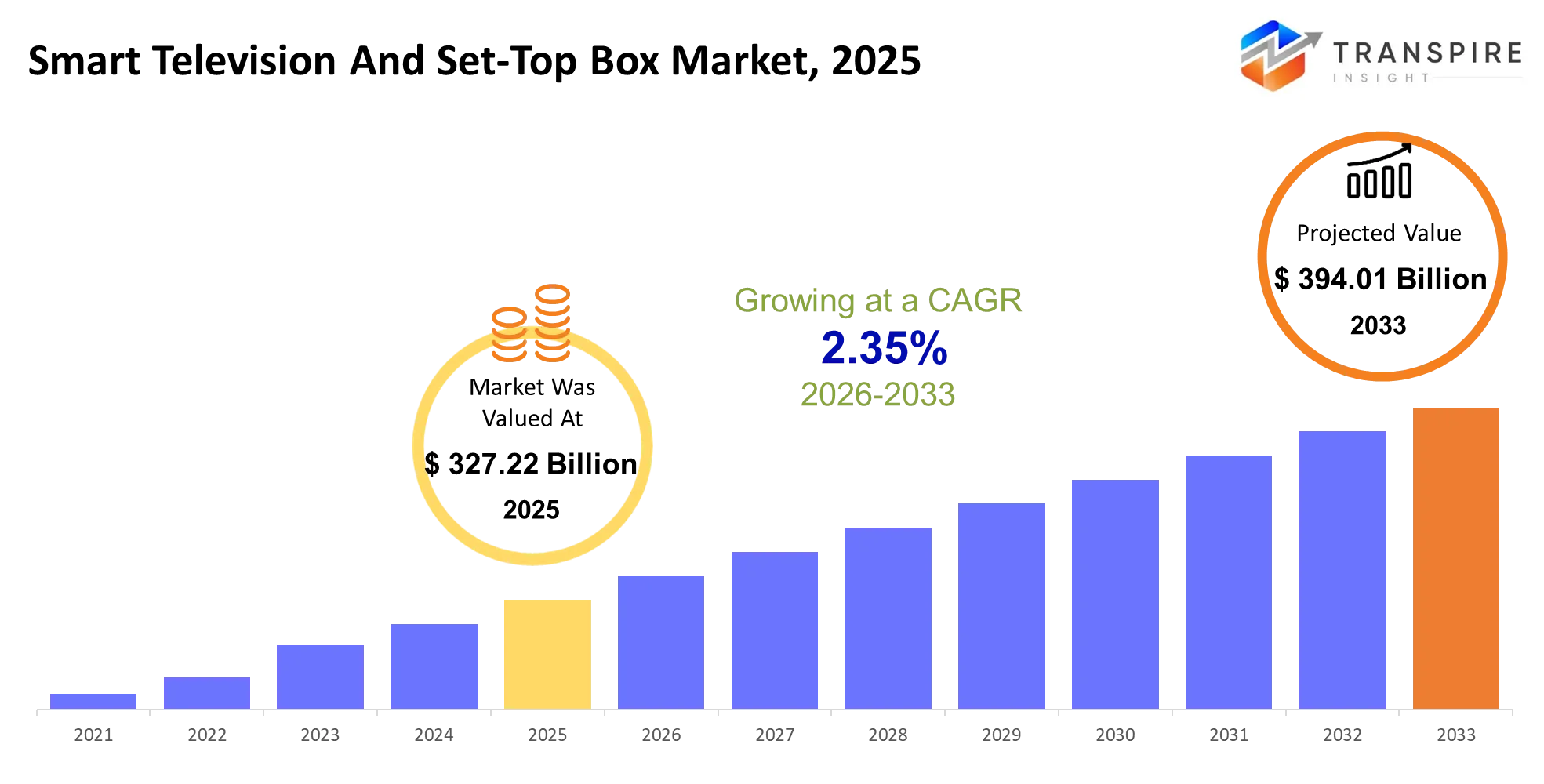
As per the Transpire Insight Analysis, The Smart Television and Set-Top Box Market size is estimated at USD 327.22 billion in 2025 and is expected to reach USD 394.01 billion by 2033, growing at a CAGR of 2.35% from 2026 to 2033.
The worldwide market for smart televisions and set-top boxes is changing from hardware-led to software-driven consumption. Over the last five years, TVs have gone beyond OTT streaming to include voice assistants, recommendation engines, gaming optimisation, connected-home control and advertising-based content, with set-top boxes increasingly serving as aggregators of standalone broadcast and OTT services. Underlying this structural change is convergence – a world where TV hardware, operating systems and content platforms are collapsing the boundary between television and media centre. A real-world recent flashpoint is NAGRAVISION and Media Tek's 2026 deal to bring its security element to future Media Tek TV System-on-Chips, where the evolution of connected TV as the end-point for premium OTT streaming has significant revenue implications. AI-enhanced display picture improvement, personalised discovery and premium display hardware are promoting replacement, whilst security and platform services broaden connected TV's role. Revenue is therefore derived from hardware devices, recurring platform services and premium content monetisation.
Smart Television And Set-Top Box Market Size & Forecast:
- Market Size 2025: USD 327.22 Billion
- Expected Market Value (2033): USD 394.01 Billion
- Forecast CAGR (2026–2033): 2.35%
- Leading Region in 2025: Asia Pacific
- Fastest Growing Region: North America
- Key Company Profiles: Samsung, LG Electronics, Sony, TCL, Hisense, Xiaomi, Panasonic, Vizio, Roku, Amazon, Apple, Skyworth, Philips, Sharp, Foxconn.
Key Smart Television And Set-Top Box Market Insights:
Display innovation and software intelligence are playing a growing role in replacement decisions, as the market moves away from connected screens to AI-powered entertainment platforms. As a result, corporate strategies are increasingly oriented towards premiumisation, customisation of user interfaces, optimisation of games, and greater access to sophisticated display technologies.
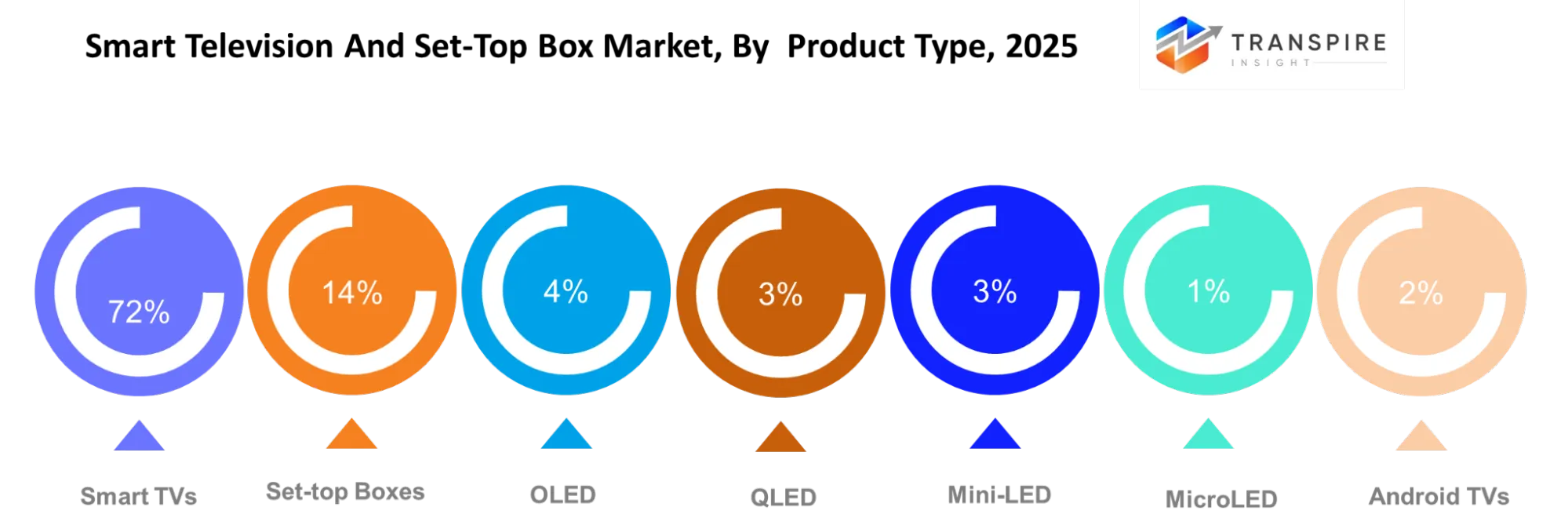
- Smart TVs dominate the market with a 72% share, bolstered by Samsung's updates to One UI Tizen for seven years and its Vision AI.
- Mini-LED/advanced displays expand at a 13.2% CAGR, and TCL's QM9K series features on-device upscaling and search powered by Google Gemini AI.
- OLED and QLED are still niche markets at 4% and 3%, respectively, and Sony and TCL's partnership is focused on cost-competitive OLED panels and access to the premium display market.
- Android TV/Google TV (2%) and Roku/Fire TV platforms are building out standardised OS layers for FAST aggregation, app discovery and voice control.
- With the LG Alpha processors and Samsung Neural Quantum technologies fine-tuning HDR and image processing, 4K UHD is the standard, with 8K UHD and Dolby Vision offering upgrade options.
- The availability of 4K/144Hz, VRR and ALLM support in HDMI 2.1 is helping to drive demand for 56 to 65-inch TVs, especially as PS5, Xbox and cloud gaming move the value to low-latency picture performance.
- AI-powered set-top boxes equipped with AI chips like Amlogic NPUs and edge AI are being deployed by telecom operators to enable unified streaming interfaces and automated optimisation and remote diagnostics.
- The Asia Pacific region has the largest share of 42%, with China contributing 52 million shipments and India's PLI-supported electronics ecosystem, while the Middle East & Africa region will grow at a 9.7% CAGR, with financing and connected-device adoption driving the growth.
- Smart TV operating systems are creating significant platform revenue from FAST and programmatic advertising, which will incentivise Roku, Amazon, and Apple to improve advertising yield optimisation, content discovery, and service-bundling.
What are the Key Drivers, Restraints, and Opportunities in the Smart Television And Set-Top Box Market?
Driver:
AI-enabled televisions are turning picture processing, sound control, and content discovery into product-level differentiators. The trigger is the 2026 expansion of AI TV portfolios, including Samsung’s 72-model Vision AI range in India, which brings AI upscaling, scene optimisation, and conversational assistance into mainstream products. This expands adoption because consumers receive visible performance improvements without separate hardware, supporting premium pricing, faster replacement cycles and stronger service attachment. Manufacturers can also use updates to extend feature lifecycles and preserve engagement after the sale.
Restraint:
Hardware fragmentation remains a structural constraint. Different operating systems, codecs, broadcast standards, app ecosystems, and legacy set-top architectures increase integration and certification requirements. This persists because broadcasters, telecom operators, and device makers often maintain market-specific technical stacks, raising development costs and slowing uniform software deployment.
Opportunity:
Hybrid broadcast-OTT architectures can unlock the next phase by combining terrestrial or satellite reception with cloud-based discovery and streaming. India’s 2026 rollout of advanced EPGs and built-in satellite tuners for DD Free Dish shows how TV hardware can absorb functions previously handled by set-top boxes. Similar integration across emerging markets could lower equipment complexity while expanding addressable connected-TV audiences.
What Has the Impact of Artificial Intelligence Been on the Smart Television And Set-Top Box Market?
AI is transforming from a novelty into a foundational layer within smart TV infrastructure. Artificial intelligence is capable of rebuilding detail within upscaled video or recognising the scene to optimise contrast, colour, motion and brightness. Audio algorithms are now capable of segregating speech, effects and ambient audio, in turn improving dialogue intelligibility without the need for manual EQ adjustment.
Intelligent recommendation engines can identify trends to suggest shows, whilst AI chatbots now power smart search and device commands. AI can infer frame data to maintain motion and lower latency for high-speed sequences; in sports, AI is able to detect match content to automatically adjust video/audio profiles for that activity. On an operational level, AI can optimise power settings, improve content tagging and content recommendation accuracy. Samsung's 2026 Vision AI portfolio demonstrates that push through the integration of AI Upscaling Pro, AI Sound Controller Pro and AI Soccer Mode across its entire line-up. The potential pitfall is that effective AI integration is reliant on significant hardware processing power, extensive software and content integration, and frequent OTA model updates; unreliable recommendations can degrade brand sentiment.
In May 2026, Samsung Electronics launched its full 2026 Vision AI TV lineup. By introducing 72 new models ly across premium and mainstream tiers like Micro RGB, OLED, Neo QLED, and Mini LED, the company brought its Vision AI Companion (VAC) platform to a wider range of screen sizes.https://news.samsung.com//samsung-launches-samsung-newsroom-the-new-website-for-samsung-news-digital-content
Key Smart Television And Set-Top Box Market Trends:
Smart TV is becoming an intelligent media and home-control device, and set-top boxes are being realigned on aggregation, compatibility, and services. The change is more and more apparent in the AI capabilities, high-end displays, software ecosystems, and hybrid broadcast-OTT structures.
- AI has transitioned from being a flagship experiment to being a part of TV portfolios, with picture, sound, and discovery optimisation becoming standard differentiators.
- TV interfaces are moving from channel-first navigation to search, recommendations, and app aggregation, mirroring fragmented viewing habits.
- Premium display innovation is moving beyond OLED and QLED to Mini-LED and Micro RGB, with hardware advances and finer brightness and colour control.
- Gaming, sports and cinematic streaming are driving the uptake of large screens, giving a new meaning to ‘high refresh rate' and ‘advanced motion processing'.
- STBs are changing not only from receivers to aggregation hubs, but are also becoming hubs for linear channels, OTT apps, search and personalised interfaces.
- Advanced electronic programme guides and built-in satellite tuners are reducing the need for external reception hardware in some broadcast environments.
- As AI brings together content discovery and smart-home control and information, voice and conversational interfaces are proving to be helpful.
- Connected TV platforms are diversifying their revenue streams by advertising, subscriptions, free channels, and platform services.
Smart Television And Set-Top Box Market Segmentation
By Product Type:
Smart TVs hold the dominant 72% share, followed by Set-top Boxes at 14%, reflecting their continued relevance in pay-TV and legacy broadcast systems. OLED accounts for 4%, QLED 3%, Mini-LED 3%, Android TVs 2%, MicroLED 1%, and Others 1%. The product mix shows a clear premiumisation trend, with Mini-LED and advanced-display TVs recording a 13.2% CAGR as manufacturers improve brightness, contrast, colour accuracy, and immersive viewing performance across premium television models.
By Screen Technology:
LED and LCD remain the volume foundation because of their affordability, manufacturing scale, and broad availability. OLED and QLED continue serving premium buyers seeking stronger contrast, colour accuracy, and cinematic performance, while Mini-LED is expanding through improved local dimming and brightness. MicroLED remains an emerging premium technology focused on ultra-large displays and superior image precision. Plasma continues to decline as replacement demand shifts toward thinner, efficient displays.
By Screen Size:
44–55-inch and 56–65-inch televisions remain important for mainstream residential viewing, balancing room suitability, price and immersive entertainment. Larger 66–75-inch, 76–85-inch and above 85-inch models are gaining relevance as consumers prioritise cinema-style viewing, sports and gaming. Manufacturers are increasingly pairing large screens with higher refresh rates, advanced HDR and AI picture processing, encouraging premium upgrades while improving the value proposition of larger-format televisions.
By Resolution:
4K UHD remains the mainstream performance standard as streaming platforms, gaming consoles and premium broadcast content increasingly support higher-quality video. HDR strengthens the value of 4K by improving brightness, contrast and colour reproduction. 8K UHD remains concentrated in premium products because suitable content and hardware costs constrain mass adoption, while Dolby Vision adds dynamic picture optimisation. AI upscaling also helps manufacturers improve perceived quality when source content remains below native resolution.
By Operating System:
Android TV, Google TV, Tizen, webOS, Roku TV, Fire TV and VIDAA compete by combining application access, content discovery, voice control and personalised recommendations. Operating systems are becoming strategic differentiators rather than basic interfaces, as manufacturers use software to retain users after hardware purchases. Integration with smart-home devices, FAST channels, advertising platforms and streaming services is strengthening platform ecosystems while encouraging recurring engagement and monetisation opportunities.
By Application:
Home Entertainment remains the primary use case, supported by streaming, sports and gaming consumption. Gaming is increasing the importance of high refresh rates, low latency and HDMI 2.1 connectivity, while Streaming strengthens demand for intuitive discovery and app integration. Sports viewing supports large-screen and motion-enhancement features. Education, Hospitality and Digital Signage expand commercial deployment, where centralised content management, remote monitoring and connected displays create additional technology requirements.
By Distribution Channel:
Online Retail strengthens model comparison, promotional pricing and convenient delivery, while Electronics Stores provide demonstrations and hands-on evaluation. Brand Stores support premium product positioning and ecosystem education, while Hypermarkets and Speciality Stores address broader consumer segments. Telecom Operators and Distributors remain important where televisions are bundled with connectivity or pay-TV services. Omnichannel strategies increasingly connect online discovery with physical demonstrations, financing, installation, and after-sales support.
What key use cases are driving the Smart Television and Set-Top Box Market?
TV remains the primary use case, with a 72% share. Smart TV users' main activities on their displays include streaming, sports, and games, making AI-enabled processing, 120Hz refresh rates, HDR, and discovery among the priorities.
Additional opportunities include hospitality, education, and digital signage where networked TVs can display managed content, data, promotions, wayfinding, and room service. STBs are still relevant in pay-TV, satellite, and hybrid broadcast TV solutions where means are needed for managed channel access and EPGs.
Future use cases for the overall TV set include voice, conversational AI for control, search, and recommendations, as well as built-in satellite receivers and EPGs to eliminate separate set-top reception units in some regions.
|
Report Metrics |
Details |
|
Market size value in 2025 |
USD 327.22 Billion |
|
Market size value in 2026 |
USD 334.82 Billion |
|
Revenue forecast in 2033 |
USD 394.01 Billion |
|
Growth rate |
CAGR of 2.35% from 2026 to 2033 |
|
Base year |
2025 |
|
Historical data |
2021 - 2024 |
|
Forecast period |
2026 - 2033 |
|
Report coverage |
Revenue forecast, competitive landscape, growth factors, and trends |
|
Regional scope |
United States; Canada; Mexico; United Kingdom; Germany; France; Italy; Spain; Denmark; Sweden; Norway; China; Japan; India; Australia; South Korea; Thailand; Brazil; Argentina; South Africa; Saudi Arabia; United Arab Emirates |
|
Key companies profiled |
Samsung, LG Electronics, Sony, TCL, Hisense, Xiaomi, Panasonic, Vizio, Roku, Amazon, Apple, Skyworth, Philips, Sharp, Foxconn |
|
Customization scope |
Free report customization (country, regional & segment scope). Available customised purchase options to meet your exact research needs. |
|
Report Segmentation |
By Product Type (Smart TVs, Connected TVs, Set-top Boxes, Android TVs, OLED TVs, QLED TVs, Mini-LED TVs, Others); By Screen Technology (LED, OLED, QLED, Mini-LED, MicroLED, LCD, Plasma, Others); By Screen Size (Below 32-inch, 32–43-inch, 44–55-inch, 56–65-inch, 66–75-inch, 76–85-inch, Above 85-inch, Others); By Resolution (HD, Full HD, 4K UHD, 8K UHD, HDR, Dolby Vision, Ultra HD, Others); By Operating System (Android TV, Google TV, Tizen, webOS, Roku TV, Fire TV, VIDAA, Others); By Application (Home Entertainment, Gaming, Streaming, Sports, Education, Hospitality, Digital Signage, Others); By Distribution Channel (Online Retail, Electronics Stores, Brand Stores, Hypermarkets, Specialty Stores, Telecom Operators, Distributors, Others) |
Which Regions are Driving the Smart Television And Set-Top Box Market Growth?
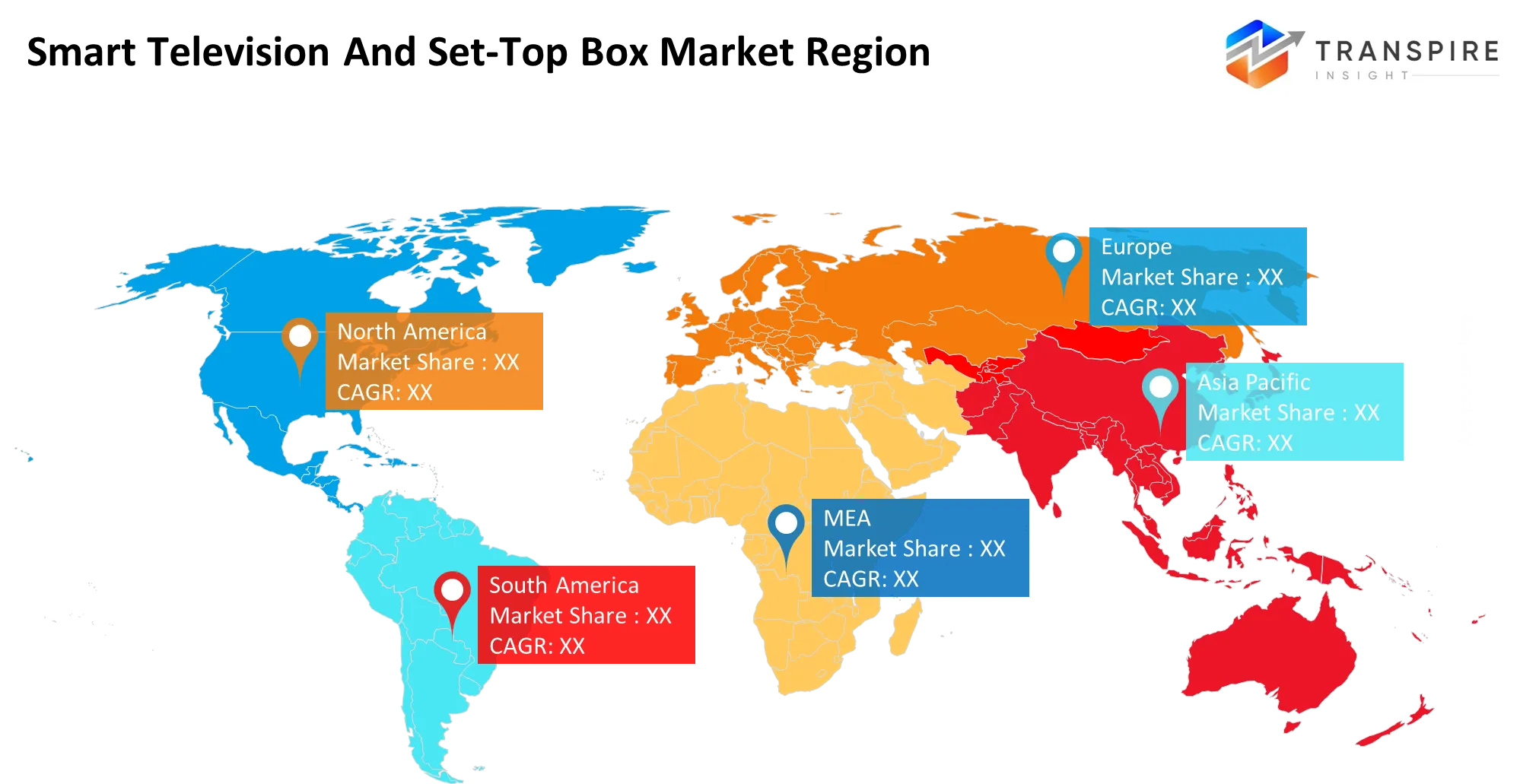
- Asia Pacific accounts for 42% of all revenue. This is driven by a vertically integrated panel supply chain in China and production-linked incentives that reduce manufacturing costs in India. Policy-led digitisation programs, larger fibre/5G networks, and the growth of the OTT ecosystem have created a virtuous, self-reinforcing cycle of low-cost-enabled smart TV adoption. This is amplified through local brands such as TCL, Hisense, Xiaomi, and Skyworth, leveraging their scale, competing on AI capabilities, and large-screen value for money.
- In April 2026, Xiaomi confirmed the official product launch of its new Xiaomi TV S Mini LED (2026) smart TV series in the Indian market. This lineup, comprising 55-inch, 65-inch, and 75-inch models, integrates localised Quantum MagiQ display technology and advanced AI-driven visual optimisation systems.https://www.croma.com/unboxed/xiaomi-tv-s-mini-led-series-2026-india-launch-date-confirmed
- Europe holds a 21% share, trailing Asia Pacific but maintaining stability through mature pay-TV transitions and premium brand loyalty. Unlike Asia’s volume-driven growth, Europe’s market is sustained by high-value segments where OLED, QLED, and Mini-LED adoption aligns with affluent consumer preferences and broadcaster-led IP migrations. Regulatory frameworks on energy efficiency and data privacy shape product roadmaps, favouring manufacturers with strong R&D in AI optimisation and local processing. This creates a stable, if slower-growing, environment where differentiation hinges on software ecosystems and sustainability credentials rather than price alone.
- In September 2026, United Group launched its third-generation cloud-based television and entertainment platform, EON 3.0, across Southeast Europe. The platform integrates a dark-first, redesigned electronic programme guide backed by a machine-learning engine that adapts recommendations to specific profiles based on household viewing habits.https://www.thefastmode.com/technology-solutions/50653-united-group-launches-ai-driven-eon-3-0-entertainment-platform-across-southeast-europe
- Middle East & Africa, though only 5% of current revenue, is the fastest-growing region at a 9.7% CAGR, driven by recent mobile-money financing models that unlock first-time smart TV buyers. Expanding OTT platforms, fibre rollouts in Gulf states, and affordable Chinese-brand imports have shifted the market from basic sets to connected screens. Future opportunity lies in bundling smart TVs with telecom packages and ad-supported FAST services tailored to local languages and content preferences. As infrastructure improves and financing deepens, this region could replicate Asia Pacific’s early-stage adoption curve over the next decade.
- In June 2026, pan-African telecom operator MTN launched MTN One TV, a digital entertainment platform designed to integrate directly with its mobile ecosystem. The service eliminates traditional credit card barriers by allowing users across 16 African markets to pay via airtime or Mobile Money.https://tech.africa/mtn-one-tv/
Who are the Key Players in the Smart Television and Set-Top Box Market, and how do they compete?
The worldwide structure of the smart TV and set-top box market is aggressive, with Korean, Chinese, Japanese, and platform-native companies competing for share by way of AI differentiation, ecosystem lock-in, and price-driven QVC. Main hardware gamers like Samsung, LG, and Sony are struggling with premium processing and display system innovation; Chinese-language rivals like TCL, Hisense, Xiaomi, Skyworth, and Vizio are competing for volume segments with higher options at scale. Platform gamers like Roku, Amazon, Apple, and Google leverage ad-tech, content material bundling, and voice ecosystems to monetise consideration past system gross sales.
Premium TV OEMs (Samsung, LG, Sony) pursue premium-centric, innovation-led strategies; Samsung and LG impose technical features (Vision AI, Micro RGB), software update premiums (seven-year OS), ads, and strategic alliances to seize higher-quality users. Sony innovates on Cognitive Processor XR, further integrating with gaming; TCL and Hisense target cost-competitive Mini-LED and common-venture OLED panels to challenge Korean premium incumbents. Xiaomi, Vizio, Skyworth, Philips, Sharp, and Foxconn aim to erode Korean premium share through aggressive pricing and regional distribution with local smart-streaming and smart-home ecosystems. Platform OEMs (Roku, Amazon, Apple) adopt platform-centric business models, licensing OS layers and ad-tech stacks for FAST channels to dozens of OEMs, decoupling TV revenue from hardware margins. Amazon and Apple also grow via bundling (Prime Video, Apple TV+) and smart-home/TV integration; Roku primarily drives yield optimisation and user acquisition for advertisers. These players redefine the smart TV as an AI-enabled, ad-funded entertainment, gaming, and smart-home control point that is more than a screen.
Key Players are:
- Samsung
- LG Electronics
- Sony
- TCL
- Hisense
- Xiaomi
- Panasonic
- Vizio
- Roku
- Amazon
- Apple
- Skyworth
- Philips
- Sharp
- Foxconn
Recent Development News
- In April 2026, China’s National Radio and Television Administration (NRTA) hosted a nationwide rollout ceremony for integrated television standards at the CCBN exhibition. This initiative, executed in collaboration with major telecom operators including China Telecom and China Mobile, embeds traditional set-top box functionality directly into smart TV sets to gradually phase out standalone hardware devices.https://www.notebookcheck.net/TV-set-top-box-era-to-end-with-single-remote-and-integration-push-in-China.1401641.0.html
- In September 2026, Samsung Electronics launched its full 2026 smart television lineup led by flagship Micro RGB and OLED models. This launch integrates a native "Samsung Vision AI Companion" that utilizes multiple software agents to deliver interactive, personalized video and image responses directly on the screen.https://www.samsung.com/hk_en/news/product/samsung-launches-full-2026-tv-lineup-led-by-flagship-micro-rgb-vision-ai-companion-for-more-intelligent-and-personalized-ai-features/
- In June 2026, Viasat partnered with TiVo to integrate the TiVo operating system across Viasat-delivered services worldwide. The collaboration expands connected TV access for satellite-served households and enables content providers to reach additional audiences through a unified television platform.https://www.viasat.com/news/latest-news/corporate/2026/viasat-and-tivo-partner-to-bring-connected-tv-experiences-via-sa/
What Strategic Insights Define the Future of the Smart Television And Set-Top Box Market?
The market is moving towards AI-native, platform-driven ecosystems, transitioning the source of revenue from the upfront hardware sale to ongoing ad-tech, gaming, and smart-home services. An additional risk factor is the rise of regulation and consumer frustration with data privacy and ACR (automatic content recognition) practices, which might necessitate reengineering of personalisation and ad-targeting stacks at high cost. A secondary opportunity is the integration of Matter/Thread and edge-AI, enabling the TV to become the central smart-home control point, creating B2B2C monetisation opportunities in hospitality, security, and automation. Strategically, companies should focus on on-device AI processing and minimise reliance on the cloud and the risk to privacy. Platform vendors should look beyond ad-yield to monetise content bundles, gaming subscriptions, and home-automation services. Operators and OEMs should consider mobile-money financing and tailoring FAST bundles for high-growth markets such as the Middle East & Africa.
Key Segmentations are:
By Product Type
- Smart TVs
- Connected TVs
- Set-top Boxes
- Android TVs
- OLED TVs
- QLED TVs
- Mini-LED TVs
- Others
By Screen Technology
- LED
- OLED
- QLED
- Mini-LED
- MicroLED
- LCD
- Plasma
- Others
By Screen Size
- Below 32-inch
- 32–43-inch
- 44–55-inch
- 56–65-inch
- 66–75-inch
- 76–85-inch
- Above 85-inch
- Others
By Resolution
- HD
- Full HD
- 4K UHD
- 8K UHD
- HDR
- Dolby Vision
- Ultra HD
- Others
By Operating System
- Android TV
- Google TV
- Tizen
- webOS
- Roku TV
- Fire TV
- VIDAA
- Others
By Application
- Home Entertainment
- Gaming
- Streaming
- Sports
- Education
- Hospitality
- Digital Signage
- Others
By Distribution Channel
- Online Retail
- Electronics Stores
- Brand Stores
- Hypermarkets
- Specialty Stores
- Telecom Operators
- Distributors
- Others
By Regional Analysis
North America
- US
- Canada
- Mexico
Europe
- Germany
- UK
- France
- Italy
- Spain
- Russia
- Rest of Europe
Asia Pacific
- China
- Japan
- India
- South Korea
- Australia
- Rest of Asia Pacific
South America
- Brazil
- Argentina
- Rest of South America
Middle East & Africa
- UAE
- Saudi Arabia
- Qatar
- South Africa
- Rest of the Middle East & Africa
Frequently Asked Questions
Find quick answers to common questions.
The smart television and set-top box market size was valued at USD 327.22 billion in 2025 and is poised to reach USD 394.01 billion by 2033, expanding at a 2.35% CAGR.
Key segments for the smart television and set-top box market are By Product Type (Smart TVs, Connected TVs, Set-top Boxes, Android TVs, OLED TVs, QLED TVs, Mini-LED TVs, Others); By Screen Technology (LED, OLED, QLED, Mini-LED, MicroLED, LCD, Plasma, Others); By Screen Size (Below 32-inch, 32–43-inch, 44–55-inch, 56–65-inch, 66–75-inch, 76–85-inch, Above 85-inch, Others); By Resolution (HD, Full HD, 4K UHD, 8K UHD, HDR, Dolby Vision, Ultra HD, Others); By Operating System (Android TV, Google TV, Tizen, webOS, Roku TV, Fire TV, VIDAA, Others); By Application (Home Entertainment, Gaming, Streaming, Sports, Education, Hospitality, Digital Signage, Others); By Distribution Channel (Online Retail, Electronics Stores, Brand Stores, Hypermarkets, Specialty Stores, Telecom Operators, Distributors, Others).
Growth is primarily driven by AI-enabled viewing, expanding OTT and FAST platforms, premium display technologies, gaming adoption, connected-home integration, and hybrid broadcast-OTT services.
The market is led by major manufacturers, including Samsung, LG Electronics, Sony, TCL, Hisense, Xiaomi, Panasonic, Vizio, Roku, Amazon, Apple, Skyworth, Philips, Sharp, and Foxconn.
Asia Pacific holds a 42% share and influences the market through strong electronics manufacturing, large consumer bases, expanding broadband and OTT adoption, competitive supply chains, and rapid technology deployment.
Commercial opportunities include AI-enabled TVs, Mini-LED and MicroLED displays, hybrid broadcast-OTT devices, FAST advertising, connected-home integration, gaming-focused products, and emerging-market expansion.
- Samsung
- LG Electronics
- Sony
- TCL
- Hisense
- Xiaomi
- Panasonic
- Vizio
- Roku
- Amazon
- Apple
- Skyworth
- Philips
- Sharp
- Foxconn
About the Authors

Avinash Kumar
I’m Avinash Kumar, a Senior Research Analyst at Transpire Insight, with expertise in the Electronics and Semiconductor and Energy & Power industry. My work focuses on analyzing emerging technologies, market trends, industry developments, and innovation across these sectors. I specialize in transforming complex technical and market insights into clear, research-backed content that helps professionals, businesses, and decision-makers stay informed. Through continuous industry research and data-driven analysis, I strive to deliver accurate, reliable, and practical perspectives on the latest advancements shaping the semiconductor and energy landscape.

Chakradhar Khansole
Chakradhar serves as the Research Director at Transpire Insight, bringing over 8 years of experience in technology, innovation, and strategic market intelligence. He specializes in transforming complex market data into actionable business insights that enable organizations to make informed, growth-oriented decisions. Recognized for his strategic vision and analytical expertise, Chakradhar leads high-impact research initiatives, delivering comprehensive market assessments, competitive intelligence, and forward-looking industry analysis.
Recently Published Reports
-
Apr 2026
Fiber Optic Faceplates Market
Fiber Optic Faceplates Market Size, Share & Analysis Report By Type (< 300 mm2, 300-350 mm2, and > 350 mm2, By Application (Night Vision, Holographic Imaging, Medical, and Others), and Geography (North America, Europe, Asia-Pacific, Middle East and Africa, South and Central America), 2021 - 2031
-
Apr 2026
High Temperature Superconductors Market
High Temperature Superconductors Market Size, Share & Analysis Report By Type (1G HTS, and 2G HTS), By Application (Power Cable, Fault Current Limiter, and Transformer), and Geography (North America, Europe, Asia-Pacific, Middle East and Africa, South and Central America), 2021 - 2031
-
Apr 2026
Industrial Plugs and Socket Market
Industrial Plugs and Socket Market Size, Share & Analysis Report By Type (Industrial Plugs, Industrial Sockets), By Current (Up to 32 A, 32 to 125 A, Above 125 A), By Protection (Dustproof and Splash Proof, Waterproof, Explosion Proof), By End User (Heavy Industries, Oil and Gas, Chemicals and Pharmaceuticals, Power Generation, Others), and Geography (North America, Europe, Asia-Pacific, Middle East and Africa, South and Central America), 2021 - 2031
-
Apr 2026
InGaAs Avalanche Photodiodes Market
InGaAs Avalanche Photodiodes Market Size, Share & Analysis Report By Type (1100 - 1700 nm, and 1000 - 1600 nm), By Application (Missile Warning System, Muzzle Flash Detection, Wafer Defect Inspection, Laser Rangefinders, and Others), and Geography (North America, Europe, Asia-Pacific, Middle East and Africa, South and Central America), 2021 - 2031