

Search Engine Optimization (SEO) Services Market Summary:
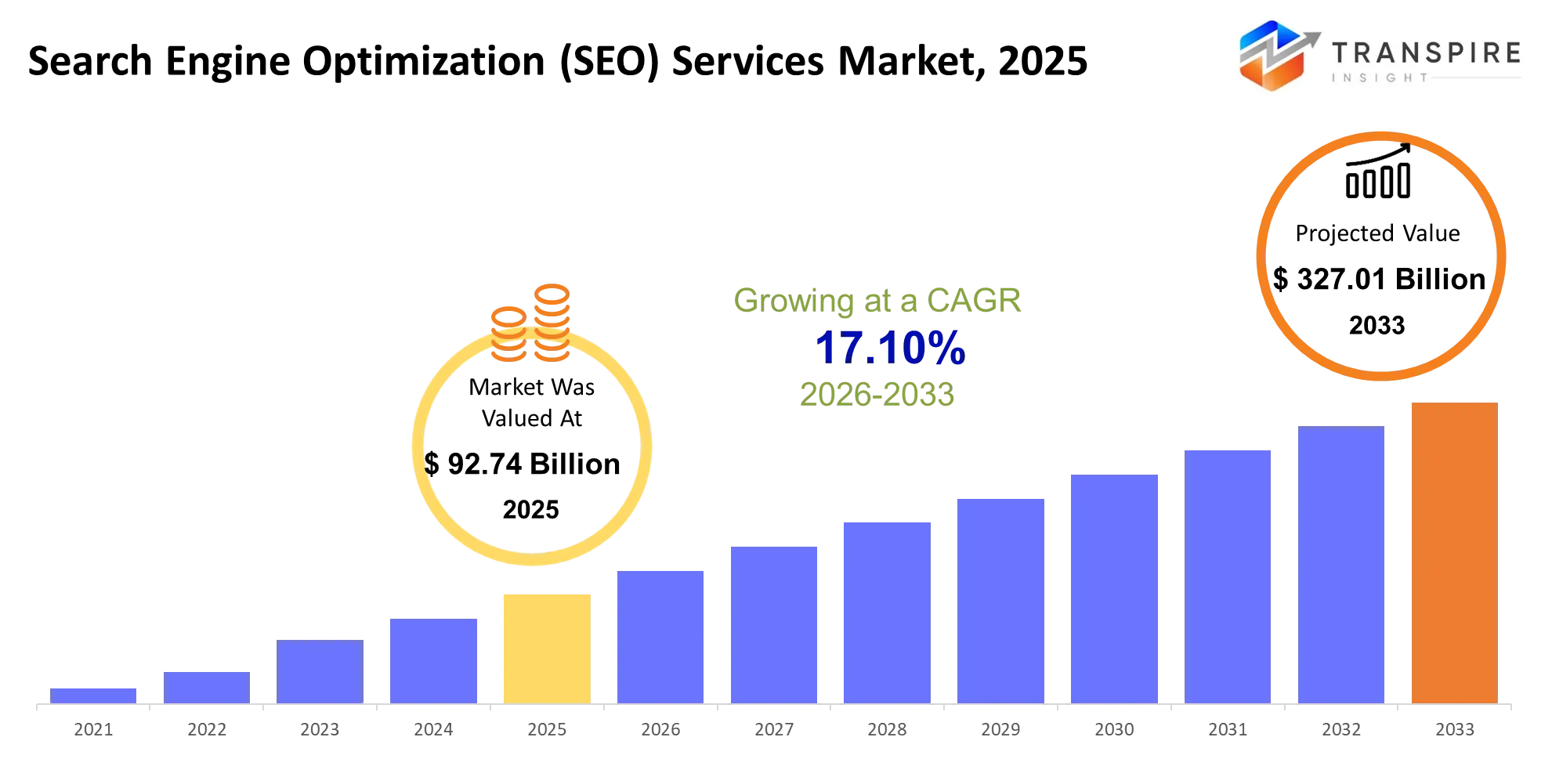
As per the Transpire Insight, The Search Engine Optimization (SEO) Services Market size is estimated at USD 92.74 billion in 2025 and is anticipated to reach USD 327.01 billion by 2033, growing at a CAGR of 17.10% from 2026 to 2033.
Search Engine Optimisation (SEO) Services Market helps businesses optimise their presence in search engines, secure relevant website traffic, and turn digital searches into opportunities. Beyond the early keyword positioning and link building over the last three to five years, the industry has expanded to include technical performance, search intent optimisation, authoritativeness of content, and AI discovery. A key structural change is the transition from traditional SEO to the combination of generative engine optimization (GEO), as search engines have increasingly pushed for information discovery via AI overviews and AI Mode, which has had a profound impact on how businesses need to approach digital visibility. As a result, businesses are ramping up investments in well-structured content, SEO optimisation of websites, and quantifiable search performance, while more rigorous search-quality policies and emerging discovery methods of consumers are also leading to specialized SEO vendors in support of service contracts.
Search Engine Optimization (SEO) Services Market Size & Forecast:
- Market Size 2025: USD 92.74 Billion
- Expected Market Value (2033): USD 327.01 Billion
- Forecast CAGR (2026–2033): 17.10%
- Leading Region in 2025: North America
- Fastest Growing Region: Asia Pacific
- Key Company Profiles: Semrush, Ahrefs, BrightEdge, Moz, Conductor, HubSpot, Searchmetrics, SpyFu, Screaming Frog, WebFX, Merkle, NP Digital, Victorious, iProspect, Wpromote.
Key Search Engine Optimization (SEO) Services Market Insights:
The market is shifting from traditional keyword ranking solutions to comprehensive brand visibility on search engines, AI assistants, and agent-assisted discovery. The days of general search intelligence, AI visibility that can be measured, and turning digital exposure into customers are over; competitive advantage now hinges on it.
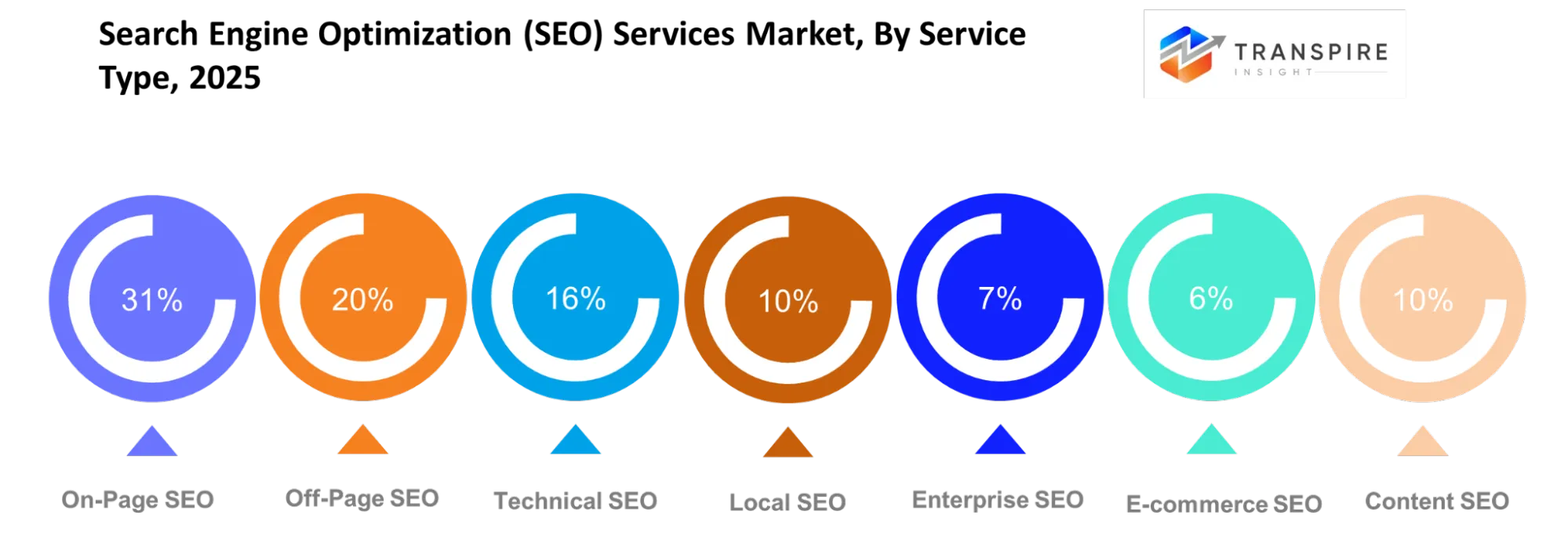
- On-Page SEO has the most demand for services at 31.0%, and agencies are integrating AI content scoring and intent mapping into page-level processes.
- Technical SEO is the fastest-moving service at 16.0% CAGR, aided by accessibility with AI crawlers, schema, site health, and Core Web Vitals remediation.
- Semrush evolved from ranking to AI Optimisation (AIO), allowing brands to compare prompts, citations, and competitors on ChatGPT, Gemini, Copilot, and Perplexity.
- The acquisition of Semrush by Adobe indicates a trend towards the integration of marketing, content, and AI-search platforms.
- BrightEdge introduced AI Catalyst, which monitors brand mentions and sentiment across Google AI Overviews, ChatGPT, and Perplexity.
- The Conductor enterprise AEO suite has been enhanced with AI topic maps, LLM-crawler monitoring, RAG-based drafting and citation-to-analytics attribution.
- Local SEO is shifting from mapping optimization to assistant-ready locations, reviews, and service-area authority, with 10.0% of respondents reporting on the topic.
- Enterprise SEO is shifting from 7.5% to becoming governance for multi-domain brands, compliance, and AI visibility.
- At 6.5%, e-commerce SEO is on the path to AI shopping journeys, product-feed quality, and assistant discovery.
What are the Key Drivers, Restraints, and Opportunities in the Search Engine Optimisation (SEO) Services Market?
Driver:
The shift towards AI-assisted search, mobile discovery, and data-led customer acquisition is driving demand for specialised SEO services. Google's expansion of AI Overviews and AI Mode has changed how users discover information, encouraging businesses to optimise content for both conventional rankings and AI-generated answers. This transition increases spending on technical audits, content restructuring, search analytics, and ongoing optimisation, creating recurring revenue opportunities for service providers.
Restraint:
Attribution remains structurally weak. Google does not separately disclose AI Overview click-through data, making it difficult for agencies to prove revenue impact or defend SEO spend when traffic declines. The problem persists because AI answers, news boxes, and conventional organic listings are blended in analytics, while AI platforms generate far fewer referrals than traditional search.
Opportunity:
Generative engine optimisation, multilingual search strategies, and AI-assisted local discovery offer new commercial opportunities. Google's 2026 introduction of dedicated generative AI performance reporting in Search Console provides website owners with additional visibility insights. SEO agencies can use these capabilities to develop AI visibility monitoring, citation analysis, and conversion-focused optimization packages. Emerging digital businesses across India and Southeast Asia provide further opportunities for affordable, scalable SEO services.
Driver Impact Analysis – Search Engine Optimization (SEO) Services Market
|
Driver |
Relative Impact on Growth (%) |
Geographic Relevance |
Impact Timeline |
Demand Strength |
Growth Mechanism |
Key Beneficiaries |
Major Constraint |
|
Growing Adoption of Digital Marketing and Organic Search Strategies |
27% |
North America, Europe, Asia-Pacific |
Short-term (≤2 years) |
High |
Expands organic visibility and reduces paid acquisition dependency |
SEO agencies, digital marketing firms, enterprise brands |
Rising competition for organic search rankings |
|
AI-Powered Search Optimization and Generative Engine Integration |
24% |
North America, Europe, Asia-Pacific |
Medium-term (2–4 years) |
High |
Creates demand for AI-driven content optimization and search visibility management |
AI SEO platforms, SEO consultants, technology vendors |
Frequent algorithm changes and uncertain attribution |
|
Rapid Expansion of E-commerce and Online Retail Platforms |
21% |
Asia-Pacific, North America, Europe |
Short-term (≤2 years) |
High |
Increases demand for product ranking and conversion optimization |
E-commerce businesses, SEO agencies, analytics providers |
High keyword competition and customer acquisition costs |
|
Increasing Adoption of Mobile, Local and Voice Search Optimization |
16% |
Asia-Pacific, North America, Europe |
Medium-term (2–4 years) |
High |
Strengthens location-based discovery and mobile search traffic |
Local SEO agencies, SMEs, retail and hospitality businesses |
Platform dependency and changing consumer search behaviour |
|
Growing Demand for Data-Driven SEO Analytics and Technical Website Optimisation |
12% |
North America, Europe, Asia-Pacific |
Long-term (≥4 years) |
High |
Drives investment in predictive analytics and technical SEO automation |
SEO software providers, analytics firms, enterprise businesses |
Data privacy restrictions and integration complexity |
|
Total |
100% |
Global |
— |
— |
— |
— |
— |
What Has the Impact of Artificial Intelligence Been on the Search Engine Optimization (SEO) Services Market?
AI has turned SEO into a process of constant optimization rather than a reporting exercise. Agencies leverage machine learning to group searcher intent, identify and prioritise technical issues, produce content briefs, project ranking and lead potential, and automate on-site linking, schema, and rank monitoring. Predictive systems help teams to discover which pages are likely to lose visibility as AI Overviews, at 13.14% of Google queries, rise from 6.49% in January. Its impact is operational: the time spent on research and audit drops, and specialists use their time for strategy, digital PR, entities and conversion pathways. It also enables GEO: producing content, facts, and schema to provide information to a generative system in order to cite a brand.
The key problem is accuracy and usability. Brands may not be aware of discrepancies in the content created, whether it is factually incorrect, branded, or compliant, and disconnected data from the Google Search Console, third-party rank tracker, and CRM makes it hard to prove ROI. As Google does not report on the number of AI Overview clicks, agencies face the challenge of understanding how AI visibility impacts their funnel and sales.
In April 2026, enterprise SEO giant Semrush was acquired by Adobe, integrating full-scale organic data, panel intelligence, and AI search optimization directly into Adobe’s enterprise marketing suite. This milestone consolidation directly targets the fragmented data and ROI tracking limitations plaguing agencies, allowing teams to seamlessly connect machine-learning-driven visibility metrics with CRM pipelines and broader digital experience workflows.
https://indexableai.com/blog/enterprise-seo-strategy/best-enterprise-seo-platforms/
Key Search Engine Optimization (SEO) Services Market Trends:
SEO is evolving from a ranking execution-based service to a digital discoverability-based service that can be measured on traditional and generative search. A key differentiator is now original content that is technically sound, builds trust, and demonstrates business results.
- With rankings no longer the sole goal, brands are now optimising to be mentioned in AI Overviews and answers from chatbots.
- Having consistent naming, author credentials, and structured data can make a brand easy for AI systems to identify as a reliable source of information.
- As generative engines become more reliant on credible sources, the importance of original research, expert review, and verifiable data grows, all the while being constrained by content volume.
- The shift from Google discovery to multi-engine discovery has a significant impact on the way customers research purchases, as they are now influenced by ChatGPT, Perplexity, social search, and marketplace search.
- While AI summaries address a lot of the content, comparison pages, calculators, FAQs, and product configurators meet a need that can't be fully met with a generic AI summary.
- Beyond rankings, firms are monitoring the presence of AI answers, proportion of citations, and branded-query performance.
- Clients are demanding more and more attention to lead, revenue, and customer acquisition cost in their SEO reporting, from traffic reporting to pipeline attribution.
- Local listings, local AI visibility, accurate locations, reviews, and service-area content are now a necessity for ‘near me' and assistant-led searches.
- Agency execution to hybrid delivery: In-house teams rely on SaaS and AI tooling, and agencies provide strategy, authority building, complex technical work, and more.
Search Engine Optimization (SEO) Services Market Segmentation
Service Type:
On-Page SEO has a 31.0% share because it optimises page search intent, content, and conversion features and matches buyer demand. Off-Page SEO has a 20.0% share because of investment in digital PR, backlinks, and brand authority in response to AI increasingly assessing external validation. Technical SEO has a 16.0% CAGR as a result of Core Web Vitals, crawlability, schema, and AI-readiness; 14.27% CAGR denotes ongoing enterprise investment. Local SEO has a 10.0% share of search due to location-based discovery; Enterprise SEO has a 7.5% share due to large-site governance. E-commerce SEO has 6.5% due to conversion rate optimisation; Content SEO has 5.5% due to search demand; International SEO has 3.5% due to web internationalisation; Other specialized services have 0.5%.
Enterprise Size:
Large enterprises dominate through complex websites, international operations, and regulatory requirements. SMEs prefer affordable, outcome-focused retainers, while startups prioritise faster organic customer acquisition. Agencies purchase white-label SEO capabilities to expand service portfolios without increasing internal staffing. E-commerce businesses invest in product-feed optimisation and category visibility. Local businesses focus on maps, reviews, and location-specific pages, whereas government institutions prioritise accessibility, accurate public information, and website discoverability.
Application:
Brand visibility and lead generation remain the primary applications, supported by e-commerce optimisation, local search, content marketing, reputation management, and website traffic development. Businesses increasingly connect organic discovery with customer acquisition and conversion performance. Reputation management is gaining importance as AI-generated answers can reproduce outdated brand information. Consequently, companies are investing in accurate business profiles, authoritative content, review monitoring, and consistent brand information across digital platforms.
Deployment:
Agency-based services remain prominent because businesses require external expertise in technical optimisation, content strategy, and campaign management. Hybrid deployment is expanding as internal marketing teams combine SaaS-assisted tools with specialist agency support. Freelancers offer cost-effective execution for smaller businesses, while consulting services address strategic requirements. Managed services are particularly relevant for enterprises undertaking website migrations, international expansion, complex technical improvements, and integration of AI-driven search optimization.
Industry:
BFSI, IT and telecom, retail, healthcare, education, travel and hospitality, manufacturing, and media and entertainment represent important application areas. BFSI prioritizes credibility and regulatory compliance, while healthcare requires authoritative information and expert-reviewed content. Retail and travel businesses emphasize product discovery, availability, and booking-related searches. Manufacturing companies use technical content to attract B2B buyers, whereas media organizations are adapting publishing strategies to maintain visibility and citations within AI-generated search experiences.
Service Model:
Monthly retainers remain important because technical maintenance, content development, and performance monitoring require continuous execution. Project-based engagements address website migrations, technical audits, and specific optimisation requirements. Performance-based and pay-per-result arrangements attract cost-conscious buyers seeking measurable outcomes, although attribution challenges can complicate contracts. Subscription models provide access to SEO software and analytics platforms, while enterprise contracts support multi-brand and international campaigns. These purchasing structures allow providers to accommodate different budgets, operational complexity, and optimisation objectives.
What are the Key Use Cases Driving the Search Engine Optimization (SEO) Services Market?
The primary use case is improving organic website visibility through on-page optimisation, which accounts for 31.0% of service-type share. Businesses use keyword research, content refinement, metadata optimization, and internal linking to attract relevant visitors and improve conversion opportunities.
Expanding applications include technical SEO for large websites, local search optimisation for multi-location retailers, and e-commerce SEO for improving product discoverability. BFSI, healthcare, education, and travel companies also use SEO to generate qualified leads and strengthen customer acquisition.
Emerging use cases involve generative engine optimisation, AI citation monitoring, conversational search, and reputation management. International businesses are also adopting multilingual optimisation to reach geographically diverse audiences, creating opportunities for integrated SEO and AI visibility services.
|
Report Metrics |
Details |
|
Market size value in 2025 |
USD 92.74 Billion |
|
Market size value in 2026 |
USD 108.28 Billion |
|
Revenue forecast in 2033 |
USD 327.01 Billion |
|
Growth rate |
CAGR of 17.10% from 2026 to 2033 |
|
Base year |
2025 |
|
Historical data |
2021 - 2024 |
|
Forecast period |
2026 - 2033 |
|
Report coverage |
Revenue forecast, competitive landscape, growth factors, and trends |
|
Regional scope |
United States; Canada; Mexico; United Kingdom; Germany; France; Italy; Spain; Denmark; Sweden; Norway; China; Japan; India; Australia; South Korea; Thailand; Brazil; Argentina; South Africa; Saudi Arabia; United Arab Emirates |
|
Key companies profiled |
Semrush, Ahrefs, BrightEdge, Moz, Conductor, HubSpot, Searchmetrics, SpyFu, Screaming Frog, WebFX, Merkle, NP Digital, Victorious, iProspect, Wpromote. |
|
Customization scope |
Free report customization (country, regional & segment scope). Available customized purchase options to meet your exact research needs. |
|
Report Segmentation |
Service Type (On-Page SEO, Off-Page SEO, Technical SEO, Local SEO, Enterprise SEO, E-commerce SEO, Content SEO, International SEO)Enterprise Size (Large Enterprises, SMEs, Startups, Agencies, E-commerce Businesses, Local Businesses, Government, Others)Application (Brand Visibility, Lead Generation, E-commerce, Local Search, Content Marketing, Reputation Management, Website Traffic, Others)Deployment (Agency-Based, In-House, Freelance, Hybrid, SaaS-Assisted, Consulting, Managed Services, Others)Industry (BFSI, IT & Telecom, Retail, Healthcare, Education, Travel & Hospitality, Manufacturing, Media & Entertainment)Service Model (Monthly Retainer, Project-Based, Performance-Based, Subscription, Consulting, Enterprise Contract, Pay-Per-Result, Others) |
Which Regions are Driving the Search Engine Optimisation (SEO) Services Market Growth?
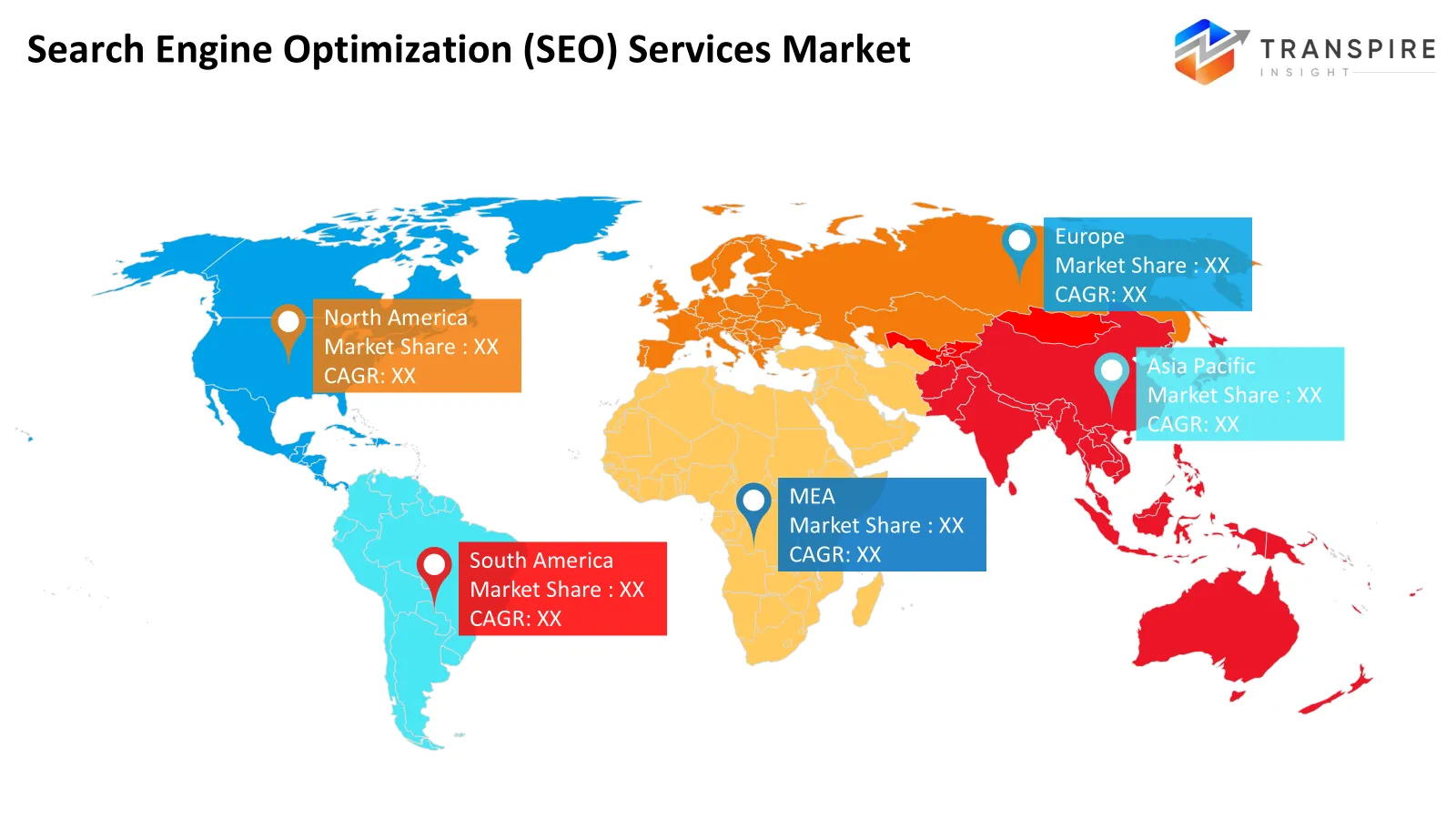
North America is the leader with a 33.90% share due to the confluence of large digital advertising budgets, a high share of SaaS and enterprise software buyers, and early contact with the AI search disruption. US companies are spending on GEO as AI Overviews and chatbots become central to the discovery of the brand. The region has a mature analytics infrastructure allowing agencies to connect SEO activities to pipeline and revenue. Strong cloud infrastructure, venture-backed martech ecosystems, and enterprise demand for compliant-ready AI workflows dominate the region.
In October 2026, AI-powered martech startup Different launched its platform following a $48 million seed funding round led by General Catalyst. This substantial early-stage investment highlights how U.S. enterprise buyers and venture ecosystems are backing next-generation workflows capable of navigating autonomous AI-driven marketing environments.
Europe 27.0% represents the rest of the market, where demand depends on cross-border trading, various websites in different languages, and segmented national markets. European languages, regulatory considerations, data governance (the GDPR), and the European Union Artificial Intelligence Act make buying decisions more sensitive than for North America. Providers of all sizes can take advantage of this environment if they can deliver integrated localisation, technical ability, and analysis that is transparent and traceable. Long-term contracts from larger agencies and export-oriented firms.
In June 2026, the European Commission proposed the Cloud and AI Development Act (CADA). This landmark regulatory initiative establishes a specialized European sovereignty assessment framework that mandates data localization requirements for cloud and AI providers targeting the continent's public sector.
https://www.mofo.com/resources/insights/260819-european-digital-compliance-key-digital-regulation
Asia Pacific is the fastest-growing region at a CAGR of 13.55%, while its share is at 25.5%. Rapid adoption of e-commerce, mobile-first search habits, and growing digital penetration among SMEs have also transitioned the ecosystem from ranking-centric providers to performance-centric ones. The growth will come from a build-out of localised language models, marketplace search, and assistant-based apps for India, Southeast Asia, China, and Japan. Companies that are able to combine low-cost delivery options and local language content capabilities will be set for growth. Latin America accounts for 8.0%, and the Middle East & Africa account for 5.6% of the market; this presents select growth potential for digitalizing small and medium-sized enterprises and government-led digital services.
In October 2026, AI Singapore partnered with regional tech consortiums to advance its open-source Sea-Lion v4 (Southeast Asian Languages in One Network) large language model across regional digital ecosystems. This localised AI rollout successfully optimized multi-language search algorithms across 11 Southeast Asian languages, allowing platforms to deliver culturally precise results.
Who are the Key Players in the Search Engine Optimization (SEO) Services Market, and how do they compete?
This division is playing out clearly in platform versus agency offerings, with platforms circling their proprietary data, AI-signal tracking and workflow automation, and agencies emphasizing vertical service expertise, creation and optimization authority, and enterprise measurable results. The front line now is not rankings but how efficiently a provider can prove why a brand is or isn't cited in an AI answer.
Semrush combines SEO, content, advertising, competitive research, and AIO workflows in an innovation-focused platform approach and is expanding via Adobe marketing integration. Bright Edge's enterprise-niche focus leans on AI Catalyst for cross-engine visibility, prompt research, sentiment analyses, and revenue-linked AI reporting. Conductor's enterprise content-centric methodology combines AI visibility, technical health, content governance, and ROI tracking in one workflow. Ahrefs, Moz and SpyFu have a depth of research, backlink data and low-cost tools for SMBs and agencies. Screaming Frog emphasizes technical audits, while HubSpot follows its inbound marketing-plus-CRM model, including SEO. WebFX, NP Digital, Victorious, iProspect and Wpromote leverage performance contract models, vertical expertise and AI-enhanced delivery. Merkle and Searchmetrics serve enterprise customers with data integrations, consultation, and multi-market oversight.
Key Players are:
- Semrush
- Ahrefs
- BrightEdge
- Moz
- Conductor
- HubSpot
- Searchmetrics
- SpyFu
- Screaming Frog
- WebFX
- Merkle
- NP Digital
- Victorious
- iProspect
- Wpromote
Search Engine Optimization (SEO) Services Market — Enhanced Competitive Benchmarking
|
Company |
Est. Revenue Share Range |
Key Offerings |
Strategic Positioning |
Geographic Strength |
Technology Focus |
|
Semrush Holdings, Inc. |
Estimated 0.30–0.60% |
Semrush One, Enterprise SEO, Keyword Research, AI Visibility Toolkit |
Broad-based SEO intelligence and SaaS leadership |
North America, Europe, Asia Pacific |
AI visibility, predictive analytics, SEO automation |
|
Ahrefs Pte. Ltd. |
Estimated 0.15–0.40% |
Site Explorer, Keywords Explorer, Site Audit, Brand Radar |
Premium backlink intelligence and competitive research |
Asia Pacific, North America, Europe |
Large-scale web crawling, backlink analytics, AI visibility |
|
BrightEdge Technologies, Inc. |
Estimated 0.10–0.30% |
BrightEdge Core, AI Hyper Cube, Data Cube, AI Agent Insights |
Enterprise SEO leadership and AI search differentiation |
North America, Europe, Asia Pacific |
AI search intelligence, predictive SEO, agent analytics |
|
Conductor, Inc. |
Estimated 0.10–0.30% |
Conductor Intelligence, Creator, Monitoring, AI Search Performance |
Integrated enterprise SEO and answer-engine optimisation |
North America, Europe, Asia Pacific |
Generative AI, content intelligence, search performance analytics |
|
WebFX, Inc. |
Estimated 0.10–0.25% |
SEO Management, Technical SEO, Local SEO, OmniSEO |
ROI-focused managed SEO and proprietary marketing technology |
North America, Europe |
AI-assisted optimisation, attribution analytics, marketing automation |
|
Botify SAS |
Estimated 0.05–0.15% |
Botify Analytics, SiteCrawler, LogAnalyzer, Activation Suite |
Enterprise technical SEO and crawl optimisation specialisation |
Europe, North America, Asia Pacific |
Log-file analytics, crawl automation, AI-powered indexing |
|
seoClarity, Inc. |
Estimated 0.05–0.15% |
Clarity ArcAI, Rank Intelligence, Content Fusion, Research Grid |
Enterprise-scale SEO intelligence and workflow automation |
North America, Europe, Asia Pacific |
Machine learning, AI workflows, large-scale rank tracking |
|
Moz, Inc. |
Estimated 0.05–0.15% |
Moz Pro, Moz Local, STAT, Link Explorer |
Accessible SEO solutions and domain authority expertise |
North America, Europe, Asia Pacific |
Link intelligence, rank tracking, local search analytics |
|
Screaming Frog Ltd. |
Estimated 0.03–0.10% |
SEO Spider, Log File Analyser, SERP Snippet Simulator |
Specialist technical SEO auditing and crawling tools |
Europe, North America, Asia Pacific |
Website crawling, JavaScript rendering, technical diagnostics |
|
Ignite Visibility, LLC |
Estimated 0.02–0.08% |
Enterprise SEO, Local SEO, International SEO, Content Marketing |
Performance-driven SEO agency and integrated digital services |
North America, Europe |
AI-assisted SEO, analytics integration, campaign automation |
Recent Development News
- In June 2026, Sitecore acquired Scrunch, an AI customer experience platform, to strengthen its capabilities in AI search visibility and content optimization. The acquisition integrates AI search performance insights with digital experience management, enabling businesses to improve brand discoverability across generative search platforms. https://www.sitecore.com/company/newsroom/press-releases/2026/06/sitecore-acquires-scrunch-to-help-brands-influence-discovery--and-buying-decisions
- In September 2026, Yext signed a definitive agreement to acquire Flamel.ai, a marketing technology company specializing in localized advertising campaigns. The acquisition is expected to connect organic search intelligence with localised paid media execution, enabling multi-location businesses to improve digital visibility and optimise customer acquisition across traditional and AI-powered search channels. https://www.yext.com/about/news-media/yext-signs-definitive-agreement-to-acquire-flamel-ai
- In September 2026, Dentsu India expanded its Generative Engine Optimization (GEO) practice by integrating proprietary search intelligence, AI technologies, content expertise, and analytics capabilities. The expansion strengthens its ability to help businesses improve brand visibility, relevance, and representation across AI-powered search and discovery platforms. https://www.dentsu.com/in/en/our-news/dentsu-india-expands-generative-engine-optimization-practice
What Strategic Insights Define the Future of the Search Engine Optimization (SEO) Services Market?
The market is heading toward answer engine accountability, where SEO providers will be judged on citations, sentiment, assisted conversions, and revenue, not rankings. An unanticipated risk is attribution opacity; AI-generated results tend to mask click paths and source contribution, which will erode measurement, erode trust, and shrink agency fees. An emerging opportunity exists in the shift to AI-readiness; enterprises will purchase access to an LLM crawler, entity accuracy, structured data, content governance, and cross-engine visibility programs. Bright Edge and Conductor are already productizing these trends as AI Catalyst and Conductor AI, respectively. Provider strategy should implement a "visibility-to-revenue" framework: incorporate Search Console, CRM, web analytics, and AI-answer monitoring; align pricing retainers to protected pipeline and citation share; emphasise Technical SEO and On-Page SEO, which make up the largest and fastest-growing opportunity sectors for SEO. The market has a CAGR of 31.0% and 16.0%, respectively.
Key Segmentations are:
Service Type
- On-Page SEO
- Off-Page SEO
- Technical SEO
- Local SEO
- Enterprise SEO
- E-commerce SEO
- Content SEO
- International SEO
Enterprise Size
- Large Enterprises
- SMEs
- Startups
- Agencies
- E-commerce Businesses
- Local Businesses
- Government
- Others
Application
- Brand Visibility
- Lead Generation
- E-commerce
- Local Search
- Content Marketing
- Reputation Management
- Website Traffic
- Others
Deployment
- Agency-Based
- In-House
- Freelance
- Hybrid
- SaaS-Assisted
- Consulting
- Managed Services
- Others
Industry
- BFSI
- IT & Telecom
- Retail
- Healthcare
- Education
- Travel & Hospitality
- Manufacturing
- Media & Entertainment
Service Model
- Monthly Retainer
- Project-Based
- Performance-Based
- Subscription
- Consulting
- Enterprise Contract
- Pay-Per-Result
- Others
By Regional Analysis
North America
- US
- Canada
- Mexico
Europe
- Germany
- UK
- France
- Italy
- Spain
- Russia
- Rest of Europe
Asia Pacific
- China
- Japan
- India
- South Korea
- Australia
- Rest of Asia Pacific
South America
- Brazil
- Argentina
- Rest of South America
Middle East & Africa
- UAE
- Saudi Arabia
- Qatar
- South Africa
- Rest of the Middle East & Africa
Frequently Asked Questions
Find quick answers to common questions.
The search engine optimization (SEO) services market size was valued at USD 92.74 billion in 2025 and is poised to reach USD 327.01 billion by 2033, expanding at a 17.10% CAGR.
Key segments for the search engine optimization (SEO) services market are Service Type (On-Page SEO, Off-Page SEO, Technical SEO, Local SEO, Enterprise SEO, E-commerce SEO, Content SEO, International SEO)Enterprise Size (Large Enterprises, SMEs, Startups, Agencies, E-commerce Businesses, Local Businesses, Government, Others)Application (Brand Visibility, Lead Generation, E-commerce, Local Search, Content Marketing, Reputation Management, Website Traffic, Others)Deployment (Agency-Based, In-House, Freelance, Hybrid, SaaS-Assisted, Consulting, Managed Services, Others)Industry (BFSI, IT & Telecom, Retail, Healthcare, Education, Travel & Hospitality, Manufacturing, Media & Entertainment)Service Model (Monthly Retainer, Project-Based, Performance-Based, Subscription, Consulting, Enterprise Contract, Pay-Per-Result, Others).
Growth is primarily driven by AI-powered search optimisation, increasing digital customer acquisition, demand for technical website improvements, e-commerce expansion, and the adoption of generative engine optimisation (GEO).
The search engine optimisation (SEO) services market is led by major manufacturers including Semrush, Ahrefs, BrightEdge, Moz, Conductor, HubSpot, Searchmetrics, SpyFu, Screaming Frog, WebFX, Merkle, NP Digital, Victorious, iProspect, and Wpromote.
North America dominates with a 33.90% market share, supported by advanced digital marketing infrastructure, high enterprise SEO spending, established technology providers, and early adoption of AI-driven search optimisation.
Key opportunities include generative engine optimisation, AI visibility monitoring, multilingual SEO, automated technical optimisation, local search solutions, and scalable SEO services for SMEs.
- Semrush
- Ahrefs
- BrightEdge
- Moz
- Conductor
- HubSpot
- Searchmetrics
- SpyFu
- Screaming Frog
- WebFX
- Merkle
- NP Digital
- Victorious
- iProspect
- Wpromote
About the Authors

Mayur Shinde
I am Mayur Shinde, a Senior Research Analyst at Transpire Insight, specializing in the Automotive & Transportation and Information & Communication Technology (ICT) Industry. My work focuses on analyzing emerging market trends, technological advancements, competitive landscapes, and industry developments to deliver accurate, data-driven insights. I am passionate about transforming complex market information into clear, actionable content that helps businesses, professionals, and decision-makers stay informed and make confident strategic decisions.

Chakradhar Khansole
Chakradhar serves as the Research Director at Transpire Insight, bringing over 8 years of experience in technology, innovation, and strategic market intelligence. He specializes in transforming complex market data into actionable business insights that enable organizations to make informed, growth-oriented decisions. Recognized for his strategic vision and analytical expertise, Chakradhar leads high-impact research initiatives, delivering comprehensive market assessments, competitive intelligence, and forward-looking industry analysis.
Recently Published Reports
-
Apr 2026
3D Optical Profiler Market
3D Optical Profiler Market Size, Share & Analysis Report By Type (Desktop 3D Optical Profiler, and Portable 3D Optical Profiler), By Technology (Confocal Technology, and White Light Interference), By End-Use Industry (Manufacturing, Research Institutions, Automotive, Aerospace and Defense, Medical Devices, and Other), and Geography (North America, Europe, Asia-Pacific, Middle East and Africa, South and Central America), 2021 - 2031
-
Apr 2026
Depth Sensor Market
Depth Sensor Market Size, Share & Analysis Report By Type (Infrared Depth Sensors, Time-of-Flight (ToF) Sensors, Stereo Vision Sensors, Structured Light Sensors, Ultrasonic Depth Sensors), By Application (Automotive, Robotics, Gaming, Consumer Electronics, Industrial Automation, Healthcare, Security & Surveillance, Others), By End Users (Automotive Manufacturers, Consumer Electronics Companies, Healthcare Providers, Industrial Companies, Security Agencies, Gaming Companies, Robotics Companies, Others), and Geography (North America, Europe, Asia-Pacific, Middle East and Africa, South and Central America), 2021 – 2031
-
Apr 2026
Digital Manufacturing Market
Digital Manufacturing Market Size, Share & Analysis Report By Component (Hardware, Software, and Services), By Technology (Robotics, 3D Printing, Internet of Things (IoT), and Others), By Application (Automotive and Transportation, Aerospace and Defense, Consumer Electronics, Industrial Machinery, and Others), By Process Type (Computer-Based Designing, Computer-Based Simulation, Computer 3D Visualization, Analytics, and Others), and Geography (North America, Europe, Asia-Pacific, Middle East and Africa, South and Central America), 2021 – 2031
-
Apr 2026
Digital Visa Services Market
Digital Visa Services Market Size, Share & Analysis Report By Type (Individual Travelers, Group Travelers), By Application (Tourism, Business Travel, Others), and Geography (North America, Europe, Asia-Pacific, Middle East and Africa, South and Central America), 2021 – 2031