

Sea Freight Forwarding Market Summary:
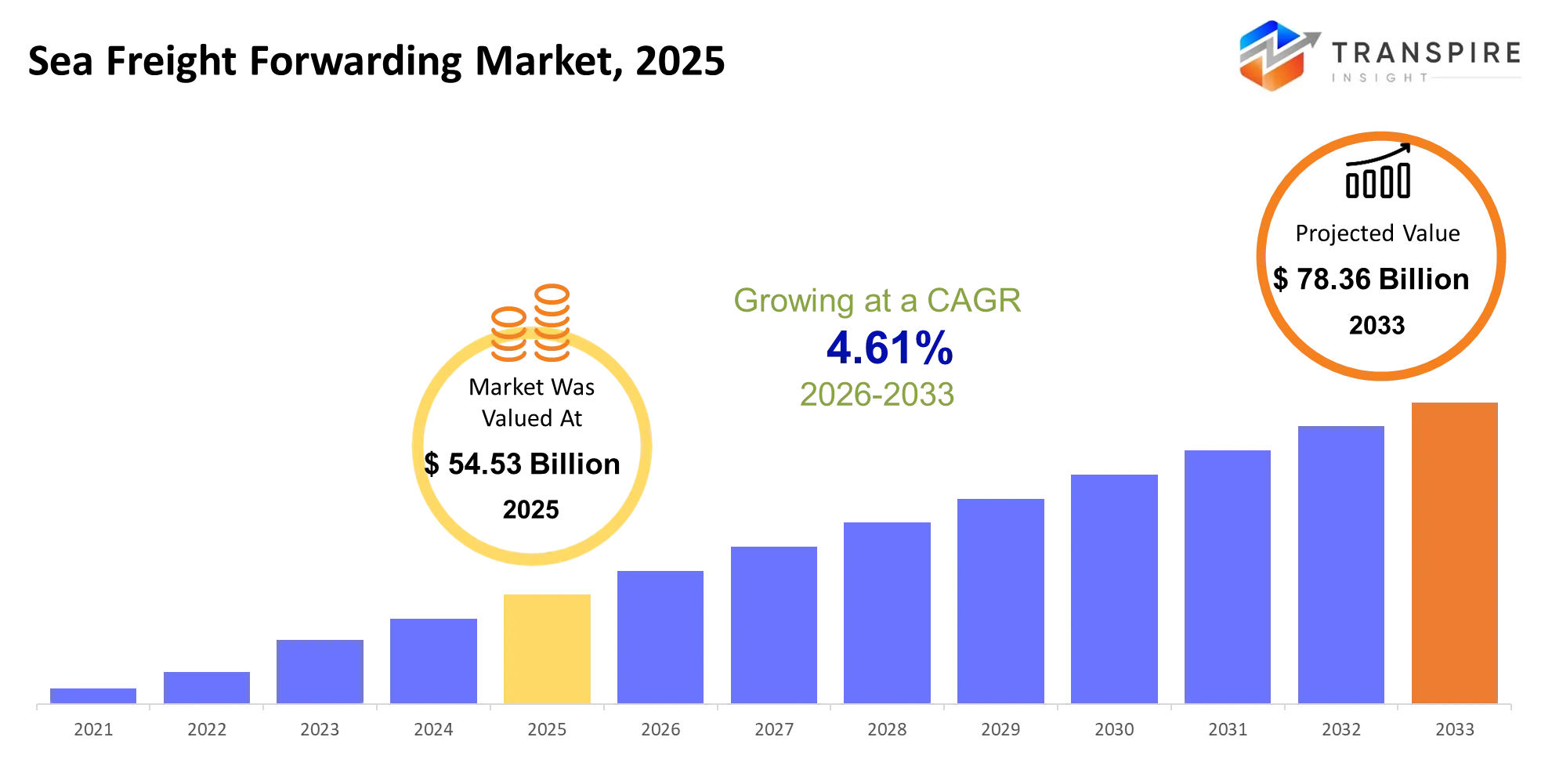
As per the Transpire Insight, The Sea Freight Forwarding Market size is estimated at USD 54.53 billion in 2025 and is anticipated to reach USD 78.36 billion by 2033, growing at a CAGR of 4.61% from 2026 to 2033.
The sea freight forwarding market involves managing ocean transport: buying space, intermodal cargo integration, export document creation, freight clearing, and delivery to port and inland points. Over the past 3-5 years, the industry has moved from sale-based transaction booking to an exception-based digital ecosystem with shipment management. Forwarders have integrated carriers' schedules, customs processing, visibility, and even customer-facing platforms. One paradigm shift has been the standardization of electronic data exchange: IMO's Maritime Single Window became mandatory, and in 2026 the IMO's digitalization strategy reinforced the need for data interoperability and governance. A real-world catalyst is the rolling cycle of maritime disruptions along ever more interconnected trade routes, forcing forwarders to reroute cargo, update bookings and provide early visibility of delays. As a result, growth stems from the growing operational importance of forwarding capabilities, as shippers spend on better route choice, compliance, consolidation and disruption management capabilities, responding to the inevitable compression of ocean freight networks.
Sea Freight Forwarding Market Size & Forecast:
- Market Size 2025: USD 54.53 Billion
- Expected Market Value (2033): USD 78.36 Billion
- Forecast CAGR (2026-2033): 4.61%
- Leading Region in 2025: Asia Pacific
- Fastest Growing Region: North America
- Key Company Profiles: Kuehne+Nagel, DSV, DHL Forwarding, DB Schenker, Expeditors, Sinotrans, CEVA Logistics, Nippon Express, Maersk Logistics, Hellmann Worldwide Logistics, GEODIS, Kerry Logistics, Bolloré Logistics, LX Pantos, CH Robinson.
Key Sea Freight Forwarding Market Insights:
Sea freight forwarding is becoming more of a risk management service, with route intelligence, carbon compliance, and document automation increasingly playing a role in customer retention. Today, the key to competitive advantage is to turn shipment information into quicker interventions and reduced administrative hassles.
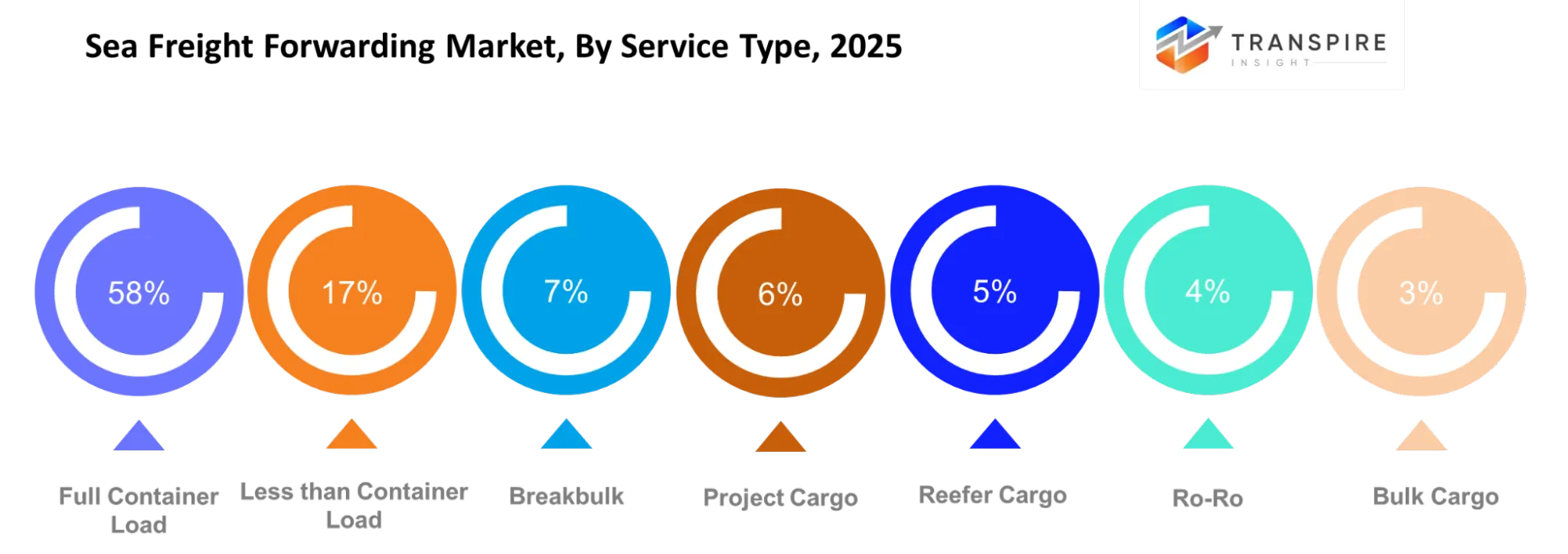
- Full Container Load is 58%, and Kuehne+Nagel is improving self-service booking and transparency with myKN.
- Less than Container Load accounts for 17%, with consolidation-based networks being preferred by smaller importers who prefer to replenish with inventory.
- Breakbulk represents 7%, which will prompt GEODIS and CEVA Logistics to further develop their industrial and oversized-cargo engineering expertise.
- Project Cargo is growing at 6% and is expected to grow at a CAGR of 7.8%, increasing the need for specialist planning of energy and infrastructure equipment.
- Reefer Cargo represents 5% of the contribution, which is increasing investment in temperature monitoring workflows for food and pharmaceutical transport.
- Ro-Ro has a 4% share of the market, so Nippon Express and LX Pantos can match vehicle logistics with automotive supply chain tracking.
- Bulk Cargo accounts for 2% and is the niche forwarding of commodities that need port, storage, and charter coordination.
- Other services make up 1%, and in those cases, automation enhances visibility for irregular, high-compliance, or low-volume shipments.
- The acquisition of DB Schenker by DSV in April 2025 is a move to build scale, and its network integration plans are focused on one transport-management platform.
What are the Key Drivers, Restraints, and Opportunities in the Sea Freight Forwarding Market?
Driver:
Supply-chain resilience is the primary revenue driver. The Red Sea disruption exposed the cost of treating ocean freight as a low-touch procurement activity: rerouting around southern Africa added roughly 9% to voyage distance and reduced available capacity by an estimated 15-20% in the second quarter. Importers of automotive components, machinery, chemicals, and retail goods therefore increased reliance on forwarders able to secure alternative capacity, recalculate landed costs, combine sea with rail or air solutions, and provide shipment-level updates. This expands revenue through premium routing, customs, cargo insurance, warehousing, and multimodal services rather than through freight booking alone.
Restraint:
Margin pressure persists because carrier capacity, port performance, customs rules, and spot-rate cycles remain largely outside a forwarder’s control. Fragmented legacy systems also force manual reconciliation between carriers, ports, banks, brokers, and customers. Electronic bill-of-lading adoption illustrates the structural issue: it was only 5.7% despite industry commitments, constrained by legal recognition, interoperability, and operational habits.
Opportunity:
Digital control towers are reshaping sea freight forwarding from a capacity-booking function into a reliability-led service model. By integrating interoperable electronic bill of lading platforms, predictive arrival alerts, carbon-cost calculators, and automated customs classification, forwarders can identify delays earlier, reduce documentation errors, and provide clearer landed-cost estimates. The first standards-based interoperable eBL transaction proved that paperless documents can move securely across different platforms, improving scalability. This shift enables forwarders to charge for visibility, compliance support, and disruption management instead of competing mainly on freight rates.
What Has the Impact of Artificial Intelligence Been on the Sea Freight Forwarding Market?
The shift to exception-based operations drives artificial intelligence in sea freight forwarding. AI-enabled document tools are applied to read data from bills of lading, invoices, packing lists, and certificates; fields are compared to shipment records, and any gaps or anomalies in customs documentation are flagged before cargo arrives at a port, reducing manual data entry and helping forwarders manage an influx of paperwork with less delay. Predictive models leverage vessel-position signals, past port dwells, weather, transhipment windows, congestion and carrier scores to approximate ETA and signal which shipments may arrive outside delivery windows, letting forwarders advise customers early, secure third-party trucking or warehousing capacity and focus on freight that might need action. AI further supports dynamic quoting, container consolidation, route comparisons and customer-service automation.
The result is improved tracking, faster exception handling, and smarter allocation of staff resources. The UN Trade and Development reports that digital tools, including AI and automation, can benefit cargo tracking and transhipment. But legacy systems are often disconnected, and status reporting on shipments can be inaccurate, leading to inaccurate ETAs and document suggestions that require intervention on regulated or disruption-affected shipments.
In March 2026, cargo.one acquired ocean rate platform Cargofive and launched the industry’s first AI-native operating system for multimodal freight. Driven by a fresh $20 million investment led by Bessemer Venture Partners, this move allowed the company to move beyond disjointed "bolt-on" AI tools and unify both air and ocean freight data into a single, cohesive foundation.
https://www.cargo.one/press/cargofive-acquisition-ai-os-multimodal-launch
Key Sea Freight Forwarding Market Trends:
Sea freight forwarding is evolving into a resilience-and-data service as the disruption of the route, the decarbonisation rules and paperless-trade standards make the value of forwarders who are able to deal with exceptions, not just procurement of vessel space, more evident. The adoption of digital workflows is speeding up, though interoperability and operational confidence are still the key barriers.
- With the Red Sea diversions extending the Asia-Europe trade routes, the lowest-rate buyer is no longer the forwarder, but rather the route-risk manager.
- More and more customers are buying live exception alerts, as opposed to status emails, and they are creating shipment-level intervention workflows.
- Carriers' 2030 digital-document commitment is driving electronic bills of lading from pilots to standardisation.
- Technical demonstration of cross-platform eBL exchange has become possible, minimizing the need for a single documentation platform.
- Predictive ETAs are increasingly using an amalgamation of vessel, port, and transhipment data rather than carrier schedule dates.
- Booking decisions now rely on port congestion analytics, driving earlier routing changes and inventory repositioning.
- As the IMO EEXI and CII rules influence vessel-efficiency decisions, carbon reporting has entered the realm of freight quotations.
- As shippers switch between cost and lead time, forwarders are growing their sea-air, rail-sea and door-to-door capabilities.
- Document automation is cutting down on manual data entry, and customs validation is still a human-supervised process.
- The consolidation networks are becoming more relevant as smaller shippers search for more resilient and cost-effective ocean capacity.
Sea Freight Forwarding Market Segmentation
By Service Type:
Full Container Load (FCL) holds the dominant 58% share, supported by predictable high-volume movements in manufacturing, retail, electronics, and automotive supply chains. Its growth logic comes from dedicated container utilization, simpler cargo planning, and better control over sailing schedules, while digital booking and shipment-visibility platforms are reducing coordination time. Less than Container Load (LCL) accounts for 17%, serving smaller exporters and fragmented consignments that increasingly require flexible consolidation. Breakbulk represents 7%, while Project Cargo holds 6% and is projected to grow at a 7.8% CAGR, supported by renewable-energy equipment, infrastructure projects, heavy machinery, and oversized industrial shipments. Reefer Cargo contributes 5%, Ro-Ro 4%, Bulk Cargo 2%, and Others 1%, with specialised handling creating higher-value forwarding opportunities.
By Cargo Type:
Consumer goods, electronics, automotive, food and beverages, chemicals, pharmaceuticals, and machinery generate distinct forwarding requirements around consolidation, security, temperature control, hazardous-material compliance, and delivery synchronization. Electronics and pharmaceuticals increasingly require tighter visibility and handling controls, while automotive and machinery shipments depend on coordinated delivery schedules. Chemicals require specialised documentation and safety procedures. Future growth will increasingly come from forwarders combining ocean capacity with digital tracking, predictive shipment monitoring, and specialised cargo handling rather than simply arranging vessel space.
By Container Type:
Dry containers remain the principal option for general cargo because of their broad compatibility and efficient utilization. Reefer containers support temperature-sensitive food, pharmaceutical, and biological shipments, while tank containers handle liquid and chemical cargo. Open-top and flat-rack containers accommodate oversized machinery and project equipment, whereas high-cube and special containers provide additional capacity for bulky or unusually configured loads. Future adoption will increasingly focus on connected container monitoring, condition sensors, digital tracking, and automated alerts to reduce cargo damage and handling uncertainty.
By Shipment Type:
Import and export movements remain fundamental to international forwarding, while cross-border and transhipment activity requires tighter coordination across customs authorities, ports, carriers, and inland providers. Intra-regional shipments benefit from shorter routes and frequent sailing networks, whereas intercontinental movements require greater schedule and documentation management. Domestic movements increasingly connect ocean gateways with inland distribution centres. Digital documentation, electronic customs submissions, shipment visibility, and real-time exception alerts are improving coordination across multi-leg journeys and reducing delays caused by fragmented information.
By End User:
Manufacturing and retail provide substantial forwarding activity because their supply chains depend on regular movement of components, finished products, and inventory between production and consumption markets. Automotive logistics requires synchronized parts flows, while healthcare depends on controlled handling and compliance. Chemicals require dangerous-goods procedures, and food and beverage shipments increasingly require temperature and traceability controls. Electronics demand security and shipment visibility because of high-value cargo. Future growth will favour forwarders offering industry-specific compliance, monitoring, warehousing, and multimodal coordination.
By Mode:
Port-to-port services remain fundamental for conventional ocean movements, but door-to-port and port-to-door solutions are expanding as shippers seek greater control over inland connections. Door-to-door forwarding integrates ocean transport with trucking, warehousing, customs, and final delivery, increasing the forwarder's role in supply-chain coordination. Multimodal solutions combine multiple transport modes, while sea-air supports time-sensitive international cargo and rail-sea connects maritime gateways with inland markets. Future adoption will favour integrated routing platforms capable of dynamically adjusting transport modes when congestion or disruption occurs.
By Service Offering:
Documentation and customs clearance remain essential because international shipments require accurate commercial, regulatory, and cargo information. Warehousing and distribution extend forwarding into inventory and fulfilment activities, while cargo insurance provides protection against transportation-related risks. Tracking is becoming more sophisticated through real-time visibility, predictive ETA tools, and automated exception alerts. Consolidation enables smaller shipments to share container capacity, improving utilization and cost efficiency. Future competition will increasingly depend on integrating these services through digital platforms rather than delivering them as disconnected operational functions.
What are the Key Use Cases Driving the Sea Freight Forwarding Market?
The core application is internationally transporting containerized consumer and industrial goods, which is, in essence, the traditional Full Container Load (FCL) segment, with a 58% share. FCL forwarding involves dedicated capacity, synchronized sailing schedules, documentation, customs support, and managed handovers between origin and destination.
The broader applications are the transport of electronics, automotive parts, machinery, food and beverage, chemicals, and pharma, which require specialized containers, consolidation, temperature control, hazardous cargo regulation, and synchronized inland transportation, thus taking forwarding services beyond the ocean booking.
The soon-to-emerge applications range from managing disruptions and digitally coordinated multimodal logistics to routing, sea-rail combination, congestion management, and AI-assisted quotation/booking - potentially removing complexity for smaller exporters, as DHL has already piloted with Alibaba.com in 2026.
|
Report Metrics |
Details |
|
Market size value in 2025 |
USD 54.53 Billion |
|
Market size value in 2026 |
USD 57.15 Billion |
|
Revenue forecast in 2033 |
USD 78.36 Billion |
|
Growth rate |
CAGR of 4.61% from 2026 to 2033 |
|
Base year |
2025 |
|
Historical data |
2021 - 2024 |
|
Forecast period |
2026 - 2033 |
|
Report coverage |
Revenue forecast, competitive landscape, growth factors, and trends |
|
Regional scope |
United States; Canada; Mexico; United Kingdom; Germany; France; Italy; Spain; Denmark; Sweden; Norway; China; Japan; India; Australia; South Korea; Thailand; Brazil; Argentina; South Africa; Saudi Arabia; United Arab Emirates |
|
Key companies profiled |
Kuehne+Nagel, DSV, DHL Forwarding, DB Schenker, Expeditors, Sinotrans, CEVA Logistics, Nippon Express, Maersk Logistics, Hellmann Worldwide Logistics, GEODIS, Kerry Logistics, Bolloré Logistics, LX Pantos, CH Robinson |
|
Customization scope |
Free report customization (country, regional & segment scope). Available customised purchase options to meet your exact research needs. |
|
Report Segmentation |
By Service Type (Full Container Load, Less than Container Load, Breakbulk, Project Cargo, Reefer Cargo, Ro-Ro, Bulk Cargo, Others); By Cargo Type (Consumer Goods, Electronics, Automotive, Food & Beverages, Chemicals, Pharmaceuticals, Machinery, Others); By Container Type (Dry Containers, Reefer Containers, Tank Containers, Open-top Containers, Flat-rack Containers, High-cube Containers, Special Containers, Others); By Shipment Type (Import, Export, Cross-border, Transshipment, Intra-regional, Intercontinental, Domestic, Others); By End User (Manufacturing, Retail, Automotive, Healthcare, Chemicals, Food & Beverage, Electronics, Others); By Mode (Port-to-port, Door-to-port, Port-to-door, Door-to-door, Multimodal, Sea-air, Rail-sea, Others); By Service Offering (Documentation, Customs Clearance, Warehousing, Cargo Insurance, Tracking, Consolidation, Distribution, Others). |
Which Regions are Driving the Sea Freight Forwarding Market Growth?
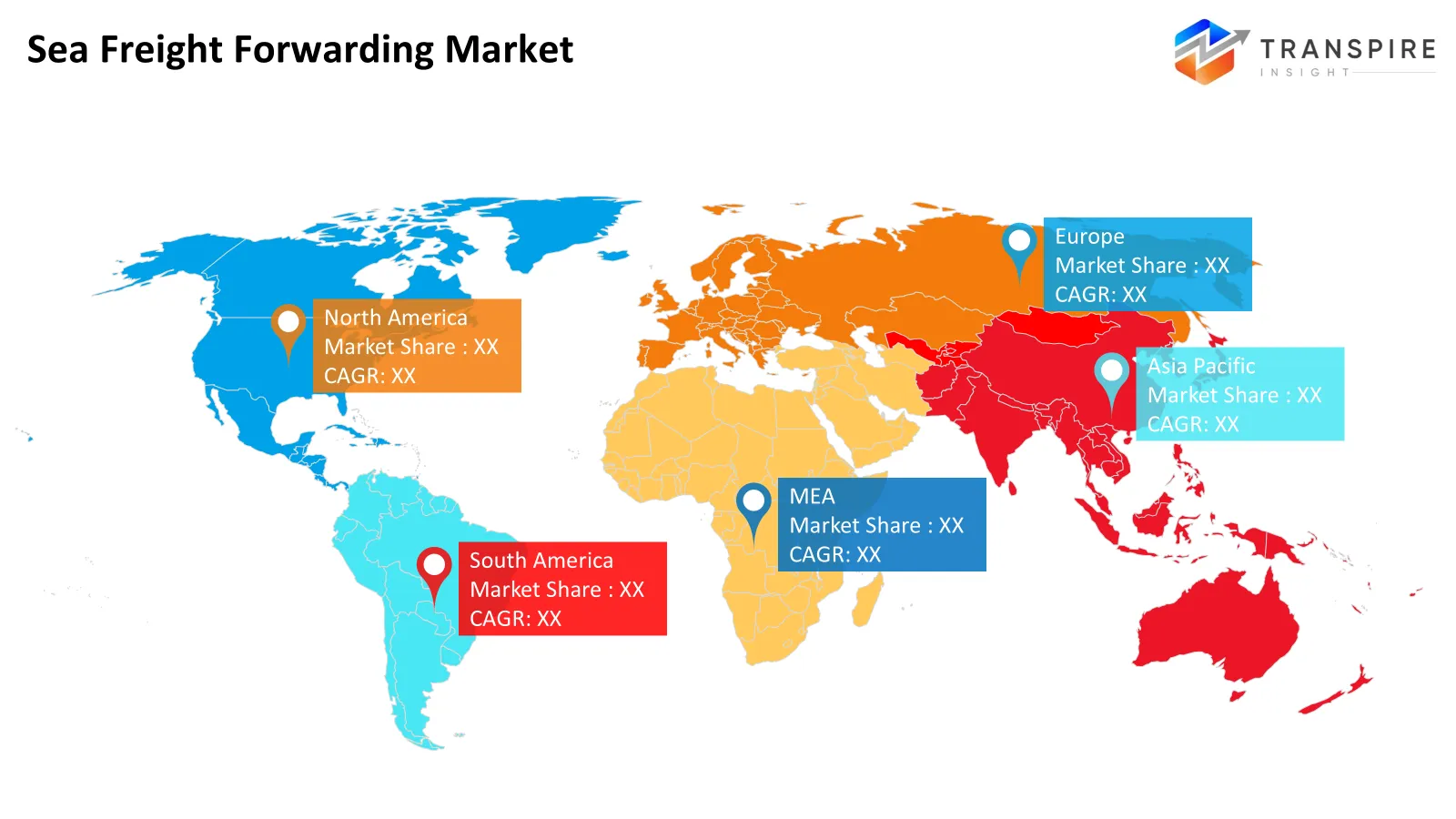
Asia Pacific commands a 40.52% share of the market due to the export manufacturing focus of the region, with gateways in China, Japan, South Korea, India, and Southeast Asia. Exporting electronics, consumer durables, machinery, auto components and industrial inputs leads to relatively high density and levels of processing on both intra-Asian and transoceanic trade lanes, with large gateway port capacity, regional trade linkages and integrated supply chains enabling high levels of consolidation and forwarder relationships for customs, warehousing and multimodal facilitation. The region's market share is thus mainly a measure of cargo production strength, not solely port throughput.
In February 2026, a consortium of major Indian logistics and maritime entities including the Container Corporation of India (CONCOR), the Shipping Corporation of India (SCI), and several gateway port authorities signed a Memorandum of Understanding to establish the Bharat Container Shipping Line (BCSL).
https://safety4sea.com/india-advances-establishment-of-national-container-line/
Europe currently accounts for 27% and is still a major forwarding market due to its dense port network and strong cross-border manufacturing base. Unlike the production-oriented, volume-oriented nature of the Asia-Pacific region, the consumer-oriented structure of Europe, diverse industrial trade, mature customs infrastructure, and clustered road-rail combinations lead the way. Rotterdam, Antwerp-Bruges, Hamburg, and Mediterranean gateways have deep linkages with Asia, North America, and intra-European supply chains. On the sustainability side, the demand for lower-emission shipping modes and improvement in shipment-level carbon footprint visibility is strengthening.
In September 2026, the Port of Rotterdam and Port of Antwerp-Bruges delivered a joint Green Port Master Plan to the European Commission, establishing a practical framework for sustainable shipping.
https://www.hellenicshippingnews.com/europes-ports-get-a-free-tested-roadmap-to-net-zero/
North America, 20%, is expected to increase at a CAGR of 5.23%, making supply-chain diversification a key growth driver. Factors such as nearshoring, tariff uncertainty, e-commerce flows, and the need for less-than-container load (LCL) flexibility are driving shippers' sourcing and routing changes. As of 2026, CEVA's analysis reveals North America's strong LCL position even in the context of tariff pressure and supply chain diversification. Latin America, 7%, and the Middle East & Africa, 5.48%, represent further growth opportunities through port investments, new trade corridors, and multimodal growth.
In July 2026, CMA CGM Group agreed to an acquisition of FedEx Supply Chain for $1.4 billion. This strategic transaction will nearly triple the size of the North American contract logistics operations for its subsidiary.
Who are the Key Players in the Sea Freight Forwarding Market, and how do they compete?
The competitive playing field is also becoming centred on network density, digital execution, industry integration, and contingency during port or route disruptions. Kuehne+Nagel has the advantage of ocean-freight density, LCL consolidation, and its digital routing platforms myKN and Sea Explorer. It has differentiators in visibility, emissions data, and vertical-market focus.
DSV is attaining scale through acquisitions (buying the freight forwarding division of HSBC) and developing integration through bringing more than 20 transport-management platforms into a single operating environment.
DHL Forwarding is adding artificial-intelligence-enabled customs clearance, digitised service centres, and customer segments focused on small and medium-sized businesses to transition from transactional to scalable service. Expeditors and C.H. Robinson stake claims based on control-tower visibility, aggregation of brokerage services, and asset-light orchestrations. Maersk Logistics and CEVA Logistics are developing integrated ocean-to-warehouse solutions, exploiting connections to carriers or contract-logistics services for greater control. Sinotrans, Nippon Express, Kerry Logistics, LX Pantos, Hellmann Worldwide Logistics, GEODIS, Bolloré Logistics and the combined DSV and DB Schenker operations compete on regional density, sector-specific strengths and cross-border capabilities.
Key Players are:
- Kuehne+Nagel
- DSV
- DHL Forwarding
- DB Schenker
- Expeditors
- Sinotrans
- CEVA Logistics
- Nippon Express
- Maersk Logistics
- Hellmann Worldwide Logistics
- GEODIS
- Kerry Logistics
- Bolloré Logistics
- LX Pantos
- CH Robinson
Recent Development News
- In September 2026, DHL Forwarding acquired Aero Cargas S.A. in Uruguay. The acquisition gives DHL its first direct operation in Uruguay and strengthens its ocean freight forwarding, project logistics, healthcare logistics, and multimodal capabilities across the Southern Cone. https://group.dhl.com/en/media-relations/press-releases/2026/dhl-invests-in-latin-american-growth-with-acquisition-of-aero-cargas-sa-in-uruguay.htm
- In September 2026, Gravity Supply Chain Solutions partnered with Coneksion to expand multi-carrier ocean booking connectivity. The integration allows customers to submit and confirm ocean freight bookings through a single connection, reducing separate carrier integrations and manual data entry while creating a foundation for further automation of shipping instructions, VGM submissions, and tracking. https://natlawreview.com/press-releases/gravity-supply-chain-and-coneksion-partner-expand-multi-carrier-ocean
What Strategic Insights Define the Future of the Sea Freight Forwarding Market?
The market is heading toward digitally orchestrated forwarding, where booking, customs, visibility, routing, and inland transport operate through connected platforms rather than separate workflows. The strategic shift is important because disruption increasingly rewards the ability to change routes and modes quickly, not simply secure the lowest freight rate. Kuehne+Nagel’s accelerated AI deployment and DHL’s 2026 TradeNavigator launch illustrate how forwarders are converting operational and customs data into decision-support services. A hidden risk is data fragmentation: AI cannot consistently automate decisions when carrier, port, customs, and customer datasets remain incompatible or incomplete. The emerging opportunity is therefore interoperability combined with specialized services such as carbon-managed shipping, battery logistics, and predictive customs management. Strategically, forwarders should prioritize common data architecture, API connectivity, AI-assisted exception handling, and sector-specific expertise rather than treating digitalization as a standalone technology investment. This approach can improve productivity while creating higher-value recurring services around compliance, resilience, and supply-chain orchestration.
Key Segmentations are:
By Service Type
- Full Container Load
- Less than Container Load
- Breakbulk
- Project Cargo
- Reefer Cargo
- Ro-Ro
- Bulk Cargo
- Others
By Cargo Type
- Consumer Goods
- Electronics
- Automotive
- Food & Beverages
- Chemicals
- Pharmaceuticals
- Machinery
- Others
By Container Type
- Dry Containers
- Reefer Containers
- Tank Containers
- Open-top Containers
- Flat-rack Containers
- High-cube Containers
- Special Containers
- Others
By Shipment Type
- Import
- Export
- Cross-border
- Transshipment
- Intra-regional
- Intercontinental
- Domestic
- Others
By End User
- Manufacturing
- Retail
- Automotive
- Healthcare
- Chemicals
- Food & Beverage
- Electronics
- Others
By Mode
- Port-to-port
- Door-to-port
- Port-to-door
- Door-to-door
- Multimodal
- Sea-air
- Rail-sea
- Others
By Service Offering
- Documentation
- Customs Clearance
- Warehousing
- Cargo Insurance
- Tracking
- Consolidation
- Distribution
- Others
By Regional Analysis
North America
- US
- Canada
- Mexico
Europe
- Germany
- UK
- France
- Italy
- Spain
- Russia
- Rest of Europe
Asia Pacific
- China
- Japan
- India
- South Korea
- Australia
- Rest of Asia Pacific
South America
- Brazil
- Argentina
- Rest of South America
Middle East & Africa
- UAE
- Saudi Arabia
- Qatar
- South Africa
- Rest of the Middle East & Africa
Frequently Asked Questions
Find quick answers to common questions.
The sea freight forwarding market size was valued at USD 54.53 billion in 2025 and is poised to reach USD 78.36 billion by 2033, expanding at a 4.61% CAGR.
Key segments for the sea freight forwarding market are By Service Type (Full Container Load, Less than Container Load, Breakbulk, Project Cargo, Reefer Cargo, Ro-Ro, Bulk Cargo, Others); By Cargo Type (Consumer Goods, Electronics, Automotive, Food & Beverages, Chemicals, Pharmaceuticals, Machinery, Others); By Container Type (Dry Containers, Reefer Containers, Tank Containers, Open-top Containers, Flat-rack Containers, High-cube Containers, Special Containers, Others); By Shipment Type (Import, Export, Cross-border, Transshipment, Intra-regional, Intercontinental, Domestic, Others); By End User (Manufacturing, Retail, Automotive, Healthcare, Chemicals, Food & Beverage, Electronics, Others); By Mode (Port-to-port, Door-to-port, Port-to-door, Door-to-door, Multimodal, Sea-air, Rail-sea, Others); By Service Offering (Documentation, Customs Clearance, Warehousing, Cargo Insurance, Tracking, Consolidation, Distribution, Others).
Growth is primarily driven by supply-chain diversification, route disruptions, digital freight platforms, cross-border trade, multimodal logistics integration, and rising demand for specialized cargo handling.
The sea freight forwarding market is led by major manufacturers, including Kuehne+Nagel, DSV, DHL Forwarding, DB Schenker, Expeditors, Sinotrans, CEVA Logistics, Nippon Express, Maersk Logistics, Hellmann Worldwide Logistics, GEODIS, Kerry Logistics, Bolloré Logistics, LX Pantos, and CH Robinson.
Asia Pacific holds 40.52% of the market, supported by manufacturing concentration, major container ports, extensive intra-regional trade, export-oriented industries, and expanding multimodal logistics infrastructure.
Commercial opportunities include AI-enabled forwarding, predictive shipment visibility, sustainable ocean services, specialized project and battery logistics, multimodal solutions, and digitally integrated customs and documentation services.
- Kuehne+Nagel
- DSV
- DHL Forwarding
- DB Schenker
- Expeditors
- Sinotrans
- CEVA Logistics
- Nippon Express
- Maersk Logistics
- Hellmann Worldwide Logistics
- GEODIS
- Kerry Logistics
- Bolloré Logistics
- LX Pantos
- CH Robinson
About the Authors

Mayur Shinde
I am Mayur Shinde, a Senior Research Analyst at Transpire Insight, specializing in the Automotive & Transportation and Information & Communication Technology (ICT) Industry. My work focuses on analyzing emerging market trends, technological advancements, competitive landscapes, and industry developments to deliver accurate, data-driven insights. I am passionate about transforming complex market information into clear, actionable content that helps businesses, professionals, and decision-makers stay informed and make confident strategic decisions.

Chakradhar Khansole
Chakradhar serves as the Research Director at Transpire Insight, bringing over 8 years of experience in technology, innovation, and strategic market intelligence. He specializes in transforming complex market data into actionable business insights that enable organizations to make informed, growth-oriented decisions. Recognized for his strategic vision and analytical expertise, Chakradhar leads high-impact research initiatives, delivering comprehensive market assessments, competitive intelligence, and forward-looking industry analysis.
Recently Published Reports
-
Apr 2026
ATV & UTV Market
ATV & UTV Market Size, Share & Analysis Report By Type (ATV, and UTV), By Variants (Less Than 400 CC, 400 CC To 800 CC, and More Than 800 CC), and Geography (North America, Europe, Asia-Pacific, Middle East and Africa, South and Central America), 2021 - 2031
-
Apr 2026
Automotive Central Gateway Module Market
Automotive Central Gateway Module Market Size, Share & Analysis Report By Type (Ethernet Central Gateway Module, CAN Central Gateway Module, LIN Central Gateway Module, and FlexRay), By Application (Powertrain Control, Body Control, Infotainment System, Advanced Driver Assistance Systems (ADAS), and Others), By End User (Passenger Vehicles, and Commercial Vehicles), and Geography (North America, Europe, Asia-Pacific, Middle East and Africa, South and Central America), 2021 - 2031
-
Apr 2026
Automotive Engine Oil Filter Market
Automotive Engine Oil Filter Market Size, Share & Analysis Report By Filter Type (Fuel Filter, Engine Oil Filter, Hydraulic Oil Filter, and Others), By Filter Media (Cellulose, Synthetic, and Micro), By Sales Channel (OEMs, and Aftermarket), By Vehicle Type (Passenger Cars, Light Commercial Vehicles, Heavy Duty Trucks, Buses and Coaches, and Off-road Vehicles), and Geography (North America, Europe, Asia-Pacific, Middle East and Africa, South and Central America), 2021 - 2031
-
Apr 2026
Automotive Parts Aluminium Die Casting Market
Automotive Parts Aluminium Die Casting Market Size, Share & Analysis Report By Production Process (Pressure Die Casting, Vacuum Die Casting, Squeeze Die Casting, Gravity Die Casting), By Application (Body Parts, Engine Parts, Transmission Parts, Battery And Related Components, Other Application Types), and Geography (North America, Europe, Asia-Pacific, Middle East and Africa, South and Central America), 2021 - 2031
Our Clients



