
Reclaimed Butyl Rubber Market Summary:
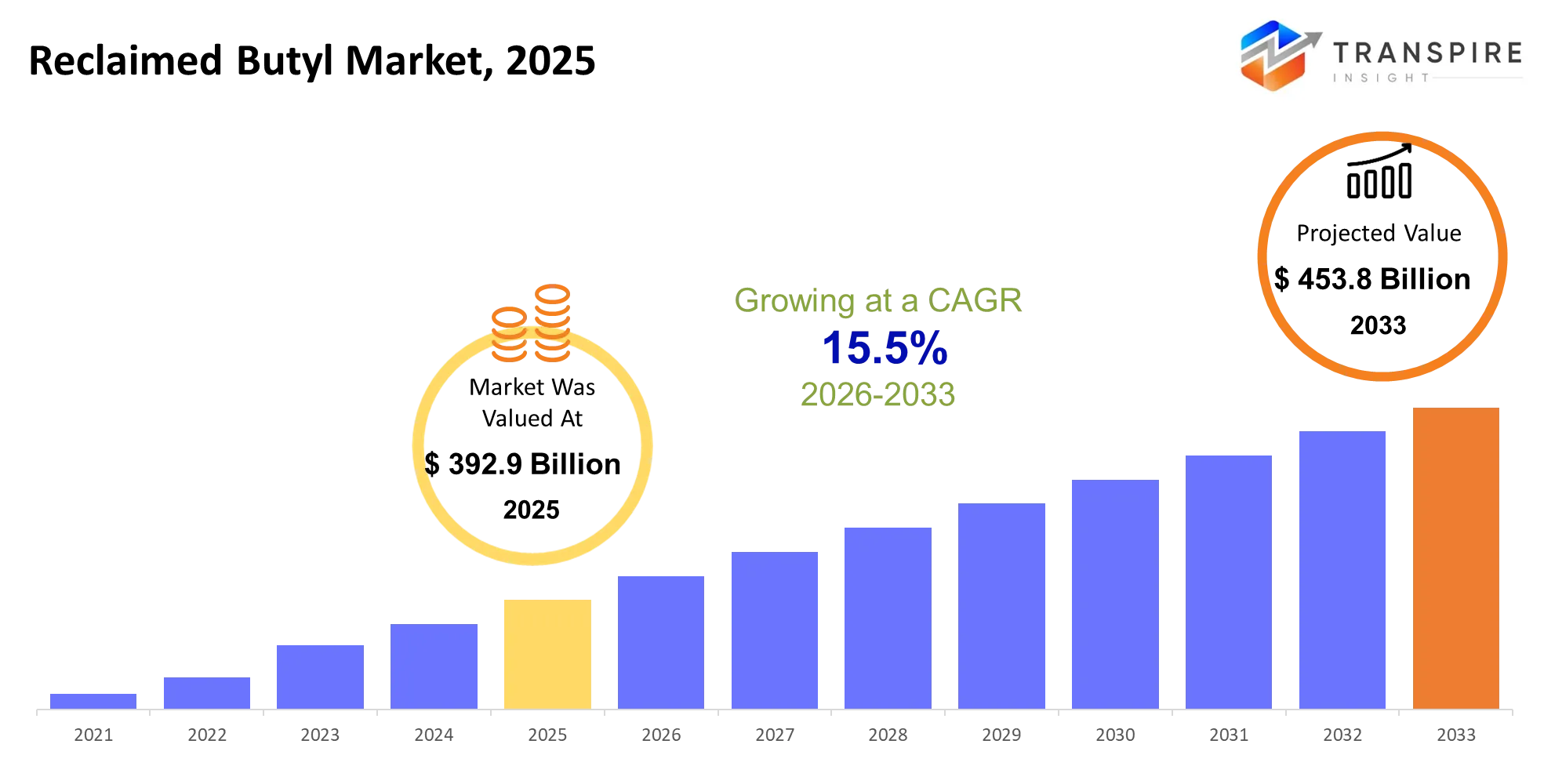
As per Transpire Insight Analysis, the Reclaimed Butyl Rubber Market size is estimated at USD 392.9 million in 2025 and is anticipated to reach USD 1244.1 million by 2033, growing at a CAGR of 15.5% from 2026 to 2033.
The reclaimed butyl rubber market is changing, as manufacturers increasingly turn to recycled rubber to reduce waste, optimise raw-material use, and lower their dependence on virgin butyl rubber. Over the years, the market has changed from simply taking old rubber waste and turning it into something useful to using more controlled ways of processing, choosing cleaner materials and improving the way rubber is broken down. A big change is that more people are choosing reclaimed rubber that comes from one source and is not mixed with materials because it has more consistent qualities. This makes it easier for companies to test and use the recycled products. At the same time, stricter goals for being good to the environment and higher costs for new materials have made companies want to use more recycled content. This is helping more companies use reclaimed butyl rubber because it reduces the need for materials and gives manufacturers another way to deal with rubber waste.
Reclaimed Butyl Rubber Market Size & Forecast:
- Market Size 2025: USD 392.9 million
- Expected Market Value (2033): USD 1244.1 million
- Forecast CAGR (2026–2033): 15.5%
- Leading Region in 2025: Asia Pacific
- Fastest Growing Region: North America
- Key Company Profiles: GRP, Klean Industries, Rubber Research Institute of India, Reclaim Rubber Products, Rolex Reclaim, Swani Rubber Industries, Arun & Sons, Kargro Recycling, Genan, Scandinavian Enviro Systems, Lehigh Technologies, ResourceCo, Tyromer, RubberJet, Eldan Recycling
Key Market Insights:
The market is shifting towards cleaner butyl grades that have specific applications, as opposed to considering the recycled rubber as one homogeneous product. Demand from tyres and the presence of significant production capacity in Asia Pacific are making reclaimed rubber more commercially relevant.
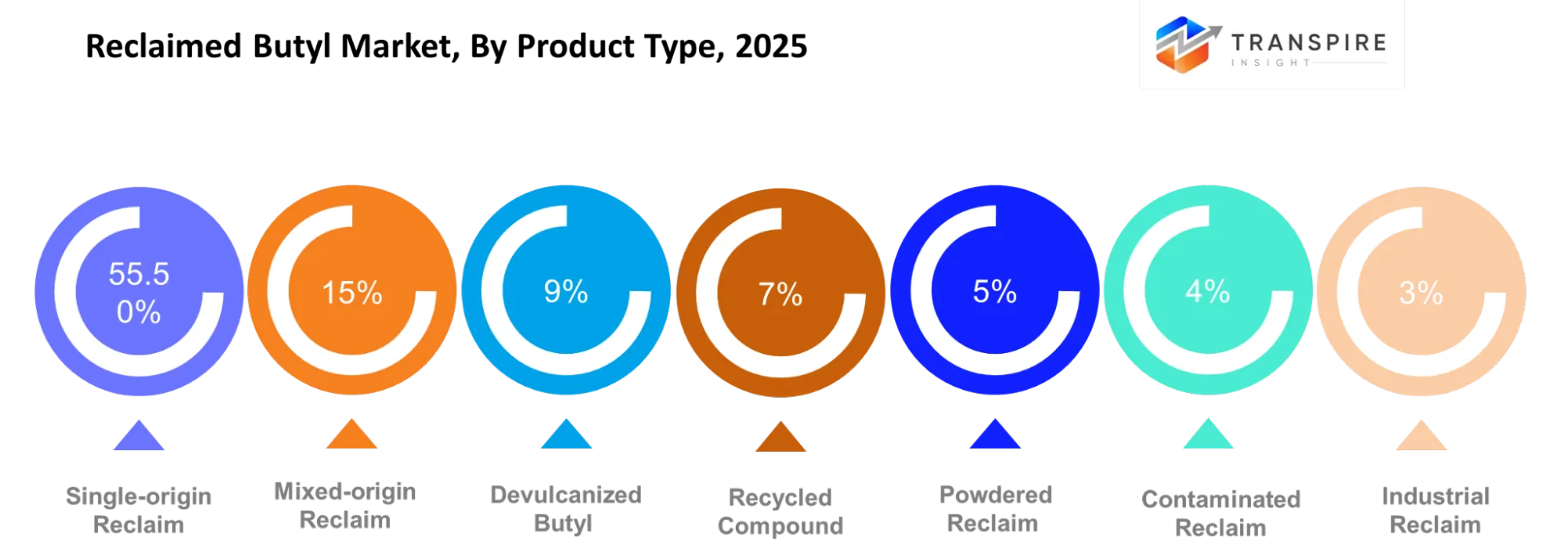
- Single-origin/uncontaminated reclaim accounts for 55.50%, due to high preference for cleaner and more consistent feedstock.
- Mixed-origin reclaim makes up 15%, demonstrating that mixed reclaimed rubber is still applicable to rubber industries where cost-efficiency is crucial.
- Devulcanized butyl rubber makes up 9%, as a result of technological innovations to reclaim the properties of used rubber.
- Recycled compounds account for 7%, which demonstrates increased use of reclaimed rubber in rubber formulations.
- Powdered reclaim makes up 5%, which is facilitated by specific applications that require easier mixing.
- Contaminated reclaim comprises 4%, remaining useful where lower requirements are applied to performance characteristics.
- The trend towards circularity in material supply encourages rubber manufacturers to integrate recycling plants closer to rubber production plants.
What are the Key Drivers, Restraints, and Opportunities in the Reclaimed Butyl Rubber Market?
Drivers
Reclaimed butyl rubber market growth will be driven by the requirement to reduce the dependency on natural rubber and the increasing amount of rubber waste. Rising costs of raw materials have forced manufacturers to consider reclaimed materials as an effective method to keep formulation costs in check without overhauling the existing process systems. Increased usage in tyres and inner liners will help make the path easier for recovered butyl rubber to enter rubber production processes.
Restraints
The limitations in the reuse process are the non-uniformity of the recovered materials due to variations in contamination levels, composition, moisture content, and processing of the waste material. Such problems continue to occur due to the fact that there is wide variation in collecting and sorting systems in different locations.
Opportunities
The primary opportunity is in enhancing accuracy and traceability of processing. Devulcanization processes, automation of sorting and testing, and better collection of feedstock can help in delivering consistent grades. Investment in recycling infrastructure in regions can further improve the supply. Firms that combine the collection of waste with processing and distribution can build more dependable supply chains and increase the commercial application of recycled butyl rubber.
What Has the Impact of Artificial Intelligence Been on the Reclaimed Butyl Rubber Market?
The use of Artificial intelligence supports reclaimed rubber processing by helping manufacturers improve sorting, quality monitoring, production planning and performance of machinery. In recycling factories, AI-based visual systems may help in identifying variations in raw rubber materials brought into the factory, and data analytics may help in identifying variations in rubber material during processing. These features may support manufacturers in producing reclaimed butyl rubber grades in a more consistent way, especially in cases when manufacturers need to exercise better control over material contamination and composition. The lack of adoption is due to the high cost of integrating AI with existing recycling technology, unreliable production data and variations in material quality. As digital monitoring technologies become cheaper, AI will play the role of a supporting factor in increasing process consistency.
Instance
In June 2025, PLANNEX introduced its new REGOM technology, which is an innovative and AI-driven tyre sorting technology. It involves inspecting tyres for contaminants using automatic inspection before the rubber recycling process begins.https://plannex.in/regom/
Key Market Trends
The recycled butyl rubber industry is transitioning from waste recovery to a more controlled and quality-oriented recycling process. In addition, producers of recycled butyl rubber are increasingly considering the suitability of the reclaimed rubber based on its end-use requirements.
- Feedstock purity is becoming increasingly significant as companies strive to ensure consistency in their reclaimed rubber qualities.
- A single-source reclaim is gaining commercial significance since uniformity makes its blending and testing easy.
- Devulcanization is getting more prominence as manufacturers aim to restore the usability features of rubber through crosslinked waste.
- The tyre industry is increasingly focusing on recycled feedstock as part of efficiency and sustainability initiatives.
- Recycling facilities are leaning towards efficient sorting and testing to minimise contamination before processing.
- Traceability is becoming increasingly significant as customers demand more transparency in the origin and history of the recycling process.
Reclaimed Butyl Rubber Market Segmentation
By product type
Single-origin reclaims lead the market with a 55.50% share of the market in accordance with the provided segmentation. Mixed-origin reclaims are present at 15%, devulcanized butyl rubber at 9%, and recycled butyl compound at 7%. Powdered reclaim is 5%, contaminated reclaims are 4%, industrial reclaim is 3%, and other types of products are 1.50%. It should be noted that the leadership of single-origin reclaims and uncontaminated materials stems from the high importance of consistency in composition and performance for rubber manufacturing companies that use them.
By application
Tyres represent the most commercially viable sector, whereas tyre applications are seen as the fastest-growing sector with a CAGR of 7.72%. Inner liners, tubes, sealants, waterproof sheets, hoses, adhesives, and other rubber products represent other applications. The rubber requirement for tyres is bolstered by the already existing usage of butyl rubbers in air-retention applications. Sealants, waterproofing, and industrial rubber products can provide additional customer sectors and reduce dependence on one particular application.
By process
the rubber recycling market involves devulcanization, mechanical process, thermal process, chemical process, cryogenic process, grinding, extrusion, and other processing methods. The devulcanization process is especially important as it seeks to restore the desirable properties of cross-linked rubber. However, mechanical and grinding processes can still be used effectively to process recycled rubber. Future process development may concentrate on increasing material uniformity, energy savings, and avoiding contamination.
By source
reclaimed butyl rubber can be sourced from used tyres, inner tubes, industrial scrap, automotive scrap, manufacturing scrap, rubber goods, consumer scrap, and others. Of these, inner tubes and manufacturing scrap are of particular interest, because they could offer a higher content of identifiable butyl rubber. Improved source segregation could allow better efficiency in processing and enable producers to develop grades with predictable properties.
By form
reclaimed butyl rubber is available in the forms of granules, powder, sheets, blocks, pellets, compounds, liquid dispersions, and others. The right form will depend on how the material is processed. Formats of powder and granules could make it easier to dose and blend, while those of sheets and blocks could still be applicable to some conventional processing systems.
By End users
Tyre manufacturers, which are considered key customers, then follow automotive industry, construction, industrial use, adhesives and sealants, waterproofing, consumer goods, and other sectors. Tire manufacturers get advantages from recycled rubber input availability in existing production chains, whereas construction and industrial usage offer possibilities for products where reclamation can give certain functional and financial benefits. End users’ wider involvement may decrease dependence on tyre manufacturing in terms of market.
By quality grades
The market comprises premium, standard, industrial, technical, general purpose, high purity, low contaminant, and other grades. Quality demands depend on final application; therefore, high purity and low contaminant grades are more suitable for those applications where high-quality materials are required. Standard and industrial grades may be appropriate for applications with cost-sensitive requirements and specific material characteristics are not required.
What are the Key Use Cases Driving the Reclaimed Butyl Rubber Market?
Butyl Rubber Tire Manufacturing is a use case for reclaimed butyl rubber due to the prominent role of tyre applications and suitability of the material for rubber formulations. The reclaimed material may be used in some specific parts of tyres if manufacturers need recycled materials along with managed production costs. Inner liners and tubes are other well-known use cases, as butyl rubber is known to have good air retention capacity. Other use cases include sealants, hoses, adhesives, and waterproofing sheets. There are emerging use cases for the material in industrial and automotive rubber products where recycled content meets the necessary performance requirements. Improvements in sorting, devulcanization, and quality control will help the material find its way to other applications.
|
Report Metrics |
Details |
|
Market size value in 2025 |
USD 392.9 million |
|
Market size value in 2026 |
USD 453.8 million |
|
Revenue forecast in 2033 |
USD 1244.1 million |
|
Growth rate |
CAGR of 15.5% from 2026 to 2033 |
|
Base year |
2025 |
|
Historical data |
2021 - 2024 |
|
Forecast period |
2026 - 2033 |
|
Report coverage |
Revenue forecast, competitive landscape, growth factors, and trends |
|
Regional scope |
United States; Canada; Mexico; United Kingdom; Germany; France; Italy; Spain; Denmark; Sweden; Norway; China; Japan; India; Australia; South Korea; Thailand; Brazil; Argentina; South Africa; Saudi Arabia; United Arab Emirates |
|
Key company profiled |
GRP, Klean Industries, Rubber Research Institute of India, Reclaim Rubber Products, Rolex Reclaim, Swani Rubber Industries, Arun & Sons, Kargro Recycling, Genan, Scandinavian Enviro Systems, Lehigh Technologies, ResourceCo, Tyromer, RubberJet, Eldan Recycling |
|
Customization scope |
Free report customization (country, regional & segment scope). Avail customized purchase options to meet your exact research needs. |
|
Report Segmentation |
By Product Type (Single-origin Reclaim, Mixed-origin Reclaim, Uncontaminated Reclaim, Contaminated Reclaim, Devulcanized Butyl Rubber, Recycled Butyl Compound, Powdered Reclaim, Others); By Application (Tires, Inner Liners, Tubes, Sealants, Waterproofing Sheets, Hoses, Adhesives, Others); By Processing Method (Devulcanization, Mechanical Processing, Thermal Processing, Chemical Processing, Cryogenic Processing, Grinding, Extrusion, Others); By Source (End-of-life Tires, Inner Tubes, Industrial Scrap, Automotive Scrap, Manufacturing Waste, Rubber Products, Post-consumer Waste, Others); By Form (Granules, Powder, Sheets, Blocks, Pellets, Compound, Liquid Dispersion, Others); By End User (Tire Manufacturers, Automotive, Construction, Industrial, Adhesives & Sealants, Waterproofing, Consumer Products, Others); By Quality Grade (Premium, Standard, Industrial, Technical, General-purpose, High-purity, Low-contaminant, Others) |
Which Regions are Driving the Reclaimed Butyl Rubber Market Growth?
North America
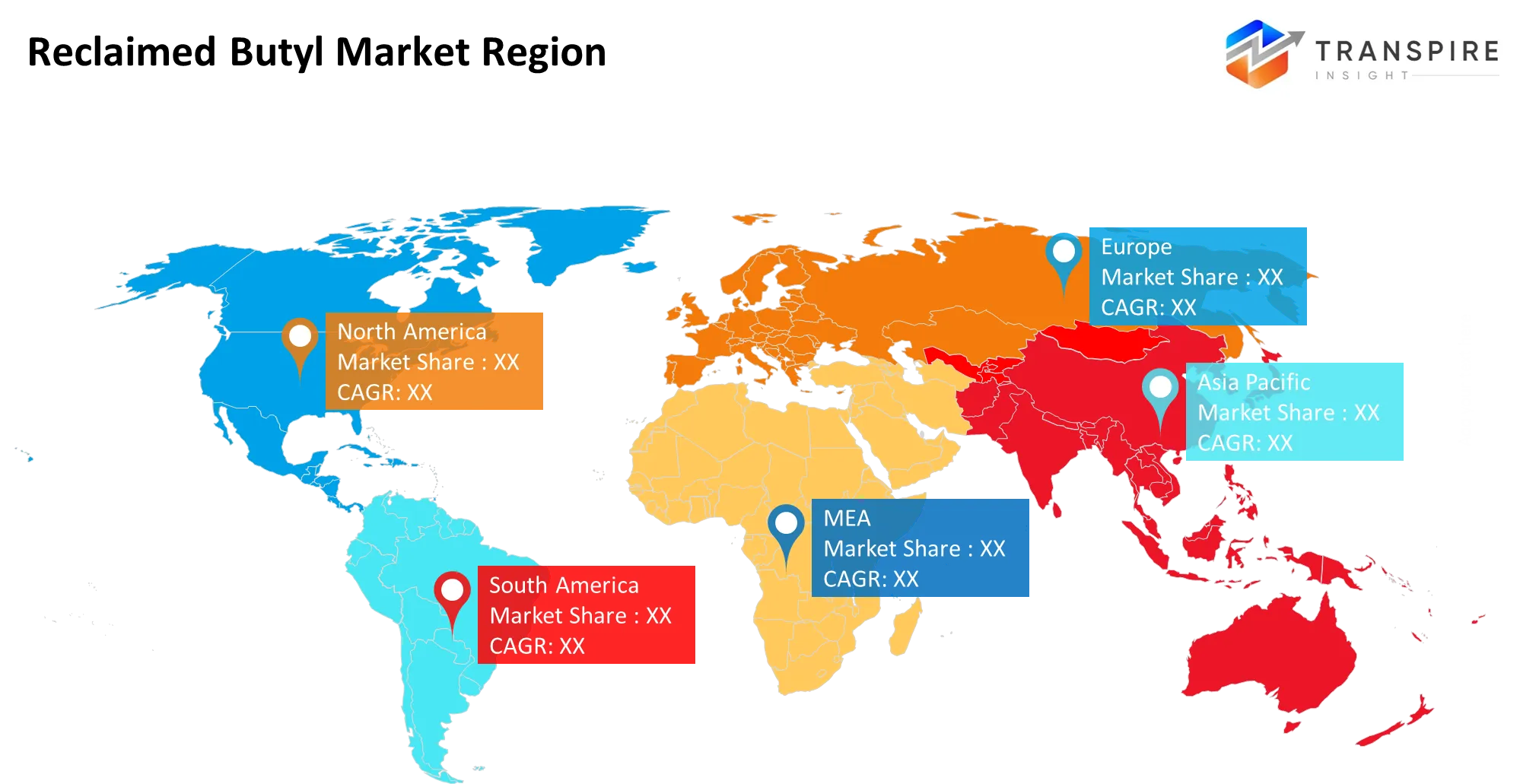
North America constitutes 18% of the market and possesses a more developed recycling system driven by automotive and industrial rubber usage. Its market is comparatively mature, with well-established collection channels and processing capabilities enabling reliable supplies of rubber waste. In addition, the companies are giving more weight to recycling materials and resources. This makes the market stable while continuing the use of reclaimed rubber in certain applications.
In July 2026, Liberty Tire Recycling acquired All American Tire, Colt Tire Recycling and Genan Inc. to boost its ability to collect and process end-of-life tyres and rubber material, reinforcing its recycling capacity in the U.S. states of Texas and Louisiana.https://libertytire.com/About/News/Liberty-Tire-Recycling-Strengthens-Gulf-Coast-Operations-and-Recycling-Efforts-with-Strategic-Acquisitions/
Europe
Europe constitutes 15% of the market and continues to be a relevant market for circular material projects and innovative recycling activities. Latin America holds 4% of the market, driven by the development of automotive and industrial applications and the Middle East and Africa hold 3.02%. According to the data provided, North America is the fastest-growing region with approximately 6.9% CAGR, providing an opportunity for processors that can develop their capabilities in material collection and meet the needs of clients for recycled rubber.
In 2026, Rubber Resources from the Netherlands continued developing its recycling and compounding operations, pointing out the development work at its production sites and increasing demand from tyre producers for recycled rubber material. Specifically, the company recycles butyl rubber, including ECORR® RBR grades of reclaimed butyl rubber, used in tyre inner liner applications.https://www.rubber-resources.com/en/products/choose-your-product/reclaim-butyl-rubber/
Asia-Pacific
Asia-Pacific has dominated the world of butyl reclaimed rubber in terms of market share that stands at 59.98%. This dominance is backed by a well-established tyre production industry and rubber processing capacity as well as an abundance of waste rubber. It is also due to the increasing number of recycling facilities and increased interest in waste materials recycling.
In June 2025, PT Terra Rubber Technology from Indonesia exported 27 tonnes of Terra Butyl Reclaim (TBR 800), marking the continuous export of the reclaimed butyl rubber produced by the company from its production site in Indonesia. Terra Rubber Technology recycles butyl rubber from waste or scrap butyl tubes.
Who are the Key Players in the Reclaimed Butyl Rubber Market, and how do they compete?
The competition in the butyl reclaimed rubber industry is influenced by factors like consistency of the product, processing capacity, availability of raw materials, pricing, and the capacity to provide application-specific grades. Firms in this industry include GRP, Fishfa Rubbers, Balaji Rubber Industries, Sun Exim, Star Polymers, SNR Reclamations, among others, who operate at various points in the chain of reclaimed rubber industries. These firms adopt various competitive strategies depending on their sizes and specialisations, among other variables. While some specialise in effective processing and bulk supplies, others distinguish themselves through specialised butyl reclaim grades, strict quality standards, and application-based products. Balaji Rubber Industries, for instance, offers several grades of reclaimed rubber products that include butyl reclaim grades, while Fishfa Rubbers produces butyl reclaim for various applications such as inner tubes, tyre liners, adhesives, cables, and hoses.
Reclaimed Butyl Rubber Market companies
- GRP
- Klean Industries
- Rubber Research Institute of India
- Reclaim Rubber Products
- Rolex Reclaim
- Swani Rubber Industries
- Arun & Sons
- Kargro Recycling
- Genan
- Scandinavian Enviro Systems
- Lehigh Technologies
- ResourceCo
- Tyrome
- RubberJet
- Eldan Recycling
Recent Development News
- In August 2026, Tolins Tyres disclosed that its subsidiary, Terra Rubber, had commenced construction of a facility for reclaiming rubber from scrap tyres and rubber waste via controlled devulcanization to support reclaimed rubber manufacturing and involvement in the waste-tyre EPR system of India.https://manufacturing.economictimes.indiatimes.com/news/automotive/tolins-tyres-arm-begins-construction-of-reclaim-rubber-facility-in-kerala/133458110
- In July 2025, GRP Limited announced that the next generation of its reclaim-rubber process had been achieved, which includes a production process aimed at reducing GHG emissions. The company stated that this process had gained customer approval and was expanding to other product SKUs, increasing production efficiency and lowering emissions.https://bsmedia.business-standard.com/_media/bs/data/announcements/bse/04082025/126f181e-d185-43a5-947e-b4738d178235.pdf
What Strategic Insights Define the Future of the Reclaimed Butyl Rubber Market?
The future reclaimed butyl rubber market will be increasingly oriented towards better grades of feedstock due to stricter criteria regarding their selection by manufacturers. Single-source and unblended reclaim will continue to be strategically relevant since uniformity of feedstock simplifies their qualification and formulation. One of the lesser-noticed threats will be the lack of consistency of adequate rubber waste, which will affect the reliability of supply and manufacturing costs of those companies depending on specific grades of rubber waste.One of the opportunities will be the combination of better sorting, quality control systems, and devulcanization process optimisation. The other will be closer collaboration with tyre makers, rubber producers, and waste collection systems. As far as strategic priorities, the company should concentrate on reliable sources of rubber feedstock, creating application-specific grades, tracing the rubber flow, and expansion in regions where the recycling industry is evolving. Such an approach will promote customer retention and will help mitigate the risks related to volatility of raw materials.
By Product Type
- Single-origin Reclaim
- Mixed-origin Reclaim
- Uncontaminated Reclaim
- Contaminated Reclaim
- Devulcanized Butyl Rubber,
- Recycled Butyl Compound
- Powdered Reclaim
By Application
- Tires
- Inner Liners
- Tubes
- Sealants
- Waterproofing Sheets
- Hoses
- Adhesives
By Processing Method
- Devulcanization
- Mechanical Processing
- Thermal Processing
- Chemical Processing
- Cryogenic Processing
- Grinding
- Extrusion
By Source
- End-of-life Tires
- Inner Tube
- Industrial Scrap
- Automotive Scrap
- Manufacturing Waste
- Rubber Products
- Post-consumer Waste
By Form
- Granules
- Powder
- Sheets
- Blocks
- Pellets
- Compound
- Liquid Dispersion
By End User
- Tire Manufacturers
- Automotive
- Construction
- Industrial
- Adhesives & Sealants
- Waterproofing
- Consumer Product
By Quality Grade
- Premium
- Standard,
- Industrial
- Technical
- General-purpose
- High-purity
- Low-contaminant
By Regional Analysis
North America
- US
- Canada
- Mexico
Europe
- Germany
- UK
- France
- Italy
- Spain
- Russia
- Rest of Europe
Asia Pacific
- China
- Japan
- India
- South Korea
- Australia
- Rest of Asia Pacific
South America
- Brazil
- Argentina
- Rest of South America
Middle East & Africa
- UAE
- Saudi Arabia
- Qatar
- South Africa
- Rest of the Middle East & Africa
Frequently Asked Questions
Find quick answers to common questions.
The reclaimed butyl rubber market size was valued at USD 392.9 million in 2025 and is poised to reach USD 1244.1 million by 2033, expanding at a 15.5% CAGR.
Key segments for the reclaimed butyl rubber market are By Product Type (Single-origin Reclaim, Mixed-origin Reclaim, Uncontaminated Reclaim, Contaminated Reclaim, Devulcanized Butyl Rubber, Recycled Butyl Compound, Powdered Reclaim, Others); By Application (Tires, Inner Liners, Tubes, Sealants, Waterproofing Sheets, Hoses, Adhesives, Others); By Processing Method (Devulcanization, Mechanical Processing, Thermal Processing, Chemical Processing, Cryogenic Processing, Grinding, Extrusion, Others); By Source (End-of-life Tires, Inner Tubes, Industrial Scrap, Automotive Scrap, Manufacturing Waste, Rubber Products, Post-consumer Waste, Others); By Form (Granules, Powder, Sheets, Blocks, Pellets, Compound, Liquid Dispersion, Others); By End User (Tire Manufacturers, Automotive, Construction, Industrial, Adhesives & Sealants, Waterproofing, Consumer Products, Others); By Quality Grade (Premium, Standard, Industrial, Technical, General-purpose, High-purity, Low-contaminant, Others)
Growth is primarily driven by increased need for recycled rubber, rising production of tyres and automobiles, tougher environmental policies, and the use of sustainable manufacturing techniques
The market is led by major manufacturers including GRP, Klean Industries, Rubber Research Institute of India, Reclaim Rubber Products, Rolex Reclaim, Swani Rubber Industries, Arun & Sons, Kargro Recycling, Genan, Scandinavian Enviro Systems, Lehigh Technologies, ResourceCo, Tyromer, RubberJet, Eldan Recycling
The Asia Pacific accounts for 59.98% of the worldwide reclaimed butyl rubber market. The domination of the region is attributed to robust tyre manufacturing activities and rising demand for recycled butyl rubber that is cost-effective and environmentally sustainable.
The opportunities in the market for reclaimed butyl rubber arise from increasing demand for sustainable rubber materials, the construction of new recycling plants, usage in automobiles, and technological innovations in reclamation techniques.
- GRP
- Klean Industries
- Rubber Research Institute of India
- Reclaim Rubber Products
- Rolex Reclaim
- Swani Rubber Industries
- Arun & Sons
- Kargro Recycling
- Genan
- Scandinavian Enviro Systems
- Lehigh Technologies
- ResourceCo
- Tyrome
- RubberJet
- Eldan Recycling
About the Authors

Pankaj Ghogare Patil
I am Pankaj Ghogare Patil, a Senior Research Analyst at Transpire Insight, specializing in the Pharmaceutical, Chemicals & Materials, Healthcare IT, and Biotechnology industry. My expertise lies in conducting comprehensive market research, analyzing industry trends, evaluating competitive landscapes, and translating complex data into actionable insights. At Transpire Insight, I closely follow emerging technologies, regulatory developments, and market innovations to create accurate, well-researched, and informative content that helps businesses and professionals make informed decisions. I am committed to producing credible, evidence-based articles that reflect industry best practices while making technical topics accessible and valuable for a broad audience.

Chakradhar Khansole
Chakradhar serves as the Research Director at Transpire Insight, bringing over 8 years of experience in technology, innovation, and strategic market intelligence. He specializes in transforming complex market data into actionable business insights that enable organizations to make informed, growth-oriented decisions. Recognized for his strategic vision and analytical expertise, Chakradhar leads high-impact research initiatives, delivering comprehensive market assessments, competitive intelligence, and forward-looking industry analysis.
Recently Published Reports
-
May 2026
Healthcare Polymer Packaging Market
Healthcare Polymer Packaging Market Size, Share & Analysis Report By Packaging Type (Syringes, IV Bottles and Pouches, Clamshells, Blisters, Bottles & Jars, Containers, Tubes, IV Parental Packaging, Others), By Type (Regulated, Non-regulated), By Polymer Type (LDPE (Low-Density Polyethylene), HDPE (High-Density Polyethylene), Homo-polymer (Homo), Random Copolymer (Random), Block Copolymer (Block), PET, Polystyrene, Polyvinyl Chloride, Polyamide/EVOH, Others), and Geography (North America, Europe, Asia-Pacific, Middle East and Africa, South and Central America), 2021 - 2031
-
Apr 2026
Hydrophilic Tape (Waterstop) Market
Hydrophilic Tape (Waterstop) Market Size, Share & Analysis Report By Type (Bentonite-Based Hydrophilic Tape, Rubber-Based Hydrophilic Tape), By Application (Residential Buildings, Commercial Buildings, Infrastructure Projects), and Geography (North America, Europe, Asia-Pacific, Middle East and Africa, South and Central America), 2021 - 2031
-
Apr 2026
Metalens Market
Metalens Market Size, Share & Analysis Report By Type (Visible Light Metalens, and Infrared Metalens), By Application (Consumer Electronics, Automotive Electronics, Industrial, Medical, and Others), and Geography (North America, Europe, Asia-Pacific, Middle East and Africa, South and Central America), 2021 - 2031
-
Apr 2026
PBT Resin Market
PBT Resin Market Size, Share & Analysis Report By Type (Reinforced PBT Resin, Unreinforced PBT Resin), By Processing Method (Injection Molding, Extrusion, Blow Molding, Others), By End-User (Automotive, Electrical & Electronics, Consumer Appliances, Industrial Machinery, Medical Devices, Packaging, Others), and Geography (North America, Europe, Asia-Pacific, Middle East and Africa, South and Central America), 2021 - 2031