

Public Relations Market Summary:
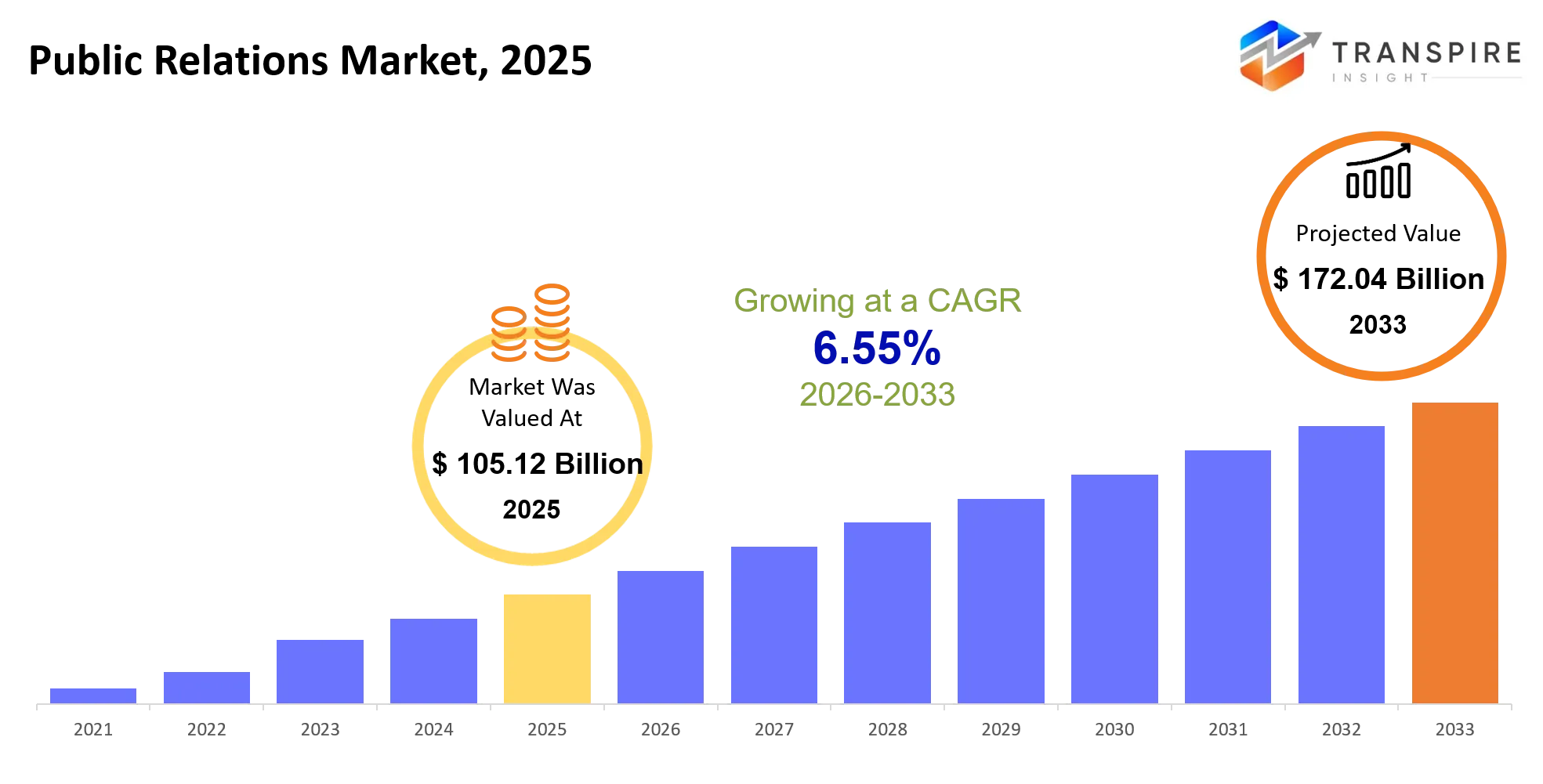
As per Transpire Insight Analysis, the Public Relations Market size is estimated at USD 105.12 billion in 2025 and is anticipated to reach USD 172.04 billion by 2033, growing at a CAGR of 6.55% from 2026 to 2033.
The public relations market around the world supports companies in taking care of their reputation, talking to people who matter, answering worries and staying on good terms with reporters, customers, investors and government groups. In the past three to five years, the business has moved past old ways of getting media coverage and has started using complete communication plans that mix online tools, listening to what people say on social media, working with people who have a lot of influence and looking at data about reputation. A big change has been using intelligence and tools that use data to watch what people think and make better plans for campaigns. The spread of information fast online, complaints, and big problems that companies face have also made it more important to have quick and effective communication. These changes make companies want to spend money on PR services to keep their brand trusted and to talk better through all kinds of channels. As companies go into places and talk to more different people, agencies that give good advice, use digital methods and show results are more likely to keep customers for a long time.
Public Relations Market Size & Forecast:
- Market Size 2025: USD 105.12 Billion
- Expected Market Value (2033): USD 172.04 Billion
- Forecast CAGR (2026–2033): 6.55%
- Leading Region in 2025: North America
- Fastest Growing Region: Asia Pacific
- Key Company Profiles: Edelman, Weber Shandwick, FleishmanHillard, BCW, Burson, Ketchum, MSL Group, Ogilvy PR, Hill & Knowlton, Brunswick Group, APCO Worldwide, FTI Consulting, WPP, Dentsu, Havas PR
Key Market Insights:
The public relations market around the world is moving on from old publicising approaches to integrated reputation management, where capabilities in the digital sphere are playing an increasing role.
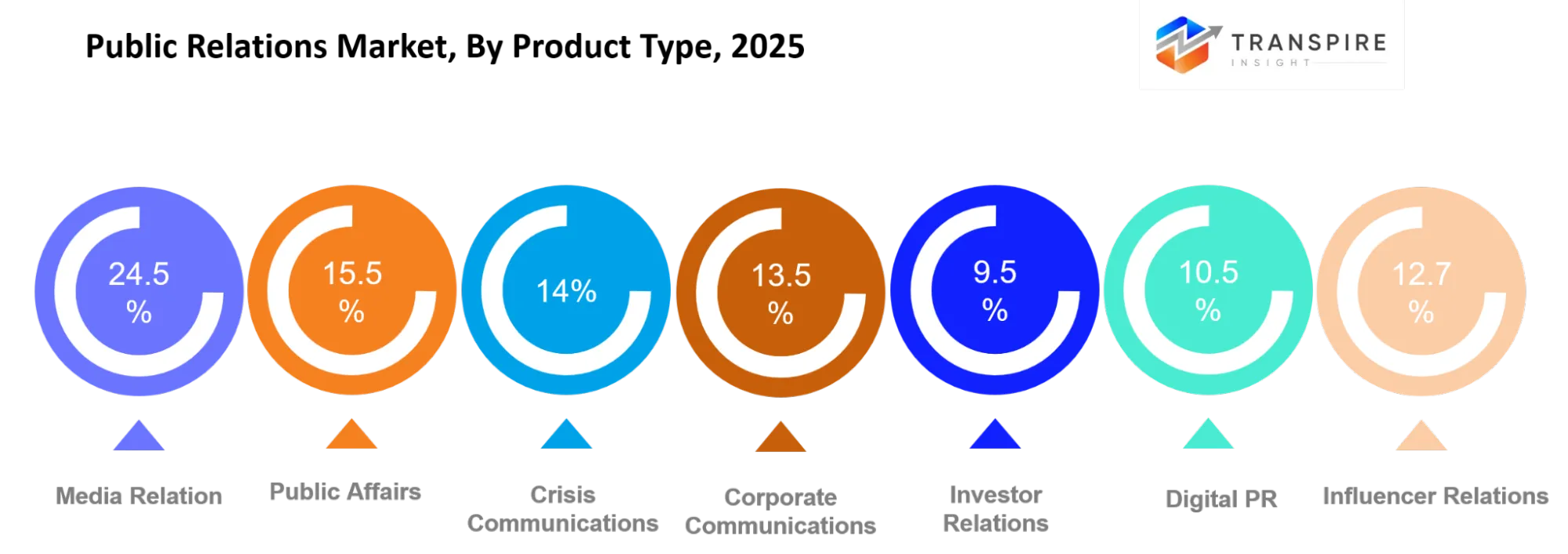
- Media Relations constitutes 24.5% of the service market, signifying the persistent relevance of relationships with journalists and reliable media coverage.
- Public affairs account for 15.5% of the market as companies have to deal with policy changes and government affairs.
- Crisis communications holds 14.0% of service activity, underlining the business importance of dealing with reputational risks.
- Digital PR holds 10.5% of the market and is expected to increase at a 9.8% CAGR, based on the market statistics provided.
- Investor relations take up 9.5% of the service portfolio as companies aim to communicate with shareholders consistently and clearly.
- Influencer relations make up 7.0% of the service market as creators become more involved in brand communication.
- Event management takes up 5.5% of the service market with organisations relying on conferences, product launches, and experiential campaigns to build direct relations.
What are the Key Drivers, Restraints, and Opportunities in the Public Relations Market?
Drivers
There has been increased pressure for the protection of reputation. This is due to social media, news and user generated content (UGC). It can easily lead to rapid distribution of any grievances or false information among consumers. It leads to an increase in demand for services in the areas of media monitoring and analysis, crisis management, and also execution of smooth communication strategy. With the growth of digital platforms, there will be growth opportunities in agencies providing linkage between media and internet visibility.
Restraint
Quantifying the direct economic return of a PR campaign continues to prove problematic. It's not always the case that increased media coverage, favourable sentiment and reputation will have an immediate impact on sales and revenues. Clients may find it tough to benchmark the results of one agency against another or justify awarding further contracts, especially in times of tighter marketing budgets. Smaller companies may find it hard to budget for dedicated teams, monitoring platforms and knowledgeable consultants.
Opportunity
AI, analytics and digital reputation management can help agencies become more efficient and offer higher-value services. AI can flag issues in real time, and using audiences can enhance targeting for campaigns. For example, agencies that service clients entering the Asia Pacific region can leverage knowledge of regional media plus multilingual monitoring and digital activation capabilities. Development of these capabilities will add scale to service offering, expand service retention and generate revenue from analytics-driven advisory services.
|
Driver |
Relative Impact on Growth (%) |
Geographic Relevance |
Impact Timeline |
Demand Strength |
Growth Mechanism (5–10 words) |
Key Beneficiaries (5–10 words) |
Major Constraint (5–10 words) |
|
Rising demand for corporate reputation and crisis management |
26% |
North America, Europe, Asia Pacific |
Short-term (≤2 years) |
High |
Strengthens brand trust and manages reputational risks. |
PR agencies, multinational corporations, crisis communication specialists. |
Negative publicity spreads rapidly across digital platforms. |
|
Expansion of digital PR, social media, and influencer communications |
23% |
North America, Asia Pacific, Europe |
Short-term (≤2 years) |
High |
Expands audience reach through digital and social channels. |
Digital PR agencies, influencer networks, brands, media platforms. |
Platform algorithm changes reduce campaign visibility. |
|
Adoption of artificial intelligence and data-driven PR analytics |
19% |
North America, Europe, Asia Pacific |
Medium-term (2–4 years) |
High |
Automates media monitoring, sentiment analysis, and campaign measurement. |
PR technology vendors, agencies, corporate communication teams. |
Data privacy concerns and inaccurate AI-generated insights. |
|
Increasing corporate investment in integrated and communications |
17% |
North America, Europe, Middle East |
Medium-term (2–4 years) |
High |
Integrates public relations with marketing and corporate messaging. |
PR networks, communication consultants, multinational businesses. |
Budget cuts and difficulty measuring campaign returns. |
|
Growing demand for ESG, sustainability, and regulatory communications |
15% |
Europe, North America, Asia Pacific |
Long-term (≥4 years) |
Medium |
Communicates sustainability commitments and evolving regulatory disclosures. |
ESG communication firms, sustainability consultants, corporate clients. |
Greenwashing allegations and inconsistent reporting standards. |
|
Total |
100% |
Global |
— |
— |
— |
— |
— |
What Has the Impact of Artificial Intelligence Been on the Public Relations Market ?
AI has changed how public relations specialists conduct story research, track media coverage, create content, and analyse communication campaigns. Summarising news stories, identifying the right journalists, categorising online mentions, and analyzing public sentiment are some of the tasks that can be done faster by AI. AI is also useful in helping PR professionals to draft press releases, create different versions of content, prepare for interviews, and create targeted messages. Human professionals are tasked with ensuring the accuracy of information and approval. Predictive analytics will allow public relations agencies to identify changes in the way people talk about issues, emerging reputational risks, and topics that might become popular.The use of AI comes with its drawbacks. These include the cost of implementation, integration with other systems, the need to protect personal data, and inaccurate analysis of data. AI may fail to understand sarcasm, cultural contexts, or language used in certain regions. It is also likely to create content that makes claims that lack evidence or makes brand communication boring.
Instance
In September 2025, PR Newswire launched Amplify to facilitate content creation and distribution for PR teams through various channels. This news showcases how AI can be used to enhance the content creation, media reach, and campaign performance in the public relations industry.
Key Market Trends
The PR industry is changing toward measurable, digital communication rather than media placements. More often, agencies are now expected to deliver services that integrate technology, relationships, and strategic advice.
- Media pitching is getting more targeted as newsrooms experience resource shortages.
- The agencies are now relying more on research and story angles to make their pitches more relevant to the media.
- The companies are customising press release content for use on the company's website, social media channels, and other digital media.
- Research and writing by the use of artificial intelligence is becoming more widespread in the communication process.
- PR professionals are using automation to increase speed and productivity without losing human control of the process.
- Agencies are monitoring online conversations to enable them to respond more quickly. Influencer marketing is changing to focus on credibility and audience fit.
Public Relations Market Segmentation
By Service Type
Media relations leads the market with a market share of 24.5% on the basis of the ongoing relevance of press exposure and engagement of journalists. Public affairs contribute 15.5%, and crisis communications contribute 14.0%, while corporates have invested in the issue of reputation management. Corporate communications contribute 13.5%, while digital PR services make up 10.5%, which are also expected to grow at a CAGR of 9.8%. Investor relations contribute 9.5%, while influencer relations contribute 7.0%, and event management contributes 5.5%.
By Organisation Size
Large firms and international corporations generally use a multi-area/departmental/multifunctional PR approach, which is in demand for comprehensive long-term agency collaborations. SME/ startup firms tend to use outsourced or project-based communications services, since managing a full internal PR department is costly. Governments and public authorities, and institutions need transparent communication, while nongovernmental non-profit organisations are interested in public awareness campaigns and gaining the trust of different groups of stakeholders. Affordable service packages and cost-effective digital tools will enable the agencies to respond to the needs of organisations with various available budgets and needs.
By End User
The BFSI sector uses PR to create and develop corporate credibility and financial news. The IT and telecom sectors mainly cover technology press release and product launch or introduction of new products. The healthcare sector is concerned with the proper communication of messages to the right audience and gaining their confidence. Media coverage and influencer relations are used by the retail and consumer goods sector for building brand awareness. Corporate communication and industry-specific media relations are used by manufacturing organizations. The government, media and entertainment (GME) sector needs specialized skills and a properly honed sectoral approach.
By Communication Channel
Traditional media still lend credibility and access to audiences at large, while social media offers more rapid engagement and reputation management. Websites and press releases are still best managed by organisations for official announcements, and email remains useful for direct communication with target audiences. Events enable businesses to establish personal connections, and podcasts and video sharing sites are new outlets for product and corporate communication. As audiences become more multimedia-oriented, agencies will probably coordinate their communication efforts so that the core information is adapted to each channel.
By Deployment
The benefits of using an agency or outsourced PR include: In-house PR teams offer some control over the production of content and internal communications. Outsourcing to a service provider introduces users to a professional and experienced service, along with useful media contacts. Different office-to-agency setups include outsourced services and mixed hybrid approaches - often suitable for businesses with fluctuating loads. Contract options include retainer agreements for continuous information flow and project-based services for specific and singular campaigns. Subscription-based solutions and consultancy options give further flexibility.
By Application
Brand management ensures uniform positioning and increased brand awareness; reputation management builds trust and credibility. Product launch activities include coordinated product announcement media relations. Crisis communications provides support for reacting to unpredictable situations; stakeholder engagement minimises loss of community, customer and partner relationships; employee communications helps organise employees; investor relations strengthens relationships with investors; public affairs achieves engagement with policy-makers and political institutions.
What are the Key Use Cases Driving the Public Relations Market?
The media relations use case is needed because there is a necessity to have credible media coverage, access to suitable journalists, and effective communication of news about the company. There are product launches, interviews with the CEO, company milestones, and research releases as some of how companies communicate value to the audience and build their reputation and brand. There are some emerging applications, which are digital reputation management, influencer relations, investor relations, and employee communications. For retail and consumer goods companies, there are some applications in which the value of creator relations can be used for audience targeting. For BFSI and healthcare companies, the importance of accuracy, creating trust, and education is more important. Other emerging applications include AI-based issue monitoring, misinformation management, and communication planning according to audience sentiment. Manufacturing companies can use these capabilities for communicating news about their operations, whereas governments and nonprofits can improve their public information campaigns.
|
Report Metrics |
Details |
|
Market size value in 2025 |
USD 105.12 Billion |
|
Market size value in 2026 |
USD 110.35 Billion |
|
Revenue forecast in 2033 |
USD 172.04 Billion |
|
Growth rate |
CAGR of 6.55% from 2026 to 2033 |
|
Base year |
2025 |
|
Historical data |
2021 - 2024 |
|
Forecast period |
2026 - 2033 |
|
Report coverage |
Revenue forecast, competitive landscape, growth factors, and trends |
|
Regional scope |
United States; Canada; Mexico; United Kingdom; Germany; France; Italy; Spain; Denmark; Sweden; Norway; China; Japan; India; Australia; South Korea; Thailand; Brazil; Argentina; South Africa; Saudi Arabia; United Arab Emirates |
|
Key company profiled |
Edelman, Weber Shandwick, FleishmanHillard, BCW, Burson, Ketchum, MSL Group, Ogilvy PR, Hill & Knowlton, Brunswick Group, APCO Worldwide, FTI Consulting, WPP, Dentsu, Havas PR |
|
Customization scope |
Free report customization (country, regional & segment scope). Avail customized purchase options to meet your exact research needs. |
|
Report Segmentation |
Service Type (Media Relations, Public Affairs, Crisis Communications, Corporate Communications, Investor Relations, Digital PR, Influencer Relations, Event Management)Organization Size (Large Enterprises, SMEs, Startups, Government Organizations, Nonprofits, Multinational Corporations, Public Institutions, Others)End User (BFSI, IT & Telecom, Healthcare, Retail, Manufacturing, Government, Media & Entertainment, Consumer Goods)Communication Channel (Traditional Media, Social Media, Websites, Email, Press Releases, Events, Podcasts, Video Platforms)Deployment (In-House, Outsourced, Hybrid, Retainer-Based, Project-Based, Subscription-Based, Consultancy, Others)Application (Brand Management, Reputation Management, Product Launches, Crisis Management, Stakeholder Engagement, Employee Communications, Investor Communications, Public Affairs) |
Which Regions are Driving the Public Relations Market Growth?
North American
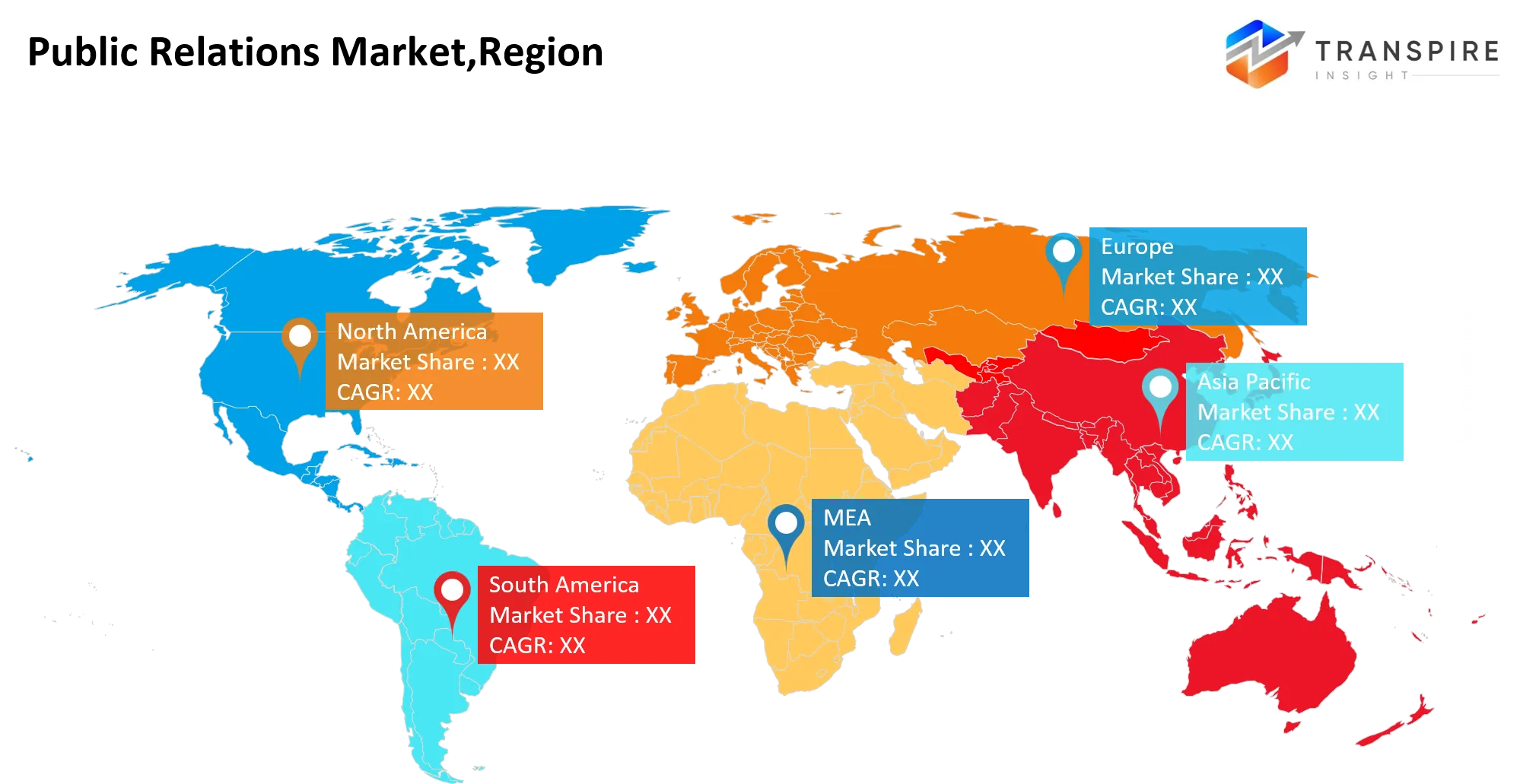
The North American region leads in market share, accounting for 38.5% due to the presence of an extensive PR agency network, corporate headquarters, media companies, and digital communication service providers. The development of mature client markets leads to the necessity of reputation management, crisis management, investor relations, and integrated communication strategies. The environment in the region provides good grounds for investing in analytics, media monitoring, and advisory services, which will help to stay leading in the PR market.
In June 2026, Edelman reinforced its communications leadership: Edelman hired Kenny Gold as the Chief Creator Officer in acknowledgement of the increasing significance of creator-based communication and integrated brand communication in public relations. The event is an indication of the need for broadening communications skills in a major PR market.
Europe
Europe represents 29.0% of the market share. The different languages, media landscape, and regulations in this region make it necessary to have a localised communication strategy. This region requires corporate communication, public affairs, and stakeholder engagement in various countries due to its mature businesses and institutions. PR firms that have regional knowledge and international capabilities can fill this gap.
In June 2026, Ballou, a strategic communications company, was recognised as one of Europe’s top PR agencies while announcing the extension of its portfolio by adding more U.S.-based brands. This event is an indication of the need for cross-media relations, reputation management, and communication services among companies entering European markets.
Asia Pacific
The Asia Pacific region contributes a 20.8% share and is considered the fastest-growing region with a forecasted CAGR of 8.9%. With increasing digitisation, rising business activity, and growing consumer marketplaces, there are emerging needs for communication from businesses within the region and even from multinational businesses. New markets have needs for culturally appropriate messaging, multilingual media relations, and digital reputation management. There are opportunities for firms that merge regional knowledge with technology-enabled campaigns.
In May 2026, Cision introduced its AI-powered communications platform known as PR Newswire Amplify in the Asia Pacific region. This platform helps in developing communications campaigns, creating content, distributing news, and analysing performance through a single platform. This event is an indication of the need for technology-driven PR campaigns, media distribution, and communications in the region.
Who are the Key Players in the Public Relations Market and how do they compete?
In the public relations market, providers include international communication networks, advisory companies and industry/region-specific agencies. These differentiating factors include reputation, expertise, media contacts, geographical presence, digital services, as well as the ability to tie the results of communication efforts back to organisational goals. Hence, competition does not solely rely on pricing, but relies on special expertise and client relationships as well. Edelman differentiates itself via corporate reputation, research-driven communication and integrated stakeholder communication. Its trust barometer and other advisory services facilitate strategy based on public opinion and the ability to communicate in difficult settings. The international network enables campaigning for multinationals. Weber Shandwick offers an integrated suite of public relations, creative communications and digital services that allows clients to orchestrate their campaigns. It provides differentiation through earned media, audience engagement and strategic advisory services. The network helps serve multinational clients.FleishmanHillard offers competitive services in the realm of strategic communications, public affairs and specialised stakeholder communications. The company's advisory model is valuable for organisations facing regulatory, corporate or reputational issues.
Public Relations Market companies
- Edelman
- Weber Shandwick
- FleishmanHillard
- BCW
- Burson
- Ketchum
- MSL Group
- Ogilvy PR
- Hill & Knowlton
- Brunswick Group
- APCO Worldwide
- FTI Consulting
- WPP
- Dentsu
- Havas PR
|
Company |
Est. Revenue Share Range |
Key Offerings |
Strategic Positioning |
Geographic Strength |
Technology Focus |
|
Edelman |
Estimated 0.8–1.2% |
Corporate reputation, media relations, crisis communications, public affairs |
Independent leader focused on trust and reputation |
North America, Europe, Asia Pacific |
AI-driven intelligence and reputation analytics |
|
Burson |
Estimated 0.7–1.1% |
Corporate communications, crisis management, public affairs, brand communications |
Integrated communications for complex corporate challenges |
North America, Europe, Asia Pacific |
AI-enabled insights and integrated communications platforms |
|
The Weber Shandwick Collective |
Estimated 0.6–1.0% |
Media relations, influencer engagement, corporate reputation, digital communications |
Earned-first campaigns combining creativity and measurable impact |
North America, Asia Pacific, Europe |
AI acceleration and performance analytics |
|
FleishmanHillard |
Estimated 0.5–0.9% |
Reputation management, public affairs, crisis communications, corporate affairs |
Advisory-led differentiation for reputation-sensitive organizations |
North America, Europe, Asia Pacific |
Digital intelligence and data-supported communications |
|
FGS Global |
Estimated 0.4–0.8% |
Financial communications, M&A advisory, crisis management, stakeholder engagement |
Specialist leadership in financial and strategic communications |
North America, Europe, Asia Pacific |
Stakeholder intelligence and digital monitoring |
|
Real Chemistry |
Estimated 0.4–0.8% |
Healthcare PR, medical communications, health marketing, scientific storytelling |
Healthcare-focused communications and marketing specialization |
North America, Europe, Asia Pacific |
Health data analytics and AI-enabled insights |
|
mc Group |
Estimated 0.4–0.7% |
International PR, public affairs, destination marketing, corporate communications |
Multilingual communications and international market localization |
Europe, Asia Pacific, Middle East & Africa |
Digital campaigns and cross-market media analytics |
|
Brunswick Group |
Estimated 0.4–0.7% |
Corporate advisory, financial communications, crisis advisory, stakeholder relations |
Premium strategic counsel for boards and senior executives |
North America, Europe, Asia Pacific |
Stakeholder analysis and reputation-risk intelligence |
|
Ketchum |
Estimated 0.3–0.6% |
Brand PR, corporate communications, influencer marketing, crisis communications |
Creative-led brand storytelling and audience engagement |
North America, Europe, Asia Pacific |
Social listening and AI-assisted content analytics |
|
MSL |
Estimated 0.3–0.6% |
Strategic communications, public affairs, influencer relations, brand PR |
Integrated communications with creative and digital expertise |
Europe, North America, Asia Pacific |
Digital engagement analytics and AI-assisted campaign planning |
Recent Development News
In February 2026, Publicis Groupe signed a deal to buy out 160over90. The agency was expected to be merged with Publicis Sports and backed up by the data, technology, and media strength of the company. Such a deal demonstrates the ongoing convergence of public relations, sports marketing, culture, and data-based branding
In July 2025, PR Newswire launched its Multichannel Amplification solution for AI-enabled search and content discovery. Its core is to spread content on various channels and improve its visibility via authoritative online sources. This move is another step of the industry that is trying to link press release distribution with search changes.
What Strategic Insights Define the Future of the Public Relations Market?
The future of the PR market will revolve around successful integration of the agency’s work on reputation management, digital presence, and results. It will not suffice to be good in traditional media relations since clients may demand a wider range of solutions covering social media platforms, websites, influencers, and other channels owned by the client. The use of AI and analytics will help in speeding up things and detecting potential problems, but technology will not become an alternative to established relationships and common sense. One unseen challenge involves relying on automatic content and sentiment analysis too much. Incorrect information or a generic approach to messaging may damage your credibility, especially when it comes to dealing with corporate issues. One upcoming trend is merging AI monitoring with local experience, multilingual communication, and reputation consultancy. Especially in the rapidly growing Asia Pacific market. Providers need to be ready to invest in safe technologies, employee training, and editorial processes, as well as develop a reporting system that correlates communications activity with clients’ goals.
Service Type
- Media Relations
- Public Affairs
- Crisis Communications
- Corporate Communications
- Investor Relations
- Digital PR
- Influencer Relations
- Event Management
Organization Size
- Large Enterprises
- SMEs
- Startups
- Government Organizations
- Nonprofits
- Multinational Corporations
- Public Institutions
- Others
End User
- BFSI
- IT & Telecom
- Healthcare
- Retail
- Manufacturing
- Government
- Media & Entertainment
- Consumer Goods
Communication Channel
- Traditional Media
- Social Media
- Websites
- Press Releases
- Events
- Podcasts
- Video Platforms
Deployment
- In-House
- Outsourced
- Hybrid
- Retainer-Based
- Project-Based
- Subscription-Based
- Consultancy
- Others
Application
- Brand Management
- Reputation Management
- Product Launches
- Crisis Management
- Stakeholder Engagement
- Employee Communications
- Investor Communications
- Public Affairs
Frequently Asked Questions
Find quick answers to common questions.
The public relations market size was valued at USD 105.12 billion in 2025 and is poised to reach USD 172.04 billion by 2033, expanding at a 6.55% CAGR.
Key segments for the public relations market are Service Type (Media Relations, Public Affairs, Crisis Communications, Corporate Communications, Investor Relations, Digital PR, Influencer Relations, Event Management)Organization Size (Large Enterprises, SMEs, Startups, Government Organizations, Nonprofits, Multinational Corporations, Public Institutions, Others)End User (BFSI, IT & Telecom, Healthcare, Retail, Manufacturing, Government, Media & Entertainment, Consumer Goods)Communication Channel (Traditional Media, Social Media, Websites, Email, Press Releases, Events, Podcasts, Video Platforms)Deployment (In-House, Outsourced, Hybrid, Retainer-Based, Project-Based, Subscription-Based, Consultancy, Others)Application (Brand Management, Reputation Management, Product Launches, Crisis Management, Stakeholder Engagement, Employee Communications, Investor Communications, Public Affairs)
Growth is primarily driven by increasing demand for brand reputation management, rising adoption of digital PR and social media campaigns, growing importance of influencer marketing, demand for crisis communication services, and the need for transparent communication between businesses and their stakeholders.
The market is led by major manufacturers including Edelman, Weber Shandwick, FleishmanHillard, BCW, Burson, Ketchum, MSL Group, Ogilvy PR, Hill & Knowlton, Brunswick Group, APCO Worldwide, FTI Consulting, WPP, Dentsu, Havas PR
North America’s share in the public relations market is 38.5%, and this is facilitated by the presence of top PR firms, corporate communication expenditure, media networks, and the use of digital PR, influencer marketing, and crisis communications.
Opportunities in the public relations business globally include a growing need for digital PR, influencer marketing, AI media monitoring, reputation management, crisis management, and data-driven PR. Opportunities are created by the expanding use of social media and growing need for brand visibility.
- Edelman
- Weber Shandwick
- FleishmanHillard
- BCW
- Burson
- Ketchum
- MSL Group
- Ogilvy PR
- Hill & Knowlton
- Brunswick Group
- APCO Worldwide
- FTI Consulting
- WPP
- Dentsu
- Havas PR
About the Authors

Mayur Shinde
I am Mayur Shinde, a Senior Research Analyst at Transpire Insight, specializing in the Automotive & Transportation and Information & Communication Technology (ICT) Industry. My work focuses on analyzing emerging market trends, technological advancements, competitive landscapes, and industry developments to deliver accurate, data-driven insights. I am passionate about transforming complex market information into clear, actionable content that helps businesses, professionals, and decision-makers stay informed and make confident strategic decisions.

Chakradhar Khansole
Chakradhar serves as the Research Director at Transpire Insight, bringing over 8 years of experience in technology, innovation, and strategic market intelligence. He specializes in transforming complex market data into actionable business insights that enable organizations to make informed, growth-oriented decisions. Recognized for his strategic vision and analytical expertise, Chakradhar leads high-impact research initiatives, delivering comprehensive market assessments, competitive intelligence, and forward-looking industry analysis.
Recently Published Reports
-
Apr 2026
3D Optical Profiler Market
3D Optical Profiler Market Size, Share & Analysis Report By Type (Desktop 3D Optical Profiler, and Portable 3D Optical Profiler), By Technology (Confocal Technology, and White Light Interference), By End-Use Industry (Manufacturing, Research Institutions, Automotive, Aerospace and Defense, Medical Devices, and Other), and Geography (North America, Europe, Asia-Pacific, Middle East and Africa, South and Central America), 2021 - 2031
-
Apr 2026
Depth Sensor Market
Depth Sensor Market Size, Share & Analysis Report By Type (Infrared Depth Sensors, Time-of-Flight (ToF) Sensors, Stereo Vision Sensors, Structured Light Sensors, Ultrasonic Depth Sensors), By Application (Automotive, Robotics, Gaming, Consumer Electronics, Industrial Automation, Healthcare, Security & Surveillance, Others), By End Users (Automotive Manufacturers, Consumer Electronics Companies, Healthcare Providers, Industrial Companies, Security Agencies, Gaming Companies, Robotics Companies, Others), and Geography (North America, Europe, Asia-Pacific, Middle East and Africa, South and Central America), 2021 – 2031
-
Apr 2026
Digital Manufacturing Market
Digital Manufacturing Market Size, Share & Analysis Report By Component (Hardware, Software, and Services), By Technology (Robotics, 3D Printing, Internet of Things (IoT), and Others), By Application (Automotive and Transportation, Aerospace and Defense, Consumer Electronics, Industrial Machinery, and Others), By Process Type (Computer-Based Designing, Computer-Based Simulation, Computer 3D Visualization, Analytics, and Others), and Geography (North America, Europe, Asia-Pacific, Middle East and Africa, South and Central America), 2021 – 2031
-
Apr 2026
Digital Visa Services Market
Digital Visa Services Market Size, Share & Analysis Report By Type (Individual Travelers, Group Travelers), By Application (Tourism, Business Travel, Others), and Geography (North America, Europe, Asia-Pacific, Middle East and Africa, South and Central America), 2021 – 2031