

Private Banking Market Summary:
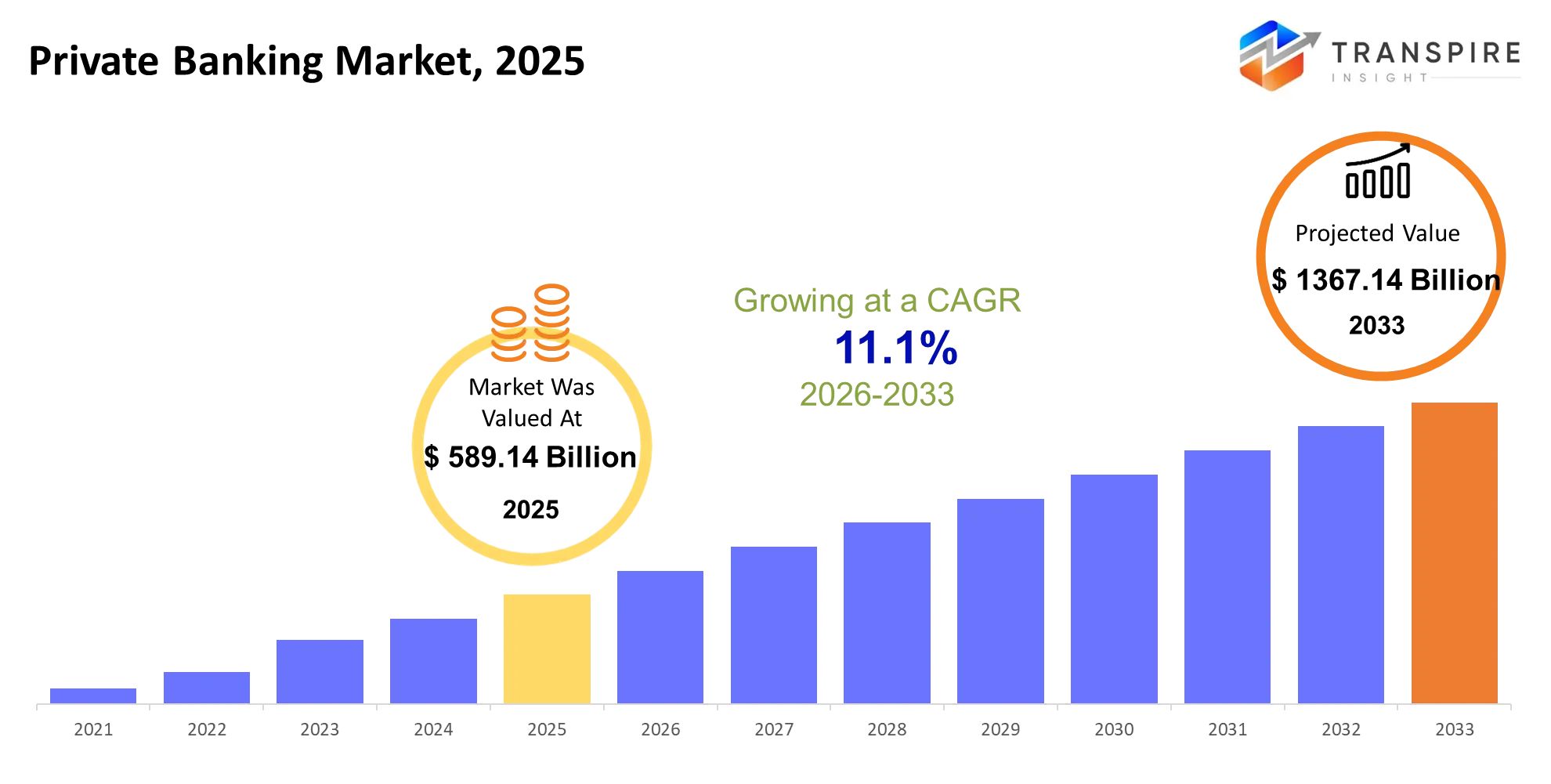
As per Transpire Insight Analysis, the Private Banking Market size is estimated at USD 589.14 billion in 2025 and is anticipated to reach USD 1367.14 billion by 2033, growing at a CAGR of 11.1% from 2026 to 2033.
Private banking provides services to individuals, families, entrepreneurs and family offices. It supports them in managing, protecting, and passing on their wealth using investment advice, portfolio management, lending, tax planning, exchange and estate services. In the past three to five years, the way this service is delivered has changed. It has shifted from being based on personal relationships to a hybrid model. This new model combines bankers with digital tools, data analytics, and faster access to alternative investments. A big change in the industry has been the increased use of technology. It allows banks to make investment choices more personal and to handle tasks faster. The market has also seen growing interest in markets building wealth across borders and more complicated plans for passing on assets. As a result, banks are now adding tools and artificial intelligence to help with advice. They are also improving how clients get into asset opportunities.The growth in this area makes sense when you look at cause and effect. As wealth becomes more complex, clients need specialised guidance. At the same time, better technology reduces the friction in delivering services. This means banks can serve clients efficiently in different regions and markets.
Private Banking Market Size & Forecast:
- Market Size 2025: USD 589.14 Billion
- Expected Market Value (2033): USD 1367.14 Billion
- Forecast CAGR (2026–2033): 11.1%
- Leading Region in 2025: North America
- Fastest Growing Region: Asia Pacific
- Key Company Profiles: UBS, JPMorgan Chase, Morgan Stanley, Goldman Sachs, Bank of America, Citigroup, HSBC, BNP Paribas, Credit Suisse, Deutsche Bank, Julius Baer, Pictet Group, Lombard Odier, Standard Chartered, Barclays
Key Market Insights:
The private banking industry is shifting towards integrated wealth management, where Wealth Management and alternative investments are becoming popular among wealthy individuals.
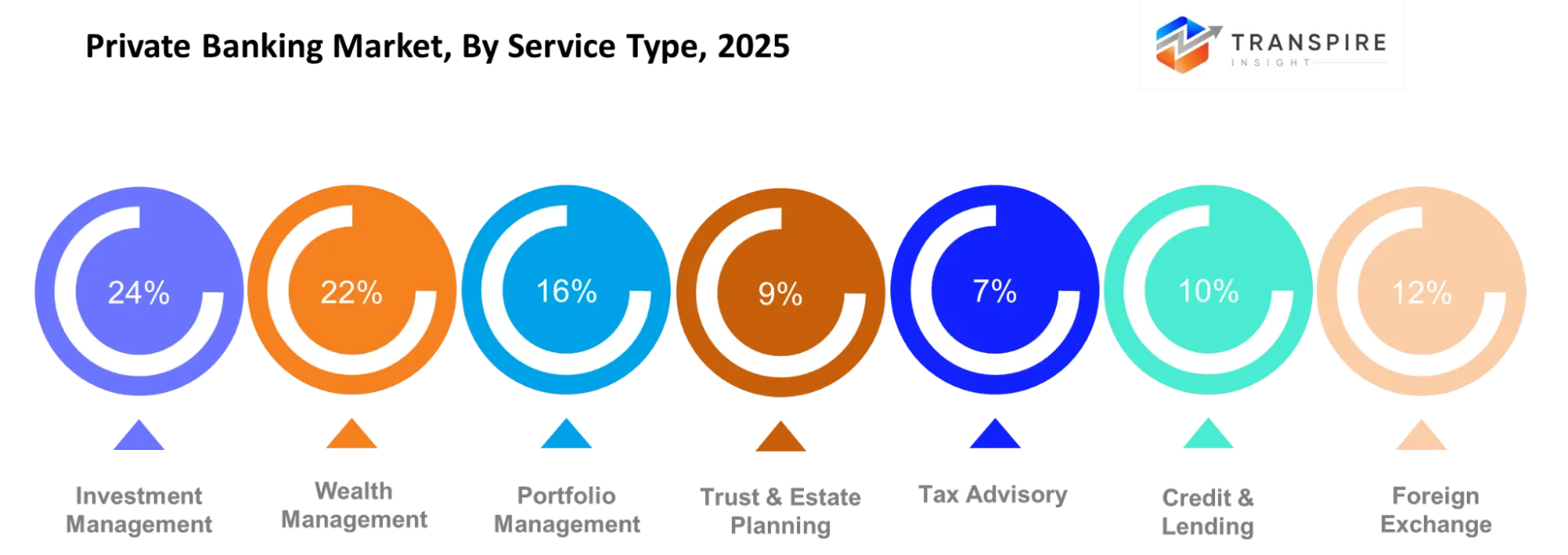
- Investment Management accounts for 24.00% due to high demand for professional asset allocation. UBS is increasing the use of technological investment and portfolio analysis.
- Wealth Management accounts for 22.00% in terms of the service offering breakdown. More banks are integrating human advisory along with AI-enabled investment research.
- Portfolio Management stands at 16.00% and is fuelled by the high demand for continuous asset allocation and risk assessment. UBS is enhancing private market analytics through MSCI.
- Credit & Lending constitutes 10.00% and supports the liquidity and financing requirements of wealthy clients. More banks are integrating credit/lending with overall wealth strategy development.
- Trust & Estate Planning accounts for 9.00% and is fueled by intergenerational wealth transfer demands. More private banks are providing estate and family wealth management solutions.
- Tax Advisory accounts for 7.00% and is fueled by the demand for efficient wealth structures. Digital analytics are helping banks to coordinate tax and investment solutions.
What are the Key Drivers, Restraints, and Opportunities in the Private Banking Market?
Drivers:
The growth in the international private banking industry has been fueled by complexities associated with wealth creation and the requirement of managing assets in both the public and private domains. Entrepreneurs, business owners and wealthy families need to integrate solutions related to investment, financing, and taxation as well. One of the triggers of this trend is the development of investment opportunities in private markets and the resultant desire of banks to increase access to alternate investments. This may improve revenue due to the aggregation of services and wealth by the customers.
Restraints:
The cost and intricacies involved in servicing high net worth clients from various geographies. The private bank needs to comply with various rules regarding compliance, cybersecurity, suitability, tax reporting, etc., while offering personal service. Such requirements make up the cost structure that cannot be eliminated using digital platforms.
Opportunities:
Opportunity is the integration of digital advisory tools and relationship managers. AI-driven research and portfolio analysis, along with customer-service automation, will help to eliminate repetitive tasks and enable the advisor to deal with more complex issues. Expansion in other regions is another area where there is scope for growth, especially in Asia Pacific, where new wealth is being generated by entrepreneurs and families.
What Has the Impact of artificial intelligence on the Private Banking Market?
AI will revolutionise the field of private banking in that it helps relationship managers to make better decisions based on vast amounts of market and client information much quicker. Banks use AI to summarise research, detect portfolio signals, prepare clients and automate service routines. For instance, HSBC has implemented Wealth Intelligence, which is a generative AI ecosystem that analyses and summarises research reports and external news from over 10,000 data sources, and is also planning to implement product screening and investment discussions. Predictive tools can help identify shifting client needs, risks in the portfolio and opportunities in advance of the meeting of the advisor with the client. That is why operational efficiency increases because the information collection process does not take a lot of time and allows the relationship manager to focus on investment strategies, financing and family wealth issues. AI needs substantial investments in security, data management, governance and model oversight. Accuracy, explainability and confidentiality are still important due to the confidential nature of private banking transactions and the value of their clients. That is why human advisers are still necessary.
Instance:
In August 2025, J.P. Morgan Private Bank identified the increasing importance of AI-driven software in revolutionising the conventional financial services industry, especially via "services as software." The innovation shows how AI is opening up new avenues of investment for the private banking clientele, as well as how financial and advisory services are being delivered.
Key Market Trends:
Private banking is evolving from its traditional relationship approach to one that integrates technology with personal advice. Access to private markets, wealth creation in the region, and more complicated family finances influence bank service development.
- The advice hybrid model gains popularity as banks merge the work of relationship managers with the use of technology and analytics.
- Alternative investments gain in importance as wealthy individuals seek diversification from stocks and bonds.
- Private market infrastructure gets better due to the use of technology to discover, analyse, compare, and invest in private assets more transparently.
- AI research helps advisors to save time on gathering and analysing information from the markets.
- Cross-border wealth management gains relevance as businesspeople and wealthy families accumulate wealth, companies, and investments in other countries.
- Digital private banking develops services like client onboarding, portfolio management, reporting, and client communication.
- Family office-like services get more popular as wealthy families need comprehensive services in investing, succession, estate planning, tax planning, and philanthropy.
Private Banking Market Segmentation
By Service Type:
Wealth Management is the leading segment at 34.80%, whereas Alternative Investments represents the fastest-growing segment with a 9.40% CAGR. Specific percentages for service type segments provided in the brief include 24.00% for Investment Management, 22.00% for Wealth Management, 16.00% for Portfolio Management, 9.00% for Trust & Estate Planning, 7.00% for Tax Advisory, 10.00% for Credit & Lending, 5.00% for Foreign Exchange and 7.00% for Alternative Investments. It needs to be reconciled why there is an inconsistency between the overall percentage of 34.80% and 22.00% for Wealth Management before finalising the report. Demand for service in the market is becoming more and more focused on integrated services which include investments advisory, portfolio creation, credit/lending and wealth management.
By Client Type:
Private banking services cater to High-Net-Worth Individuals (HNWIs), Ultra-High-Net-Worth Individuals (UHNWIs), Family Offices, Entrepreneurs, Business Owners, Institutional and Corporate Clients. These HNW/UHNW clients remain an important segment since there is still a need for specialized investment solutions, liquidity solutions and wealth conservation planning. The need for financing, succession planning, and private market products comes about due to the fact that entrepreneurs and business owners have linked their business finance with personal finance. Family offices will require a more integrated offering involving portfolio management, estate planning, tax planning, reporting, and intergenerational wealth transfer among other areas.
By Wealth Range:
The market targets clients from USD 1 – 5 million, USD 5 – 10 million, USD 10 – 50 million, USD 50 – 100 million, USD 100 – 500 million, above USD 500 million, and Billionaires. The lower wealth ranges offer scope for scalable private banking and digital advisory services, whereas the higher wealth ranges demand customised solutions and access to more complex investments. On the higher side, clients will also need allocation in private markets, customised financing, estate planning, and family office facilities. This would provide a business model wherein client complexity increases with wealth.
By Investment Type:
Private banks providers include Equities, Fixed Income, Mutual Funds, ETFs, Real Estate, Private Equity, Hedge Funds and Commodities. The traditional public market products remain a source of liquidity and portfolio stability, and the real estate, private equity, hedge funds and commodities can offer diversification and exposure to other return drivers. As alternative investments become more significant, banks have opportunities to grow their relationship with and access to private markets and related advisory solutions. The future competition will be based on the successful integration of traditional portfolio construction and access to less liquid investments.
By Banking Model:
The types of banking models that exist are Full Service Private Banking, Pure Private Banking, Universal Bank, Boutique Banking, Family Office Banking, Digital Private Banking, and Hybrid Bank. The use of integration of wealth management and lending, Investment banking and financial services in full-service and universal banking could be of help. The type of advice and relationship that the customers want could make it possible for the boutique service providers to compete. The type of advice and relationship that the clients demand could make it possible for the boutique service providers to compete. In the age of personal relationships, clients are requiring access to reporting, portfolio and communication through digital mode.
By Channel:
Private Banking services are offered through Relationship Managers, Bank Branches, Digital Platform, Mobile Banking, Wealth Advisors, Family Offices and Private Banking Centres. As a result, the role of the relationship manager is still vital, especially when it comes to making complex financial decisions, as well as maintaining confidentiality and providing long-term guidance for wealthy clients. Digital platforms and mobile banking are gaining share of importance in everyday account access, reporting and communication and family offices and private banking centres serve clients with more advanced needs. In the future, the channel mix will thus likely be a mix of humans and digital tools, not a replacement of one for the other.
What are the Key Use Cases Driving the Private Banking Market?
The use case is wealth management integration, which is directly related to the leading Wealth Management category of the market. Private banks provide their clients with investment advisory services, portfolio management, financing, tax and estate planning, all through one relationship. Applications become more diverse in the categories of high-net-worth and ultra-high-net-worth individuals, family offices and entrepreneurs. Portfolio management, fixed income investment, forex, alternative investments, and access to private markets are gaining traction as ways to diversify the portfolio and safeguard its value in the long term. The new use cases include AI-powered investment research, digital customer onboarding, automation of portfolio management and financial advice. These relate to digital private banking, the relationship manager channel and alternative investments. They allow banks to share timely information but maintain human oversight in making crucial financial decisions.
|
Report Metrics |
Details |
|
Market size value in 2025 |
USD 589.14 Billion |
|
Market size value in 2026 |
USD 654.54 Billion |
|
Revenue forecast in 2033 |
USD 1367.14 Billion |
|
Growth rate |
CAGR of 11.1% from 2026 to 2033 |
|
Base year |
2025 |
|
Historical data |
2021 - 2024 |
|
Forecast period |
2026 - 2033 |
|
Report coverage |
Revenue forecast, competitive landscape, growth factors, and trends |
|
Regional scope |
United States; Canada; Mexico; United Kingdom; Germany; France; Italy; Spain; Denmark; Sweden; Norway; China; Japan; India; Australia; South Korea; Thailand; Brazil; Argentina; South Africa; Saudi Arabia; United Arab Emirates |
|
Key company profiled |
UBS, JPMorgan Chase, Morgan Stanley, Goldman Sachs, Bank of America, Citigroup, HSBC, BNP Paribas, Credit Suisse, Deutsche Bank, Julius Baer, Pictet Group, Lombard Odier, Standard Chartered, Barclays |
|
Customization scope |
Free report customization (country, regional & segment scope). Avail customized purchase options to meet your exact research needs. |
|
Report Segmentation |
Service Type (Investment Management, Wealth Management, Portfolio Management, Trust & Estate Planning, Tax Advisory, Credit & Lending, Foreign Exchange, Alternative Investments); Client Type (High-Net-Worth Individuals, Ultra-High-Net-Worth Individuals, Family Offices, Entrepreneurs, Business Owners, Institutional Clients, Corporate Executives); Wealth Range (USD 1–5 Million, USD 5–10 Million, USD 10–50 Million, USD 50–100 Million, USD 100–500 Million, Above USD 500 Million, Billionaires); Investment Type (Equities, Fixed Income, Mutual Funds, ETFs, Real Estate, Private Equity, Hedge Funds, Commodities); Banking Model (Full-Service Private Banking, Pure Private Banking, Universal Banking, Boutique Private Banking, Family Office Banking, Digital Private Banking, Hybrid Banking); Channel (Relationship Managers, Bank Branches, Digital Platforms, Mobile Banking, Wealth Advisors, Family Offices, Private Banking Centers) |
Which Regions are Driving the Private Banking Market Growth?
North America:
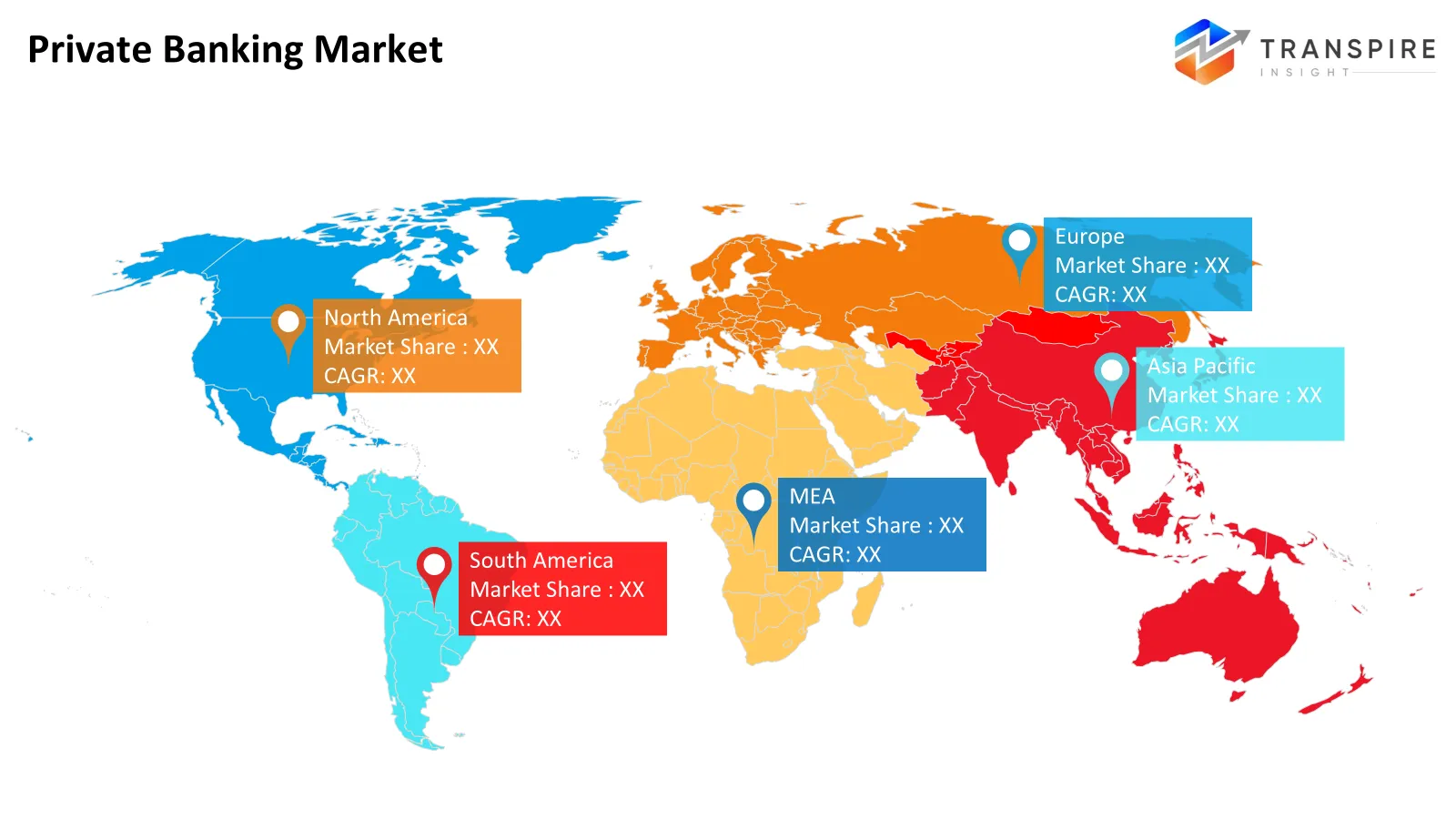
North America is the leader in the private banking sector globally with a regional share of 39.50%, as it has a well-developed financial environment, capital markets and high-net-worth individuals. There are mature private banks, investment managers, family offices, and digital wealth platforms in the region. High demand for alternative investments and services for managing portfolios add to this advantage. All these factors provide the region with a wide platform to cater to wealth management needs both domestic and international.
In September 2026, J.P. Morgan named Nelle Miller and William Sinclair as Co-CEOs of its U.S. Private Bank, enhancing its leadership in U.S. private banking activities. Its U.S. Private Bank manages more than USD 2.4 trillion in client assets and operates out of 57 offices employing more than 5,500 professionals, underscoring the magnitude and ongoing development of private banking services in North America. J.P. Morgan Private Bank
Europe:
Europe constitutes 32.00% of the market and is a stable private banking region due to wealth management institutions already present there along with the long tradition of serving multigenerational wealthy families. In comparison to North America, Europe has more cross-border wealth structures, succession planning and private banking centres. Europe's stability is further ensured by mature advisory networks and the demand for trust, estate and tax-related services.
In May 2026, UBS reported that 67% of European family offices surveyed planned to adjust their strategic asset allocation in 2026, reflecting continued demand for advanced investment and wealth-management solutions in the European private banking market
Asia Pacific:
Asia Pacific accounts for 21.00% of the total and is the fastest-growing region in terms of growth rate at 8.90%. The growth seen lately is attributed to wealth creation, increased entrepreneurial activities, increased investor involvement and the development of onshore private banking. Banks are extending their local reach and connecting Asian clients to international investments. Thus, the Asia-Pacific region presents a huge growth opportunity, especially for those offering wealth management solutions.
In January 2025,HSBC launched a new wealth centre in Kuala Lumpur for Premier Elite and high-net-worth clients and extended its wealth centres network in mainland China.
https://www.hsbc.com/investors/investing-in-hsbc/hsbc-shareholder-updates/2025/march
Who are the Key Players in the Private Banking Marketand how do they compete?
The competition in the private banking market is moving from the conventional relationship approach to platform-based approaches that involve investment expertise, alternative market access, technology and regional knowledge. Big players compete through developing client relationships, broadening alternative portfolios and using technology for better advisory services, while regional firms compete through their local market knowledge and niche client segments. What helps HSBC compete is technology, international connectivity and personalisation. HSBC's partnerships with Google Cloud aim to speed up the development of AI technologies in wealth management, while expanding private banking services in Asia helps with regional growth. As for Goldman Sachs, it follows a competitive strategy based on investments, where private wealth combines with asset management and private markets. The acquisition of Industry Ventures gives better access to entrepreneurs in the tech field.
Private Banking Market companies
- UBS
- JPMorgan Chase
- Morgan Stanley
- Goldman Sachs
- Bank of America
- Citigroup
- HSBC
- BNP Paribas
- Credit Suisse
- Deutsche Bank
- Julius Baer
- Pictet Group
- Lombard Odier
- Standard Chartered
- Barclays
Recent Development News
- In June 2026, HSBC has entered into a multi-year collaboration with Google Cloud for faster AI adoption in its banking business operations, with some of the early applications being the use of AI in hyper-personalised wealth management advice and AI tools for relationship managers. The project is expected to deliver over 200 new AI use cases within two years. Original HSBC source https://www.hsbc.com/news-and-views/news/media-releases/2026/hsbc-and-google-cloud-announce-transformative-ai-banking-partnership
- In May 2025, UBS teamed up with General Atlantic through a strategic collaboration in private credit investment. This partnership helps improve access to direct lending and other private-credit services, especially in relation to increasing use of alternative investments in private banking. https://www.ubs.com/global/it/media/display-page-ndp/en-20250506-strategic-partnership.html
What Strategic Insights Define the Future of the Private Banking Market?
The future of private banking is in a hybrid model where relationship managers will be supported by AI, digitisation, and access to private markets. The best banks will no longer compete on their investment offerings; they will compete on how well they can offer their clients an integrated service of portfolio management, lending, succession planning, taxation and cross-border services. The risk of technological innovation is that it could result in cybersecurity risks, increased data governance and modelling risks if banks adopt AI faster than their risk management systems allow for. The opportunity of technological innovation is that it will allow for greater personalisation and provide more sophisticated services to the growing wealth pools in Asia Pacific. Therefore, banks must focus on investing in AI technologies that are secure, integration of client data and advisor tools without losing control of humans over critical decisions. The trick here is to invest in technologies that promote trust and increase advisor effectiveness.
Key Segmentations are:
Service Type
- Investment Management
- Wealth Management
- Portfolio Management
- Trust & Estate Planning
- Tax Advisory
- Credit & Lending
- Foreign Exchange
- Alternative Investments
Client Type
- High-Net-Worth Individuals
- Ultra-High-Net-Worth Individuals
- Family Offices
- Entrepreneurs
- Business Owners
- Institutional Clients
- Corporate Executives
Wealth Range
- USD 1–5 Million
- USD 5–10 Million
- USD 10–50 Million
- USD 50–100 Million
- USD 100–500 Million
- Above USD 500 Million
- Billionaires
Investment Type
- Equities
- Fixed Income
- Mutual Funds
- ETFs
- Real Estate
- Private Equity
- Hedge Funds
- Commodities
Banking Model
- Full-Service Private Banking
- Pure Private Banking
- Universal Banking
- Boutique Private Banking
- Family Office Banking
- Digital Private Banking
- Hybrid Banking
Channel
- Relationship Managers
- Bank Branches
- Digital Platforms
- Mobile Banking
- Wealth Advisors
- Family Offices
- Private Banking Centers
By Regional Analysis
North America
- US
- Canada
- Mexico
Europe
- Germany
- UK
- France
- Italy
- Spain
- Russia
- Rest of Europe
Asia Pacific
- China
- Japan
- India
- South Korea
- Australia
- Rest of Asia Pacific
South America
- Brazil
- Argentina
- Rest of South America
Middle East & Africa
- UAE
- Saudi Arabia
- Qatar
- South Africa
- Rest of the Middle East & Africa
Frequently Asked Questions
Find quick answers to common questions.
The private banking market size was valued at USD 589.14 Billion in 2025 and is poised to reach USD 1367.14 Billion by 2033, expanding at an 11.1% CAGR.
Key segments for the private banking market are Service Type (Investment Management, Wealth Management, Portfolio Management, Trust & Estate Planning, Tax Advisory, Credit & Lending, Foreign Exchange, Alternative Investments); Client Type (High-Net-Worth Individuals, Ultra-High-Net-Worth Individuals, Family Offices, Entrepreneurs, Business Owners, Institutional Clients, Corporate Executives); Wealth Range (USD 1–5 Million, USD 5–10 Million, USD 10–50 Million, USD 50–100 Million, USD 100–500 Million, Above USD 500 Million, Billionaires); Investment Type (Equities, Fixed Income, Mutual Funds, ETFs, Real Estate, Private Equity, Hedge Funds, Commodities); Banking Model (Full-Service Private Banking, Pure Private Banking, Universal Banking, Boutique Private Banking, Family Office Banking, Digital Private Banking, Hybrid Banking); Channel (Relationship Managers, Bank Branches, Digital Platforms, Mobile Banking, Wealth Advisors, Family Offices, Private Banking Centers).
Growth is primarily driven by increased use of digital and AI banking services, increasing use of alternative investments, and growing requirements for tax planning and estate management.
The market is led by major manufacturers including UBS, JPMorgan Chase, Morgan Stanley, Goldman Sachs, Bank of America, Citigroup, HSBC, BNP Paribas, Credit Suisse, Deutsche Bank, Julius Baer, Pictet Group, Lombard Odier, Standard Chartered, and Barclays.
North America accounts for 39.50% of the private banking market owing to its high concentration of HNWIs, strong financial institutions, wealth management technology, and robust investment infrastructure.
- UBS
- JPMorgan Chase
- Morgan Stanley
- Goldman Sachs
- Bank of America
- Citigroup
- HSBC
- BNP Paribas
- Credit Suisse
- Deutsche Bank
- Julius Baer
- Pictet Group
- Lombard Odier
- Standard Chartered
- Barclays
About the Authors

Mayur Shinde
I am Mayur Shinde, a Senior Research Analyst at Transpire Insight, specializing in the Automotive & Transportation and Information & Communication Technology (ICT) Industry. My work focuses on analyzing emerging market trends, technological advancements, competitive landscapes, and industry developments to deliver accurate, data-driven insights. I am passionate about transforming complex market information into clear, actionable content that helps businesses, professionals, and decision-makers stay informed and make confident strategic decisions.

Chakradhar Khansole
Chakradhar serves as the Research Director at Transpire Insight, bringing over 8 years of experience in technology, innovation, and strategic market intelligence. He specializes in transforming complex market data into actionable business insights that enable organizations to make informed, growth-oriented decisions. Recognized for his strategic vision and analytical expertise, Chakradhar leads high-impact research initiatives, delivering comprehensive market assessments, competitive intelligence, and forward-looking industry analysis.
Recently Published Reports
-
Apr 2026
3D Optical Profiler Market
3D Optical Profiler Market Size, Share & Analysis Report By Type (Desktop 3D Optical Profiler, and Portable 3D Optical Profiler), By Technology (Confocal Technology, and White Light Interference), By End-Use Industry (Manufacturing, Research Institutions, Automotive, Aerospace and Defense, Medical Devices, and Other), and Geography (North America, Europe, Asia-Pacific, Middle East and Africa, South and Central America), 2021 - 2031
-
Apr 2026
Depth Sensor Market
Depth Sensor Market Size, Share & Analysis Report By Type (Infrared Depth Sensors, Time-of-Flight (ToF) Sensors, Stereo Vision Sensors, Structured Light Sensors, Ultrasonic Depth Sensors), By Application (Automotive, Robotics, Gaming, Consumer Electronics, Industrial Automation, Healthcare, Security & Surveillance, Others), By End Users (Automotive Manufacturers, Consumer Electronics Companies, Healthcare Providers, Industrial Companies, Security Agencies, Gaming Companies, Robotics Companies, Others), and Geography (North America, Europe, Asia-Pacific, Middle East and Africa, South and Central America), 2021 – 2031
-
Apr 2026
Digital Manufacturing Market
Digital Manufacturing Market Size, Share & Analysis Report By Component (Hardware, Software, and Services), By Technology (Robotics, 3D Printing, Internet of Things (IoT), and Others), By Application (Automotive and Transportation, Aerospace and Defense, Consumer Electronics, Industrial Machinery, and Others), By Process Type (Computer-Based Designing, Computer-Based Simulation, Computer 3D Visualization, Analytics, and Others), and Geography (North America, Europe, Asia-Pacific, Middle East and Africa, South and Central America), 2021 – 2031
-
Apr 2026
Digital Visa Services Market
Digital Visa Services Market Size, Share & Analysis Report By Type (Individual Travelers, Group Travelers), By Application (Tourism, Business Travel, Others), and Geography (North America, Europe, Asia-Pacific, Middle East and Africa, South and Central America), 2021 – 2031