
Pipeline Maintenance Services Market Summary:
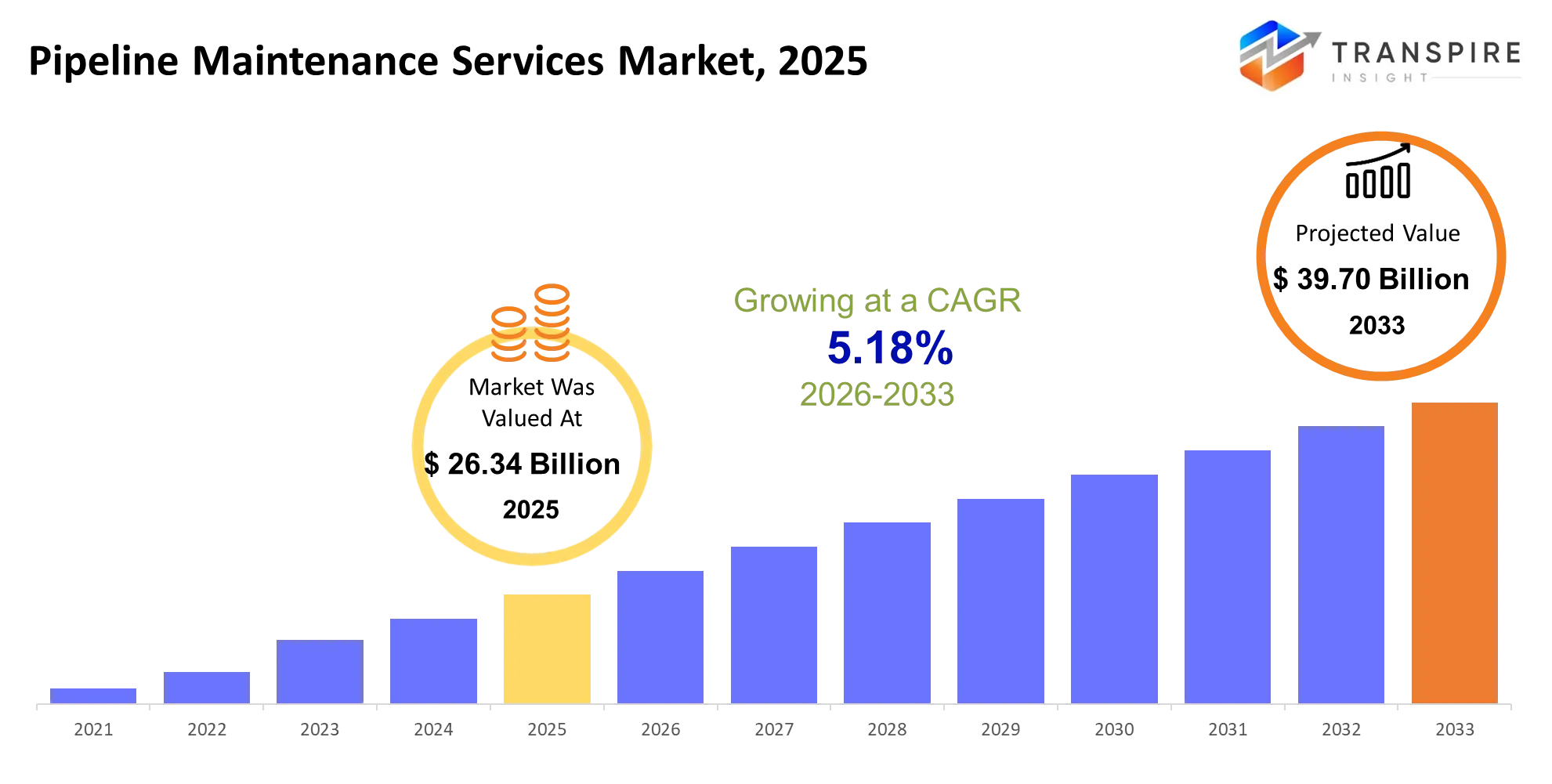
As per Transpire Insight, the Pipeline Maintenance Services Market size is estimated at USD 26.34 billion in 2025 and is anticipated to reach USD 39.70 billion by 2033, growing at a CAGR of 5.18% from 2026 to 2033.
The Pipeline maintenance services support people who operate oil, gas, water, wastewater and industrial pipelines, keeping them safe and reliable. These services include checking, cleaning, fixing, stopping rust and watching the condition of the pipes. Over the past three to five years, there has been a gradual shift from the traditional maintenance process to data-driven maintenance in the industry. In this process, there is use of devices that are inserted into the pipes, digital documentation and risk-based planning. Ageing pipes, growing demands, leak prevention and costs associated with issues have made it essential to detect issues early. Rust, cracks or any issue with pressure can be detected early and help in planning solutions to prevent small issues from becoming major problems. New devices also make it easy to conduct tests on difficult-to-reach parts of the pipeline. Analysis of the data also helps in prioritising the work that needs to be done. Therefore, the market is improving since efforts are being made to protect existing pipes, prevent downtime and extend the lifespan of the pipes. This is taking place alongside investment in water and energy transportation infrastructure.
Pipeline Maintenance Services Market Size & Forecast:
- Market Size 2025: USD 26.34 Billion
- Expected Market Value (2033): USD 39.70 Billion
- Forecast CAGR (2026–2033): 5.18%
- Leading Region in 2025: North America
- Fastest Growing Region: Asia Pacific
- Key Company Profiles: Baker Hughes, SLB, Halliburton, ROSEN, T.D. Williamson, NDT Global, Intero Integrity, Applus+, MISTRAS Group, Oceaneering, Quest Integrity, Acuren, Team, STATS Group, T.D. Williamson
Key Market Insights:
The market is shifting from reactive repairs to condition-based maintenance, whereby the results of inspections guide decision-making regarding the prioritisation of the assets that require attention.
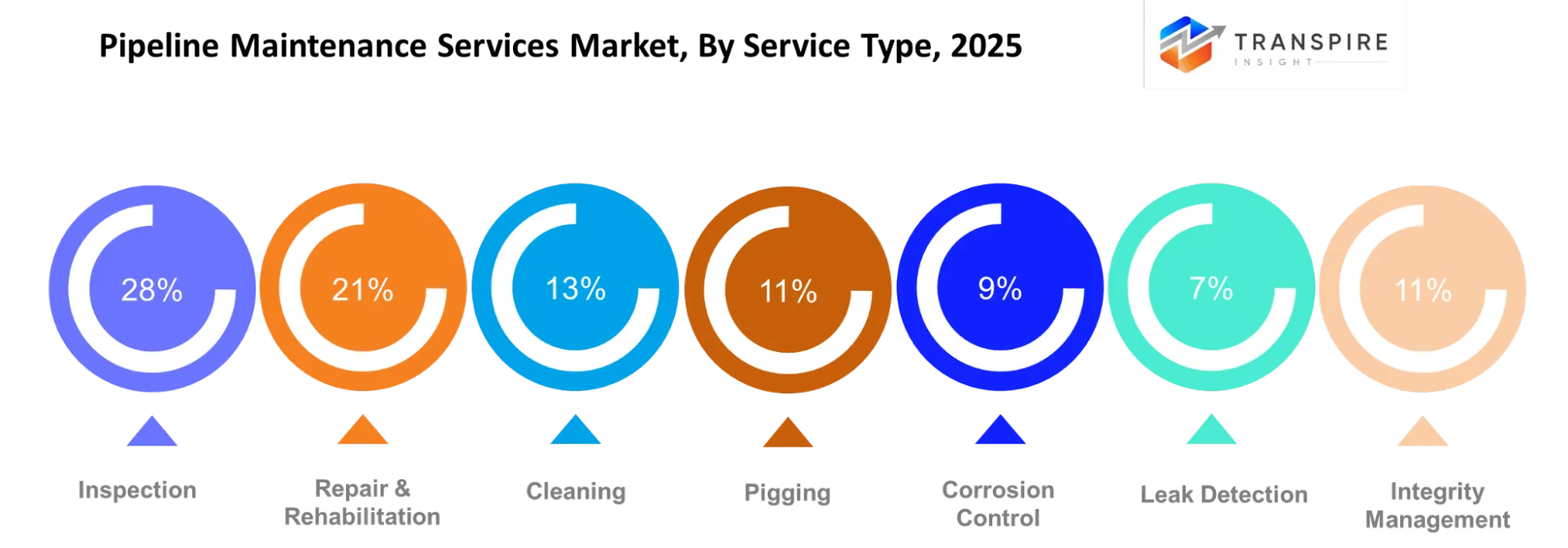
- Maintenance services are the largest market category at 54.0% of the estimates supplied, due to the need to maintain older assets and to prevent surprises.
- Inspection is responsible for 28.0% of the total share of service distribution, where companies like ROSEN and NDT provide technologies that enable operators to detect issues and act.
- Repair and rehabilitation constitute 21.0% of the total share, and facilitate restoration of pipeline functionality without replacement of the whole line where possible.
- Cleaning represents 13.5% of the total share of service distribution, and there is an increasing trend of conducting cleaning in conjunction with inspections by operators.
- Pigging constitutes 11.0% of the total share of service distribution, where dedicated technologies help in inspecting segments of pipelines in different operating conditions.
- Corrosion control represents 9.0% of the total share of service distribution, keeping the role of protective coating and cathodic protection in pipelines alive.
What are the Key Drivers, Restraints, and Opportunities in the Pipeline Maintenance Services Market?
Drivers:
The market drivers are Prevention of failure that could lead to service interruption in energy transmission, water distribution, and industrial processes, drives the pipeline maintenance process. Corrosion, ground movement, impact from outside, and material degradation may lead to leaks and weak spots if not detected. Pipeline operators are cutting down on expenses and risk by concentrating their inspection, cleaning, repair, and integrity management on early detection of any anomaly and spending on maintenance on those at risk. Compliance with regulations, environmental damage, water loss, safety, and unplanned downtime are some other reasons why preventive maintenance is necessary.
Restraints:
Operating costs and technical difficulties still pose significant challenges. Offshore, subsea, urban and cross-country lines could need unique tools, permissions and traffic management, along with a knowledgeable team in the field. Decent pipeline drawings and reactive maintenance logs might make it difficult to determine the right tools or estimate the cost of repairs, while limited budgets can cause delays to preventative work even when operators understand their future needs.
Opportunities:
Opportunities are the linkage of inspection data to technology such as predictive analytics, remote monitoring and risk-based maintenance planning. Water companies can use condition data to guide rehabilitation programmes, while oil and gas companies can use in-line inspection results with their digital integrity management system. Suppliers that can bring technical skills and local support teams will be best placed to offer a more targeted service with less downtime and avoidance of false alarms.
|
Driver |
Relative Impact on Growth (%) |
Geographic Relevance |
Impact Timeline |
Demand Strength |
Growth Mechanism (5–10 words) |
Key Beneficiaries (5–10 words) |
Major Constraint (5–10 words) |
|
Aging pipeline infrastructure and rehabilitation needs |
28% |
North America, Europe, Asia-Pacific |
Short-term |
High |
Aging assets require recurring inspection, repair, and rehabilitation. |
Pipeline operators, integrity specialists, repair service providers. |
Difficult access and extensive repairs increase maintenance costs. |
|
Stringent pipeline safety regulations and integrity management |
24% |
North America, Europe, India |
Short-term |
High |
Compliance mandates increase inspection, monitoring, and corrective maintenance. |
Inspection contractors, integrity consultants, pipeline operators. |
Regulatory complexity and compliance costs constrain smaller operators. |
|
Expansion of oil, gas, water, and wastewater pipeline networks |
20% |
Asia-Pacific, Middle East, North America |
Medium-term |
High |
Expanding networks create recurring maintenance and inspection requirements. |
Pipeline contractors, utility operators, maintenance service providers. |
Project delays and funding limitations postpone maintenance contracts. |
|
Adoption of advanced inspection, AI, and predictive maintenance technologies |
16% |
North America, Europe, Asia-Pacific |
Medium-term |
High |
Smart inspection identifies defects before costly pipeline failures. |
Technology vendors, digital service providers, pipeline operators. |
High implementation costs and legacy-system integration challenges. |
|
Environmental protection, leak prevention, and energy-transition infrastructure |
12% |
Europe, North America, Asia-Pacific |
Long-term |
Medium |
Leak prevention and repurposing increase specialized integrity service demand. |
Environmental monitoring firms, engineering providers, pipeline operators. |
Uncertain project economics and material compatibility requirements. |
|
Total |
100% |
Global |
— |
— |
— |
— |
— |
What Has the Impact of Artificial Intelligence Been on the Pipeline Maintenance Services Market?
AI technologies enhance the maintenance of pipelines by providing assistance to operators in analysing inspection data, detecting anomalies in operation, and identifying segments that should be repaired. AI-based systems can integrate in-line inspection data, ultrasonic testing data, pressure data and previous maintenance data to indicate possible corrosion, cracking and leaking. This helps operators focus on critical assets rather than following a fixed schedule for inspection. Predictive analytics based on automation also reduces the time needed to process the vast amount of inspection data and develop a schedule for repairs. Predictive analytics can analyse previous defects and operating conditions to predict possible degradation. This allows operators to plan their maintenance activities, allocate field crews and order spare parts. Implementation of these technologies is difficult due to the need for reliable data, integration with pipeline management systems and specialist supervision. Faulty sensor readings and lack of maintenance data can impact the quality of predictions
Instance:
In November 2025, ADNOC Gas works with AIQ and Gecko Robotics to enhance maintenance processes in the industry. This partnership will leverage the power of AI technology and robotics to help with inspections, identify maintenance requirements, minimise unscheduled downtime, and extend asset life. This example demonstrates how AI can be used to enhance pipeline maintenance.
https://www.adnocgas.ae/en/news-and-media/press-releases/2025/gecko-aiq
Key Market Trends:
The industry trend is shifting to condition-based maintenance, where inspection results dictate when and where repair crews operate. The competitive edge is no longer in data collection but in using that information to make effective maintenance decisions.
- The scheduling of inspections is shifting from the traditional calendar basis to risk-based schedules based on the condition of the pipelines, their service record and failure consequences.
- Inspection instruments are becoming advanced enough to help professionals detect corrosion, cracks, dents and variations in pipeline geometry.
- Wireless and robotic inspection systems are increasing access to difficult areas and reducing time spent accessing pipelines.
- Digital integrity management systems are integrating geographic information systems, inspection reports and maintenance records for enhanced collaboration between engineers and field crews.
- Service agreements now combine cleaning, inspection, condition assessment and repairs for a more comprehensive picture of the condition of pipelines.
- Water utilities are increasingly focusing on leak localisation and condition assessment due to ageing infrastructure and lack of water resources.
Pipeline Maintenance Services Market Segmentation
By service type:
Maintenance services constitute the highest category in the dataset given at 54.0%, whereas inspection is the highest single itemized category at 28.0%. The category that includes repair and rehabilitation consists of 21.0% and cleaning constitutes 13.5%. Pigging takes up 11.0%, corrosion protection takes up 9.0% and leak detection makes up 7.5%, integrity management makes up 6.0% and monitoring makes up 4.0% of the total pipeline assets activities. These services have varying impacts depending on the stage at which the pipeline assets are handled through inspection, maintenance and monitoring of its performance in future.
By pipeline type:
Oil and gas pipelines continue to be relevant due to the need to prevent disruptions that may affect production, transportation and deliveries of the product. Water and wastewater pipelines constitute a unique growth area. Maintenance services for chemical and petrochemical pipelines should be tailored to the nature of transported products and the potential risk of corrosion.
By deployment:
Onshore operations can be carried out via routes that are easier to access and there are clearly defined field service providers while offshore and subsea operations require specialized tools, strategic planning and sometimes even specialized vessels. Each type of facility, be it cross country, near shore, urban and industrial, has specific challenges ranging from access to permits. Service providers who understand these challenges can plan their projects more effectively and control costs.
By technology:
Smart Pigging, Ultrasonic Testing, and Magnetic Flux Leakage are applied for pipeline inspections and non-destructive testing. Radiography and Hydrotesting take care of inspection or validation concerns while Cathodic Protection is employed to fight external corrosion. Digital monitoring and inter-connected data systems can be other means of obtaining advantage in terms of data since it allows the operator to access inspection data as well as operating history and any defects found.
By application:
The oil and gas industry continues to be one of the main users of pipeline maintenance and integrity services; however, the water supply and waste utilities have specific requirements related to the control of leakage, reliability of the services, and budgets for service restoration. Pipelines are essential for the transportation of chemicals, power and utilities, and mining industry products. The maintenance of equipment is directly connected with production and the minimisation of risks associated with it. The transportation of hydrogen and carbon dioxide is a novel application, which would require special pipeline inspections and repairs.
By end users:
The oil companies, gas companies, and independent pipeline operators have requirements for the throughput protection, obligations and risk management. The utilities and municipalities have the requirements for network reliability, detection of leaks, and the cost of the replacement of aging infrastructure. The chemical companies and other industries need the maintenance solutions, which would be consistent with the process safety and production schedules, while the government organisations may influence the demand through regulation, infrastructure investments, and oversight. Among the various customer categories, the service providers can distinguish themselves through their technical expertise, regional presence in the field, reporting and maintenance recommendations.
What are the Key Use Cases Driving the Pipeline Maintenance Services Market?
The use case is preventive maintenance of operating pipelines. Operators use inspection, cleaning, corrosion protection and repairs to minimise failures and prolong the life of assets. In-line inspections and non-destructive testing aid in identifying any defects before the need for major intervention arises. The applications are increasingly moving into water and wastewater networks. Leak detection and condition assessment are used by utilities to minimise losses and plan for rehabilitation of their pipelines. The same is done by oil, gas, chemical and petrochemical companies to ensure flow of products and prevent shutdowns. New use cases are integrity assessment of pipelines carrying hydrogen and carbon dioxide. Other new applications include digital monitoring between inspections and robotic assessment of inaccessible pipework.
|
Report Metrics |
Details |
|
Market size value in 2025 |
USD 26.34 Billion |
|
Market size value in 2026 |
USD 27.88 Billion |
|
Revenue forecast in 2033 |
USD 39.70 Billion |
|
Growth rate |
CAGR of 5.18% from 2026 to 2033 |
|
Base year |
2025 |
|
Historical data |
2021 - 2024 |
|
Forecast period |
2026 - 2033 |
|
Report coverage |
Revenue forecast, competitive landscape, growth factors, and trends |
|
Regional scope |
United States; Canada; Mexico; United Kingdom; Germany; France; Italy; Spain; Denmark; Sweden; Norway; China; Japan; India; Australia; South Korea; Thailand; Brazil; Argentina; South Africa; Saudi Arabia; United Arab Emirates |
|
Key company profiled |
Baker Hughes, SLB, Halliburton, ROSEN, T.D. Williamson, NDT Global, Intero Integrity, Applus+, MISTRAS Group, Oceaneering, Quest Integrity, Acuren, Team, STATS Group, T.D. Williamson |
|
Customization scope |
Free report customization (country, regional & segment scope). Avail customized purchase options to meet your exact research needs. |
|
Report Segmentation |
Service Type (Inspection, Repair & Rehabilitation, Cleaning, Pigging, Corrosion Control, Leak Detection, Integrity Management, Monitoring)Pipeline Type (Oil Pipelines, Gas Pipelines, Water Pipelines, Wastewater Pipelines, Chemical Pipelines, Petrochemical Pipelines, CO₂ Pipelines, Hydrogen Pipelines)Deployment (Onshore, Offshore, Subsea, Nearshore, Cross-Country, Urban, Industrial, Others)Technology (Smart Pigging, Ultrasonic Testing, Magnetic Flux Leakage, Radiography, Hydrotesting, Cathodic Protection, Digital Monitoring, Others)Application (Oil & Gas, Water Supply, Wastewater, Chemicals, Power & Utilities, Mining, Hydrogen, CO₂ Transport)End User (Oil Companies, Gas Companies, Pipeline Operators, Utilities, Municipalities, Chemical Companies, Government Agencies, Industrial Companies) |
Which Regions are Driving the Pipeline Maintenance Services Market Growth?
North America:
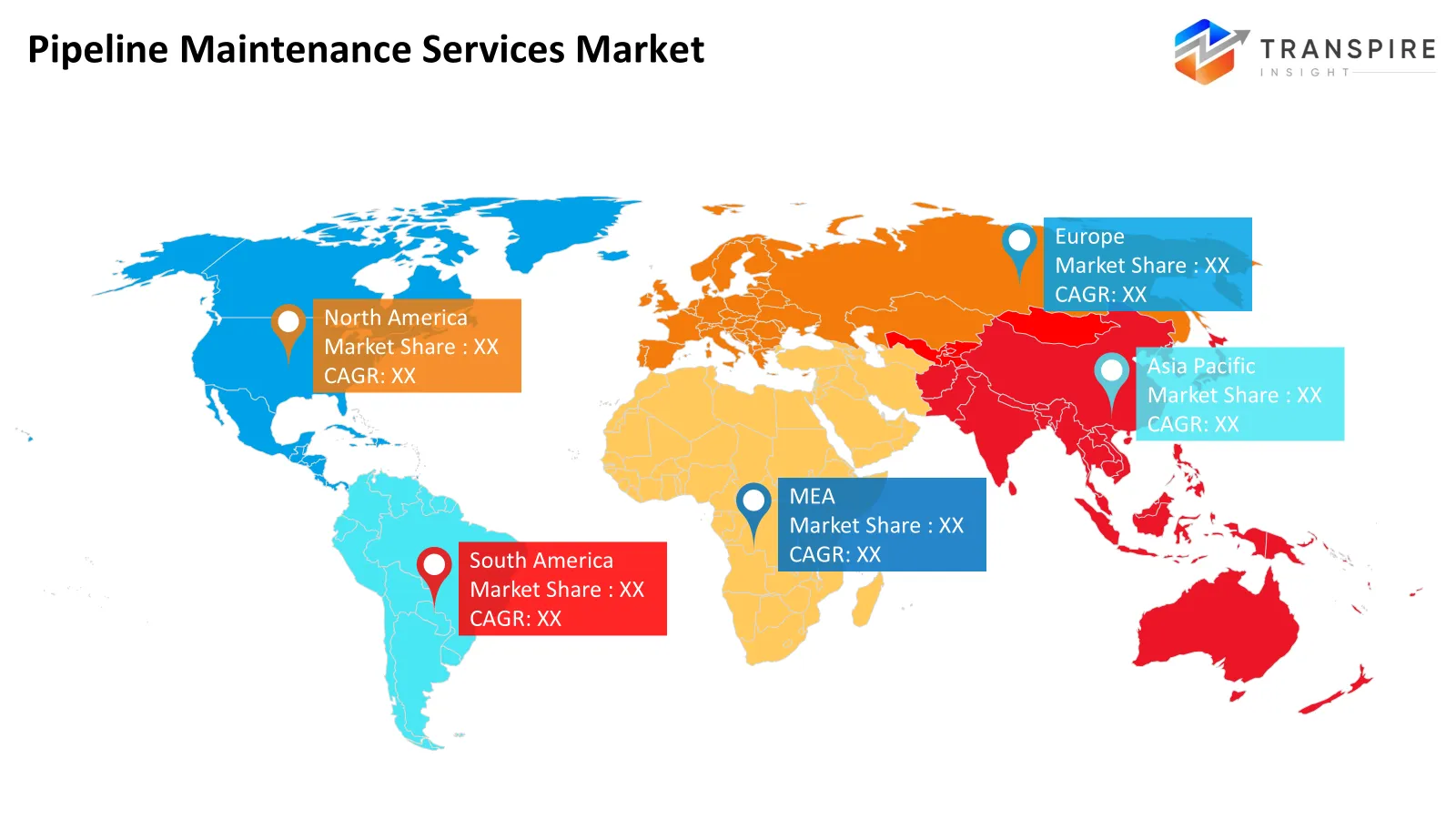
North America holds 41.0%. region has an advanced pipeline system, inspection capabilities and a focus on the safe operation of mature oil, gas and utility infrastructure. Operators are motivated to seek specialised inspection and repair services in order to manage their ageing infrastructure, minimise downtime and adhere to safety guidelines. Another factor contributing to the market in the region is the presence of an advanced ecosystem of technology suppliers, field contractors and engineers.
In September 2025, SI Solutions increased pipeline inspection capacity. SI Solutions made a strategic acquisition of Integrity Specialists, LLC, thus gaining enhanced expertise in pipeline inspection, materials identification, and non-destructive examination. The event is indicative of the needs of North America for specialised inspection services aimed at preserving its ageing pipeline network.
Europe:
Europe holds 18.5%. Market conditions in Europe are driven by existing mature gas and industrial networks, technical service providers and a focus on asset integrity, environmental performance and cross-border infrastructure reliability. With the presence of existing pipeline infrastructure, there is a requirement for inspections, rehabilitation, and maintenance. Projects aimed at energy transition raise questions regarding adapting the networks for lower-carbon gases and carbon dioxide transportation.
In April 2026, Equinor collaborates with Njord Survey for pipeline inspection. Equinor entered into a multi-year contract with Njord Survey for offshore pipeline inspection and monitoring services. The event illustrates the priorities of Europe in the field of pipeline integrity, preventive maintenance, and offshore energy infrastructure reliability.
Asia Pacific:
Asia Pacific accounts for 25.0% of the supplied market distribution and has been described as the fastest growing region, growing at a CAGR of 7.3%. The growth in urbanization and industries along with investments in infrastructure such as water, wastewater, and energy will result in increased demand for inspection and rehabilitation services. Several regions will need to upgrade their capacity while also ensuring that the existing systems are reliable, thus offering opportunities to providers who have the right technology and local field force.
In July 2026 ,Conventional Energy Services enhances pipeline integrity services. Conventional Energy Services announced an expansion of pipeline testing, pigging, inspection assistance, cleaning and rehabilitation services in Asia Pacific. The event is indicative of the needs of the region to preserve its existing pipeline network and prolong its service life.
Who are the Key Players in the Pipeline Maintenance Services Market and how do they compete?
The competition in market include inspection accuracy, field implementation, geographic coverage, and the capability to translate technical findings into actionable repairs. Large companies provide inspection, integrity assessment, maintenance, and intervention services, while specialised firms concentrate on sophisticated diagnostics or certain pipeline operation scenarios. The purchasers usually assess the technical fit, safety record, reporting, equipment availability, and the potential disruption caused by maintenance.ROSEN concentrates on specialised inspection, integrity assessment, and engineering services for certain asset risks. The company is focused on diagnostics and assistance in evaluating the state of pipelines, including needs related to new transport applications. The difference of ROSEN is in the combination of inspection technology and engineering expertise. T.D. Williamson offers pigging, pipeline integrity, isolation, and repair services aimed at assisting the operator in maintaining safe operation and fulfilling the intervention needs. The broad range of services and international presence allows T.D. Williamson to perform in different pipeline environments.NDT competes with in-line inspection technology, diagnostics, and integrity assessment services aimed at identifying anomalies and prioritising repair actions. Applus+ is also engaged through inspection, testing, and integrity services, while STATS Group concentrates on pipeline isolation, intervention, and maintenance services.
Pipeline Maintenance Services Market Companies
- Baker Hughes
- SLB
- Halliburton
- ROSEN
- T.D. Williamson
- NDT Global
- Intero Integrity
- Applus+
- MISTRAS Group
- Oceaneering
- Quest Integrity
- Acuren
- TEAM
- STATS Group
|
Company |
Est. Revenue Share Range |
Key Offerings |
Strategic Positioning |
Geographic Strength |
Technology Focus |
|
Baker Hughes |
Estimated 5–9% |
In-line inspection, pipeline cleaning, pre-commissioning, integrity engineering |
Integrated lifecycle services for complex pipeline assets |
North America, Europe, Middle East |
Multi-sensor inspection and digital integrity analytics |
|
T.D. Williamson |
Estimated 4–8% |
Pipeline pigging, hot tapping, isolation, repair and intervention |
Specialized live-pipeline maintenance solutions |
North America, Europe, Middle East |
Advanced pigging and pressure isolation systems |
|
ROSEN Group |
Estimated 4–8% |
In-line inspection, integrity assessment, corrosion detection, engineering consultancy |
Premium inspection technology and integrity expertise |
Europe, North America, Asia Pacific |
Magnetic flux leakage, ultrasonic sensing and defect analytics |
|
NDT Global |
Estimated 3–6% |
Ultrasonic inspection, crack detection, metal-loss inspection, integrity assessment |
High-resolution inspection for critical pipeline assets |
North America, Europe, Middle East |
Ultrasonic sensing and advanced defect characterization |
|
Halliburton |
Estimated 2–5% |
Pipeline cleaning, testing, maintenance support, integrity services |
Integrated energy-service capabilities for pipeline operators |
North America, Middle East, Latin America |
Field diagnostics and pipeline service technologies |
|
STATS Group |
Estimated 2–4% |
Pipeline isolation, hot tapping, line plugging, emergency repair systems |
Specialized intervention with reduced shutdown requirements |
Europe, Middle East, North America |
Double-block isolation and remote plugging systems |
|
EnerMech |
Estimated 1–3% |
Pipeline cleaning, hydrotesting, dewatering, drying, maintenance |
Integrated pipeline project and maintenance delivery |
Europe, Asia Pacific, Middle East |
Automated testing and specialized service equipment |
|
Intero Integrity Services |
Estimated 1–3% |
Pipeline inspection, robotic inspection, cleaning, integrity management |
Turnkey inspection and integrity management solutions |
Europe, North America, Asia Pacific |
Robotic inspection, ultrasonic sensing and data analytics |
|
TEAM, Inc. |
Estimated 1–3% |
Non-destructive testing, leak repair, asset integrity, field maintenance |
Specialized in-service maintenance and repair |
North America, Europe, Asia Pacific |
Advanced NDT and in-service repair technologies |
|
Applus+ |
Estimated 1–3% |
Pipeline inspection, non-destructive testing, corrosion monitoring, integrity assessment |
Independent inspection and technical assurance |
Europe, North America, Latin America |
Advanced NDT and fitness-for-service assessment |
Recent Development News
- In June 2026, Applus+ in the UAE signed a five-year onshore pipeline integrity and in-line inspection agreement with a leading pipeline company. This will include mechanical cleaning, pipeline mapping, and advanced inspection reporting, which will help continue their presence in the regional pipeline services market. https://www.applus.com/ae/en/news/applus%2B-in-uae-awarded-5-year-onshore-pipeline-integrity-contract
- In January 2025, DarkVision unveiled its Kraken, which is an in-line pipeline inspection system that makes use of high-resolution acoustic imaging and machine learning software that can aid in characterising pipeline anomalies. https://darkvisiontech.com/unveiling-kraken-in-line-inspection/
What Strategic Insights Define the Future of the Pipeline Maintenance Services Market?
The market will shift towards integrated asset management, where inspection data, operating history and repair planning are all considered together. Service providers that convert technical data to maintainability decisions could beat those that solely focus on pricing against their competition. A third issue, not so much talked about, is that of inconsistent asset data. Outdated drawings, patchy maintenance history and software systems that don't integrate with others can affect prediction models even if the inspection technology used is sophisticated. Water and wastewater networks represent an opportunity for growth because of the need to detect leaks in order to direct maintenance budgets to the critical sections of the network. Transportation of hydrogen and carbon dioxide will introduce a further need for specialists in pipeline infrastructure inspection. Investments must be made in validated analytics, proper training of field staff on inspection results, and creation of regional partnerships. Business claims should be connected with concrete results.
Key Segmentations are:
Service Type
- Inspection
- Repair & Rehabilitation
- Cleaning
- Pigging
- Corrosion Control
- Leak Detection
- Integrity Management
- Monitoring
Pipeline Type
- Oil Pipelines
- Gas Pipelines
- Water Pipelines
- Wastewater Pipelines
- Chemical Pipelines
- Petrochemical Pipelines
- CO₂ Pipelines
- Hydrogen Pipelines
Deployment
- Onshore
- Offshore
- Subsea
- Nearshore
- Cross-Country
- Urban
- Industrial
- Others
Technology
- Smart Pigging
- Ultrasonic Testing
- Magnetic Flux Leakage
- Radiography
- Hydrotesting
- Cathodic Protection
- Digital Monitoring
- Others
Application
- Oil & Gas
- Water Supply
- Wastewater
- Chemicals
- Power & Utilities
- Mining
- Hydrogen
- CO₂ Transport
End User
- Oil Companies
- Gas Companies
- Pipeline Operators
- Utilities
- Municipalities
- Chemical Companies
- Government Agencies
- Industrial Companies
By Regional Analysis
North America
- US
- Canada
- Mexico
Europe
- Germany
- UK
- France
- Italy
- Spain
- Russia
- Rest of Europe
Asia Pacific
- China
- Japan
- India
- South Korea
- Australia
- Rest of Asia Pacific
South America
- Brazil
- Argentina
- Rest of South America
Middle East & Africa
- UAE
- Saudi Arabia
- Qatar
- South Africa
- Rest of the Middle East & Africa
Frequently Asked Questions
Find quick answers to common questions.
The pipeline maintenance services market size was valued at USD 26.34 Billion in 2025 and is poised to reach USD 39.70 Billion by 2033, expanding at a 5.18% CAGR.
Key segments for the pipeline maintenance services market are Service Type (Inspection, Repair & Rehabilitation, Cleaning, Pigging, Corrosion Control, Leak Detection, Integrity Management, Monitoring)Pipeline Type (Oil Pipelines, Gas Pipelines, Water Pipelines, Wastewater Pipelines, Chemical Pipelines, Petrochemical Pipelines, CO₂ Pipelines, Hydrogen Pipelines)Deployment (Onshore, Offshore, Subsea, Nearshore, Cross-Country, Urban, Industrial, Others)Technology (Smart Pigging, Ultrasonic Testing, Magnetic Flux Leakage, Radiography, Hydrotesting, Cathodic Protection, Digital Monitoring, Others)Application (Oil & Gas, Water Supply, Wastewater, Chemicals, Power & Utilities, Mining, Hydrogen, CO₂ Transport)End User (Oil Companies, Gas Companies, Pipeline Operators, Utilities, Municipalities, Chemical Companies, Government Agencies, Industrial Companies).
Growth is primarily driven by increasing oil and gas transportation, stringent safety and environmental regulations, rising demand for leak detection and corrosion control, and growing investments in pipeline inspection, rehabilitation, and predictive maintenance technologies.
The market is led by major manufacturers including Baker Hughes, SLB, Halliburton, ROSEN, T.D. Williamson, NDT Global, Intero Integrity, Applus+, MISTRAS Group, Oceaneering, Quest Integrity, Acuren, Team, STATS Group, T.D. Williamson.
The North American region represents 41.0% of the world pipeline maintenance service market, with reasons being that of the huge number of oil and gas pipelines present in North America, strict safety regulations, the need for inspection of the aging pipelines, and adoption of leak and pipeline monitoring systems.
The market opportunities within pipeline maintenance services include an increasing demand for pipeline repair and replacement, artificial intelligence-based pipe inspection and predictive maintenance systems, increase in leak detection services, increasing investment in offshore pipeline maintenance, and an increase in demand for pipeline corrosion protection.
- Baker Hughes
- SLB
- Halliburton
- ROSEN
- T.D. Williamson
- NDT Global
- Intero Integrity
- Applus+
- MISTRAS Group
- Oceaneering
- Quest Integrity
- Acuren
- TEAM
- STATS Group
About the Authors

Avinash Kumar
I’m Avinash Kumar, a Senior Research Analyst at Transpire Insight, with expertise in the Electronics and Semiconductor and Energy & Power industry. My work focuses on analyzing emerging technologies, market trends, industry developments, and innovation across these sectors. I specialize in transforming complex technical and market insights into clear, research-backed content that helps professionals, businesses, and decision-makers stay informed. Through continuous industry research and data-driven analysis, I strive to deliver accurate, reliable, and practical perspectives on the latest advancements shaping the semiconductor and energy landscape.

Chakradhar Khansole
Chakradhar serves as the Research Director at Transpire Insight, bringing over 8 years of experience in technology, innovation, and strategic market intelligence. He specializes in transforming complex market data into actionable business insights that enable organizations to make informed, growth-oriented decisions. Recognized for his strategic vision and analytical expertise, Chakradhar leads high-impact research initiatives, delivering comprehensive market assessments, competitive intelligence, and forward-looking industry analysis.
Recently Published Reports
-
Apr 2026
Active Power Filter Market
Active Power Filter Market Size, Share & Analysis Report By Type (Shunt Active Power Filters, Series Active Power Filter, Hybrid Active Power Filter), By Application (Harmonics Mitigation, Reactive Power Compensation, Voltage Regulation, Power Factor Correction), By Phase (Single Phase, Three Phase), By End-User Industry (Manufacturing, Healthcare, Commercial, Automotive, Oil and Gas, Others), and Geography (North America, Europe, Asia-Pacific, Middle East and Africa, South and Central America), 2021 - 2031
-
Apr 2026
Electrical Transformer Market
Electrical Transformer Market Size, Share & Analysis Report By Core (Closed, Shell, and Berry), By Insulation (Gas, Oil, Solid, Air, and Other), By Phase (Single, and Three), By Rating (100 MVA to 500 MVA, 501 MVA to 800 MVA, and 801 MVA to 1200 MVA), and Geography (North America, Europe, Asia-Pacific, Middle East and Africa, South and Central America), 2021 – 2031
-
Apr 2026
Hydraulic Piston Pumps Market
Hydraulic Piston Pumps Market Size, Share & Analysis Report By Type (Axial Piston Pumps, Radial Piston Pumps), By Operating Pressure (Low Pressure, Medium Pressure, High Pressure), By Application (Construction, Mining, Agriculture, Automotive, Oil & Gas, Industrial Machinery, Others), By End-User (OEMs, Aftermarket), and Geography (North America, Europe, Asia-Pacific, Middle East and Africa, South and Central America), 2021 – 2031
-
Apr 2026
Laboratory Gas Generators Market
Laboratory Gas Generators Market Size, Share & Analysis Report By Product (Nitrogen Gas Generator, Hydrogen Gas Generator, Zero Air Gas Generator, Purge Gas Generator, TOC Gas Generators, Others), By Application (Gas Chromatography, Liquid Chromatography-mass Spectrometry (LC-MS), Gas Analyzers, Others), By End-user (Life Science, Chemical & Petrochemical, Food & Beverage, Others), and Geography (North America, Europe, Asia-Pacific, Middle East and Africa, South and Central America), 2021 – 2031