

Optical Transport Network Market Summary:
According to Transpire Insights, a detailed research report on the market reflects that the telecom backbone network application segment dominates the Optical Transport Network Market, accounting for approximately 75% of the total share worldwide. Ciena Corporation leads the market with approximately (around USD 4.3 billion) in annual revenue and an estimated 18–22% market share, making it the leading contributor to market development, innovation, advanced optical transport network solutions, expanding high-capacity networking capabilities, and growth dynamics.
Market Snapshot
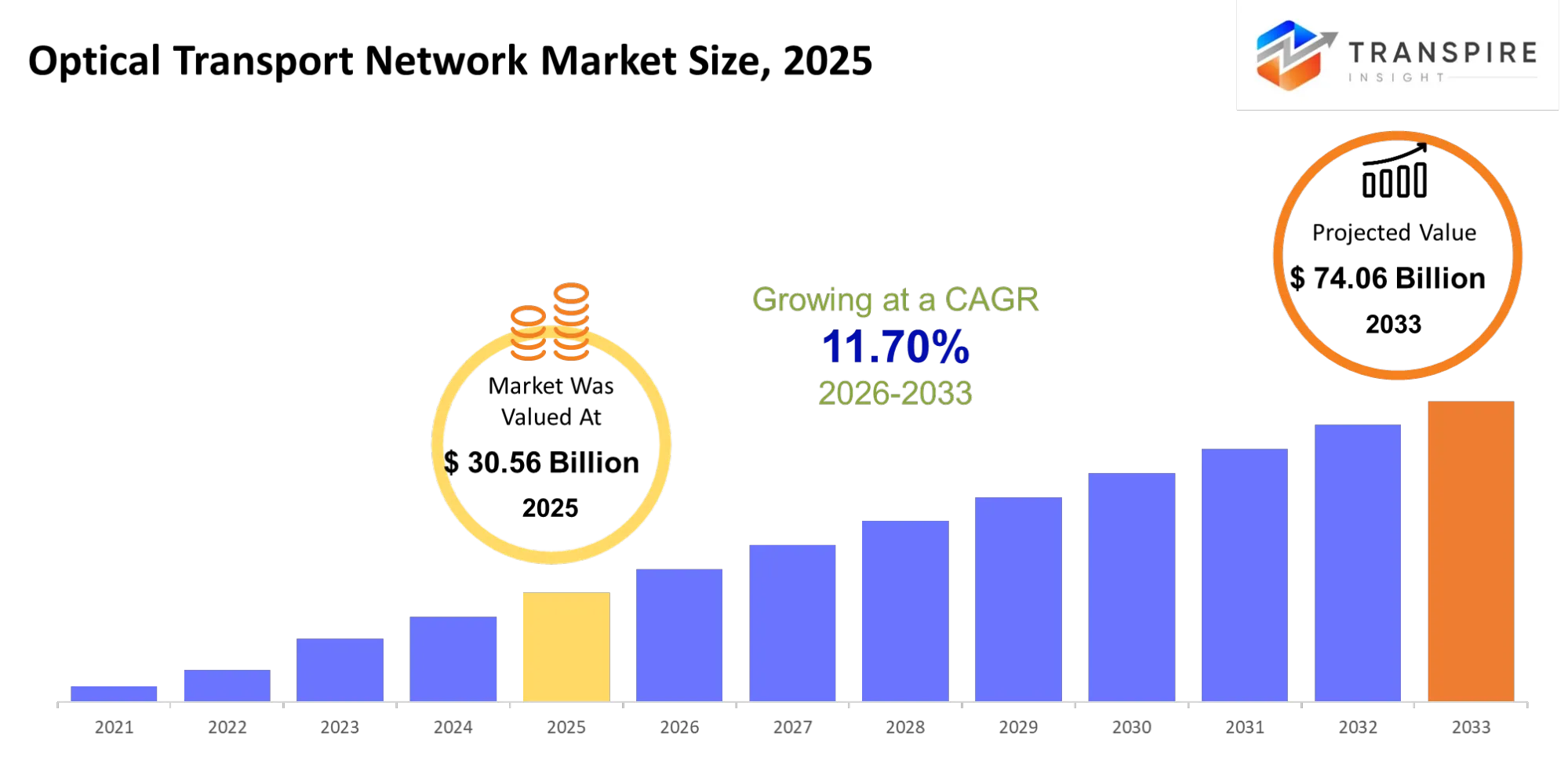
- Market Value (2025): USD 30.56 Billion.
- Expected Market Value (2026): USD 34.14 Billion.
- Estimated Market Value (2033): USD 74.06 Billion.
- Forecast CAGR (2026–2033): 11.70%.
- Leading Region in 2025: Asia Pacific
- Second-largest Region: North America
- Fastest Growing Region: Europe
Introduction
An optical transport network (OTN) functions mathematically as the bedrock of digital communication. It makes use of a standardized technology called "digital wrapping" to multiplex, switch, manage, and transfer client signals transparently through fiber optic links. An Optical Transport Network (OTN) is a special standardized technology that functions according to the ITU-T, and defines the physical fiber optic link between network devices. It acts like a digital wrapper for the different data signals transmitted over long distances such as Ethernet, IP and video. A set of superior Advanced Optical Transport Network (OTN) technologies aids networks to attain maximum efficiency with extended reach, intelligent monitoring features, and clever use of resources. The implementation of Forward Error Correction (FEC) allows for reliable transmission by rectifying errors that occur in transmission, thus increasing the distance between amplifiers and reducing infrastructure costs. The standardization of performance monitoring protocols helps in the efficient management of several data payloads, thus enabling quick fault identification and improving overall network performance. Wavelength Division Multiplexing (WDM) substantially boosts the efficiency of the network's capacity since it permits multiple data streams to be sent through a single fiber which results in reduced power consumption and minimal physical infrastructure. The advanced features of OAM&P provide an opportunity for automation of resource provisioning, remote diagnostics, and centralized network control thus improving the performance of the network.
- For instance: Cloud traffic, data center interconnects, and 5G rollouts are driving the worldwide optical transport network (OTN) industry. The Middle East and Africa sector is growing as regional investments aim to improve digital infrastructure and broadband in South Africa.
Market Highlights: -
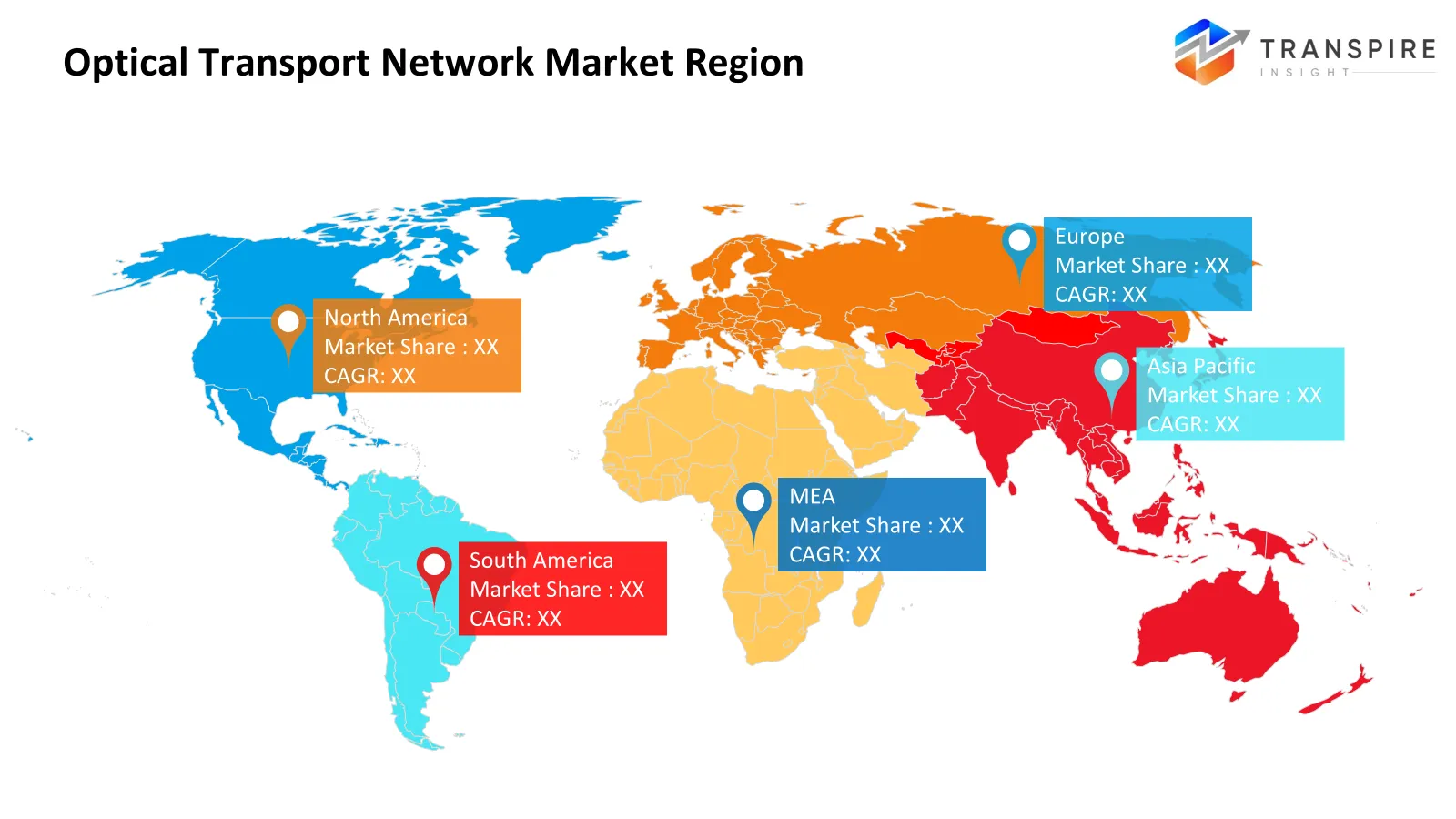
- Asia Pacific is anticipated to hold almost 35% share of the Optical Transport Network Market over the predicted timeframe.
- North America is expected to grow at a rapid CAGR in the Optical Transport Network Market by holding an estimated 28% of the share during the forecast period.
- Europe is anticipated to hold nearly 22% share of the Optical Transport Network Market over the predicted timeframe.
- By component, the Optical Modules segment dominated the market and holds an estimated 31% share in 2025 and is projected to grow at a substantial CAGR during the forecast period.
- By end user, the BFSI (Banking, Financial Services, and Insurance) segment dominated the market and holds nearly 28% share in 2025 and is projected to grow at a substantial CAGR during the forecast period.
- By application, the Cloud Connectivity segment dominated the market and holds nearly 38% share in 2025 and is projected to grow at a substantial CAGR during the forecast period.
- National Broadband Initiatives (Global): In order to improve connectivity, enable 5G networks, and satisfy expanding data transmission demands, government-led broadband expansion programs throughout Europe and Asia-Pacific are speeding up investments in high-speed fiber-optic backhaul infrastructure and supporting the deployment of cutting-edge Optical Transport Network (OTN) solutions.
How is Technology Driving Growth in the Optical Transport Network Market?
The Optical Network Equipment Market is registering a remarkable increase in demand fueled by rapid advancements in generative AI technology, development of 5G infrastructure, and new optical systems. The increasing application of generative AI workloads has led to the rising need for high-capacity communication solutions like coherent pluggable technology and optical WDM systems, which have significantly enhanced the data transfer process between hyperscale networks. The cutting-edge coherent optical systems that allow for ultra-fast transmission rates are boosting bandwidth utilization efficiency. Moreover, convergence of optical and internet protocols enables a more simplified architecture without compromising the network’s performance.
Market Drivers
The Optical Transport Network Market is surging mainly because of the increase in 5G deployments, growth in data proliferation, and higher demand for high-capacity connectivity solutions. The growing adoption of 5G networks creates a need for sophisticated fiber backhaul systems that ensure low-latency communications and improved network performance. The increasing use of artificial intelligence, hyperscale data centers, and data center interconnection (DCI) are boosting demand for optical technologies that deliver high-speed performance. Furthermore, the rapid advancement of cloud computing services, video streaming, and internet services require continuous upgrades of network capacity. The expansion of broadband networks funded by governments and fiber expansion projects are stimulating and encouraging investments in advanced optical transport network infrastructure. OTN or Optical Transport Network technology improves the functionality and performance of communication systems with the help of the high-capacity transmission technology, effective maximization of bandwidth and intelligent management capabilities. The Wavelength Division Multiplexing (WDM) technology can transmit several data signals via one fibre, thus increasing the efficiency of the network. It provides transparent carry of all types of client services such as Ethernet, IP and TDM. Whereas things such as tandem connection monitoring, forward Error Correction (FEC) as well as network survivability technology make it more reliable and manageable. Moreover, the use of compact coherent optical solutions has minimized the cost of infrastructure and also energy consumption of modern communication networks.
- For Instance: - Data center interconnect demands, 5G rollouts, and cross-border European financing are driving the optical transport network (OTN) industry. A significant amount of this value comes from Europe, which is supported by infrastructure investments totaling millions of euros from both public and private sources.
- Cloud computing, regional investments in digital infrastructure, and the expansion of 5G are driving the optical transport network (OTN) industry. Enterprise data transmission, AI-driven network management, and regional telecom advancements in places like Europe and Russia are important market scopes.
Restrain
The Optical Transport Network Market is confronted with several challenges like steep capital configurations for sophisticated optical infrastructure, time-consuming procurement process for exclusive components, and uncertainty in supply chain. Furthermore, integration of advanced OTN systems with existing technologies, complexity in technology adoption, and shortage of qualified personnel can impede market growth. Market expansion can be also affected by competition from various technologies like Carrier Ethernet systems.
Analysis of Prices and Consumer Behaviour
The majority of the Optical Transport Network (OTN) segment is governed by optical transport solutions (around 31% of the entire segment) due to the growing demand from telecommunications providers, cloud services, hyperscale datacenters, and businesses for giving high speed data. Pricing of next-generation coherent optical systems, which enable 400G, 800G and next-gen transmission technologies, is projected to be higher than conventional optical networking solutions by around 25-35%, because of the need for advanced technologies and higher bandwidth as well as higher energy efficiency. Around 45% of OTN implementation is related to optical modules and transmission devices due to growing demand for bandwidth, 5G rollouts and cloud connections. In the telecommunication and data center industry, the demand accounts for nearly 65%-70% of the overall demand due to investments directed towards digital infrastructure. The buying pattern of businesses demonstrates that they show preference for network capacity, scalability, reliability and safety in 55% of cases and for long-term contracts as well as managed services in 33% of situations to minimize operational costs and provide stable connectivity.
Top Companies in the Optical Transport Network Market
- Ciena
- Huawei
- Nokia
- Cisco Systems
- Infinera
- Fujitsu
- NEC Corporation
- ADVA Optical Networking
- ZTE
- Juniper Networks
- Ribbon Communications
- Ericsson
- Mitsubishi Electric
- Coriant
- Ekinops
Market Segmentation
The Optical Transport Network Market share is divided into five categories: By component, technology, deployment, end user and application.
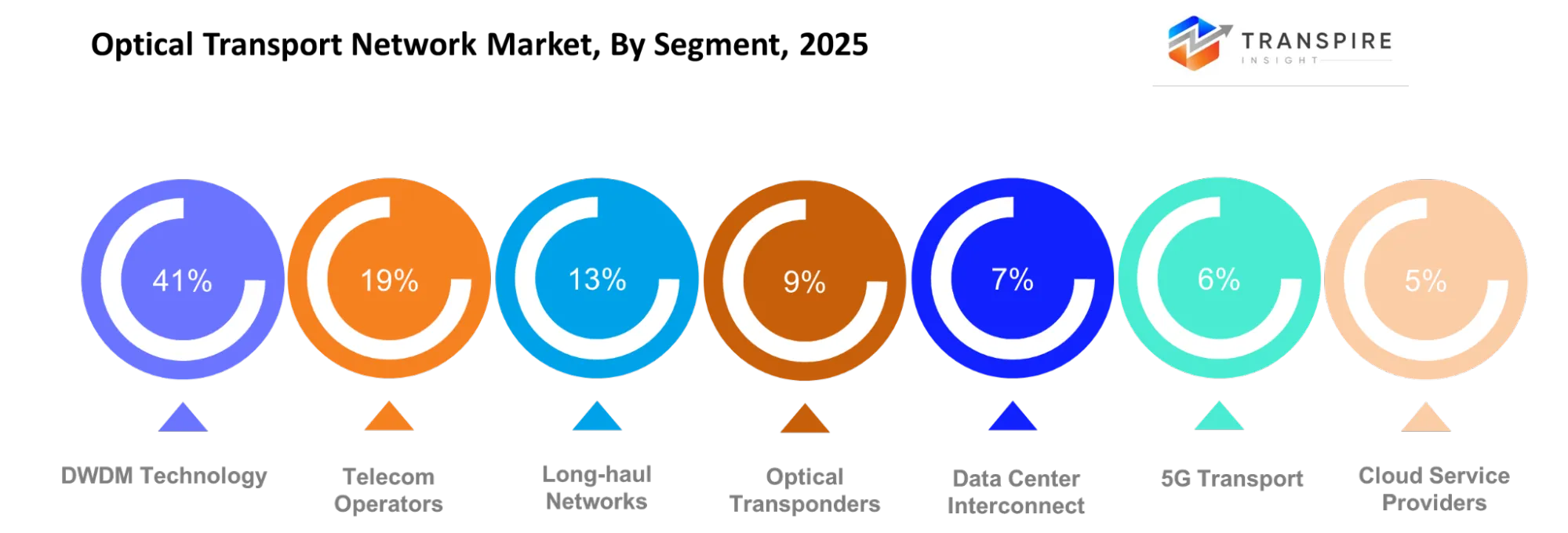
The Optical Modules dominated the market, accounting for estimated 31% in 2025 and is expected to rise at a significant CAGR during the forecast period.
The Optical Transport Network Market is segmented by component into Optical Switches, Optical Transponders, Optical Amplifiers, WDM Systems, Optical Routers, Network Management Software, Optical Modules, Others. Among these, the Optical Modules segment dominated the market, accounting for estimated 31% in 2025 and expected to increase at a significant CAGR during the forecast period. Coherent Pluggable Optics: The swift introduction of miniaturized 400ZR and 800ZR systems, such as QSFP-DD configurations, facilitates the direct plug-and-play connection with routers and switches, which brought important cost savings. Open and Disaggregated Systems: Moving from proprietary vendor-specific hardware equipment towards line system architectures created through modular, multi-vendor interchangeability with the use of open standards such as Open ROADM. IP and Optical Convergence: The integration of IPoDWDM (IP-over-DWDM) to eliminate unnecessary layers of equipment, decrease energy consumption, and simplify network management.
The BFSI (Banking, Financial Services, and Insurance) dominated the market, accounting for nearly 28% in 2025, and is expected to rise at a significant CAGR during the forecast period.
The Optical Transport Network Market is segmented by end user into Telecom Operators, Cloud Service Providers, Government, Enterprises, Utilities, Media & Entertainment, BFSI, Others Among these, the BFSI (Banking, Financial Services, and Insurance) segment dominated the market, accounting for nearly 28% in 2025 and expected to increase at a significant CAGR during the forecast period. In 2025, the BFSI sector accounted for nearly 28% of the market due to the increasing need for secure, speedy optical connections, secure data movement, and advanced network infrastructure. Financial companies have resorted to optical networking solutions to fulfill the demands of digital banking, cloud solutions, cyber security, and real-time transactions.
The Cloud Connectivity dominated the market, accounting for nearly 38% in 2025 and is expected to rise at a significant CAGR during the forecast period.
The Optical Transport Network Market is segmented by application into 5G Transport, Broadband Networks, Cloud Connectivity, Data Center Interconnect, Enterprise Connectivity, Video Streaming, AI Networking, Others. Among these, the Cloud Connectivity segment dominated the market, accounting for nearly 38% in 2025 and expected to increase at a significant CAGR during the forecast period. Cloud Connectivity will rule the market in 2025, with almost 38% share, owing to growing acceptance of cloud computing, hyperscale data centers, and digital transformation trends. Businesses are spending on flexible cloud infrastructure, fast connectivity solutions, and safe data transfer networks in support of AI utilization, remote working, and advanced communication.
Regional Segment Analysis of the Optical Transport Network Market:
- North America (U.S., Canada, Mexico)
- Europe (Germany, France, U.K., Italy, Spain, Rest of Europe)
- Asia-Pacific (China, Japan, India, Rest of APAC)
- South America (Brazil and the Rest of South America)
- The Middle East and Africa (UAE, South Africa, Rest of MEA)
Asia Pacific is the fastest-growing region in the Optical Transport Network Market during the period, holding almost 35% share.
Asia Pacific is the fastest-growing region in the Optical Transport Network Market during the forecast period, holding almost 35% share during the forecast period. The Optical Transport Network Market is growing fastest in the Asia Pacific region, which has a market share of around 35%, owing to a rapid increase in digital transformation, growing deployment of 5G networks, investment in data centers, and increase in internet penetration. The emergence of the demand for high-speed connectivity, cloud services, and advanced means of communication is resulting in a fast acceptance of the concept of optical networks.
North America is the fastest-growing region in the Optical Transport Network Market during the period, holding an estimated 28% share.
North America is expected to grow at a rapid CAGR in the Optical Transport Network Market holding an estimated 28% share during the forecast period. The Optical Transport Network Market is growing fastest in the Asia Pacific region, which has a market share of around 35%, owing to a rapid increase in digital transformation, growing deployment of 5G networks, investment in data centers, and increase in internet penetration. The emergence of the demand for high-speed connectivity, cloud services, and advanced means of communication is resulting in a fast acceptance of the concept of optical networks.
Europe is expected to grow at a rapid CAGR in theOptical Transport Network Market, holding nearly 22% of the share during the forecast period.
Europe is expected to grow at a rapid CAGR in the Optical Transport Network Market holding nearly 22% share during the forecast period. Europe is projected to witness remarkable growth in the Optical Transport Network Market with a market share of nearly 22% as a result of fiber network modernization, expansion of 5G technology as well as increasing need for high-speed connectivity. Initiatives by the government regarding digitalization, cloud technology and investments into developing telecommunications infrastructure have also led to an increase in optical transport networks installations in this particular region.
Strategies for Market Growth in Non-Leading Regions:
The advancement of Optical Transport Network (OTN) systems will enhance the expansion of non-leading geographical regions and create new opportunities for small to medium-sized enterprises and providers of telecommunication services. By using fiber-optic networks locally and creating regional optical network facilities, the dependency on external connectivity providers can be reduced, thus minimizing the costs of operation. The creation of strategic alliances with telecommunications companies, cloud services providers, data center companies, and equipment suppliers in the field of transportation networks will help penetrate the market for Optical Transport Networks. In order to obtain knowledge in the field of optical technologies, network management, and cybersecurity, it will be necessary to provide education programs and skill development. Moreover, flexible financing schemes, long-term service agreements, and managed networks will provide further access to Optical Transport Networks products at lower costs.
Future Market Trends for the Optical Transport Network Market: -
1.Coherent Pluggable Optics: The swift introduction of miniaturized 400ZR and 800ZR systems, such as QSFP-DD configurations, facilitates the direct plug-and-play connection with routers and switches, which brought important cost savings.
2.Open and Disaggregated Systems: Moving from proprietary vendor-specific hardware equipment towards line system architectures created through modular, multi-vendor interchangeability with the use of open standards such as Open ROADM.
3.IP and Optical Convergence: The integration of IPoDWDM (IP-over-DWDM) to eliminate unnecessary layers of equipment, decrease energy consumption, and simplify network management.
4.AI-Driven Automation: Including machine learning and artificial intelligence in control layers for self-optimizing pathways, automated provisioning, and predictive fault detection.
Recent Development
- In March 2026: Nokia unveiled a number of application-oriented coherent optical transport solutions, enabling AI evolution in networks, facilitating data communication and enhancing optical transmission. The newly released solutions are capable of cutting down the total ownership cost by up to 70% through effective coherent optics, higher energy efficiency and scalable transport systems. The recent development gives a boost to the Optical Transport Network Market, which caters to the increasing demand for AI workloads, big-data center interconnections, cloud-based communications and next-generation telecommunication technologies.
- In March 2026: In order to improve high-capacity, bi-directional optical transmission across fiber networks, Coherent Corp. launched cutting-edge coherent optical module solutions, such as QSFP28-DCO technology. By addressing the increasing need for effective data center interconnects, cloud connectivity, and next-generation communication networks, these innovations support increased bandwidth efficiency, decreased infrastructure complexity, and scalable optical connectivity, strengthening the optical transport network market.
- In March 2026: Ahead of the OFC 2026 conference, Adtran demonstrated cutting-edge ultra-low-power 800G pluggable optical transceiver technology, which is intended to serve next-generation data center connectivity requirements, high-capacity optical transport networks, and AI-driven data traffic growth. By increasing bandwidth efficiency, lowering power consumption, and providing scalable, high-performance connectivity options for contemporary communication infrastructures, this invention boosts the optical transport network market.
Market Segment
This study forecasts revenue at global, regional and country levels from 2020 to 2033. Transpire Insights has segmented the Optical Transport Network Market based on the below-mentioned segments:
Optical Transport Network Market, By Component
- Optical Switches
- Optical Transponders
- Optical Amplifiers
- WDM Systems
- Optical Routers
- Network Management Software
- Optical Modules
- Others
Optical Transport Network Market, By Technology
- DWDM
- CWDM
- OTN Switching
- Packet Optical Transport
- SDN-enabled OTN
- Flex-grid OTN
- Optical Ethernet
- Others
Optical Transport Network Market, By Deployment
- Long-haul Networks
- Metro Networks
- Data Centers
- Access Networks
- Submarine Networks
- Enterprise Networks
- Edge Networks
- Others
Optical Transport Network Market, By End User
- Telecom Operators
- Cloud Service Providers
- Government
- Enterprises
- Utilities
- Media & Entertainment
- BFSI
- Others
Optical Transport Network Market, By Application
- 5G Transport
- Broadband Networks
- Cloud Connectivity
- Data Center Interconnect
- Enterprise Connectivity
- Video Streaming
- AI Networking
- Others
Optical Transport Network Market, By Regional Analysis
North America
- United States
- Canada
- Mexico
Europe
- Germany
- United Kingdom
- France
- Spain
- Italy
- Rest of Europe
Asia Pacific
- Japan
- China
- Australia & New Zealand
- South Korea
- India
- Rest of Asia Pacific
South America
- Brazil
- Argentina
- Rest of South America
Middle East & Africa
- Saudi Arabia
- United Arab Emirates
- South Africa
- Rest of the Middle East & Africa
Frequently Asked Questions
Find quick answers to common questions.
5G expansion, AI traffic, cloud computing, data centers, broadband investments, and increasing demand for high-speed connectivity drive market growth.
Cloud Connectivity dominates with 38% share due to cloud adoption, digital transformation, hyperscale data centers, and secure data transmission demand.
Asia Pacific leads due to 5G deployment, data center expansion, internet growth, digital initiatives, and optical infrastructure investments.
High costs, supply chain issues, integration complexity, skilled workforce shortages, and alternative networking technologies challenge market expansion.
800G optics, AI automation, IP-optical convergence, open systems, and advanced OTN solutions will shape future connectivity.
- Ciena
- Huawei
- Nokia
- Cisco Systems
- Infinera
- Fujitsu
- NEC Corporation
- ADVA Optical Networking
- ZTE
- Juniper Networks
- Ribbon Communications
- Ericsson
- Mitsubishi Electric
- Coriant
- Ekinops
About the Authors

Mayur Shinde
I am Mayur Shinde, a Senior Research Analyst at Transpire Insight, specializing in the Automotive & Transportation and Information & Communication Technology (ICT) Industry. My work focuses on analyzing emerging market trends, technological advancements, competitive landscapes, and industry developments to deliver accurate, data-driven insights. I am passionate about transforming complex market information into clear, actionable content that helps businesses, professionals, and decision-makers stay informed and make confident strategic decisions.

Chakradhar Khansole
Chakradhar serves as the Research Director at Transpire Insight, bringing over 8 years of experience in technology, innovation, and strategic market intelligence. He specializes in transforming complex market data into actionable business insights that enable organizations to make informed, growth-oriented decisions. Recognized for his strategic vision and analytical expertise, Chakradhar leads high-impact research initiatives, delivering comprehensive market assessments, competitive intelligence, and forward-looking industry analysis.
Recently Published Reports
-
Apr 2026
3D Optical Profiler Market
3D Optical Profiler Market Size, Share & Analysis Report By Type (Desktop 3D Optical Profiler, and Portable 3D Optical Profiler), By Technology (Confocal Technology, and White Light Interference), By End-Use Industry (Manufacturing, Research Institutions, Automotive, Aerospace and Defense, Medical Devices, and Other), and Geography (North America, Europe, Asia-Pacific, Middle East and Africa, South and Central America), 2021 - 2031
-
Apr 2026
Depth Sensor Market
Depth Sensor Market Size, Share & Analysis Report By Type (Infrared Depth Sensors, Time-of-Flight (ToF) Sensors, Stereo Vision Sensors, Structured Light Sensors, Ultrasonic Depth Sensors), By Application (Automotive, Robotics, Gaming, Consumer Electronics, Industrial Automation, Healthcare, Security & Surveillance, Others), By End Users (Automotive Manufacturers, Consumer Electronics Companies, Healthcare Providers, Industrial Companies, Security Agencies, Gaming Companies, Robotics Companies, Others), and Geography (North America, Europe, Asia-Pacific, Middle East and Africa, South and Central America), 2021 – 2031
-
Apr 2026
Digital Manufacturing Market
Digital Manufacturing Market Size, Share & Analysis Report By Component (Hardware, Software, and Services), By Technology (Robotics, 3D Printing, Internet of Things (IoT), and Others), By Application (Automotive and Transportation, Aerospace and Defense, Consumer Electronics, Industrial Machinery, and Others), By Process Type (Computer-Based Designing, Computer-Based Simulation, Computer 3D Visualization, Analytics, and Others), and Geography (North America, Europe, Asia-Pacific, Middle East and Africa, South and Central America), 2021 – 2031
-
Apr 2026
Digital Visa Services Market
Digital Visa Services Market Size, Share & Analysis Report By Type (Individual Travelers, Group Travelers), By Application (Tourism, Business Travel, Others), and Geography (North America, Europe, Asia-Pacific, Middle East and Africa, South and Central America), 2021 – 2031