

Optical GPU Interconnect Market Summary:
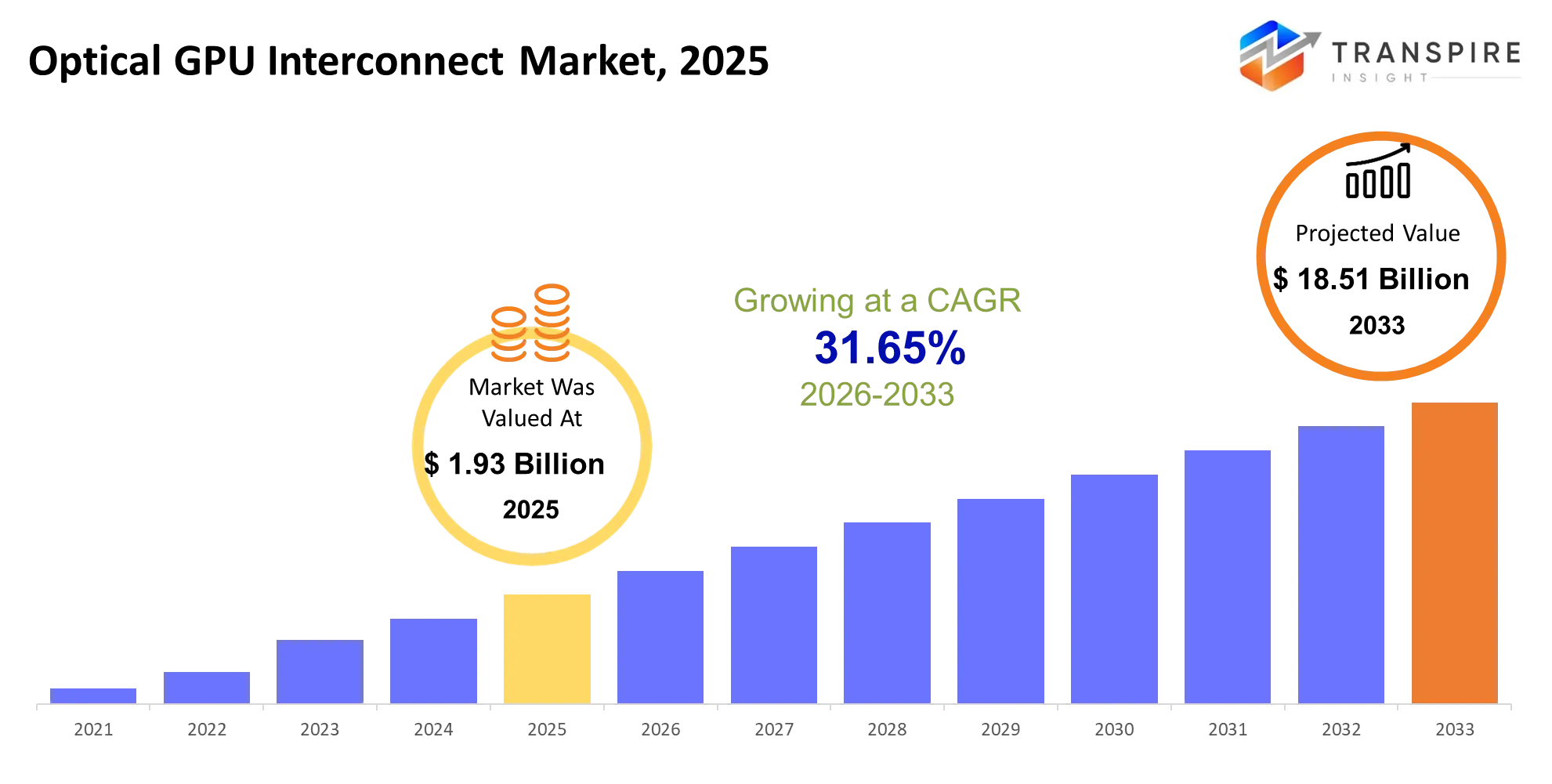
As per the Transpire Insight, The Optical GPU Interconnect Market size is estimated at USD 1.93 billion in 2025 and is anticipated to reach USD 18.51 billion by 2033, growing at a CAGR of 31.65% from 2026 to 2033.
The optical GPU interconnect market allows data to be transferred between GPUs installed in servers, racks, and large-scale computing clusters without the bandwidth and power limitations commonly found on traditional electrical interconnects. Over the last three to five years, as we move from general-purpose cloud computing to distributed AI training, there is a requirement for higher-speed communication among accelerators. Larger AI models require GPUs to keep exchanging parameters, gradients, and intermediate results, making interconnect performance a key driver for computing. One of the fundamental changes is a move from modular optical transceivers towards integrated optical modules and co-packaged optics, providing more integrated optical connectivity for the computing chips. As adoption of high-density data centres triggered by the arrival of generative AI services continues, hyperscalers and competitive AI computing vendors are investing in optical links. As GPU cluster size increases, the interconnect speeds help eliminate bottlenecks in communications, improve energy efficiency, and scale the infrastructure.
Optical GPU Interconnect Market Size & Forecast:
- Market Size 2025: USD 1.93 Billion
- Expected Market Value (2033): USD 18.51 Billion
- Forecast CAGR (2026–2033): 31.65%
- Leading Region in 2025: North America
- Fastest Growing Region: Asia Pacific
- Key Company Profiles: NVIDIA, Broadcom, AMD, Intel, Cisco, Marvell, Coherent, Lumentum, Applied Optoelectronics, Fabrinet, Ayar Labs, Lightmatter, Ranovus, DustPhotonics, Innolight.
Key Optical GPU Interconnect Market Insights:
The market is shifting from replaceable optical modules to tightly integrated architectures for photonic systems, which are more bandwidth-dense and energy-efficient. The commercial success will rely on manufacturing readiness, component supply reliability, and quantifiable performance improvement for AI computing systems.
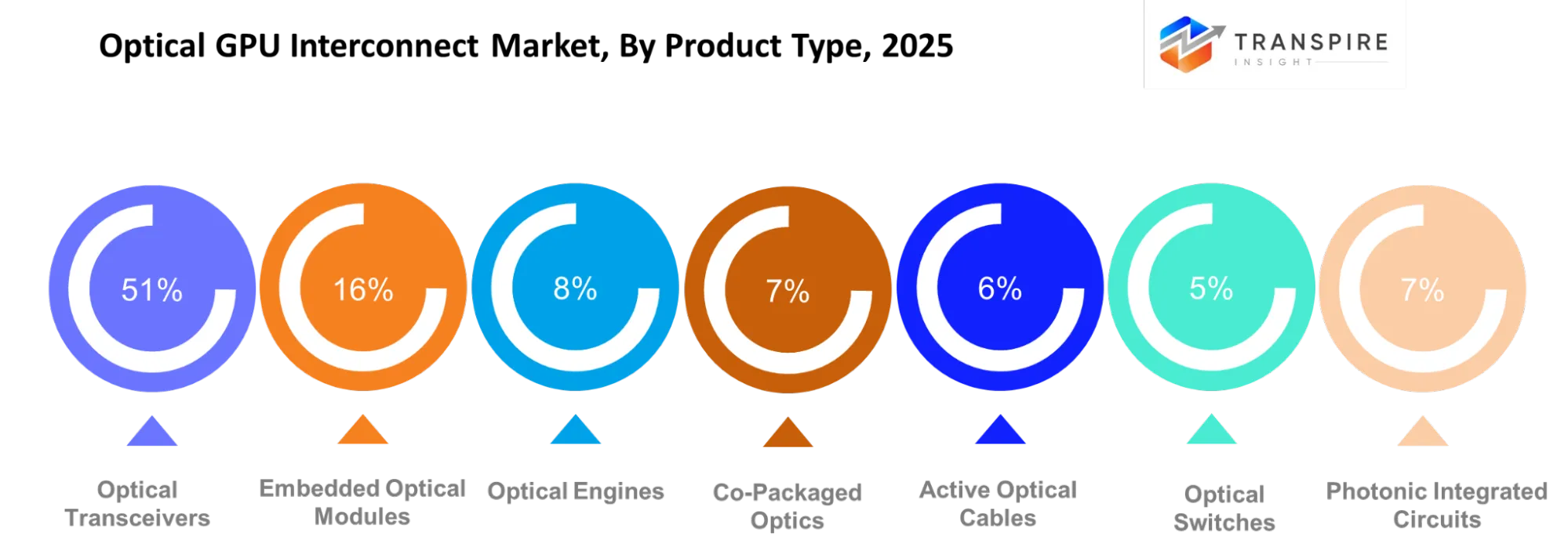
- Innolight's 800G QSFP-DD output hit 500,000 units per month, marking a transition to cost-driven, mass-produced AI optics, with Optical transceivers accounting for 51.47% of product demand.
- Near-package integration is driving the development of embedded optical modules, which account for 34.29% and are expanding at 16.0% CAGR.
- Co-packaged optics represent 7.0% of the market, with Broadcom commercialising the CPO platforms based on the Tomahawk 6 technology, bringing CPO out of trials and into adoption by hyperscalers.
- Optical engines account for 8.5%, and Ayar Labs raised $500 million with a valuation of $3.75 billion for its efforts to scale TeraPHY optical chiplets for rack-scale AI systems.
- Active optical cables account for 6.0%, and Fabrinet has started direct 800G deliveries to a hyperscaler, marking a closer relationship between ODM and cloud.
- Optical switches are 4.5%, and NVIDIA's new Spectrum-X Photonics switches power up AI factories on a multi-petabit scale.
- Photonic integrated circuits represent 4.0%, and Marvell is also acquiring Celestial AI, bringing Photonic Fabric capability to memory-centric AI fabrics.
- Optical engines and CPO make up 15.5%, and laser supply is starting to become a differentiator for NVIDIA's $2 billion Lumentum investment.
- 1.6T products are starting to ramp away from pilots: Lumentum reported initial 1.6T product shipments in fiscal Q4 2026, and Coherent saw a faster-than-anticipated ramp.
What are the Key Drivers, Restraints, and Opportunities in the Optical GPU Interconnect Market?
Driver:
The principal growth driver is the expansion of multi-GPU AI clusters, where communication between accelerators increasingly determines training speed and infrastructure utilization. The deployment of generative AI platforms triggered larger investments in high-speed networking, particularly 800 Gbps and 1.6 Tbps optical transceivers. TrendForce reported in February 2026 that 800G-and-above modules could exceed 60% of optical transceiver shipments by 2026. This shift increases optical component purchases per computing cluster and creates opportunities for suppliers of lasers, transceivers and photonic engines.
Restraint:
High manufacturing costs, limited availability of specialised laser components and complex photonic packaging continue to constrain deployment. These issues persist because optical engines require precise alignment, thermal management and extensive reliability testing. Component shortages can delay production, while redesigning GPU boards and networking systems adds integration costs for data-centre operators.
Opportunity:
Co-packaged optics and linear pluggable optics can spur growth by enabling lower power consumption per bit and higher bandwidth density. SPIL announced that it is working with NVIDIA to increase its optical-engine capacity by 15 times by mid-2027, making co-packaged optics less of a demonstration technology and more of a priority for the supply chain. Supporting larger AI clusters, reducing OPEX, and driving demand for more lasers, packaging, and high-density optics.
Driver Impact Analysis — Optical GPU Interconnect Market
|
Driver |
Relative Impact on Growth (%) |
Geographic Relevance |
Impact Timeline |
Demand Strength |
Growth Mechanism |
Key Beneficiaries |
Major Constraint |
|
AI and hyperscale data-center expansion |
30% |
North America, China, Asia-Pacific |
Short-term (≤2 years) |
High |
Expanding AI clusters require higher-bandwidth optical GPU links |
GPU vendors, hyperscalers, optical transceiver manufacturers |
High deployment costs and power infrastructure limitations |
|
Copper interconnect limitations and bandwidth scaling requirements |
24% |
North America, Taiwan, South Korea |
Medium-term (2–4 years) |
High |
Optical links overcome copper reach, signal-loss, and bandwidth limitations |
Optical engine suppliers, photonics firms, AI system integrators |
Optical integration complexity and interoperability challenges |
|
Adoption of silicon photonics and co-packaged optics (CPO) |
20% |
United States, Taiwan, Europe, Japan |
Medium-term (2–4 years) |
High |
CPO integrates optical engines near processors, improving bandwidth density |
Photonic chipmakers, semiconductor foundries, packaging specialists |
Thermal management, repairability, and manufacturing yield challenges |
|
Transition to 800G, 1.6T, and next-generation optical connectivity |
16% |
North America, Taiwan, China, South Korea |
Short-term (≤2 years) |
High |
Faster optical links increase data throughput across GPU clusters |
Laser manufacturers, transceiver vendors, optical component suppliers |
Laser shortages and demanding qualification requirements |
|
Energy efficiency, network scalability, and strategic capacity investments |
10% |
North America, Europe, Asia-Pacific |
Long-term (≥4 years) |
Medium |
Lower energy per bit improves scalability of large AI computing fabrics |
Cloud operators, data-center developers, photonics technology vendors |
High initial investment and uncertain long-term technology standards |
|
Total |
100% |
— |
— |
— |
— |
— |
— |
What Has the Impact of Artificial Intelligence Been on the Optical GPU Interconnect Market?
AI is also a customer as well as an engineering work in this market. In training applications, the optical interconnects transmit activations, gradients, and parameter updates between GPUs, and in inference, the links connect accelerators to memory, storage, and the various tiers of serving layers with as little latency as possible. Increasingly, the AI-driven cluster designs are relying on optical fabric for both scale-up and scale-out.
Automation and optimization are also apparent in network design, where AI-based traffic management can optimize GPU-to-GPU communication paths, alleviate congestion, and improve utilisation of expensive optical ports; predictive analytics are being used to detect link health, laser degradation, and faults, and to predict thermal behaviour, helping operators avoid expensive training failures. Operationally, CPO reduces power consumption and increases resiliency; NVIDIA has achieved a five-fold improvement in power efficiency and higher sustained AI application runtime with its CPO-based networking platforms. However, integration remains a major challenge; CPO involves a tightly coupled design of lasers, photonics, packaging, cooling, and switch silicon; shortages of chips and component fine-pitch alignment constrain volume. As a result, for the foreseeable future, pluggable optics, near-packaged optics and CPO will not displace one another but coexist.
In October 2026, NVIDIA formally unveiled its Spectrum-6 Co-Packaged Optics (CPO) switch line and announced a manufacturing capacity expansion with Siliconware Precision Industries (SPIL) to ramp production of related optical engines 15-times over by mid-2027.
Key Optical GPU Interconnect Market Trends:
The market is shifting from a stand-alone optical module to connectivity that is being designed along with the GPU and switch architectures. Energy efficiency and integration quality, or scaling clusters of AI links, are becoming a competitive advantage.
- The migration from copper to optics is gaining momentum as 224 Gbps-per-lane designs start to make short board-level copper links power-hungry.
- The transition from 400G to 800G for new AI training fabrics has taken place.
- 1.6T is set to go into volume production once 200G per lane technology of laser devices has matured.
- Moving from trials to early commercial deployments of CPO, particularly in scale-out switch networks.
- Hyperscalers are increasingly signing up for laser, optical-engine, and packaging capacity on a long-term basis, instead of buying it on the spot.
- Linear pluggable optics and silicon photonics are emerging as of interest, as they require less power for processing and DSP.
- Capacity, cooling, and power availability – both for interconnect and in the AI factory – are becoming a single design challenge.
- The focus of supply-chain investment is on EMLs, CW lasers, VCSEL arrays, and advanced optical packaging.
- Optical links are slowly splitting high-speed memory from compute processors, making memory disaggregation an emerging topic and concept.
Optical GPU Interconnect Market Segmentation
Product Type:
Optical transceivers lead with 51.47%, as the most intended and interchangeable form factor for AI-server and switch connectivity. Embedded optical modules represent 34.29%, with a faster growth rate of 16.0%, as vendors co-package optics closer to the server and switches to reduce electrical trace lengths and increase density. Optical engines on 8.5%, co-packaged optics on 7.0%, active optical cables on 6.0%, optical switches on 4.5%, photonic integrated circuits on 4.0%, others on 2.53%. Overall, this data shows a shift from field-replaceable modules towards integrated photonics.
Interconnect Level:
In the short term, investments are mostly focused on GPU-to-GPU and rack-to-rack links, because the AI training workload requires accelerators to synchronize within a group regularly. Chip-to-chip and board-to-board interconnects are becoming more strategic as co-packaged optics reduce the distance from the optical engine to the accelerator and switch packages. Rack-to-rack, node-to-node, and cluster-level links drive the adoption of scale-out fabrics, where optical switching and higher fibre-count infrastructure are critical as the AI cluster scales out toward one million GPUs.
Fibre Mode:
Multimode fibre remains the clear choice for short-reach in-rack connections, while single-mode fibre enables long rack-to-rack and data-centre-interconnect routes. Parallel, ribbon, and active optical fibre are needed for high-density GPU clusters where having a small cabling profile and reliable high-bandwidth transmission are essential. Silicon-photonics fibre and hybrid fibre are becoming more important for future co-packaged optics that require higher integration densities, better thermal control, and lower power consumption.
Data Rate:
The main area of commercial activity is the 400-800 Gbps segment, in which we have a current 800G AI cluster on sale. Up to 800 Gbps, everything is standard; at 1.6Tbps and 3.2Tbps/3.2Tbps/4x800 Gbps, you already have the new cycle of acquisition, since with the growth of scale and model density it is where you want to go; custom high-speed lines are in development for hyperscalers who require a specific range of bandwidth, latency, and power consumption for AI-factory and high-performance computing applications.
Application:
AI training is the strongest demand driver of all on the basis of the volume of synchronisation traffic it creates over GPUs as part of distributed training. AI inference, high-performance computing, cloud computing, and data-centre networking are all expanding as optical fabrics provide an ultra-low latency service for scalable infrastructure. Although data communication remains the most significant application base, AI workloads are reorienting buying behaviour toward latency, power efficiency, fabric resilience, and predictable performance at high utilisation.
End User:
Hyperscalers and cloud service providers lead adoption, given their deployment of the largest GPU fleets that can support new 800G, 1.6T, and co-packaged optics early. AI players come next as they build out their training and inference clusters. Enterprise data centres adopt optics for more demanding workloads on select workloads. Requiring optics is the fastest-growing market, with research institutions, telecom providers, and governments as players. Adoption is dependent on cluster size, budgets, and mission criticality.
What are the Key Use Cases Driving the Optical GPU Interconnect Market?
The core use case is high-speed communication within AI training clusters. Optical transceivers, representing 51.47% of product share, connect GPU servers and switches, enabling rapid exchange of model parameters and training data. As clusters span multiple racks, optical links help overcome copper-based transmission limitations.
Expanding applications include AI inference, cloud computing and high-performance computing. Hyperscalers use optical connectivity to coordinate distributed accelerators, while enterprise data centres deploy it for large-model workloads, scientific simulations and complex analytics.
Emerging use cases include chip-to-chip optical communication, rack-scale GPU systems and optical circuit switching. Embedded optical modules, growing at a 34.29% CAGR, could support tighter integration, while co-packaged optics may improve bandwidth density and energy efficiency in next-generation AI infrastructure.
|
Report Metrics |
Details |
|
Market size value in 2025 |
USD 1.93 Billion |
|
Market size value in 2026 |
USD 2.70 Billion |
|
Revenue forecast in 2033 |
USD 18.51 Billion |
|
Growth rate |
CAGR of 31.65% from 2026 to 2033 |
|
Base year |
2025 |
|
Historical data |
2021 - 2024 |
|
Forecast period |
2026 - 2033 |
|
Report coverage |
Revenue forecast, competitive landscape, growth factors, and trends |
|
Regional scope |
United States; Canada; Mexico; United Kingdom; Germany; France; Italy; Spain; Denmark; Sweden; Norway; China; Japan; India; Australia; South Korea; Thailand; Brazil; Argentina; South Africa; Saudi Arabia; United Arab Emirates |
|
Key companies profiled |
NVIDIA, Broadcom, AMD, Intel, Cisco, Marvell, Coherent, Lumentum, Applied Optoelectronics, Fabrinet, Ayar Labs, Lightmatter, Ranovus, DustPhotonics, Innolight. |
|
Customization scope |
Free report customization (country, regional & segment scope). Available customized purchase options to meet your exact research needs. |
|
Report Segmentation |
Product Type (Optical Transceivers, Embedded Optical Modules, Optical Engines, Co-Packaged Optics, Active Optical Cables, Optical Switches, Photonic Integrated Circuits, Others)Interconnect Level (Board-to-Board, Rack-Level, Chip-to-Chip, GPU-to-GPU, Rack-to-Rack, Node-to-Node, Cluster-Level, Others)Fiber Mode (Multimode Fiber, Single-Mode Fiber, Parallel Fiber, Ribbon Fiber, Active Optical Fiber, Hybrid Fiber, Silicon Photonics Fiber, Others)Data Rate (Below 100 Gbps, 100–400 Gbps, 400–800 Gbps, Above 800 Gbps, 1.6 Tbps, 3.2 Tbps, Custom High-Speed, Others)Application (Data Communication, AI Training, AI Inference, HPC, Cloud Computing, Data Centers, Networking, Others)End User (Hyperscalers, Cloud Service Providers, AI Companies, Enterprise Data Centers, Research Institutions, Telecom Operators, Government, Others) |
Which Regions are Driving the Optical GPU Interconnect Market Growth?
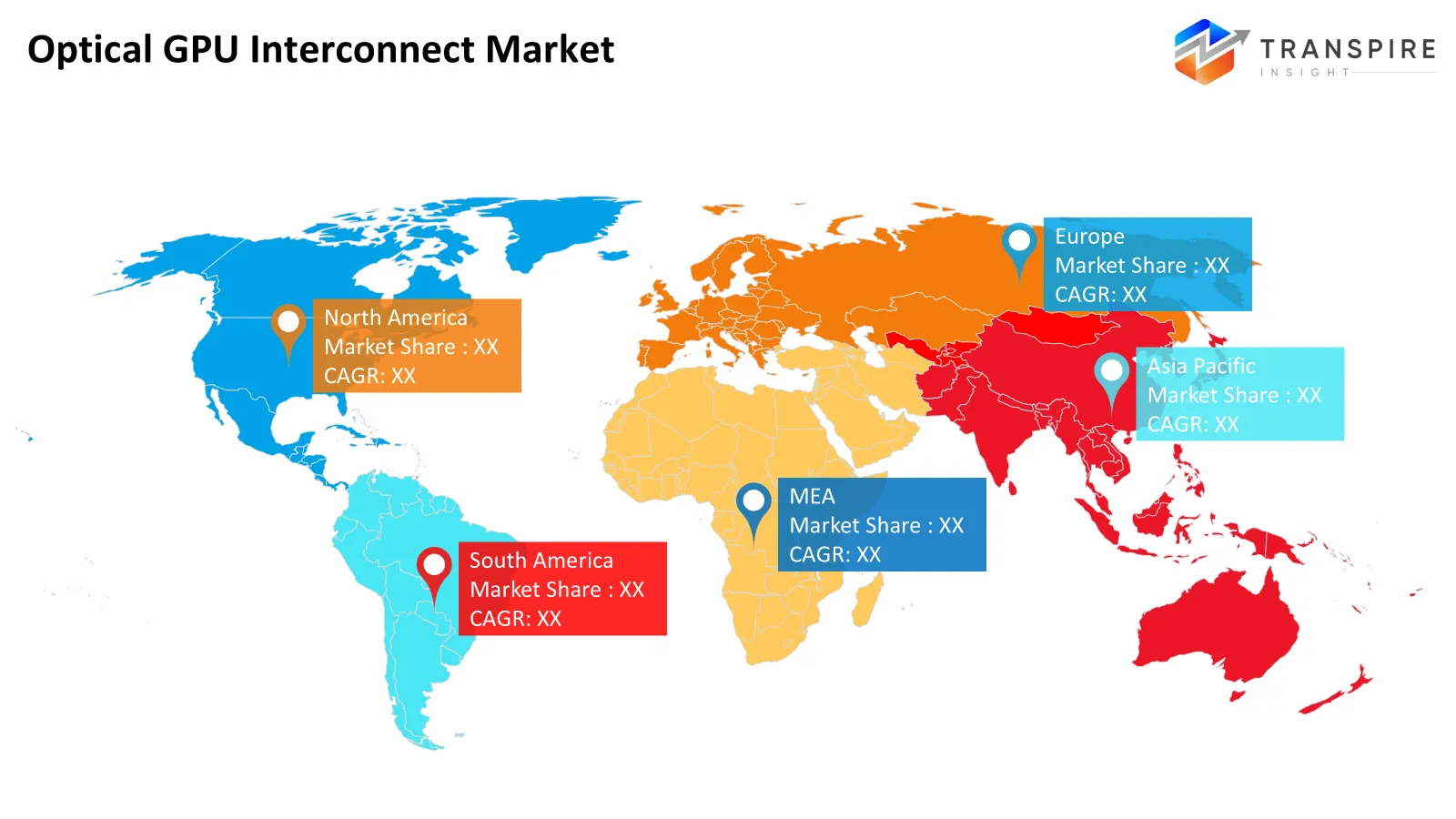
North America leads at 46.32% share of the demand base as hyperscale artificial intelligence factories, graphics processing unit platform vendors, and early adopters of 800G and co-packaged optics are all based there. It benefits from a dense cloud infrastructure, large capital budgets, and a broad ecosystem of suppliers including silicon photonics, lasers, packaging, and networking. Now under increasing policy support, North America Coherent's $50 million CHIPS Act letter of intent (LOI) with the company to add indium-phosphide capacity in Texas highlights how industrial policy is now directly related to the supply of artificial intelligence optics.
In September 2026, Coherent officially unveiled its PhotonLink integrated optics platform at the European Conference on Optical Communication (ECOC). This platform consolidates the company's vertically integrated component capabilities ranging from lasers to silicon photonics specifically designed to power co-packaged optics (CPO) and chip-to-chip connectivity in next-generation AI infrastructure.
Europe has 20.0%, while Europe's growth is more stable than North America since it is relying on sovereign cloud projects, research institutions, high-performance computing centres and industrial artificial intelligence, instead of a few hyperscalers. Core Weave turning its artificial intelligence infrastructure build-out to Copenhagen into an initial 22.5 MW data centre powered by renewable energy gives Europe good potential to build out energy-efficient and policy-compliant artificial intelligence capacity, rather than initially buying into GPU capacity.
In July 2026, the European Commission officially launched a major EuroHPC JU tender and funding initiative to construct up to seven multi-billion-euro AI Gigafactories across Europe.
https://ec.europa.eu/commission/presscorner/detail/en/ip_26_1708
Asia-Pacific represents 25.5% of the market and is expected to grow at a CAGR of 34.27%, making it the fastest-growing region. The build-up of semiconductor manufacturing, optical component production and data centre infrastructure is solidifying its position in the supply chain. The emerging photonics packaging, testing and high-speed transceiver manufacturing ecosystem could benefit from the region's internal investment. China, Japan, South Korea and Taiwan can benefit as artificial intelligence (AI) infrastructure investment increases and next-generation optical architectures move to commercialization.
In September 2026, the Kaohsiung City Government and TSMC broke ground on a new advanced packaging industrial park in Kaohsiung, Taiwan. This multi-hectare infrastructure expansion includes a dedicated technology validation laboratory to test, scale, and optimise next-generation high-performance computing and AI chip packaging ecosystems.
Who are the Key Players in the Optical GPU Interconnect Market, and how do they compete?
Competition is moving from transceiver price and speed to optical input/output standards control, laser supply, packaging capacity, and AI-fabric software. NVIDIA and Broadcom compete with vertically integrated co-packaged optics platforms; module players are competing through manufacturing scale and cost per bit.
NVIDIA's ecosystem approach, including its Spectrum-X and Quantum-X Photonics switches, investments in Coherent and Lumentum, and the NVLink Fusion partnership with Ayar Labs, distinguishes it with an integrated GPU-networking architecture, whereas Broadcom's innovation-led switch approach leverages its expanding Tomahawk-based co-packaged optics platforms and OCI-MSA scale-up standard alongside AMD, Meta, Microsoft, and NVIDIA. Meanwhile, Marvell competes with an acquisition and vertical specialization strategy utilizing Celestial AI's Photonic Fabric and 1.6 terabits Ara digital signal processor portfolio to address memory-hog AI inference; Coherent and Lumentum focusing on supply chain depth through lasers, optical circuit switches, and 1.6 terabits; and Innolight and Fabrinet focusing on scale and cost, with Innolight with leadership in 800 gigabits volume and Fabrinet with a contract manufacturing role in several NVIDIA-related 800 gigabits programs. Leaders, Lightmatter, Ayar Labs, Ranovus, and Dust Photonics leverage optical chiplets, photonic fabrics, and rack-scale co-packaged optics design.
Key Players are:
- NVIDIA
- Broadcom
- AMD
- Intel
- Cisco
- Marvell
- Coherent
- Lumentum
- Applied Optoelectronics
- Fabrinet
- Ayar Labs
- Lightmatter
- Ranovus
- DustPhotonics
- Innolight
Optical GPU Interconnect Market — Enhanced Competitive Benchmarking
|
Company |
Est. Revenue Share Range |
Key Offerings |
Strategic Positioning |
Geographic Strength |
Technology Focus |
|
Broadcom Inc. |
Estimated 12–20% |
Tomahawk 6 Davisson CPO switch; Bailly CPO; silicon photonics optical engines; high-speed Ethernet switching |
Integrated CPO switching leadership for hyperscale AI networks |
North America, Asia Pacific, Europe |
Silicon photonics, 200G/lane CPO, high-bandwidth Ethernet |
|
NVIDIA Corporation |
Estimated 10–18% |
Spectrum-X Photonics; Quantum-X Photonics; NVLink ecosystem; silicon-photonics networking switches |
GPU-network platform integration and AI infrastructure ecosystem control |
North America, Asia Pacific, Europe |
CPO switches, GPU fabrics, power-efficient optical networking |
|
Marvell Technology, Inc. |
Estimated 7–13% |
Photonic Fabric; optical interconnect chiplets; data-center DSPs; high-speed connectivity silicon |
End-to-end connectivity expansion through optical scale-up integration |
North America, Asia Pacific, Europe |
Optical I/O, photonic chiplets, low-latency scale-up fabrics |
|
Intel Corporation |
Estimated 5–10% |
Optical Compute Interconnect (OCI); silicon photonics integrated circuits; optical I/O chiplets |
Integrated silicon manufacturing and optical compute connectivity |
North America, Asia Pacific, Europe |
DWDM, integrated photonics, multi-terabit optical I/O |
|
Coherent Corp. |
Estimated 5–10% |
Advanced optical engines; high-speed lasers; photonic components; datacom optical devices |
Optical component leadership supported by manufacturing investment |
North America, Asia Pacific, Europe |
High-speed lasers, silicon photonics, optical component integration |
|
Lumentum Holdings Inc. |
Estimated 4–8% |
High-speed optical transceivers; 800G coherent transceivers; optical components; laser technologies |
Specialist optical component supplier for high-bandwidth data-center connectivity |
North America, Asia Pacific, Europe |
Indium phosphide photonics, coherent optics, high-speed laser technology |
|
Cisco Systems, Inc. |
Estimated 3–7% |
Silicon One networking silicon; optical networking systems; high-speed optical transceivers; CPO-related networking technologies |
Networking-system integration and enterprise-to-cloud connectivity |
North America, Europe, Asia Pacific |
Silicon photonics, optical networking, high-capacity switching |
|
Ayar Labs, Inc. |
Estimated 1–4% |
TeraPHY optical I/O chiplets; SuperNova multi-wavelength light sources; co-packaged optical I/O |
Specialist optical I/O innovation for next-generation AI scale-up |
North America, Asia Pacific |
Optical I/O chiplets, wavelength-division multiplexing, low-power links |
|
Lightmatter, Inc. |
Estimated 1–4% |
Passage CPO chiplets; Passage optical engines; Guide laser technology; near-packaged optics |
Photonic interconnect differentiation for high-density AI compute systems |
North America, Asia Pacific, Europe |
Photonic engines, DWDM, CPO and near-packaged optics |
|
Ranovus Inc. |
Estimated 1–3% |
ODIN optical engines; CPO and NPO platforms; multi-terabit optical interconnects |
Power-efficient optical engine specialization for AI infrastructure |
North America, Asia Pacific, Europe |
Monolithic electronic-photonic integration, multi-terabit CPO, low-power optics |
Recent Development News
- In September 2026, Coherent Corp. launched its PhotonLink integrated optics platform for AI infrastructure, supporting co-packaged optics, near-packaged optics and emerging chip-to-chip connectivity. The platform combines lasers, silicon photonics, optical fibres, and detectors with assembly and testing capabilities to simplify integration and support high-bandwidth, energy-efficient connectivity in next-generation AI data centres. https://www.coherent.com/news/press-releases/launches-photonlink-integrated-optics-platform-ai-infrastructure
- In August 2026, Aeva launched its Optical Connectivity business and signed a joint development agreement with a high-speed optical-engine provider serving a major hyperscaler. The initiative applies its high-power optical sources and silicon photonics technology to near-packaged and co-packaged optics, with initial deployment. https://www.aeva.com/press/aeva-launches-optical-connectivity-business-signs-first-customer-agreement-for-a-major-hyperscaler/
- In October 2026, Kopin Corporation, in partnership with Fabric.AI, released its Neural I/O technical white paper modelling a massively parallel MicroLED-based optical interconnect architecture. This micro-display hardware integration maps a path to break the data centre "copper wall," increasing useful training throughput by up to 1.6 times and letting large GPU clusters reduce total workload execution times. https://www.kopin.com/press-releases/kopin-analysis-finds-optical-interconnect-architecture-could-break-the-data-center-copper-wall/
What Strategic Insights Define the Future of the Optical GPU Interconnect Market?
The market is heading towards a hybrid architecture, with pluggable transceivers taking the lion's share in the short term, while CPO and optical I/O chiplets are set to dominate scale-up GPU fabrics. One of the biggest inherent risks is with laser and advanced-packaging capacity: if EML, CW-laser, and InP do not grow, then 1.6T and CPO scale-up ramp can be delayed even with the strongest GPU demand. Optical shared memory and photonic-fabric connectivity for inference is a new playfield; Marvell Photonic Fabric and Lightmatter Passage M1000 (114 Tbps) show that it is not compute power, but memory bandwidth that will become the new bottleneck. From a strategy point of view, vendors should lock down multi-year laser, substrate, and package capacities, and develop products to align with open standards such as OCI-MSA; buyers should qualify two optical suppliers per speed class to de-risk concentrations over 800G, 1.6T, and CPO platforms.
Key Segmentations are:
Product Type
- Optical Transceivers
- Embedded Optical Modules
- Optical Engines
- Co-Packaged Optics
- Active Optical Cables
- Optical Switches
- Photonic Integrated Circuits
- Others
Interconnect Level
- Board-to-Board
- Rack-Level
- Chip-to-Chip
- GPU-to-GPU
- Rack-to-Rack
- Node-to-Node
- Cluster-Level
- Others
Fibre Mode
- Multimode Fibre
- Single-Mode Fibre
- Parallel Fibre
- Ribbon Fibre
- Active Optical Fibre
- Hybrid Fibre
- Silicon Photonics Fibre
- Others
Data Rate
- Below 100 Gbps
- 100–400 Gbps
- 400–800 Gbps
- Above 800 Gbps
- 1.6 Tbps
- 3.2 Tbps
- Custom High-Speed
- Others
Application
- Data Communication
- AI Training
- AI Inference
- HPC
- Cloud Computing
- Data Centres
- Networking
- Others
End User
- Hyperscalers
- Cloud Service Providers
- AI Companies
- Enterprise Data Centres
- Research Institutions
- Telecom Operators
- Government
- Others
By Regional Analysis
North America
- US
- Canada
- Mexico
Europe
- Germany
- UK
- France
- Italy
- Spain
- Russia
- Rest of Europe
Asia Pacific
- China
- Japan
- India
- South Korea
- Australia
- Rest of Asia Pacific
South America
- Brazil
- Argentina
- Rest of South America
Middle East & Africa
- UAE
- Saudi Arabia
- Qatar
- South Africa
- Rest of the Middle East & Africa
Frequently Asked Questions
Find quick answers to common questions.
The optical GPU interconnect market size was valued at USD 1.93 billion in 2025 and is poised to reach USD 18.51 billion by 2033, expanding at a 31.65% CAGR.
Key segments for the optical GPU interconnect market are Product Type (Optical Transceivers, Embedded Optical Modules, Optical Engines, Co-Packaged Optics, Active Optical Cables, Optical Switches, Photonic Integrated Circuits, Others)Interconnect Level (Board-to-Board, Rack-Level, Chip-to-Chip, GPU-to-GPU, Rack-to-Rack, Node-to-Node, Cluster-Level, Others)Fiber Mode (Multimode Fiber, Single-Mode Fiber, Parallel Fiber, Ribbon Fiber, Active Optical Fiber, Hybrid Fiber, Silicon Photonics Fiber, Others)Data Rate (Below 100 Gbps, 100–400 Gbps, 400–800 Gbps, Above 800 Gbps, 1.6 Tbps, 3.2 Tbps, Custom High-Speed, Others)Application (Data Communication, AI Training, AI Inference, HPC, Cloud Computing, Data Centers, Networking, Others)End User (Hyperscalers, Cloud Service Providers, AI Companies, Enterprise Data Centers, Research Institutions, Telecom Operators, Government, Others).
Growth is primarily driven by the expansion of AI training clusters, rising deployment of high-speed optical transceivers, increasing bandwidth requirements between GPUs, and the shift toward silicon photonics and co-packaged optics to improve energy efficiency and data transmission performance.
The market is led by major manufacturers, including NVIDIA, Broadcom, AMD, Intel, Cisco, Marvell, Coherent, Lumentum, Applied Optoelectronics, Fabrinet, Ayar Labs, Lightmatter, Ranovus, DustPhotonics, and Innolight.
North America holds a 46.32% market share, supported by hyperscaler investments, advanced AI infrastructure, semiconductor innovation, and strong collaboration between GPU developers and optical component suppliers.
Commercial opportunities include co-packaged optics, silicon photonics, embedded optical modules, 1.6 Tbps connectivity, and expansion of optical component manufacturing for next-generation AI data centres.
- NVIDIA
- Broadcom
- AMD
- Intel
- Cisco
- Marvell
- Coherent
- Lumentum
- Applied Optoelectronics
- Fabrinet
- Ayar Labs
- Lightmatter
- Ranovus
- DustPhotonics
- Innolight
About the Authors

Avinash Kumar
I’m Avinash Kumar, a Senior Research Analyst at Transpire Insight, with expertise in the Electronics and Semiconductor and Energy & Power industry. My work focuses on analyzing emerging technologies, market trends, industry developments, and innovation across these sectors. I specialize in transforming complex technical and market insights into clear, research-backed content that helps professionals, businesses, and decision-makers stay informed. Through continuous industry research and data-driven analysis, I strive to deliver accurate, reliable, and practical perspectives on the latest advancements shaping the semiconductor and energy landscape.

Chakradhar Khansole
Chakradhar serves as the Research Director at Transpire Insight, bringing over 8 years of experience in technology, innovation, and strategic market intelligence. He specializes in transforming complex market data into actionable business insights that enable organizations to make informed, growth-oriented decisions. Recognized for his strategic vision and analytical expertise, Chakradhar leads high-impact research initiatives, delivering comprehensive market assessments, competitive intelligence, and forward-looking industry analysis.
Recently Published Reports
-
Apr 2026
Fiber Optic Faceplates Market
Fiber Optic Faceplates Market Size, Share & Analysis Report By Type (< 300 mm2, 300-350 mm2, and > 350 mm2, By Application (Night Vision, Holographic Imaging, Medical, and Others), and Geography (North America, Europe, Asia-Pacific, Middle East and Africa, South and Central America), 2021 - 2031
-
Apr 2026
High Temperature Superconductors Market
High Temperature Superconductors Market Size, Share & Analysis Report By Type (1G HTS, and 2G HTS), By Application (Power Cable, Fault Current Limiter, and Transformer), and Geography (North America, Europe, Asia-Pacific, Middle East and Africa, South and Central America), 2021 - 2031
-
Apr 2026
Industrial Plugs and Socket Market
Industrial Plugs and Socket Market Size, Share & Analysis Report By Type (Industrial Plugs, Industrial Sockets), By Current (Up to 32 A, 32 to 125 A, Above 125 A), By Protection (Dustproof and Splash Proof, Waterproof, Explosion Proof), By End User (Heavy Industries, Oil and Gas, Chemicals and Pharmaceuticals, Power Generation, Others), and Geography (North America, Europe, Asia-Pacific, Middle East and Africa, South and Central America), 2021 - 2031
-
Apr 2026
InGaAs Avalanche Photodiodes Market
InGaAs Avalanche Photodiodes Market Size, Share & Analysis Report By Type (1100 - 1700 nm, and 1000 - 1600 nm), By Application (Missile Warning System, Muzzle Flash Detection, Wafer Defect Inspection, Laser Rangefinders, and Others), and Geography (North America, Europe, Asia-Pacific, Middle East and Africa, South and Central America), 2021 - 2031