
Oil and Gas Electric Submersible Pump Market Summary:
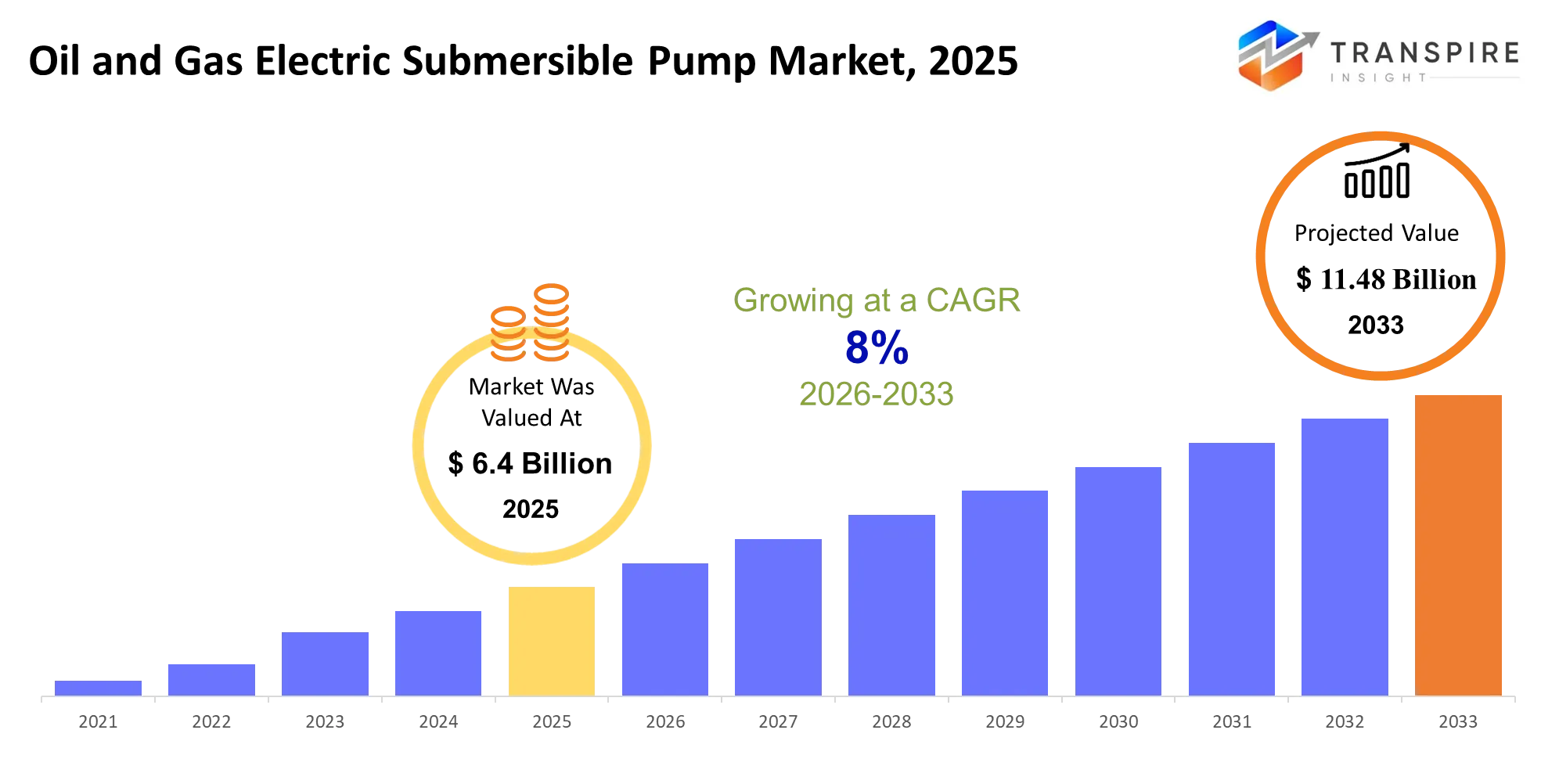
As per the Transpire Insight Analysis, The Oil and Gas Electric Submersible Pump Market size is estimated at USD 6.4 billion in 2025 and is anticipated to reach USD 11.48 billion by 2033, growing at a CAGR of 8% from 2026 to 2033.
Oil and gas Electric Submersible Pumps (ESPs) are employed for lifting reservoir fluids to the surface when natural pressure is unable to support economic output. The systems are especially critical for mature wells, offshore projects, and high-capital onshore fields where every minute of pump failure equates to an immediate production delay. In recent years, the market has shifted away from hardware refreshes to integrated lift packages, including robust motors, superior gas handling, variable-speed drives and automated management and deployment. Cost control and methane mitigation concerns, and the drive to minimize counterproductive emissions, energy wastage and repeated interventions, mean producers are increasingly seeking high-reliability ESPs, extending the initial capital cost of the equipment and technology through prolonged deployment. Growth is thus not simply attributed to incremental drilling activity, but instead to sustaining new field life, bringing constrained production online, squeezing greater efficiency from existing assets and better operating economics.
Oil and Gas Electric Submersible Pump Market Size & Forecast:
- Market Size 2025: USD 6.4 Billion
- Expected Market Value (2033): USD 11.48 Billion
- Forecast CAGR (2026–2033): 8%
- Leading Region in 2025: North America
- Fastest Growing Region: Middle East and Africa
- Key Company Profiles: SLB, Baker Hughes, Halliburton, Weatherford, Borets, Novomet, Schlumberger, Dover Artificial Lift, Alkhorayef Petroleum, General Electric, Tenaris, Ebara, Sulzer, Grundfos, Summit ESP.
Key Oil and Gas Electric Submersible Pump Market Insights:
Reliability-as-a-service is becoming more important than pump replacement in the market, where operators are prioritising uptime, energy efficiency and avoiding unnecessary intervention over pump cost. This behaviour is driving suppliers towards local production, high-temperature machines and digital lift.
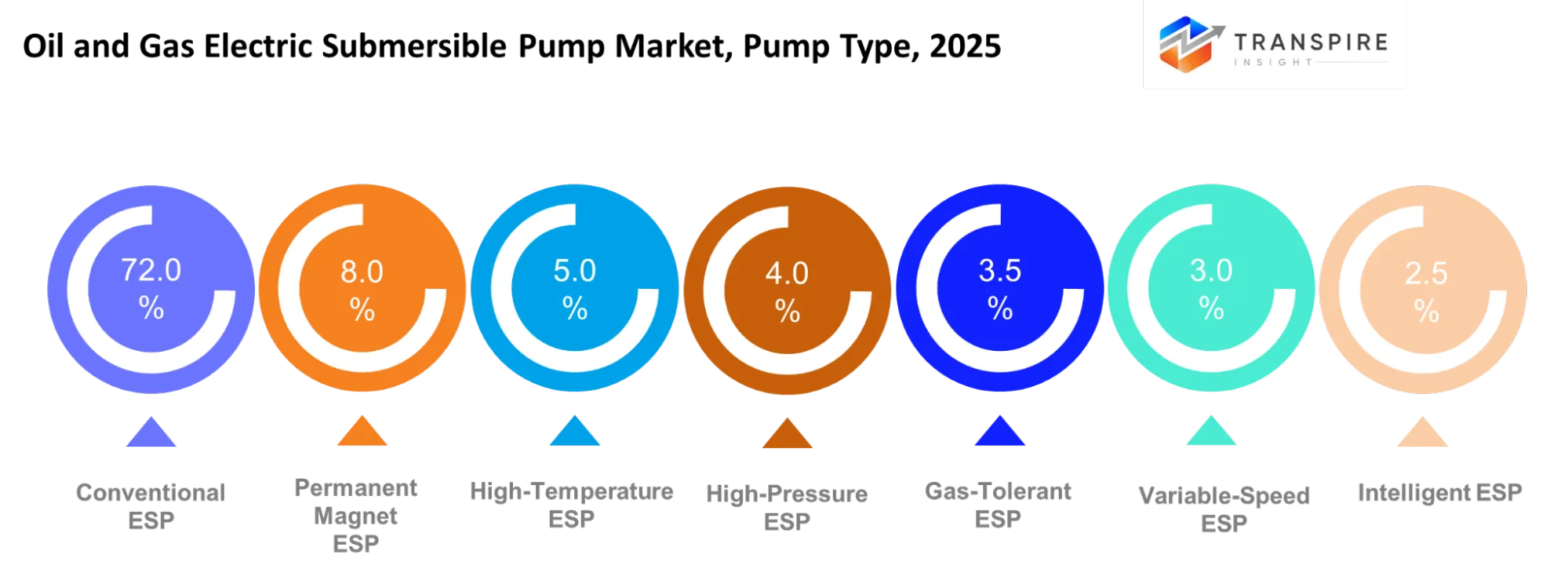
- Vendors are redefining the conventional lift in and around more broadly targeted operating ranges and reduced emissions, as seen with SLB's Reda Agile and PowerEdge systems, keeping conventional ESPs at 72.0% of the market.
- Permanent magnet ESPs account for 9.5% and are progressing steadily in Novomet's cable capacity of 180 km per month and capability for hot & deep wells.
- High-temperature ESPs are 5.0%; Baker Hughes developed an ESP above 200°C, which it commercialised after Middle East and Permian validation.
- ESPs with Gas Tolerant (GT) components represent 3.5% and separator designs have been increased to improve performance in gassy unconventional wells.
- Variable-speed ESPs are a control layer, with 3.0% increasing as operators adjust lift rates to the variable reservoir inflow.
- SLB's LIFT IQ is being used on 1,200 Aramco wells, as intelligent ESPs advance into AI-powered surveillance.
- The Kuwait Oil Company (KOC) project for Baker Hughes is a sign of interest in bundled ESP systems and production-enhancement services.
- The ChampionX acquisition adds to SLB's artificial-lift, chemistry, automation and optimisation capabilities.
- The localisation and supply-chain resilience strategies are being implemented by Borets' Sawafi project, which is developing Saudi capacity for 500 ESPs per year.
- The six-year contracts for weather forecasting and installation from Ecopetrol, in addition to the contracts for weather forecasts, indicate a transition to long cycles of service partnerships.
What are the Key Drivers, Restraints, and Opportunities in the Oil and Gas Electric Submersible Pump Market?
Driver:
ESP adoption is supported by declining reservoir pressure, mature-field redevelopment, and production targets that prioritize existing wells. The trigger is the rising cost of drilling replacement wells, alongside the need to sustain flow from assets whose natural lift has weakened. Operators install or upgrade ESPs to restore production and improve recovery per well; this also creates recurring demand for motors, cables, protectors, monitoring and field services. Digital production programs enable remote adjustment and earlier intervention across producing assets and operational teams.
Restraint:
ESP systems remain costly to install, power and maintain, particularly in deep, offshore, high-temperature or gas-prone wells. Harsh downhole conditions accelerate motor, cable and hydraulic failures, while workovers require expensive rigs or specialized intervention. This exposure persists because pumps operate in inaccessible environments, and fluid composition, pressure, and temperature can change unpredictably. Smaller operators may defer upgrades when cash flow weakens.
Opportunity:
Digital and efficiency-led upgrades. AI-enabled surveillance, IoT sensing, and PMM retrofits can unlock growth by converting ESPs from periodic-replacement assets into continuously optimised systems. For example, SLB’s LIFT IQ deployment with Saudi Aramco across 1,200 wells targets production optimization and predictive intervention, while Baker Hughes’ ClearLIFT platform is designed to reduce unplanned failures. The opportunity is strongest where operators can justify premium equipment through lower power bills, fewer workovers, and longer pump life.
Driver Impact Analysis – Oil and Gas Electric Submersible Pump (ESP) Market
|
Driver |
Relative Impact on Growth (%) |
Geographic Relevance |
Impact Timeline |
Demand Strength |
Growth Mechanism |
Key Beneficiaries |
Major Constraint |
|
Mature oilfield revitalization and declining reservoir pressure |
28% |
North America, Middle East, Latin America |
Short-term (≤2 years) |
High |
Maintains production from depleted reservoirs through artificial lift. |
ESP manufacturers, field operators, artificial lift service providers |
High installation costs and uncertain remaining reservoir productivity. |
|
Rising unconventional oil production and shale development |
23% |
North America, particularly the United States and Canada |
Medium-term (2–4 years) |
High |
Supports high-volume extraction from horizontal and unconventional wells. |
Pump manufacturers, shale operators, completion and well-service companies |
Reservoir complexity, gas interference, and volatile oil prices. |
|
Deepwater and offshore exploration investments |
19% |
Brazil, Gulf of Mexico, Middle East, Asia-Pacific |
Long-term (≥4 years) |
High |
Enables reliable fluid lifting from deep and complex offshore reservoirs. |
Offshore ESP suppliers, subsea engineering firms, oilfield technology providers |
High capital expenditure and challenging offshore operating conditions. |
|
Advanced ESP technology, automation, and digital optimization |
17% |
North America, Europe, Middle East |
Medium-term (2–4 years) |
High |
Predictive monitoring reduces failures, downtime, and operating costs. |
Digital technology vendors, ESP manufacturers, operators, maintenance providers |
Integration complexity, cybersecurity risks, and legacy infrastructure. |
|
Energy efficiency, production optimization, and sustainability investments |
13% |
Europe, North America, Middle East, Asia-Pacific |
Long-term (≥4 years) |
Medium |
Efficient motors and variable-speed drives reduce energy consumption. |
Energy-efficient ESP suppliers, oilfield operators, electrical equipment vendors |
Upfront investment, electricity availability, and oil-price uncertainty. |
|
Total |
100% |
— |
— |
— |
— |
— |
— |
What Has the Impact of Artificial Intelligence Been on the Oil and Gas Electric Submersible Pump Market?
AI is enabling ESPs to evolve from manually supervised machines to autonomous production assets. As downhole and surface data-vibration, temperature, pressure, current, flow, and power quality-are gathered and integrated, AI models can distinguish between incipient equipment failure and reservoir condition variation. Armed with this knowledge, operators can schedule maintenance to avoid failures caused by those bellwethers, such as gas lock, scale formation, bearing or seal fatigue, or rotor stress, before catastrophic failure occurs. AI can also facilitate automation and optimization. Variable speed drives can learn to vary the frequency of a pump in response to inflow variation; some AI models suggest operating parameters that optimize production at a given rate of energy input or equipment stress. Field-focused platforms such as SK Well Pages and SLB's DELFI Production Operations Suite are being assembled to collect ESP data for faster decision-making. With the latter comes less downtime, longer equipment run life, and steadier output; one AI optimization strategy extended pump life by as much as 20%.
The greatest constraint relates to the quality of deployment. The precision of the AI is reliant on: representative historical failure data, trustworthy sensors, cybersecurity controls, and human oversight. Inadequate data and inconsistent instrumentation can result in anomalous reports that fail to identify failures or predict false alarms. Additionally, interfacing with existing control systems and the costs of retrofitting aging wells prevent the technology from being implemented at scale.
In May 2026, Halliburton and Shape Digital formed a strategic collaboration to merge subsurface and surface operational intelligence across production systems using artificial intelligence. The integrated platform combines Halliburton Landmark's Digital Field Solver (DFS) with Shape Digital's applied AI technologies to link live equipment conditions, energy efficiency, and reservoir behaviour in real time. https://worldoil.com/news/2026/5/6/halliburton-shape-digital-target-production-optimization-with-ai-asset-management/
Key Oil and Gas Electric Submersible Pump Market Trends:
The ESP market is shifting from merely equipment supply to a focus on performance guarantees, with the value now being defined not just by the horsepower of the pump, but by the time it's up and running, the amount of energy saved, and the number of workovers avoided.
- Operators are moving away from induction motors to permanent magnet motors due to the need for increased efficiency, wellbore power density, and reduced heat in a confined wellbore.
- Variable speed operation is becoming more common since it allows the operator to adjust the lift rate as the reservoirs feed into the plant change.
- Artificial Intelligence-driven failure prediction is moving the needle from reactive to predictive maintenance using vibration, current, and temperature signatures.
- The introduction of the “smart ESPs” enabled by IoT is bringing downhole assets onto a remote production dashboard, cutting down on site visits and allowing central monitoring.
- Designs that are tolerant to gas and improved separators take on greater significance as unconventional and gassy wells test conventional pumps to the limits of gas interference.
- As water cuts, solids and chemistry in mature fields grow, operators are turning to sand-tolerant and corrosion-resistant materials.
- To meet the challenges of horizontal drilling, shale operators are now embracing ESP systems that are optimized for unconventional wells, and ESP sales for unconventional wells increased 28% year over year in 2025.
- Digital twins and pre-deployment simulation are being applied for lift performance validation before installation to minimise design risk in deepwater and complex wells.
- Energy efficiency has become a purchasing requirement – PMM and low-speed systems achieve tangible power savings and low emissions.
- Service providers are now offering analytics subscriptions along with hardware, helping to create a digital-services revenue stream from ESP reliability.
Oil and Gas Electric Submersible Pump Market Segmentation
Pump Type:
Conventional ESPs make up 72.0% of the market by pump type, reflecting the maturity of their design, the high number of available suppliers, and their ability to perform on a daily basis in most artificial-lift conditions. Permanent-magnet ESPs account for 8.0% of the market with a CAGR of 9.5%, a sign of the increasing adoption of these systems driven by the pursuit of the highest possible energy efficiency and the desire for small-footprint motors. High-temperature ESPs constitute 5.0%, and high-pressure ESPs constitute 4.0%, targeting the most-demanding well environments. Gas-tolerant ESPs constitute 3.5%, variable-speed ESPs account for 3.0%, intelligent ESPs make up 2.5%, and others constitute 2.0%, all seeking to address specific production challenges.
Application:
Onshore operations form the deployment base, supported by shale, heavy-oil, mature-field, and unconventional-well production. Offshore projects require dependable equipment because interventions involve substantial costs, logistical complexity and operational downtime. Enhanced oil recovery and other specialized applications create additional opportunities as operators seek to extend asset life, improve reservoir productivity and maintain output from increasingly challenging wells.
Component:
Motors, pumps and protectors remain fundamental to ESP performance, efficiency and durability. Intakes, cables, sensors, power supplies and other components increasingly influence system reliability through electrical integrity, fluid handling and operational monitoring. Component selection depends on well conditions, fluid characteristics, and operating requirements. Integrated designs and improved diagnostics help operators identify potential failures, reduce unplanned shutdowns, and support longer equipment service intervals.
Power Rating:
Below-100-HP and 100–300-HP systems serve comparatively lower-load wells, while 300–500-HP and 500–750-HP units support higher production requirements. Systems rated 750–1,000-HP, above-1,000-HP, high-power ESPs, and other configurations address demanding lifting conditions. Selection depends on well depth, fluid volume, reservoir pressure, pump performance, and required lift capacity, balancing production targets with energy consumption and operating costs.
Well Type:
Vertical wells generally support simpler installation and equipment configuration, whereas horizontal, directional and deviated wells require application-specific designs. Deep, high-pressure and high-temperature wells impose greater engineering demands on motors, cables, materials and thermal management. Equipment selection must account for trajectory, operating environment and intervention constraints. Other well configurations remain specialized, with design decisions influenced by reservoir characteristics, production objectives and reliability expectations.
End User:
National and international oil companies influence procurement volumes, equipment specifications and technology standards across major projects. Independent producers and shale operators prioritize cost efficiency, uptime, and rapid deployment, while oilfield service companies support equipment integration and operational performance. Offshore operators emphasize reliability and intervention reduction. Private operators and other end users increasingly evaluate lifecycle support, maintenance capabilities, and production optimization when selecting ESP systems.
What are the Key Use Cases Driving the Oil and Gas Electric Submersible Pump Market?
The core use case is artificial lift in mature, pressure-depleted onshore wells, aligned with conventional ESPs’ 72.0% share. Operators sustain flow, stabilize output, and defer drilling or workovers. Pump, motor, protector and cable reliability affect production continuity.
Expanding applications include shale, unconventional wells, heavy oil and offshore fields. Horizontal, deviated and deep wells require tailored sizing, gas handling, power and monitoring. Offshore operators value systems that reduce interventions.
Emerging use cases centre on intelligent ESP fleets, permanent-magnet upgrades, variable-speed optimization and AI-supported failure prediction. These tools manage power, identify gas interference and schedule maintenance before shutdowns. Their value is highest where wells are costly to access, and production losses justify upgrades.
|
Report Metrics |
Details |
|
Market size value in 2025 |
USD 6.4 Billion |
|
Market size value in 2026 |
USD 6.7 Billion |
|
Revenue forecast in 2033 |
USD 11.48 Billion |
|
Growth rate |
CAGR of 8% from 2026 to 2033 |
|
Base year |
2025 |
|
Historical data |
2021 - 2024 |
|
Forecast period |
2026 - 2033 |
|
Report coverage |
Revenue forecast, competitive landscape, growth factors, and trends |
|
Regional scope |
United States; Canada; Mexico; United Kingdom; Germany; France; Italy; Spain; Denmark; Sweden; Norway; China; Japan; India; Australia; South Korea; Thailand; Brazil; Argentina; South Africa; Saudi Arabia; United Arab Emirates |
|
Key companies profiled |
SLB, Baker Hughes, Halliburton, Weatherford, Borets, Novomet, Schlumberger, Dover Artificial Lift, Alkhorayef Petroleum, General Electric, Tenaris, Ebara, Sulzer, Grundfos, Summit ESP. |
|
Customization scope |
Free report customization (country, regional & segment scope). Available customized purchase options to meet your exact research needs. |
|
Report Segmentation |
Pump Type (Conventional ESP, Permanent Magnet ESP, High-Temperature ESP, High-Pressure ESP, Gas-Tolerant ESP, Variable-Speed ESP, Intelligent ESP, Others)Application (Onshore, Offshore, Shale, Heavy Oil, Mature Fields, Unconventional Wells, Enhanced Oil Recovery, Others)Component (Motor, Pump, Protector, Intake, Cable, Sensor, Power Supply, Others)Power Rating (Below 100 HP, 100–300 HP, 300–500 HP, 500–750 HP, 750–1,000 HP, Above 1,000 HP, High-Power ESP, Others)Well Type (Vertical Wells, Horizontal Wells, Directional Wells, Deviated Wells, Deep Wells, High-Pressure Wells, High-Temperature Wells, Others)End User (National Oil Companies, International Oil Companies, Independent Producers, Oilfield Service Companies, Offshore Operators, Shale Producers, Private Operators, Others) |
Which Regions are Driving the Oil and Gas Electric Submersible Pump Market Growth?
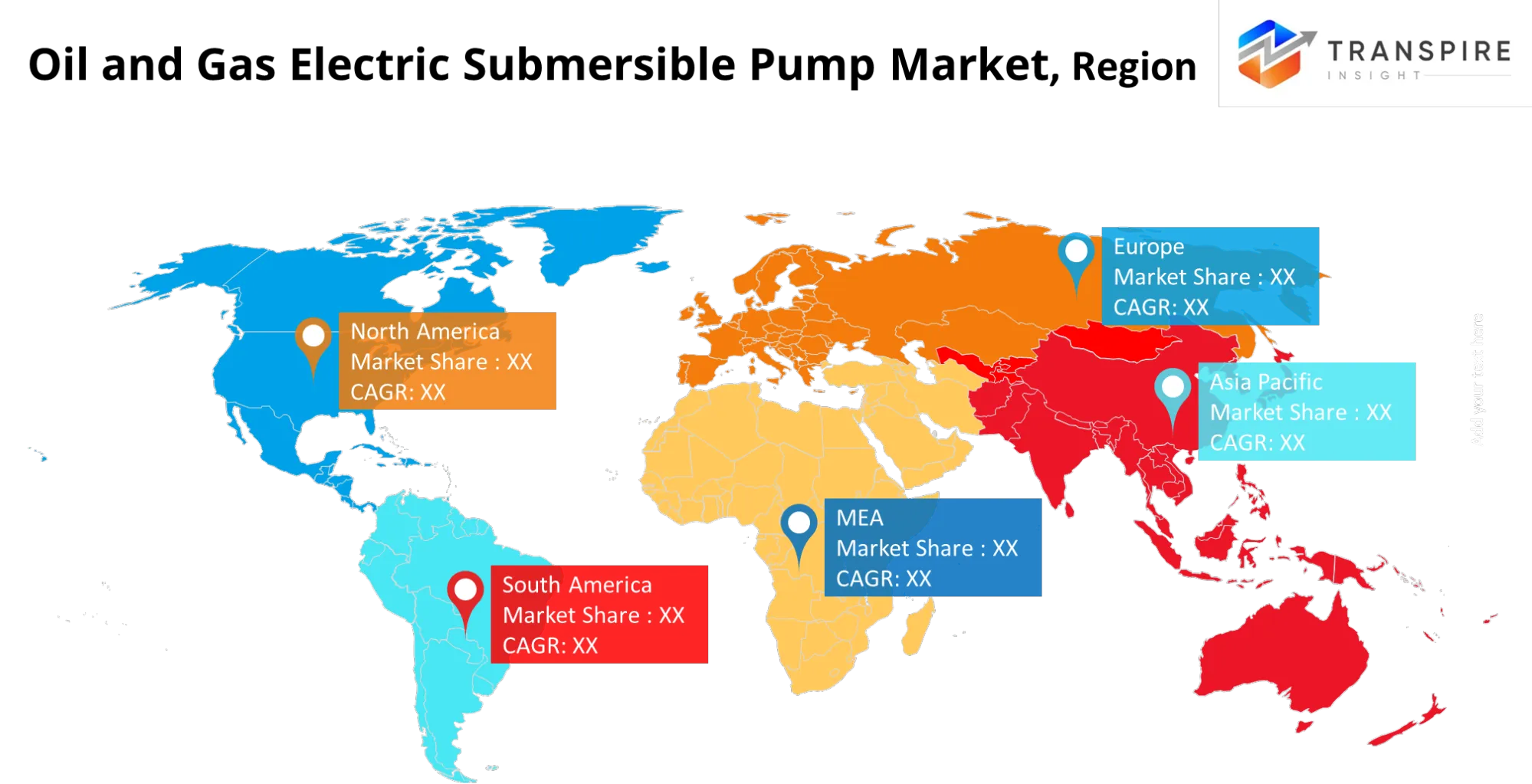
North America is the market leader, accounting for 38.5% of the share. Mature onshore fields, the Permian Basin, and significant levels of unconventional shale activity, where falling reservoir pressure leaves conventional wells in need of ongoing artificial lift, have all contributed to North America's lead. A large oilfield-service infrastructure, fast pace of technology adoption, operators willing to use digital and high-temperature ESP systems, and policy and commercial push to reduce flaring and energy intensity have all supported the performance of efficient PMM and variable speed designs.
In October 2026, Flowco Holdings Inc. closed the strategic acquisition of Lifting Solutions Energy Services Inc. This transaction expands Flowco's production optimization and artificial lift portfolio by incorporating progressing cavity pumps (PCP) and continuous rod technologies deployed across mature land-based wells in the United States and Canada. https://ir.flowco-inc.com/news-events/news/news-details/2026/Flowco-Broadens-Production-Optimization-Portfolio-Through-Strategic-Acquisition-of-Lifting-Solutions/default.aspx
Asia Pacific holds 18.5% of the market compared to the established magnitude of North America. Mature offshore assets, ongoing energy demand, and nation-driven production programs position Asia Pacific favourably. Demand is diversified between China, India, Southeast Asia, and Australia, reducing exposure to individual basins. State-supported operators, offshore engineering capacity, and production-focused programs support procurement, driven by both field redevelopment and operational excellence.
In June 2026, ONGC signed a Technical Services Contract with bp. This strategic operational partnership authorizes bp to optimize 43 mature blocks across India's Western Offshore Basin (excluding Mumbai High), aiming to leverage brownfield expertise to moderate natural production declines and boost the basin's combined oil and gas output. https://scanx.trade/stock-market-news/companies/ongc-and-bp-enter-agreement-to-boost-production-in-western-offshore-basin/43920971
Middle East and Africa represent 24.0% of the market and display the strongest regional growth, with a CAGR of 8.1% supported by focus on production restoration, mature-field redevelopment, and recovery optimization. Multi-year artificial-lift contracts support the increasing demand for ESP equipment and lifecycle services. Kuwait, Oman, Saudi Arabia, and the United Arab Emirates are key for the integration of packages with pump, monitoring, and maintenance. Geopolitical unrest, logistical barriers, and project timing remain risks to execution.
In February 2026, Alkhorayef Petroleum Services secured a major five-year artificial lift tender from Petroleum Development Oman (PDO). This partnership marks the company’s strategic return to Oman's energy sector after nearly two decades, deploying advanced engineering and pump packages to optimize mature-field recovery assets managed by the national oil company. https://www.saudigulfprojects.com/2026/02/alkhorayef-petroleum-services-secures-major-artificial-lift-contract-from-petroleum-development-oman/
Who are the Key Players in the Oil and Gas Electric Submersible Pump Market, and how do they compete?
The competitive landscape has transitioned from an ESP equipment environment to the overall production performance environment. Competition has expanded into run life, digital optimisation, energy efficiency, and local capability for services. The combined market share of SLB, Baker Hughes, Halliburton, Weatherford and Borets in this larger artificial-lift market now accounts for 57%, all leaning towards scale and technology depth.
SLB's approach is to innovate and integrate with the best technology and solutions: Reda Agile and Power Edge systems for optimisation and installation flexibility; the ChampionX acquisition for production chemistry, automation and optimisation. SLB has differentiating end-to-end lift-to-production systems and platform technology in LIFT IQ and remote surveillance. Baker Hughes' artificial intelligence-based optimization and high-end specification equipment contribute to its differentiation. Leucipa Lift Optimizer is installed with Repsol, and its above-200°C ESP system differentiates it for digital control and challenging well applications. Its reach is growing rapidly through awards such as those from Kuwait Oil Company. Weatherford adopts a service-based growth model, gaining multi-year contracts with Ecopetrol as well as establishing a foothold in Saudi Arabia's Jafurah field. Halliburton combines intelligent completions with a Smart Well-linked digital control system. Borets, Novomet, Summit ESP, Alkhorayef Petroleum, Dover Artificial Lift, GE, Tenaris, Ebara, Sulzer, and Grundfos are competing by having regional manufacturing and well-trained personnel, offering designs for demanding environments, or through competitive OEM aftermarket support.
Key Players are:
- SLB
- Baker Hughes
- Halliburton
- Weatherford
- Borets
- Novomet
- Schlumberger
- Dover Artificial Lift
- Alkhorayef Petroleum
- General Electric
- Tenaris
- Ebara
- Sulzer
- Grundfos
- Summit ESP
Oil and Gas Electric Submersible Pump Market — Enhanced Competitive Benchmarking
|
Company |
Est. Revenue Share Range |
Key Offerings |
Strategic Positioning |
Geographic Strength |
Technology Focus |
|
SLB |
7–10% |
REDA ESP systems, Agile, MaxFORTE, rigless deployment, ESP controls |
leader combining integrated artificial lift expertise and services |
North America, Middle East, Latin America |
High-performance ESPs, digital surveillance, gas handling, rigless deployment |
|
Baker Hughes |
5–8% |
Centrilift ESP systems, CENtrilift pumps, motors, ESP monitoring, controls |
Integrated artificial lift provider emphasising reliability and production optimisation |
North America, Middle East, Latin America |
ESP predictive analytics, gas separation, remote monitoring, variable-speed controls |
|
Halliburton |
4–7% |
Summit ESP systems, horizontal pumping systems, SpyGlass pump-sizing software, maintenance services |
Service-led competitor emphasising tailored pumping solutions and operational reliability. |
North America, Middle East, Latin America |
Pump simulation, ESP sizing software, run-life optimisation, performance monitoring |
|
Borets International |
4–7% |
ESP pumps, permanent magnet motors, gas handlers, downhole sensors, VSDs |
Vertically integrated ESP specialist competing through manufacturing and field services |
Europe, Middle East, North America |
Permanent magnet motors, gas management, sand control, downhole monitoring |
|
Novomet |
3–6% |
Standard ESP, PowerSave, Colibri rigless ESP, Impala extended-range ESP |
Innovation-led challenger focused on energy efficiency and specialised well applications |
Europe, Russia/CIS, Middle East |
Permanent magnet motors, high-efficiency pump stages, compact ESP architecture |
|
Weatherford International |
3–5% |
ESP artificial lift systems, ESP monitoring, production optimisation services |
Artificial lift competitor leveraging integrated production solutions and service networks. |
North America, Middle East, Latin America |
Digital production optimisation, ESP monitoring, autonomous artificial lift |
|
Alkhorayef Petroleum |
2–4% |
SPECTRUM ESP systems, motors, protectors, gas separators, VSDs |
Regional specialist combining local manufacturing and responsive field support |
Middle East, Africa, Asia Pacific |
Gas handling, high-temperature ESPs, corrosion resistance, downhole monitoring |
|
Canadian Advanced ESP |
1–3% |
ESP systems, horizontal pumping systems, ACT VFDs, advanced monitoring |
Independent engineering specialist serving demanding oilfield applications |
North America, Latin America |
High-pressure ESPs, variable-frequency drives, monitoring, custom engineering |
|
DOS Canada |
1–3% |
ESP systems, artificial lift equipment, related field services |
Independent challenger emphasising specialised artificial lift equipment and customer service |
North America, Latin America |
ESP engineering, pump configuration, application-specific equipment |
|
Extract Production Services |
1–2% |
ESP systems, horizontal pumping systems, artificial lift equipment, field services |
Independent specialist competing through flexibility and customer-focused service |
North America |
ESP system integration, application engineering, field performance optimisation |
Recent Development News
- In January 2026, SLB secured two five-year contracts from Petroleum Development Oman to supply wellheads and artificial lift technologies, including electric submersible pumps, for Block-6 operations. The contracts support production efficiency, improved hydrocarbon recovery, and localized ESP assembly and manufacturing capabilities in Oman. https://www.slb.com/newsroom/press-release/2026/pr-2026-0128-slb-pdo-contract
- In January 2026, KSB SE & Co. KGaA launched the Omega 2 pump series. The release optimizes fluid-handling hydraulics and improves structural reliability with replaceable components that simplify maintenance routines across highly demanding processing environments. https://www.ksb.com/en-/media/press-releases/uebersicht/easier-to-service-and-more-efficient-2204800
- In January 2025, Novomet launched its size 5U electric submersible pump (ESP) system designed specifically for wells with 127 mm casing inner diameters. This system incorporates a displacement module that successfully transmits torque via offset shaft axes, broadening the operational viability of ESP installations within narrow or complex well geometries. https://www.novometgroup.com/news/2025-01-15/
What Strategic Insights Define the Future of the Oil and Gas Electric Submersible Pump Market?
The industry is moving toward performance-based ESP contracts where vendors are paid on uptime, energy savings, and consistent production, rather than equipment sales. That favours companies offering a single, comprehensive package of PMM hardware, variable-speed control, downhole sensors, and AI diagnostics. Artificially Intelligent Lift Optimisation may not work if sensors don't cover enough of the well, if failure history isn't well known, or if cybersecurity controls aren't built into the system, turning promised reliability into liability. A new opportunity emerges in the Middle East and Africa, where Borets' 500-unit planned capacity in Saudi Arabia and operators' extended programs are encouraging local manufacturing and support. More importantly, instead of just new intelligent installations, vendors should focus on modular retrofits for existing conventional ESPs that are 72.0% of the market, with hardware, analytics, and intervention guarantees that will ensure better value for operators' maturing well economics.
Key Segmentations are:
Pump Type
- Conventional ESP
- Permanent Magnet ESP
- High-Temperature ESP
- High-Pressure ESP
- Gas-Tolerant ESP
- Variable-Speed ESP
- Intelligent ESP
- Others
Application
- Onshore
- Offshore
- Shale
- Heavy Oil
- Mature Fields
- Unconventional Wells
- Enhanced Oil Recovery
- Others
Component
- Motor
- Pump
- Protector
- Intake
- Cable
- Sensor
- Power Supply
- Others
Power Rating
- Below 100 HP
- 100–300 HP
- 300–500 HP
- 500–750 HP
- 750–1,000 HP
- Above 1,000 HP
- High-Power ESP
- Others
Well Type
- Vertical Wells
- Horizontal Wells
- Directional Wells
- Deviated Wells
- Deep Wells
- High-Pressure Wells
- High-Temperature Wells
- Others
End User
- National Oil Companies
- International Oil Companies
- Independent Producers
- Oilfield Service Companies
- Offshore Operators
- Shale Producers
- Private Operators
- Others
By Regional Analysis
North America
- US
- Canada
- Mexico
Europe
- Germany
- UK
- France
- Italy
- Spain
- Russia
- Rest of Europe
Asia Pacific
- China
- Japan
- India
- South Korea
- Australia
- Rest of Asia Pacific
South America
- Brazil
- Argentina
- Rest of South America
Middle East & Africa
- UAE
- Saudi Arabia
- Qatar
- South Africa
- Rest of the Middle East & Africa
Frequently Asked Questions
Find quick answers to common questions.
The oil and gas electric submersible pump market size was valued at USD 6.4 billion in 2025 and is poised to reach USD 11.48 billion by 2033, expanding at an 8% CAGR.
Key segments for the oil and gas electric submersible pump market are Pump Type (Conventional ESP, Permanent Magnet ESP, High-Temperature ESP, High-Pressure ESP, Gas-Tolerant ESP, Variable-Speed ESP, Intelligent ESP, Others)Application (Onshore, Offshore, Shale, Heavy Oil, Mature Fields, Unconventional Wells, Enhanced Oil Recovery, Others)Component (Motor, Pump, Protector, Intake, Cable, Sensor, Power Supply, Others)Power Rating (Below 100 HP, 100–300 HP, 300–500 HP, 500–750 HP, 750–1,000 HP, Above 1,000 HP, High-Power ESP, Others)Well Type (Vertical Wells, Horizontal Wells, Directional Wells, Deviated Wells, Deep Wells, High-Pressure Wells, High-Temperature Wells, Others)End User (National Oil Companies, International Oil Companies, Independent Producers, Oilfield Service Companies, Offshore Operators, Shale Producers, Private Operators, Others).
Growth is primarily driven by increasing oil production from mature and unconventional wells, rising demand for artificial-lift systems, enhanced oil recovery activities, and technological advancements in energy-efficient, intelligent ESP systems.
The oil and gas electric submersible pump market is led by major manufacturers including SLB, Baker Hughes, Halliburton, Weatherford, Borets, Novomet, Schlumberger, Dover Artificial Lift, Alkhorayef Petroleum, General Electric, Tenaris, Ebara, Sulzer, Grundfos, Summit ESP.
North America holds a 38.5% market share, supported by extensive shale production, mature oilfields, advanced artificial-lift infrastructure, strong oilfield service capabilities, and continuous investment in production optimization
Commercial opportunities include advanced intelligent ESP systems, permanent-magnet motors, high-temperature and gas-tolerant pumps, offshore applications, digital monitoring, and aftermarket maintenance services.
- SLB
- Baker Hughes
- Halliburton
- Weatherford
- Borets
- Novomet
- Schlumberger
- Dover Artificial Lift
- Alkhorayef Petroleum
- General Electric
- Tenaris
- Ebara
- Sulzer
- Grundfos
- Summit ESP
About the Authors

Avinash Kumar
I’m Avinash Kumar, a Senior Research Analyst at Transpire Insight, with expertise in the Electronics and Semiconductor and Energy & Power industry. My work focuses on analyzing emerging technologies, market trends, industry developments, and innovation across these sectors. I specialize in transforming complex technical and market insights into clear, research-backed content that helps professionals, businesses, and decision-makers stay informed. Through continuous industry research and data-driven analysis, I strive to deliver accurate, reliable, and practical perspectives on the latest advancements shaping the semiconductor and energy landscape.

Chakradhar Khansole
Chakradhar serves as the Research Director at Transpire Insight, bringing over 8 years of experience in technology, innovation, and strategic market intelligence. He specializes in transforming complex market data into actionable business insights that enable organizations to make informed, growth-oriented decisions. Recognized for his strategic vision and analytical expertise, Chakradhar leads high-impact research initiatives, delivering comprehensive market assessments, competitive intelligence, and forward-looking industry analysis.
Recently Published Reports
-
Apr 2026
Active Power Filter Market
Active Power Filter Market Size, Share & Analysis Report By Type (Shunt Active Power Filters, Series Active Power Filter, Hybrid Active Power Filter), By Application (Harmonics Mitigation, Reactive Power Compensation, Voltage Regulation, Power Factor Correction), By Phase (Single Phase, Three Phase), By End-User Industry (Manufacturing, Healthcare, Commercial, Automotive, Oil and Gas, Others), and Geography (North America, Europe, Asia-Pacific, Middle East and Africa, South and Central America), 2021 - 2031
-
Apr 2026
Electrical Transformer Market
Electrical Transformer Market Size, Share & Analysis Report By Core (Closed, Shell, and Berry), By Insulation (Gas, Oil, Solid, Air, and Other), By Phase (Single, and Three), By Rating (100 MVA to 500 MVA, 501 MVA to 800 MVA, and 801 MVA to 1200 MVA), and Geography (North America, Europe, Asia-Pacific, Middle East and Africa, South and Central America), 2021 – 2031
-
Apr 2026
Hydraulic Piston Pumps Market
Hydraulic Piston Pumps Market Size, Share & Analysis Report By Type (Axial Piston Pumps, Radial Piston Pumps), By Operating Pressure (Low Pressure, Medium Pressure, High Pressure), By Application (Construction, Mining, Agriculture, Automotive, Oil & Gas, Industrial Machinery, Others), By End-User (OEMs, Aftermarket), and Geography (North America, Europe, Asia-Pacific, Middle East and Africa, South and Central America), 2021 – 2031
-
Apr 2026
Laboratory Gas Generators Market
Laboratory Gas Generators Market Size, Share & Analysis Report By Product (Nitrogen Gas Generator, Hydrogen Gas Generator, Zero Air Gas Generator, Purge Gas Generator, TOC Gas Generators, Others), By Application (Gas Chromatography, Liquid Chromatography-mass Spectrometry (LC-MS), Gas Analyzers, Others), By End-user (Life Science, Chemical & Petrochemical, Food & Beverage, Others), and Geography (North America, Europe, Asia-Pacific, Middle East and Africa, South and Central America), 2021 – 2031