
Oil And Gas CAPEX Market Summary:
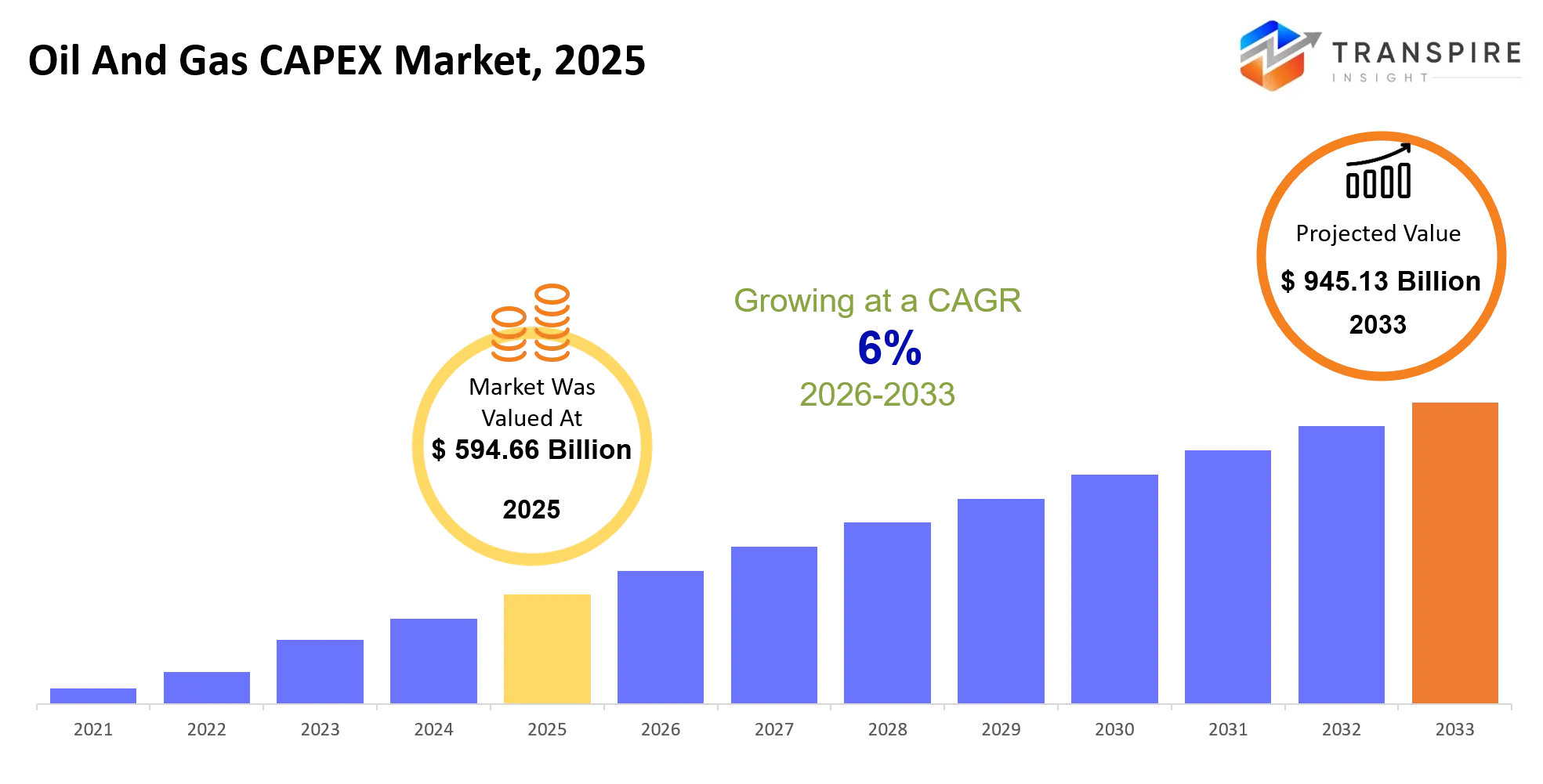
As per Transpire Insight Analysis, the Oil And Gas CAPEX Market size is estimated at USD 594.66 billion in 2025 and is anticipated to reach USD 945.13 billion by 2033, growing at a CAGR of 6% from 2026 to 2033.
The oil and gas CAPEX market provides finance for the purposes of exploration, extraction, transport, processing, liquefaction, refining, and upgrading of existing facilities.. In the three to five years, investment priorities have changed. Operators are now more careful about choosing projects. They are focusing more on production efficiency, asset modernisation, and digital technologies. A big change has been the increased use of automation, AI and digital oilfield solutions. These tools help improve project planning and make assets perform better. Supply-chain disruptions and worries about energy security have also pushed companies to keep investing in production and key infrastructure. Because of this, CAPEX is rising. Operators are putting money into production capacity, offshore developments, infrastructure expansion and modernisation. These investments create demand for engineering services, drilling work, construction, equipment and specialised oilfield services, across the value chain.
Oil And Gas CAPEX Market Size & Forecast:
- Market Size 2025: USD 594.66 Billion
- Expected Market Value (2033): USD 945.13 Billion
- Forecast CAGR (2026–2033): 6%
- Leading Region in 2025: Asia Pacific
- Fastest Growing Region: Middle East & Africa
- Key Company Profiles: Saudi Aramco, ExxonMobil, Shell, BP, Chevron, TotalEnergies, PetroChina, CNOOC, Equinor, Petrobras, ConocoPhillips, ENI, Suncor Energy, Woodside Energy, ONGC
Key Market Insights:
The oil and gas CAPEX market is moving toward selective investment, with upstream activities accounting for the highest supplied segment share. Capital allocation is also shifting to LNG, digitalisation, production efficiency and the projects that drive long-term asset productivity.
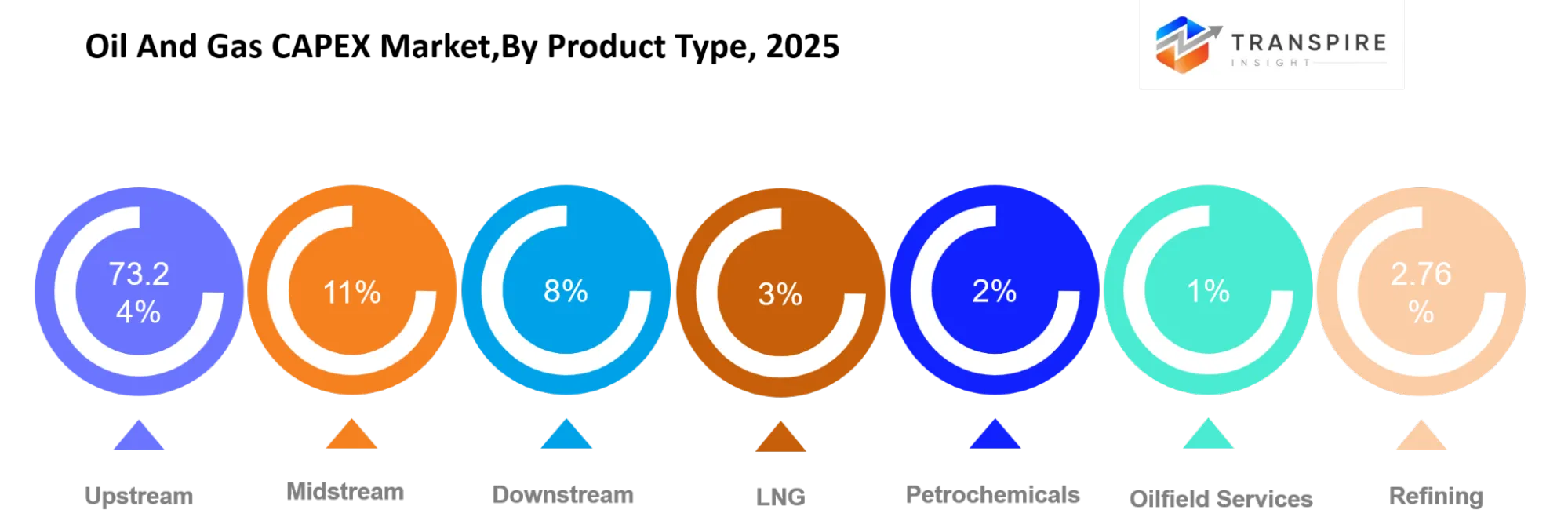
- Upstream holds a 73.24% market share, being the major segment as the operators keep investing in exploration, drilling, production, and field developments.
- Offshore is the fastest-growing location segment, growing at a 7.21% CAGR, due to increasing investments in offshore hydrocarbons as well as improving technologies in offshore drilling and subsea operations.
- Midstream holds 11% of the supplied segmentation, owing to investments in pipelines, storage, transport networks, and connectivity processing.
- Downstream holds 8% of the total market segmentation as refineries and integrated energy companies continue investing in their modernisations and efficiency improvements, as well as flexible products production.
- Petrochemicals hold 2% of the supplied market segmentation. Other sectors form 1.96%, consisting of specialised infrastructures and project activities other than the main sectors.
What are the Key Drivers, Restraints, and Opportunities in the Oil And Gas CAPEX Market?
Drivers
Oil and gas companies are allocating more capital decommissioning for investments in projects that can enhance their production capacity and energy security and create cash flow from existing sources. The reason is the combination of the problems with supply and the necessity to replace projects and to build new liquefied natural gas plants. While investing in better assets, money allocated for drilling, production, pipelines, and exports stimulates demand for equipment.
Restraints
Higher costs of projects may affect CAPEX growth, especially in the case of complex offshore and deep water projects. Large projects need higher up-front investments, special equipment, and a longer period of development. This process becomes more difficult if the economics or the conditions in the market change.
Opportunities
Digitalisation, automation, AI and technologies for emissions reduction may create investment opportunities for companies to increase the efficiency of their assets and manage OPEX. The offshore projects that are expected to be may create opportunities for suppliers of drilling and production technologies.
What Has the Impact of Artificial Intelligence Been on the Oil And Gas CAPEX Market?
The use of artificial intelligence is transforming the way oil and gas companies design, implement, and manage capital-intensive projects. AI-powered technology is capable of analysing seismic data, production information, equipment data and other operational information to assist in making quick decisions when conducting exploration and production. Predictive analytics is used to detect abnormal performance of machinery in order to schedule preventative maintenance before equipment failures disrupt operations. Other areas where AI is utilised include drilling activities optimisation, reservoir characterisation, asset management, and elimination of unnecessary downtime. All this has the potential of helping oil and gas companies allocate capital more effectively through efficient project planning and asset management. The automation process aids in remote monitoring and minimises manual labour in specific field operations. the adoption of artificial intelligence into existing oil and gas industry infrastructure may prove difficult due to the need to integrate new technology with existing machinery and massive amounts of incompatible data.
Instance
In November 2025, Chevron extended the application of its ApEX generative artificial intelligence solution for use in oil and gas exploration. The technology works by analyzing vast amounts of subsurface and exploration data and helps drilling teams find optimal drilling locations.
https://www.chevron.com/newsroom/2025/q4/a-smarter-way-to-prospect-for-oil-and-gas
Key Market Trends
There is a trend within the international oil and gas CAPEX industry toward being more selective about investing, with firms focusing more on efficiency and technological advancements. The capital allocation process is also affected by the need to improve performance and address technological and environmental factors.
- The oil and gas producers have shifted their focus from expansionary capital investments to selectivity in making capital investments in those fields that are more likely to be profitable.
- Investments in offshore operations have gained popularity because of the exploration of technically difficult resources and the development of offshore production capacities.
- Digital oilfields are being used more widely by companies; they provide a completely new approach to asset monitoring and management as well as to making operational decisions.
- Automation is being used increasingly for managing field operations and decreasing the necessity to intervene manually.
- Predictive maintenance technologies are employed by companies to prevent malfunctions of equipment and decrease operational disruptions.
- Companies pay more attention to the modernisation of existing facilities in the form of brownfield projects.
Oil And Gas CAPEX Market Segmentation
By Sector
Upstream is the dominant sector for investment in the worldwide oil and gas CAPEX industry, holding a 73.24% share owing to the steady investment made in exploration, drilling, production, and development of fields. The midstream sector has a share of 11%, while downstream holds 8%, representing investments in transport and processing. Liquefied natural gas accounts for 3%, petrochemicals hold 2%, oilfield services 1%, and refining 0.8%. Other activities hold a 1.96% share.
By Location
Offshore is the fastest-growing location type, with a CAGR of 7.21%, as producers keep exploring technologically advanced reserves and offshore producing capacity. Onshore is still a vital location as well due to its infrastructure and easy access to resources. Projects are being built in the deep water and shallow water locations; however, Arctic and desert locations will need special approaches to the construction process.
By Service
Construction is a vital area of capital expenditure as producers keep building production facilities, pipelines, terminals, and other infrastructure elements. Maintenance and turnaround services help the existing facilities work properly. Engineering and drilling services are closely related to the development of upstream projects.
By Asset Type
The exploration and production assets will continue to be upstream investments, while the pipelines and storage assets will be responsible for transportation and management of hydrocarbons. The refineries and process plants will need investments for expansion and modernization purposes, while the LNG facilities will also be important in this context due to the increasing investments in gas assets.
By Investment Type
Greenfield investments will refer to the construction of new facilities, while brownfield investments will be related to upgrading existing assets. The expansion and replacement investments will contribute to capacity improvement and operational continuity, while modernisation and digitalisation will become more relevant, as well as the reduction of emissions.
By Technology
Traditional technologies are still supporting basic functions in the oil and gas industry, while digital oilfields, automation, AI, and IoT are revolutionising monitoring and management of assets. Drilling technology is especially important for difficult exploration and production. Carbon capture technologies are opening another sphere for capital investment as they help solve emissions challenges.
By Operator
National oil companies are one of the main players in capital expenditures in industry, together with international oil companies, independents, integrators, and privately-owned companies. Oilfield service companies and offshore companies also have an effect on capital expenditures through project development, providing special services and technologies.
What are the Key Use Cases Driving the Oil And Gas CAPEX Market?
Upstream operations are a key use case for oil and gas capital expenditure, with capital allocated towards exploration, drilling, production development, and field infrastructure. Such capital investments will involve expenditure on engineering, construction, completions, inspections, and oilfield services to develop resources. Additional use cases that are gaining traction include pipeline construction, storage facilities, LNG terminal facilities, processing units, and refineries. Capital is also being allocated to maintain the current assets by improving efficiency through maintenance, turnaround projects, brownfield, and expansion projects. Use cases that are currently emerging are increasingly related to digitisation, automation, artificial intelligence, IoT, advanced drilling techniques, and emission reduction technologies. Such technology solutions are currently being embedded in capital projects to enhance asset monitoring and management of oil and gas assets.
|
Report Metrics |
Details |
|
Market size value in 2025 |
USD 594.66 Billion |
|
Market size value in 2026 |
USD 628.50 Billion |
|
Revenue forecast in 2033 |
USD 945.13 Billion |
|
Growth rate |
CAGR of 6% from 2026 to 2033 |
|
Base year |
2025 |
|
Historical data |
2021 - 2024 |
|
Forecast period |
2026 - 2033 |
|
Report coverage |
Revenue forecast, competitive landscape, growth factors, and trends |
|
Regional scope |
United States; Canada; Mexico; United Kingdom; Germany; France; Italy; Spain; Denmark; Sweden; Norway; China; Japan; India; Australia; South Korea; Thailand; Brazil; Argentina; South Africa; Saudi Arabia; United Arab Emirates |
|
Key company profiled |
Saudi Aramco, ExxonMobil, Shell, BP, Chevron, TotalEnergies, PetroChina, CNOOC, Equinor, Petrobras, ConocoPhillips, ENI, Suncor Energy, Woodside Energy, ONGC |
|
Customization scope |
Free report customization (country, regional & segment scope). Avail customized purchase options to meet your exact research needs. |
|
Report Segmentation |
By Sector (Upstream, Midstream, Downstream, LNG, Petrochemicals, Oilfield Services, Refining, Others); By Location (Onshore, Offshore, Deepwater, Shallow Water, Arctic, Desert, Urban/Industrial, Others); By Service (Construction, Maintenance & Turn-around, Decommissioning, Engineering, Drilling, Completion, Inspection, Others); By Asset Type (Exploration, Production, Pipelines, Refineries, LNG Terminals, Storage, Processing Plants, Others); By Investment Type (Greenfield, Brownfield, Expansion, Replacement, Modernization, Digitalization, Emissions Reduction, Others); By Technology (Conventional, Digital Oilfield, Automation, AI, IoT, Carbon Capture, Advanced Drilling, Others); By Operator (NOCs, IOCs, Independents, Integrated Majors, Private Operators, Offshore Operators, Oilfield Services, Others) |
Which Regions are Driving the Oil And Gas CAPEX Market Growth?
North America
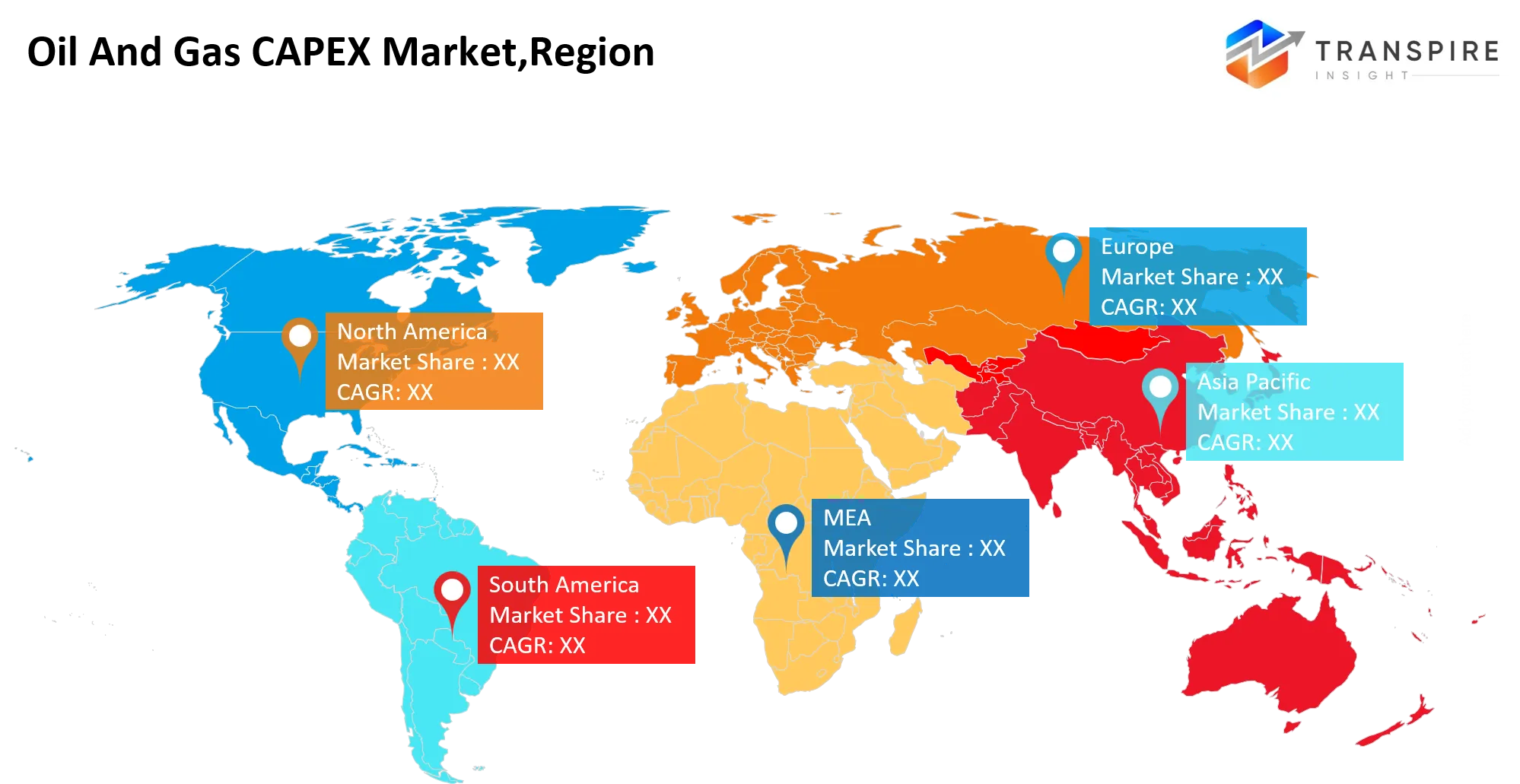
North America holds 24% of the market share of oil and gas CAPEX, backed by existing oil and gas infrastructure and investments made in the upstream, midstream, and downstream. The region is well-endowed with an experienced production ecosystem that has an extensive pipeline and processing network. This existing infrastructure makes for a solid foundation to continue developing and upgrading the existing assets. Investments in production and infrastructure continue to support this region’s participation in the CAPEX.
In December 2025, Chevron released its capital investment plans for the following year, and a large part of those plans would be dedicated to the production and development of U.S. oil and gas in various shale regions. Such an investment provides for further development of energy infrastructure in North America.
https://www.chevron.com/newsroom/2025/q4/chevron-announces-2026-capex-budget-of-18-to-19-billion
Europe
Europe accounts for 18% of the market, with capital expenditure driven by the need for modernisation of infrastructure and change in the energy landscape. Players in this region are making investments in existing assets and also making efficiency, digitalisation, and emissions-related investments. This region has an industrial base to support spending on refineries, processing, and other oil and gas infrastructure.
In June 2025, Equinor, along with its partners, decided on the development of the Fram Sor subsea project in Norway. This development connects new sources of oil and gas to already-existing offshore infrastructure and helps to develop the Norwegian Continental Shelf and use existing production facilities.
https://www.equinor.com/news/20250626-fram-sor-pdo
Asia Pacific
The Asia Pacific region has the largest market share of 29.36% due to investments in energy infrastructure in the entire value chain of oil and gas. Investments will be facilitated by growth in industry and infrastructural development in the region. This region offers opportunities for new production, processing, LNG, and transportation projects.
In May 2026, INPEX concluded agreements in principle with some energy firms for the offtake of LNG from the Abadi LNG project in Indonesia. This development is one of the milestones in the development of the project and contributes to further LNG infrastructure development in the Asia-Pacific region.
https://www.inpex.com/english/news/upload/20260520.pdf
Who are the Key Players in the Oil And Gas CAPEX Market and how do they compete?
The competition in the oil and gas CAPEX industry consists of national oil companies, international oil companies, independent operators, integrated energy companies, offshore operators, and oilfield services providers. Factors of the competitive landscape in the industry include project execution capabilities, financial resources, technological capability, efficiency, and development complexity management. Competition is possible not only via production increases but also via modernisation and digitisation, automation, and costs optimization. As a result, the market structure features not only integrated operators but also specialists working with specific phases of projects.The competition among oilfield services companies is based on specialized drilling, engineering, completion, inspections, and digital solutions. The competition among offshore companies is based on advanced project execution and technologies that are required for technically challenging environments.
Oil And Gas CAPEX Market companies
- Saudi Aramco
- ExxonMobil
- Shell,
- BP
- Chevron
- TotalEnergies
- PetroChina
- CNOOC
- Equinor
- Petrobras
- ConocoPhillips
- ENI
- Suncor Energy
- Woodside Energy
- ONGC
Recent Development News
In August 2026, Aramco has made deals and signed a memorandum of understanding with French companies concerning project management, drilling equipment, technology transfers, industrial artificial intelligence, and digital twin technologies. These collaborations aim at enhancing the resilience of the supply chain and increasing operational efficiency in its oil and gas operations
In March 2025, Shell made a Final Investment Decision regarding the development of the deep-water Gato do Mato project in Santos Basin, Brazil. The project involves an FPSO that can produce up to 120,000 barrels of oil per day. It is another offshore upstream project
What Strategic Insights Define the Future of the Oil And Gas CAPEX Market?
Oil and gas CAPEX investments globally will be more selective and driven by technology considerations with an emphasis on efficiency, asset renewal, and projects capable of generating operational value. Capital allocation is anticipated to become more focused on the combination of traditional E&P activities with digitalisation and automated solutions, including artificial intelligence and carbon emission reduction technologies. One of the hidden dangers is the challenge of integrating new digital technologies with old legacy systems, increasing implementation expenses and making it harder to operate. On the other hand, offshore assets and advanced drilling technologies offer opportunities for companies that specialise in providing engineering, equipment, and field services. Operators could improve project performance over the long term by analysing the cost of their investments not just in terms of the initial capital expense but through their entire life cycle. Predictive technologies, automation, and data-based project planning would enable companies to use their assets more efficiently and control their operational risks.
By Sector
- Upstream
- Midstream
- Downstream
- LNG
- Petrochemicals
- Oilfield Services
- Refining
- Others
By Location
- Onshore
- Offshore
- Deepwater
- Shallow Water
- Arctic
- Desert
- Urban/Industrial
- Others
By Service
- Construction
- Maintenance & Turn-around
- Decommissioning
- Engineering
- Drilling
- Completion
- Inspection
- Others
By Asset Type
- Exploration
- Production
- Pipelines
- Refineries
- LNG Terminals
- Storage
- Processing Plants
- Others
By Investment Type
- Greenfield
- Brownfield
- Expansion
- Replacement
- Modernization
- Digitalization
- Emissions Reduction
- Others
By Technology
- Conventional
- Digital Oilfield
- Automation
- AI
- IoT
- Carbon Capture
- Advanced Drilling
- Others
By Operator
- NOCs
- IOCs
- Independents
- Integrated Majors
- Private Operators
- Offshore Operators
- Oilfield Services
- Others
Frequently Asked Questions
Find quick answers to common questions.
The oil and gas CAPEX market size was valued at USD 594.66 Billion in 2025 and is poised to reach USD 945.13 Billion by 2033, expanding at a 6% CAGR.
Key segments for the oil and gas CAPEX market are By Sector (Upstream, Midstream, Downstream, LNG, Petrochemicals, Oilfield Services, Refining, Others); By Location (Onshore, Offshore, Deepwater, Shallow Water, Arctic, Desert, Urban/Industrial, Others); By Service (Construction, Maintenance & Turn-around, Decommissioning, Engineering, Drilling, Completion, Inspection, Others); By Asset Type (Exploration, Production, Pipelines, Refineries, LNG Terminals, Storage, Processing Plants, Others); By Investment Type (Greenfield, Brownfield, Expansion, Replacement, Modernization, Digitalization, Emissions Reduction, Others); By Technology (Conventional, Digital Oilfield, Automation, AI, IoT, Carbon Capture, Advanced Drilling, Others); By Operator (NOCs, IOCs, Independents, Integrated Majors, Private Operators, Offshore Operators, Oilfield Services, Others)
Growth is primarily driven by Increasing demand for energy, oil and gas exploration, construction of LNG plants, offshore and deepwater projects, as well as upgrading of old oil and gas complexes.
The market is led by major manufacturers including Saudi Aramco, ExxonMobil, Shell, BP, Chevron, TotalEnergies, PetroChina, CNOOC, Equinor, Petrobras, ConocoPhillips, ENI, Suncor Energy, Woodside Energy, ONGC
The Asia Pacific region accounts for 29.36% of the total expenditure in the oil and gas industry, driven by the increase in energy demand, exploration and production developments, liquefied natural gas developments, refineries, pipelines, and offshore installations. The industrialisation and infrastructure developments in countries like China, India, and those in Southeast Asia also contribute to the growth in CAPEX.
There are commercial opportunities from offshore and deepwater developments, expansion of LNG infrastructure, upgrading of pipelines, refineries, and other investments related to digitalisation and automation. There are also opportunities created by the increasing demand for energy and the replacement of old infrastructure.
- Saudi Aramco
- ExxonMobil
- Shell,
- BP
- Chevron
- TotalEnergies
- PetroChina
- CNOOC
- Equinor
- Petrobras
- ConocoPhillips
- ENI
- Suncor Energy
- Woodside Energy
- ONGC
About the Authors

Avinash Kumar
I’m Avinash Kumar, a Senior Research Analyst at Transpire Insight, with expertise in the Electronics and Semiconductor and Energy & Power industry. My work focuses on analyzing emerging technologies, market trends, industry developments, and innovation across these sectors. I specialize in transforming complex technical and market insights into clear, research-backed content that helps professionals, businesses, and decision-makers stay informed. Through continuous industry research and data-driven analysis, I strive to deliver accurate, reliable, and practical perspectives on the latest advancements shaping the semiconductor and energy landscape.

Chakradhar Khansole
Chakradhar serves as the Research Director at Transpire Insight, bringing over 8 years of experience in technology, innovation, and strategic market intelligence. He specializes in transforming complex market data into actionable business insights that enable organizations to make informed, growth-oriented decisions. Recognized for his strategic vision and analytical expertise, Chakradhar leads high-impact research initiatives, delivering comprehensive market assessments, competitive intelligence, and forward-looking industry analysis.
Recently Published Reports
-
Apr 2026
Active Power Filter Market
Active Power Filter Market Size, Share & Analysis Report By Type (Shunt Active Power Filters, Series Active Power Filter, Hybrid Active Power Filter), By Application (Harmonics Mitigation, Reactive Power Compensation, Voltage Regulation, Power Factor Correction), By Phase (Single Phase, Three Phase), By End-User Industry (Manufacturing, Healthcare, Commercial, Automotive, Oil and Gas, Others), and Geography (North America, Europe, Asia-Pacific, Middle East and Africa, South and Central America), 2021 - 2031
-
Apr 2026
Electrical Transformer Market
Electrical Transformer Market Size, Share & Analysis Report By Core (Closed, Shell, and Berry), By Insulation (Gas, Oil, Solid, Air, and Other), By Phase (Single, and Three), By Rating (100 MVA to 500 MVA, 501 MVA to 800 MVA, and 801 MVA to 1200 MVA), and Geography (North America, Europe, Asia-Pacific, Middle East and Africa, South and Central America), 2021 – 2031
-
Apr 2026
Hydraulic Piston Pumps Market
Hydraulic Piston Pumps Market Size, Share & Analysis Report By Type (Axial Piston Pumps, Radial Piston Pumps), By Operating Pressure (Low Pressure, Medium Pressure, High Pressure), By Application (Construction, Mining, Agriculture, Automotive, Oil & Gas, Industrial Machinery, Others), By End-User (OEMs, Aftermarket), and Geography (North America, Europe, Asia-Pacific, Middle East and Africa, South and Central America), 2021 – 2031
-
Apr 2026
Laboratory Gas Generators Market
Laboratory Gas Generators Market Size, Share & Analysis Report By Product (Nitrogen Gas Generator, Hydrogen Gas Generator, Zero Air Gas Generator, Purge Gas Generator, TOC Gas Generators, Others), By Application (Gas Chromatography, Liquid Chromatography-mass Spectrometry (LC-MS), Gas Analyzers, Others), By End-user (Life Science, Chemical & Petrochemical, Food & Beverage, Others), and Geography (North America, Europe, Asia-Pacific, Middle East and Africa, South and Central America), 2021 – 2031