
Occupant Classification Systems Market Summary:
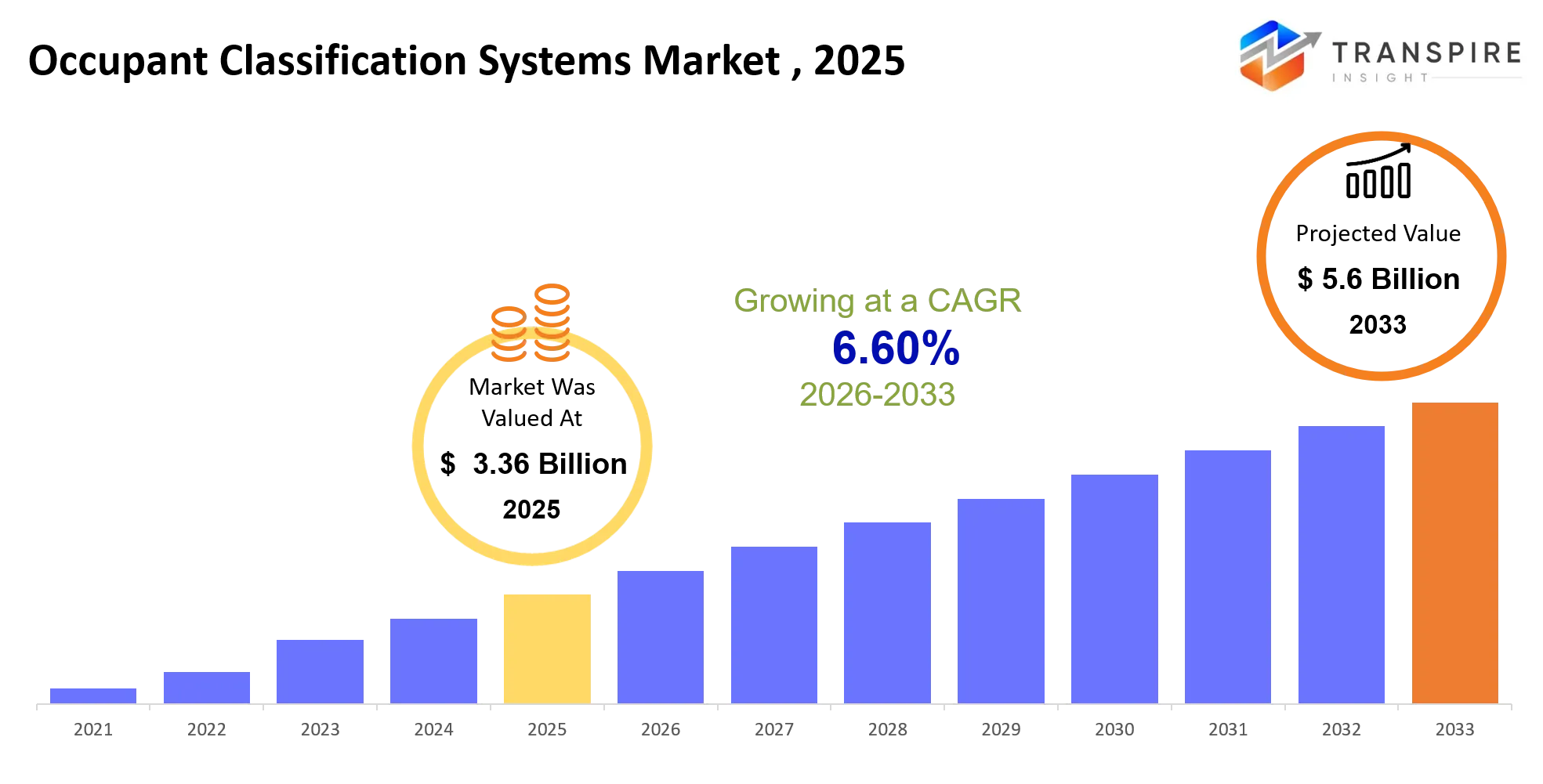
As per the Transpire Insight Analysis, The Occupant Classification Systems Market size is estimated at USD 3.36 billion in 2025 and is anticipated to reach USD 5.6 billion by 2033, growing at a CAGR of 6.60% from 2026 to 2033.
The market for occupant classification systems helps deliver the right occupant classification and optimise safety restraint deployment response. These systems can identify adults, children, child seats, and empty seats, so that the airbag controller can make more informed decisions as to whether the relevant restraint should deploy. Over the past three to five years, there has been a move from weight-based seat sensors to a comprehensive sensing architecture that incorporates pressure, radar, cameras, and smart software to provide more accurate occupant recognition in a wider variety of seating arrangements, particularly with the increase in the number of electric vehicles and software-defined vehicles with flexible seating. In the past, regulatory safety tests and the risk of airbag injuries to children have driven the need to implement more reliable occupant recognition, but as interior layouts become more flexible, traditional sensors may struggle to determine occupant seating position and posture, while manufacturers will incorporate more comprehensive sensing information into the restraint system.
Occupant Classification Systems Market Size & Forecast:
- Market Size 2025: USD 3.36 Billion
- Expected Market Value (2033): USD 5.6 Billion
- Forecast CAGR (2026–2033): 6.60%
- Leading Region in 2025: North America
- Fastest Growing Region: Asia-Pacific
- Key Company Profiles: Robert Bosch, Continental AG, ZF Friedrichshafen, Aptiv, Denso, Autoliv, Veoneer, Valeo, Hyundai Mobis, Joyson Safety Systems, IEE S.A., Aisin Corporation, NXP Semiconductors, Texas Instruments, TE Connectivity.
Key Occupant Classification Systems Market Insights:
The market is shifting from individual seat sensors to cabin intelligence, with the combination of classification accuracy and system cost driving adoption. Suppliers are bidding against one another using AI, radar sensing, and the ability to integrate the restraint system into an expanding range of models.
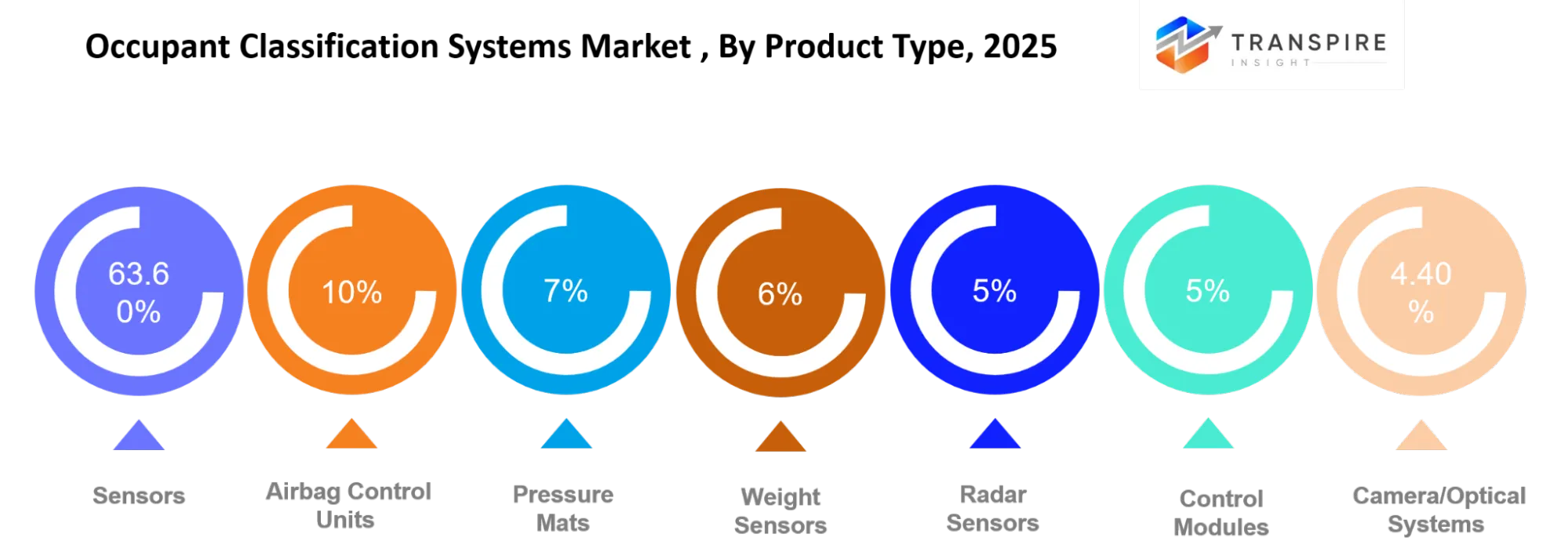
- Sensors account for 63.60% of the component share, and Bosch is working on radar-vision fusion for in-cabin sensing and readiness for autonomous platforms.
- Radar sensors are growing the fastest at a 12.21% CAGR; Denso is working on a single-module UWB radar for child presence detection.
- Airbag control units account for 10.00% of components, while Continental is using AI-based classification software to minimise false detections and help with compliance.
- Pressure mats make up 7.00% and are being used as complementary inputs in multi-sensor occupancy platforms as opposed to standalone systems.
- Weight sensors account for 6.00% of the market, and although their use is becoming more limited, it is still increasing as contactless radar systems become more common to determine the size of the occupants.
- Camera/optical systems account for 2.00%; Hyundai Mobis is adding cabin monitoring and child and unbelted passenger alerts.
- Control modules make up 4.00% while NXP is growing its UWB multi-application platforms with CPD, occupant monitoring, and secure access capabilities.
- Valeo's 60 GHz Life Presence Detection system can detect breathing and motion under blankets, which is used for CPD and pet detection.
- Texas Instruments is marketing edge-AI 60 GHz radar demonstrations for child presence, vital sign, and occupant detection.
- Gradual adoption of higher-specification vehicle safety packages is driving South America's fastest-growing regional market, which has a CAGR of 8.48%.
What are the Key Drivers, Restraints, and Opportunities in the Occupant Classification Systems Market?
Driver:
Automotive safety requirements and the integration of advanced restraint systems are driving adoption. Updated child-restraint testing requirements under the US Federal Motor Vehicle Safety Standard reinforce the need for reliable occupant recognition and appropriate airbag suppression. As automakers introduce more sophisticated safety architectures, classification systems help reduce inappropriate deployment and improve occupant protection. This creates revenue opportunities for sensor suppliers, software developers, and Tier-1 automotive safety integrators.
Restraint:
High validation costs and inconsistent detection across real-world conditions constrain deployment. Sensors must distinguish children, adults, child seats, and objects despite variations in posture, clothing, temperature, and seat configuration. Manufacturers must also validate electronic control units, software, and restraint interactions across vehicle platforms. These requirements extend development cycles and make advanced systems harder to justify in price-sensitive vehicle segments.
Opportunity:
Radar-based sensing and camera-driven classification offer routes to improve detection while reducing hardware complexity. Texas Instruments' edge-AI-enabled 60 GHz radar platform combines multiple cabin-sensing functions, illustrating the potential to consolidate components. Meanwhile, modular software and sensor-fusion architectures can help automakers scale safety features across vehicle ranges. Suppliers that demonstrate robust classification, manageable integration costs, and compliance-ready performance can capture additional OEM contracts as cabin designs evolve.
What Has the Impact of Artificial Intelligence Been on the Occupant Classification Systems Market?
AI is affecting occupant classification by switching from default "weighing" to "situational awareness" of the cabin. Using inputs from cameras, radar, pressure mats, and seat-belt sensors, machine-learning models can distinguish between an adult and a child, a child seat, a pet, and an object, and quantify it even if the occupant is in an unusual position or cabin lighting changes.
In automation and optimisation, sensor fusion can combine weak readings from multiple sensors into one occupancy decision to replace individual single-use sensors. In predictive applications, algorithms based on radar sensors can detect micro-movements and respiration patterns of a child left behind, before the loss of consciousness that causes heatstroke. AI increases the fidelity of airbag deployment decisions by classifying occupant size, location, and posture in real time to adjust the restraint force applied rather than "on-off" control. It can also provide seat-belt reminders and future comfort or driver-monitoring features on a shared cockpit platform. The models require large datasets, which need children, pets, apparel, cabin seats, lighting, and mobility of the vehicle. Otherwise, the system may have accuracy shortfalls or false alarms. Further, the cost of integration and the requirement to certify safety-related decisions slow down adoption for low-priced vehicles.
Key Occupant Classification Systems Market Trends:
A shift in the market from individual seat sensors to intelligent software-based cabin safety architectures. Being able to classify reliably and reduce integration costs and reuse sensing hardware for multiple functions is becoming a key component of competitive advantage.
- Multi-modal sensing is supplanting weight-based sensing, with pressure, radar, optical, and belt-status inputs.
- The key to the success of the radar for child-presence detection is the ability to detect breathing and movement without the need to see the light.
- The camera systems are growing in size from just occupancy detection to posture, distraction, and cabin-state monitoring.
- Direct detection of living occupants is being rewarded over seat-weight inference by regulators and safety programmes.
- OEMs are incorporating OCS into their driver-monitoring systems to cut down on part duplication and software complexity.
- Synthetic cabin data is used more and more for AI training to address rare situations like hidden infants, pets, and unusual seating positions.
- As OEMs are developing different safety features for their cabins, the EV platforms are implementing smarter restraint logic.
- Suppliers are transitioning to scalable sensor and software platforms that can be used across different vehicle types and markets.
- Occupancy information is relevant to safety compliance and usage monitoring, making fleet and shared-mobility operators relevant buyers.
Occupant Classification Systems Market Segmentation
Component:
Sensors dominate the market with a share of 63.60%, providing the basis for the detection of occupancy, position, weight, and presence. Radar sensors are the most rapidly growing sub-sector, with a CAGR of 12.21%, supported by sensor innovations for contactless child-presence detection and occupant monitoring. Airbag control units account for 10.00%, pressure mats for 7.00%, weight sensors for 6.00%, radar sensors for 5.00%, control modules for 4.00%, camera and optical sensors for 2.00%, and all other components for 2.40%. Leading automotive suppliers are shifting from discrete components towards integrated sensing modules and centralized cabin controllers to facilitate intensive data correlation, cut down on hardware complexity, and deliver more flexible occupant safety functionalities.
Sensor Type:
Pressure sensors and weight sensors remain important for established seat-based classification, measuring seat loading to distinguish occupants from objects. Radar sensors support contactless detection of occupant presence and movement, with adoption expected to accelerate as cabin sensing advances. Ultrasonic sensors assist proximity detection, while infrared and optical sensors help identify presence and position. Capacitive sensors provide alternative occupancy measurements. Future sensor selection will depend on classification accuracy, cost efficiency, environmental reliability, and compatibility with integrated vehicle safety architectures.
Vehicle Type:
Passenger light vehicles represent a major application area because occupant classification supports airbag deployment and seatbelt functions. SUVs require adaptable sensing across multiple seating configurations and larger cabins. Commercial vehicles offer opportunities to strengthen driver and passenger protection across fleet operations. Electric and hybrid vehicles favour compact electronic architectures compatible with advanced vehicle platforms. Luxury vehicles can integrate sophisticated cabin monitoring, while autonomous vehicles may require more flexible occupant recognition as seating arrangements evolve. These requirements will influence future system development.
Sales Channel:
OEM-fitted systems benefit from factory integration, biometric sensor vehicle-level validation, and direct coordination with restraint controllers, making them suitable for large-scale deployment. Dealer-fitted solutions address selected installation requirements, while aftermarket and retrofit channels serve compatible vehicles needing additional monitoring capabilities. Fleet operators may adopt specialised systems to support passenger safety and operational requirements. Speciality suppliers and direct-sales arrangements provide alternative routes to market. Future channel growth will depend on installation costs, compatibility, certification requirements, and manufacturers' ability to deliver dependable performance across vehicle platforms.
Application:
Passenger detection and occupant-size classification help restraint controllers determine appropriate airbag responses. Child-seat detection supports safer airbag management, while seatbelt detection and presence monitoring strengthen passenger protection. Occupant-positioning systems can provide additional information for adaptive restraint strategies. Emerging applications include rear-seat child-presence alerts and contactless cabin monitoring using radar or cameras. As vehicle interiors become more flexible, applications will extend beyond conventional front-seat classification. Commercial success will depend on reliable detection, seamless integration with vehicle electronics, and demonstrated safety performance under varied operating conditions.
What are the Key Use Cases Driving the Occupant Classification Systems Market?
The core use case is safer airbag deployment. Sensors, which represent 63.60% of the component market, identify occupant presence, size, and position, enabling control units to suppress, delay, or adjust airbag force for children, small adults, and out-of-position passengers. This directly supports FMVSS 208 compliance and reduces injury risk during collisions.
Expanding applications include child-seat detection, seat-belt reminder logic, and occupant positioning. Radar sensors, growing at a 12.21% CAGR, are increasingly used to detect a child left behind by recognising breathing and movement, while camera and pressure inputs help distinguish an occupied seat from luggage or a folded seat.infineon+1
Emerging use cases connect OCS with in-cabin monitoring and autonomous mobility. AI-enabled systems can identify posture, distraction, unfastened belts, and abnormal occupant behaviour, supporting adaptive restraints, fleet safety compliance, and future robotaxi passenger monitoring.
|
Report Metrics |
Details |
|
Market size value in 2025 |
USD 3.36 Billion |
|
Market size value in 2026 |
USD 3.58 Billion |
|
Revenue forecast in 2033 |
USD 5.6 Billion |
|
Growth rate |
CAGR of 6.60% from 2026 to 2033 |
|
Base year |
2025 |
|
Historical data |
2021 - 2024 |
|
Forecast period |
2026 - 2033 |
|
Report coverage |
Revenue forecast, competitive landscape, growth factors, and trends |
|
Regional scope |
United States; Canada; Mexico; United Kingdom; Germany; France; Italy; Spain; Denmark; Sweden; Norway; China; Japan; India; Australia; South Korea; Thailand; Brazil; Argentina; South Africa; Saudi Arabia; United Arab Emirates |
|
Key companies profiled |
Robert Bosch, Continental AG, ZF Friedrichshafen, Aptiv, Denso, Autoliv, Veoneer, Valeo, Hyundai Mobis, Joyson Safety Systems, IEE S.A., Aisin Corporation, NXP Semiconductors, Texas Instruments, TE Connectivity. |
|
Customization scope |
Free report customization (country, regional & segment scope). Available customised purchase options to meet your exact research needs. |
|
Report Segmentation |
Component (Sensors, Airbag Control Units, Pressure Mats, Weight Sensors, Control Modules, Radar Sensors, Camera Systems, Others); Sensor Type (Pressure Sensors, Weight Sensors, Radar Sensors, Ultrasonic Sensors, Infrared Sensors, Capacitive Sensors, Optical Sensors, Others); Vehicle Type (Passenger Light Vehicles, SUVs, Commercial Vehicles, Electric Vehicles, Hybrid Vehicles, Luxury Vehicles, Autonomous Vehicles, Others); Sales Channel (OEM-Fitted, Aftermarket, Dealer-Fitted, Retrofit, Fleet, Specialty, Direct Sales, Others); Application (Passenger Detection, Child Seat Detection, Occupant Size Detection, Seatbelt Detection, Airbag Deployment, Occupant Positioning, Presence Detection, Others) |
Which Regions are Driving the Occupant Classification Systems Market Growth?
Asia-Pacific is the largest region for the occupant classification systems market, with 30.60% market share. The significant sales in the market are driven by high production volumes, mature automotive electronics supply chains, and lower sensor manufacturing costs. China, Japan, South Korea, and India provide multiple sources of demand, from advanced vehicle platforms to the growing safety needs in mass-market cars. suppliers are able to cost-effectively provide sensors and restraint electronics when they are locally produced close to the saleable vehicles, in turn driving growth and investor confidence within this region.
In March 2026, Bosch Limited announced a 50:50 joint venture partnership with Tata AutoComp Systems to locally manufacture e-axles and traction motors in India. This collaboration accelerates domestic sourcing and engineering for electrified platforms.
https://www.bosch-press.in/pressportal/in/en/press-release-7616.html
North America has a 28.00% market share, just behind, and has a solid, predictable demand source of vehicle certifications. The experience of FMVSS 208 sets mandates for airbag turn-offs and child-safety gear that bolster occupant protection. Purchasers of in the premium class of SUVs, pickups, and electric-powered vehicles are more likely to accept cutting-edge in-car safety know-how. North America's market differs from the Asia-Pacific scene centred on manufacturing, as these markets also have safety, vehicle combination, and tech adoption impacts from current OEMs.
In June 2026, automotive technology supplier Aptiv launched its Advanced Occupancy Classification (AOC) system, the industry’s first camera-only occupant detection solution.
South America is projected to grow at a CAGR of 8.48% and a regional share of 9.00%. The regional opportunity is driven by incremental safety system penetration, vehicle fleet renewal, and potential growth of locally assembled vehicles with advanced restraint technology. Brazil and Argentina buyers offer opportunities for systems suppliers to customise existing sensing systems for regional vehicle platform specifications and pricing. Inexpensive pressure sensors, modular electronics, and scalable radar systems could all boost penetration as carmakers add safety features to more vehicle segments outside of premium vehicles.
In June 2026, ECARX Holdings Inc. was honoured with Volkswagen Brazil's Partnership Connectivity Award at the automaker's annual supplier summit.
Who are the Key Players in the Occupant Classification Systems Market, and how do they compete?
The competition centres on classification accuracy, integration with airbag controllers, validation, hardware cost, and ability to support vehicle programs. Traditional automotive suppliers compete using integrated restraint systems, while semiconductor and sensing companies provide the sensors enabling more compact, smarter solutions. Aptiv's early 2026 launch of a camera-only classification system is an example of where the software-led differentiation is heading, along with a trend toward decreasing seat hardware.
Major players such as Robert Bosch, Continental AG, ZF Friedrichshafen, Denso, and Hyundai Mobis participate by applying their expertise in automotive electronics, building OEM relationships, and providing scalable systems. Bosch combines occupant sensing with interior monitoring capabilities, while ZF and Autoliv are focusing on integrating restraint systems. Continental, Denso, and Hyundai Mobis leverage their entire vehicle-electronics portfolios to provide platform-level supply; Joyson Safety Systems offers a robust passive-safety portfolio; Veoneer and Valeo complement sensing and vehicle-safety capabilities. Key differentiators for Aptiv include cabin intelligence software; IEE S.A., occupant sensing; and Aisin Corporation, seats-vehicle-systems integration. NXP Semiconductors and Texas Instruments focus on sensing- and processing-enabling semiconductors, and TE Connectivity offers sensors-and-connectivity components. Their expanding opportunities depend upon OEM wins, stable validation and cost optimisation, and cooperation between hardware and software.
Key Players are:
- Robert Bosch
- Continental AG
- ZF Friedrichshafen
- Aptiv
- Denso
- Autoliv
- Veoneer
- Valeo
- Hyundai Mobis
- Joyson Safety Systems
- IEE S.A.
- Aisin Corporation
- NXP Semiconductors
- Texas Instruments
- TE Connectivity
Recent Development News
- In September 2026, ZF LIFETEC introduced an integrated passive-safety approach combining occupant detection with adaptive airbag and seatbelt technologies. The development enables vehicle restraint systems to adjust protection strategies according to occupant size, position, and seating conditions, supporting advanced safety requirements and more personalised crash protection.
- In May 2026, Magna secured a driver and occupant monitoring system program with a European automaker, expanding the application of its mirror-integrated sensing technology across vehicle platforms. The program combines camera hardware, monitoring software, and system integration to support occupant awareness while minimising additional cabin hardware and preparing vehicles for software-defined safety functions.
- In June 2026, Aptiv launched its Advanced Occupancy Classification (AOC) platform. This camera-only occupant detection system utilises artificial intelligence and computer vision to determine passenger height, weight, and positioning directly through the digital cockpit camera stack, effectively eliminating the need for traditional, seat-integrated weight-sensing hardware.
What Strategic Insights Define the Future of the Occupant Classification Systems Market?
The market is moving toward a centrally integrated cabin-intelligence architecture including radar-vision-enabled airbag deployment, child presence detection, seat-belt use monitoring, and driver monitoring. This transition shifts value away from dedicated sensors to proven artificial intelligence software, sensor fusion, and integrated safety design, as exemplified by occupant monitoring and automotive electronics. A remote risk exists if AI models trained on limited cabin scenarios (blankets, rear-facing child seats, pets, abnormal occupant posture) fail to operate properly or trigger false alarms, degrading classification quality and increasing liability. The biggest opportunity is scalable 60 GHz radar combined with edge artificial intelligence that detects child presence and vital signs independently of camera hardware. Suppliers should focus on modular and certifiable sensor-software platforms and early partnering with vehicle original equipment manufacturers. By targeting Asia- Pacific, which accounts for 30.60% of the market, and South America with a projected compound annual growth rate of 8.48%, wider adoption can be realised through low-cost integration and scalable production.
Key Segmentations are:
Component
- Sensors
- Airbag Control Units
- Pressure Mats
- Weight Sensors
- Control Modules
- Radar Sensors
- Camera Systems
- Others
Sensor Type
- Pressure Sensors
- Weight Sensors
- Radar Sensors
- Ultrasonic Sensors
- Infrared Sensors
- Capacitive Sensors
- Optical Sensors
- Others
Vehicle Type
- Passenger Light Vehicles
- SUVs
- Commercial Vehicles
- Electric Vehicles
- Hybrid Vehicles
- Luxury Vehicles
- Autonomous Vehicles
- Others
Sales Channel
- OEM-Fitted
- Aftermarket
- Dealer-Fitted
- Retrofit
- Fleet
- Speciality
- Direct Sales
- Others
Application
- Passenger Detection
- Child Seat Detection
- Occupant Size Detection
- Seatbelt Detection
- Airbag Deployment
- Occupant Positioning
- Presence Detection
- Others
Frequently Asked Questions
Find quick answers to common questions.
The occupant classification systems market size was valued at USD 3.36 billion in 2025 and is poised to reach USD 5.6 billion by 2033, expanding at a 6.60% CAGR
Key segments for the occupant classification systems market are Component (Sensors, Airbag Control Units, Pressure Mats, Weight Sensors, Control Modules, Radar Sensors, Camera Systems, Others); Sensor Type (Pressure Sensors, Weight Sensors, Radar Sensors, Ultrasonic Sensors, Infrared Sensors, Capacitive Sensors, Optical Sensors, Others); Vehicle Type (Passenger Light Vehicles, SUVs, Commercial Vehicles, Electric Vehicles, Hybrid Vehicles, Luxury Vehicles, Autonomous Vehicles, Others); Sales Channel (OEM-Fitted, Aftermarket, Dealer-Fitted, Retrofit, Fleet, Specialty, Direct Sales, Others); Application (Passenger Detection, Child Seat Detection, Occupant Size Detection, Seatbelt Detection, Airbag Deployment, Occupant Positioning, Presence Detection, Others)
Growth is primarily driven by stringent vehicle safety regulations, rising adoption of advanced airbag systems, increasing focus on child occupant protection, and integration of AI-enabled sensors, radar, and camera-based occupant detection technologies.
The occupant classification systems market is led by major manufacturers, including Robert Bosch, Continental AG, ZF Friedrichshafen, Aptiv, Denso, Autoliv, Veoneer, Valeo, Hyundai Mobis, Joyson Safety Systems, IEE S.A., Aisin Corporation, NXP Semiconductors, Texas Instruments, and TE Connectivity
North America influences market dynamics through stringent vehicle safety standards, strong automotive technology investment, advanced airbag adoption, and demand for improved child occupant protection; insert the region's market share from your data sheet to quantify its dominance.
Commercial opportunities include AI-powered camera classification, radar-based contactless sensing, integrated sensor-fusion modules, child-presence detection, and scalable occupant safety solutions for electric and autonomous vehicles
- Robert Bosch
- Continental AG
- ZF Friedrichshafen
- Aptiv
- Denso
- Autoliv
- Veoneer
- Valeo
- Hyundai Mobis
- Joyson Safety Systems
- IEE S.A.
- Aisin Corporation
- NXP Semiconductors
- Texas Instruments
- TE Connectivity
About the Authors

Mayur Shinde
I am Mayur Shinde, a Senior Research Analyst at Transpire Insight, specializing in the Automotive & Transportation and Information & Communication Technology (ICT) Industry. My work focuses on analyzing emerging market trends, technological advancements, competitive landscapes, and industry developments to deliver accurate, data-driven insights. I am passionate about transforming complex market information into clear, actionable content that helps businesses, professionals, and decision-makers stay informed and make confident strategic decisions.

Chakradhar Khansole
Chakradhar serves as the Research Director at Transpire Insight, bringing over 8 years of experience in technology, innovation, and strategic market intelligence. He specializes in transforming complex market data into actionable business insights that enable organizations to make informed, growth-oriented decisions. Recognized for his strategic vision and analytical expertise, Chakradhar leads high-impact research initiatives, delivering comprehensive market assessments, competitive intelligence, and forward-looking industry analysis.
Recently Published Reports
-
Apr 2026
ATV & UTV Market
ATV & UTV Market Size, Share & Analysis Report By Type (ATV, and UTV), By Variants (Less Than 400 CC, 400 CC To 800 CC, and More Than 800 CC), and Geography (North America, Europe, Asia-Pacific, Middle East and Africa, South and Central America), 2021 - 2031
-
Apr 2026
Automotive Central Gateway Module Market
Automotive Central Gateway Module Market Size, Share & Analysis Report By Type (Ethernet Central Gateway Module, CAN Central Gateway Module, LIN Central Gateway Module, and FlexRay), By Application (Powertrain Control, Body Control, Infotainment System, Advanced Driver Assistance Systems (ADAS), and Others), By End User (Passenger Vehicles, and Commercial Vehicles), and Geography (North America, Europe, Asia-Pacific, Middle East and Africa, South and Central America), 2021 - 2031
-
Apr 2026
Automotive Engine Oil Filter Market
Automotive Engine Oil Filter Market Size, Share & Analysis Report By Filter Type (Fuel Filter, Engine Oil Filter, Hydraulic Oil Filter, and Others), By Filter Media (Cellulose, Synthetic, and Micro), By Sales Channel (OEMs, and Aftermarket), By Vehicle Type (Passenger Cars, Light Commercial Vehicles, Heavy Duty Trucks, Buses and Coaches, and Off-road Vehicles), and Geography (North America, Europe, Asia-Pacific, Middle East and Africa, South and Central America), 2021 - 2031
-
Apr 2026
Automotive Parts Aluminium Die Casting Market
Automotive Parts Aluminium Die Casting Market Size, Share & Analysis Report By Production Process (Pressure Die Casting, Vacuum Die Casting, Squeeze Die Casting, Gravity Die Casting), By Application (Body Parts, Engine Parts, Transmission Parts, Battery And Related Components, Other Application Types), and Geography (North America, Europe, Asia-Pacific, Middle East and Africa, South and Central America), 2021 - 2031
Our Clients