

North America Poppy Seeds Market Size & Forecast:
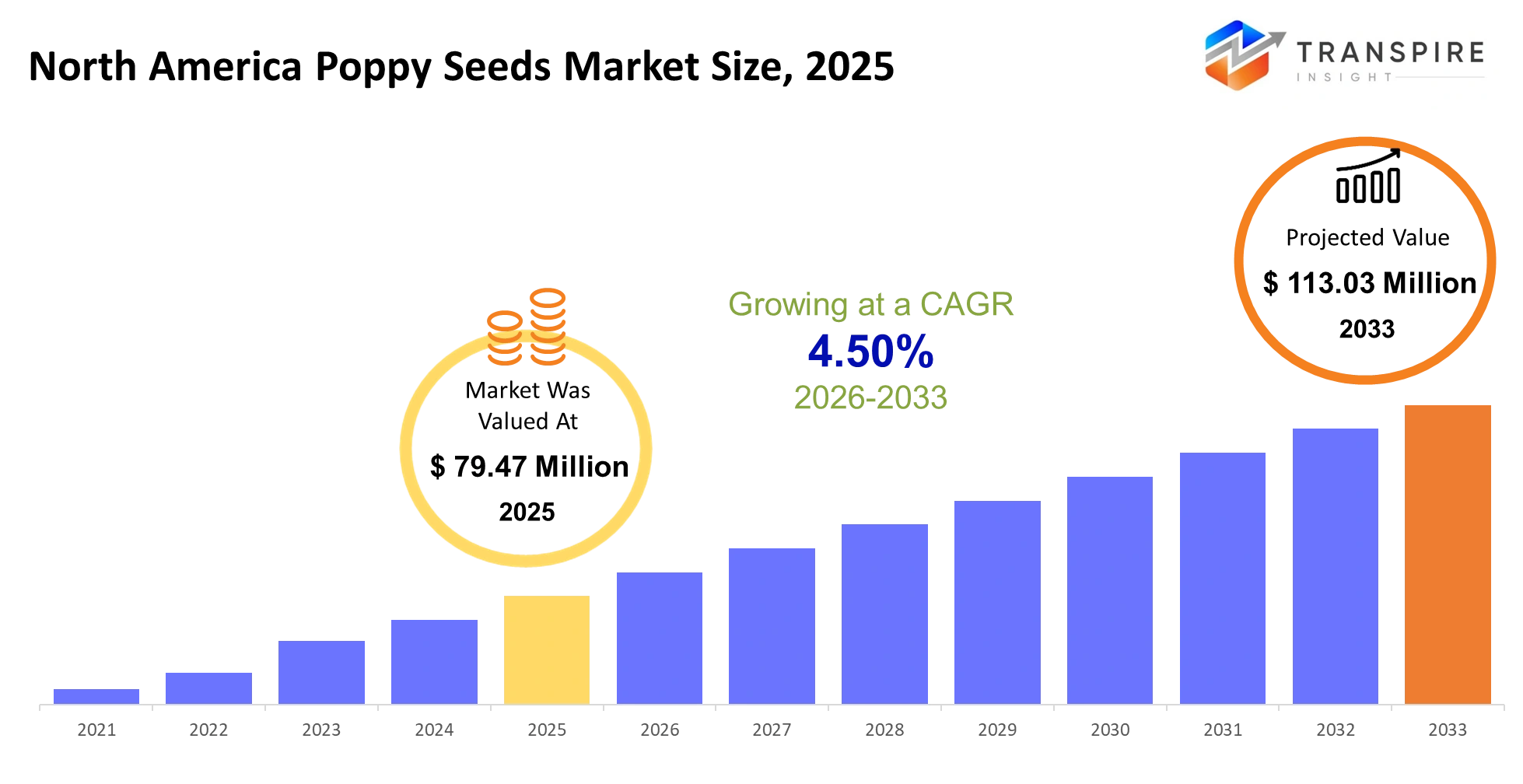
- North America Poppy Seeds Market Size 2025: USD 79.47 Million
- North America Poppy Seeds Market Size 2033: USD 113.03 Million
- North America Poppy Seeds Market CAGR: 4.50%
- North America Poppy Seeds Market Segments: By Type (White, Blue, Black, Organic, Conventional, Hulled, Unhulled); By Application (Bakery, Confectionery, Culinary, Oil Extraction, Snacks, Food Processing, Retail); By Form (Whole, Powder, Oil, Paste, Extract, Roasted, Raw); By Distribution (Online, Retail, Supermarkets, Specialty Stores, Wholesale, Direct, Export); By End-User (Consumers, Food Industry, Bakeries, Restaurants, Retailers, Pharma, Cosmetic).
To learn more about this report,  Download Free Sample Report
North America Poppy Seeds Market Summary:
The North America Poppy Seeds Market size is estimated at USD 79.47 Million in 2025 and is anticipated to reach USD 113.03 Million by 2033, growing at a CAGR of 4.50% from 2026 to 2033.
The North America poppy seeds market within the broader food ingredients industry will continue to reflect a steady interplay between culinary tradition and modern consumption patterns. The demand for poppy seeds will increase because more people want to bake artisan bread which uses poppy seeds to create their specific texture and subtle nutty flavor. Customers will require more information about product origins because they will start paying more attention to where their products come from and how they were made. The industry will develop transparent supply chains while establishing distribution methods that match customer needs for both retail and online platforms.
Business operations will change as technological advancements in cleaning and decontamination methods shape product quality and safety standards. The regulatory framework will continue to control alkaloid content, which will force importers and processors to comply with newly established standards.
What Has the Impact of Artificial Intelligence Been on the North America Poppy Seeds Market?
Artificial intelligence is currently changing the North American poppy seeds industry because it improves business operations for collecting data and predicting market trends and handling changes in consumer behavior. The North American poppy seeds market uses AI technology to help businesses analyze extensive data from retail outlets and agricultural sites and international trade operations with improved precision.
Market stakeholders use machine learning models to identify new market trends and track price changes and execute data-informed choices at a faster speed than conventional approaches. The North America poppy seeds market research now uses artificial intelligence research methods which deliver greater transparency and decrease market uncertainties to help producers and distributors maintain their market edge.
AI-based predictive analytics serves as a fundamental component for both demand forecasting and production planning tasks that exist within the North America poppy seeds market. Companies can achieve better inventory management and waste reduction by examining past sales data and seasonal consumption trends and external factors which include weather conditions and trade regulations. Automated technologies are enhancing agricultural operations and processing tasks which result in better crop outcomes and reduced expenses for workers.
The North American poppy seeds market now operates with high-performing AI systems which achieve operational efficiency while enabling farmers to manage their resources through sustainable agricultural practices. AI technology now operates in the North American poppy seeds market supply chain to achieve cost savings and flexible business operations.
AI-enabled logistics software solutions help organizations to improve their route management and supplier selection and risk assessment processes while decreasing operational delays and service interruptions. Companies use artificial intelligence to create customized products while improving their methods of reaching customers which results in new business development opportunities.The North America poppy seeds market will achieve long-term technological advancement and business sustainability and market dominance through increasing AI adoption.
Key Market Trends & Insights:
- The United States dominates the North American poppy seeds market which will reach 68% market share in 2025 because of bakery product consumption.
- Canada represents the fastest-growing region expected to expand at a CAGR above 5% during 2025–2030 because people want clean-label and organic food products.
- Conventional poppy seeds hold the largest share at approximately 72% in 2025 because they exist in many locations and have lower costs.
- The second biggest market segment for organic poppy seeds has gained popularity because more people choose to eat healthy.
- The organic segment will become the fastest-expanding market which will grow at more than 6% annual rate until 2030 because people increasingly demand natural ingredients.
- The bakery market and confectionery market together make up 60% of total demand for poppy seeds in North America which will reach its peak in 2025.
- The functional foods segment together with health-based applications respectively represent the market segment which shows the fastest growth according to increasing consumer knowledge about their nutritional advantages and the benefits of plant-based eating.
- The food processing industry dominates the North American poppy seeds market because it consumes industrial quantities, which account for 55% of total market share.
- Home baking activities increased after 2022, creating higher demand for retail-direct consumer products that now benefit from e-commerce growth.
- The main companies in the market include McCormick & Company, Bob’s Red Mill Natural Foods, Frontier Co-op, Woodland Foods, and Spice Hunter.
North America Poppy Seeds Market Segmentation
By Type :
The section demonstrates different color characteristics and processing techniques and agricultural production methods. White, blue, and black seeds vary in flavor and visual appeal, which people choose according to their regional cooking preferences. The two types of organic and conventional products depend on their respective farming methods, while hulled and unhulled products show different texture preferences and cooking requirements.
The demand for this category depends on two factors which include quality perception and customer intended use of the product. Health-conscious consumers prefer organic products, while conventional products remain easy for consumers to purchase. Hulled seeds create a smoother baking texture, while unhulled seeds maintain their original shape to deliver stronger flavor and extended shelf life.
By Application :
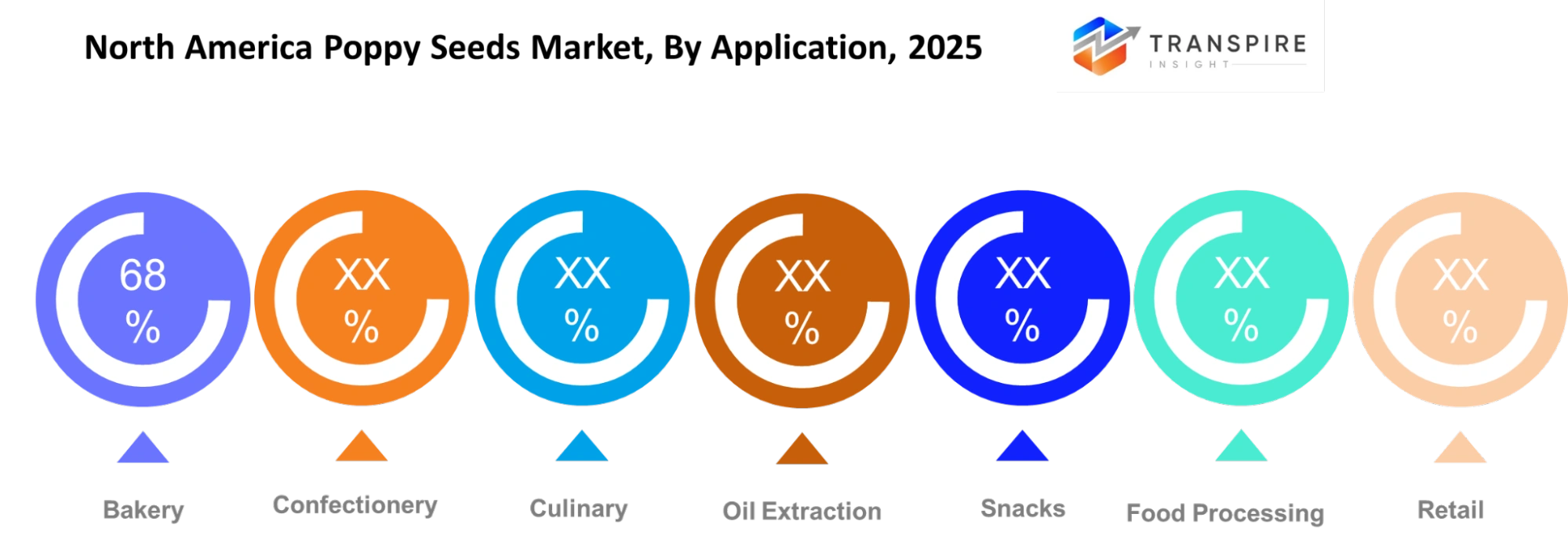
The application shows all ways that people use poppy seeds in their cooking and food production. The bakery and confectionery segments use seeds to create flavoring and decorative elements while their culinary applications extend to traditional recipes. The extraction of oil enables industrial applications which include snacks and processed food items that people consume during their daily activities.
The segment experiences growth because of two factors which are consumer dietary pattern changes and new product developments. Food processing industries use seeds as ingredients for their packaged products while home cooking trends increase retail demand. The extraction of oil provides industrial solutions for specific needs while keeping demand levels steady for all uses.
To learn more about this report, Download Free Sample Report
By Form :
Poppy seed consumption and processing methods depend on their physical shape. Bakers and cooks use whole seeds as their main ingredient, while chefs create sauces and fillings through their use of powder and paste forms. The oil and extract products provide both culinary and industrial purposes, which deliver users powerful taste experiences and practical benefits.
The taste and shelf stability of the product are affected by its roasted and raw variations. Roasted seeds produce better flavor, but raw seeds keep all their natural elements. The various forms of the product enable different preparation methods, which commercial producers and individual consumers can use.
By Distribution :
The available distribution channels determine how people make purchases which they can access. Supermarkets and retail stores dominate everyday sales, while specialty stores cater to niche demand. Online platforms provide convenience to customers, while wholesale channels serve the needs of bulk buyers.
The two main distribution methods for international trade operate through export and direct distribution. Online growth reflects digital adoption, while traditional retail maintains a strong presence. The different distribution channels help various buyer groups, which enables products to remain accessible in all areas.
By End-User :
The research reveals how various sectors use poppy seeds through their end-user segmentation analysis. Consumers use seeds in home cooking, while bakeries and restaurants rely on them for menu offerings. The food industry incorporates seeds into packaged products.
The pharmaceutical and cosmetic industries use extracts and oils for their designated purposes. Retailers function as intermediaries who guarantee product distribution to customers. The diverse customer base creates consistent demand which results in market expansion through the contributions of each customer segment.
What are the Main Challenges for the North America Poppy Seeds Market Growth?
The North America poppy seeds market faces several technical and operational challenges that limit its growth potential. North America poppy seeds market operations experience their main difficulty when operators must maintain product quality because seed origin and climatic conditions and harvesting techniques create product quality differences.
The North American poppy seeds market experiences its main market restriction through manufacturing and commercialization barriers. The regulatory framework requirements for alkaloid content and food safety standards force producers to spend money on compliance testing and testing procedures.
Adoption challenges continue to affect the expansion of the north america poppy seeds market, particularly in niche and emerging applications. The market for poppy seeds faces expansion challenges because consumers lack knowledge about the seeds' nutritional advantages while distribution systems remain undeveloped. The industry faces workforce challenges because it needs specialized personnel for processing and quality assurance and it lacks financial resources to develop cutting-edge technologies. The market faces two major challenges because consumers are shifting to different seeds and regulatory authorities are increasing their monitoring activities.
Country Insights
The North America Poppy Seeds Market demonstrates continuous demand which bakery products and packaged food sales create throughout both the United States and Canada. The growing demand for natural ingredients together with traditional recipes enables people to use poppy seeds in both bread and snack products because the region depends on imports which affects both pricing and supply reliability.
North American countries display different patterns of poppy seed consumption because the United States consumes more poppy seeds than any other country because of its active bakery sector and its numerous food manufacturing facilities. The country of Canada shows consistent poppy seed demand because of its various food traditions and home baking practices which people adopt in their everyday cooking.
The market performance throughout North America depends on import channels which bring products from Turkey and the Czech Republic because local weather conditions do not support extensive domestic farming. The combined effect of trade rules and quality requirements determines how companies obtain their supplies while customer demand for clean-label products helps premium-grade poppy seeds to achieve market growth.
People in urban areas consume more because they can find more artisanal bakery items and ready-to-eat meals. The retail distribution system which includes supermarkets and specialty stores, enhances product availability while food service providers keep up constant customer demand. The market maintains steady activity throughout the region because seasonal consumption patterns occur when people prepare festive and cultural meals.
Recent Development News
In April 2026, Olam Food Ingredients (OFI) announced that it would expand its specialty seed sourcing network to improve its supply operations across North America. The system enhancement provides better tracking abilities for traceability and supply assurance of poppy seeds used in bakery and packaged food products.
Source https://www.ofi.com/
In March 2026, Frontier Co-op expanded its organic seed collection to include poppy seeds which it now sells to United States retail customers. The company introduced new products to meet increasing consumer demand for certified organic and clean-label baking ingredients throughout North America.
Source https://www.frontiercoop.com/
|
Report Metrics |
Details |
|
Market size value in 2025 |
USD 79.47 Million |
|
Market size value in 2026 |
USD 83.05 Million |
|
Revenue forecast in 2033 |
USD 113.03 Million |
|
Growth rate |
CAGR of 4.50% from 2026 to 2033 |
|
Base year |
2025 |
|
Historical data |
2021 - 2024 |
|
Forecast period |
2026 - 2033 |
|
Report coverage |
Revenue forecast, competitive landscape, growth factors, and trends |
|
Regional scope |
North America (Canada, The United States, and Mexico) |
|
Key company profiled |
McCormick, Olam, Cargill, ADM, SunOpta, Borges, Frontier Co-op, Badia Spices, TreeHouse Foods, Woodland Foods, Starwest Botanicals, Simply Organic, Monterey Bay Spice, Terrasoul, Spice Islands. |
|
Customization scope |
Free report customization (country, regional & segment scope). Avail customized purchase options to meet your exact research needs. |
|
Report Segmentation |
By Type (White, Blue, Black, Organic, Conventional, Hulled, Unhulled); By Application (Bakery, Confectionery, Culinary, Oil Extraction, Snacks, Food Processing, Retail); By Form (Whole, Powder, Oil, Paste, Extract, Roasted, Raw); By Distribution (Online, Retail, Supermarkets, Specialty Stores, Wholesale, Direct, Export); By End-User (Consumers, Food Industry, Bakeries, Restaurants, Retailers, Pharma, Cosmetic). |
How Can New Companies Establish a Strong Foothold in the North America Poppy Seeds Market?
New entrants can build a strong presence in the north america poppy seeds market by targeting niche, high-value segments rather than competing with other companies through volume. The company meets current industry standards by implementing organic non-GMO products which consumers want to trace. Companies that position themselves to sell clean-label and health-focused products will achieve rapid market differentiation because wellness-oriented food consumption drives market growth.
Entry barriers become easier to overcome through innovation strategies while these strategies help companies to secure their competitive advantages. Startups can address their main operational challenges, which include contamination risks and regulatory compliance requirements, by investing in advanced cleaning and decontamination and quality assurance technologies. Small enterprises can improve their cost control and sourcing operations through technological benefits which the implementation of smart supply chain tools and predictive analytics provides.
The process of expanding business operations and entering new markets requires equal importance for strategic partnerships and distribution alliances. The company achieves rapid market entry through its partnerships with local distributors, food manufacturers and e-commerce platforms. New companies should also invest in transparent branding, certifications, and sustainability practices to build trust and credibility. The emerging players in the North America poppy seeds market must establish their competitive advantage through innovative solutions and strategic partnerships and dedicated market positioning.
Key North America Poppy Seeds Market Company Insights
The bakery and food processing industries will sustain their need for poppy seeds which will result in continuous growth for the North American poppy seeds market. People will continue to use traditional cooking methods which require specific textures and mild tasting ingredients for their packaged food needs. The region will depend on imported products which will determine both market prices and the availability of goods throughout the area.
Home cooking and artisanal baking will see increased demand because people want natural and plant-based ingredients. Consumers who care about their health will choose seeds because they provide both fiber and essential nutrients, which will lead to steady market growth. Supermarkets and online platforms will provide retail access, which will increase product visibility and accessibility to customers.
The trade operations will depend on regulatory authorities who establish standards for sourcing and product quality control. The testing requirements and import restrictions will determine how long it takes to supply products and the expenses incurred. Food industry suppliers will need to focus on two main areas which are compliance and traceability to deliver safe products through regular distribution channels.
The market will experience moderate competition because main competitors will concentrate on acquiring high-quality products while developing pricing plans and establishing permanent supplier connections. Food manufacturers will establish supply routes which will enable importers and distributors to compete in the market. Retail spaces will increase their stock of private label products while established brands will maintain consumer trust through dependable product performance.
Company List
- McCormick
- Olam
- Cargill
- ADM
- SunOpta
- Borges
- Frontier Co-op
- Badia Spices
- TreeHouse Foods
- Woodland Foods
- Starwest Botanicals
- Simply Organic
- Monterey Bay Spice
- Terrasoul
- Spice Islands
What are the Key Use-Cases Driving the Growth of North America Poppy Seeds Market?
Poppy seeds have become a commercial product in the North American market because bakery and confectionery businesses use them to create special flavors and textural experiences while delivering nutritional value to their products.The market maintains constant growth because consumers use bread products including bagels and muffins and pastries as their most common baked goods. Poppy seeds have become essential for North American baked goods because urban markets demand more artisanal and speciality products which drive their increasing demand.
Another important use case driving the North American poppy seed market's growth is the rising popularity of health-oriented and functional food products. Poppy seeds contain essential minerals, dietary fibre, and plant-based nutrients, making them suitable for use in cereals, snacks, and superfood blends. Food manufacturers can create new product development opportunities by using poppy seeds, as consumers prefer clean-label products with high nutritional value.
Both the foodservice sector and the retail industry drive customer demand for poppy seeds in the North American market. Restaurants, cafes, and packaged food brands now use poppy seeds to enhance their gourmet menu items, salad dressings, and convenient meals. The growth of e-commerce, combined with direct-to-consumer distribution methods, has made products more readily available to customers while expanding distribution networks. The various real-world applications that companies develop throughout different industries will help establish the North American poppy seeds market as a persistent business segment that will continue to grow.
North America Poppy Seeds Market Report Segmentation
By Type
- White
- Blue
- Black
- Organic
- Conventional
- Hulled
- Unhulled
By Application
- Bakery
- Confectionery
- Culinary
- Oil Extraction
- Snacks
- Food Processing
- Retail
By Form
- Whole
- Powder
- Oil
- Paste
- Extract
- Roasted
- Raw
By Distribution
- Online
- Retail
- Supermarkets
- Specialty Stores
- Wholesale
- Direct
- Export
By End-User
- Consumers
- Food Industry
- Bakeries
- Restaurants
- Retailers
- Pharma
- Cosmetic
Frequently Asked Questions
Find quick answers to common questions.
The approximate North America Poppy Seeds Market size for the market will be USD 113.03 Million in 2033.
Key segments for the North America Poppy Seeds Market are By Type (White, Blue, Black, Organic, Conventional, Hulled, Unhulled); By Application (Bakery, Confectionery, Culinary, Oil Extraction, Snacks, Food Processing, Retail); By Form (Whole, Powder, Oil, Paste, Extract, Roasted, Raw); By Distribution (Online, Retail, Supermarkets, Specialty Stores, Wholesale, Direct, Export); By End-User (Consumers, Food Industry, Bakeries, Restaurants, Retailers, Pharma, Cosmetic).
Major North America Poppy Seeds Market players are McCormick, Olam, Cargill, ADM, SunOpta, Borges, Frontier Co-op, Badia Spices, TreeHouse Foods, Woodland Foods, Starwest Botanicals, Simply Organic, Monterey Bay Spice, Terrasoul, Spice Islands.
The North America Poppy Seeds Market size is USD 79.47 Million in 2025.
The North America Poppy Seeds Market CAGR is 4.50%.
- McCormick
- Olam
- Cargill
- ADM
- SunOpta
- Borges
- Frontier Co-op
- Badia Spices
- TreeHouse Foods
- Woodland Foods
- Starwest Botanicals
- Simply Organic
- Monterey Bay Spice
- Terrasoul
- Spice Islands
Recently Published Reports
-
Dec 2024
Baby Infant Formula Market
Baby Infant Formula Market Size, Share & Analysis Report By ype (Infant Milk, Follow On Milk, Specialty Baby Milk, Growing-Up Milk), By Ingredient (Carbohydrate, Fat, Protein, Minerals, Vitamins, and Others), By Product Form (Powder, Liquid, and Ready-to-feed), By Distribution Channels (Supermarket/Hypermarket, Specialty Store, Pharmacies, Online Retail, and Others), and Geography (North America, Europe, Asia-Pacific, Middle East and Africa, South and Central America), 2021 - 2031
-
Jan 2025
Edible Insects for Animal Feed Market
Edible Insects for Animal Feed Market Size, Share & Analysis Report By Type (Insect Powder, Insect Meal, Insect Bar, Insect Paste, Insect Oil, and Others), By Insect Type (Beetles, Cricket, Caterpillar, Hymenoptera, Orthoptera, Tree Bugs, and Others), By Application (Livestock, Pet Food, and Aquaculture), By Livestock Type (Poultry, Swine, and Others), and Geography (North America, Europe, Asia-Pacific, Middle East and Africa, South and Central America), 2021 - 2031
-
Jan 2025
Food Industry Disinfection and Bacterial Control Market
Food Industry Disinfection and Bacterial Control Market Size, Share & Analysis Report By Type (Chemical Disinfectants, Physical Disinfectants, and Biocides and Antimicrobials), By Application (Food Processing Equipment Surface Disinfection, Food Preparation Areas Surface Disinfection, Storage Areas Surface Disinfection, Anti-microbial Coatings Food Preservation, and Preservative Solutions Food Preservation), By End User (Meat and Poultry Processing, Dairy Processing, Seafood Processing, Bakery and Confectionery, Restaurants and Commercial Kitchens, and Food Service Providers), By Sales Channel (Online, Offline), and Geography (North America, Europe, Asia-Pacific, Middle East and Africa, South and Central America), 2021 - 2031
-
Jan 2025
Freeze Dried Food Market
Freeze Dried Food Market Size, Share & Analysis Report By Product Type (Fruits, Vegetables, Freeze-Dried Dairy Products, Freeze-Dried Meat and Seafood, Freeze-Dried Pet Food, and Prepared Meal), By Nature (Organic, and Conventional), By Form (Powdered, Granules, and Diced), By End Use (Breakfast Cereals, Dairy Products, Bakery & Confectionery, Nutritional Bars & Supplements, Powdered Beverages, Snacks, and Retail (Household)), and Geography (North America, Europe, Asia-Pacific, Middle East and Africa, South and Central America), 2021 - 2031