North America Periodontal Disease Treatment Market Size & Forecast:
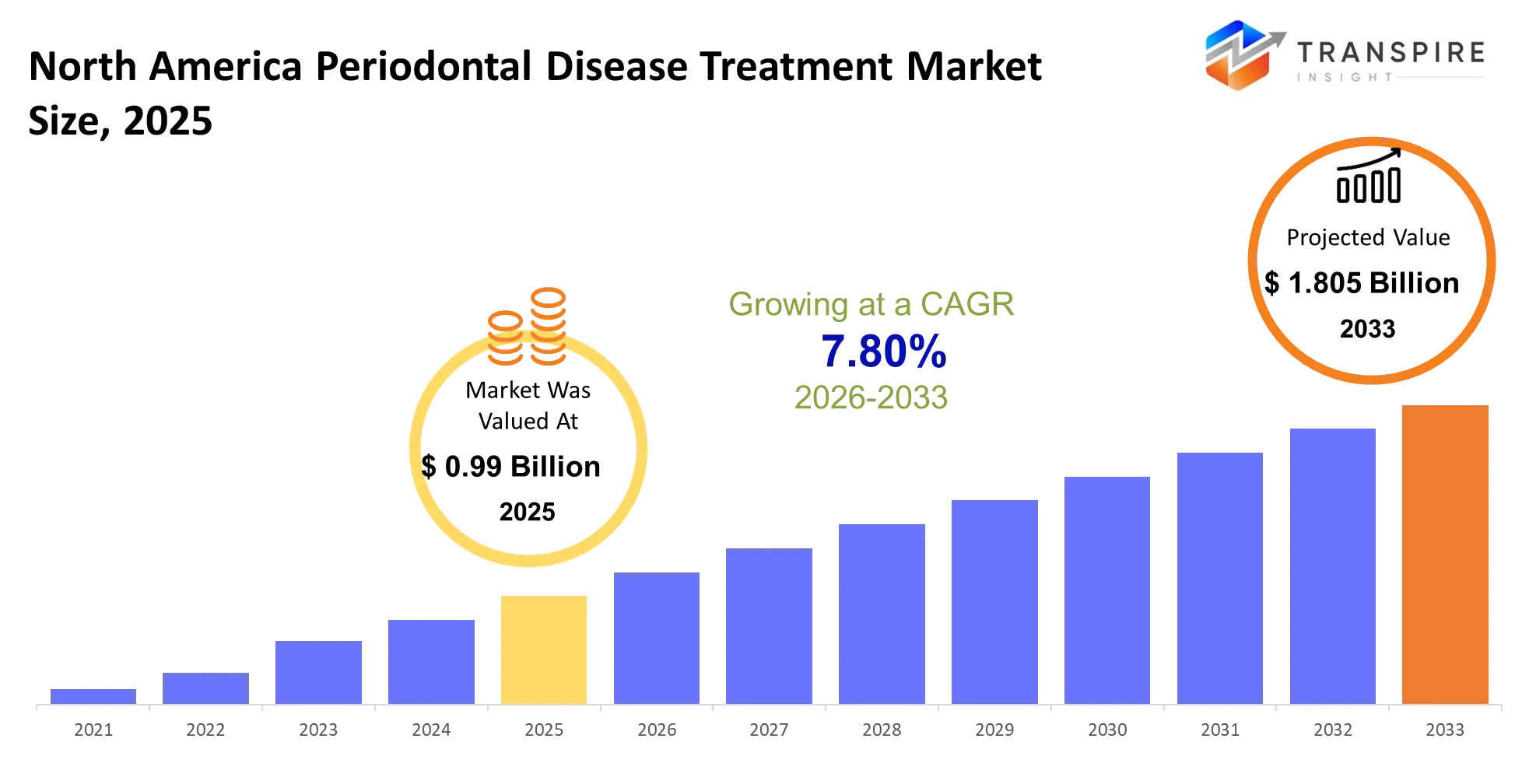
- North America Periodontal Disease Treatment Market Size 2025: USD 0.99 Billion
- North America Periodontal Disease Treatment Market Size 2033: USD 1.805 Billion
- North America Periodontal Disease Treatment Market CAGR: 7.80%
- North America Periodontal Disease Treatment Market Segments: By Type (Drugs, Surgery, Laser Therapy, Scaling & Root Planing, Others), By Application (Gingivitis, Periodontitis, Others), By End-User (Dental Clinics, Hospitals, Others), By Product (Antibiotics, Devices, Instruments, Others).
To learn more about this report,  Download Free Sample Report
North America Periodontal Disease Treatment Market Summary:
The North America Periodontal Disease Treatment Market size is estimated at USD 0.99 Billion in 2025 and is anticipated to reach USD 1.805 Billion by 2033, growing at a CAGR of 7.80% from 2026 to 2033. The North America periodontal disease treatment market is sort of sitting at that overlap between preventive dentistry, chronic disease management, and restorative oral care. In real life, it’s the kind of market that backs clinics, dental service organizations, and hospitals as they work through gum inflammation, tissue breakdown, and also tooth-supporting bone loss, which can later result in tooth loss and even some wider systemic health complications. You’ll see treatments that range from scaling and root planing to regenerative biologics , plus laser therapies, and then implant-supported restoration procedures too.
Over the last five years, things have been moving , more from reactive surgical response toward earlier, tech-assisted handling. AI-enabled imaging , minimally invasive laser systems, and combined periodontal diagnostics are helping providers spot progression sooner, and keep patients inside long-term treatment programs. The COVID-19 pandemic was a big trigger, it actually slowed or postponed routine dental appointments , and that raised the number of more advanced periodontal cases once clinics reopened. That backlog then pushed investment into quicker chairside workflows , and multi-location dental networks that can manage higher patient throughput with less friction. Also, as insurers and employers are tying oral health to diabetes and cardiovascular risk management, periodontal care is getting tucked into broader preventive healthcare budgets instead of being treated as some single stand-alone dental expense.
Key Market Insights
- In 2025, the United States really dominated the North America Periodontal Disease Treatment Market, it took nearly 82% market share, mainly because the area has pretty advanced dental infrastructure and strong clinical capabilities, too.
- Canada looks like the fastest growing regional market all the way through 2032, with growth pushed by expanding dental insurance coverage, plus more preventive oral care initiatives, being adopted by both clinics and patients.
- Across North America, urban dental networks are putting more money into AI-based imaging and laser assisted periodontal treatment technologies, not just for the wow-factor but for workflow efficiency.
- At the same time, cross border adoption of cosmetic and restorative dental procedures keeps adding momentum, which helps strengthen the regional industry size and treatment demand drivers.
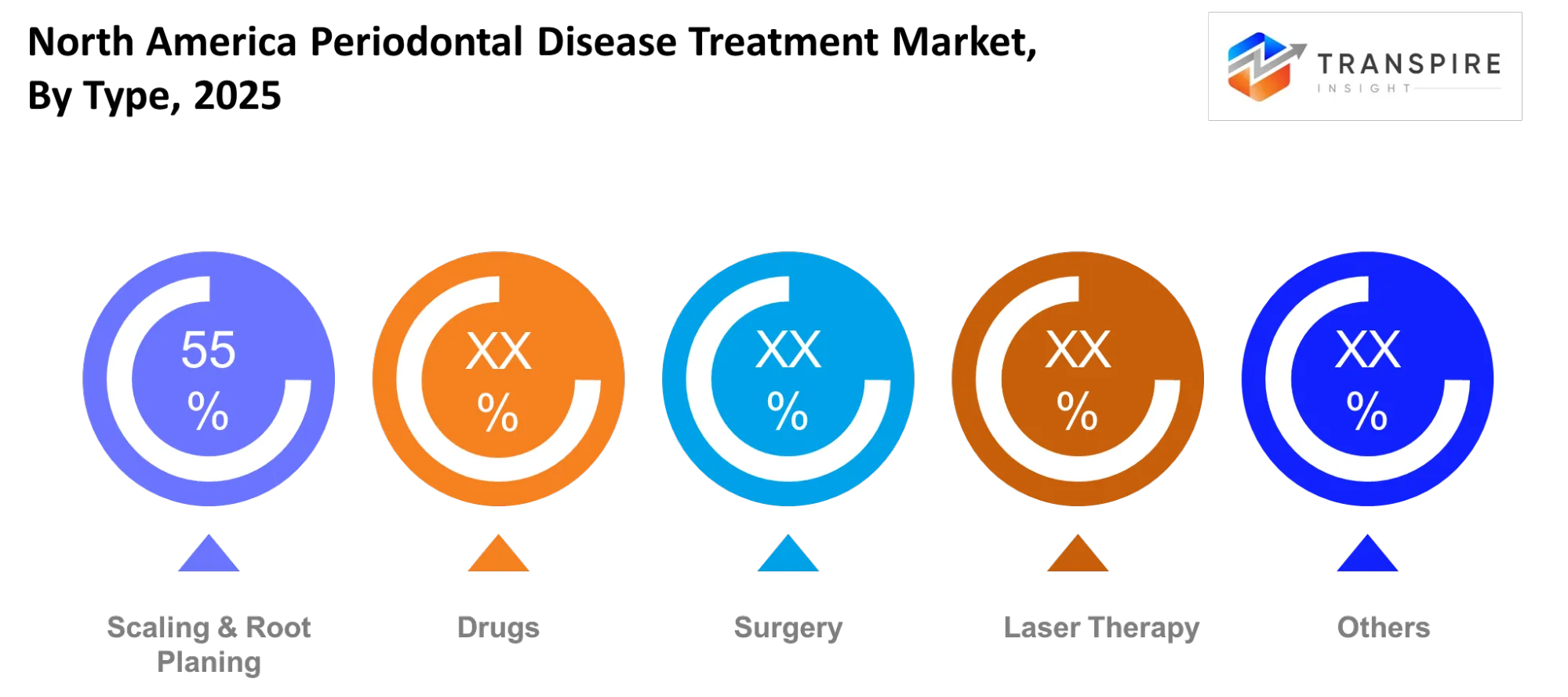
- When it comes to treatment type, non surgical periodontal therapies held the largest share in 2025, with the support of solid demand for scaling and root planing procedures.
- Antibiotic therapy and regenerative biomaterials came in as the second largest segment, largely due to a growing preference for tissue preserving treatments and less invasive approaches.
- Laser assisted periodontal treatment is expected to be the fastest growing segment during the forecast period, since it can mean reduced recovery time, and better precision outcomes compared with older methods.
- Dental implant supported periodontal restoration services are also picking up meaningful traction among aging patient populations across North America, because many people want durable, functional solutions.
- Chronic periodontitis treatment accounted for more than 58% of revenue share in 2025, mostly driven by the increasing prevalence among adults over 40 years.
- For applications, preventive periodontal care is moving the fastest, as clinics focus on long term disease management, and they work hard to keep patients coming back repeatedly.
- Finally, demand for personalized periodontal treatment planning is rising, supported by digital diagnostics and intraoral imaging technologies , which makes treatment decisions feel more tailored.
What are the Key Drivers, Restraints, and Opportunities in the North America Periodontal Disease Treatment Market?
The most powerful thing pushing the North America periodontal disease treatment market forward is how periodontal care is being worked into wider programs for chronic disease, not just treated as a separate issue. In the past five years insurers, hospital systems, and dental networks have been linking gum problems with diabetes, cardiovascular disorders and also other inflammatory conditions. That change is mostly happening because more and more clinical reports have piled up showing that if periodontal disease is left untreated, it can raise long term healthcare costs via complications connected to whole body illness. So providers are starting to put more money into earlier diagnostic steps, digital imaging, and prevention focused care routes, and those routes lead to continued patient visits rather than just a single one-time surgical moment. Because of that, market revenue is creeping beyond only procedures and moving into long-term periodontal maintenance, and ongoing monitoring services too.
Still, the biggest structural headache is uneven insurance reimbursement for the more advanced periodontal procedures. Regenerative therapies, laser assisted approaches, and implant supported restorations can need a lot of out of pocket spending, especially in the United States. This is structural because dental coverage is still kind of split up between private insurance, employer offered plans, and public healthcare systems. Clinics often face delayed patient approvals, which quietly reduces procedural volume and, even when outcomes look strong, it slows down adoption of higher priced technologies.
One noticeable opportunity sits in AI enabled periodontal diagnostics along with remote oral health monitoring. Major dental service organizations across North America are putting resources into cloud connected imaging setups that can spot early tissue deterioration during ordinary checkups.
What Has the Impact of Artificial Intelligence Been on the North America Periodontal Disease Treatment Market?
Artificial intelligence along with advanced digital technologies is sort of reshaping the North America periodontal disease treatment market , mostly by sharpening diagnostic precision, tweaking treatment planning, and making day to day operations more efficient across dental networks. AI enabled imaging platforms are starting to automate periodontal charting, bone loss measurement , and gum inflammation detection using intraoral scans mixed with radiographic analysis. In practice this kind of workflow cuts down on the manual assessment time clinicians usually spend and it also lets multi location dental service organizations standardize how patients get evaluated in each clinic. Plus, when digital workflow tools sync with electronic health records it tends to boost scheduling efficiency, smooth follow up tracking, and improve long term periodontal maintenance compliance.
Machine learning models are also being used more and more to anticipate disease progression and how well a patient might respond to treatment based on patient history, smoking status, diabetes indicators, and imaging data. Some of the larger dental groups in the United States have mentioned shorter diagnostic turnaround times, and higher case acceptance rates once they integrated AI assisted treatment visualization tools. Predictive analytics then backs preventive intervention strategies too, which can lower restorative treatment costs and support patient retention over time.
On top of that, advanced laser guided therapies together with 3D imaging systems are improving procedural accuracy while reducing chair time and maybe even recovery periods. Still, full scale AI adoption is held back by a few things, like high integration costs, dental software ecosystems that don’t really talk to each other, and inconsistent clinical data quality across separate practices. Smaller clinics often don’t have the infrastructure needed to fully deploy AI powered periodontal management systems , so the rollout can be slower than expected.
Key Market Trends
- From 2020 to 2025 , dental service organizations pushed their periodontal treatment networks outward by more than 20% , sort of to lock in procedural consistency while also speeding up patient flow.
- AI powered radiographic analysis tools cut the time for periodontal evaluation in major U.S. dental chains , which made it easier to roll out preventive care initiatives after 2022 , and adoption kind of moved faster.
- Starting in 2021 , laser assisted periodontal procedures got stronger traction in clinics , because the recovery timeline was shorter , and that made patients more willing to come back. In turn it improved repeat treatment compliance in a pretty noticeable way.
- Big names like Dentsply Sirona and Straumann Group increased spending on digital workflow alignment and regenerative biomaterials after 2023 , pushing deeper into that tech driven direction.
- Dental insurers also kept expanding reimbursement support for preventive periodontal upkeep, after evidence linked gum disease with diabetes and cardiovascular complications. They did this slowly but steadily .
- Multi location dental groups were increasingly using cloud based imaging platforms between 2022 and 2025 , to line up diagnostics and treatment decisions across different clinics , even when teams were separated.
- During the COVID-19 period supply chain disruptions delayed implant and biomaterial availability , so clinics started diversifying procurement partnerships after 2021 , mostly to avoid bottlenecks and delays.
- Regenerative therapy approaches, using growth factor biomaterials , came up as a more decisive competitive emphasis as providers looked for alternatives to aggressive surgical interventions.
- In Canada , dental providers leaned into tele-dentistry after 2022, improving periodontal consultation access in suburban areas and also in underserved regional markets.
- Independent clinics felt increasing competitive strain as corporate dental networks leaned on centralized purchasing, AI diagnostics, and subscription based patient maintenance programs.
North America Periodontal Disease Treatment Market Segmentation
By Type
By type , scaling and root planing still kind of keeps the leading spot, mostly because many dental professionals just… prefer non-surgical care when gum disease is still in the early to moderate phase. There’s a lot of reimbursement familiarity too, plus the procedural cost stays comparatively lower, and the overall clinical acceptance feels pretty broad, so treatment volumes don’t really slow down in outpatient dental settings. Drug-based therapies, meaning locally delivered antibiotics and other antimicrobial agents, also keep steady demand. Providers are more and more likely to mix pharmacological support with mechanical cleaning to try to boost outcomes, so it stays “worth it” in practice.
Surgical procedures are still important, especially when periodontal damage is more advanced. But higher overall costs and the longer recovery times do curb wider adoption, so it’s not taking over completely. Laser therapy, on the other hand, seems to be the fastest-growing category. The pitch there is shorter healing cycles, less bleeding risk , and patients increasingly like minimally invasive care. Continued investment in precision-guided dental technologies should make laser-based adoption stronger. Manufacturers are zeroing in on compact imaging-integrated systems, while clinics are pushing for procedures that improve chairside efficiency and help long-term patient retention.
To learn more about this report, Download Free Sample Report
By Application
By application, periodontitis is basically the dominant segment here, because advanced gum disease makes up most of the clinical work and restorative treatment spending across North America. There is also this large aging population, plus higher rates of diabetes, and, well, delayed preventive dental visits, which all keep pushing up the overall burden from severe periodontal tissue damage. Gingivitis treatment is still pretty major too, mainly because preventive care programs keep expanding and employer-supported oral health initiatives motivate people to show up sooner, before the damage becomes irreversible. Mild inflammatory conditions tend to be handled with lower-cost therapies. That gives strong procedural volume but the revenue per patient can be lower, especially compared with the way advanced disease is managed.
More and more, the attention is shifting toward maintenance-based periodontal care, so treatment patterns slowly move away from just episodic fixes toward continuous observation, plus recurring clinical visits. This change is, honestly, looking good for dental service organizations since they can expand digital diagnostics and also build more personalized treatment pathways. Investors, at the same time are increasingly aiming at technologies that improve the precision of disease tracking, while providers are leaning into preventive retention models to keep recurring revenue steadier.
By End-User
For end-users, dental clinics do end up holding the biggest industry share, mostly because periodontal work tends to happen in outpatient settings, with lots of patients moving through each day and with access to specialized equipment. So independent practices as well as larger dental service groups are still expanding their periodontal programs, aiming for those repeat maintenance appointments, and also for cosmetic restorative add ons. Hospitals still matter, but in a smaller capacity, still kind of strategically, especially where patients need combined care, like when diabetes management comes in alongside cardiovascular complications, or when oral surgery support is needed. However, hospitals use more resources, and the scheduling time lines tend to be longer, which basically limits how many periodontal cases they can handle compared with the clinic focused approach.
At the same time corporate dental chains are gaining influence quite quickly, via centralized purchasing, AI aided diagnostics, and unified treatment planning platforms, which helps keep operations consistent from one location to the next. Tele-dentistry is also playing a role, it is enabling more consultations in suburban areas and places that are underserved, sometimes even before a patient can reach a physical office. Looking forward, competition is likely to favor providers that can blend preventive monitoring, digital imaging, and minimally invasive therapies into multi-location service models that actually scale well, and that can improve patient staying power plus day to day productivity.
By Product
By product, periodontal devices and instruments kinda end up pulling in most of the revenue, mainly because the usual treatment steps really lean on ultrasonic scalers, curettes, imaging systems, and even laser assisted surgical equipment. Because things get updated, and units are swapped out on fairly steady replacement cycles, dental networks plus specialty clinics keep buying again, year over year. Antibiotics are still a big product group too, since they’re used a lot for infection control, and as an adjunctive element in periodontal therapy, but worries about antimicrobial resistance are changing how clinicians prescribe, it’s just becoming more careful.
Regenerative biomaterials and tissue repair products now show stronger commercial momentum, since many providers are looking for options that help preserve bone and soft tissue integrity after advanced disease progression. Digital imaging systems, along with AI enabled diagnostic tools are also expanding fast as clinics try to boost workflow efficiency and sharpen treatment precision. Manufacturers, meanwhile, are pouring investment into combined product ecosystems that connect diagnostics, imaging and minimally invasive intervention. And buyers seem to care more and more about long term procedural efficiency, interoperability, and better patient outcomes when they’re judging new periodontal technologies, so the evaluation criteria is getting pretty strict.
What are the Key Use Cases Driving the North America Periodontal Disease Treatment Market?
Routine management of chronic periodontitis still feels like the main use case moving market adoption forward in dental clinics, and even more in multi location dental service organizations. When clinics scale up, things like root planing, scaling and adjunctive antibiotic therapies keep showing steady procedural demand, mainly because providers see lots of middle-aged and older patients with ongoing gum deterioration, plus tooth-support complications that don’t really wait.
Then there are nearby applications that are getting bigger too , like preventive periodontal monitoring and implant supported restorative dentistry. Corporate dental chains are also rolling in digital imaging along with maintenance based gum care plans, partly so they can dial down long term restorative costs. On top of that, hospitals are increasingly using periodontal treatment pathways for people with diabetes and cardiovascular conditions, where care needs to be coordinated with oral health management.
More emerging directions are showing up as well, for example AI assisted periodontal diagnostics, and regenerative tissue engineering that uses biologic materials. Tele dentistry consultations, together with cloud connected imaging systems, are picking up pace too. This is especially noticeable in suburban, and underserved Canadian and U.S. regional healthcare markets where access to specialized periodontal care is still sort of constrained.
|
Report Metrics |
Details |
|
Market size value in 2025 |
USD 0.99 Billion |
|
Market size value in 2026 |
USD 1.067 Billion |
|
Revenue forecast in 2033 |
USD 1.805 Billion |
|
Growth rate |
CAGR of 7.80% from 2026 to 2033 |
|
Base year |
2025 |
|
Historical data |
2021 - 2024 |
|
Forecast period |
2026 - 2033 |
|
Report coverage |
Revenue forecast, competitive landscape, growth factors, and trends |
|
Country scope |
North America (Canada, The United States, and Mexico) |
|
Key company profiled |
Dentsply Sirona, Straumann, 3M, Zimmer Biomet, Danaher, GC Corporation, Henry Schein, Coltene, Ivoclar Vivadent, Septodont, Ultradent, Nobel Biocare, Align Technology, Planmeca, Kerr |
|
Customization scope |
Free report customization (country, regional & segment scope). Avail customized purchase options to meet your exact research needs. |
|
Report Segmentation |
By Type (Drugs, Surgery, Laser Therapy, Scaling & Root Planing, Others), By Application (Gingivitis, Periodontitis, Others), By End-User (Dental Clinics, Hospitals, Others), By Product (Antibiotics, Devices, Instruments, Others) |
Which Regions are Driving the North America Periodontal Disease Treatment Market Growth?
The United States is still basically the main regional market, mostly due to its huge dental clinic network, a well developed private insurance ecosystem , and an early go in to advanced periodontal technologies. Big dental service organizations keep on putting money into AI assisted imaging, laser therapy systems and regenerative biomaterials, to get better procedural speed and also keep patients longer. On top of that, the reimbursement rules look favorable for preventive dental checkups and chronic disease management programs , so the demand for repeat periodontal treatment stays steady. There’s also a mature mix of manufacturers, specialty clinics, research groups and digital health providers that kinda keeps the whole thing running and supports leadership in both preventive and surgical periodontal care.
Canada sits in the second largest position, but the way the market behaves is not quite the same as the United States, because the growth feels more tied to consistent public health expansion and easier preventive care access rather than high procedural intensity. Provincial oral health plans plus gradual dental coverage expansion are helping bring in patients for routine periodontal monitoring and early stage help. At the same time, Canadian providers are rolling out tele dentistry and cloud based imaging platforms, so access improves in suburbs and other underserved areas where it’s harder to get appointments. Overall, the investment habits seem consistent, and treatment volatility is lower , so Canada is viewed as a dependable long term contributor to regional revenue growth.
Mexico looks like it’s becoming the fastest-growing market, sort of, because private dental infrastructure is expanding quickly and there is more and more money going into affordable restorative dental services. Lately, even dental tourism is picking up, and many urban specialty clinics are being modernized , so that more people are adopting digital imaging and minimally invasive periodontal procedures. International manufacturers seem to be aiming at Mexico more directly too, using distributor partnerships plus localized training programs for advanced dental technologies. Across the 2026–2033 timeframe , this momentum should be turning into real chances for equipment suppliers, implant manufacturers and also multi-location dental operators that want a cost-efficient way to expand through the region.
Who are the Key Players in the North America Periodontal Disease Treatment Market and How Do They Compete?
The competitive landscape for the North America periodontal disease treatment market is still somewhat consolidated, i mean moderately, but there’s a mix of big multi national dental technology manufacturers trading head to head with smaller periodontal focused solution providers, plus a wave of expanding dental service organizations. A lot of the fight lately isn’t about procedural pricing only, it’s more about digital workflow integration , minimally invasive treatment systems, and regenerative biomaterials that can actually change outcomes. The bigger names are usually holding ground with integrated imaging platforms, chairside efficiency tools, and then the ongoing push from recurring consumables sales. Meanwhile, smaller innovators are drifting into the market with AI assisted diagnostics, cloud based treatment planning, and laser focused periodontal devices that seem to resonate with high-volume outpatient clinics, because those clinics want operational differentiation not just another option.
Dentsply Sirona, for example, competes by leaning hard on end to end digital dentistry integration, where imaging, diagnostics, and treatment systems are stitched together into one unified clinical workflow. They also maintain strong relationships with North American dental clinics and educational institutions which helps adoption happen for chairside technologies and then keeps recurring equipment upgrades moving. Straumann Group, on the other hand, differentiates with premium implantology and regenerative tissue solutions, these are built for advanced periodontal reconstruction procedures. Their strategic partnerships with specialty dental networks plus continued investment in digital treatment planning platforms help keep procedural consistency tighter and encourage specialist engagement all across the region.
Zimmer Biomet kinda leans into precision focused implant systems, and surgical tech that’s meant for those pretty complex restorative as well as periodontal reconstruction cases. They bank on advanced biomaterial integration, plus really solid surgeon training programs , which ends up giving them a competitive edge in specialty treatment environments. Then Henry Schein, kind of expands the market presence by way of large scale distribution capabilities. They also bring in practice management software integration, and ongoing supply chain support for independent clinics and for corporate dental groups , not just one type of customer. And Envista Holdings is working on competitive positioning by pushing AI enabled imaging systems. On top of that they blend orthodontic-periodontal treatment integration so providers can manage restorative , and even preventive workflows through connected digital platforms.
Company List
- Dentsply Sirona
- Strauman
- 3M
- Zimmer Biomet
- Danaher
- GC Corporation
- Henry Schein
- Coltene
- Ivoclar Vivadent
- Septodont
- Ultradent
- Nobel Biocare
- Align Technology
- Planmeca
- Kerr
Recent Development News
In May 2026, Dentsply Sirona Launches FDA-Cleared AI Dental Diagnostic Tool in Q1 2026: Dentsply Sirona announced the launch of Smart View-Detect, described as the world’s first FDA-cleared AI-enabled diagnostic aid for identifying periapical radiolucencies in CBCT scans. The development strengthens the company’s digital periodontal diagnostics portfolio and reflects growing adoption of AI-assisted oral disease detection across North America.
Source: https://investor.dentsplysirona.com
In February 2026, Reuters Reports North American Dental Recovery Expectations for 2026: The North American dental companies including Envista Holdings, Henry Schein, Align Technology, and Dentsply Sirona were preparing for sector stabilization after uneven demand in 2025. The report highlighted continued investment in restorative and periodontal treatment technologies despite slower patient traffic trends.
Source: https://www.reuters.com
What Strategic Insights Define the Future of the North America Periodontal Disease Treatment Market?
North America periodontal disease treatment market is kind of shifting, or structurally moving, toward an integrated preventive oral healthcare model that’s powered by AI assisted diagnostics, regenerative biomaterials, and more recurring maintenance based treatment patterns. In the next five to seven years, the growth will depend more and more on how well providers connect periodontal care with wider chronic disease programs for diabetes, cardiovascular disorders, and the aging population. This change should end up favoring multi location dental organizations and technology enabled specialty clinics, those that can deliver standardized longer term monitoring for patients, not just one-off procedural care.
One less visible risk is market concentration around a small set of digital imaging and implant technology providers. When clinics start relying on proprietary software ecosystems and combined treatment platforms, the switching costs can go up pretty fast. That means pricing flexibility gets limited, and smaller independent practices may hesitate to adopt new systems. At the same time, saliva based diagnostic testing and AI driven predictive periodontal screening is an emerging opportunity, especially across preventive care networks and employer sponsored healthcare programs. Market players should push for interoperable digital platforms and scalable preventive care partnerships, instead of banking only on high margin surgical procedures, to stay competitive over the long run.
North America Periodontal Disease Treatment Market Report Segmentation
By Type
- Drugs
- Surgery
- Laser Therapy
- Scaling & Root Planing
- Others
By Application
- Gingivitis
- Periodontitis
- Others
By End-User
- Dental Clinics
- Hospitals
- Others
By Product
- Antibiotics
- Devices
- Instruments
- Others
Frequently Asked Questions
Find quick answers to common questions.
The approximate North America Periodontal Disease Treatment Market size for the market will be USD 1.805 Billion in 2033.
The key segments of the North America Periodontal Disease Treatment Market are By Type (Drugs, Surgery, Laser Therapy, Scaling & Root Planing, Others), By Application (Gingivitis, Periodontitis, Others), By End-User (Dental Clinics, Hospitals, Others), By Product (Antibiotics, Devices, Instruments, Others).
Major players in the North America Periodontal Disease Treatment Market are Dentsply Sirona, Straumann, 3M, Zimmer Biomet, Danaher, GC Corporation, Henry Schein, Coltene, Ivoclar Vivadent, Septodont, Ultradent, Nobel Biocare, Align Technology, Planmeca, Kerr.
The current market size of the North America Periodontal Disease Treatment Market is USD 0.99 Billion in 2025.
The North America Periodontal Disease Treatment Market CAGR is 7.80%.
- Dentsply Sirona
- Strauman
- 3M
- Zimmer Biomet
- Danaher
- GC Corporation
- Henry Schein
- Coltene
- Ivoclar Vivadent
- Septodont
- Ultradent
- Nobel Biocare
- Align Technology
- Planmeca
- Kerr
Recently Published Reports
-
Apr 2026
AI in Diabetic Retinopathy Market
AI in Diabetic Retinopathy Market Size, Share & Analysis Report By Type (Screening AI Systems, Diagnostic AI Systems, and Predictive AI Models), By Application Segment (Hospitals, Ophthalmology Clinics, Diagnostic Centers, and Research and Development), and Geography (North America, Europe, Asia-Pacific, Middle East and Africa, South and Central America), 2021 - 2031
-
Apr 2026
Psychometric Tests Market
Psychometric Tests Market Size, Share & Analysis Report By Type (Personality Tests, Ability/Aptitude Tests, Skill/Knowledge Tests, and Others), By Application (Talent Acquisition and Talent Management), and Geography (North America, Europe, Asia-Pacific, Middle East and Africa, South and Central America), 2021 – 2031
-
Apr 2026
Rare Biological Sample Collection Market
Rare Biological Sample Collection Market Size, Share & Analysis Report By Type (Isolation Kits & Reagent, Blood Collection Tubes, and Others), By Application (Oncology, Transcriptomics, Pharmacogenomics, and Others), and Geography (North America, Europe, Asia-Pacific, Middle East and Africa, South and Central America), 2021 – 2031
-
May 2026
Patient Lift Pendant Market
Patient Lift Pendant Market By Product Type (Wired Pendants, Wireless, Programmable), By Operation Type(Manual, Electric), By End-Users (Healthcare Professionals, Patients), By Application (Hospitals, Homecare, Rehabilitation Centers, Others), By Industry Analysis, Size, Share, Growth, Trends, and Forecasts 2021-2033
Our Clients
.jpg)